





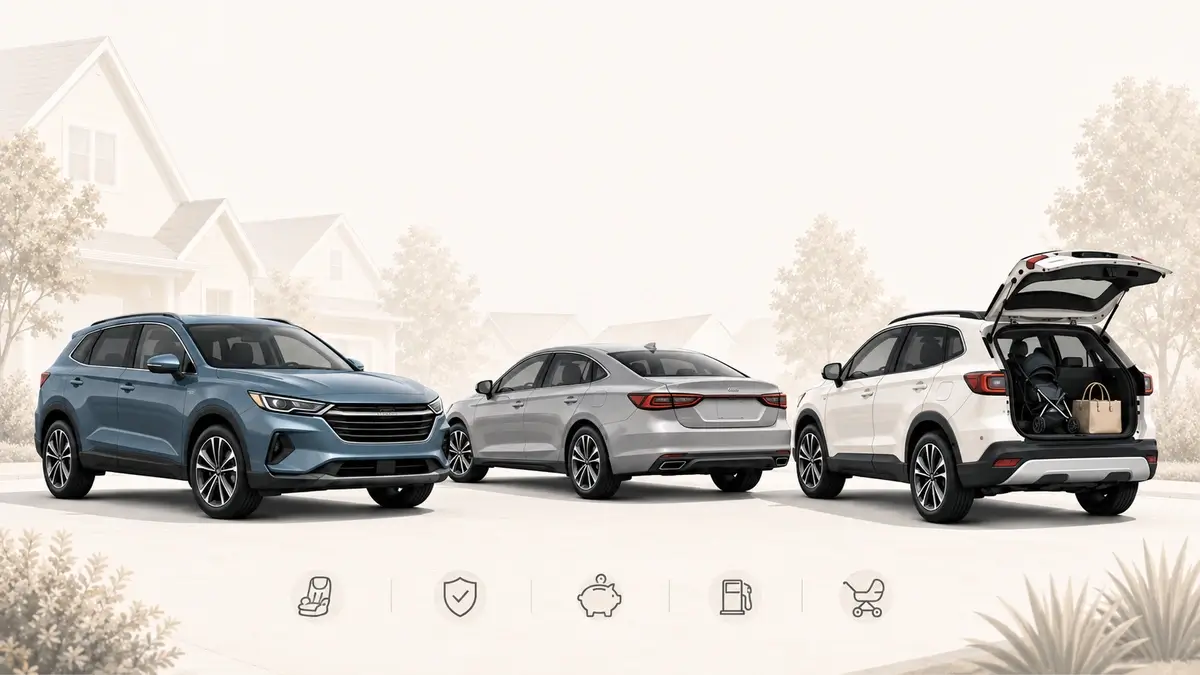
The best used family cars are not always the biggest vehicles. A smart family car has to fit your passengers, cargo, commute, parking situation, budget, and long-term ownership risk.
For many used buyers, that points toward a practical compact SUV like the Honda CR-V, Toyota RAV4, or Mazda CX-5. For others, a midsize sedan like the Toyota Camry or Honda Accord makes more sense because it is comfortable, efficient, and better aligned with families that do not need SUV cargo height. Actual purchase value still depends on the model year, mileage, condition, configuration, and local listings.
This guide focuses on CarMerit-covered used family options: compact SUVs, midsize sedans, and small SUVs. Minivans and three-row SUVs can be excellent family vehicles, especially for larger families, but they are not the core of this CarMerit shortlist yet. The goal here is narrower: help you choose the right used family car from the models CarMerit has already covered in deeper comparison, reliability, model-year, and ownership guides.
A family car under $20,000 needs more than space; it needs clean records, realistic ownership costs, and the right year band. Compare family-friendly sedans and SUVs in our best used cars under $20,000 guide.
Quick Verdict
- Best all-around starting point: Toyota RAV4
Start here if you want SUV practicality and a balanced family-friendly size without jumping into a larger three-row SUV. - Best comfort and space pick: Honda CR-V
Choose the CR-V if rear-seat room, easy loading, visibility, and daily family usability matter more than style or sportiness. - Best premium-feel SUV: Mazda CX-5
Pick the CX-5 if you want a more upscale cabin feel and better driving experience, but you can live with less family space than a CR-V. - Lowest-drama family sedan pick: Toyota Camry
Choose the Camry if your family does not need SUV cargo height and you want simple, comfortable, efficient transportation. - Best family sedan for driving feel: Honda Accord
Pick the Accord if you want a roomy sedan that feels more enjoyable than the Camry, while still staying practical. - Best small-family city SUV: Toyota Corolla Cross
Choose the Corolla Cross if you want an easy-to-drive small SUV for a smaller household and do not need RAV4 or CR-V space. - Best smaller-SUV alternative: Honda HR-V
Consider the HR-V if you want a smaller used SUV and the specific listing has clean records, clear recall status, and a fair price.
Family-car buying should start with real use, not just size. If your family needs cargo room, all-weather confidence, and easier loading, compare this guide with our best used compact SUVs list.
Quick Comparison: Which Used Family Car Fits You?
A family-car decision should start with real use, not brand loyalty. The right choice for a family of four with one stroller may be wrong for a family with older kids, sports gear, and regular road trips.
Use this table as a routing guide. Then open the deeper CarMerit guide before choosing a specific model year, trim, or used listing.
| Family Need | Best Fit | Why It Makes Sense | Deeper Guide |
|---|---|---|---|
| Best all-around compact SUV family pick | Toyota RAV4 | Balanced size, useful cargo flexibility, and broad family usability | Honda CR-V vs Toyota RAV4 |
| Best comfort-first compact SUV | Honda CR-V | Strong rear-seat room, easy daily driving, and family-friendly packaging | Used Honda CR-V Reliability and Cost to Own |
| Best premium-feel SUV | Mazda CX-5 | More upscale cabin feel and better driving experience than many mainstream SUVs | Mazda CX-5 vs Honda CR-V |
| Best sedan when SUV height is unnecessary | Toyota Camry | Comfortable, efficient, and practical for families that do not need SUV cargo access | Toyota Camry Reliability and Cost to Own |
| Best roomier sedan alternative | Honda Accord | Spacious cabin, strong comfort, and better driving feel than many sedans | Honda Accord vs Toyota Camry |
| Best small-family city SUV | Toyota Corolla Cross | Easy to drive, efficient, and practical for smaller households | Honda HR-V vs Toyota Corolla Cross |
| Best flexible small-SUV alternative | Honda HR-V | Compact footprint, flexible interior, and useful small-family practicality | Honda HR-V Reliability and Cost to Own |
Best Overall Used Family SUV Starting Point: Toyota RAV4
The Toyota RAV4 is the best starting point for many used-family SUV shoppers because it sits in the useful middle of the market. It is larger than a Corolla Cross or HR-V, easier to live with than many larger SUVs, and practical enough for family duty without feeling oversized.
For a family buyer, that balance matters. You get SUV ride height, useful cargo space, easier child-seat loading than most sedans, and broad used-market availability. You also avoid the size, fuel, and tire-cost penalties that can come with larger three-row SUVs.
For families comparing the RAV4 with the Nissan Rogue, use the RAV4 as the space-and-practicality benchmark rather than assuming it is automatically the lower-risk or better-value choice. A Rogue may still deserve consideration when the year, mileage, condition, service history, equipment, and asking price compare favorably. Use the Nissan Rogue vs Toyota RAV4 guide before deciding.
The RAV4 is not automatically the best deal. Compare the same model year, mileage range, drivetrain, trim, condition, and history before deciding whether an asking price is justified. Asking prices are starting points, not proof of transaction value. Some families may also prefer the Honda CR-V’s rear-seat and cabin packaging, so treat the RAV4 as a strong first comparison point rather than an automatic buy.
Before buying one, compare it directly against the CR-V in CarMerit’s Honda CR-V vs Toyota RAV4 guide. Then check Toyota RAV4 reliability and cost to own and Toyota RAV4 years to avoid before choosing a specific model year.
Best Used Family SUV for Comfort and Space: Honda CR-V
The Honda CR-V is the better family SUV pick if your priority is day-to-day usability. The CR-V’s case is not about excitement. It is about space, access, visibility, comfort, and packaging.
That matters for parents because the small details become daily friction. Rear-seat access, child-seat room, cargo loading height, stroller space, and easy visibility can matter more than horsepower or styling.
Families who are deciding between comfort-first practicality and standard-AWD confidence should also compare the CR-V with the Subaru Forester. The Honda CR-V vs Subaru Forester comparison is useful if winter driving, cargo space, ownership cost, and family usability are all part of the decision.
Against the RAV4, the CR-V often feels more cabin-first. Against the Mazda CX-5, it gives up some premium feel and driving engagement but usually makes a stronger family-space argument. That makes it a useful option for small and midsize families that want a compact SUV without moving into a larger class.
Still, condition and model year matter. A CR-V with poor records, accident history, neglected tires, or unresolved issues is not a smart buy just because the model has a good reputation. Use the Used Honda CR-V Reliability and Cost to Own guide and Honda CR-V years to avoid before shopping seriously.
For families shopping used compact SUVs, use the CR-V as the comfort-and-space benchmark and the Sportage as an equipment-and-price alternative. Do not assume either model is automatically lower-risk or better value; compare the model year, service history, condition, recall status, equipment, and asking price. See Kia Sportage vs Honda CR-V for the direct used-SUV decision.
Best Used Family SUV for Premium Feel: Mazda CX-5
The Mazda CX-5 is the family SUV for buyers who want a more polished cabin and a better driving experience without leaving the mainstream used market. It works best for small families, couples with one child, or buyers who want a compact SUV that feels less basic.
Its strongest argument is value. A used CX-5 can feel more upscale than its price suggests, especially in better trims. The trade-off is that it is not the roomiest option here. If maximum rear-seat space and cargo flexibility are the top priorities, the CR-V is usually the cleaner family choice.
That does not make the CX-5 weak. It just means you should buy it for the right reason: cabin feel, comfort, steering, and overall refinement at a sensible used-car price.
If you are cross-shopping, start with Mazda CX-5 vs Honda CR-V and Mazda CX-5 vs Toyota RAV4. Then use Mazda CX-5 reliability and cost to own, Mazda CX-5 years to avoid, and Mazda CX-5 trim levels to avoid overpaying for the wrong version.
Best Used Family Sedan When SUV Space Is Unnecessary: Toyota Camry
Not every family needs an SUV. If your family mostly drives on paved roads, does not need tall cargo space, and wants dependable daily transportation, the Toyota Camry is one of the clearest sedan answers.
The Camry’s advantage is the sedan trade-off: a roomy cabin, strong comfort, and competitive EPA fuel economy without SUV cargo height. That can make it a strong family choice when bulky cargo is not part of normal use, but it does not automatically prove lower total ownership cost. Compare purchase price, insurance, condition, repair exposure, and the exact powertrain separately.
For smaller families or city-heavy driving, a small SUV may be enough without the cost of a larger vehicle. Compare those options in our best used small SUVs guide.
The downside is obvious. It is not as flexible for bulky cargo, large strollers, home-store runs, or taller items. If your family regularly uses the full cargo space of an SUV, the Camry may feel limiting.
But if your real use case is commuting, school runs, groceries, and normal highway driving, the Camry deserves serious consideration. It makes the strongest case when comfort and efficiency matter more than SUV cargo height or extra features.
Read Honda Accord vs Toyota Camry if you are comparing the two family sedans. Then check Toyota Camry reliability and cost to own and best years for Toyota Camry before choosing a used example.
Best Used Family Sedan for Driving Feel: Honda Accord
The Honda Accord is the better family sedan if you want more driver involvement without giving up practical space. It has long been a strong answer for families that want comfort, cabin room, and a sedan that does not feel dull.
Compared with the Camry, the Accord may appeal more to buyers who care about steering feel, cabin layout, and a more responsive commute. It can work well for a family of four if rear-seat comfort matters but SUV cargo height does not.
A midsize sedan can still be a smart family car if you value comfort and fuel economy and do not need SUV cargo height. Our best used midsize sedans guide compares the strongest sedan choices for used buyers.
The trade-off is that the Camry is often the easier low-drama recommendation. With the Accord, the specific model year, engine, condition, maintenance history, and price matter. That does not make it a risky choice by default. It means you need to shop with more attention.
Start with Honda Accord vs Toyota Camry, then review Honda Accord reliability and cost to own and Honda Accord years to avoid.
Best Used Small SUV for Small Families: Toyota Corolla Cross
The Toyota Corolla Cross is not the right family car for everyone. It is smaller than a CR-V or RAV4, and families with multiple child seats, large strollers, frequent road trips, or heavy cargo needs may outgrow it quickly.
For a smaller household, though, it makes sense. It gives buyers an SUV shape, easy parking, and useful daily practicality in a smaller footprint. It is especially worth considering when city use and lighter cargo needs matter more than the extra rear-seat and cargo space of a CR-V or RAV4.
The key is not the Toyota badge. The key is the specific used example. A good Corolla Cross should have clean records, clear recall status, no warning lights, even tire wear, normal braking, and a price that still makes sense against HR-V, CX-30, Crosstrek, and RAV4 alternatives.
Use Honda HR-V vs Toyota Corolla Cross to compare the small-SUV choices. Then read Toyota Corolla Cross reliability and cost to own and Toyota Corolla Cross years to avoid before buying.
Best Smaller Used SUV Alternative: Honda HR-V
The Honda HR-V is another practical small-family option, especially if your priorities are easy driving, flexible cargo use, and a smaller footprint. Treat price as listing-specific rather than assuming the HR-V will always cost less than a larger SUV.
It is not the right pick if you need strong acceleration, generous cargo room, or maximum road-trip comfort. It is better treated as a small family runabout than a full family-hauling SUV.
If your family budget is limited, the best choice is often the vehicle that balances space, safety, and ownership cost. Our best used cars under $20,000 guide can help you avoid overpaying for the wrong category.
That is not a knock against the HR-V. It simply means the fit has to be honest. The HR-V works best for commuters, small households, city drivers, and budget-conscious buyers who want a small SUV and do not need CR-V space.
The inspection standard should stay high. A used HR-V should have clean records, smooth CVT behavior, no warning lights, clear recall status, and a price that reflects age, mileage, and condition. If the seller cannot document maintenance or refuses inspection, walk away from the listing, not just the model.
Before buying, compare it with the Corolla Cross in Honda HR-V vs Toyota Corolla Cross. Then check Honda HRV reliability and cost to own and best Honda HR-V years to buy and avoid.
SUV or Sedan: Which Is Better for a Family?
A used SUV is usually better if you need cargo flexibility, easier child-seat loading, a higher seating position, or more road-trip practicality. That is why the CR-V, RAV4, CX-5, Corolla Cross, and HR-V are strong family options.
A used sedan is usually better if you want lower running costs, easier highway efficiency, strong comfort, and better value for the money. That is where the Camry and Accord still make sense.
The mistake is assuming every family needs an SUV. Many buyers pay extra for cargo height they rarely use. If your real use case is commuting, school runs, groceries, and normal errands, a Camry or Accord may be the smarter decision.
If you are unsure, compare CarMerit’s broader segment guides: Best Used Compact SUVs, Best Used Midsize Sedans, and Best Used Small SUVs.
Families who want hybrid efficiency but are unsure whether they need liftback cargo flexibility should compare the Prius and Corolla Hybrid directly. Our Toyota Prius vs Toyota Corolla Hybrid comparison explains when the Prius’s cargo access is worth paying for and when the Corolla Hybrid is the better-value sedan.
How Fuel Economy Changes the Family-Car Decision
Body style alone does not determine fuel use. The exact model year, engine, drivetrain, and powertrain matter more than a simple SUV-versus-sedan label. The following selected 2022 configurations use official FuelEconomy.gov estimates.
Selected 2022 Gasoline Configurations
| Model Year | Model | Configuration | City | Highway | Combined |
|---|---|---|---|---|---|
| 2022 | Toyota RAV4 | 2.5L, 8-speed automatic, FWD | 27 | 35 | 30 |
| 2022 | Honda CR-V | 1.5L, CVT, FWD | 28 | 34 | 30 |
| 2022 | Mazda CX-5 | 2.5L, 6-speed automatic, AWD | 24 | 30 | 26 |
| 2022 | Toyota Camry LE/SE | 2.5L, 8-speed automatic, FWD | 28 | 39 | 32 |
| 2022 | Honda Accord | 1.5L, CVT, FWD | 30 | 38 | 33 |
| 2022 | Toyota Corolla Cross | 2.0L, CVT, FWD | 31 | 33 | 32 |
| 2022 | Honda HR-V | 1.8L, CVT, FWD | 28 | 34 | 30 |
Table Note: Figures are EPA MPG for the exact configurations shown, not model-year averages. Other trims, engines, transmissions, and drivetrains may have different ratings. EPA estimates do not guarantee real-world fuel economy.
Selected 2022 Hybrid Configurations
| Model Year | Model | Configuration | City | Highway | Combined |
|---|---|---|---|---|---|
| 2022 | Toyota RAV4 Hybrid | 2.5L hybrid, automatic, AWD | 41 | 38 | 40 |
| 2022 | Honda CR-V Hybrid | 2.0L hybrid, automatic, AWD | 40 | 35 | 38 |
| 2022 | Toyota Camry Hybrid LE | 2.5L hybrid, automatic, FWD | 51 | 53 | 52 |
| 2022 | Honda Accord Hybrid | 2.0L hybrid, automatic, FWD | 48 | 47 | 47 |
Table Note: Figures are EPA MPG for the exact hybrid configurations shown. Gasoline and hybrid ratings should not be averaged together, and fuel economy alone does not establish total ownership cost.
The useful takeaway is that category labels are only a starting point. In these selected gasoline configurations, the Accord rates at 33 MPG combined, the Camry LE/SE and Corolla Cross at 32, and the RAV4, CR-V, and HR-V at 30. The CX-5 AWD rates lower at 26 combined, while the available hybrid configurations materially change the comparison. Match the EPA configuration to the exact used vehicle before using fuel economy as a tie-breaker.
When This Shortlist Is Not Enough
This guide is intentionally focused on CarMerit-covered family options. That keeps the recommendations grounded in existing comparison, reliability, ownership, and model-year guides.
You may need to look beyond this page if you need three rows, sliding doors, maximum cargo volume, or seating for more than five people. In that case, a minivan or three-row SUV may be the better family vehicle.
A family car needs to be more than roomy. It also has to be dependable, affordable to maintain, and easy to live with, so check our most reliable used cars guide before finalizing your shortlist.
That does not weaken this shortlist. It just defines its purpose. These are practical used family cars for buyers who are mainly choosing between compact SUVs, midsize sedans, and smaller SUVs. If your family needs more space than that, do not force a five-seat vehicle to solve a six- or seven-seat problem.
Best Used Family Cars by Buyer Type
The best choice depends on your real family use. A family that needs cargo space should not shop like a commuter. A family that rarely uses cargo height should not automatically pay SUV prices.
This table keeps the decision practical. Use it to narrow the shortlist before you compare model years, trims, ownership costs, and specific listings.
| Buyer Type | Best First Choice | Also Consider | What to Avoid |
|---|---|---|---|
| Family of four wanting one practical all-rounder | Toyota RAV4 | Honda CR-V | Overpaying for a rough example just because it is a Toyota |
| Family needing more rear-seat comfort | Honda CR-V | Toyota RAV4 | Smaller SUVs if cargo space is already tight |
| Family wanting a nicer-feeling SUV | Mazda CX-5 | Honda CR-V | Choosing it if maximum cargo room is the top priority |
| Family that does not need an SUV | Toyota Camry | Honda Accord | Paying SUV prices for space you rarely use |
| Driver-focused family sedan buyer | Honda Accord | Toyota Camry | Ignoring model-year and engine-specific ownership risks |
| Small family in the city | Toyota Corolla Cross | Honda HR-V | Buying too small if a second child seat or frequent road trips are likely |
| Budget-conscious small-SUV buyer | Honda HR-V | Toyota Corolla Cross | Expecting compact-SUV space from a subcompact SUV |
Family-Fit and Cargo Reality Check
CarMerit has not yet completed hands-on child-seat, booster-seat, stroller, cargo-loading, or scored family-use benchmark testing for every vehicle in this shortlist. Because of that, this section should be treated as a buyer verification checklist, not a CarMerit hands-on test result.
That matters because family-car fit is not decided by the model name alone. A Toyota RAV4 or Honda CR-V may look like the safer family choice on paper, but your actual child seat, stroller, cargo needs, driver height, rear-door access, and daily parking situation still decide whether it works for your household.
Before buying any used family car, test the real vehicle with the gear your family actually uses.
| Family-Use Area | CarMerit Guidance |
|---|---|
| Rear-facing child seat | Not hands-on verified across this shortlist. Rear-facing fit can change depending on child-seat size, front-seat position, dashboard shape, and passenger height. Before buying, install your own rear-facing seat behind both front seats and confirm adults can still sit comfortably. |
| Forward-facing child seat | Not hands-on verified across this shortlist. Check whether the seat sits flat and secure on the rear bench, whether the top tether is easy to reach, and whether the child seat blocks front-seat comfort. HealthyChildren says the top tether should be used with a forward-facing child seat whether the seat is installed with LATCH or the seat belt. |
| Booster-seat fit | Not hands-on verified across this shortlist. Do not assume a booster fits properly just because the rear seat looks roomy. NHTSA says proper belt fit means the lap belt sits across the upper thighs, not the stomach, and the shoulder belt sits across the shoulder and chest, not the neck or face. |
| LATCH access | Inspection required. CarMerit has not physically checked lower-anchor visibility, anchor depth, or tether-anchor access for every model listed here. Buyers should confirm whether the anchors are easy to reach or buried between the seat cushions. |
| Three-across child seats | Not confirmed. Do not assume any five-seat SUV or sedan can handle three-across child seats unless you test the exact child seats you plan to use. Narrow child seats may work where standard-width seats do not. |
| Stroller cargo fit | Not hands-on verified across this shortlist. Cargo volume numbers do not always show real usability. Test your own stroller, especially if you use a full-size stroller, travel system, double stroller, or need room for groceries and bags at the same time. |
| Rear-door access | Must be checked in person. Wide-opening rear doors can make child-seat loading much easier. Smaller SUVs and sedans may still work, but tight openings can become daily frustration. |
| Road-trip cargo use | Depends on family habits. A car that handles school runs may feel tight on weekend trips. Test bags, stroller, sports gear, and daily cargo together instead of judging cargo space by numbers alone. |
| Family-use score | Pending. CarMerit should not assign a scored family-use benchmark until hands-on child-seat, booster-seat, cargo, and daily-family-use checks are completed for each vehicle. |
IIHS LATCH Ease-of-Use Comparison
CarMerit has not completed hands-on child-seat testing, but IIHS LATCH ease-of-use ratings provide a useful screening point for the common 2022 model year across this shortlist.
| Model Year | Vehicle | IIHS-Listed Trim or Seat Scope | LATCH Ease-of-Use Rating |
|---|---|---|---|
| 2022 | Toyota RAV4 | LE trim, cloth seat, extra LATCH positions | G+ |
| 2022 | Honda CR-V | LX trim, cloth seat | A |
| 2022 | Mazda CX-5 | Touring trim, leatherette seats | A |
| 2022 | Toyota Camry | LE trim, cloth seat, extra LATCH positions | G+ |
| 2022 | Honda Accord | Displayed four-door sedan scope | G+ |
| 2022 | Toyota Corolla Cross | LE trim, cloth seat, extra LATCH positions | G+ |
| 2022 | Honda HR-V | LX trim, cloth seat | A |
Table Note: G+ means Good+ with extra LATCH positions; A means Acceptable. Ratings apply only to the IIHS-listed scopes and measure anchor ease of use—not child-seat fit, three-across capability, crashworthiness, or suitability for a specific family. Test your own child seat in the exact vehicle before buying.
For these listed 2022 scopes, the RAV4, Camry, Accord, and Corolla Cross provide the stronger IIHS LATCH ease-of-use starting point, while the CR-V, CX-5, and HR-V still require more careful in-person anchor-access checks. Use this only as a family-use tie-breaker, not as an overall safety ranking.
What Family Buyers Should Check Before Buying
Use this quick test before committing to any used family SUV or sedan:
- Install your own rear-facing child seat behind the driver and front passenger seats.
- Confirm the front seats still have comfortable adult space after installation.
- Test a forward-facing child seat and confirm top-tether access.
- Place your booster seat in the rear seat and check real belt position.
- Open the rear doors fully and confirm loading a child seat is easy.
- Load your stroller into the cargo area.
- Add grocery bags, school bags, sports gear, or travel bags to check real cargo usability.
- Drive the car on your normal route, not only a short smooth test loop.
- Check visibility, cabin noise, parking ease, and rear-seat comfort.
- Run the VIN through official recall tools before buying.
For most families, the Honda CR-V and Toyota RAV4 are the strongest starting points because they offer better space and cargo flexibility than smaller SUVs or sedans. The Mazda CX-5 is better if cabin feel and driving experience matter more than maximum family space.
If your family needs a real third row, the Pilot and Highlander solve different problems. Use our Honda Pilot vs Toyota Highlander comparison to decide whether extra space or easier long-term ownership matters more.
The Pilot is useful for families who need three rows, but it should not be treated as a safe buy on reputation alone. Before shortlisting one, use the Honda Pilot reliability and cost-to-own guide to check maintenance, recall, transmission, and inspection risks.
The Highlander is one of the stronger used family SUV choices, but condition still decides the deal. Before shortlisting a specific example, use the Toyota Highlander reliability and cost to own guide to check ownership-cost risks, hybrid considerations, and pre-purchase inspection priorities.
For families comparing two mainstream compact SUVs, Kia Sportage vs Hyundai Tucson is a useful next step. It focuses on space, ownership risk, warranty reality, trims, fuel economy, and which used example makes more sense.
Use it when a Tucson or Sportage appears on your family-car shortlist but you still need a direct used-SUV decision.
The Toyota Camry and Honda Accord still make sense if your family does not need SUV cargo height. They can be easier to justify for buyers who want comfort, efficiency, and lower ownership complexity.
The Toyota Corolla Cross and Honda HR-V are better treated as small-family vehicles, not full family haulers. They can work well for city driving, one-child households, or lighter cargo needs. But if you use multiple child seats, large strollers, or frequent road-trip cargo, move up to a larger family vehicle.
CarMerit has not yet completed hands-on family-fit testing for every vehicle in this guide. We do not claim verified child-seat fit, stroller fit, three-across usability, cargo-loading results, or scored family-use benchmarks until those checks are completed. Buyers should confirm fit with their own child seat, booster seat, stroller, passengers, and normal family cargo before purchase.
After deciding that the Highlander fits your family better, narrow the search by model year before comparing listings. The Toyota Highlander years to avoid and best years to buy guide identifies the stronger starting points and the gas- or hybrid-specific checks that still matter.
If the Pilot remains on your shortlist, narrow the search by model year before comparing listings. The Honda Pilot years to avoid and best years to buy guide separates avoid-first years, caution years, and stronger relative starting points.
Reliability and Ownership Cost
A family car has to be dependable because downtime creates real problems. Repair delays, surprise costs, and repeated shop visits are more painful when the car is used for school, work, groceries, and weekend travel.
That is why reliability should matter more than flashy features. A panoramic roof, large screen, premium trim badge, or sporty package is less valuable than clean service records, good tires, working safety systems, no warning lights, and a model year with fewer known buyer concerns.
For a wider low-risk shortlist, use CarMerit’s Most Reliable Used Cars to Buy guide. It connects the main ownership-risk guides across compact cars, midsize sedans, compact SUVs, and small SUVs.
Before buying any used family car, also check the vehicle’s VIN for open recalls through the NHTSA recall lookup, compare crash-test information through NHTSA safety ratings and IIHS vehicle ratings, and compare fuel economy through FuelEconomy.gov.
Which Used Family Car Should You Buy?
Choose the Toyota RAV4 if you want the strongest compact-SUV starting point and its space, configuration, condition, and asking price compare favorably with equivalent CR-V and CX-5 listings.
Choose the Honda CR-V if comfort, space, and family-friendly daily usability matter most.
Choose the Mazda CX-5 if you want a compact SUV that feels more premium and engaging without leaving the mainstream used market.
Choose the Toyota Camry if your family can live without an SUV and you want a simple, efficient, low-drama sedan.
Choose the Honda Accord if you want a roomier, more enjoyable sedan and are willing to pay closer attention to model year and condition.
Choose the Toyota Corolla Cross if you have a smaller family and want a newer, easy-to-drive small SUV.
Choose the Honda HR-V if you want a smaller, flexible SUV and do not need compact-SUV space.
The final decision should not stop at the model name. Pick the vehicle type first, then the model, then the model year, then the trim, then the specific listing. The specific car’s records, recall status, inspection result, and price still decide the buy.
Related CarMerit Guides
Start with these if you want the shortest path to a smart decision:
- Most Reliable Used Cars to Buy
- Best Used Compact SUVs
- Best Used Midsize Sedans
- Best Used Small SUVs
- Honda CR-V vs Toyota RAV4
- Honda Accord vs Toyota Camry
- Honda HR-V vs Toyota Corolla Cross
Frequently Asked Questions
What is the best used family car overall?
For many buyers, the Toyota RAV4 is the best used family car starting point because it combines compact SUV practicality, useful cargo space, and broad market availability. The Honda CR-V is the closest alternative if you care more about rear-seat room and daily comfort.
What is the most reliable used family car?
This category guide does not establish one model as the most reliable family car overall. Start with the Toyota Camry if a sedan fits your needs, or the Toyota RAV4 and Honda CR-V if SUV cargo flexibility matters. Then use the Most Reliable Used Cars to Buy guide and the linked model-year and reliability guides before choosing a specific vehicle. Condition, service records, VIN recall status, and inspection results still decide the final buy.
What is the best used car for a family of four?
A family of four should start with the Honda CR-V, Toyota RAV4, Toyota Camry, and Honda Accord. Choose the SUVs if cargo flexibility and easier child-seat loading matter. Choose the sedans if comfort, value, and lower running costs matter more.
Are used SUVs better than used sedans for families?
Used SUVs usually offer more cargo height, easier child-seat loading, greater road-trip flexibility, and a higher seating position. Sedans may deliver stronger highway fuel economy and can make more sense when SUV cargo height is unnecessary, but the exact EPA configuration matters and neither body style automatically guarantees lower total ownership cost. Choose based on the space your family actually uses.
Is the Mazda CX-5 a good used family SUV?
Yes, the Mazda CX-5 can be a good used family SUV for buyers who want a nicer cabin and better driving feel. It is less ideal if maximum rear-seat room and cargo space are the top priorities.
Should I buy a small SUV for my family?
A small SUV like the Toyota Corolla Cross or Honda HR-V can work for a small family, especially in city driving. If you use multiple child seats, carry large strollers, or take frequent road trips, move up to a CR-V or RAV4.
What should I check before buying a used family car?
Check service history, accident history, tire and brake condition, child-seat fit, cargo usability, fuel economy, safety ratings, and open recalls. The specific used example matters as much as the model’s reputation.
Can CarMerit verify child-seat and stroller fit for every car in this guide?
Not yet. CarMerit has not completed hands-on child-seat, booster-seat, stroller, cargo-loading, or scored family-use benchmark testing for every vehicle in this guide. Use the family-fit checklist before buying and confirm fit with your own child seat, booster seat, stroller, passengers, and normal cargo.