

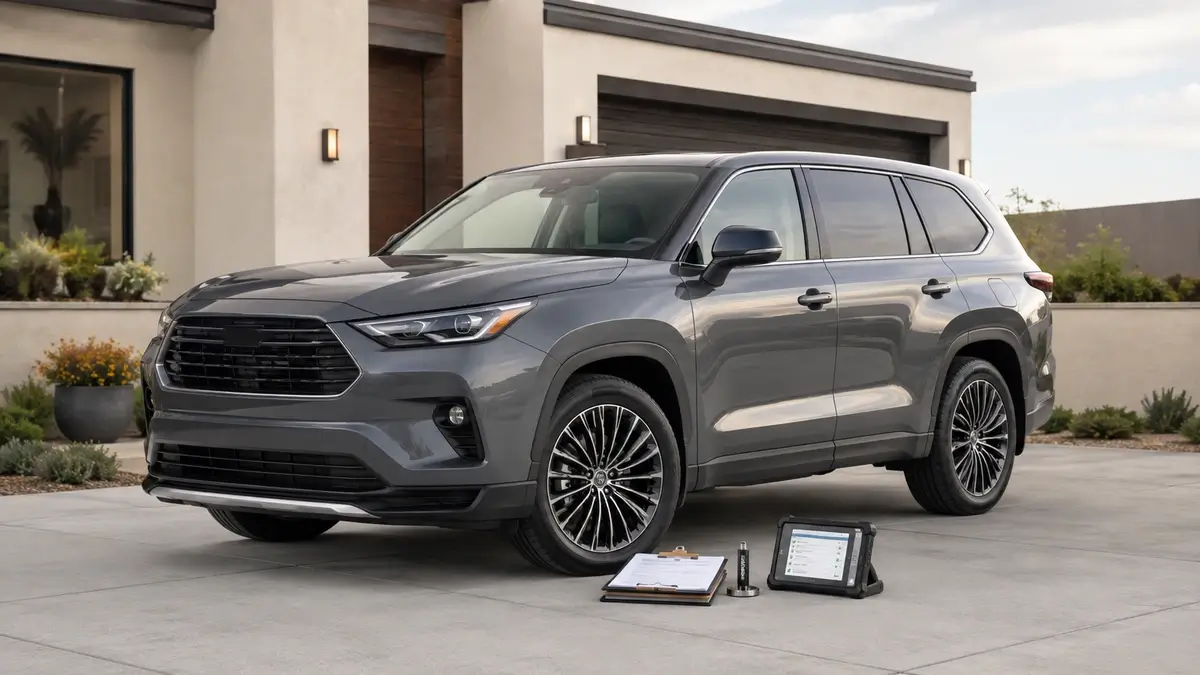
The Toyota Highlander can be a strong used midsize family SUV candidate, but the badge does not make every used one a good deal. Safety evidence also changes by model year, test era, and equipment, so the exact vehicle still matters.
The smart answer is simple: buy the right Highlander, not just any Highlander. A well-maintained example with clean records can make sense. A neglected high-mileage one can still become expensive.
The safest default is this: shortlist a Highlander only after you verify maintenance records, run a VIN recall check, and get a pre-purchase inspection.
Pick wrong, and you can overpay for a tired SUV because the model has a strong reputation.
Quick Verdict: Is the Toyota Highlander Reliable?
Yes, the Toyota Highlander is generally reliable for used buyers. It is a strong family SUV candidate if the specific vehicle has clean records, reasonable mileage for its age, and no major inspection issues.
RepairPal gives the Highlander an above-average reliability rating and lists an average annual repair-cost estimate of $489. That is a model-level estimate, not a promise for the vehicle in front of you.
Age, mileage, location, shop rates, prior use, and deferred maintenance can change the cost quickly.
The Highlander makes the most sense for buyers who want a comfortable three-row SUV with practical long-term ownership potential. It is not the best fit for someone chasing the lowest possible purchase price or compact-SUV running costs.
The real buying rule:
| Used Highlander scenario | Reliability confidence | Main cost risk | Buyer action |
|---|---|---|---|
| Clean records, normal family use, no inspection issues | High | Routine maintenance, tires, brakes | Strong shortlist |
| Good records but higher mileage | Medium-high | Age-related repairs and wear items | Buy only after inspection |
| Poor records or unclear history | Medium-low | Deferred maintenance | Negotiate hard or skip |
| Heavy towing, rough use, leaks, warning lights, or bad shifts | Low | Major repair exposure | Skip unless repaired and verified |
| Older hybrid with unclear battery/system history | Medium | Hybrid-system age and diagnostic risk | Inspect before deciding |
A Highlander is reliable enough to consider. It is not reliable enough to buy blindly.
What Toyota Highlander Reliability Means for Used Buyers
Used Toyota Highlander reliability is not just about the model’s reputation. It is about how the SUV was maintained before you found it.
A clean Highlander with steady oil changes, documented service, matching tires, and no warning lights is a different risk from one with missing records and bargain-lot pricing.
Start with three questions:
- Did the previous owner follow the maintenance schedule?
- Does the mileage make sense for the age and condition?
- Did an independent inspection confirm the story?
Toyota’s manuals and warranties page is useful because maintenance and warranty details can vary by model year, powertrain, and driving conditions. Do not rely on a generic online maintenance list when a VIN-specific manual or warranty guide is available.
The best used Highlander is usually not the cheapest one. It is the one with the cleanest paper trail and the fewest hidden costs.
That matters because many Highlanders are bought as family vehicles. They may have seen school runs, road trips, heavy cargo, winter driving, third-row use, and sometimes towing.
None of that automatically makes one bad. It does mean condition matters more than reputation.
Toyota Highlander Reliability by Age, Mileage, and Use Case
Toyota Highlander reliability by year matters, but this article should not be treated as a full year-ranking guide. Use year risk as one filter, then judge the actual vehicle.
For deeper model-year risk, use the separate Toyota Highlander Years to Avoid and Best Years to Buy guide before you commit to a specific listing.
Toyota Highlander NHTSA Generation Evidence Snapshot
| Generation / years / how to read it | Owner complaints | Unique recall campaigns | Investigations | Manufacturer communications |
|---|---|---|---|---|
| Gen 1, 2001-2007 – older ownership window; use mainly for age, condition, brake, visibility, and leak checks | 2,083 | 15 | 8 | 1,062 |
| Gen 2, 2008-2013 – older high-signal group; inspect brakes, steering, restraint systems, and service history closely | 1,597 | 18 | 20 | 2,020 |
| Gen 3, 2014-2019 – mid-age group; powertrain, electrical, fuel-system, and recall checks matter most | 1,428 | 15 | 6 | 1,781 |
| Gen 4, 2020-2026 – newer evidence window; verify recalls and avoid treating lower age exposure as proof of lower risk | 1,225 | 15 | 3 | 946 |
Table note: Counts are raw NHTSA records, not defect rates or reliability scores. Older generations have had more time to collect complaints and communications, so this table should guide inspection priorities rather than rank generations.
What IIHS Adds to the Used-Buying Decision
IIHS evidence is most useful here for spotting meaningful safety change points, not for creating one cross-generation safety score. Test families and criteria changed over time, and some ratings vary by equipment.
| Used model years | Selected IIHS evidence | Buyer takeaway |
|---|---|---|
| 2001–2007 | Original moderate-overlap front: G. On the 2004 page, two head-restraint/seat configurations are rated M and P. | Treat this as legacy-era evidence, and do not assume every seat configuration had the same restraint rating. |
| 2008–2013 | Original moderate-overlap front: G; side: G; roof strength: G; head restraints and seats: G. | This is useful legacy-era coverage, but these tests should not be compared directly with later updated tests. |
| 2014–2015 | Driver-side small overlap: A; original moderate-overlap front: G. | Small-overlap performance is the important distinction for these years. |
| 2016–2019 | Driver-side small overlap: G after IIHS notes structural reinforcement beginning with 2016 models; passenger-side small overlap: A where applicable. 2017–2019 headlights: A. | The 2016 structural revision is the meaningful change point rather than a blanket “generation” safety verdict. |
| 2020–2026 | Driver- and passenger-side small overlap: G. In 2020, headlights ranged from P to A to G by trim. The 2022 updated moderate-overlap test is M, while the updated side test is G. | Check the exact year and trim. The updated-moderate M should not be read as a direct downgrade from an older original-moderate G because the test changed. |
Table Note: G = Good, A = Acceptable, M = Marginal, P = Poor. IIHS test families and criteria changed over time, so these ratings are not one combined safety score. Missing or discontinued ratings are not negative findings, and configuration-specific restrictions still apply.
Age and use case usually change the buying decision more than a broad reliability score.
| Used Highlander type | What matters most | Main inspection focus | Best move |
| Lower-mileage family-use example | Records and condition | Tires, brakes, fluids, electronics | Good shortlist if priced fairly |
| Mid-mileage daily driver | Maintenance consistency | Suspension, leaks, transmission behavior | Inspect and compare records |
| High-mileage example | Deferred maintenance risk | Engine, transmission, AWD, cooling system | Buy only if documentation is strong |
| Older low-mileage example | Age-related wear | Rubber parts, leaks, corrosion, stale fluids | Do not assume low mileage means low risk |
| AWD example | Tire matching and driveline health | Tires, transfer components, fluid history | Avoid mismatched tires and neglected AWD |
| Towing or heavy-use example | Heat and wear exposure | Transmission behavior, cooling, brakes | Require stronger inspection proof |
A high-mileage Highlander can still be worth considering. But the discount has to be real, and the records have to be better than average.
An older Highlander with low miles is not automatically safer. Sitting, short trips, old fluids, dry rubber, rust, and neglected service can all create problems.
For most buyers, the best balance is a well-kept example with normal use, documented maintenance, and no major inspection findings.
Common Toyota Highlander Problems to Check Before Buying
Common Toyota Highlander problems should be handled as inspection points, not panic points.
Do not treat forum complaints as proof that every Highlander has the same issue. Use them as clues for what to inspect, then verify with records, a scan, a test drive, and a mechanic.
Toyota Highlander NHTSA Complaint Areas to Use as Inspection Triggers
| Generation / years | Highest owner-reported area | Complaint count | Share of generation complaints | Buyer check |
|---|---|---|---|---|
| Gen 1, 2001-2007 | Brakes | 382 | 18.3% | Check pedal feel, ABS warnings, braking performance, and brake-service history. |
| Gen 2, 2008-2013 | Brakes | 312 | 19.5% | Test braking carefully and review brake, ABS, and related service records. |
| Gen 3, 2014-2019 | Powertrain / Transmission | 290 | 20.3% | Test shift quality, driveline behavior, warning lights, and prior transmission work. |
| Gen 4, 2020-2026 | Powertrain / Transmission | 336 | 27.4% | Scan for codes and test cold/warm drivability before trusting a newer listing. |
Table note: Percentages show each area’s share of owner-filed NHTSA complaints within that generation. They are not defect rates, and lower counts on newer years do not prove lower long-term risk.
Before buying, check these areas:
| Area to check | What to look for | Why it matters | Buyer action |
| Engine | Leaks, rough idle, warning lights, overheating signs | Repairs can get expensive if ignored | Skip if symptoms are active and unexplained |
| Transmission | Harsh shifts, slipping, delay into gear, shudder | Drivetrain repairs can erase the value case | Require diagnosis before buying |
| AWD system | Binding, mismatched tires, noises, fluid neglect | AWD components dislike uneven tire wear | Avoid neglected AWD examples |
| Suspension and steering | Clunks, uneven tire wear, loose feel | Family SUVs can wear suspension parts over time | Price repairs into the deal |
| Brakes and tires | Vibration, cheap tires, uneven tread | Heavy SUVs consume wear items | Use as negotiation if otherwise clean |
| Electronics | Infotainment issues, warning lights, sensors | Annoying faults can be costly to trace | Test everything before purchase |
| Hybrid system | Battery health, warning lights, fuel economy behavior | Hybrid savings weaken if diagnostics are ignored | Get a hybrid-specific inspection |
Also run a VIN check through the NHTSA recall lookup and Toyota’s recall and service campaign lookup. Recalls are VIN-specific, and a general model-year search is not enough.
A recall does not automatically make a used Highlander a bad buy. An unrepaired recall that the seller cannot explain is a negotiation point and a safety check.
Toyota Highlander Maintenance Cost and Repair-Cost Reality
Toyota Highlander maintenance cost is usually reasonable for a midsize three-row SUV, but it is not the same as owning a compact car.
The Highlander is larger, heavier, and often used harder than a small commuter vehicle. Tires, brakes, suspension parts, fluids, and AWD-related maintenance can cost more than buyers expect.
RepairPal lists the Highlander’s average annual repair and maintenance cost at $489, compared with $573 for midsize SUVs and $652 for all models in its data. Use that as a baseline, not a guarantee.
The useful question is not “Is the average cost low?” The better question is: Will this specific Highlander need catch-up maintenance after I buy it?
| Cost area | Normal expectation | What raises risk | Buyer check |
| Oil, filters, fluids | Routine ownership cost | Missing records or long gaps | Ask for service history |
| Tires | Moderate to high, depending on size and brand | Uneven wear, AWD mismatch | Check tread and matching tire set |
| Brakes | Normal SUV wear item | Heavy city use or towing | Test for vibration and noise |
| Suspension | More likely as mileage rises | Clunks, looseness, uneven wear | Inspect before purchase |
| AWD components | Manageable if maintained | Mismatched tires, fluid neglect | Verify tire and fluid history |
| Hybrid components | Often low-drama when healthy | Age, warning lights, unclear diagnostics | Get hybrid-specific checks |
Budget-sensitive buyers should not stretch just to get a Highlander. A cheaper listing can become the expensive one if it needs tires, brakes, fluids, suspension work, and overdue repairs soon after purchase.
The better buy is usually the one that costs more upfront but needs less catch-up work.
Gas vs Hybrid Toyota Highlander Ownership Cost
Gas vs hybrid Toyota Highlander ownership cost depends on your driving pattern, purchase price, and how long you plan to keep the SUV.
The hybrid can be the smarter ownership play if you drive often in city traffic and keep the vehicle long enough to benefit from fuel savings. The gas model can make more sense if it is cheaper to buy, easier to inspect locally, or comes with better records.
FuelEconomy.gov’s official vehicle data, together with the existing 2023 Highlander ratings, show a meaningful change in the gas-versus-hybrid efficiency case around the 2020 redesign. Rather than averaging different drivetrains and configurations together, these selected AWD examples keep the comparison more useful.
| Model year | Gas AWD configuration | City | Highway | Combined | Hybrid AWD configuration | City | Highway | Combined |
|---|---|---|---|---|---|---|---|---|
| 2019 | Highlander AWD LE, 3.5L V6, 8-speed automatic | 20 | 27 | 23 | Highlander Hybrid AWD LE Plus, 3.5L V6 | 30 | 28 | 29 |
| 2020 | Highlander AWD, 3.5L V6, 8-speed automatic | 20 | 27 | 23 | Highlander Hybrid AWD, 2.5L | 35 | 35 | 35 |
| 2023 | Highlander AWD, 2.4L, 8-speed automatic | 21 | 28 | 24 | Highlander Hybrid AWD, 2.5L | 35 | 35 | 35 |
Table Note: City, highway, and combined figures are EPA MPG for the exact selected AWD configurations shown. They are not model-year averages or complete configuration coverage. EPA estimates are standardized for comparison; actual fuel economy varies with driving and operating conditions.
The important used-buyer change is the 2020-and-newer Hybrid’s move into the mid-30s combined MPG. That materially strengthens the fuel-savings case for buyers who drive enough to benefit, especially in city use, but it still does not prove that a particular used Hybrid will have a lower total ownership cost.
| Buyer situation | Gas Highlander fit | Hybrid Highlander fit | Better default |
| Mostly city driving | Acceptable | Stronger fuel-savings case | Hybrid |
| Mostly highway driving | Stronger than in city use | Still efficient, but savings gap may feel smaller | Compare price difference |
| Purchase-price priority | Compare same-year, similar-mileage listings with similar trim, drivetrain, condition, and records | Use the same like-for-like standard | Choose after the actual price gap is known |
| Long ownership plan | Good if maintained | Strong if battery/system checks are clean | Depends on inspection |
| Poor records | Risky | Riskier because hybrid diagnostics matter | Skip both |
| Buyer fears hybrid battery cost | Simpler decision | Must verify warranty and battery health | Gas unless hybrid is well documented |
For 2020-and-newer Highlander Hybrids, Toyota’s hybrid warranty information states hybrid-battery coverage of 10 years or 150,000 miles from the vehicle’s in-service date, whichever comes first, for defects in materials or workmanship.
For a used vehicle, do not assume that coverage remains. The model year, in-service date, mileage, and exact eligibility still need to be verified. Toyota does not state a battery-capacity-retention percentage in this coverage.
Some older hybrids need a separate VIN-specific coverage check. Toyota’s Customer Support Program 24TE01 covers specified internal malfunctions of the brake booster and brake booster pump assemblies on certain 2014–2016 Highlander Hybrid vehicles produced from mid-January 2014 through early November 2016.
If an older Highlander Hybrid has brake-system repair history, check CarMerit’s Manufacturer Special Coverage Lookup before treating that expense as a normal hybrid ownership cost, then have Toyota confirm the VIN, production date, diagnosis, mileage, and remaining program eligibility.
The program’s primary coverage period ended March 31, 2025. Any secondary coverage is vehicle-specific and is limited to 10 years or 150,000 miles from the date of first use, whichever comes first. VIN, production date, in-service date, mileage, title status, Toyota’s listed diagnostic criteria, and dealer verification control eligibility.
How Long Do Toyota Highlanders Last?
A Toyota Highlander can be a good long-term used SUV, but exact lifespan promises are unsafe.
The better answer is conditional: a Highlander can age well when it has steady maintenance, no serious accident history, clean fluids, and a good inspection. It can also become expensive if the previous owner delayed repairs.
Do not use one mileage number as a buying rule. A 120,000-mile Highlander with clean records can be more convincing than a lower-mileage one with gaps, warning lights, leaks, and cheap tires.
For high-mileage examples, focus on:
- documented oil and fluid service
- smooth engine and transmission behavior
- no overheating history
- no active warning lights
- clean tire wear
- no suspension looseness
- no AWD binding or driveline noise
- no major rust or accident damage
- a clean hybrid-system scan if applicable
High mileage is not an automatic dealbreaker. Poor documentation is.
Who Should Buy a Used Toyota Highlander?
A used Toyota Highlander is a strong fit for buyers who want a practical family SUV and are willing to pay for condition.
It is especially worth shortlisting if you want a three-row SUV that feels more conservative than flashy. It works best for buyers who care about dependability, comfort, visibility, cargo flexibility, and long-term practicality more than sporty driving.
| Buyer type | Highlander fit | Why |
| Family buyer | Strong | Practical size, three-row flexibility, calm ownership profile |
| Long-term owner | Strong | Reliability reputation supports longer ownership if maintained |
| Road-trip buyer | Strong | Comfortable, stable, and family-friendly |
| Budget-conscious but cautious buyer | Medium | Good examples may cost more upfront |
| Hybrid-focused city driver | Strong if inspected | Fuel savings can matter in stop-and-go use |
| Shopper comparing midsize family SUVs | Strong | Natural alternative to Pilot, CX-9, and similar SUVs |
If you are deciding between this and another family SUV, the Honda Pilot vs Toyota Highlander comparison is the next natural step.
A clean Honda Pilot can still be a serious alternative to a Highlander. Compare the Toyota checks here with the Honda Pilot reliability and cost-to-own guide before deciding which specific SUV has the stronger combination of condition, service history, inspection results, and ownership fit.
If you are still building a wider shortlist, start with Best Used Family Cars before narrowing down to one model.
Who Should Skip a Used Toyota Highlander?
Skip a used Highlander if the deal only works because the price is low.
That usually means the seller is asking you to absorb hidden risk. Missing maintenance records, warning lights, rough shifts, mismatched tires, accident history, or vague ownership history should all slow you down.
You should also skip one if:
- your budget cannot handle SUV-size tires, brakes, and maintenance
- you need the cheapest possible used vehicle to run
- the seller refuses an independent inspection
- the hybrid system has warning lights or unclear diagnostics
- the AWD system shows binding, noise, or tire mismatch
- the service history is missing on a high-mileage example
- you are expecting compact-SUV ownership costs
The Highlander is a sensible SUV. It is not a magic shield against bad maintenance.
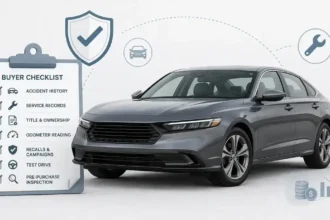
Used Toyota Highlander Pre-Purchase Checklist
Use this checklist before buying a used Highlander. Do not rely on reputation alone.
Before applying the checklist, make sure the Highlander in the listing is the exact configuration you think you are evaluating, especially when gas and hybrid versions can lead to different ownership checks. Run the Highlander’s VIN through CarMerit and compare the returned vehicle details with the seller’s description and paperwork. Once those details line up, continue with the official NHTSA and Toyota recall searches, service records, test drive, and pre-purchase inspection.
| Check | What to do | Pass condition |
| VIN recall search | Check NHTSA and Toyota recall tools | No unrepaired recall surprises |
| Service records | Review oil changes, fluids, major service, tires, brakes | Records match mileage and age |
| Test drive | Drive cold and warm, city and highway if possible | Smooth shifts, no warning lights, no odd noises |
| Engine bay | Look for leaks, overheating clues, poor repairs | Clean and consistent condition |
| Tires | Check brand, tread, age, and matching set | Even wear, no AWD mismatch |
| Suspension | Listen for clunks and check ride stability | No loose or worn-out feel |
| Electronics | Test infotainment, cameras, sensors, climate controls | All major systems work |
| Hybrid system | Request a hybrid-specific scan if applicable | No warning lights or battery concerns |
| Price check | Compare condition, mileage, trim, and records | Price reflects real condition |
| Inspection | Use an independent mechanic | No major hidden repair risk |
The final decision should be based on the specific SUV, not the Highlander name.
Bottom Line: Is Toyota Highlander Reliability Good Enough?
Toyota Highlander reliability is good enough to make it one of the stronger used midsize family SUV candidates.
The catch is simple: the best Highlander is the one with proof.
Buy one with clean records, reasonable mileage, no major inspection issues, and a price that reflects its condition. Be more cautious with high-mileage examples, poor records, neglected AWD systems, and hybrids without clear battery or system history.
A used Highlander is a smart buy when the vehicle earns the reputation. It is a risky buy when the seller expects the badge to do all the work.
Frequently Asked Questions
Are Toyota Highlanders reliable?
Yes, Toyota Highlanders are generally reliable used SUVs, but condition matters. A clean service history, good inspection result, and sensible mileage are more important than the badge alone.
Are Toyota Highlanders expensive to maintain?
They are usually reasonable for a midsize three-row SUV, but they are not as cheap to run as a compact car. Tires, brakes, suspension, fluids, and AWD-related maintenance can add up as mileage rises.
How long do Toyota Highlanders last?
A Highlander can be a good long-term SUV when maintained well, but exact mileage promises are unsafe. Records, inspection results, rust, prior use, and repair history matter more than a single lifespan number.
Is the Toyota Highlander Hybrid reliable?
The Highlander Hybrid can be a strong used choice when the battery and hybrid system check out. It is best for buyers who drive enough, especially in city traffic, to benefit from the fuel savings.
Is a used Highlander Hybrid cheaper to own than gas?
Not always. The hybrid may save fuel, but purchase price, battery/system condition, warranty status, and inspection results decide whether it is cheaper overall.
Should I check Toyota Highlander years to avoid before buying?
Yes. This reliability guide helps you judge ownership risk, but model-year risk is a separate decision. Check the Highlander years-to-avoid guide before committing to a specific listing.