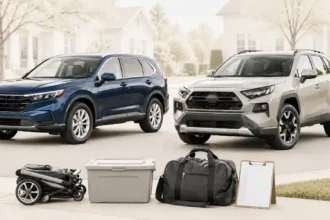


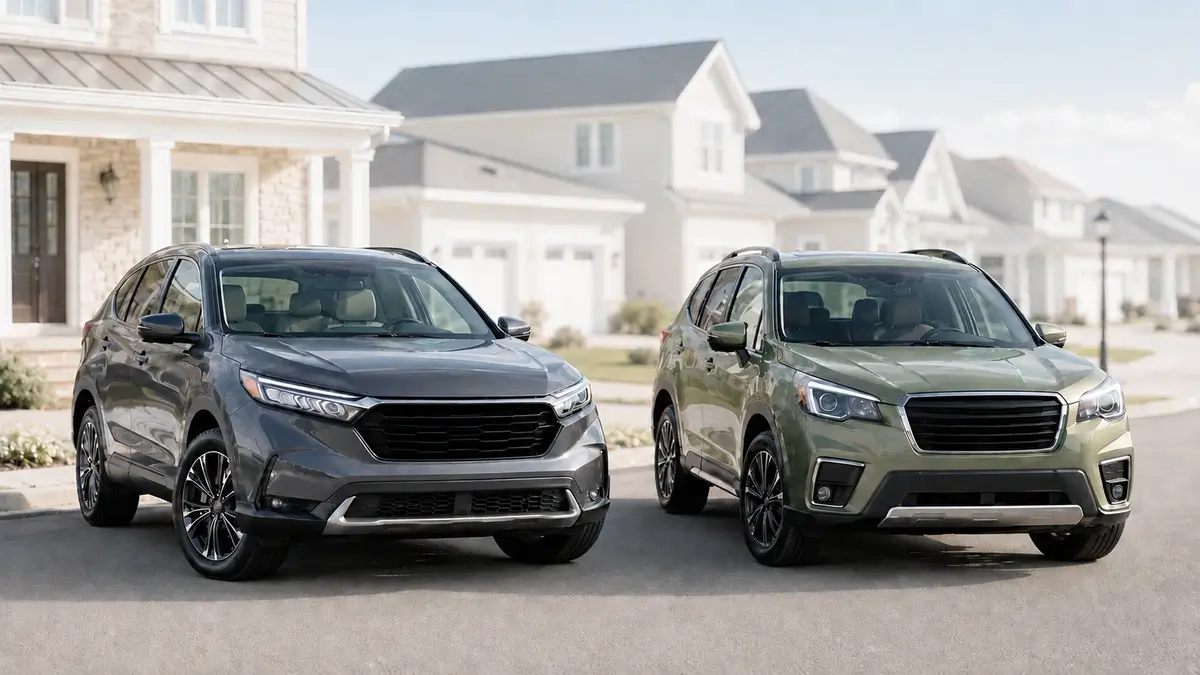
The Honda CR-V vs Subaru Forester decision comes down to one practical question: do you want the easier mainstream used-SUV default, or do you need the stronger AWD and rough-weather fit?
For most used compact SUV buyers, start with the Honda CR-V. It is practical, efficient, easy to shop for, and usually easier to justify as a long-term family or commuter SUV.
Choose the Subaru Forester if standard AWD, upright visibility, higher ground clearance, and bad-weather confidence matter more than having the more conventional family or commuter setup.
The wrong choice is not picking a “bad” SUV. The wrong choice is buying the right model for the wrong use case, or buying a weak used example because a new-car comparison made it look like the automatic winner.
Fastest practical default: CR-V for most mainstream buyers. Forester for snow-belt, rural, outdoor, and AWD-first buyers.
CarMerit reliability comparator
Honda CR-V vs Subaru Forester: 2002-2026 NHTSA snapshot
Owner-complaint and recall counts from NHTSA for 2002-2026, each model’s best used-year lane, and which buyer each one fits.
| 15,386 | complaints (2002-26) | 5,955 |
| 201 | recalls (2002-26) | 112 |
Airbags / seatbelts / structureEngineElectricalSteering | top issues | Visibility / wipersAirbags / seatbelts / structureEngineElectrical |
Honda CR-V
Best used year: 2016
Shortlist 2016 and 2020-2022; inspect hard 2015 and 2017-2018; older 2002-2011 examples need stronger proof.
Best for: Mainstream buyers who want practical space, strong efficiency, easy shopping, and the mainstream family or commuter default.
Subaru Forester
Best used year: 2021
Shortlist 2021-2024; value 2019-2020; older budget target 2016-2018; use more caution with 2011-2015.
Best for: Snow-belt, rural, and outdoor buyers who want standard AWD, upright visibility, higher ground clearance, and bad-weather confidence.
Quick take: The CR-V is the easier mainstream default for most used compact-SUV buyers: practical, efficient, easy to shop, and lower-friction to own. Choose the Forester when standard AWD, visibility, ground clearance, and bad-weather confidence are part of your normal driving, not occasional needs. Do not crown either SUV from raw NHTSA counts alone.
Complaint counts are raw owner reports filed with NHTSA, not adjusted for sales volume, so they should guide inspection rather than crown a winner. The quick comparator above uses a 2002-2026 overlapping NHTSA snapshot for both models; if one model has older NHTSA history before 2002, those model-only years are excluded here to keep the comparison balanced. Always inspect the specific vehicle before buying.
IIHS Safety Check: 2021–2022 Shortlist-Year Overlap
The 2021–2022 overlap is especially useful because those years sit inside the used-year lanes highlighted above for both SUVs.
| IIHS checkpoint | 2021–2022 Honda CR-V | 2021–2022 Subaru Forester |
|---|---|---|
| Driver-side small overlap front | G | G |
| Passenger-side small overlap front | G | G |
| Updated side | A | A |
| Headlights | G on Touring/Hybrid Touring; A on Hybrid EX/EX-L; M on gas LX/EX/EX-L/SE | G — all trims |
Table Note: G = Good, A = Acceptable, M = Marginal, P = Poor. These are selected model-year-specific IIHS ratings, not overall safety scores. CR-V headlight performance varies by trim and equipment in these years. IIHS ratings, test criteria, and applicability can change by model year, so verify the exact year and trim you are shopping.
Quick Verdict: Honda CR-V vs Subaru Forester
The CR-V is the better used SUV for most buyers who want strong practicality, useful fuel-economy choices, and a conventional family or commuter setup with fewer capability-driven trade-offs to manage.
The Forester is the better fit if winter roads, steep driveways, gravel access, trailheads, or outdoor gear are part of your normal life.
Neither SUV should be bought on brand reputation alone. A clean service history, verified recall status, correct trim, matching tires, and fair price matter more than a general Honda or Subaru image.
| Buyer Need | Better Pick | Why It Matters |
|---|---|---|
| Mainstream all-around default | Honda CR-V | Better fit for commuting, family use, cargo practicality, and buyers who do not need standard AWD |
| Snow and bad-weather confidence | Subaru Forester | Standard AWD and higher clearance give it a clearer winter-use case |
| Fuel-economy flexibility | Honda CR-V | FWD and hybrid choices broaden the efficiency options, while gas AWD is much closer to the Forester than a blanket MPG win suggests |
| Outdoor and light-adventure use | Subaru Forester | Better fit for gravel roads, trailheads, snow, and rougher access |
| Hybrid interest | Honda CR-V | Longer EPA-rated AWD hybrid used-year range in this comparison; compare the exact year, drivetrain, and price |
| Cargo-first family use | Honda CR-V | Stronger cargo-space case in many late-model comparisons |
| Visibility and upright cabin feel | Subaru Forester | Forester feels open, tall, and easy to place on the road |
Choose the CR-V if you want the practical default.
Choose the Forester if AWD and rough-weather confidence are not optional for you.
Skip the CR-V if you will always feel underprepared without standard AWD.
Skip the Forester if your real priority is a conventional family or commuter setup, available FWD or hybrid efficiency choices, and you do not need standard AWD or extra rough-weather capability.
If you like the Forester but want a more refined-feeling alternative than the CR-V, the Mazda CX-5 is the next comparison to check. The Mazda CX-5 vs Subaru Forester decision is useful when comfort, cabin feel, visibility, cargo access, and winter confidence all matter.
How the CR-V and Forester Compare as Used Compact SUVs
The CR-V and Forester are both mainstream compact SUVs, but they solve different problems.
The CR-V is the more conventional family and commuter choice. It makes sense for buyers who want space, efficiency, easy shopping, and fewer compromises.
The Forester is more specialized. It is still practical, but its stronger case comes from standard AWD, upright visibility, ground clearance, and outdoor-friendly usability.
| Factor | Honda CR-V | Subaru Forester |
| Main personality | Practical, efficient, mainstream | Upright, AWD-focused, outdoorsy |
| Best buyer | Commuter or family buyer | Snow-belt or outdoor buyer |
| AWD setup | Available on many used examples, depending on trim/year | Standard on Forester models |
| Fuel-economy choice | Broader mix of gas FWD/AWD and hybrid options; exact MPG depends on year and configuration | Standard AWD; standard gas versions are close to CR-V gas AWD in many recent comparisons, while Wilderness is lower |
| Cabin feel | Smooth, modern, family-friendly | Open, tall, easy to see out of |
| Used-buying risk | Still year, trim, mileage, and maintenance dependent | More sensitive to maintenance history, tires, and AWD-related wear |
| Best reason to buy | Lower-friction ownership | Weather and utility confidence |
A used buyer should not copy a new-car verdict blindly.
You are not buying a perfect showroom example. You are buying a specific year, trim, mileage, condition, tire set, and service history.
That is why a clean CR-V can be a better buy than a neglected Forester, and a clean Forester can be a better buy than an overpriced CR-V.
Honda CR-V vs Subaru Forester Reliability and Common Problems
The Honda CR-V is the easier default for many used buyers, but reliability still depends on the exact model year, configuration, mileage, maintenance history, and condition.
The Subaru Forester can also be a strong long-term SUV, but it asks more from the used buyer. You need to verify the exact model year, maintenance history, tire condition, AWD behavior, and ownership pattern.
Do not use forums as proof. Use forums to spot concerns, then verify with service records, recall checks, inspections, and model-year research.
| Reliability Check | Honda CR-V | Subaru Forester |
| Brand reputation | Strong mainstream reliability image | Strong loyalty and durability image |
| Used-buyer risk | Still depends on year, engine, mileage, and maintenance | More sensitive to maintenance history, tire condition, CVT feel, and AWD-related wear |
| Best inspection focus | Oil changes, transmission behavior, recall status, hybrid system if equipped | CVT behavior, oil leaks, suspension wear, tire matching, AWD system, recall status |
| Safe buying rule | Avoid neglected high-mileage examples | Avoid poor service history, mismatched tires, and unclear AWD maintenance |
| Verdict | Better default for lower-friction ownership | Good choice when condition and history are clean |
The CR-V is the easier default if you want fewer capability-driven buying variables.
The Forester becomes more appealing when you can verify that the previous owner maintained it properly.
For either SUV, check open recalls before purchase. Use the VIN, not only the model year.
Warranty Extensions Worth Checking by VIN
A few manufacturer coverage extensions are worth checking because they can change what a used buyer may still be able to claim. Model year alone does not confirm eligibility.
If the CR-V and Forester listings you are comparing fall into these coverage periods, run both model years through CarMerit’s Manufacturer Special Coverage Lookup before using an A/C, CVT, or coolant-control repair history to favor one SUV over the other.
| Vehicle / years | Official coverage change | What to verify |
|---|---|---|
| 2017–2022 Honda CR-V 1.5T | A/C compressor shaft-seal coverage was extended to 10 years from the original purchase date with no mileage limit | Confirm the 1.5T configuration, VIN/program eligibility, original purchase date, and current written coverage |
| Certain 2014–2020 Subaru Foresters with CVT | Separate year-specific Subaru programs extended eligible CVT powertrain coverage to 10 years / 100,000 miles | Confirm the exact model year, VIN/Vehicle Coverage Inquiry, in-service date, mileage, CVT applicability, and current eligibility |
| 2019–2021 Subaru Forester | Thermo Control Valve coverage was extended to 15 years / 150,000 miles | Confirm Vehicle Coverage Inquiry eligibility and the required diagnosis |
Table Note: A warranty extension does not prove that a component commonly fails or that coverage remains on a specific used vehicle. VIN, model year, in-service date, mileage, equipment, diagnosis, and current manufacturer terms can control eligibility.
Fuel Economy and Ownership Trade-Offs
EPA fuel-economy estimates become much more useful when the exact drivetrain and powertrain are matched instead of comparing the two model names broadly. The tables below focus on selected 2020–2025 AWD configurations that are directly relevant to this used-SUV comparison.
Honda CR-V EPA Fuel Economy — Selected Gas AWD Configurations
| Model Year | Configuration | City | Highway | Combined |
|---|---|---|---|---|
| 2020 | 1.5L gas AWD, CVT | 27 | 32 | 29 |
| 2021 | 1.5L gas AWD, CVT | 27 | 32 | 29 |
| 2022 | 1.5L gas AWD, CVT | 27 | 32 | 29 |
| 2023 | 1.5L gas AWD, CVT | 27 | 32 | 29 |
| 2024 | 1.5L gas AWD, CVT | 27 | 32 | 29 |
| 2025 | 1.5L gas AWD, CVT | 26 | 31 | 28 |
Table Note: EPA city/highway/combined MPG for the exact AWD gasoline configurations shown. Values are official configuration-level estimates, not real-world guarantees. Source: FuelEconomy.gov official data.
Subaru Forester EPA Fuel Economy — Selected Gas AWD Configurations
| Model Year | Configuration | City | Highway | Combined |
|---|---|---|---|---|
| 2020 | 2.5L AWD, Automatic (AV-S7) | 26 | 33 | 29 |
| 2021 | 2.5L AWD, Automatic (AV-S7) | 26 | 33 | 29 |
| 2022 | 2.5L AWD, Automatic (AV-S7) | 26 | 33 | 29 |
| 2022 | Wilderness AWD, 2.5L, Automatic (AV-S8) | 25 | 28 | 26 |
| 2023 | 2.5L AWD, Automatic (AV-S7) | 26 | 33 | 29 |
| 2023 | Wilderness AWD, 2.5L, Automatic (AV-S8) | 25 | 28 | 26 |
| 2024 | 2.5L AWD, Automatic (AV-S8) | 26 | 33 | 29 |
| 2024 | Wilderness AWD, 2.5L, Automatic (AV-S8) | 25 | 28 | 26 |
| 2025 | 2.5L AWD, Automatic (AV-S8) | 26 | 33 | 29 |
| 2025 | Sport/Touring AWD, 2.5L, Automatic (AV-S8) | 25 | 32 | 28 |
| 2025 | Wilderness AWD, 2.5L, Automatic (AV-S8) | 25 | 28 | 26 |
Table Note: EPA city/highway/combined MPG for the exact gasoline AWD configurations shown. Wilderness and other separately rated configurations are kept separate rather than averaged together. Source: FuelEconomy.gov official data.
The important takeaway is that recent gas-AWD fuel economy is closer than a simple CR-V-versus-Forester label suggests. From 2020 through 2024, the gas CR-V AWD and the standard Forester shown above both carry a 29-mpg combined EPA rating. For 2025, the standard Forester is rated at 29 combined versus 28 for the gas CR-V AWD. Wilderness versions trade some fuel economy for their more rugged setup.
The CR-V’s clearest fuel-economy advantage comes from having additional drivetrain and hybrid choices rather than from automatically beating every gas AWD Forester.
Hybrid AWD EPA Fuel Economy
| Model Year | Configuration | City | Highway | Combined |
|---|---|---|---|---|
| 2020–2022 | Honda CR-V Hybrid AWD, 2.0L | 40 | 35 | 38 |
| 2023 | Honda CR-V Hybrid AWD, 2.0L | 40 | 34 | 37 |
| 2024–2025 | Honda CR-V AWD, 2.0L hybrid | 40 | 34 | 37 |
| 2025 | Subaru Forester Hybrid AWD, 2.5L | 35 | 34 | 35 |
Table Note: EPA city/highway/combined MPG for the exact AWD hybrid configurations shown. Identical model-year results are grouped for readability; they are not averaged. CR-V AWD hybrid EPA records in this comparison extend back to 2020, while Forester Hybrid AWD first appears for 2025. Actual fuel economy varies with driving conditions, weather, load, tires, and vehicle condition. Source: FuelEconomy.gov official data.
These EPA ratings do not create a one-number ownership-cost winner. Available verified repair-cost evidence does not support a clean model-wide CR-V-versus-Forester cost comparison, because procedure estimates are tied to specific repairs, years, locations, and assumptions.
This comparison also does not establish a resale-value winner. Asking prices are not the same as transaction prices, depreciation, retention, or future resale value. For either SUV, the exact purchase price, condition, service history, tire condition, inspection findings, and local repair quotes matter more than a broad ownership-cost label.
AWD, Snow Driving, and Ground Clearance
This is where the Forester makes its strongest case.
Subaru gives the Forester standard Symmetrical All-Wheel Drive, and recent Forester models have strong ground-clearance numbers for this class. That makes the Forester easier to recommend for buyers who regularly deal with snow, gravel roads, steep driveways, rural lanes, or rougher access.
The CR-V offers available Real Time AWD, but it is not the same buyer promise. The CR-V is a practical SUV that can be equipped for bad weather. The Forester is built around that use case from the start.
That does not mean the Forester automatically wins for every winter buyer.
Tires matter more than badges. A CR-V AWD with good winter tires can feel safer than a Forester on worn all-seasons.
| Winter or Outdoor Need | Better Pick | Reason |
| Snow-belt daily driving | Subaru Forester | Standard AWD and clearance are useful |
| Occasional winter trips | Honda CR-V AWD | Enough for many buyers with good tires |
| Gravel roads and trailheads | Subaru Forester | Better fit for rougher access |
| City driving with light snow | Honda CR-V | AWD may be enough if condition and tires are right |
| Maximum rugged trim appeal | Subaru Forester Wilderness | Useful only if you will use the extra capability |
The Forester’s snow advantage is real when your location makes it real.
If you live in a mild-weather area, the CR-V’s broader drivetrain and hybrid fuel-economy choices, ownership ease, and family practicality may matter more.
Cargo Space, Seating, Comfort, and Family Practicality
The CR-V is the stronger family default.
It has a roomy cabin, strong cargo space, and an easy daily-use layout. It feels like the compact SUV built for the widest range of buyers.
The Forester is not small or impractical. Its tall roof, large glass area, and upright shape make it easy to see out of and easy to live with.
The difference is in feel.
The CR-V feels more polished and conventional. The Forester feels more open, square, and utility-focused.
| Practical Use | Better Pick | Why |
| Family errands | Honda CR-V | Easier all-around default |
| Rear-seat comfort | Close, slight CR-V edge | CR-V has strong passenger packaging |
| Cargo loading | Honda CR-V | Strong cargo volume and daily usability |
| Visibility | Subaru Forester | Upright cabin and large glass help |
| Outdoor gear | Subaru Forester | Boxier shape and roof-friendly identity help |
| Road trips | Honda CR-V | Better default for comfort, fuel-economy flexibility, and broad family use |
Choose the CR-V if your SUV needs to disappear into daily life.
Choose the Forester if you want a more upright, outdoorsy cabin that feels easy to place on rough roads or in bad weather.
Trims, Hybrid Options, and Value Traps
Do not let trim badges make the decision for you.
A clean, fairly priced mid-trim CR-V or Forester is usually smarter than a high-trim example with questionable maintenance, worn tires, accident history, or an inflated asking price.
The CR-V Hybrid deserves attention if fuel economy is a priority. It gives used shoppers a longer EPA-rated hybrid year range in this comparison, but the exact drivetrain, condition, and used-price premium still matter.
The Forester Hybrid is a newer used-market consideration. Its EPA hybrid entry in this comparison begins with the 2025 model year, so buyers have a much shorter used-year range to shop than they do with the CR-V Hybrid.
The Forester Wilderness is useful for the right buyer. It is overkill if you only want a comfortable city SUV with occasional bad-weather confidence.
| Trim Question | Better Direction |
| Best CR-V value path | Look for a well-kept mainstream trim with the right drivetrain |
| Best Forester value path | Prioritize clean maintenance, good tires, and the right AWD-focused trim |
| CR-V Hybrid | Longer used-year EPA hybrid lane; compare exact drivetrain, condition, and price premium |
| Forester Hybrid | Newer used-year option; EPA hybrid coverage in this comparison begins with 2025 |
| Forester Wilderness | Good for real rough-weather or outdoor use; weak value if bought for image |
| Biggest value trap | Paying for capability or features you will not use |
The value trap is simple.
Do not pay for capability you will not use. Do not chase features while ignoring tires, service records, recalls, and ownership condition.
Which One Fits Your Buyer Type?
Your buyer type matters more than a universal winner.
The CR-V is best for buyers who want a practical, lower-friction used SUV.
The Forester is best for buyers who will actually use its AWD, visibility, and clearance advantages.
| Buyer Type | Better Pick | Why |
| Daily commuter | Honda CR-V | Strong practical default; compare the exact drivetrain because gas AWD MPG is close to the standard Forester in many recent years |
| Small family | Honda CR-V | Strong cargo, space, and daily comfort |
| Snow-belt driver | Subaru Forester | Standard AWD and clearance matter |
| Outdoor weekend driver | Subaru Forester | Better fit for gravel, trailheads, and rough weather |
| High-mileage driver | Honda CR-V Hybrid | Hybrid fuel economy can matter more as annual mileage rises; compare the used-price premium and exact configuration |
| Budget-sensitive buyer | No automatic winner | Compare purchase price, condition, service history, tires, inspection findings, and any VIN-specific coverage instead of assuming one model always costs less |
| Visibility-focused buyer | Subaru Forester | Upright cabin and large glass area help |
| Mild-climate buyer | Honda CR-V | Better default if AWD is not a regular need |
A buyer in Florida, Texas, or Southern California should usually start with the CR-V.
A buyer in Vermont, Colorado, Maine, Pennsylvania, Minnesota, or rural upstate areas should take the Forester more seriously.
That is not a rule. It is the right starting point.
Used Buying Checklist Before You Choose
Do not choose between CR-V and Forester from a listing photo.
Use the same filter for both SUVs. Then let the better example win.
| Check | Why It Matters |
| VIN recall check | Confirms open safety recalls before purchase |
| Service records | Shows whether the SUV was maintained, not just cleaned |
| Tire match and tire age | Critical for AWD systems and winter confidence |
| Test drive from cold start | Reveals noises, hesitation, vibration, and warning lights |
| Transmission or CVT behavior | Helps catch expensive drivability issues |
| Suspension and brake feel | Important on higher-mileage compact SUVs |
| Hybrid system condition | Important for CR-V Hybrid and newer Forester Hybrid shoppers |
| Accident history | Affects safety, resale, alignment, and long-term confidence |
| Realistic price check | Prevents overpaying for a popular badge or trim |
For the Forester, pay extra attention to tire matching, AWD behavior, suspension noise, oil leaks, and CVT feel.
For the CR-V, check maintenance records, recall status, turbo or hybrid system condition, transmission behavior, and accident history.
A clean Forester can beat a tired CR-V.
A clean CR-V can beat a neglected Forester.
Final Recommendation: CR-V or Forester?
Most used compact SUV buyers should choose the Honda CR-V.
It is the better default if you want a practical family SUV, useful fuel-economy choices, good cargo space, and a conventional daily-use setup that does not depend on standard AWD.
Choose the Subaru Forester if your real life makes its advantages matter.
That means snow, rough roads, standard AWD preference, outdoor gear, trailheads, rural use, or a strong need for visibility and ground clearance.
The CR-V is the smarter used buy for most buyers.
The Forester is the smarter used buy for the right buyer.
The best final choice is not the model with the most wins on a spec sheet. It is the cleanest, best-maintained example that fits how you actually drive.
Once you know whether the CR-V or Forester fits you better, narrow the risk by model year — check our Honda CR-V years to avoid guide if you lean Honda, or the best Subaru Forester years to buy used if you lean Subaru.
Frequently Asked Questions
Is a Honda CR-V or Subaru Forester better used?
The Honda CR-V is the easier all-around default for most mainstream buyers, especially for commuting, family use, cargo practicality, and buyers who do not need standard AWD.
The Subaru Forester is the stronger fit when standard AWD, snow confidence, visibility, and ground clearance are regular needs.
Which is more reliable, the Honda CR-V or Subaru Forester?
Do not treat this comparison as proof that one model is universally more reliable. The CR-V remains the easier mainstream default, while the Forester can still be a strong used choice when condition and history are clean.
For either SUV, judge the exact model year by service records, recall status, inspection results, mileage, and condition rather than brand reputation alone.
Is the Subaru Forester better than the Honda CR-V for snow?
Yes, the Forester is usually the better snow-state choice because AWD is standard and ground clearance is a major strength.
A CR-V AWD with good tires can still work well for many buyers. Tires, condition, and driver behavior matter more than the badge.
Which has lower ownership costs, CR-V or Forester?
There is no verified one-number ownership-cost winner in this comparison.
Fuel economy depends heavily on the exact drivetrain and powertrain. Recent gas AWD versions can be quite close, while CR-V hybrid options create a stronger MPG case for fuel-focused buyers. Repair-cost estimates are also procedure- and scope-specific rather than proof that one model always costs less.
Compare the exact vehicle’s purchase price, condition, service history, tires, inspection findings, and local repair quotes before deciding which one is cheaper to own.
Which has better resale value, Honda CR-V or Subaru Forester?
This comparison does not establish a resale-value winner.
Asking prices are not the same as transaction prices, depreciation, retention, or future resale value. Compare same-year, similar-mileage, like-for-like local listings and the condition and history of the exact vehicle before paying a premium for either badge.
Which has more cargo space, Forester or CR-V?
The CR-V has the stronger cargo-space case in many late-model comparisons.
The Forester still works well for gear because of its upright shape, wide opening, and boxier utility feel.
Is Subaru AWD better than Honda CR-V AWD?
Subaru’s AWD is the stronger reason to choose the Forester because it is standard and central to the vehicle’s identity.
Honda’s available AWD is enough for many normal buyers. It makes sense if you want a CR-V but need extra traction.
Are the CR-V Hybrid and Forester Hybrid worth comparing used?
Yes, if fuel economy materially affects your buying decision.
The available used-year depth is different: EPA-rated CR-V Hybrid AWD records in this comparison begin with 2020, while Forester Hybrid AWD first appears for 2025. Use the fuel-economy tables above to compare the exact model year and configuration rather than treating every hybrid version as equivalent.
Also compare the actual used price, condition, service history, and how much you expect to drive before paying extra for either hybrid.
Should I choose a Forester Wilderness or a CR-V AWD?
Choose the Forester Wilderness only if you will use the extra ground clearance, trail-focused setup, and rugged features.
Choose the CR-V AWD if you mostly drive on pavement and want practical all-weather confidence without paying for capability you do not need.
Which used years should I avoid for the CR-V or Forester?
Do not answer that from this comparison alone.
Both SUVs need year-specific checking. Review recalls, complaints, service records, and a dedicated years-to-avoid guide before buying a specific model year.
Once your CR-V-versus-Forester choice narrows to actual listings, verify that each SUV matches the vehicle you think you are comparing. Run each VIN through the CarMerit VIN Lookup and compare the returned vehicle details with the seller’s listing and paperwork. Then use the correct model-year guidance, recall checks, service history, and pre-purchase inspection to decide whether the CR-V’s simpler ownership case or the Forester’s AWD capability is the better buy.