

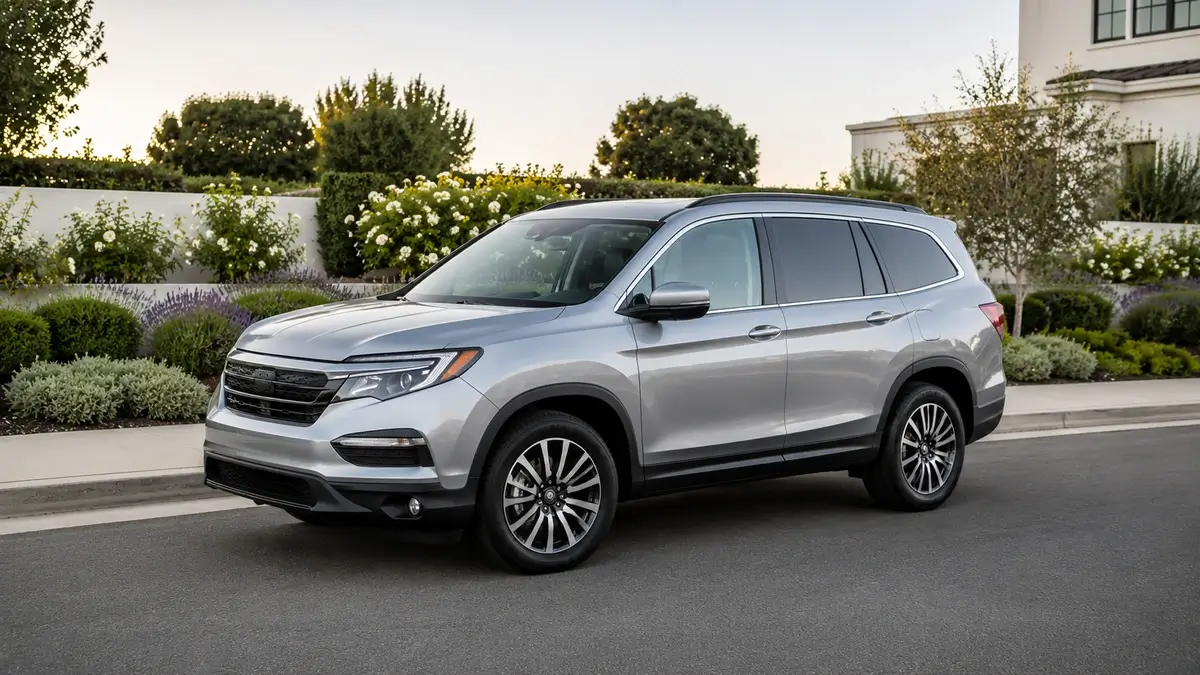
The Honda Pilot can be a strong used family SUV, but it is not a blind buy.
The safest answer is simple: shortlist a used Honda Pilot only if the specific SUV has clean records, no open safety recall issues, smooth transmission behavior, and proof of major maintenance. A neglected Pilot can become expensive fast, especially at higher mileage.
This guide focuses on used Honda Pilot reliability, cost-to-own risk, maintenance checks, common problems, and when a buyer should walk away.
Honda Pilot Reliability Quick Verdict
The Pilot is best for families who need three-row space and want a mainstream SUV with broad parts and service support. It makes the most sense when the inspection is clean and the maintenance history is real.
It is weaker for buyers who want the lowest-risk used SUV possible. A Pilot with missing records, unresolved recall exposure, harsh shifting, rust, fluid leaks, or ignored major service should not stay on the shortlist.
| Buyer situation | Used-buy verdict | What to do before buying |
|---|---|---|
| Clean service records, clean inspection, no open VIN recall issues | Strong shortlist | Compare price, mileage, trim, and model year |
| Good condition but limited records | Possible, with caution | Require a pre-purchase inspection and budget for catch-up service |
| High mileage with strong maintenance proof | Still possible | Check timing-belt proof where applicable, fluids, leaks, suspension, and transmission behavior |
| High mileage with weak records | Risky | Skip unless the price leaves room for immediate repairs |
| Rough shifting, warning lights, leaks, rust, or unresolved recall issues | Walk away | Do not rely on brand reputation to offset obvious risk |
| Family buyer comparing three-row SUVs | Worth comparing | Use the Pilot against Highlander ownership and model-year risk |
The key point: Honda Pilot reliability depends more on the individual SUV than on the badge.
What the Evidence Says About Honda Pilot Reliability
Reliability ratings can help set a baseline, but they do not replace a used-car inspection.
RepairPal’s Honda Pilot reliability page rates the Pilot at 3.5 out of 5.0 and lists an average total annual repair and maintenance cost of $542. That is useful context, but it averages many vehicles and cannot tell you whether one used Pilot was maintained well.
The same source also separates cost, repair frequency, and repair severity. That matters because a vehicle can have a reasonable average cost and still be a bad buy if one example has deferred maintenance.
Owner forums and social posts are useful for finding buyer concerns. They are not strong proof by themselves. A few owner complaints should send you toward inspection questions, not hard conclusions.
Reliability ratings vs real used-buy risk
A rating source can tell you the Pilot is not an outlier in the midsize SUV class. It cannot confirm timing-belt history, transmission condition, rust exposure, accident damage, or open recalls on a specific VIN.
That is why the best buying process is layered:
- Use reliability ratings for broad context.
- Use model-year guidance to avoid higher-risk years.
- Use service records and inspection to judge the exact SUV.
- Use VIN recall checks before money changes hands.
Long-term reliability signal
A Honda Pilot with consistent maintenance can be a durable family SUV. That does not mean every high-mileage Pilot is safe.
Mileage matters less than maintenance proof. A 150,000-mile Pilot with documented fluids, timing-belt service where applicable, clean shifting, and no rust can be more attractive than a lower-mileage one with gaps.
The weak version is the opposite: high mileage, no records, vague seller answers, warning lights, and “runs fine” language.
What forums can and cannot prove
Forums can reveal patterns buyers worry about, including transmission behavior, electronics, leaks, and high-mileage maintenance. They cannot prove defect rates.
Treat forum concerns as prompts for your mechanic. Do not treat them as the final answer.
Honda Pilot Cost to Own: What Buyers Should Expect
The Honda Pilot is a three-row SUV, so ownership cost should be judged differently from a compact car or small crossover.
Even when reliability is acceptable, the Pilot can still cost more to run because it has larger tires, more weight, more fluids, available AWD, and family-SUV wear. Fuel use also matters if the vehicle will handle school runs, commuting, road trips, or city traffic.
Fuel economy varies enough across Honda Pilot years, drivetrains, and transmissions to matter when comparing used examples. EPA/FuelEconomy.gov ratings below keep 2WD/FWD and 4WD/AWD configurations separate rather than averaging them together.
| Model Year (2WD) | Configuration | City | Highway | Combined | Model Year (4WD) | Configuration | City | Highway | Combined |
|---|---|---|---|---|---|---|---|---|---|
| — | — | — | — | — | 2003 | 4WD, 5-speed automatic | 15 | 21 | 17 |
| — | — | — | — | — | 2004 | 4WD, 5-speed automatic | 15 | 21 | 17 |
| — | — | — | — | — | 2005 | 4WD, 5-speed automatic | 15 | 20 | 17 |
| 2006 | 2WD, 5-speed automatic | 16 | 22 | 18 | 2006 | 4WD, 5-speed automatic | 15 | 20 | 17 |
| 2007 | 2WD, 5-speed automatic | 16 | 22 | 18 | 2007 | 4WD, 5-speed automatic | 15 | 20 | 17 |
| 2008 | 2WD, 5-speed automatic | 16 | 22 | 18 | 2008 | 4WD, 5-speed automatic | 15 | 20 | 17 |
| 2009 | 2WD, 5-speed automatic | 17 | 23 | 19 | 2009 | 4WD, 5-speed automatic | 16 | 22 | 18 |
| 2010 | 2WD, 5-speed automatic | 17 | 23 | 19 | 2010 | AWD, 5-speed automatic | 16 | 22 | 18 |
| 2011 | 2WD, 5-speed automatic | 17 | 23 | 19 | 2011 | AWD, 5-speed automatic | 16 | 22 | 18 |
| 2012 | 2WD, 5-speed automatic | 18 | 25 | 20 | 2012 | AWD, 5-speed automatic | 17 | 24 | 20 |
| 2013 | 2WD, 5-speed automatic | 18 | 25 | 20 | 2013 | AWD, 5-speed automatic | 17 | 24 | 20 |
| 2014 | 2WD, 5-speed automatic | 18 | 25 | 20 | 2014 | AWD, 5-speed automatic | 17 | 24 | 20 |
| 2015 | 2WD, 5-speed automatic | 18 | 25 | 20 | 2015 | AWD, 5-speed automatic | 17 | 24 | 20 |
| 2016 | 2WD, 9-speed automatic | 20 | 27 | 23 | 2016 | AWD, 9-speed automatic | 19 | 26 | 22 |
| 2016 | 2WD, 6-speed automatic | 19 | 27 | 22 | 2016 | AWD, 6-speed automatic | 18 | 25 | 21 |
| 2017 | FWD, 9-speed automatic | 20 | 27 | 23 | 2017 | AWD, 9-speed automatic | 19 | 26 | 22 |
| 2017 | FWD, 6-speed automatic | 19 | 27 | 22 | 2017 | AWD, 6-speed automatic | 18 | 26 | 21 |
| 2018 | FWD, 9-speed automatic | 20 | 27 | 23 | 2018 | AWD, 9-speed automatic | 19 | 26 | 22 |
| 2018 | FWD, 6-speed automatic | 19 | 27 | 22 | 2018 | AWD, 6-speed automatic | 18 | 26 | 21 |
| 2019 | FWD, 9-speed automatic | 20 | 27 | 23 | 2019 | AWD, 9-speed automatic | 19 | 26 | 22 |
| 2019 | FWD, 6-speed automatic | 19 | 27 | 22 | 2019 | AWD, 6-speed automatic | 18 | 26 | 21 |
| 2020 | FWD, 9-speed automatic | 20 | 27 | 23 | 2020 | AWD, 9-speed automatic | 19 | 26 | 22 |
| 2020 | FWD, 6-speed automatic | 19 | 27 | 22 | 2020 | AWD, 6-speed automatic | 18 | 26 | 21 |
| 2021 | FWD, 9-speed automatic | 20 | 27 | 23 | 2021 | AWD, 9-speed automatic | 19 | 26 | 22 |
| 2022 | FWD, 9-speed automatic | 20 | 27 | 23 | 2022 | AWD, 9-speed automatic | 19 | 26 | 22 |
| — | — | — | — | — | 2022 | AWD TrailSport, 9-speed automatic | 19 | 25 | 21 |
| 2023 | FWD, 10-speed automatic | 19 | 27 | 22 | 2023 | AWD, 10-speed automatic | 19 | 25 | 21 |
| — | — | — | — | — | 2023 | AWD Touring/Elite/Black, 10-speed automatic | 19 | 25 | 21 |
| — | — | — | — | — | 2023 | AWD TrailSport, 10-speed automatic | 18 | 23 | 20 |
| 2024 | FWD, 10-speed automatic | 19 | 27 | 22 | 2024 | AWD, 10-speed automatic | 19 | 25 | 21 |
| — | — | — | — | — | 2024 | AWD Touring/Elite/Black, 10-speed automatic | 19 | 25 | 21 |
| — | — | — | — | — | 2024 | AWD TrailSport, 10-speed automatic | 18 | 23 | 20 |
| 2025 | FWD, 10-speed automatic | 19 | 27 | 22 | 2025 | AWD, 10-speed automatic | 19 | 25 | 21 |
| — | — | — | — | — | 2025 | AWD Touring/Elite/Black, 10-speed automatic | 19 | 25 | 21 |
| — | — | — | — | — | 2025 | AWD TrailSport, 10-speed automatic | 18 | 23 | 20 |
| 2026 | FWD, 10-speed automatic | 19 | 27 | 22 | 2026 | AWD, 10-speed automatic | 19 | 25 | 21 |
| — | — | — | — | — | 2026 | AWD Touring/Elite/Black, 10-speed automatic | 19 | 25 | 21 |
| — | — | — | — | — | 2026 | AWD TrailSport, 10-speed automatic | 18 | 23 | 20 |
Table Note: EPA city/highway/combined MPG for the exact Honda Pilot configurations shown. The left side is the 2WD/FWD lane and the right side is the 4WD/AWD lane. EPA naming changes from 2WD/4WD to FWD/AWD in later records, so the Configuration column preserves that distinction. Separate transmission and TrailSport/Touring/Elite/Black configurations are not averaged together. Actual fuel economy varies with driving and operating conditions.
| Cost area | Why it matters on a used Pilot | Buyer check |
| Maintenance | Larger SUVs need steady fluid, brake, tire, and suspension care | Ask for service records, not verbal claims |
| Repairs | Age, mileage, and deferred maintenance drive the biggest surprises | Look for leaks, warning lights, noises, and rough shifting |
| Fuel | The Pilot is a three-row SUV, especially costly in city use | Check EPA rating for the exact year and drivetrain |
| Tires and brakes | Family SUVs are heavier than compact cars | Inspect tread, rotor condition, and braking vibration |
| AWD service | AWD adds fluid-service needs and more parts to inspect | Verify rear differential and transfer-case service where applicable |
| Depreciation | Used value depends heavily on year, trim, mileage, and condition | Do not overpay for a weak-record example |
| Insurance | Three-row family SUV rates vary by location and driver profile | Quote insurance before buying |
The most expensive Pilot is not always the oldest one. It is the one that needs tires, brakes, timing-belt service, fluid catch-up, suspension work, and recall repairs at the same time.
Common Honda Pilot Problems to Check Before Buying
Do not approach common Honda Pilot problems as scare content. Approach them as inspection priorities.
Most used SUVs have some weak points. The buyer’s job is to find whether the specific Pilot has symptoms, neglected service, or known exposure before purchase.
Honda Pilot NHTSA Complaint Areas to Turn Into Inspection Checks
| NHTSA complaint area | Complaints | Years covered | Used-buyer check |
|---|---|---|---|
| Engine | 1,832 | 2003-2025 | Cold start, leaks, warning lights, oil history, and engine-noise checks. |
| Electrical | 1,520 | 2003-2025 | Cameras, sensors, infotainment, locks, battery/charging, and warning lights. |
| Airbags / seatbelts / structure | 1,157 | 2003-2026 | Airbag lights, seatbelt operation, body repairs, rust, and crash-history review. |
| Powertrain / transmission | 943 | 2003-2025 | Cold and warm shifts, shudder, delay, reverse engagement, and fluid records. |
| Fuel system | 581 | 2003-2006, 2008-2009, 2011-2025 | Fuel odor, stalling, fuel-pump recall status, and no-start symptoms. |
| Brakes | 512 | 2003-2026 | Pulsing pedal, rotor vibration, uneven braking, and brake warning lights. |
Table note: Complaint areas use the first-listed NHTSA component only, so one complaint is not double-counted across multiple categories. Unknown/other records were excluded from this article table because they are not useful inspection triggers.
| Area to check | Why it matters | What should make you cautious |
| Transmission behavior | Transmission complaints appear often enough to deserve a careful test drive | Harsh shifts, delayed engagement, shudder, warning lights, or vague service history |
| Timing-belt service where applicable | A missed major service can change the whole deal | No proof of belt and water-pump service on relevant years |
| Fluid maintenance | Transmission, transfer-case, rear differential, coolant, and brake fluid can be overlooked | “Lifetime fluid” seller talk or no dated records |
| Brakes and rotors | Large SUVs can show brake wear and vibration | Steering wheel shake, pulsing pedal, or uneven braking |
| Suspension and steering | Family use and rough roads can wear parts | Clunks, wandering, uneven tire wear, or poor alignment |
| Rust and subframe condition | Rust exposure is a major issue in salt-belt vehicles | Heavy underbody rust, weak lift points, or failed inspection |
| Electronics and infotainment | Used family SUVs often have many cabin systems | Faulty screens, cameras, sensors, locks, liftgate, or warning lights |
| Recall status | Recalls can be VIN-specific | Any open recall that has not been scheduled or repaired |
Before buying, run the VIN through the NHTSA recall lookup and Honda’s official recall lookup. Recall status is vehicle-specific, so do not assume one Pilot is clear because another similar one was.
Honda Pilot Recall and VIN Due-Diligence Snapshot
| Recall area | Affected years in scope | Unique camps | Fire-risk camps | Buyer check |
|---|---|---|---|---|
| Airbag / seatbelt / restraint | 2003-2022, 2025 | 25 | 0 | Confirm restraint campaign completion and check airbag/seatbelt warning lights. |
| Fuel system / fuel pump | 2005, 2012, 2015-2021, 2023-2025 | 8 | 5 | Verify fuel-system and fuel-pump recall status by VIN. |
| Engine / powertrain | 2003-2004, 2013, 2016, 2018-2019 | 5 | 1 | Check recall completion and test engine/transmission behavior carefully. |
| Tires / suspension / wheels | 2004, 2016-2022 | 5 | 0 | Inspect tires, suspension, alignment, vibration, and related recall records. |
| Brake system | 2005, 2016, 2021-2025 | 4 | 0 | Verify brake-related recalls and road-test for vibration or warning lights. |
| Camera / visibility | 2019-2022 | 4 | 0 | Test rear-camera and visibility systems during the inspection. |
| Steering | 2005, 2011, 2023-2024 | 3 | 0 | Confirm steering-related recalls and check steering feel, warnings, and noises. |
Table note: This is a recall due-diligence summary, not a complete campaign list. Always check the exact VIN before purchase because recall applicability can vary by vehicle.
Honda Pilot Maintenance Cost and Major Service Items
The Honda Pilot maintenance cost depends on year, mileage, drivetrain, shop rates, and how much maintenance was delayed by previous owners.
Do not judge the cost only by oil changes. The bigger questions are fluids, brakes, tires, timing-belt service where applicable, and evidence that the owner followed the maintenance minder.
Honda’s Maintenance Minder documentation for a 2022 Pilot lists service items such as engine oil, tire rotation, transmission and transfer fluid, spark plugs, timing belt and water pump inspection, coolant, rear differential fluid, brake fluid, and brake and suspension inspections. The exact schedule can vary by year and use, so always check the owner’s manual for the specific Pilot.
Timing-belt proof matters
For relevant Pilot model years, timing-belt service is a major used-buy checkpoint.
Ask for a dated receipt, mileage, and shop name. A seller saying “it was probably done” is not enough.
If proof is missing, price the SUV as if the service may be due soon. That can change whether the deal still makes sense.
Transmission and AWD fluid service
A smooth test drive is important, but it is not the whole story.
Ask for transmission-fluid service records. If the Pilot has AWD, also look for rear differential and transfer-case service where applicable.
A vehicle with smooth shifting and documented fluid service is much safer than one with symptoms and no paperwork.
Tires, brakes, and suspension
Tires and brakes are normal wear items, but they are not cheap on a three-row SUV.
Uneven tire wear can point to alignment or suspension problems. Brake vibration can point to rotor issues. Clunks over bumps can point to worn suspension parts.
None of these automatically makes the Pilot a bad vehicle. They do change the price you should pay.
Honda Coverage Extensions That Can Change the Repair Bill
Some used Pilots fall under Honda-issued warranty extensions for specific diagnosed conditions. These are more useful to a used buyer than a generic factory-warranty summary because qualifying coverage can change whether the owner or Honda pays for a particular repair.
If a Pilot has a documented starting, injector, or Idle Stop concern, run its model year through CarMerit’s Manufacturer Special Coverage Lookup before budgeting the repair as fully out of pocket; the exact configuration, VIN, diagnosis, and Honda’s current program terms still determine eligibility.
| Pilot years / configuration | Covered condition or component | Honda extension | What the buyer should verify |
|---|---|---|---|
| 2016–2017, certain vehicles | Engine start/stop switch associated with keyless-start system errors | 9 years / 125,000 miles | Check VIN eligibility, mileage, original in-service timing, and the qualifying condition under Honda’s warranty-extension notice. |
| 2016–2019, certain vehicles | Fuel injectors under specified MIL/DTC conditions | 10 years / 150,000 miles | The applicable bulletin differs by vehicle scope. Check the 2016–2017 notice or the 2017–2019 notice, then verify VIN and diagnosis. |
| 2016–2021 Pilot with 9-speed automatic and Idle Stop | Valve adjustment and starter replacement related to a no-auto-restart condition | 10 years / unlimited miles | Verify the exact configuration, VIN, diagnosis, and any required prerequisite work under Honda’s applicable coverage bulletin. |
| 2021–2022 Pilot with 9-speed automatic and Idle Stop | Valve adjustment related to a no-auto-restart condition | 10 years / unlimited miles | Verify the configuration, VIN, diagnosis, and applicable requirements under Honda’s coverage bulletin. |
Table Note: These are Honda coverage extensions for certain vehicles and diagnosed conditions, not recalls, failure-rate evidence, or proof that every affected-year Pilot develops the problem. Do not assume current coverage from model year alone; VIN eligibility, original in-service date, mileage where applicable, configuration, diagnosis, and the exact Honda terms must be checked. Some older vehicles may already be outside a time-limited extension.
Honda Pilot Reliability by Year and Generation
This page is not a full model-year ranking. For that decision, use the Honda Pilot years to avoid and best years to buy guide.
For this reliability and cost-to-own page, the safer approach is to understand the broad risk pattern.
Honda Pilot IIHS Safety Changes Used Buyers Should Know
IIHS results answer a different question from reliability complaints: how crashworthiness and related safety performance changed across Pilot years. The useful buying point is not to memorize every sub-rating, but to recognize the model-year changes that can distinguish two used Pilots.
| Model years | Selected IIHS evidence | What it means when comparing used Pilots |
|---|---|---|
| 2003–2005 | Original moderate-overlap front: G. Head restraints were M with leather seats and P with cloth seats. | Seat configuration mattered, so one rating should not be applied blindly across every early Pilot. |
| 2006–2008 | Original moderate-overlap front: G. Original side: G. Head restraints: G. | These years have a different IIHS evidence set from 2003–2005. |
| 2009–2015 | Driver-side small overlap: P. Original moderate overlap: G. Roof strength was M for 2009–2011 and G for 2012–2015. | Stronger results in some older tests do not erase the P driver-side small-overlap result. |
| 2016–2022 | Driver-side small overlap: G. Passenger-side small overlap: A. Updated side: M. Headlight results vary by trim and year. The 2022 Pilot received P in the updated moderate-overlap test. | Check the exact year and trim rather than treating the whole generation as having one identical safety record. |
| 2023–2024 | Driver- and passenger-side small overlap: G. Updated side: G. Updated moderate overlap: M. Headlights: G on all trims. | The redesigned Pilot has a materially different IIHS evidence set from the 2016–2022 generation. |
| 2025–2026 | Updated moderate overlap improved to A after IIHS notes changes to second-row seat belts; the listed small-overlap, updated-side, and headlight results remain G. | Do not automatically apply the 2023–2024 updated-moderate result to 2025–2026 Pilots. |
Table Note: IIHS uses G = Good, A = Acceptable, M = Marginal, and P = Poor. Test protocols and criteria changed over time, so ratings from different test families should not be combined into one longitudinal safety score. A missing IIHS rating is not a negative rating.
Honda Pilot NHTSA Ownership-Risk Snapshot by Generation
| Generation and years | Compl. | Inv. | Mfr. Comms. | Ownership-risk context |
|---|---|---|---|---|
| Gen 1, 2003-2008 | 2,552 | 24 | 842 | Oldest ownership age means rust, powertrain behavior, safety systems, and service proof matter most. |
| Gen 2, 2009-2015 | 1,199 | 1 | 550 | Lower raw volume than Gen 1 and Gen 3, but age and major-service records still control cost risk. |
| Gen 3, 2016-2022 | 4,816 | 22 | 1,250 | More modern family features come with heavier reported-record volume and stronger VIN-check need. |
| Gen 4, 2023-2026 | 368 | 5 | 165 | Newer evidence is still immature, so lower raw counts do not prove long-term durability. |
Table Note: NHTSA complaints and manufacturer communications accumulate over time, so this snapshot should be used for ownership-risk context only, not as a reliability ranking or model-year buy/avoid verdict. For specific model-year buy-or-avoid guidance, use the separate Honda Pilot years-to-avoid guide.
| Used Pilot group | Reliability and cost-to-own view | Buyer action |
| Older high-mileage Pilots | Age, rust, leaks, suspension wear, and deferred maintenance matter most | Buy only with unusually strong records and a clean inspection |
| Mid-age Pilots | Can be solid, but major service history becomes critical | Verify timing-belt service where applicable, fluids, brakes, and transmission behavior |
| 2016-2022 generation | More modern and family-friendly, but still requires recall, transmission, electronics, rust, and maintenance checks | Run VIN recall checks and inspect carefully before buying |
| Newer used Pilots | Less age-related risk, but less long-term used data | Do not overpay without records, warranty context, and a clean inspection |
Avoid blanket claims like “all newer Pilots are safe” or “all older Pilots are bad.” The right answer is more practical: buy the cleanest year, condition, and record set you can afford.
Used Honda Pilot Inspection Checklist
A used Honda Pilot inspection should focus on the expensive stuff first.
Do not waste time debating minor trim features before checking records, recall status, powertrain behavior, rust, and major services.
Before those Pilot-specific checks begin, confirm that the three-row SUV in front of you matches the vehicle described in the listing and paperwork. Run the Honda Pilot’s VIN through CarMerit and compare the returned vehicle details with the seller’s information. Once they line up, focus the inspection on the items that can change the ownership decision most: recall status, timing-belt proof where applicable, transmission behavior, AWD service, rust, and overall maintenance history.
| Inspection item | What to verify | Walk-away signal |
| VIN recall check | Use NHTSA and Honda recall tools | Open recall with no repair plan |
| Service records | Oil, fluids, brakes, tires, major service | Missing records on a high-mileage SUV |
| Timing belt where applicable | Receipt with mileage and date | Seller cannot prove it was done |
| Transmission test | Cold start, low-speed shifts, highway shifts, reverse engagement | Shudder, harsh shift, delay, or warning light |
| Rust check | Undercarriage, rear subframe area, lift points, suspension mounts | Heavy corrosion or structural concern |
| Leak check | Engine, transmission, coolant, power steering where applicable | Fresh leaks or burning smell |
| AWD system | Rear differential service, noises, binding | Groaning, vibration, or no fluid records |
| Brakes and tires | Rotor vibration, tread depth, uneven wear | Pulsing pedal or uneven tire wear |
| Electronics | Cameras, sensors, screen, locks, liftgate, HVAC | Multiple electrical faults |
| Pre-purchase inspection | Independent mechanic inspection | Seller refuses inspection |
The best used Honda Pilot is the one that passes boring checks. Boring records, boring test drive, boring inspection report. That is what you want.
Honda Pilot vs Toyota Highlander Ownership Reality
The Pilot and Highlander are natural used family SUV rivals.
The Pilot often makes sense for buyers who want three-row space, family usability, and a familiar Honda ownership path. The Highlander can be the safer direction for buyers who want a more conservative used-SUV reputation and are willing to pay for the right Toyota example.
The right choice still depends on the exact SUV. A clean Pilot with records is better than a neglected Highlander. A clean Highlander may be smarter than a Pilot with transmission concerns, weak records, or unresolved recall issues.
Use the full Honda Pilot vs Toyota Highlander comparison before choosing between them. If the Highlander is also on your list, check the Toyota Highlander reliability and cost-to-own guide as well.
Who Should Buy a Used Honda Pilot
A used Honda Pilot fits buyers who need real family space and are willing to inspect carefully.
It is a good shortlist candidate if:
- You need three rows more than sporty handling.
- You want a mainstream family SUV with broad service support.
- The vehicle has clean records and a clean inspection.
- The VIN recall check is clear or repairs are documented.
- The transmission behaves normally during a full test drive.
- You accept three-row SUV fuel, tire, brake, and maintenance costs.
- The model year fits your risk tolerance.
The Pilot is strongest when it is treated as a practical family tool, not a bargain gamble.
For broader family-car shopping, compare it against the options in the best used family cars guide.
Who Should Skip a Used Honda Pilot
Skip a used Honda Pilot when the seller cannot prove maintenance, especially on higher-mileage examples.
You should also walk away if:
- The VIN shows unresolved recall work and the seller has no repair plan.
- The transmission shifts harshly, slips, shudders, or delays engagement.
- The vehicle has heavy underbody rust or structural corrosion concerns.
- Timing-belt proof is missing on relevant years.
- The seller refuses an independent inspection.
- Warning lights are present.
- The price does not reflect needed repairs.
- You want the lowest-risk used family SUV with minimal inspection burden.
A cheap Pilot with bad records is not a smart value play. It is usually a repair bill waiting for the next owner.
Final Recommendation
The Honda Pilot is reliable enough to shortlist as a used family SUV, but only with discipline.
The best buy is a clean, well-documented Pilot with no open VIN recall issues, smooth transmission behavior, proof of major maintenance, and a clean pre-purchase inspection.
The wrong buy is a neglected Pilot sold on Honda reputation alone.
If you are close to buying, take these steps in order:
- Choose the model year carefully.
- Check the VIN for recalls.
- Review service records.
- Test the transmission cold and warm.
- Inspect for rust, leaks, tires, brakes, and suspension wear.
- Get an independent pre-purchase inspection.
- Compare against the Highlander if risk feels too high.
That process matters more than any single reliability rating.
Frequently Asked Questions
Are Honda Pilots reliable as used SUVs?
Yes, the Honda Pilot can be reliable as a used SUV, but condition matters heavily.
A clean Pilot with records, no open recall issues, smooth shifting, and a clean inspection is a reasonable shortlist choice. A neglected Pilot with missing records is not.
How long do Honda Pilots usually last?
A well-maintained Pilot can be a long-term family SUV, but mileage alone is not the right test.
Look for service history, fluid records, timing-belt proof where applicable, rust condition, and transmission behavior. Those items matter more than an optimistic mileage claim.
Are Honda Pilots expensive to maintain?
The Pilot is a three-row SUV, so tires, brakes, fluids, fuel, suspension work, and major services can cost more than smaller vehicles. The safest buy is one with records showing those items were handled on time.
What are the most common Honda Pilot problems to check?
Check transmission behavior, brake vibration, leaks, suspension wear, rust, electronics, AWD service, and timing-belt proof where applicable.
Do not assume every Pilot has these problems. Use them as inspection points.
Do Honda Pilots have transmission problems?
Some buyers report transmission concerns, so the transmission deserves a careful test drive and record check.
Watch for rough shifts, delayed engagement, shudder, warning lights, or missing fluid-service records. If the transmission feels wrong, skip the vehicle.
Does the Honda Pilot have high maintenance costs?
The Pilot can have higher running costs than smaller used SUVs or sedans because it is larger, heavier, and often family-used.
The real risk is deferred maintenance. A Pilot needing tires, brakes, fluids, timing-belt service, and suspension work can quickly become expensive.
Is a high-mileage Honda Pilot worth buying?
A high-mileage Pilot can be worth buying if records are strong and the inspection is clean.
Do not buy a high-mileage example with vague maintenance history, rust, transmission concerns, leaks, or missing major-service proof.
Which Honda Pilot years should buyers be careful with?
Use model-year guidance before buying, because reliability can vary by generation and year.
This page gives broad ownership guidance. For year-specific risk, use the Honda Pilot years-to-avoid guide before choosing a specific model year.
What should I check before buying a used Honda Pilot?
Check the VIN for recalls, service records, timing-belt proof where applicable, transmission behavior, rust, leaks, tires, brakes, suspension, electronics, and AWD service.
Then get an independent pre-purchase inspection. Do not rely only on the seller’s description.
Is a used Honda Pilot a good family SUV?
Yes, a used Pilot can be a good family SUV for buyers who need three rows and accept SUV ownership costs.
It is not the right choice if you want the lowest-risk option with minimal inspection work. In that case, compare it carefully with the Highlander and other family SUVs.