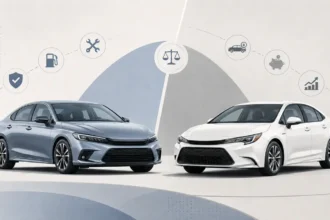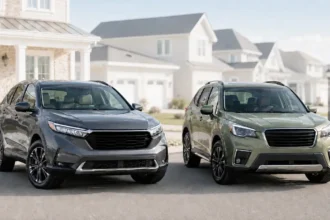


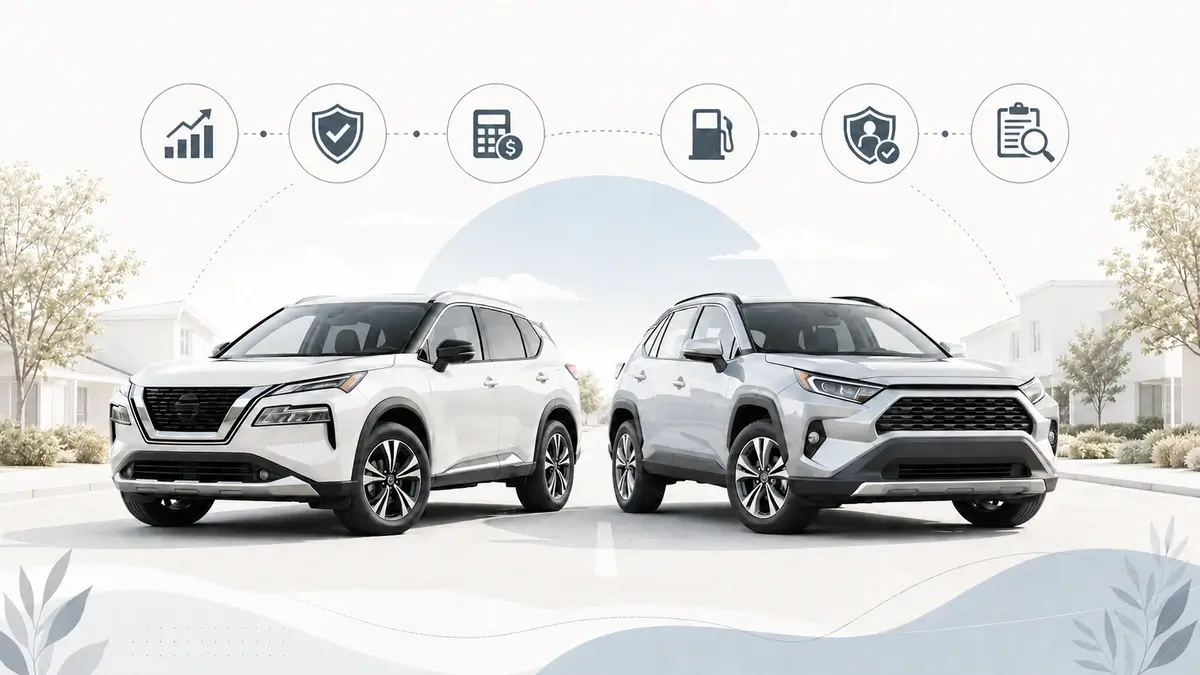
The nissan rogue vs toyota rav4 decision is not just about size, features, or styling. For used SUV buyers, the real choice is price savings versus long-term confidence.
The Toyota RAV4 is the safer default for most shoppers. The Nissan Rogue can still be the smarter buy if the price gap is large and the specific vehicle checks out cleanly.
In this comparison, “safer default” means the lower-uncertainty used-buying choice. It is not a claim that the RAV4 has better crash-test results across every model year, test, trim, or equipment configuration.
Pick wrong and the problem is simple. You either overpay for reputation or save money on an SUV that brings more risk than the discount justifies.
CarMerit reliability comparator
Nissan Rogue vs Toyota RAV4: 2007-2026 NHTSA snapshot
Owner-complaint and recall counts from NHTSA for 2007-2026, each model’s best used-year lane, and which buyer each one fits.
| 7,056 | complaints (2007-26) | 7,137 |
| 83 | recalls (2007-26) | 125 |
Powertrain / transmissionAirbags / seatbelts / structureEngineUnknown / other | top issues | Airbags / seatbelts / structureEngineElectricalUnknown / other |
Nissan Rogue
Best used year: 2020
Shortlist 2019-2021; inspect 2017-2018 hard; use more caution with 2008-2016, especially without strong CVT and service proof.
Best for: Value-play buyers who want a lower purchase price and are willing to verify CVT behavior, service records, recall status, and inspection results.
Toyota RAV4
Best used year: 2016
Shortlist 2016-2018 and 2020-2022 gas; older budget 2009-2012; use more caution with 2007-2008, 2013-2015, 2019, and some hybrid / Prime cases.
Best for: Safer-default buyers who prioritize ownership predictability and lower uncertainty.
Quick take: The RAV4 is the safer default for most used compact-SUV buyers: predictable ownership and lower uncertainty. Choose the Rogue when the price gap is meaningfully larger and the specific vehicle has clean records, normal CVT behavior, and a strong inspection result. Do not crown either SUV from raw NHTSA counts alone.
Complaint counts are raw owner reports filed with NHTSA, not adjusted for sales volume, so they should guide inspection rather than crown a winner. The quick comparator above uses a 2007-2026 overlapping NHTSA snapshot for both models; if one model has older NHTSA history before 2007, those model-only years are excluded here to keep the comparison balanced. Always inspect the specific vehicle before buying.
Quick Verdict: Toyota RAV4 Is Safer, Nissan Rogue Is the Value Play
Choose the Toyota RAV4 if you want the safer used SUV default. It usually makes more sense for buyers who care about ownership predictability and lower uncertainty.
Choose the Nissan Rogue if the deal is meaningfully cheaper and the vehicle has clean records. The Rogue should win because the specific example is strong, not because it has a lower sticker price.
Fastest safe default: buy the RAV4 unless the Rogue gives you a real discount and cleaner proof.
That proof means service history, a clean inspection, normal transmission behavior, and a price that still looks good after likely ownership costs.
If the RAV4 stays high on your shortlist, compare its broader ownership case in our Toyota RAV4 reliability and cost to own guide.
Nissan Rogue vs Toyota RAV4: Buyer-Fit Matrix
A normal spec table is not enough here. Used buyers need to know which SUV fits their risk tolerance.
The Rogue can be a smart value in the right deal. The RAV4 can be the better buy even when it costs more.
Use this table before you get attached to either badge.
| Decision Factor | Toyota RAV4 | Nissan Rogue |
|---|---|---|
| Safest default choice | Stronger fit | Weaker fit |
| Price-gap fit | Pay more only when the specific vehicle justifies the premium | Stronger value case only when the discount remains meaningful after inspection |
| Long-term confidence | Stronger fit | Depends more on condition |
| Future-value planning | Do not assume a model-wide future-value advantage | Do not assume a lower buy-in guarantees better future value |
| Repair-cost planning | Use inspection findings and written estimates | Use inspection findings and written estimates |
| Comfort and features for less | Good, but often pricier | Stronger value angle |
| Low-risk ownership | Stronger fit | Needs more checking |
| High-mileage used buy | Safer default, still inspect | Be stricter before buying |
| Best for budget-first shoppers | Only if fairly priced | Better if clean and discounted |
| Best for risk-averse shoppers | Better fit | Usually not first choice |
Table Note: Asking price is not transaction price, future resale is not guaranteed, and a repair estimate is not an expected annual bill.
Why the Toyota RAV4 Is the Better Default
The RAV4 wins for buyers who want fewer doubts after purchase. That matters more in the used market than a long list of features.
The RAV4’s strongest case here is lower ownership uncertainty, not a promise that every used RAV4 will be cheap to repair or easy to resell. Condition, mileage, maintenance history, accident history, inspection findings, and purchase price still control the real deal quality.
Do not treat the Toyota badge as a blank check. If a comparable RAV4 costs more than a Rogue, pay the premium only when the specific year, mileage, condition, history, and service records justify it.
When the Nissan Rogue Makes More Sense
The Rogue makes sense when the deal is strong enough to beat the RAV4’s safer reputation.
That usually starts with a real price gap. If the Rogue is only slightly cheaper, the RAV4 is usually the cleaner choice.
A used Rogue can work well for commuting, errands, and family use. It can also offer good comfort and features for the money.
The Rogue side of this comparison depends heavily on choosing the right used year. If you are still considering the Rogue, review the Nissan Rogue years to avoid before comparing final listings against a RAV4.
The catch is simple: the lower price must still look good after inspection findings, overdue maintenance, tire or brake needs, and other near-term work. Judge the value case from the actual price gap between comparable vehicles, not from a model-level depreciation percentage.
Do not buy a Rogue just because it is cheaper. Buy it because the specific SUV has the right condition, history, mileage, service records, and inspection result.
Nissan Rogue vs RAV4 Reliability: What Used Buyers Should Actually Check
For reliability, focus on the exact model year, service history, mileage, transmission behavior, and inspection result rather than a model-wide reliability score or annual repair-cost estimate.
For a used Rogue, transmission behavior should be a serious test-drive and inspection point. Pay attention to hesitation, shuddering, slipping sensations, warning lights, delayed response, or unusual noises.
Nissan also extended CVT warranty coverage for eligible non-hybrid 2014–2018 Rogue vehicles from 60 months/60,000 miles to 84 months/84,000 miles. For a used buyer today, treat that history as a reason to check the VIN and ask for CVT diagnosis, repair, or replacement records—not as proof that the transmission will fail or that warranty coverage remains today.
If the Rogue’s lower price is being offset by uncertainty about its CVT history, check that model year in CarMerit’s Manufacturer Special Coverage Lookup before treating the transmission concern as entirely owner-paid and deciding the RAV4 premium is automatically worth it.
For both SUVs, check open recalls before buying. The NHTSA recall lookup lets buyers search by VIN to see whether a specific vehicle needs recall repair.
A clean recall check does not prove the SUV is perfect. It only removes one major unknown.
The Rogue can make sense if the price is meaningfully lower than a comparable RAV4, but it needs more careful year, maintenance, and transmission-history checking. Before treating it as the value pick, review the full Nissan Rogue reliability and ownership risks to understand where the savings may come with extra risk.
Price Gap vs Long-Term Value
The Rogue usually has to win on price. The RAV4 usually wins on confidence.
That is the core trade-off.
If the Rogue is only a little cheaper, the RAV4 is usually the better used buy. A small discount is not enough to justify more uncertainty.
If the Rogue is much cheaper and passes inspection, the answer changes. At that point, it can become the practical value pick.
Use a simple rule before deciding: the Rogue’s discount should still feel meaningful after inspection findings, maintenance catch-up, tires, brakes, and other near-term needs are considered.
RAV4 buyers need discipline too. A RAV4 can still be a weak deal if its asking price is not justified by year, mileage, condition, history, and service records.
A fair RAV4 deal beats a questionable Rogue deal. A clean, discounted Rogue can beat an overpriced RAV4.
The Rogue is one way to spend less than RAV4 money, but it is not the only value alternative. If you want another cheaper compact SUV comparison, read Hyundai Tucson vs Toyota RAV4 before deciding how much Toyota’s lower-risk reputation is worth.
If you are still comparing RAV4 against other used compact SUVs, our Honda CR-V vs Toyota RAV4 comparison and Mazda CX-5 vs Toyota RAV4 comparison can help narrow the next choice.
Nissan Rogue vs RAV4 Cost of Ownership
Cost of ownership is not just repairs. It also includes fuel, insurance, tires, brakes, depreciation, maintenance, and surprise problems.
A model-wide annual repair-cost estimate is not the expected bill for either specific SUV. Use a pre-purchase inspection to identify work the vehicle needs now or soon, then get written local estimates before deciding whether the price gap still makes sense.
Before choosing, compare five things:
- Purchase price: the actual gap between comparable examples.
- Mileage: whether one SUV has clearly easier use.
- Service records: whether required maintenance is documented.
- Inspection findings: what the specific SUV needs now or soon.
- Near-term needs: tires, brakes, overdue service, diagnosis, or other identified work.
If the Rogue is cheaper but needs tires, brakes, overdue service, or diagnosis, the deal may disappear.
If the RAV4 costs more, pay the premium only when its condition, history, mileage, and inspection result justify it.
For a broader ownership view, use the Toyota RAV4 reliability and cost to own guide before paying extra for a used RAV4.
Fuel Economy, Safety, and Hybrid Options
Fuel economy should be checked by exact model year, engine, drivetrain, and powertrain. For the older used-year lanes already highlighted elsewhere in this guide, EPA lists the 2019 Rogue AWD gasoline configuration at 25/31/27 mpg city/highway/combined and the 2019 Rogue Hybrid AWD at 31/34/33. For the RAV4’s 2016–2018 shortlist, EPA lists the RAV4 AWD configuration at 22/28/25 and the RAV4 Hybrid AWD at 34/30/32 in each of those model years.
Those are exact EPA configurations, not model-wide averages. For newer used examples, the selected AWD configurations below show the main fuel-economy differences without averaging incompatible engines or powertrains together.
Nissan Rogue EPA Fuel Economy — Selected AWD Configurations
| Model Year | Configuration | City | Highway | Combined |
|---|---|---|---|---|
| 2020 | 2.5L AWD, Automatic (variable gear ratios) | 25 | 31 | 27 |
| 2021 | 2.5L AWD, Automatic (AV-S8) | 26 | 33 | 29 |
| 2021 | 1.5L AWD, Automatic (AV-S8) | 30 | 36 | 33 |
| 2022 | 1.5L AWD, Automatic (AV-S8) | 28 | 35 | 31 |
| 2023 | 1.5L AWD, Automatic (AV-S8) | 28 | 35 | 31 |
| 2024 | 1.5L AWD, Automatic (AV-S8) | 28 | 35 | 31 |
| 2025 | 1.5L AWD, Automatic (AV-S8) | 28 | 35 | 31 |
Table Note: EPA city/highway/combined MPG for the exact selected Rogue AWD configurations shown. These are not model-wide averages or complete configuration coverage. Some trim-specific configurations have different ratings. Actual fuel economy varies with driving and operating conditions. Source: FuelEconomy.gov official data.
Toyota RAV4 EPA Fuel Economy — Selected AWD Configurations
| Model Year | Configuration | City | Highway | Combined |
|---|---|---|---|---|
| 2020 | AWD LE, 2.5L, Automatic (S8) | 27 | 34 | 30 |
| 2020 | Hybrid AWD, 2.5L, Automatic (AV-S6) | 41 | 38 | 40 |
| 2021 | AWD LE, 2.5L, Automatic (S8) | 27 | 34 | 30 |
| 2021 | Hybrid AWD, 2.5L, Automatic (AV-S6) | 41 | 38 | 40 |
| 2022 | AWD LE, 2.5L, Automatic (S8) | 27 | 34 | 30 |
| 2022 | Hybrid AWD, 2.5L, Automatic (AV-S6) | 41 | 38 | 40 |
| 2023 | AWD LE, 2.5L, Automatic (S8) | 27 | 34 | 30 |
| 2023 | Hybrid AWD, 2.5L, Automatic (AV-S6) | 41 | 38 | 40 |
| 2024 | AWD LE, 2.5L, Automatic (S8) | 27 | 34 | 30 |
| 2024 | Hybrid AWD, 2.5L, Automatic (AV-S6) | 41 | 38 | 39 |
| 2025 | AWD LE, 2.5L, Automatic (S8) | 27 | 34 | 30 |
| 2025 | Hybrid AWD, 2.5L, Automatic (AV-S6) | 41 | 38 | 39 |
Table Note: EPA city/highway/combined MPG for the exact RAV4 configurations shown. Gas AWD LE and Hybrid AWD are separate configurations and are not model-wide averages. Other trims/configurations can differ. RAV4 Prime/Plug-in Hybrid is intentionally excluded because EPA reports different MPG/MPGe operating-mode metrics. Actual fuel economy varies with driving and operating conditions. Source: FuelEconomy.gov official data.
Use FuelEconomy.gov to compare the exact vehicle before deciding. It is the official U.S. government fuel-economy site.
Safety should be checked the same way. Use IIHS ratings and NHTSA ratings for the exact model year you are considering.
Do not assume one SUV is safer across every year, trim, and equipment package. Verify the exact vehicle.
IIHS results show why that exact-year check matters. The most useful comparison is not every available sub-rating, but the major change points that can alter how a used model year should be interpreted.
Selected IIHS Safety Checkpoints
| Vehicle / Model Years | IIHS Checkpoint | Rating | Buyer-Useful Applicability |
|---|---|---|---|
| Nissan Rogue 2018–2020 | Small overlap — driver / passenger | G / A | Passenger result applies to vehicles built after April 2018 |
| Nissan Rogue 2021 | Small overlap — driver / passenger | G / G | Passenger-side G is recorded in separate before-March and after-February 2021 build configurations. |
| Nissan Rogue 2022–2026 | Small overlap — driver / passenger | G / G | Passenger-side G applies to vehicles built after April 2022; driver-side G continues through 2026. |
| Toyota RAV4 2015–2018 | Small overlap — driver / passenger | G / P | Driver G applies to vehicles built after November 2014; passenger P applies within the 2013–2018 rating group |
| Toyota RAV4 2019–2025 | Small overlap — driver / passenger | G / G | Later RAV4 rating group |
| Nissan Rogue 2021–2023 | Updated moderate overlap | M | Updated IIHS test |
| Nissan Rogue 2025–2026 | Updated moderate overlap | A | Updated test; do not infer a 2024 rating from this row |
| Toyota RAV4 2021–2025 | Updated moderate overlap | M | Updated IIHS test |
Table Note: G = Good, A = Acceptable, M = Marginal, P = Poor. These are selected official IIHS change points, not complete rating histories or a safety-winner table. Small-overlap and updated moderate-overlap tests remain separate, and stated model-year/build-date applicability must be preserved. A model year or test not shown should not be interpreted as a poor result.
This is also why “safer default” in this guide should not be read as an all-years IIHS crash-test verdict. Verify the exact model year and applicable test results before buying.
Comfort, Space, and Daily Use
The Rogue can be a strong daily-use SUV. It often appeals to buyers who want comfort and features without paying the RAV4 premium.
The RAV4’s advantage is different. It feels like the better fit for shoppers who care more about long-term confidence than feature value.
For families, both can work. The better choice depends on rear-seat comfort, cargo needs, visibility, child-seat setup, and how the SUV feels in normal use.
Do not choose from cargo numbers alone. Open the hatch, fold the seats, and test your real items.
A stroller, luggage, sports gear, or dog crate can change the decision faster than a spec sheet.
If family practicality is your main reason for buying, our best used family cars guide can help you compare this choice against broader family-use options.
Model Year and Condition Matter More Than Brand Loyalty
A good model can still have bad examples. A weaker model can still be worth buying in the right condition.
That is why model year and maintenance history matter so much here.
The Rogue needs more caution. You should be stricter about service records, transmission feel, inspection results, and ownership history.
The RAV4 still needs checking. Toyota reputation does not protect you from neglect, accidents, rust, deferred maintenance, or an inflated price.
A cheaper Rogue only represents better value if you are comparing it with the correct RAV4 and both listings are accurately described. Run each candidate VIN through the CarMerit VIN Lookup and compare the returned vehicle details with the seller’s listing and paperwork. Once those details match, let service history, transmission behavior, condition, inspection results, and the real price gap determine whether the Rogue’s savings outweigh the RAV4’s lower-risk appeal.
Before buying either SUV, check:
- accident history
- title status
- open recalls
- service records
- tire and brake condition
- fluid leaks
- warning lights
- transmission behavior
- hybrid system condition if applicable
- independent inspection results
A strong used SUV should survive all of those checks.
Before buying a RAV4, also check our Toyota RAV4 years to avoid and best years to buy guide so you do not choose the right SUV in the wrong year.
Who Should Buy the Toyota RAV4?
The RAV4 is the better choice if you want the safer answer.
Buy the RAV4 if you:
- plan to keep the SUV for years
- dislike ownership uncertainty
- value long-term reputation
- found a clean example at a fair price
The RAV4 is not the best choice if the price is inflated.
If the RAV4 costs far more than a clean Rogue, slow down. The Toyota badge does not excuse a weak deal.
Who Should Buy the Nissan Rogue?
The Rogue is better for buyers who want value and are willing to inspect carefully.
Buy the Rogue if:
- the price gap is meaningful
- the model year checks out
- the service history is clean
- the test drive feels normal
- an independent mechanic finds no major issue
- you want comfort and features for less money
The Rogue is not ideal if ownership uncertainty will bother you.
If transmission concerns or service gaps will make you second-guess the purchase, choose the RAV4 instead.
Used SUV Buying Filter Before You Decide
Use this quick filter before committing to either SUV.
First, compare real asking prices. Only compare similar year, mileage, trim, condition, accident history, and drivetrain.
Second, check service records. A lower price means less if maintenance history is missing.
Third, check recalls by VIN. Open recalls should be handled before purchase or clearly understood.
Fourth, compare fuel economy by exact year and drivetrain. Do not compare a gas Rogue against a RAV4 Hybrid without adjusting for price.
Fifth, check safety ratings by exact year. Use IIHS and NHTSA rather than relying on seller claims.
Sixth, get an independent inspection. If the seller resists, treat that as a warning.
This filter protects you from both common mistakes: overpaying for reputation and buying cheap without enough proof.
If neither SUV feels right after this filter, start with our best used compact SUVs guide before expanding your shortlist.
Final Verdict: Nissan Rogue vs Toyota RAV4
For most used SUV buyers, the Toyota RAV4 is the better default.
It gives you stronger ownership confidence and fewer doubts after purchase. That matters if you want to keep the SUV for years.
The Nissan Rogue is the better value play only when the specific deal earns it.
A clean Rogue with a meaningful discount can be a smart buy. A questionable Rogue with weak service records is not worth the savings.
The RAV4 is one safer Rogue alternative, but the Nissan Rogue vs Honda CR-V comparison gives another useful benchmark for reliability, value, and ownership confidence.
So the nissan rogue vs toyota rav4 decision comes down to proof. Choose the RAV4 if you want the safer used SUV. Choose the Rogue only if the price, condition, service history, and inspection result are strong enough to beat the RAV4’s long-term confidence.
For broader shortlist building, compare this decision with CarMerit’s best used compact SUVs to buy and most reliable used cars to buy.
Frequently Asked Questions
Is the Nissan Rogue better than the Toyota RAV4?
The Nissan Rogue can make more sense when the price gap is meaningful and the specific vehicle checks out cleanly. For most used buyers, the RAV4 remains the lower-uncertainty default when prices are close.
Is the Toyota RAV4 worth paying more for than a Nissan Rogue?
Yes, if the price premium is reasonable and the RAV4 has clean history, fair mileage, and good maintenance records.
No, if the RAV4 is overpriced. A clean, well-vetted Rogue can be the smarter buy when the price gap is large enough.
Should I worry about Nissan Rogue transmission problems?
You should not panic, but you should inspect carefully.
For a used Rogue, transmission behavior should be part of the test drive and pre-purchase inspection. Watch for hesitation, shuddering, slipping sensations, warning lights, or delayed response.
Which is better for long-term ownership, Rogue or RAV4?
The RAV4 is the better long-term ownership pick for most buyers.
The Rogue can still work if it has clean service history and a strong inspection result. It just needs more deal-specific proof.
Which SUV is better for families?
Both can work for families. The RAV4 is the safer default if ownership confidence matters most. The Rogue can make sense if comfort, features, and a meaningful price advantage matter more. Test the rear seats, cargo area, child-seat setup, and visibility before deciding.
Should I buy a used Nissan Rogue or Toyota RAV4?
Buy the RAV4 if you want the safer default.
Buy the Rogue if it is meaningfully cheaper, has strong maintenance records, and passes an independent inspection. Do not buy the Rogue only because the sticker price is lower.
Should hybrid versions change the decision?
Yes. Treat each powertrain as a separate buying lane. EPA records include Rogue Hybrid FWD and AWD configurations for 2017–2019, while used RAV4 shoppers may encounter gas, Hybrid, and plug-in hybrid versions depending on model year.
If you are comparing a Rogue Hybrid or RAV4 Hybrid, also check the original hybrid-system warranty terms. For the applicable 2017–2019 Rogue Hybrid scope, Nissan lists Hybrid System Coverage of 8 years/100,000 miles. For 2020–2025 RAV4 Hybrid models, Toyota lists 10 years/150,000 miles for hybrid-battery defect coverage and 8 years/100,000 miles for specified hybrid-system components.
Those are original warranty terms, not proof that a particular used vehicle still has coverage. Verify the VIN, original in-service date, mileage, and eligibility before relying on them.
Then compare the exact model year, powertrain, drivetrain, fuel economy, mileage, condition, service history, and asking price before deciding.