

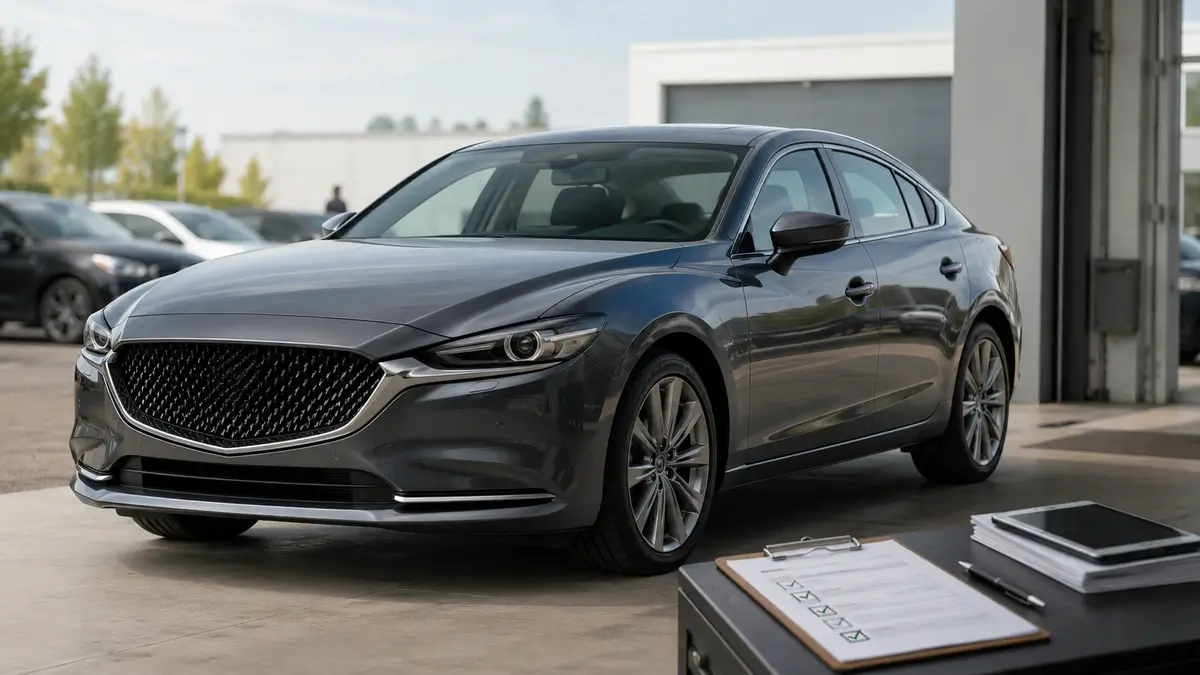
The Mazda6 is a strong used midsize-sedan option for buyers who want sharp handling and a well-finished cabin.
That does not mean every year is a safe buy.
The Mazda6 years to avoid are mainly unrepaired 2003–2008 cars with Takata airbag recall risk, older 2009–2013 cars with unclear recall history, and rough 2014–2016 examples with shifting, electrical, maintenance, or inspection red flags.
The safest default is simple. Shortlist 2018–2021 first, especially clean non-turbo cars with service records. Then consider a clean 2017, or a carefully inspected 2015–2016, only if the condition and records are strong.
If you are choosing between the Mazda6 and Toyota’s safer reputation, read the Mazda6 vs Toyota Camry comparison before you commit.
CarMerit reliability tool
Check any Mazda6 year – NHTSA-backed snapshot
Pick a model year to see Mazda6 complaint, recall, investigation, and manufacturer-communication counts from the article’s NHTSA snapshot, plus CarMerit’s used-buy verdict for that year band.
Owner complaints
…
NHTSA, CarMerit snapshot
Recall records
…
NHTSA, CarMerit snapshot
Investigations
…
NHTSA, CarMerit snapshot
Manufacturer communications
…
NHTSA, CarMerit snapshot
Most-reported problem areas
Complaint counts and manufacturer communications are raw NHTSA records, not defect rates or reliability scores. Older model years have had more time to collect reports, so lower counts on newer years do not prove better reliability. Verdicts come from CarMerit’s article guidance. Data source: NHTSA.gov. Always verify VIN recall status, Mazda recall status, service records, Takata airbag recall completion, fuel-tank recall status where applicable, cold start, transmission behavior, electronics, rust, warning lights, accident or flood history, and independent inspection results before buying. For turbocharged 2018-2021 models, inspect oil history, coolant level, startup smoke, boost behavior, and overheating signs more strictly.
Quick Verdict: Mazda6 Years to Avoid
Avoid the 2003–2008 Mazda6 unless the VIN proves all Takata airbag recall work is complete.
Be careful with 2009–2013 models. They are old now, some appear in Mazda’s Takata passenger-airbag recall coverage, and they are rarely worth buying without complete recall records.
Treat 2014 as the third-generation year to inspect hardest. It was the first year of the redesigned Mazda6, and buyer-reported issue patterns make it a higher-risk used pick than later years.
Use extra care with 2015–2016. They are not automatic rejects, but they need a careful transmission check, service-record review, and electronics test.
The safest Mazda6 years to buy used are usually 2018–2021, followed by a clean 2017 if your budget is tighter.
Fastest safe default: buy the cleanest 2018–2021 non-turbo Mazda6 you can afford, then verify recalls, service history, and inspection results before purchase.
Mazda6 Years to Avoid and Buy With Caution by Model Year
A year list alone is not enough.
The same model year can be a smart buy or a bad buy depending on mileage, records, repairs, rust, accident history, and recall status.
Use this table as a risk filter, not a final buying decision.
| Model years / used-buying verdict | Why it matters | Evidence status | Buyer action |
|---|---|---|---|
| 2003–2008 — Avoid unless recall-verified | Mazda issued serious Takata airbag warnings for unrepaired vehicles in this range. | Official recall/advisory support, VIN still required | Buy only if the VIN proves completed recall repairs and the body is clean underneath. |
| 2009–2013 — Buy with high caution | These are older second-generation cars. Some are included in Takata passenger-airbag recall coverage. | Official recall/advisory support, VIN still required | Verify recalls, inspect rust and warning lights, and avoid neglected examples. |
| Certain 2010–2012 2.5L cars — Recall-sensitive caution | Certain 2010–2012 Mazda6 vehicles with the 2.5L engine had fuel-tank recall coverage. | Official NHTSA recall support, VIN still required | Confirm recall completion and check for fuel smell, warning lights, and EVAP-related codes. |
| 2014 — Avoid rough examples | First-year redesign risk makes this the third-generation year to inspect hardest. | Directional owner-report and inspection signal | Buy only if the test drive is clean and there is no transmission whine, hesitation, or electrical trouble. |
| 2015–2016 — Caution, not automatic skip | These can be decent buys, but they are not the safest blind-purchase years. | Directional owner-report and inspection signal | Require service records, smooth shifting, clean electronics, and no repeated warning lights. |
| 2017 — Safer budget shortlist | A clean 2017 can be a good lower-cost choice before the later refresh years. | Lower-risk shortlist, still condition-dependent | Buy if maintenance, tires, brakes, recalls, and title history check out. |
| 2018–2021 — Best shortlist | These are later-run Mazda6 years and usually make the most sense for used buyers. | Lower-risk shortlist, still inspection-dependent | Prefer clean non-turbo cars. Inspect turbo models more strictly. |
Best Mazda6 Years to Buy Used
The best years for Mazda 6 buyers are usually 2018, 2019, 2020, and 2021.
These years sit late in the model run. That helps because Mazda had moved past the first-year 2014 redesign period, and buyers get the most modern cabin, safety features, and refinement.
A clean 2018–2021 Mazda6 is the right target if you want a used sedan that feels more polished than many mainstream rivals.
Turbo vs. Non-Turbo Mazda6: The Ownership Trade-Off
The turbo choice has a measurable fuel-economy and maintenance trade-off. EPA rates the 2018–2021 Mazda6 with the non-turbo 2.5-liter automatic at 26 mpg city, 35 mpg highway, and 29 mpg combined. The 2.5-liter turbo automatic is rated at 23 city, 31 highway, and 26 combined.
Mazda’s maintenance schedule also calls for spark-plug replacement at about 75,000 miles on the non-turbo engine and about 40,000 miles on the 2.5T. That does not prove the turbo engine is unreliable. It does make the non-turbo version the simpler default for buyers who prioritize fuel economy and longer routine-service intervals over stronger acceleration.
| 2018–2021 Mazda6 configuration | EPA city/highway/combined | Mazda spark-plug interval | Used-buyer meaning |
|---|---|---|---|
| 2.5L non-turbo, automatic, FWD | 26 / 35 / 29 mpg | Approximately 75,000 miles | Better official fuel economy and longer plug-service interval |
| 2.5L turbo, automatic, FWD | 23 / 31 / 26 mpg | Approximately 40,000 miles | More performance, but lower official MPG and more frequent plug service |
Table note: EPA figures apply to the exact front-wheel-drive automatic configurations shown. Actual fuel economy varies with condition, driving, weather, tires, and use. Fuel economy and maintenance intervals do not prove reliability.
A clean 2017 is the best fallback if 2018–2021 prices are too high. It is not as fresh, but it can still be a smart budget Mazda6 if the records are strong.
Mazda6 Years to Avoid by Generation
The Mazda6 ran through three main used-car eras in the U.S.
Each generation has a different risk profile. That matters more than repeating a flat best-and-worst-years list.
First generation: 2003–2008
The 2003–2008 Mazda6 is now an old used car first and a sporty sedan second.
The biggest issue is not normal age alone. Mazda issued a Takata do-not-drive advisory for certain unrepaired vehicles, including 2003–2008 Mazda6 models.
Do not buy one unless the VIN proves recall repairs are complete.
Even with recalls handled, these cars need rust checks, suspension checks, engine-leak checks, and a realistic repair budget.
At this age, a cheap purchase price can hide expensive deferred maintenance.
Second generation: 2009–2013
The 2009–2013 Mazda6 is usually less attractive than a later third-generation car.
Some 2009–2013 Mazda6 vehicles are included in Mazda’s Takata passenger-airbag recall coverage. That makes a VIN check non-negotiable.
Certain 2010–2012 Mazda6 vehicles with the 2.5L engine were also covered by a fuel-tank recall campaign. Do not assume every car is affected, but do verify the VIN.
A clean 2011–2013 car can still work as budget transportation. But do not pay close to later-generation money for one.
Third generation: 2014–2021
The 2014–2021 Mazda6 is the era most used buyers should focus on.
The key split is early versus later.
The 2014 model year is the one to inspect hardest. It launched the redesigned Mazda6 and has enough owner-reported problem signals to deserve caution.
The 2015–2016 years are better than 2014 for many buyers, but not perfect. Do not skip the test drive or service-record review.
The 2017 model year is a stronger budget choice. The 2018–2021 years are the best shortlist if your budget allows.
IIHS Safety Differences That Matter When Shopping 2014–2021
Safety equipment and IIHS results did not remain identical throughout the third-generation Mazda6. Later cars gained meaningful structural, airbag, crash-prevention, and headlight improvements, but the exact trim, equipment package, and—in 2019—the production date still matter.
| Model years | Material IIHS difference | Used-buyer action |
|---|---|---|
| 2014–2015 | Driver-side small-overlap result was Acceptable. Moderate-overlap front, original side, roof-strength, and head-restraint results were Good. Front crash prevention was optional. | Do not assume these cars have later structure, airbags, or crash-prevention equipment. |
| 2016–2017 | Longer side-curtain airbags and revised airbag deployment were introduced. Driver-side small-overlap improved to Good. Crash-prevention and headlight performance still depended on configuration. | Confirm the fitted driver-assistance package and headlights. |
| 2018 | Passenger-side structure was strengthened. Both small-overlap ratings were Good. Stronger crash prevention and better headlights depended on trim and equipment. | Verify trim and option content rather than relying on model year alone. |
| 2019 | Front crash prevention with pedestrian detection became standard in the rated scope. Headlight performance depended on trim and build date. Qualifying later-build configurations earned Top Safety Pick+. | Check the door-jamb production date and exact headlights. |
| 2020 | Standard front crash prevention continued. Grand Touring Reserve and Signature headlights were Good; other rated configurations were Acceptable. | Trim still affects the exact safety evidence. |
| 2021 | Standard front crash prevention continued. Grand Touring Reserve, Signature, and Blackout Edition headlights were Good; other rated configurations were Acceptable. | Verify the exact configuration rather than assuming every 2021 car is identical. |
Table note: This evidence applies to the U.S. Mazda6 four-door sedan within the exact IIHS-rated scopes. IIHS tests and award requirements changed over time. A Top Safety Pick+ statement applies only to the qualifying model year, equipment, build date, and headlight configuration.
Why Some Mazda6 Years Are Riskier Than Others
A risky Mazda6 year usually has one or more problems.
First, the car may be tied to a serious recall. That does not make every car bad, but it makes VIN verification mandatory.
Second, the year may have more owner-reported problems. These reports are useful for inspection planning, but they are not proof that every car from that year will fail.
Third, the year may be a first-year redesign. That is why 2014 gets more scrutiny than later third-generation Mazda6 years.
Fourth, the car may simply be old. A 2006 Mazda6 with completed recalls can still have rust, worn suspension, aging rubber, oil leaks, weak mounts, or neglected fluids.
The Mazda6 is not a car to buy by year alone. Buy the condition, records, recall status, and inspection result.
Mazda6 Common Problems by Year: What to Inspect
Common problems matter only if they help you inspect the actual car.
Do not use forum noise as proof. Use owner-report databases as checklist starters, then verify the car in front of you.
| Area to inspect | Years to watch harder | What to check before buying |
| Open airbag recalls | 2003–2008 and some 2009–2013 cars | Check the VIN through NHTSA and Mazda before driving or buying. |
| Fuel-tank or EVAP recall history | Certain 2010–2012 2.5L cars | Confirm recall work and inspect for fuel smell, warning lights, and EVAP-related trouble codes. |
| Transmission behavior | 2014–2016 | Check for whining, hesitation, harsh shifts, slipping, or delayed engagement. |
| Electrical features | 2014–2016 | Test infotainment, backup camera, windows, locks, lights, sensors, and warning messages. |
| Rust and body condition | 2003–2013, especially snow-belt cars | Inspect rocker panels, wheel wells, underbody, brake lines, exhaust, and suspension mounting points. |
| Brakes and suspension | All used years | Listen for clunks, vibration, uneven tire wear, brake pulsation, and steering pull. |
| Turbo-related wear | 2018–2021 turbo trims | Check oil history, coolant level, startup smoke, boost behavior, and overheating signs. |
For 2014, CarComplaints owner reports point buyers toward transmission, interior, and electrical checks. Treat that as an inspection signal, not proof that every 2014 Mazda6 is bad.
For 2015, owner-report patterns still justify extra transmission, brake, wheel, and electronics checks.
For 2016, owner reports make engine, transmission, and interior-electronics checks worth taking seriously before purchase.
Mazda 6 Reliability by Year: What the Data Can and Cannot Prove
Mazda 6 reliability by year is useful, but it can create false confidence.
A reliability chart cannot tell you whether one used car was maintained, overheated, crashed, flooded, or ignored. It also cannot tell you whether recall work was completed.
Do not use one model-wide repair-cost average as a forecast for a specific Mazda6. Actual repair spending depends on model year, powertrain, mileage, location, vehicle condition, and the repair required. A more useful pre-purchase check is whether the car is approaching major scheduled service and whether its VIN qualifies for a Mazda warranty extension or coverage program.
For 2018–2021 cars, the official Mazda service schedule and the VIN-specific coverage programs explained below provide more actionable guidance than a single annual average.
The best reliability move is not buying the best year blindly.
A one-owner 2017 with records can be safer than a neglected 2020 turbo. A clean 2015 with smooth shifting can be better than a cheaper 2018 with poor maintenance.
Use reliability data to narrow your search. Use inspection to decide whether the individual car is worth buying.
Once you have narrowed the year range, the next question is whether the specific car’s maintenance, powertrain, mileage, and current condition support the purchase. Our Mazda 6 reliability guide covers the ownership risks, high-mileage checks, maintenance evidence, and inspection findings that should decide whether a shortlisted Mazda6 is actually worth buying.
Recall, Complaint, and Safety Checks Before You Buy
Before buying any used Mazda6, check the VIN through the official NHTSA recall lookup.
Mazda6 NHTSA official-action snapshot by model year
| Model year | Generation | Recalls | Investigations | Mfr. Comms. | Buyer-useful reading |
|---|---|---|---|---|---|
| 2003 | Gen 1 | 9 | 4 | 208 | Highest Gen 1 recall and investigation stack; verify VIN before test drive. |
| 2004 | Gen 1 | 7 | 3 | 218 | Multiple recalls and investigations; records should match the VIN. |
| 2005 | Gen 1 | 6 | 3 | 192 | Heavy recall and communication volume; do not rely on seller assurance. |
| 2006 | Gen 1 | 6 | 3 | 190 | Recall and investigation counts stay elevated; completed recall records matter. |
| 2007 | Gen 1 | 6 | 3 | 217 | Official-action activity remains high; match records to the exact VIN. |
| 2008 | Gen 1 | 5 | 3 | 212 | Fewer recalls than earlier Gen 1, but communication count stays high. |
| 2009 | Gen 2 | 10 | 2 | 250 | Highest recall count among the Mazda6 model years shown here; VIN recall screening matters. |
| 2010 | Gen 2 | 9 | 1 | 246 | Recall count remains high; fuel-tank and airbag history need VIN checks. |
| 2011 | Gen 2 | 6 | 0 | 244 | Recall count stays meaningful; verify fuel-system and airbag campaign status. |
| 2012 | Gen 2 | 6 | 0 | 243 | No investigations shown, but recalls and communications remain active. |
| 2013 | Gen 2 | 4 | 0 | 235 | Fewer recalls and no investigations; still use VIN rather than year alone. |
| 2014 | Gen 3 | 4 | 0 | 755 | First Gen 3 year has high communications; ask about dealer service history. |
| 2015 | Gen 3 | 3 | 0 | 607 | High communication count with fewer recalls; service records matter. |
| 2016 | Gen 3 | 1 | 0 | 668 | One recall but high communications; verify campaign and service completion. |
| 2017 | Gen 3 | 1 | 0 | 514 | One recall and large communication count; check dealer repair history. |
| 2018 | Gen 3 | 2 | 0 | 547 | Two recalls and high communications; inspect records beyond the recall count. |
| 2019 | Gen 3 | 1 | 0 | 416 | One recall and no investigations; still verify VIN before purchase. |
| 2020 | Gen 3 | 0 | 0 | 360 | No recalls or investigations shown, but communications exist. |
| 2021 | Gen 3 | 0 | 0 | 297 | No recalls or investigations shown, but VIN status still needs checking. |
Table note: Manufacturer communications are service or technical communications, not recalls. These records do not show whether recalls were completed, so a VIN recall lookup is still required before buying.
Also check Mazda’s recall information page. Do not rely only on a seller saying the car should be fine.
This is especially important for older Mazda6 years. Mazda and NHTSA have issued serious Takata airbag warnings for unrepaired vehicles.
For safety ratings, use the exact model-year page from IIHS vehicle ratings. Ratings and headlight performance can vary by year and trim.
For fuel economy, check FuelEconomy.gov by year, engine, and trim. Do not assume every Mazda6 gets the same mileage.
For owner-reported problem patterns, use complaint databases carefully. They can show what to inspect, but they should not become the final verdict.
The NHTSA data below covers the buyer-useful Mazda6 range in this guide: 2003–2021. Counts are neutral NHTSA evidence, not reliability scores.
Mazda6 NHTSA complaint snapshot by model year
| Model year | Generation | Owner complaints | Top reported area | Top-area complaints | Buyer-useful reading |
|---|---|---|---|---|---|
| 2003 | Gen 1 | 174 | Airbags / seatbelts / structure | 39 | Higher count plus safety-category reports; verify recalls and warning lights. |
| 2004 | Gen 1 | 159 | Airbags / seatbelts / structure | 67 | Safety-category reports dominate; VIN recall proof matters before purchase. |
| 2005 | Gen 1 | 147 | Airbags / seatbelts / structure | 80 | Safety-category reports stay high; inspect airbag lights, body, and recall status. |
| 2006 | Gen 1 | 173 | Airbags / seatbelts / structure | 99 | High safety-category count; do not skip VIN and airbag-system checks. |
| 2007 | Gen 1 | 156 | Airbags / seatbelts / structure | 101 | Safety-category reports peak within Gen 1; verify completed recall work. |
| 2008 | Gen 1 | 111 | Airbags / seatbelts / structure | 80 | Safety-category reports still lead; recall history remains central to this year. |
| 2009 | Gen 2 | 385 | Airbags / seatbelts / structure | 178 | Largest complaint count among the Mazda6 model years shown here; check safety recalls and suspension wear closely. |
| 2010 | Gen 2 | 225 | Airbags / seatbelts / structure | 105 | High count remains; verify airbag recall status and suspension or steering feel. |
| 2011 | Gen 2 | 134 | Airbags / seatbelts / structure | 52 | Counts ease, but safety reports still lead; inspect recalls and suspension wear. |
| 2012 | Gen 2 | 99 | Airbags / seatbelts / structure | 38 | Safety reports lead with lighting next; check recall status and exterior lights. |
| 2013 | Gen 2 | 22 | Airbags / seatbelts / structure | 6 | Lower complaint count, but recalls still exist; use VIN-specific checks. |
| 2014 | Gen 3 | 137 | Electrical | 37 | Electrical reports lead first-year Gen 3; test electronics and warning lights. |
| 2015 | Gen 3 | 60 | Brakes | 13 | Brake reports lead; road-test braking and check service records. |
| 2016 | Gen 3 | 76 | Brakes; airbags / seatbelts / structure | 10 each | Safety and brake reports tie; inspect warning lights and braking feel. |
| 2017 | Gen 3 | 59 | Unknown / other | 19 | Unknown or other leads; rely on full history, not category alone. |
| 2018 | Gen 3 | 54 | Engine | 27 | Engine reports lead; check cold starts, warning lights, and service history. |
| 2019 | Gen 3 | 6 | Unknown / other | 2 | Very small complaint sample; do not overread the top category. |
| 2020 | Gen 3 | 2 | Brakes; airbags / seatbelts / structure | 1 each | Only two NHTSA complaints are shown for 2020; use this as a light signal only. |
| 2021 | Gen 3 | 17 | Engine | 11 | Engine reports lead the small sample; check records and warning lights. |
Table Note: Complaint counts are owner-filed NHTSA reports, not defect rates. Older model years have had more time to collect complaints, so use this as an inspection signal, not a reliability score.
Mazda6 Warranty Programs Worth Checking by VIN
A used Mazda6 may have received extra manufacturer coverage for a narrowly defined component or condition. These programs do not automatically apply to every car in the listed model years. Eligibility depends on the VIN, original warranty-start date, mileage, production range, diagnosis, and current Mazda records.
If a Mazda6 you are considering falls into one of these older airbag/dashboard or newer powertrain coverage periods, use CarMerit’s Manufacturer Special Coverage Lookup to identify the model-year program worth investigating before Mazda verifies the exact vehicle.
| Model years and program | Covered area | Published boundary | Buyer action |
|---|---|---|---|
| Certain 2003–2013 vehicles — SSPB3 | Final or permanent Takata repair inflators | Published communication states coverage until at least 2026, unlimited mileage; current endpoint must be verified | Confirm completed Takata repairs and current VIN status |
| Certain 2009–2010 vehicles — SSPA7 | Specified SAS airbag sensor-unit condition | 15 years from original warranty start, unlimited mileage | Verify VIN, original warranty date, condition, and current eligibility |
| Certain 2009–2013 vehicles — SSPA0 | Defined sticky-dashboard condition | 10 years from original warranty start, unlimited mileage | Check whether repair was completed and inspect dashboard condition |
| Certain 2018–2020 2.5T vehicles — CSP11 | Specified cylinder-head coolant leak | 10 years or 120,000 miles | Verify VIN, mileage, coolant history, and required diagnosis |
| Certain 2018–2021 vehicles — SSPD8 | Covered thermostat/P0126 condition | 15 years or 150,000 miles | Verify VIN, mileage, diagnostic history, and current coverage |
| Affected 2021 2.5T vehicles — SSPD5 | Defined powertrain coverage | 7 years or 84,000 miles, subject to program rules | Confirm class membership and remaining eligibility with Mazda |
Table note: These are condition- and VIN-specific manufacturer programs, not blanket warranties for every Mazda6 in the listed years. A program may have expired, may already have been completed, or may not include the vehicle. Coverage does not establish reliability or failure probability.
Used Mazda6 Inspection Checklist
A used Mazda6 inspection should be stricter than a normal test drive.
The year guide can steer you away from weaker Mazda6 periods, but it cannot confirm that a particular listing is exactly what the seller says it is. Before putting weight on maintenance records or inspection results, check the Mazda6 VIN with CarMerit and compare the returned vehicle details with the ad and paperwork. Resolve any mismatch first, then judge the car on its service history, condition, and pre-purchase inspection.
Start with the VIN. Confirm no open recalls, no branded title, no flood history, and no mileage inconsistency.
Then review service records. Prioritize oil changes, transmission-fluid history, brake service, tires, battery, cooling-system work, and recall completion.
For 2018–2021 Cars, Add These Record Checks
- Match the spark-plug history to the engine. Mazda specifies replacement at approximately 40,000 miles for the 2.5T and approximately 75,000 miles for the non-turbo 2.5-liter engine.
- Check the first coolant-service timing. Mazda lists the first coolant replacement at approximately 124,000 miles or 10 years, followed by shorter recurring intervals.
- Ask Mazda to check the VIN for active or completed coverage programs. Pay particular attention to the 2018–2020 turbo cylinder-head program, the 2018–2021 thermostat program, and the affected 2021 turbo powertrain program.
- Treat a missing service record as an unanswered question, not automatic proof of neglect. Use inspection findings, fluid condition, diagnostic scans, invoices, and available owner records together.
Checklist note: These are scheduled-service and eligibility checks. They do not show that the listed components commonly fail.
During the test drive, let the car start cold if possible. Listen for rough idle, rattles, belt noise, smoke, or delayed warning lights.
Check the transmission when cold and warm. Walk away from whining, harsh engagement, slipping, or repeated hesitation.
Test every electronic feature. That includes infotainment, camera, blind-spot monitoring, climate controls, seat functions, windows, locks, lights, and keyless entry.
Inspect underneath. Rust, oil leaks, damaged splash shields, worn suspension parts, and uneven tires can erase the Mazda6 value case.
For turbo models, be stricter. Look for coolant loss, oil leaks, overheating history, startup smoke, and poor maintenance records.
A pre-purchase inspection is worth it on any Mazda6 you are serious about. It matters most on 2003–2016 cars and any turbocharged 2018–2021 model.
Who Should Buy a Used Mazda6?
Buy a Mazda6 if you want a used midsize sedan that feels sharper and more premium than the typical appliance-style choice.
It makes the most sense if you care about steering feel, cabin design, and value more than maximum rear-seat space or hybrid fuel economy.
FuelEconomy.gov’s current U.S. records for the 2003–2021 Mazda6 contain gasoline configurations only, so there is no Mazda6 hybrid configuration in that official dataset.
The Mazda6 is also a strong fit if you are cross-shopping Camry and Accord prices but want something less common.
For most buyers, a clean 2018–2021 non-turbo Mazda6 is the best target. It gives you the strongest blend of age, refinement, and lower mechanical complexity.
A 2017 can work if you want a cheaper car and can find one with strong records.
For broader alternatives, compare it against the best used midsize sedans before choosing.
Who Should Skip the Mazda6?
Skip the Mazda6 if you want the safest reputation-first sedan choice with the broadest parts familiarity and resale confidence.
A Toyota Camry may be the better fit if low-risk ownership matters more than steering feel. Start with the Toyota Camry reliability and cost to own guide if that is your priority.
Skip older Mazda6 years if the seller cannot prove recall work. Do not take a chance on unresolved airbag recalls.
Skip 2014–2016 examples with rough shifting, warning lights, weak records, or seller excuses.
Skip the turbocharged 2018–2021 Mazda6 if your priority is the lower-fuel-use, longer-service-interval version. The 2.5T offers more performance, but it carries the fuel-economy and spark-plug-service trade-offs shown above. That is a maintenance and efficiency distinction—not proof that every turbocharged Mazda6 is unreliable.
A Honda Accord may also make more sense if you want a larger-feeling sedan with broader family use. Use the Honda Accord vs Toyota Camry comparison if you are still deciding between the traditional midsize sedan leaders.
Final Buying Advice
The Mazda6 can be a smart used sedan, but the right year matters.
Avoid 2003–2008 unless Takata recall repairs are verified and the car is unusually clean. Be careful with 2009–2013 cars if recall history is unclear.
Treat 2014 as the third-generation year to inspect hardest. Be selective with 2015–2016.
Shortlist 2018–2021 first. Choose a non-turbo car if lower fuel use and longer spark-plug service intervals matter most.
A clean 2017 is a good budget fallback. A clean 2015–2016 can work, but only after a careful inspection.
The best Mazda6 is not just the newest one. It is the one with clean recall status, service records, smooth shifting, no rust, and no expensive warning signs.
Frequently Asked Questions
What year Mazda 6 should I avoid?
The highest-risk Mazda6 years are 2003–2008 unless Takata recall repairs are verified, older 2009–2013 cars if recall history is unclear, and rough 2014–2016 examples with poor records or shifting issues.
A clean car from a caution year can still be worth buying. A neglected car from a safer year is still a bad buy.
What are the best years for Mazda 6?
The best Mazda6 years to buy used are usually 2018–2021, especially clean non-turbo cars.
A 2017 Mazda6 is a solid lower-budget fallback. A clean 2015–2016 can be acceptable if the inspection and service history are strong.
Is the 2014 Mazda6 a bad year?
The 2014 Mazda6 is not an automatic reject, but it is the third-generation year to inspect hardest.
It was the first year of the redesigned model, and owner-reported issue patterns make transmission, interior, and electrical checks especially important.
Are Mazda6 transmission problems common?
The Mazda6 does not have the same broad transmission reputation problem as some rivals, but 2014–2016 cars deserve a careful transmission test.
Walk away from whining, slipping, harsh engagement, delayed shifting, or warning lights.
Is a high-mileage Mazda6 worth buying?
A high-mileage Mazda6 can be worth buying if it has records, completed recalls, smooth shifting, and no rust.
Avoid high-mileage cars with missing service history. The discount is usually not worth it if the car needs catch-up repairs.
Is a Mazda6 a good first car?
A later Mazda6 can be a good first car if the buyer wants a sedan and can afford insurance, tires, maintenance, and inspection costs.
For a first car, avoid old 2003–2010 examples unless the recall and condition history are exceptionally strong.
Should I buy a Mazda6 or a Toyota Camry?
Buy the Mazda6 if you want sharper handling and a nicer-feeling cabin.
Buy the Camry if your top priority is conservative long-term ownership. Check the best years for Toyota Camry if you are leaning Toyota.