

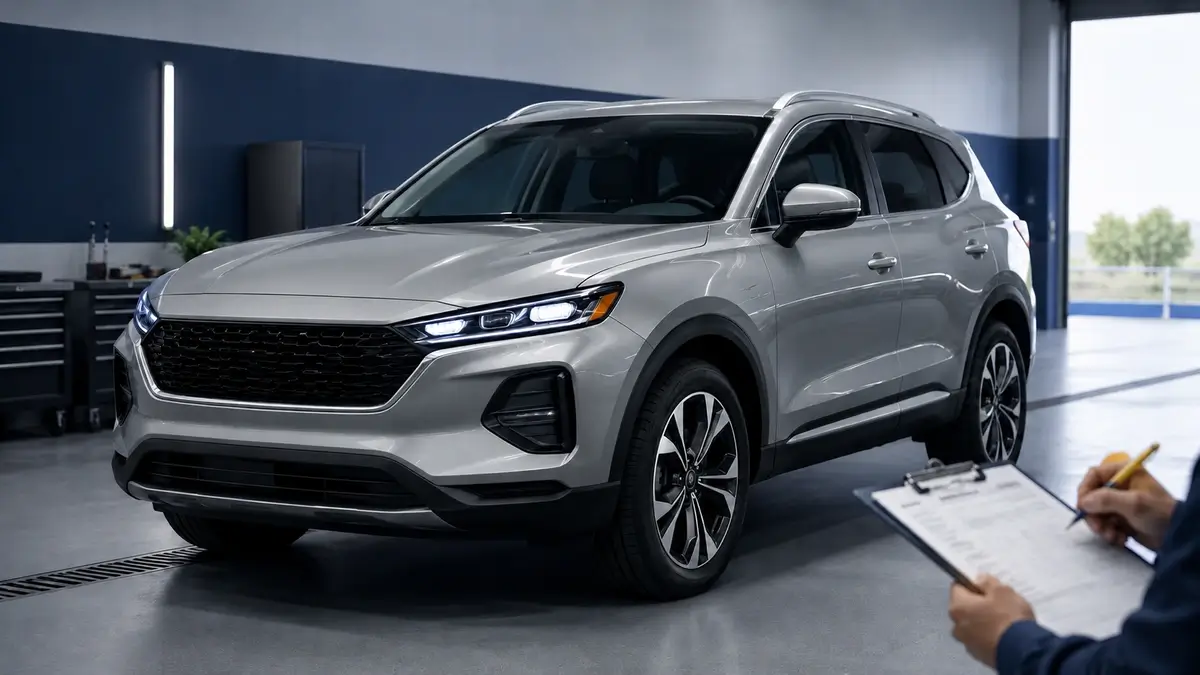
Hyundai Tucson reliability is not a simple yes-or-no answer for used buyers. A clean, well-maintained Tucson with completed recalls can be a smart value-focused compact SUV, but a neglected one can become a risky buy even if the price looks attractive.
The safe answer is this: shortlist a used Tucson only after checking the model year, service records, recall status, engine behavior, transmission feel, and inspection results. Do not buy one just because it is newer, cheaper, nicely equipped, or backed by a broad reliability score.
Choose a used Hyundai Tucson if you want a comfortable compact SUV with good value and you are willing to verify its history carefully.
Skip one if the seller cannot show maintenance records, the VIN has unresolved recall uncertainty, warning lights are present, or the test drive reveals engine or transmission concerns.
Fastest safe default: compare the Tucson against a cleaner Toyota RAV4 or Honda CR-V before buying if reliability is your top priority.
What goes wrong if you pick poorly: you may save money upfront but inherit repair risk, recall uncertainty, or inspection issues that erase the value advantage.
Is the Hyundai Tucson reliable enough to buy used?
A used Hyundai Tucson can be reliable enough to buy, but only under the right conditions. The strongest Tucson purchase is not the cheapest one; it is the one with the cleanest records, completed recalls, smooth test drive, and no signs of neglected maintenance.
| Buyer question | Practical answer |
|---|---|
| Is the Tucson reliable overall? | Generally acceptable as a used compact SUV when condition and records are strong. |
| Is it a blind-buy reliable SUV? | No. Treat it as a verify-first SUV, not a no-question purchase. |
| What matters most? | Model year, mileage, service history, recall completion, engine behavior, and transmission feel. |
| Biggest buyer mistake | Choosing a Tucson only because it is cheaper or better equipped than a RAV4 or CR-V. |
| Best-fit buyer | Value-focused used-SUV shopper who will inspect carefully before buying. |
| Risk-averse buyer move | Compare a cleaner RAV4, CR-V, or proven compact SUV first. |
The Tucson is strongest when the purchase price gives you real value and the vehicle passes a careful inspection. It is weakest when the low price is covering up missing records, high mileage, unresolved recalls, engine noise, transmission hesitation, or vague seller answers.
Hyundai Tucson reliability by year and generation
Hyundai Tucson reliability by year matters because used-car risk is not spread evenly across every model year. A newer Tucson is not automatically safer, and an older Tucson is not automatically bad. The specific year, powertrain, maintenance history, and recall status decide the real risk.
For most used buyers, the right way to think about Tucson model years is not “best year” versus “bad year” in isolation. The better question is: what extra checks does this year need before I trust it?
Hyundai Tucson NHTSA Ownership-Risk Context by Generation
| Tucson years / generation | Complaints | Unique recall campaigns | Investigations / Mfr. Comms. | Owner-reported severity flags |
|---|---|---|---|---|
| 2005-2009 (Gen 1) | 446 | 9 | 3 / 221 | 42 crash / 13 fire / 33 injury / 0 death |
| 2010-2015 (Gen 2) | 1,122 | 8 | 13 / 788 | 47 crash / 46 fire / 30 injury / 0 death |
| 2016-2021 (Gen 3) | 3,673 | 6 | 8 / 806 | 60 crash / 74 fire / 42 injury / 1 death |
| 2022-2026 (Gen 4) | 1,162 | 14 | 2 / 276 | 102 crash / 8 fire / 51 injury / 0 death |
Table note: Complaint counts are raw NHTSA owner reports from the NHTSA records, not defect rates, sales-adjusted rankings, or reliability scores. Severity flags are owner-reported complaint flags, not verified crash causation or safety ratings. Do not use this table to rank generations.
| Tucson model-year area | What it means for used buyers | Buyer action |
| Older used Tucsons | Condition, maintenance gaps, age-related wear, and previous repairs matter heavily. | Prioritize records and inspection over appearance. |
| 2016–2021 generation | This is a common used-market generation, so history and drivetrain behavior deserve close attention. | Test drive carefully and check recalls before negotiating. |
| 2022 and newer generation | Newer design and more technology can be appealing, but newer vehicles can still have recalls or software campaigns. | Do not skip the VIN recall check just because the SUV is newer. |
| Hybrid and plug-in hybrid models | Fuel savings may be attractive, but hybrid and PHEV checks are not the same as gas-model checks. | Separate gas, hybrid, and PHEV assumptions before buying. |
| High-mileage examples | Reliability depends more on records, fluids, wear items, and previous repairs. | Avoid if service history is missing or inspection raises doubts. |
| Low-price examples | A low price can be real value or a warning sign. | Compare price against condition, not just mileage. |
If your main concern is choosing the safer years and avoiding the riskier ones, read the dedicated Hyundai Tucson Years to Avoid and Best Years to Buy guide. This reliability page keeps the focus broader: whether the Tucson is reliable enough to own, what costs to expect, and what to inspect before buying.
Common Hyundai Tucson problems used buyers should know
Hyundai Tucson common problems should be treated as inspection triggers, not panic labels. The goal is not to assume every Tucson has the same faults. The goal is to know what would make one specific used Tucson a bad purchase.
NHTSA Complaint Themes to Use as Inspection Triggers
These NHTSA tables give ownership-risk context only. For buy-year, avoid-year, and model-year verdicts, use the dedicated Hyundai Tucson Years to Avoid and Best Years to Buy guide.
| Reported NHTSA theme | Complaints | Affected years / generations | Buyer inspection trigger | Use constraint |
|---|---|---|---|---|
| Engine issues | 2,177 / 34.0% | 2005-2026 / Gen 1-4 | Cold start, oil history, warning lights, leaks, scan codes, unusual noise | Owner-report pattern, not proof every Tucson has engine trouble |
| Powertrain / transmission issues | 824 / 12.9% | 2005-2026 / Gen 1-4 | Low-speed engagement, reverse, warm stop-and-go driving, highway shifts | Use as a test-drive trigger, not a blanket verdict |
| Brake performance issues | 644 / 10.1% | 2005-2026 / Gen 1-4 | Brake feel, vibration, ABS lights, HECU/ABS recall proof, service records | VIN and condition matter more than theme count alone |
| Airbag / seatbelt / structure issues | 546 / 8.5% | 2005-2026 / Gen 1-4 | SRS lights, accident history, airbag/restraint recalls, structural repair evidence | Not a crash-test rating |
| Electrical / infotainment / software issues | 505 / 7.9% | 2005-2026 / Gen 1-4 | Test cameras, locks, windows, infotainment, charging ports, warning messages | Comfort/electrical risk can still affect ownership cost |
| Driver-assist / ADAS false alerts or malfunctions | 226 / 3.5% | 2016-2026 / Gen 3-4 | Test forward-collision alerts, sensors, cameras, lane systems, calibration history | Most relevant to newer tech-equipped Tucsons |
| Fuel-system issues | 213 / 3.3% | 2005-2026 / Gen 1-4 | Fuel smell, leaks, warning lights, recalls, fuel-system repair history | Needs vehicle-specific diagnosis |
Table note: Themes are extracted from NHTSA complaint components and summaries in the NHTSA records. They are inspection triggers, not confirmed defect rates or buy/avoid verdicts.
The strongest warning sign is not one isolated complaint online. It is a combination of weak records, poor test-drive behavior, active warning lights, fluid leaks, and a seller who cannot explain the vehicle’s history.
Do not use forums or owner comments as hard proof that a specific Tucson is bad. Use them only to know what questions to ask and what systems to inspect.
Engine, transmission, and hybrid-system risk areas
Engine and transmission checks matter more than cosmetic features because they can turn a good-value Tucson into a bad ownership decision. A Tucson with a clean cabin but questionable mechanical behavior is not a smart buy.
Start with the engine. During a cold start, listen for unusual knocking, ticking, rough idle, heavy vibration, smoke, or warning lights. After the drive, check for leaks, burning smells, and fresh fluid residue. If the seller warmed the vehicle before you arrived, ask why.
Then check the transmission. A used Tucson should move away smoothly, shift predictably, reverse without hesitation, and respond cleanly in traffic. Walk away or demand a professional inspection if you feel slipping, clunking, delayed engagement, harsh low-speed behavior, or repeated hesitation.
For hybrid and plug-in hybrid Tucsons, do not assume gas-model advice fully applies. Hybrid checks should include battery-related warning messages, smooth gas-electric transitions, regenerative braking behavior, charging-equipment condition for plug-in models, and service documentation from a shop familiar with Hyundai hybrid systems.
This is also where recall status matters. Use the NHTSA recall lookup and Hyundai’s Safety Recalls and Service Campaigns tool before purchase. If a vehicle has open recall uncertainty, treat the purchase as unfinished until the seller or dealer proves the remedy status.
Hyundai Coverage Checks That Can Change the Repair Math
Before assuming an engine or safety-system problem will be fully out of pocket, check Hyundai’s VIN-specific coverage. Also, do not assume Hyundai’s headline 10-year/100,000-mile powertrain term automatically transfers unchanged to an ordinary used Tucson. Ownership status, model-year terms, original in-service date, mileage, VIN eligibility, and any applicable extension program control what remains. See Hyundai’s warranty information.
A Tucson with engine-bearing history, an airbag warning, or previous major repair work is a good case for checking CarMerit’s Manufacturer Special Coverage Lookup first, so you can identify model-year programs worth verifying before deciding what repair exposure belongs in your budget.
| Used Tucson scope | Coverage that may matter | What to verify |
|---|---|---|
| Certain 2010–2013 2.4L MPI and 2014–2021 2.0L GDI Tucsons | TXXM provides a 15-year/150,000-mile total term for certain engine repairs or replacement caused by connecting-rod-bearing failure. | Exact VIN, engine, original in-service date, mileage, KSDS/recall status, and current program eligibility. |
| Certain 2014–2015 and 2018–2019 2.4L Tucsons | TXXI provides a 10-year/120,000-mile total term for certain long-block repairs tied to excessive connecting-rod-bearing damage. | Exact VIN, engine, original in-service date, mileage, and current program terms. |
| Certain 2016–2017 Tucsons | TXXQ provides a 15-year/unlimited-mile term for the airbag control unit under the program’s specified warning-light/DTC condition. | Exact VIN, applicable condition/DTC, original in-service date, and current program eligibility. |
Table Note: These are warranty extensions for certain vehicles and may apply to original and subsequent owners under Hyundai’s written program terms. They are not recalls, defect-rate evidence, or proof that a particular Tucson qualifies. VIN, engine or component scope, diagnosis, original in-service date, mileage where applicable, campaign prerequisites, exclusions, and current written terms control eligibility.
Hyundai Tucson Maintenance Cost and Cost to Own
Hyundai Tucson maintenance cost is usually not the only issue. The better question is whether the total ownership burden fits the deal: routine maintenance, unexpected repairs, fuel cost, tires, brakes, insurance, registration, inspection needs, and the possibility of age-related repairs.
| Cost area | Tucson ownership reality | Buyer takeaway |
| Routine maintenance | Oil service, filters, fluids, brakes, tires, battery, and scheduled inspections still matter. | Compare records against Hyundai’s maintenance schedule. |
| Unexpected repairs | One neglected vehicle can still become expensive even when routine maintenance looks current. | Use the inspection to identify work due now or soon, then get current local quotes for any repair or diagnosis before judging the deal. |
| Tires and brakes | Compact SUVs can become costly if tires are mismatched, worn unevenly, or cheap replacements were used. | Inspect tire brand, tread depth, date codes, and brake feel. |
| Fuel cost | Gas, hybrid, and plug-in hybrid Tucsons have different fuel-cost profiles. | Use FuelEconomy.gov to compare the exact year and drivetrain. |
| AWD ownership | AWD can help traction but adds parts and tire-matching sensitivity. | Check tire matching and listen for drivetrain noise. |
| Hybrid ownership | Fuel savings may help, but hybrid diagnostics require more care. | Verify hybrid-system health and service history before paying extra. |
EPA Fuel Economy by Powertrain
For 2022-and-newer Tucsons, powertrain choice changes the running-cost math enough that one model-wide MPG number can be misleading. FuelEconomy.gov lists gas, hybrid, Hybrid Blue, and plug-in-hybrid configurations separately.
| Model years | Gas FWD combined MPG | Gas AWD combined MPG | Hybrid AWD / Hybrid Blue AWD combined MPG | PHEV AWD charge-sustaining combined MPG | PHEV AWD charge-depleting combined MPGe | PHEV electric range |
|---|---|---|---|---|---|---|
| 2022 | 29 | 26 | 37 / 38 | 35 | 80 | 33 mi |
| 2023–2024 | 28 | 25 | 37 / 38 | 35 | 80 | 33 mi |
| 2025 | 28 | 26 | 35 / 38 | 35 | 77 | 32 mi |
| 2026 | 28 | 26 | 36 / 38 | 35 | 77 | 32 mi |
Table Note: EPA/FuelEconomy.gov estimates for the configurations shown. Slash-separated Hybrid values are separate official Hybrid and Hybrid Blue configurations, not an average or range. PHEV MPG and MPGe represent different operating modes and must not be merged: MPG is charge-sustaining gasoline operation, while MPGe is charge-depleting operation. Electric range is the charge-depleting range. Actual fuel economy and electric range vary with driving style, weather, speed, traffic, temperature, vehicle condition, cargo, charging frequency, and trip pattern. Use these figures as running-cost inputs, not as a reliability or total-ownership-cost score.
Use Hyundai’s Vehicle Maintenance Schedule and manuals and warranties resources to confirm what should have been done for the specific year and trim. If records are missing, assume the maintenance story is incomplete.
Recalls, complaints, and safety checks before buying
Recalls and complaints should be checked before buying because they can change the risk of a specific Tucson. A vehicle can look clean, drive well, and still have an open recall or unresolved campaign that needs attention.
Hyundai Tucson Recall/VIN Due-Diligence Themes
| Recall / VIN-check area | Unique campaigns | Affected years / generations | Fire-risk flag in NHTSA records | Used-buyer action |
|---|---|---|---|---|
| Brake / ABS / stop-lamp / HECU | 14 | 2005-2021, 2025-2026 / Gen 1-4 | Yes | Verify VIN recall status and written remedy proof before buying |
| Engine / engine-cooling | 3 | 2011-2013, 2017, 2025-2026 / Gen 2-4 | Yes | Confirm engine recall/program status and inspect for noise, oil issues, warnings |
| Airbag / seat-belt restraints | 6 | 2005-2007, 2010, 2025-2026 / Gen 1, Gen 2, Gen 4 | No | Confirm restraint/SRS recall completion and check warning lights |
| Steering | 2 | 2011-2014, 2024 / Gen 2, Gen 4 | No | Verify steering recall status and inspect for abnormal steering feel |
| Powertrain / transmission | 2 | 2011, 2023-2024 / Gen 2, Gen 4 | Yes | Confirm campaign status and test transmission behavior carefully |
| Software / control module / wiring | 4 | 2022-2026 / Gen 4 | Yes | Check for software, wiring, and dealer-update completion by VIN |
Table note: Campaign counts are deduplicated recall campaigns from the NHTSA records. Affected years do not mean every VIN in that year is affected. Always verify the exact VIN through NHTSA and Hyundai.
Table scope note: These NHTSA evidence tables are meant for general ownership-risk context, not a separate verdict for gas, hybrid, or plug-in hybrid Tucson models. Always verify the exact powertrain, model year, and VIN before applying these checks to a specific vehicle.
Use this order:
- Run the VIN through the NHTSA recall lookup.
- Run the same VIN through Hyundai’s Safety Recalls and Service Campaigns page.
- Ask the seller for written proof that any recall remedy or service campaign was completed.
- Check NHTSA complaints by year, make, and model to understand repeated owner concerns.
- If safety ratings matter to your decision, check the relevant model year through IIHS or NHTSA instead of assuming every Tucson year performs the same.
Owner complaints are useful, but they are not the same thing as verified defects. A complaint pattern can tell you where to look. It does not prove that every Tucson from that year has the same problem.
IIHS Safety Checkpoints That Matter for a Used Tucson
IIHS answers a different question from reliability: how defined model-year, test-family, equipment, and build-date scopes performed in specific safety evaluations. Use these as safety checkpoints, not as a reliability score or a generation ranking.
| Model years / scope | Selected IIHS evidence | What it means for the buyer |
|---|---|---|
| 2005–2009 | Original moderate overlap: A; original side: A; roof strength: P | The Poor roof-strength result is a material older-generation safety checkpoint. Do not convert it into a reliability verdict. |
| 2010–2015 | Driver-side small overlap: P; original moderate overlap: G; original side: G; roof strength: G | Different test families produced different results, which is why one overall safety label would be misleading. |
| 2016–2020 | Driver- and passenger-side small overlap: G; original moderate overlap: G; updated side: M | The tougher updated-side result adds useful qualification despite strong results in several older test families. |
| 2021 | Updated moderate overlap: P; updated side: M | The updated tests materially change the safety context and should not be merged with the older Good ratings. |
| 2022 / 2023 | 2022 headlights: G on Limited, A on SE/SEL/N-Line. 2023 vehicle-to-vehicle 2.0: M; Limited headlights: G before November 2022 and A after October 2022; other listed headlights: A | Trim and, for the 2023 Limited, build date can change the applicable result. |
| 2024 / 2025 / 2026 | Updated moderate overlap: G for 2024–2026 models built after March 2024; updated side: G. Vehicle-to-vehicle 2.0: M for 2024–2025 and G for 2026. Whiplash prevention: P for 2025–2026. | Later models still need test-by-test reading. A newer model year does not mean every IIHS measure has the same rating. |
Table Note: G = Good; A = Acceptable; M = Marginal; P = Poor. Ratings apply only to the stated model years, equipment/build-date conditions, and IIHS test families. Original and updated tests should not be merged into one overall score, and a rating not shown here should not be interpreted as a poor result.
Who should buy a used Hyundai Tucson?
A used Tucson makes the most sense for buyers who want compact-SUV comfort and practicality and are willing to compare the exact deal carefully. Judge value against a similar RAV4, CR-V, Rogue, or Sportage by model year, mileage, drivetrain, condition, vehicle history, service records, and equipment instead of assuming one badge is automatically cheaper or better value.
A real price advantage can matter, but it has to survive those like-for-like checks.
| Buyer type | Fit verdict | Why |
| Value-focused compact-SUV buyer | Good fit | A competitive asking price can strengthen the case if the specific vehicle checks out. |
| Buyer who verifies records | Good fit | The Tucson rewards careful shopping more than blind brand trust. |
| Buyer comparing Hyundai and Kia | Good fit | The Kia Sportage vs Hyundai Tucson decision is closely related. |
| Buyer open to alternatives | Good fit | Tucson can stay on the shortlist while RAV4, CR-V, Rogue, or Sportage are compared. |
| Buyer who wants features for the money | Possible fit | Higher equipment value can make sense if mechanical risk is controlled. |
| Buyer who keeps cars long-term | Conditional fit | Choose only a clean, well-documented example. |
A Tucson is strongest when it gives you a meaningful price advantage without asking you to accept hidden risk. If it costs nearly the same as a cleaner RAV4 or CR-V, the Tucson needs a stronger condition, mileage, features, or maintenance-history case to win.
Who should skip a used Hyundai Tucson?
Skip a used Tucson if you want the lowest-risk compact SUV and do not want to do much verification. The Tucson can be a smart buy, but it is not the best fit for buyers who want the safest default with the least homework.
You should be cautious or walk away if:
- The seller cannot provide service records.
- The VIN recall status is unclear.
- The vehicle has an active check-engine light.
- The engine makes unusual noise at startup or idle.
- The transmission hesitates, slips, clunks, or shifts harshly.
- The tires are mismatched or badly worn.
- The vehicle has accident history that is not properly documented.
- The price is low but the inspection explains why.
- A comparable RAV4 or CR-V is cleaner and not much more expensive.
Risk-averse buyers should also look at broader low-risk options in Most Reliable Used Cars to Buy and compact SUV alternatives in Best Used Compact SUVs to Buy.
Tucson vs RAV4, CR-V, and Sportage reliability context
The Tucson should not be judged in isolation. Many used buyers compare it with the Toyota RAV4, Honda CR-V, Kia Sportage, Nissan Rogue, Mazda CX-5, and Subaru Forester.
If your priority is the lowest-risk ownership path, compare the Tucson against the RAV4 and CR-V first. If the RAV4 or CR-V you are considering costs more, judge that premium against the exact vehicle’s year, mileage, condition, history, service records, and inspection result rather than assuming the badge justifies it. Start with the Hyundai Tucson vs Toyota RAV4 comparison if those are your final two choices.
If you are cross-shopping Hyundai and Kia, the Sportage is the closest related alternative. The Kia Sportage vs Hyundai Tucson guide is the better place for that head-to-head decision.
The Sportage is close enough to the Tucson that condition, records, and recall completion can matter more than the badge. Before choosing the Kia side of that comparison, use the Kia Sportage Reliability and Cost to Own guide to check Sportage-specific ownership cost, common problems, model-year risk, and inspection red flags.
If you are choosing between mainstream compact SUVs more broadly, compare ownership risk, year guidance, maintenance records, and inspection results instead of relying on brand reputation alone. A clean Tucson can beat a neglected RAV4. A clean CR-V can be the better buy than a questionable Tucson. Condition decides more than the badge.
Used Hyundai Tucson inspection checklist
A used Hyundai Tucson inspection checklist should be specific enough to catch the risks that change the buying decision. Use this before you commit to the vehicle or pay for a pre-purchase inspection.
A Tucson’s inspection priorities can change with the exact model year and configuration, so make sure the SUV in the ad is the vehicle you think you are evaluating. Run the Tucson’s VIN through CarMerit and compare the returned vehicle details with the seller’s listing and paperwork. Once they line up, use the checklist below to work through recall status, cold-start behavior, transmission feel, AWD checks, and hybrid or plug-in-hybrid items where applicable.
| Check | What to do | Bad sign |
| VIN recall check | Search the VIN through NHTSA and Hyundai. | Open recall, unclear campaign status, no proof of remedy. |
| Service records | Compare records with the maintenance schedule. | Missing oil-service history, vague “dealer maintained” claim, no invoices. |
| Cold start | Start the SUV after it has been sitting. | Knocking, rough idle, smoke, warning lights, heavy vibration. |
| Test drive | Drive in city traffic and at highway speed. | Hesitation, slipping, clunking, rough shifts, steering pull. |
| Warning lights | Scan codes before buying. | Seller says the light is harmless or recently reset. |
| Fluids and leaks | Inspect engine bay and underbody. | Fresh leaks, burnt smell, low fluids, messy repairs. |
| Tires | Check brand, tread depth, wear pattern, and date codes. | Mismatched tires, uneven wear, cheap replacements on AWD. |
| Brakes and suspension | Listen and feel during braking and rough roads. | Pulsation, grinding, clunks, bouncing, uneven ride height. |
| AWD system | Confirm smooth operation and tire matching. | Binding, drivetrain noise, mismatched tire sizes. |
| Hybrid/PHEV system | Check warnings, charging equipment, and service records. | Battery warnings, rough gas-electric transition, missing charger. |
| Seller documentation | Ask for title, history report, repair invoices, and recall proof. | Seller pressure, missing paperwork, inconsistent story. |
Do not skip a professional pre-purchase inspection just because the Tucson looks clean. A good inspection is cheaper than buying the wrong SUV.
Final verdict: Is the Hyundai Tucson a smart used SUV?
Hyundai Tucson reliability is good enough to make the Tucson worth shortlisting, but not strong enough to justify a careless purchase. The Tucson is a smart used SUV when the year, mileage, service history, recall status, and inspection results all support the deal.
Buy one if it is clean, documented, fairly priced, and mechanically sound.
Skip one if it has vague records, unresolved recall uncertainty, warning lights, rough drivetrain behavior, suspiciously low pricing, or seller pressure.
The Tucson’s value case is deal-specific. It can make sense when its asking price, condition, mileage, equipment, service history, and inspection result compare well with the alternatives. A lower asking price is not automatically better value if the SUV needs deferred maintenance, diagnosis, or repair.
For most buyers, the right move is simple: keep the Tucson on your shortlist, but make it prove itself before you buy.
Frequently Asked Questions
Is the Hyundai Tucson reliable?
Yes, the Hyundai Tucson can be reliable enough to buy used, but only when the specific vehicle has strong records, completed recalls, clean inspection results, and no engine or transmission warning signs. Do not rely on reputation alone.
Are Hyundai Tucsons reliable used SUVs?
Hyundai Tucsons can be reliable used SUVs, but reliability varies by model year, mileage, maintenance history, powertrain, and recall status. A clean Tucson is a reasonable shortlist candidate; a poorly documented one is not.
What Hyundai Tucson years are most reliable?
The most reliable Hyundai Tucson year depends on condition, records, and current recall history. Do not choose a year only from a generic list. Use the dedicated Hyundai Tucson Years to Avoid and Best Years to Buy guide for model-year detail.
What Hyundai Tucson years should used buyers avoid?
Avoid any Tucson year if the vehicle has poor service records, open recall uncertainty, warning lights, rough engine behavior, or transmission issues. Some years may need extra caution, but the final decision should come from the exact vehicle’s history and inspection.
Is the Hyundai Tucson expensive to maintain?
Routine maintenance and unexpected repair exposure are different. Compare the service records with Hyundai’s exact model-year maintenance guidance, then budget around the specific SUV’s inspection findings and any work it needs now or soon.
Do not treat a model-wide annual repair average as the expected bill for one used Tucson. Get current local quotes for identified repairs or diagnosis before you buy.
What are the most common Hyundai Tucson problems?
Used buyers should check for engine behavior, warning lights, transmission hesitation, leaks, tire wear, brake wear, air-conditioning issues, electronics, and recall status. These are inspection priorities, not proof that every Tucson has the same problem.
Does the Hyundai Tucson have engine problems?
Some Tucson shoppers worry about engine problems, so engine behavior should be inspected carefully. Listen during cold start, scan for codes, check oil history, look for leaks, and avoid any example with unexplained noises or warning lights.
Does the Hyundai Tucson have recalls?
Yes, Hyundai Tucson models can have recalls or service campaigns depending on year, build date, and VIN. Always check the VIN through NHTSA and Hyundai before buying because recall status is vehicle-specific.
Should I buy a used Hyundai Tucson or compare it with a Toyota RAV4 first?
Compare with the RAV4 first if reliability is your top priority or the price difference is small. A Tucson can be the better value when it is cleaner, cheaper, and well documented, but a cleaner RAV4 may be the lower-risk buy.
What should I check before buying a used Hyundai Tucson?
Check the VIN recall status, service records, maintenance schedule, cold-start behavior, warning lights, transmission feel, fluid leaks, tires, brakes, suspension, AWD operation, and hybrid/PHEV system if applicable. Get a pre-purchase inspection before buying.