

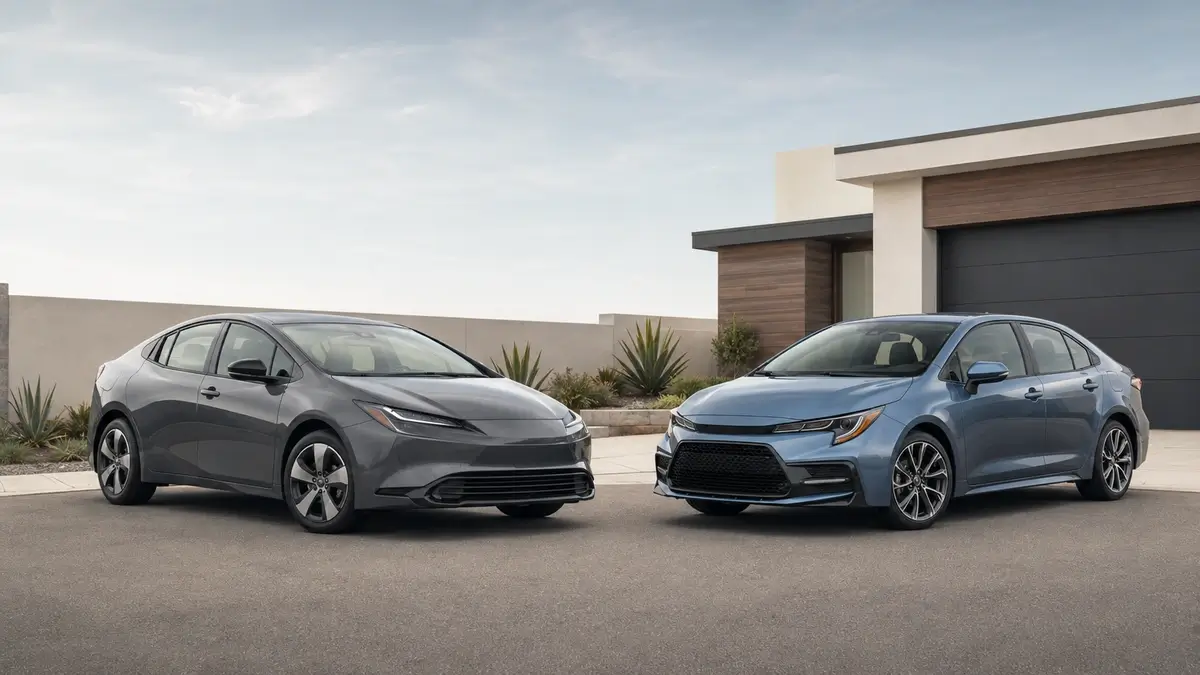
The Prius vs Corolla Hybrid decision is not a simple MPG contest. A used buyer must compare model year, mileage, condition, purchase price, body style, drivetrain, and service history before choosing.
The safest default is simple: buy the stronger individual car first. When two examples are genuinely comparable, the Prius is the better all-rounder. The Corolla Hybrid is the better value when the same budget buys a newer, cleaner, or lower-mileage vehicle.
- Choose the Prius when cargo access matters, the price difference is justified by features you will use, or you want the stronger 2023-and-newer powertrain.
- Choose the Corolla Hybrid when it performs the same daily job for less money or gives you the better-condition vehicle.
- Walk away from either car when warning lights, accident repairs, missing records, or inspection concerns remain unresolved.
- Do not treat an older, higher-mileage Prius as the better deal simply because it has a liftback.
- Test the rear seat and cargo area. The body-style difference can matter more than a small specification advantage.
This comparison covers the standard non-plug-in Prius and the Corolla Hybrid sedan in the U.S. used market. The Corolla Hybrid entered the U.S. lineup for the 2020 model year, so 2020 and newer cars form the cleanest direct overlap. Prius Prime, Corolla Cross Hybrid, the gasoline Corolla, and Camry Hybrid are outside this comparison.
CarMerit reliability comparator
Toyota Prius vs Toyota Corolla Hybrid: 2020-2026 NHTSA snapshot
Owner-complaint and recall counts from NHTSA for 2020-2026, each model’s best used-year lane, and which buyer each one fits.
| 157 | complaints (2020-26) | 5 |
| 13 | recalls (2020-26) | 7 |
ElectricalUnknown / otherSuspension / wheelsBrakes | top issues | ElectricalAirbags / seatbelts / structureExterior lightingVehicle speed control |
Toyota Prius
Best used year: 2021
Best start 2020-2022; 2023-2026 models have limited long-term evidence and need VIN-specific recall checks.
Best for: Cargo-and-capability buyers who want liftback practicality and the stronger 2023-and-newer powertrain when the price is justified.
Toyota Corolla Hybrid
Best used year: 2022
Best 2022; shortlist 2021, repaired 2023-2024, and clean 2025; use more caution with 2020, 2023, and 2024; 2026 is too new to judge as used.
Best for: Value-and-condition buyers who want the same daily hybrid job for less money, or a younger, better-documented car.
Quick take: When price, age, mileage, and condition are close, the Prius is the better all-round used hybrid because its liftback is more useful for cargo and the 2023 redesign added real power. Choose the Corolla Hybrid when the same money buys meaningfully better records, fewer miles, a cleaner inspection, or remaining factory coverage. Test the rear seat and cargo area before treating either model as the winner. Do not crown either hybrid from raw NHTSA counts alone.
Complaint counts are raw owner reports filed with NHTSA, not adjusted for sales volume, so they should guide inspection rather than crown a winner. The quick comparator above uses a 2020-2026 overlapping NHTSA snapshot for both models; if one model has older NHTSA history before 2020, those model-only years are excluded here to keep the comparison balanced. Always inspect the specific vehicle before buying.
Quick Verdict: Prius or Corolla Hybrid?
The Prius is the better all-round used hybrid when price, age, mileage, condition, and history are close. Its liftback is more useful for bulky cargo, and the 2023 redesign brought a clear power advantage.
The Corolla Hybrid is the better purchase when it gives you the stronger actual car for the money. A newer model with fewer miles, cleaner history, or better records can outweigh the Prius’s broader capability.
| Decision factor | Toyota Prius | Toyota Corolla Hybrid | Better choice |
|---|---|---|---|
| Same price | Strong when age, mileage, and history are close | Strong when the same money buys a newer or cleaner car | Depends on the actual examples |
| Same age and mileage | More flexible cargo access; clear 2023+ power advantage | Efficient and familiar sedan package | Prius if price and condition are close |
| Fuel economy | Exact result depends on year, trim, wheels, and drivetrain | Excellent economy without the liftback body | Verify the exact configuration |
| Rear-seat use | Fit varies by generation and roofline | Conventional sedan profile may suit some passengers better | Sit in both |
| Cargo | Large rear opening handles awkward loads better | Separate trunk is secure and conventional | Prius |
| Highway use | 2023+ models have substantially more system output | Calm, efficiency-first performance | Prius for buyers who value the output difference |
| Ownership risk | Age, history, and inspection control the risk | Same | Tie |
| Value | Better when you will use its added capability | Better when it is newer, cleaner, or cheaper | Listing-specific |
Better Buy at the Same Price
At the same price, compare what the money buys. A newer Corolla Hybrid with lower mileage and a clean inspection can be a safer purchase than an older Prius bought mainly for its reputation or liftback.
A same-year Prius with similar mileage, history, and condition is a different case. When the price is close, its cargo access and wider use-case range can justify choosing it.
Better Buy at the Same Age and Mileage
Generation matters. For 2020 through 2022 comparisons, condition, trim, tires, and price often matter more than performance.
For 2023, the Prius produces 194 horsepower with front-wheel drive and 196 with all-wheel drive. The Corolla Hybrid produces 138 horsepower. That is a meaningful output difference, but confirm how much it matters to you during a highway test drive.
When Condition Overrides the Model-Level Winner
A documented Corolla Hybrid with even tire wear, no active warnings, and a strong inspection is better than a neglected Prius. The reverse is equally true.
Condition is the first filter, not a final tiebreaker. Reject the weaker individual car before debating which model is better.
Who Should Buy Each Used Hybrid?
Buyer fit decides whether the Prius’s added capability is useful or simply something you paid for. The Corolla Hybrid suits buyers who want efficient transportation without needing liftback flexibility or the newer Prius’s power advantage.
| Buyer or use case | Better fit | Why | Main caution |
| High-mileage commuter | Either | Both can deliver excellent fuel economy | Purchase price can erase modest fuel savings |
| Value-focused buyer | Corolla Hybrid | The same budget may buy a newer or cleaner example | Do not assume it is cheaper without comparing local listings |
| Bulky cargo or frequent luggage | Prius | Liftback opening is easier for large items | Roof shape and usable height vary by generation |
| Frequent highway merging and passing | 2023+ Prius | Large system-output advantage | Test the exact car; older Prius models are different |
| Conventional sedan preference | Corolla Hybrid | Familiar trunk and cabin layout | Less flexible for tall or awkward cargo |
| Winter traction buyer | Model-year-matched AWD example | Both offer AWD in certain years | Compare AWD with AWD, not AWD with FWD |
| Risk-averse used buyer | Better-condition car | History and inspection outweigh the nameplate | No Toyota badge replaces due diligence |
The High-Mileage Commuter
Start with annual miles, then include purchase price. A small MPG advantage has little value if it requires a large premium or comes with more age and mileage.
A commuter carrying little cargo can choose either car. The Corolla Hybrid often makes more sense when it completes the same job with a younger or better-documented vehicle.
The Value-Focused Used-Car Buyer
Choose the Corolla Hybrid when the same money buys meaningfully better records, fewer miles, a cleaner inspection, or remaining factory coverage.
Choose the Prius when the added cost buys capability you will use. Paying more for a liftback, stronger newer powertrain, or upgraded trim is poor value when those benefits do not affect your routine.
The Buyer Who Needs Better Cargo Access or Rear-Seat Usability
The Prius wins the cargo-access decision. Toyota rated the fourth-generation front-wheel-drive Prius at 50.7 cubic feet behind the front seats.
The Corolla Hybrid remains a sedan with a separate trunk and folding rear seatbacks. That layout works well for groceries and normal luggage but is less convenient for tall or awkward items.
Rear-seat comfort is not a universal win for either model. Roof shape, door opening, seat height, and front-seat position can matter more than one published dimension. Put the tallest regular passenger in both cars before buying.
Who Should Skip Each Option
Skip the Prius when you would pay heavily for cargo flexibility or performance you will rarely use. Also skip any generation whose rear-seat entry or headroom does not suit your household.
Skip the Corolla Hybrid when its trunk opening limits the loads you carry. It is also a weak fit when you want the 2023-and-newer Prius’s power output and are willing to pay for it.
Compare the Same Kind of Used Car
A fair Toyota Prius vs Toyota Corolla Hybrid comparison needs a controlled baseline. Otherwise, you are comparing age, trim, drivetrain, or condition rather than the vehicles themselves.
Use two shopping views. First compare cars at the same price. Then compare cars from the same model year with similar mileage.
Same Price vs Same Model Year
A same-price comparison answers: What is the strongest car this budget buys? It may place a newer Corolla Hybrid against an older Prius.
A same-year comparison answers: Which vehicle is the better design and ownership fit? It reduces the age difference but may expose a larger price gap.
Do not combine those conclusions. The better model is not always the better purchase at a fixed budget.
Match Mileage, Trim, Drivetrain, and Condition
Before comparing two listings, match these factors as closely as possible:
- Model year and generation
- Mileage and likely usage pattern
- Front-wheel drive or all-wheel drive
- Trim, wheel size, and important equipment
- Accident history and repair quality
- Service records and ownership history
- Tire condition and other near-term wear items
- Warning lights, diagnostic results, and inspection findings
Large wheels, premium equipment, and AWD can change MPG, ride quality, tire cost, and purchase price. Treat them as part of the comparison, not free upgrades.
Avoid Cross-Generation and New-vs-Used Comparisons
The 2023 Prius is a different proposition from the 2016 through 2022 generation. Its powertrain, seating position, roofline, technology, and efficiency range changed enough to affect the recommendation.
The Corolla Hybrid also added more trims and available AWD for 2023. Ignoring those changes can produce the wrong winner before condition is considered.
Purchase Price, Depreciation, and Overall Value
There is no safe universal dollar premium that makes every Prius worth more than every Corolla Hybrid. Used prices move with year, mileage, trim, drivetrain, condition, history, location, and local supply.
The correct value question is listing-specific: What are you receiving for the extra out-the-door cost?
Why One Used Hybrid May Cost Less
A lower price can reflect age, mileage, trim, accident history, cosmetic condition, local supply, or poor documentation. It is not automatically a bargain.
A higher price does not prove higher quality either. It may reflect lower mileage, a newer generation, added equipment, or an optimistic seller.
What the Same Budget Buys
Build two shortlists:
- The best-condition Prius within your budget.
- The best-condition Corolla Hybrid within your budget.
Then compare the exact out-the-door prices, years, mileage, records, tires, inspection results, and immediate repair needs. Do not price the badge. Price the vehicle.
The stronger purchase is the car that meets your needs while leaving the least unresolved risk. A lower purchase price also preserves money for tires, maintenance, registration, insurance, or an unexpected repair.
Depreciation, Supply, and Resale Context
Resale matters only after purchase price and condition are considered. Paying a large premium today to protect uncertain future value can be worse than buying the cleaner vehicle at a fair price.
Use a break-even test:
- Record the Prius’s extra out-the-door cost.
- Estimate annual fuel cost for both exact configurations.
- Divide the purchase premium by the annual fuel savings.
- Compare the result with your likely ownership period.
If the break-even period is longer than you expect to own the car, fuel economy alone does not justify the premium.
| Ownership factor | What to compare | What can reverse the winner |
| Acquisition cost | Actual out-the-door difference | Large premium for benefits you will not use |
| Fuel | Exact EPA rating, annual miles, and local fuel price | Low annual mileage or a small MPG difference |
| Maintenance | Records, tires, brakes, fluids, and scheduled service | Deferred maintenance on the cheaper car |
| Hybrid system | Vehicle age, warranty status, warnings, and qualified inspection | Unresolved faults or uncertain condition |
| Repair exposure | Current defects, accident work, and worn components | One unresolved issue can erase price savings |
| Depreciation | Entry price and likely ownership length | Overpaying at purchase |
| Resale | Condition, mileage, demand, and documentation | Poor history or cosmetic neglect |
| Inspection burden | Independent inspection and written findings | Seller blocks inspection |
Fuel Economy and Daily Running Cost
The Prius vs Corolla Hybrid MPG answer changes by model year, trim, wheel size, and drivetrain. Use the exact EPA rating for the configuration rather than a model-wide headline.
EPA and FuelEconomy.gov records show how sharply the answer can change by configuration:
| Model years and drivetrain | Prius — city / highway / combined MPG | Corolla Hybrid — city / highway / combined MPG |
|---|---|---|
| 2020–2022 FWD | Prius: 54 / 50 / 52 | Corolla Hybrid: 53 / 52 / 52 |
| 2020–2022 higher-efficiency FWD | Prius Eco: 58 / 53 / 56 | No separate Eco-equivalent record |
| 2020 AWD | Prius AWD: 52 / 48 / 50 | AWD not offered |
| 2021–2022 AWD | Prius AWD: 51 / 47 / 49 | AWD not offered |
| 2023–2026 higher-rated FWD record | Prius: 57 / 56 / 57 | Corolla Hybrid: 53 / 46 / 50 |
| 2023–2026 lower-rated FWD record | Prius XLE/Limited: 52 / 52 / 52 | Corolla Hybrid: 50 / 43 / 47 |
| 2023–2026 higher-rated AWD record | Prius AWD: 53 / 54 / 54 | Corolla Hybrid AWD: 51 / 44 / 48 |
| 2023–2026 lower-rated AWD record | Prius AWD XLE/Limited: 49 / 50 / 49 | Corolla Hybrid AWD: 47 / 41 / 44 |
Table Note: These are EPA/FuelEconomy.gov rounded estimates; real-world results vary. The Corolla Hybrid’s 2023–2025 higher- and lower-rated records do not consistently expose a consumer trim name, while the 2026 lower-rated records are identified as SE and SE AWD. Verify the exact vehicle’s window sticker and drivetrain rather than inferring a trim mapping or averaging configurations. Source: EPA and FuelEconomy.gov data downloads.
City Driving vs Highway Driving
Hybrids can benefit from regenerative braking in lower-speed, stop-and-go driving. Highway results depend heavily on speed, weather, terrain, tires, load, and trim.
A buyer with a short commute should not pay heavily for a small MPG edge. A high-mileage driver has a stronger case, but only after calculating the real difference.
Annual Mileage and Fuel-Savings Assumptions
Use a transparent calculation:
Annual fuel cost = annual miles ÷ expected MPG × fuel price
For example, at 12,000 miles per year and $3.50 per gallon, 50 MPG costs about $840 annually. At 45 MPG, it costs about $933. The difference is roughly $93 per year.
That saving is useful, but it does not justify a multi-thousand-dollar premium by itself.
Why MPG Alone Does Not Decide the Better Buy
Fuel is one ownership cost. Tires, financing, insurance, deferred service, accident damage, depreciation, and one repair can outweigh a modest efficiency advantage.
Choose the Prius for MPG only when the exact trim has a verified advantage and your annual mileage makes that advantage meaningful.
Reliability, Hybrid Battery Risk, and Repair Exposure
The Prius vs Corolla Hybrid reliability question has no safe universal winner. Model year, maintenance, accident history, age, and current condition matter more than broad reputation.
Do not buy either car on the assumption that its hybrid battery will last a fixed number of years. The correct response to battery uncertainty is a stronger inspection and a price that reflects the remaining risk.
The Prius can be the stronger efficiency play, but the right answer depends on age, mileage, battery confidence, and how much ownership uncertainty you are willing to accept. For a deeper used-buying risk check, read the Toyota Prius reliability and cost-to-own guide before treating fuel savings as the whole decision.
Vehicle Age vs Hybrid-Battery Age
A low odometer reading does not make an older battery new. Evaluate battery warranty status from the original in-service date, not only mileage.
For model-year 2020 and newer Toyota hybrids, Toyota’s hybrid-battery warranty provides defect coverage for 10 years or 150,000 miles from the original date of first use, whichever comes first. It is not a battery-capacity or degradation guarantee. Other listed hybrid-system components are covered for 8 years or 100,000 miles, whichever comes first. Verify the exact vehicle’s VIN, original in-service date, mileage, certification, component eligibility, and written model-year terms before assuming any coverage remains.
Which One Is More Likely to Last Longer?
There is not enough model-wide evidence to promise that one will outlast the other. A complete service history and strong inspection are better purchase indicators than a general reliability ranking.
Ask a simpler question: Which car has fewer unresolved risks today?
Service History, Cooling, and Repair Exposure
Ask for maintenance records and confirm that scheduled service was not ignored. Look for active warning lights, leaks, poor accident repairs, uneven tire wear, weak air-conditioning performance, and unresolved noises.
For same-year 2023 examples, the official Prius/Prius AWD guide and Corolla Hybrid guide share several core checkpoints: service every 5,000 miles or six months; normal-use oil and filter replacement every 10,000 miles or 12 months when the recommended oil was used; HV-battery cooling-intake inspection every 5,000 miles with cleaning as needed and scheduled cleaning every 20,000 miles or 24 months; initial engine-coolant replacement at 100,000 miles or 120 months; initial inverter-coolant replacement at 150,000 miles or 180 months; and spark-plug replacement at 120,000 miles or 144 months.
The 2023–2024 Corolla Hybrid AWD schedule additionally calls for drive-shaft-nut re-torque at 15,000-mile or 18-month checkpoints and rear-differential-oil inspection at 30,000-mile or 36-month checkpoints. Use whichever interval comes first, keep special-use requirements separate, and judge the actual records rather than assuming either model has a lighter schedule.
Have a hybrid-qualified technician perform the pre-purchase inspection. The inspection should evaluate both the hybrid system and conventional components, then provide written findings rather than a verbal assurance.
If the price comparison brings an older Prius into consideration, ask a Toyota dealer to check the VIN for Customer Confidence Program 23TE02 and Customer Confidence Program 23TE03. These programs apply to certain 2010–2015 Prius vehicles with specified intelligent power module or inverter conditions and provide coverage for 20 years with no mileage limit from the original date of first use. Eligibility depends on the VIN and diagnosed condition; the programs identify specific diagnostic codes and, for 23TE02, a qualifying inverter thermal event.
For a 2020 or 2021 Corolla Hybrid, ask the dealer to check the VIN for Customer Support Program 24TE04. Toyota issued the program for certain Corolla vehicles with a flow shut-off valve coolant leak that may cause a Maintenance Required message or abnormal A/C operation. The no-mileage primary window ended November 30, 2025; vehicle-specific secondary coverage runs for 10 years from the original date of first use or 100,000 miles, whichever comes first.
These are special-coverage or customer-confidence programs, not recalls, and they do not establish that either condition is common. Confirm the VIN, production eligibility, in-service date, mileage, diagnosed condition, and current written terms before relying on coverage.
If your shortlist comes down to an older Prius and an early Corolla Hybrid, check both model years in CarMerit’s Manufacturer Special Coverage Lookup before letting an inverter or coolant-related repair history tip the decision toward the other hybrid.
When Battery Concern Should Affect the Price
Battery uncertainty should reduce your confidence when the car is older, warranty coverage is limited, warning history is unclear, or the seller blocks an independent inspection.
Do not accept a generic statement that the battery is “good.” Ask for written diagnostic results from a qualified inspection, including the date and the vehicle identification number.
Passenger Space, Cargo, and Everyday Practicality
The Prius vs Corolla Hybrid size comparison is really about access and shape. The Prius liftback handles tall or awkward items better. The Corolla Hybrid uses a conventional trunk that keeps cargo separate from the cabin.
Raw dimensions do not settle the choice. Opening size, seat-folding shape, roofline, visibility, and passenger fit determine everyday usefulness.
Rear-Seat Space and Seating Ergonomics
Do not declare a rear-seat winner without matching model years. The fifth-generation Prius uses a lower roofline and seating position, while the Corolla Hybrid keeps a traditional sedan profile.
Check entry height, head clearance, knee room, seat cushion support, and how far the front seats must move. A five-minute family fit test is more useful than one legroom figure.
Trunk Capacity vs Liftback Cargo Access
The Prius is the better choice for strollers, boxes, folding equipment, luggage, and other bulky loads. Its large rear opening can accept items that a sedan trunk opening blocks.
The Corolla Hybrid’s trunk has advantages too. It hides cargo, separates loose items from passengers, and works well for groceries or normal luggage.
Dimensions, Visibility, and Parking Use
Both cars are compact enough for normal commuting and city parking, but the view from the driver’s seat differs by generation.
Test low-speed visibility, mirror coverage, backup-camera clarity, and your ability to judge the corners. Do not assume the smaller-looking car will be easier for you to place.
Family, Luggage, and Bulky-Item Scenarios
Choose the Prius when you regularly combine passengers with awkward cargo. Choose the Corolla Hybrid when rear cargo is modest and the sedan layout feels more natural.
A family using rear-facing child seats should install the actual seat before buying. Front-passenger space can change sharply once a large child seat is fitted.
Performance, Ride Comfort, and Highway Use
Driving differences matter most when you compare the correct generations. Older Prius and Corolla Hybrid models are both efficiency-first cars. The 2023-and-newer Prius has a clear system-output advantage.
Do not pay for performance you do not need. Extra power matters most for short ramps, passing, hills, and frequent highway use.
Acceleration and Highway Merging
The 2023 Prius produces 194 to 196 horsepower, compared with 138 horsepower for the 2023 Corolla Hybrid. That makes the Prius the stronger candidate for buyers who prioritize acceleration, but horsepower alone does not replace a test drive.
For 2020 through 2022 comparisons, the performance difference is less central. Tires, load, road grade, and vehicle condition may matter more to the buying decision.
Ride Quality and Road Noise
Wheel size and tire choice can change comfort and noise more than a trim badge suggests. Lower-profile tires may sharpen response but can increase impact harshness and replacement cost.
Drive both cars on the roads you use. Include broken pavement, a highway merge, steady cruising, braking, and a tight parking maneuver.
Seating Position, Visibility, and Long-Trip Comfort
The Corolla Hybrid offers a familiar sedan seating position. The Prius varies more by generation, especially after the 2023 redesign.
Spend at least 20 minutes in each car. Check seat support, steering-wheel reach, instrument visibility, wind noise, and rear-passenger comfort.
Safety, Features, and Trim Value
Safety and equipment comparisons must be model-year specific. Do not apply the newest driver-assistance package to an older used car or assume a listed feature is standard.
The useful question is not which car has more features. It is which exact features change safety, comfort, or daily value for you.
IIHS results show several model-year-specific trade-offs that a generic safety winner would hide:
| Model years and IIHS test | Prius | Corolla Hybrid | Buyer check |
|---|---|---|---|
| 2020–2022 passenger-side small overlap | Acceptable | Good | Compare the same passenger-side test family |
| 2020–2021 headlights | Acceptable | Marginal on Hybrid LE | Verify the installed headlight configuration |
| 2022 headlights | Acceptable | Marginal if built before December 2021; Acceptable if built after November 2021 | Check the Corolla’s build date and headlights |
| 2023–2024 updated moderate overlap | Acceptable | Marginal | Do not mix this with the original moderate-overlap test |
| 2023–2024 updated side | Good | Acceptable | Compare only the updated side-test results |
| 2023–2026 headlights | Acceptable on all listed Prius trims | Good on listed Hybrid LE, SE, and XLE trims | Verify trim and equipment |
| 2025–2026 updated moderate overlap | Good | No applicable Corolla Hybrid rating | Do not treat a missing or non-applicable result as a poor rating |
Table Note: IIHS uses Good, Acceptable, Marginal, and Poor ratings. Compare only the same test family and criteria period; IIHS procedures and criteria changed over time. The displayed 2025–2026 Corolla sedan Marginal updated-moderate-overlap rating explicitly excludes the hybrid variant. Sources: 2022 Prius, 2022 Corolla, 2024 Prius, 2024 Corolla, 2026 Prius, and 2026 Corolla.
Shared results also matter: both models have Good driver- and passenger-side small-overlap ratings for 2023–2026, Good pedestrian-prevention ratings under the current scale for 2024–2026, Good updated-side ratings for 2025–2026, and Good+ LATCH ease-of-use ratings for 2023–2026.
Model-Year Safety and Driver-Assistance Differences
Verify automatic emergency braking, adaptive cruise control, lane support, blind-spot monitoring, parking sensors, and rear cross-traffic alert on the actual vehicle.
Check crash ratings for the exact model year. Use the NHTSA VIN lookup to identify unrepaired safety recalls before purchase.
Features Worth Paying For
Useful upgrades can include blind-spot monitoring, heated seats in cold climates, a power-adjustable driver’s seat, smartphone integration, and a clear backup camera.
Do not overpay for cosmetic packages, oversized wheels, or infotainment differences that do not improve your routine.
FWD vs AWD When Both Are Valid Used Options
The Prius offered electronic AWD before the Corolla Hybrid. Corolla Hybrid AWD joined the U.S. lineup for 2023.
AWD can improve low-speed traction, but it does not replace winter tires. It can also change MPG, trim availability, price, and complexity, so compare AWD with AWD whenever possible.
Trim Differences That Should Not Drive the Whole Decision
A higher trim is not automatically the better used buy. Premium upholstery, audio, wheels, and convenience features matter less than clean history, good tires, complete records, and a strong inspection.
Buy the condition first, then choose the trim that meets your real needs.
Used-Year, Condition, and Inspection Checks
The individual car decides whether the model-level recommendation is safe to follow. A proper inspection should cover the hybrid system, conventional mechanical condition, accident evidence, and likely near-term costs.
When your Prius-versus-Corolla Hybrid decision narrows to two specific listings, first make sure both cars match the vehicles you think you are comparing. Run both VINs through the CarMerit VIN Lookup and compare the returned vehicle details with each seller’s listing and paperwork. Once those details line up, use hybrid-battery diagnostics, service records, recall status, accident history, and a hybrid-qualified inspection to decide which actual car is the stronger buy.
Walk away when the seller blocks an independent inspection or cannot explain an active warning light.
Prius model-year risk deserves a separate check because age, battery condition, and campaign exposure vary across generations. Before choosing a listing, review the Toyota Prius years to avoid and best years to buy to see which year bands require the highest proof burden.
Hybrid-Battery Health and Warning Signs
A dashboard warning, stored fault code, drivability concern, or unclear repair history requires qualified diagnosis. None of these alone proves battery failure, and a clean dashboard does not prove battery health.
Ask for written inspection results tied to the VIN. Do not rely on a seller’s verbal assurance or an undocumented “battery test.”
Service Records, Recall Status, and Accident History
Match records to the VIN and mileage. Look for consistent maintenance, repairs that align with the vehicle history, and evidence that accident work was completed correctly.
Run a recall check by VIN and verify completed remedies. A general model search cannot tell you whether the specific car still has an open recall.
Tires, Brakes, Warning Lights, and Cooling-System Checks
Check tire age, tread depth, matching tire type, alignment, brake condition, fluid leaks, and cooling-system condition. Uneven wear or neglected components can turn a lower purchase price into immediate expense.
Any active warning light should be diagnosed before negotiation, not after purchase.
Pre-Purchase Inspection and Test-Drive Priorities
A strong inspection should include:
- Diagnostic scan with written results
- Hybrid-system evaluation by a qualified technician
- 12-volt battery test
- Engine, cooling, fluid, and leak checks
- Brake, tire, steering, and suspension inspection
- Underbody and collision-repair review
- Verification of trim, drivetrain, options, keys, and non-plug-in configuration
- City, highway, braking, and parking test drive
Do not let a clean dashboard replace an inspection. The objective is not to predict every future repair. It is to identify current faults, weak documentation, and near-term costs before you buy.
Final Recommendation: Which One Is the Better Used Buy?
For most buyers comparing equivalent vehicles, the Prius is the better all-rounder. It offers more flexible cargo access, and 2023-and-newer models add a clear power advantage while retaining excellent fuel economy.
The Corolla Hybrid is the better value when it gives you the newer, cleaner, lower-mileage, or less expensive individual car. It delivers efficient daily transportation without asking you to pay for Prius capability you may not use.
If the Corolla Hybrid is the better fit for your daily driving needs, the next decision is choosing the right model year. Before buying, use the Toyota Corolla Hybrid years to avoid and best years to buy guide to check caution years, safer used-year targets, recall status, and hybrid inspection priorities.
Winner at the Same Price
At the same price, choose the vehicle with the better condition, history, mileage, and inspection result. Do not accept an older or riskier Prius solely because it has the more versatile body style.
When those factors are genuinely equal, choose the Prius. Its liftback and wider use-case range make it the more capable purchase.
Winner at the Same Age and Mileage
For 2023-and-newer cars, the Prius is the stronger overall model when its extra cost is justified by cargo use, power, or the exact trim’s efficiency.
For 2020 through 2022 cars, the answer is closer. Choose the Prius for cargo flexibility and the Corolla Hybrid when it gives you the better price, condition, or sedan fit.
The Corolla Hybrid can be the better fit if you want a normal compact sedan with strong fuel economy, but it still needs a car-specific reliability check. Before choosing it over a Prius, read the full Toyota Corolla Hybrid reliability and cost-to-own guide to judge battery confidence, 12V history, maintenance records, and ownership math.
Best for Commuters, Practicality, and Value
- Best for a high-mileage commuter: whichever exact configuration produces the better total cost after purchase price is included.
- Best for cargo and flexible household use: Prius.
- Best for buyers prioritizing 2023+ power: Prius.
- Best for a value-focused sedan buyer: Corolla Hybrid when it is newer, cleaner, or cheaper.
- Best low-risk purchase: the car with complete records and the stronger independent inspection.
Rule-Out Conditions That Reverse the Recommendation
Reject the Prius when its premium is not supported by benefits you will use, or when its age, mileage, or condition is materially worse.
Reject the Corolla Hybrid when the trunk limits your real use, the rear-seat fit fails, or its price approaches a comparable Prius that offers capability you need.
The final answer is direct: buy the Prius when its advantages are useful and fairly priced. Buy the Corolla Hybrid when it is the stronger individual car for the money.
Frequently Asked Questions
Is a used Prius or Corolla Hybrid the better value?
The Corolla Hybrid is the better value when the same budget buys a newer, lower-mileage, cleaner, or better-documented vehicle. The Prius becomes the better value when its added cost is modest and you will use its cargo access, stronger newer-generation powertrain, or exact trim’s efficiency.
Should I compare the same model year or the same purchase price?
Use both comparisons. Same-price shopping shows what your budget buys. Same-year shopping shows the clearer model-level difference.
Which has better fuel economy, the Prius or Corolla Hybrid?
It depends on model year, trim, wheels, and drivetrain. The 2023 Prius reached up to 57 MPG combined, while the 2023 Corolla Hybrid reached up to 50 MPG combined. Lower-rated trims and AWD versions differ.
Is the Prius more reliable than the Corolla Hybrid?
There is no safe universal winner. Service history, age, accident history, inspection results, and current condition should control the purchase.
How much should hybrid-battery age affect the decision?
Battery age should raise the inspection standard and affect the price when warranty coverage is limited or the vehicle’s history is unclear. Use a qualified inspection and written results rather than a visual check or seller claim.
Which has more useful cargo space?
The Prius has the more flexible cargo layout because its liftback opening handles bulky items better. The Corolla Hybrid has a conventional trunk that works well for smaller, contained loads.
Is AWD available on both the Prius and Corolla Hybrid?
Yes, but availability depends on model year and trim. Corolla Hybrid AWD began for 2023, while Prius AWD was available earlier. Match drivetrain when comparing used listings.
Which is better for rear-seat passengers?
There is no universal answer across all years. Test entry height, headroom, seating position, child-seat fit, and front-seat compromise in the exact cars you are considering.