

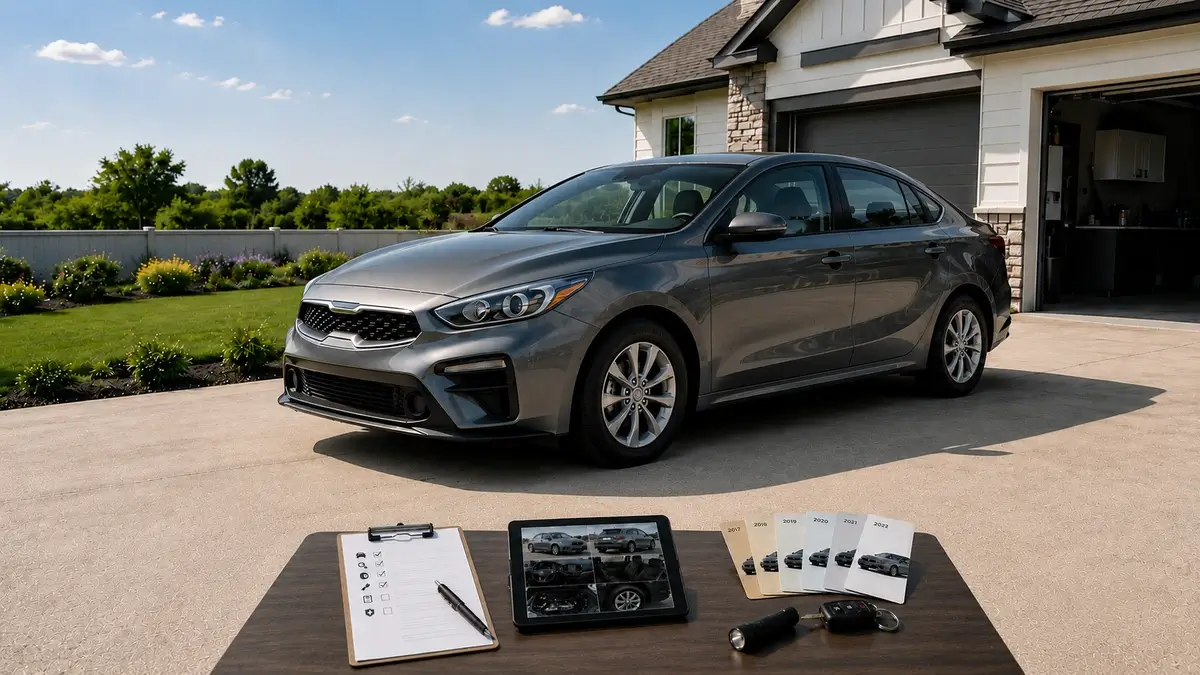
The Kia Forte years to avoid are not all risky for the same reason. Some are old enough that age is the main problem. Others need closer engine, recall, or maintenance checks.
For most used buyers, the safest move is simple. Be very careful with high-mileage 2010-2013 cars. Inspect 2014-2018 2.0-liter GDI models closely. Treat 2019 as a conditional buy because it was the first year of a redesign.
The better used Forte years are usually 2020-2024. They are strongest when the car has clean service records, no open recalls, and no engine, transmission, or electrical warning signs.
A used Forte can still be a smart budget compact sedan. But it should not be treated as a blind buy just because its asking price looks attractive beside a Civic or Corolla.
CarMerit reliability tool
Check 2010-2024 Forte years – NHTSA-backed snapshot
Pick a model year to see Kia Forte complaint, recall, investigation, and manufacturer-communication counts from the article’s NHTSA snapshot, plus CarMerit’s used-buy verdict for that year band.
Owner complaints
…
NHTSA, CarMerit snapshot
Recall records
…
NHTSA, CarMerit snapshot
Investigations
…
NHTSA, CarMerit snapshot
Manufacturer communications
…
NHTSA, CarMerit snapshot
Most-reported problem areas
Complaint counts and manufacturer communications are raw NHTSA records, not defect rates or reliability scores. Newer model years have had less time to collect reports, so lower counts do not prove better reliability. Verdicts come from CarMerit’s article guidance. Data source: NHTSA.gov. Always verify VIN recall status, Kia recall status, service records, engine cold-start behavior, oil level and condition, smoke, warning lights, transmission feel, brakes, tires, electrical features, insurance cost, accident or flood history, and independent inspection results before buying. For 2014-2018 2.0-liter GDI examples, inspect engine history and oil-change records more strictly.
Quick verdict: Kia Forte years to avoid and best years to buy
If you want the shortest answer, prioritize a clean 2020-2024 Forte. Be more cautious with 2010-2013, 2014-2018, and 2019 examples unless the price, mileage, service history, recall status, and inspection results are strong.
| Kia Forte model years and used-buying verdict | Why it matters | Buyer action |
|---|---|---|
| 2010–2013 — Approach with the most caution | These are older first-generation cars. Certain 2010–2013 Forte and Forte Koup vehicles were also included in a Kia fire-risk recall tied to the ABS system. | Avoid high-mileage or poorly documented cars. Check VIN recall status before considering one. |
| 2014–2016 — Caution | These early second-generation cars need close engine and maintenance scrutiny, especially 2.0-liter GDI examples. | Consider only with strong service records, clean inspection results, and no oil-use or knocking symptoms. |
| 2017–2018 — Caution, not automatic avoid | Later second-generation cars can be usable, but 2.0-liter GDI settlement coverage and maintenance history make inspection important. | Buy only if maintenance history is strong and the engine checks out cold and hot. |
| 2019 — Conditional buy | First year of the third-generation Forte. It can be a good value, but early redesign years deserve extra checks. | Inspect transmission feel, drivability, electronics, and recall status before buying. |
| 2020–2021 — Better used buy | These years avoid some first-year redesign concern and are newer than the highest-risk older examples. | Prioritize clean, lower-mileage cars with proof of maintenance. |
| 2022–2024 — Best Forte years to prioritize | These are the newest Forte years and usually make the strongest used-buy case if the price is fair. | Best choice if budget allows. Still check recalls, insurance cost, tires, brakes, and service history. |
This verdict is intentionally cautious. A clean 2017 Forte may be better than a neglected 2022 Forte. Condition still beats the year badge.
How we judged Kia Forte model years
A good Kia Forte year guide should not treat every complaint, forum story, and recall as equal. That creates bad advice.
This guide uses a practical evidence hierarchy.
| Evidence type | How it should be used |
| Official recalls and VIN checks | Best for confirming whether a specific safety repair may apply. |
| NHTSA complaints and safety records | Useful for spotting patterns, but not proof that every car from that year is bad. |
| Kia settlement or campaign information | Useful for identifying engines or model years that need closer scrutiny. |
| Strong reliability and repair references | Helpful for broad ownership-risk context. |
| Owner reports and forums | Useful for concern discovery only. They should not be the final proof. |
| Pre-purchase inspection | Critical because a used car’s condition can override a broad year-level verdict. |
Before buying any used Forte, check the VIN through the NHTSA recall lookup and Kia’s official recall page.
A year-level guide can narrow your risk. It cannot confirm whether one specific car still needs recall work.
Once you have narrowed the model year, use our Kia Forte reliability guide to evaluate the broader ownership-risk picture, including powertrain warning signs, high-mileage evidence, maintenance history, and walk-away conditions. It helps you decide whether the specific car is still worth shortlisting after the year-level screen.
Also check service records. A cheap Forte with weak records is not a bargain if it hides engine wear, oil consumption, poor tire condition, or delayed maintenance.
Once a Forte’s model-year record looks acceptable, make sure the individual car you are considering matches the seller’s description. Check the Forte’s VIN with CarMerit and compare the returned vehicle details with the listing and paperwork. If anything does not line up, resolve that before relying on service history, recall status, or the rest of the pre-purchase checks.
Kia Forte years to avoid
The main Kia Forte years to avoid are the ones where used-buying risk is highest unless proof is strong.
That does not mean every car from these years is junk. It means you should demand more evidence before buying.
2010-2013 Kia Forte
The 2010-2013 Forte is the highest-caution group for most used buyers. Age alone is now a major issue. Many cars from this range will have high mileage, multiple owners, and incomplete service history.
There is also a recall-related reason to be careful. Kia’s NHTSA Part 573 recall report for campaign 23V652 identifies certain 2010-2013 Forte and Forte Koup vehicles equipped with Electronic Stability Control. The report says an HECU electrical short can increase the risk of an engine-compartment fire while driving or parked.
That does not mean every 2010-2013 Forte is unsafe today. It means you should not buy one without checking the VIN and confirming recall completion.
The 2010-2013 Forte also appears in the Kia Engine Class Settlement FAQ vehicle list for certain Theta II 2.4-liter MPI engines. That makes engine history especially important.
Avoid these years if you see engine knocking, oil loss, smoke, warning lights, overheating, poor maintenance records, or a seller who cannot prove recall status.
2014-2016 Kia Forte
The 2014-2016 Forte can look appealing because it is newer than the first generation. Price alone should not offset the need for stricter engine and maintenance checks.
The problem is that this range still needs serious engine scrutiny. The Kia Engine Class Settlement FAQ identifies 2014-2018 Kia Forte models with the Nu 2.0-liter GDI engine as class vehicles.
That does not mean every car will fail. It means engine condition should be a central buying issue.
For 2014-2016 cars, do not rely on a short test drive around the block. Start the engine cold. Listen for ticking or knocking. Watch for smoke. Check oil level and condition. Scan for stored codes.
A clean 2016 Forte with strong records can still be worth considering. A 2014 or 2015 with missing records, oil-use signs, or engine noise should be skipped.
There is also a warranty detail worth checking on some 2014-2015 cars. Kia extended coverage for the driver’s front airbag clock-spring assembly to 15 years with unlimited mileage from the vehicle’s first-service date for affected Forte and Forte Koup vehicles manufactured from November 7, 2012 through April 10, 2015.
During the extended period, Kia’s terms provide no-charge diagnosis for the relevant airbag-warning-light concern and no-charge clock-spring replacement if the clock spring is the cause. Unrelated airbag-system repairs are not covered. Confirm the VIN, production date, first-service date, and current eligibility with Kia before relying on the extension.
This is a warranty extension, not a recall, and coverage is vehicle-specific.
If a 2014–2015 Forte shows an airbag-warning-light history, check CarMerit’s Manufacturer Special Coverage Lookup before assuming the repair is fully owner-paid; the tool can surface the relevant Kia coverage record, while VIN, production date, first-service date, and the diagnosed cause still control eligibility.
2017-2018 Kia Forte
The 2017-2018 Forte is not an automatic avoid. These years can be decent budget buys when they are clean.
The reason for caution is still the engine and maintenance history. The 2017 and 2018 Forte remain inside the Nu 2.0-liter GDI settlement coverage group.
Used buyers can also get misled by appearance alone. A newer-looking 2017-2018 Forte is not automatically a better choice than an older rival; maintenance history, engine condition, recall status, and inspection results still control the decision.
A 2017-2018 Forte is worth considering if it has no warning lights, no abnormal engine noise, no oil-use history, no drivability issue, and clean recall status.
Walk away if the seller says “they all make that noise,” refuses an inspection, or cannot show oil-change history.
2019 Kia Forte
The 2019 Forte deserves a conditional verdict. It was the first model year of the third-generation Forte.
First-year redesigns are not always bad. They just deserve closer review because early production issues and owner experience can be less settled than later years.
Safety is not a simple “newer is better” story here. IIHS evidence for 2017-2024 includes equipment- and build-date-specific award eligibility as well as newer crash-test protocols that should not be merged into one generation-wide score. Use the exact year, equipment, build date, and test shown below.
IIHS safety context for 2017-2024 Kia Forte
| IIHS evidence | Exact Forte scope | What a used buyer should verify |
|---|---|---|
| 2017 Top Safety Pick+ | 2017 Forte 4-door sedan with optional front crash prevention and specific headlights; built after March 2017 | Build date and equipment |
| 2018 Top Safety Pick+ | 2018 Forte 4-door sedan with optional front crash prevention and specific headlights | Body style and equipment |
| 2019 Top Safety Pick+ listing | 2019-2020 Forte 4-door sedan with specific headlights | Exact headlight equipment |
| 2020 Top Safety Pick listing | 2020-2021 Forte 4-door sedan with optional front crash prevention and specific headlights | Exact safety equipment |
| Updated side test: Poor overall | Rating applies to 2019-2024 models | Treat this as one newer IIHS test result, not an overall safety score |
| Updated moderate-overlap front test: Poor overall | Rating applies to 2022-2024 models | Treat this as one test family, not a stand-alone buy-or-avoid verdict |
Table note: IIHS award criteria and crash-test protocols changed over time. Do not compare these rows as one continuous safety ladder, and do not treat the absence of an award as a poor safety rating.
On a 2019 Forte, focus on transmission feel, low-speed drivability, electronics, infotainment behavior, tire wear, brake feel, and recall status.
A well-kept 2019 can still be worth considering when its condition, service history, inspection results, and asking price make sense against the specific alternatives you are shopping. A rough 2019 with jerky acceleration, warning lights, or poor records is not worth chasing.
Best Kia Forte years to buy used
The best used Forte years to buy are usually 2020-2024. They are newer than the higher-caution older groups, but mileage, prior use, and maintenance history still vary car by car.
That does not mean you should pay any price for them. If a Civic, Corolla, Mazda3, or Elantra is in the same budget, compare the exact cars rather than assuming one model is automatically the better value.
2020-2021 Kia Forte
The 2020 and 2021 Forte are often the sweet spot for budget-focused shoppers because they avoid the first-year-redesign concern attached to 2019 while remaining newer than the higher-caution older groups.
They make sense when you want straightforward compact-sedan practicality and can find a clean example with documented maintenance.
Still, do not skip inspection. Check transmission behavior, tires, brakes, alignment, battery age, service history, and recall status.
A clean 2020 or 2021 Forte can be a smart used compact car. A neglected one should be treated like any other risky used sedan.
2022-2024 Kia Forte
The 2022-2024 Forte years are the best used-buy targets if your budget allows. They are the newest Forte years in this guide, but mileage, prior use, and maintenance quality still need to be checked car by car.
They are also better choices if you want a car that feels newer inside. Driver-assistance features vary by trim, so confirm equipment on the exact car.
These years are not risk-free. They still need recall checks, maintenance records, insurance quotes, and a real inspection.
For most buyers, a clean 2022-2024 Forte with no open recalls is the strongest answer.
What 2024 Forte 2.0 MPI/IVT service records should show
For the exact 2024 U.S. Forte with the 2.0-liter MPI engine and IVT, Kia’s official maintenance schedule gives these checkpoints:
| Service item | Official Kia checkpoint | Important condition |
|---|---|---|
| Engine oil and filter | Every 8,000 miles or 12 months | Severe use shortens this to every 5,000 miles or 6 months |
| IVT fluid | No service required under the normal schedule | Under severe use, replace every 56,000 miles |
| Brake fluid | Replace every 48,000 miles or 48 months | Whichever comes first |
| Spark plugs | Replace every 96,000 miles | Kia calls for more frequent replacement under applicable severe-use conditions |
| Engine coolant | First replacement at 120,000 miles or 120 months; then every 24,000 miles or 24 months | Whichever comes first |
Kia’s severe-use conditions include repeated short trips, extended idling or low-speed driving, heavy traffic, frequent stop-and-go use, rough, dusty or salt-treated roads, repeated hills, towing or camping, commercial use, and frequent high-speed or rapid acceleration and deceleration.
EPA fuel economy across the 2020-2024 Forte shortlist
Fuel economy is a configuration check, not a reason to rank these years by itself. FuelEconomy.gov shows meaningful differences within the 2020-2024 shortlist:
| Model years | FuelEconomy.gov configuration | City MPG | Highway MPG | Combined MPG |
|---|---|---|---|---|
| 2020 | Forte 1.6L turbo, Automatic (AM7) | 27 | 35 | 30 |
| 2021-2024 | Forte 1.6L turbo, Automatic (AM-S7) | 27 | 35 | 30 |
| 2020-2021 | Forte 1.6L turbo, Manual 6-spd | 25 | 32 | 28 |
| 2022-2024 | Forte 1.6L turbo, Manual 6-spd | 22 | 31 | 26 |
| 2020-2022 | Forte FE 2.0L, automatic (variable gear ratios) | 31 | 41 | 35 |
| 2023-2024 | Forte FE 2.0L, automatic (variable gear ratios) | 30 | 41 | 34 |
| 2020-2021 | Forte 2.0L, automatic (variable gear ratios) | 29 | 40 | 33 |
| 2022 | Forte 2.0L, automatic (variable gear ratios) | 29 | 39 | 33 |
| 2023-2024 | Forte 2.0L, automatic (variable gear ratios) | 28 | 39 | 32 |
| 2020-2021 | Forte 2.0L, Manual 6-spd | 27 | 37 | 31 |
Table note: EPA estimates are configuration-specific. FuelEconomy.gov labels do not always map one-to-one to retail trim names, so verify the engine and transmission on the exact car. Do not average these rows into one model-year MPG rating.
Kia Forte reliability by year and generation
Kia Forte reliability by year is best understood by generation and engine context. A simple good-year or bad-year list is not enough.
Kia Forte NHTSA owner complaints by model year
| Model year | Owner complaints | Top NHTSA complaint area | Why it matters |
|---|---|---|---|
| 2010 (Gen 1) | 232 | Engine (74) | Early high-volume year with engine reports leading owner filings. |
| 2011 (Gen 1) | 160 | Engine (41) | Lower than 2010, but engine remains the main complaint area. |
| 2012 (Gen 1) | 302 | Engine (153) | Largest Gen 1 complaint count, with engine reports dominant. |
| 2013 (Gen 1) | 211 | Engine (111) | Engine reports remain the leading owner-filed category. |
| 2014 (Gen 2) | 437 | Engine (192) | Highest complaint count in this table, mostly engine-related. |
| 2015 (Gen 2) | 255 | Engine (145) | Engine filings remain high after the 2014 peak. |
| 2016 (Gen 2) | 131 | Engine (56) | Complaint volume drops, but engine stays the top category. |
| 2017 (Gen 2) | 300 | Engine (134) | Complaint volume rises again inside the second generation. |
| 2018 (Gen 2) | 134 | Engine (56) | Lower than 2017, with engine still the largest area. |
| 2019 (Gen 3) | 145 | Powertrain / Transmission (43) | First Gen 3 row shifts toward drivability and powertrain filings. |
| 2020 (Gen 3) | 70 | Unknown / other (21) | Lower total volume, led by broad uncategorized reports. |
| 2021 (Gen 3) | 67 | Engine (20) | Modest total count, with engine as the largest category. |
| 2022 (Gen 3) | 24 | Engine and Unknown / other tie (5 each) | Low total count, with no single category far ahead. |
| 2023 (Gen 3) | 56 | Airbags / Seatbelts / Structure and Steering tie (9 each) | Newer-year reports include safety-structure and steering signals. |
| 2024 (Gen 3) | 22 | Unknown / other (7) | Newest row has limited time on road, so counts are early signals. |
Table note: Complaints are owner-filed NHTSA reports, not defect rates or reliability scores. Newer years have had less time to collect reports.
2010-2013: older first-generation cars
The first-generation Forte is now old enough that condition matters more than brochure specs. Many examples will have high mileage, aging rubber parts, worn suspension components, tired interiors, and incomplete records.
The best case for these years is a cheap commuter with documented care and no open recalls.
The worst case is a low-price car that needs engine, brake, tire, suspension, or electrical work soon after purchase.
Most buyers should skip this group unless the car is unusually clean, well documented, and priced to reflect its age, condition, and likely near-term needs.
2014-2018: better age, but engine checks matter
The 2014-2018 generation is tempting because it looks much newer than the first generation. This is also where engine scrutiny matters most.
The key point is not panic. The key point is proof.
Ask for oil-change records. Check for any engine-related repair history. Inspect the car before purchase.
A mechanic should listen for cold-start noise, scan for codes, check oil condition, and look for leaks.
These years can work for a budget buyer, but they should not be bought casually.
2019-2024: newer and usually easier to shortlist, but still inspect
The 2019-2024 Forte generation is usually easier to shortlist because it is newer and avoids some of the age-related problems that make older Fortes harder to recommend. That does not make it uniformly safer in every IIHS test or automatically better than a well-kept older car.
The best years in this range are typically 2020-2024. They avoid the first-year redesign concern attached to 2019.
The main used-buying checks are transmission feel, electronics, recall status, tire wear, brakes, and maintenance. If the car was used for delivery work or heavy commuting, inspect it more closely.
Common Kia Forte problems to check before buying
Kia Forte common problems should be handled as inspection items. They are not proof that every car is bad.
Use this table before purchase.
| Area to check | What to look for | Why it matters |
| Engine | Knocking, ticking, oil loss, smoke, rough idle, low oil level | Engine issues are the biggest risk on many higher-caution Forte years. |
| Transmission or drivability | Jerky takeoff, hesitation, flare, harsh shifts, delayed engagement | A cheap car becomes expensive if drivability problems are ignored. |
| Recalls | Open recall status by VIN | A year-level recall does not prove the exact car was repaired. |
| Electrical features | Backup camera, screen, locks, windows, lights, sensors | Small issues can add up and hurt daily use. |
| Brakes and tires | Uneven wear, vibration, poor stopping feel, cheap mismatched tires | These are common used-car cost traps. |
| Service history | Oil-change gaps, missing records, repeated engine complaints | Records matter more on higher-risk years. |
| Theft and insurance | Keyed ignition, anti-theft update eligibility, insurance quote | Some used Kia vehicles can cost more to insure in certain areas. |
The best inspection is simple. Start the car cold. Drive it long enough to warm up. Test it at low and highway speeds. Scan for codes. Check it on a lift.
Do not buy a Forte with engine noise and hope it is normal.
Recalls, safety, and ownership checks before purchase
Recall status is one of the most important checks on any used Kia Forte. Do not rely on the seller’s word.
Use the VIN on the windshield, door jamb, registration, or title. Then check it through the NHTSA recall tool and Kia’s official recall page.
NHTSA explains that VIN searches can show whether a specific vehicle needs unrepaired recall work. Year, make, and model searches give more general recall, complaint, investigation, and manufacturer communication results.
Kia Forte NHTSA recalls, investigations, and manufacturer communications by year
| Model year | Recalls | Investigations | Manufacturer communications | Why it matters |
|---|---|---|---|---|
| 2010 (Gen 1) | 3 | 2 | 86 | Multiple recalls and investigations appear for VIN review. |
| 2011 (Gen 1) | 3 | 2 | 78 | Recall and investigation counts match 2010. |
| 2012 (Gen 1) | 4 | 3 | 70 | Higher official-action activity than 2010-2011. |
| 2013 (Gen 1) | 5 | 4 | 73 | Most recalls and investigations among Gen 1 rows. |
| 2014 (Gen 2) | 3 | 1 | 169 | Highest manufacturer-communication count in this table. |
| 2015 (Gen 2) | 1 | 2 | 142 | Fewer recalls, but communication activity remains high. |
| 2016 (Gen 2) | 1 | 0 | 118 | No investigations, but a substantial communication trail. |
| 2017 (Gen 2) | 3 | 0 | 137 | Recall count rises again with high communication volume. |
| 2018 (Gen 2) | 3 | 0 | 90 | Recall activity continues, with fewer communications than 2017. |
| 2019 (Gen 3) | 2 | 0 | 94 | First Gen 3 year has two recall rows and many communications. |
| 2020 (Gen 3) | 0 | 0 | 91 | No recalls or investigations, but communications are still present. |
| 2021 (Gen 3) | 2 | 0 | 63 | Two recall rows return with lower communication volume. |
| 2022 (Gen 3) | 1 | 0 | 37 | One recall row and lower communication count. |
| 2023 (Gen 3) | 3 | 0 | 44 | Three recall rows appear for this newer year. |
| 2024 (Gen 3) | 0 | 0 | 21 | No recall or investigation rows in the NHTSA records. |
Table note: Recall, investigation, and manufacturer-communication counts show year-level NHTSA campaign rows. A VIN lookup is still required because a specific car may already have been repaired.
That difference matters. A model year can be listed in a recall, but your exact car may have already been repaired.
Kia Forte NHTSA recall campaigns to check by model year
| Campaign | Affected Forte years | System / theme | Fire risk | Why it matters |
|---|---|---|---|---|
| 13V114000 | 2010 | Brake light switch | No | Stop-lamp or shift-interlock malfunction can affect crash risk. |
| 15V015000 | 2014 | Electrical system | Yes | Cooling fan resistor overheating can increase vehicle-fire risk. |
| 16V070000 | 2011 | Transmission cooler hose | No | Fluid leak can affect vehicle movement and crash risk. |
| 16V312000 | 2013 | Front seat belt retractor | No | Retaining plate issue can affect occupant protection in a crash. |
| 17V773000 | 2012-2014 | Brake pedal stopper pad | No | Brake lights or shift interlock can behave incorrectly. |
| 18V363000 | 2010-2013 | Airbag control unit / restraint | No | Airbags or pretensioners may not deploy as intended. |
| 18V771000 | 2019 | LED headlight aiming | No | Incorrect low-beam aim can reduce visibility. |
| 20V459000 | 2019 | Front axle driveshaft | No | Driveshaft failure can cause loss of drive power. |
| 20V750000 | 2012-2015 | Engine fire risk | Yes | Engine-compartment fire can occur while driving. |
| 21V164000 | 2021 | Occupant classification sensor | No | Passenger airbag behavior can be wrong with a child restraint. |
| 21V260000 | 2017-2018 | Engine oil pump | No | Oil pump failure can damage the engine and lead to stalling. |
| 21V622000 | 2016-2018 | Trunk lid latch | No | Trunk release problem can create occupant-entrapment risk. |
| 22V031000 | 2017-2018 | Airbag control unit | No | Airbags may not deploy correctly in a crash. |
| 22V304000 | 2021-2022 | Steering column bolt | No | Steering column separation can affect control. |
| 22V906000 | 2023 | Steering knuckle | No | Cracked knuckle can cause loss of steering control. |
| 23V649000 | 2023 | Front lower control arm | No | Control-arm failure can affect steering control. |
| 23V652000 | 2010-2013 | ABS / HECU fire risk | Yes | HECU short can increase engine-compartment fire risk. |
| 24V244000 | 2023 | Front lower control arm | No | Later control-arm campaign keeps 2023 VIN checks important. |
Table note: This is a year-level campaign view, not proof that a specific Forte has an open recall. Check the exact VIN before purchase.
Recall checklist before buying
Before you agree to buy the car, confirm:
- The VIN matches the title, dashboard, and door label.
- NHTSA shows no unrepaired recall for that VIN.
- Kia’s recall page does not show unresolved work.
- The seller has service records or dealer repair proof.
- The car has no warning lights during the test drive.
- A mechanic finds no engine, brake, or electrical red flags.
For 2010-2013 cars, pay special attention to the Kia ABS fire-risk recall. For 2014-2018 2.0-liter GDI cars, pay special attention to engine history.
For 2019-2024 cars, check recall status, insurance cost, transmission behavior, tire condition, and electronic features.
Theft and insurance checks
Some Kia theft and insurance concerns are real, but they should be handled carefully.
Kia says it continues to offer a free enhanced security software upgrade for eligible vehicles targeted by social-media theft methods. NHTSA also says Hyundai and Kia developed theft-deterrent software for millions of vehicles that lack an immobilizer.
That does not mean every Forte has the same risk. The smart move is to check the exact car.
Before buying, ask:
- Does this Forte have a keyed ignition or push-button start?
- Is it eligible for a Kia anti-theft update?
- Has the update already been completed?
- Will your insurer cover it normally?
- Is the quote still reasonable after the VIN is checked?
Do this before paying a deposit. A low purchase price can lose its advantage if insurance is expensive.
Which used Kia Forte should you buy?
The best used Kia Forte for most shoppers is a clean 2020-2024 sedan with complete maintenance records, no open recalls, reasonable mileage, and a clean inspection.
The Forte makes the most sense when the exact car offers a strong combination of condition, records, mileage, equipment, insurance cost, and asking price for your budget. If a Civic, Corolla, Mazda3, or Elantra is in the same budget, compare the actual cars instead of assuming the Forte or the rival is automatically the better long-term buy.
Use the Kia Forte vs Honda Civic, Hyundai Elantra vs Honda Civic, and Hyundai Elantra vs Toyota Corolla comparisons before deciding.
If you are comparing the Forte against the Elantra, use the Hyundai Elantra years to avoid guide to see the matching Hyundai risk view before you choose.
If you want the lowest-risk compact-car shortlist, use the Best Used Compact Cars guide next. If reliability is your main filter, compare the Forte with the broader Most Reliable Used Cars list.
You should skip the Forte if the seller cannot prove maintenance, the engine sounds rough, the VIN shows unresolved recall work, or your insurance quote is unusually high.
You should consider it if the car is clean, priced sensibly for its mileage and condition, inspected properly, and still fits your budget after insurance and immediate maintenance needs are accounted for.
Final used-buy checklist
Before buying a used Kia Forte, do these checks in order:
- Choose the right year range first.
- Check the VIN for recalls.
- Verify maintenance records.
- Start the engine cold.
- Listen for knocking, ticking, or rough idle.
- Watch for smoke or oil smell.
- Test low-speed acceleration and highway cruising.
- Scan for stored diagnostic codes.
- Get an insurance quote.
- Pay only if the price reflects the risk.
A Forte is not a bad used car by default. The mistake is buying the wrong year, with the wrong records, at the wrong price.
Frequently Asked Questions
What year Kia Forte should I avoid?
The highest-caution Kia Forte years are 2010-2013, 2014-2018 with the 2.0-liter GDI engine, and 2019 if it shows early redesign-year issues or weak records.
These are not all automatic rejects. They need stronger proof before purchase.
What are the best years for a used Kia Forte?
The best years for a used Kia Forte are usually 2020-2024. These are newer third-generation cars and make the strongest case when they have clean service records, no open recalls, and no drivability issues.
What year did Kia Forte have engine problems?
Engine concern is strongest around older and middle-year Forte examples, especially 2010-2013 and 2014-2018 cars listed in Kia engine-settlement class-vehicle materials.
Do not rely only on the model year. Check the engine cold, review oil-change records, and get a mechanic’s inspection.
Is a used Kia Forte a good buy?
A used Kia Forte can be a good buy if it is clean, recall-cleared, well maintained, properly inspected, and priced sensibly for its mileage and condition.
It becomes a weak buy if the seller has no records, the engine sounds rough, unresolved recall work remains, or another compact sedan in the same budget gives you a stronger exact-car combination of condition, history, equipment, and inspection results.
How many miles can a Kia Forte last?
A well-maintained Forte can be a long-lasting commuter, but mileage claims depend heavily on engine condition, oil-change history, driving style, and prior repairs.
Treat high mileage as acceptable only when the car has strong records and passes inspection.
How do I check recalls before buying a used Kia Forte?
Use the car’s 17-digit VIN on the NHTSA recall lookup and Kia’s official recall page.
A model-year recall list is not enough because it does not prove whether that exact car has already been repaired.
Are Kia Forte owner complaints enough to avoid a model year?
No. Owner complaints are useful warning signals, but they are not enough by themselves.
Use them to decide what to inspect. Then confirm with recall records, service history, diagnostic scans, and a pre-purchase inspection.
Should I buy a used Kia Forte or compare it with a Civic, Corolla, or Elantra?
Compare before buying whenever a Civic, Corolla, Mazda3, or Elantra is in the same budget. Judge the exact cars on condition, service history, mileage, safety equipment, fuel economy, insurance cost, and inspection results rather than assuming one badge is automatically the safer or better-supported choice.