

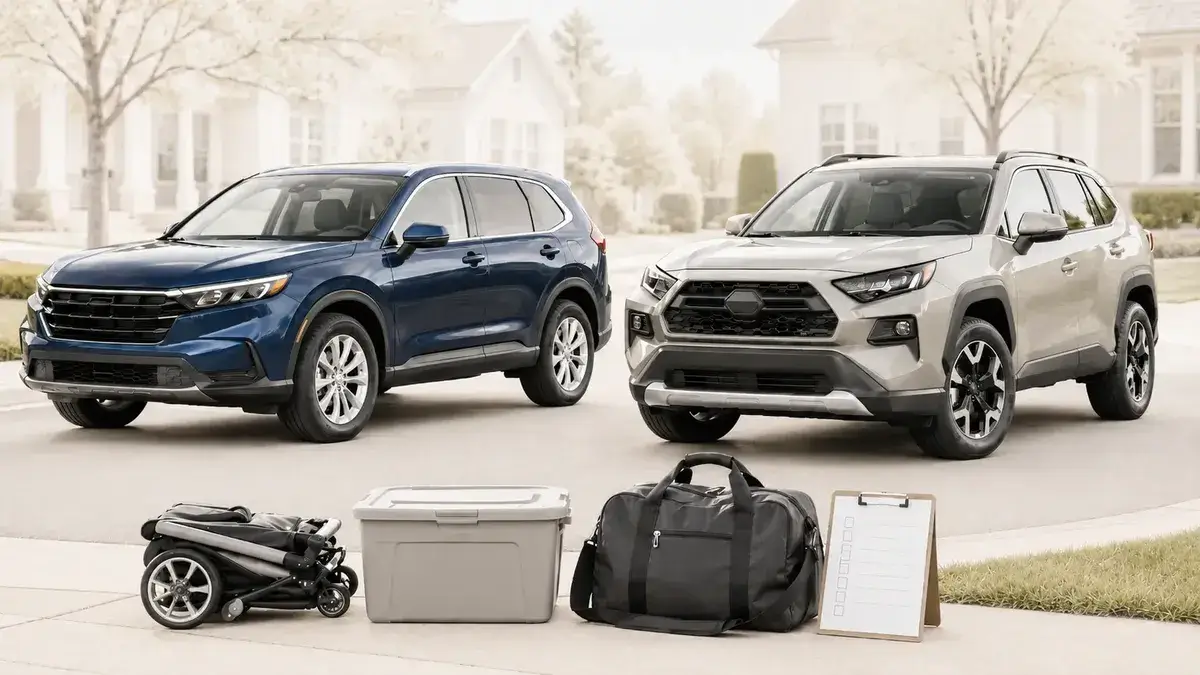
A Honda CRV vs Toyota RAV4 decision looks easy until you compare real used listings. Both compact SUVs have strong reputations, broad availability, useful cargo space, good fuel economy, and enough room for a small family.
The better used buy is not decided by the badge. It depends on the exact year, trim, drivetrain, mileage, maintenance history, accident history, recall status, and asking price.
For most used buyers, the Honda CR-V makes more sense if comfort, cargo usability, rear-seat space, and easy daily driving matter most. The Toyota RAV4 makes more sense if hybrid efficiency matters more and the specific vehicle’s year, condition, history, configuration, and asking price make the deal worthwhile.
CarMerit reliability comparator
Honda CR-V vs Toyota RAV4: 2002-2026 NHTSA snapshot
Owner-complaint and recall counts from NHTSA for 2002-2026, each model’s best used-year lane, and which buyer each one fits.
| 15,386 | complaints (2002-26) | 8,976 |
| 201 | recalls (2002-26) | 143 |
Airbags / seatbelts / structureEngineElectricalSteering | top issues | Airbags / seatbelts / structureEngineElectricalPowertrain |
Honda CR-V
Best used year: 2016
Shortlist 2016 and 2020-2022; check 2015 and 2017-2018 harder for vibration, oil-history, and cold-climate-use proof.
Best for: Comfort-first family buyers who want the stronger cabin, rear-seat space, easy daily driving, and maximum cargo-use case.
Toyota RAV4
Best used year: 2016
Shortlist 2016-2018 and 2020-2022 gas models; use high caution with 2002-2003 automatic and 2006-2008 examples.
Best for: Hybrid-first buyers who prioritize fuel efficiency and will pay more only when the exact vehicle’s condition, history, and configuration justify it.
Quick take: Both are strong used compact SUVs, so the individual vehicle matters more than the badge. Choose the Honda CR-V when daily comfort, rear-seat space, and cargo usability come first; choose the Toyota RAV4 when hybrid efficiency and the specific vehicle justify the premium. Do not crown either SUV from raw NHTSA counts alone.
Complaint counts are raw owner reports filed with NHTSA, not adjusted for sales volume, so they should guide inspection rather than crown a winner. The quick comparator above uses a 2002-2026 overlapping NHTSA snapshot for both models; older records have had more time to collect reports, so use the figures as inspection signals, not rankings. Always inspect the specific vehicle before buying.
Honda CRV vs Toyota RAV4 Quick Verdict
The CR-V is the better default for a comfort-first family buyer. The RAV4 is the better default for a hybrid-first buyer who prioritizes fuel efficiency and is willing to pay more only when the specific vehicle justifies it.
| Decision Point | Honda CR-V | Toyota RAV4 |
|---|---|---|
| Best for | Comfort, cargo usability, family driving | Hybrid efficiency and deal-specific value |
| Better fit if both are clean and fairly priced | Better for comfort-first buyers | Better for hybrid-first buyers |
| Main used-buy risk | Ignoring year, trim, drivetrain, or maintenance context | Overpaying for the badge or the wrong configuration |
| Hybrid logic | Strong if smoothness and comfort matter | Strong if efficiency is the priority |
| Family practicality | Usually the easier fit | Still practical, but check rear-seat comfort |
| Best shopping rule | Buy it if condition and price are strong | Buy it if the premium is justified |
The sharpest answer is conditional: choose the CR-V when daily comfort and usable space matter most; choose the RAV4 when hybrid efficiency and the exact vehicle’s condition, history, and configuration justify its price.
CR-V and RAV4 are two of the best used SUVs under $20,000, but this budget usually means shopping older, cleaner examples. For a broader list that includes sedans and compact cars too, see our best used cars under $20,000 guide.
Compare the Actual SUVs, Not Just the Names
A used Honda CR-V vs used Toyota RAV4 comparison only works when the examples are matched fairly. A base gas RAV4 is not the same decision as a CR-V Hybrid Touring. A one-owner CR-V with service records is not the same risk as a cheaper RAV4 with accident history.
Use these filters before deciding:
- Year: Safety tech, infotainment, drivetrains, and known issues can change by generation.
- Trim: Higher trims can add comfort, but they can also inflate the used price.
- Drivetrain: Gas, hybrid, front-wheel drive, and all-wheel drive change cost and value.
- Condition: Service records, tire condition, brakes, title status, and accident history matter.
- Recall status: Check the exact VIN before purchase.
The biggest mistake is assuming “Toyota reliability” or “Honda reliability” protects you from a bad individual vehicle. It does not. A neglected RAV4 is not automatically safer than a well-maintained CR-V.
CR-V vs RAV4 at a Glance
The CR-V and RAV4 solve the same basic problem, but they reward different buyers. Honda leans toward comfort, space, and daily ease. Toyota leans toward hybrid efficiency and a more rugged personality.
Honda’s official 2025 CR-V specs list cargo volume at 39.3 cubic feet with the rear seat up on several trims and up to 76.5 cubic feet with the rear seat down. Toyota’s official 2025 RAV4 page lists cargo capacity at up to 69.8 cubic feet. That gives the CR-V the stronger maximum cargo-space case in this late-model comparison, while the RAV4 still has enough usable cargo room for most family routines.
| Factor | Honda CR-V | Toyota RAV4 |
|---|---|---|
| Cabin feel | Softer, calmer, more family-friendly | More rugged and upright |
| Cargo space | Stronger maximum cargo advantage in recent specs | Practical, but lower official maximum figure |
| Rear-seat comfort | Often the easier fit for passengers | Good, but check comfort before buying |
| Fuel economy | Strong gas and hybrid numbers | Strong gas numbers and excellent hybrid appeal |
| Driving feel | Smoother and more carlike | Firmer and more SUV-like |
| Used value | Stronger deal when condition, records, and asking price are better | Stronger deal when any premium is justified by condition, records, powertrain, and equipment |
The CR-V’s strengths are easier to feel every day. The RAV4’s clearest measurable advantage in this comparison appears in selected hybrid fuel-economy examples, while the final used-buy decision still depends on the exact vehicle.
Used Price, Availability, and Value
Used asking prices can differ sharply by model year, mileage, drivetrain, trim, condition, history, and local supply. Do not assume a RAV4 premium—or a CR-V discount—without comparing genuinely similar listings.
If one RAV4 costs more than a comparable CR-V, make the premium prove itself through the exact vehicle: cleaner history, lower mileage, a powertrain you actually want, stronger condition, or better service records. The same rule works in reverse; a cheaper CR-V is not automatically better value if it needs more work.
Buyers comparing the RAV4 against other compact SUVs should also review Forester vs RAV4. It adds a useful AWD-focused angle for shoppers who care about winter confidence, visibility, and used-SUV value.
Compare similar examples only:
- Same generation or close model year
- Similar mileage
- Similar drivetrain
- Similar trim level
- Similar service records
- Similar accident and title history
- Similar tire, brake, and suspension condition
If the RAV4 costs materially more, make it prove the premium. Hybrid efficiency, cleaner history, lower mileage, better condition, or a configuration you specifically want can justify it. Badge reputation alone does not.
Honda CR-V vs Toyota RAV4 Reliability
Honda CR-V vs Toyota RAV4 reliability is close enough that the individual vehicle matters more than the logo. Both models are strong mainstream compact SUV choices, but neither is risk-free.
The safest conclusion is not “CR-V always wins” or “RAV4 always wins.” Generic model-wide repair averages do not establish the expected bill for the specific SUV you may buy. Compare service records and use a pre-purchase inspection to identify actual near-term work before treating one as cheaper to own.
Honda CR-V vs Toyota RAV4 NHTSA Evidence Snapshot
| NHTSA evidence field | Honda CR-V | Toyota RAV4 | How used buyers should use it |
|---|---|---|---|
| Model-year coverage | 1997-2026 | 1995-2026 | Compare similar model years, not nameplates alone. |
| Owner complaints | 15,970 | 9,471 | Use as inspection signals, not sales-adjusted reliability scores. |
| Recall rows | 212 | 158 | Check the exact VIN for open or completed recall work. |
| Investigations | 66 | 28 | Treat as official-action context, not a prediction for one vehicle. |
| Manufacturer communications | 3,654 | 6,054 | Use for service-history and known-issue awareness. |
| Owner-reported severity flags | 827 crash / 180 fire / 536 injury / 8 death | 811 crash / 286 fire / 418 injury / 11 death | Review accident history, safety-system status, warning lights, and inspection results carefully. |
Table note: These are raw NHTSA record counts across the available model-year coverage for each SUV. They are not sales-adjusted, not defect rates, and not buy-or-avoid verdicts. Use them to decide how carefully to verify VIN recall status, service records, warning lights, accident history, and inspection results.
Honda CR-V vs Toyota RAV4 Cost to Own
Honda CR-V vs Toyota RAV4 cost to own depends on more than fuel economy. Maintenance records, tires, brakes, suspension condition, drivetrain type, and hybrid-system health can change the real cost.
Gas models are easier to evaluate. Hybrid models can save fuel, but the used price premium and battery age need attention. A hybrid is a smart buy only when the premium is reasonable and the vehicle checks out.
Two manufacturer coverage checks are worth asking about because they overlap with used-year and powertrain lanes discussed in this guide.
Before letting an A/C repair on the CR-V or a high-voltage cable concern on the RAV4 Hybrid decide this matchup, check each model year in CarMerit’s Manufacturer Special Coverage Lookup to see whether manufacturer coverage deserves verification on the exact vehicle.
| Vehicle / Scope | Manufacturer Coverage Change | What to Verify |
|---|---|---|
| 2017–2022 Honda CR-V 1.5T | Honda extended A/C compressor shaft-seal coverage from the original three years to 10 years from the original purchase date, with no mileage limit. | Confirm the 1.5T configuration, VIN/program eligibility, original purchase date, diagnosis, and current written coverage. |
| Certain 2020–2024 AWD Toyota RAV4 Hybrid vehicles | Toyota’s high-voltage floor-under-wire harness/rear-motor cable connector corrosion program can provide 10 years from first use with unlimited mileage when the related Limited Service Campaign 25TD01 requirement is completed by September 30, 2028; otherwise the program specifies the shorter 8-year/100,000-mile boundary when that campaign expires. | Confirm VIN eligibility, AWD Hybrid applicability, campaign-completion status, in-service date, diagnosis, and current Toyota program terms. |
Table Note: These are selected manufacturer coverage checks, not a complete warranty list, failure-rate evidence, reliability rankings, or proof that coverage remains on a specific vehicle. Vehicle-specific eligibility and current remaining coverage must be verified.
Before buying either SUV, check:
- Oil-change history
- Transmission service guidance for that year
- Tire condition and matching tire type
- Brake condition
- Suspension noise
- Cooling-system condition
- Hybrid-system health if applicable
- Open recalls by VIN
- Accident, flood, or title history
NHTSA’s recall page lets shoppers search by VIN or license plate to see whether a specific vehicle has an unrepaired recall. That check belongs before purchase, not after.
Comfort, Cargo Space, and Family Practicality
The CR-V’s best case is daily family use. It feels like the SUV designed to make ordinary driving easier.
That matters if you carry kids, adults, groceries, sports gear, pets, luggage, or a stroller. The CR-V’s stronger maximum cargo number in recent official specs and generally calmer cabin feel make it the easier family recommendation for many buyers.
The RAV4 is still practical. Its upright shape, durable-feeling interior, and square cargo area work well for errands and road trips. The issue is not that the RAV4 is small. The issue is that the CR-V may feel easier if rear-seat comfort and cargo flexibility are daily priorities.
| Family Use Case | Better Fit | Why |
|---|---|---|
| Rear-seat comfort | CR-V | Usually easier for passengers and child seats |
| Maximum cargo flexibility | CR-V | Stronger recent maximum cargo figure |
| Durable everyday cabin | RAV4 | Tougher-feeling interior personality |
| Long highway trips | CR-V | Comfort and calmness matter over time |
| Outdoor or rugged image | RAV4 | Better fit if you prefer a tougher SUV feel |
Do the practical test before buying. Bring the child seat, stroller, work bag, dog crate, or sports gear you actually use. If the SUV fails your real routine, the better spec sheet does not matter.
CR-V vs RAV4 Fuel Economy and Hybrid Choice
EPA estimates change by model year and exact configuration. To keep this comparison tied to the used-year lanes highlighted in this guide, the tables below use selected AWD or 4WD configurations rather than averaging different trims, drivetrains, or powertrains together.
Honda CR-V EPA Fuel Economy — Selected AWD/4WD Configurations
| Model Year | Configuration | City | Highway | Combined |
|---|---|---|---|---|
| 2016 | 2.4L 4WD, Automatic (variable gear ratios) | 25 | 31 | 27 |
| 2020–2022 | 1.5L AWD, Automatic (variable gear ratios) | 27 | 32 | 29 |
| 2020–2022 | 2.0L Hybrid AWD, Automatic (variable gear ratios) | 40 | 35 | 38 |
| 2025 | 1.5L AWD, Automatic (variable gear ratios) | 26 | 31 | 28 |
| 2025 | 2.0L Hybrid AWD, Automatic (variable gear ratios) | 40 | 34 | 37 |
Table Note: EPA city/highway/combined MPG for the exact selected CR-V AWD/4WD configurations shown. A year range is used only where the listed configuration carries the same EPA ratings throughout that range. These are not model-wide averages or complete configuration coverage. Actual fuel economy varies with driving and operating conditions. Source: FuelEconomy.gov official data.
Toyota RAV4 EPA Fuel Economy — Selected AWD Configurations
| Model Year | Configuration | City | Highway | Combined |
|---|---|---|---|---|
| 2016–2018 | 2.5L AWD, Automatic (S6) | 22 | 28 | 25 |
| 2016–2018 | 2.5L Hybrid AWD, Automatic (AV-S6) | 34 | 30 | 32 |
| 2020–2022 | 2.5L AWD LE, Automatic (S8) | 27 | 34 | 30 |
| 2020–2022 | 2.5L Hybrid AWD, Automatic (AV-S6) | 41 | 38 | 40 |
| 2025 | 2.5L AWD LE, Automatic (S8) | 27 | 34 | 30 |
| 2025 | 2.5L Hybrid AWD, Automatic (AV-S6) | 41 | 38 | 39 |
Table Note: EPA city/highway/combined MPG for the exact selected RAV4 AWD configurations shown. A year range is used only where the listed configuration carries the same EPA ratings throughout that range. Gas AWD and Hybrid AWD remain separate. Other configurations can differ; RAV4 Plug-in Hybrid is excluded because EPA reports separate MPG/MPGe operating modes. Source: FuelEconomy.gov official data.
In these selected AWD examples, the older 2016–2018 RAV4 gas and hybrid lanes differ meaningfully from the newer models, while the 2020–2022 gas SUVs are much closer. For 2020–2022, the selected RAV4 Hybrid AWD is rated at 40 mpg combined versus 38 for the CR-V Hybrid AWD; for 2025, the figures are 39 versus 37. Treat gas and hybrid versions as separate buying lanes rather than averaging them together.
A hybrid is not automatically the better used buy. It becomes better when the price premium is reasonable, the battery system checks out, your mileage is high enough, and you plan to keep the SUV long enough to benefit from the fuel savings.
Safety, Driver Assistance, and Year Differences
Safety should be checked by exact year and trim. A newer trim with better driver-assistance features can be a smarter buy than an older base trim from the same model line.
Do not assume one model should be bought blindly over the other. The exact vehicle matters.
IIHS ratings also show why exact model year, trim, build date, equipment, and test era matter. The most useful evidence here is the shared 2016 lane plus the 2020–2022 years already highlighted elsewhere in this guide—not every rating IIHS has published for either SUV.
| Vehicle / Years | Selected IIHS Evidence | What the Used Buyer Should Verify |
|---|---|---|
| 2016 Honda CR-V | Driver-side small overlap: G, applying to 2015–2016. Touring headlights: A. LX, SE, EX, and EX-L headlights: M. Optional Collision Mitigation Braking System vehicle-to-vehicle prevention: Superior. | Confirm the exact trim, headlight hardware, and whether the optional prevention system is actually present. |
| 2016–2018 Toyota RAV4 | Driver-side small overlap: G for 2015–2018 models built after November 2014. Headlights: A on listed upper trims and M on XLE, Hybrid XLE, and LE. For 2016 specifically, the optional Pre-Collision System with Pedestrian Detection vehicle-to-vehicle evaluation is Superior. | Confirm build date, exact trim, lamp type, and whether the optional prevention system is installed. |
| 2020–2022 Honda CR-V | Touring and Hybrid Touring headlights: G. Hybrid LX/EX/EX-L in 2020 and Hybrid EX/EX-L in 2021–2022: A. Gas LX, EX, EX-L, and Special Edition headlights: M. Standard Collision Mitigation Braking System vehicle-to-vehicle prevention: Superior. The updated moderate-overlap rating is P for 2021–2022. | Exact year, powertrain, trim, and headlight configuration matter; do not assume every CR-V in this lane carries the same rating set. |
| 2020–2022 Toyota RAV4 | Headlight results vary substantially by exact trim and package. For 2020–2021, IIHS records include G, M, and P configurations; for 2022, listed projector-headlight trims are G while LE remains M. The updated moderate-overlap rating is M for 2021–2022 within its broader applicability. | Verify the exact year, trim, headlight package, and equipment instead of carrying one rating across the whole RAV4 lineup. |
Table Note: IIHS uses G = Good, A = Acceptable, M = Marginal, and P = Poor for the crashworthiness/headlight ratings shown. Front-crash-prevention evaluations use the separate Basic/Advanced/Superior scale. Updated moderate-overlap results must remain within their own test and criteria context; the P and M entries above are not an overall CR-V-versus-RAV4 safety ranking. Exact year, build date, trim, equipment, and applicability remain controlling.
The practical takeaway is not that one SUV is safer across every year. In 2016, build date, trim, headlights, and optional equipment can change what you are actually buying. In 2020–2022, headlight configuration and the newer IIHS test results make exact-year and exact-trim verification even more important.
Before buying, check:
- IIHS and NHTSA data for the exact model year
- VIN recall status
- Trim-level driver-assistance features
- Blind-spot monitoring availability
- Adaptive cruise and lane-assist behavior
- Backup camera and parking-sensor function
- Headlight condition and visibility
Do not assume every used CR-V or RAV4 has the same safety equipment. Trim and year can change the answer.
One Short Rule Before You Decide
Before choosing either SUV, compare the exact year, trim, drivetrain, mileage, service records, accident history, title status, tire and brake condition, and VIN recall status.
That rule matters more than brand reputation. A clean example of the “second choice” is often better than a neglected example of the “winner.”
Which One Should Different Buyers Choose?
The right answer depends on how you will use the SUV. A commuter, family buyer, hybrid shopper, and high-mileage owner are not making the same decision.
The CR-V is usually the better fit for comfort-first buyers. The RAV4 is usually the better fit for efficiency-first hybrid buyers when the specific vehicle and asking price make sense.
| Buyer Type | Better Pick | Reason |
|---|---|---|
| Family with kids and cargo | Honda CR-V | Better comfort and cargo-use case |
| Efficiency-first hybrid shopper | Toyota RAV4 Hybrid | Higher combined MPG in the selected same-year AWD hybrid examples |
| Comfort-focused commuter | Honda CR-V | Calmer daily-use feel |
| Budget-sensitive buyer | Depends on local pricing | Buy the cleaner, fairer-priced SUV |
| High-mileage buyer | Depends on records | Maintenance history matters most |
| Road-trip buyer | Honda CR-V | Comfort and cargo matter over long drives |
| Buyer who wants a tougher SUV feel | Toyota RAV4 | More upright, rugged-feeling personality |
The best used choice is not the model with the louder fan base. It is the one that fits your use case and comes with the stronger ownership evidence.
If you are comparing these two SUVs mainly for family use, also read our best used family cars guide. It shows where the CR-V and RAV4 fit against family sedans and smaller SUVs before you commit to one body style.
Common Mistakes When Choosing Between the CR-V and RAV4
The easiest way to make a bad choice is to compare reputations instead of vehicles. “Honda vs Toyota” is too broad to protect your money.
Avoid these mistakes:
- Comparing mismatched trims: A loaded CR-V and a base RAV4 are not a fair comparison.
- Ignoring drivetrain: Gas, hybrid, AWD, and plug-in hybrid versions change the math.
- Skipping service records: Maintenance history can matter more than the badge.
- Overpaying for the badge: A higher asking price needs to be justified by the exact vehicle, not assumed market reputation.
- Assuming CR-V comfort always wins: Sit in the exact vehicle and test the ride.
- Ignoring recalls: Use the VIN, not the model name.
- Buying on mileage alone: Low mileage with poor maintenance is not automatically safer.
- Skipping inspection: A pre-purchase inspection can save more than any spec comparison.
A clean inspection can flip the verdict. If the CR-V has better records, better tires, cleaner title history, and a lower price, it can beat the RAV4. If the RAV4 is cleaner and the premium is fair, it can be the safer long-term bet.
For a wider three-SUV shortlist, compare both models against Mazda’s alternative in our best used compact SUVs guide.
Final Recommendation
Honda CRV vs Toyota RAV4 is a close comparison, but it does not need a vague answer. Choose the Honda CR-V if you want the better comfort-first used compact SUV with strong cargo usability, a calmer cabin, and easier family practicality. Choose the Toyota RAV4 if hybrid efficiency matters more and the exact vehicle’s condition, history, configuration, and asking price justify the choice.
If the RAV4 still feels expensive after this comparison, the Nissan Rogue is another value-focused compact SUV to consider. It brings a different trade-off: lower used prices, but more need for service-history and inspection discipline. Compare that choice in our Nissan Rogue vs Toyota RAV4 guide.
For most practical used buyers, the CR-V is the better everyday choice when comfort, cargo, and price discipline matter. The RAV4 is the stronger efficiency-first choice when the hybrid setup, vehicle condition, and asking price justify the premium.
The CR-V is the closest RAV4 rival for many used buyers, but it is not the only alternative. If value and features matter more than the lowest-risk default, compare Hyundai Tucson vs Toyota RAV4 before locking in your shortlist.
The final rule is simple: buy the cleaner vehicle, not the louder reputation. If the RAV4 costs more, make it prove the premium with records, condition, drivetrain, and the powertrain or equipment you actually want. If the CR-V is cheaper, make sure the lower price is real value, not a warning sign.
If CR-V and RAV4 prices feel too high, compare Kia Sportage vs Hyundai Tucson as a value-focused backup decision. The Tucson often makes sense as the calmer used-SUV pick, while the Sportage can work if the exact example is cleaner or better equipped.
This is most useful for buyers who still want a mainstream compact SUV but are shopping beyond the Toyota-Honda benchmark.
If the CR-V is on your shortlist but you are also considering a cheaper Nissan alternative, the Nissan Rogue vs Honda CR-V comparison explains the risk-versus-price trade-off.
CR-V vs RAV4 is the main reliability-focused SUV matchup for many used buyers. If you are not locked into an SUV yet, compare both against other low-risk picks in our Most Reliable Used Cars guide.
The CR-V is the safer default in many compact SUV comparisons, but price still matters. If you are also considering a lower-cost alternative, Kia Sportage vs Honda CR-V explains when the Sportage discount is worth taking.
Frequently Asked Questions
Is the Honda CR-V or Toyota RAV4 better to buy used?
The Honda CR-V is usually better if comfort, cargo space, and family usability matter most. The Toyota RAV4 is usually better if hybrid efficiency matters more and the exact vehicle justifies its asking price. For used buyers, condition and service history can override the badge.
Which is more reliable, the Honda CR-V or Toyota RAV4?
Neither SUV should be crowned from raw NHTSA totals or generic model-level repair-cost estimates. Compare the exact model year, service records, recall status, drivetrain, warning lights, and pre-purchase inspection results before deciding which specific vehicle presents the cleaner used-buy case.
Is the CR-V cheaper to maintain than the RAV4?
Do not decide this from a generic annual or 10-year estimate. Maintenance and repair needs vary by model year, drivetrain, condition, service history, and local labor and parts prices. Compare documented service and inspection findings, then price the work the exact SUV actually needs.
Which has more cargo space, the CR-V or RAV4?
Recent official specs give the CR-V the stronger maximum cargo-space figure. Honda lists up to 76.5 cubic feet with the CR-V rear seat down, while Toyota lists the 2025 RAV4 at up to 69.8 cubic feet. Exact usable space can still vary by trim, cargo-floor setup, and model year, so verify the specific SUV before buying.
Is the CR-V Hybrid better than the RAV4 Hybrid?
The CR-V Hybrid is better if you value smoother driving, comfort, and Honda’s cabin layout. The RAV4 Hybrid is the stronger efficiency choice in the selected AWD EPA examples shown above: 40 mpg combined versus 38 for the CR-V Hybrid in 2020–2022, and 39 versus 37 in 2025. The better used hybrid still depends on price, mileage, hybrid-system condition, and service history.
Which compact SUV is better for families?
The CR-V is usually the easier family recommendation because of its comfort and cargo usability. The RAV4 still works well for families, especially if hybrid efficiency matters more or the specific RAV4 is the cleaner, better-priced example.
Is the RAV4 worth paying more for used?
Yes, but only when the premium is justified by the specific vehicle. Cleaner records, lower mileage, better condition, a hybrid powertrain you actually want, or better equipment can support a higher price. It is not worth paying more simply because it is a Toyota.
Which one should high-mileage buyers choose?
High-mileage buyers should choose the better-maintained example. At higher mileage, service records, transmission behavior, suspension condition, hybrid-system checks, and title history matter more than the model name.
Should I buy a gas or hybrid CR-V/RAV4?
Buy gas if the purchase price is better, your annual mileage is moderate, and you want a simpler used-buy decision. Buy hybrid if the price premium is reasonable, you drive enough to benefit from fuel savings, and the hybrid system checks out.
What should I check before buying either SUV?
Check the VIN for recalls, review service records, scan for accident or title issues, test driver-assistance features, check tires and brakes, listen for suspension noise, and get a pre-purchase inspection. NHTSA says a VIN or license plate search can show whether a specific vehicle has an unrepaired recall.
Once the CR-V-versus-RAV4 decision comes down to actual listings, make sure you are comparing the SUVs the ads claim they are. Run each VIN through the CarMerit VIN Lookup and compare the returned vehicle details with the seller’s description and paperwork. Then keep official recall status, accident and title history, service records, and mechanical condition as separate checks before choosing between the two.