

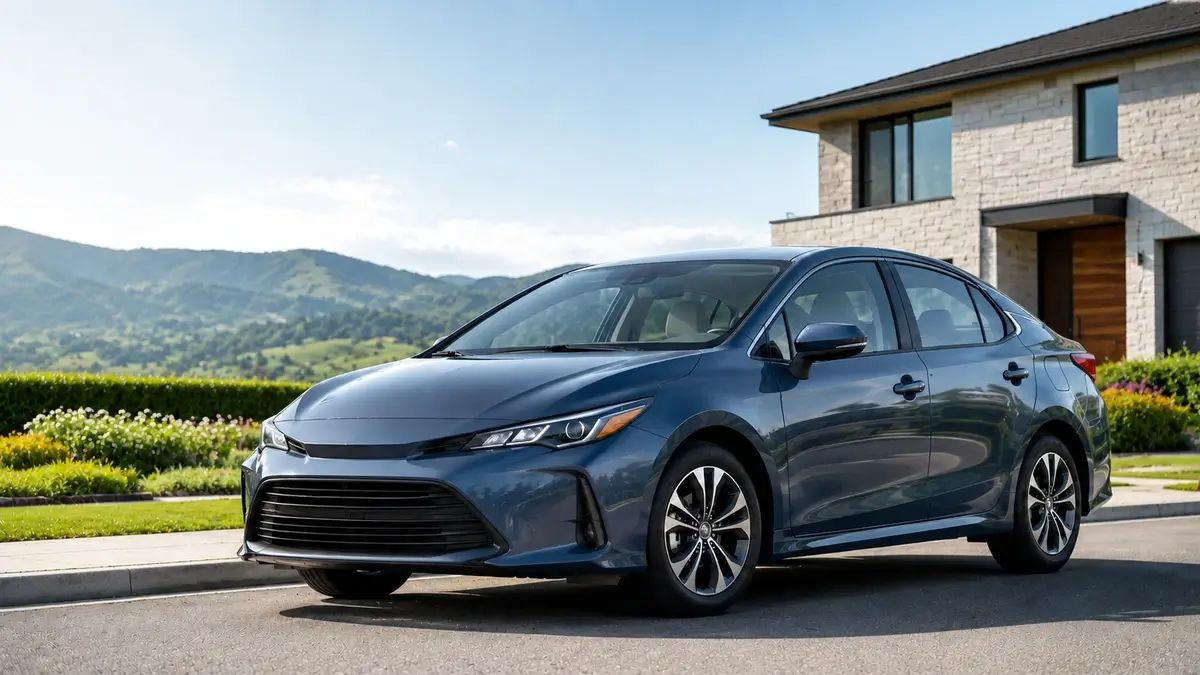
Toyota Corolla Hybrid reliability is strong enough to make this sedan a smart used-car shortlist pick. But it is not an automatic buy just because it wears a Toyota badge.
The right used Corolla Hybrid can be easy to live with, efficient, and low-risk. The wrong one can erase its fuel savings with neglected maintenance, warning lights, unresolved recall work, weak 12V battery history, or a price premium that does not fit your driving.
Fastest safe default: buy a clean-history Corolla Hybrid with documented maintenance, no warning lights, a clean recall check, and a hybrid-aware inspection.
What goes wrong if you pick badly? You can pay extra for the hybrid version, then lose the advantage through deferred service, electrical issues, or weak ownership math.
Use this quick filter first:
- Shortlist it if you commute often, want high fuel economy, and can verify service records.
- Be cautious if the seller cannot explain maintenance, 12V battery history, or warning lights.
- Skip it if there are unresolved hybrid-system warnings, open recall issues, flood history, salvage history, or a vague seller story.
- Compare alternatives if the hybrid price premium is high or your annual mileage is low.
Quick Verdict: Is the Toyota Corolla Hybrid Reliable?
Yes, the Toyota Corolla Hybrid is generally a reliable used-car choice when you buy the right example. The safest verdict is not “buy any Corolla Hybrid.” It is buy one with proof.
The car’s strongest case is simple. It combines the Corolla’s practical compact-sedan formula with Toyota’s hybrid experience. That makes it appealing for commuters, city drivers, and buyers who want lower fuel use without moving into a larger or more expensive hybrid.
The risk is also simple. A used hybrid has more inspection points than a basic gas Corolla. You need to check the hybrid system, 12V battery, service records, warning lights, recall status, and fuel-savings math before you commit.
Start with two official checks. Run the VIN through Toyota’s recall lookup and NHTSA’s recall search. Then compare the car’s records against Toyota maintenance information for the exact model year.
For U.S. Corolla Hybrids, Toyota lists separate hybrid coverage. The Hybrid System Warranty covers specified hybrid components for 8 years or 100,000 miles, while the Hybrid Battery Warranty is 10 years or 150,000 miles, whichever comes first, measured from the original in-service date and subject to the written terms.
The battery warranty is defect coverage, not a guarantee of battery lifespan or capacity retention. On a used car, verify the original in-service date, current mileage and applicable terms through Toyota’s manuals and warranties information.
| Buyer question | Practical answer |
|---|---|
| Is it reliable enough to buy used? | Yes, if the specific car passes inspection and has clean maintenance history. |
| Do safety results vary by year or configuration? | Yes. IIHS results vary by model year, test family, equipment and, for 2022 Hybrid LE headlights, build date. Use the IIHS checkpoints below instead of treating the Corolla Hybrid as uniformly safer or worse than other hybrids. |
| Should you worry about the hybrid battery? | Do not panic, but verify warning lights, service history, diagnostic codes, and remaining warranty context. |
| Should you worry about the 12V battery? | Yes. A weak 12V battery can create confusing symptoms and should be tested. |
| Is it cheap to own? | It can be, but only if you do not overpay upfront or ignore maintenance. |
| Should every buyer choose it over a gas Corolla? | No. Low-mileage drivers may not save enough fuel to justify the premium. |
Toyota Corolla Hybrid Reliability Snapshot
The Corolla Hybrid’s reliability case is strongest when you treat it as a practical commuter, not a blind bargain. Its value comes from low fuel use, simple daily usability, and Toyota’s hybrid reputation.
Still, a used-car decision has to be car-specific. A clean 60,000-mile example with records is a different risk than a cheaper car with warning lights and no maintenance trail.
| Reliability area | Buyer read | What to verify before buying |
| Overall reliability | Strong used-buy potential | Maintenance records, ownership history, inspection report |
| Hybrid battery | Not a reason to panic | Remaining warranty context, warning lights, diagnostic scan |
| 12V battery | Small part, big symptoms | Battery age, test result, no-start history, low-voltage codes |
| Maintenance | Usually manageable if records are clear | Exact model-year maintenance schedule, oil changes, inspections |
| Fuel economy | Main ownership advantage | Exact year, trim, drivetrain, and your annual mileage |
| Model-year risk | Needs year-level checking | Recall status, complaint patterns, and deeper year guide |
| Price premium | Can weaken the deal | Compare against gas Corolla and Prius pricing |
Do not treat the Corolla Hybrid as identical to the regular Corolla. The gas Corolla still has a broader ownership history and simpler hardware. If you are comparing the hybrid against the regular model, read the full Toyota Corolla reliability guide before deciding.
Who Should Buy a Used Toyota Corolla Hybrid?
The best Corolla Hybrid buyer drives enough miles to make fuel savings matter. This car makes the most sense for commuters, city drivers, rideshare-light users, and buyers who keep cars for several years.
It is also a strong fit if you want a compact sedan with low running-cost potential but do not want a full Prius shape. The Corolla Hybrid feels more conventional, which many buyers prefer.
You should put it high on your list if:
- You drive often in city or mixed traffic.
- You want strong fuel economy without a larger car.
- You plan to keep the car long enough for fuel savings to matter.
- You can verify maintenance and recall status.
- You want a practical sedan instead of a hatchback-style hybrid.
- You are shopping for a lower-risk compact car, not a feature-heavy car.
You should be more cautious if:
- You drive very few miles each year.
- The hybrid costs much more than a comparable gas Corolla.
- The car has warning lights or unexplained electrical symptoms.
- The seller cannot provide service records.
- You need the cheapest possible repair path.
- You dislike extra inspection steps before buying.
A used Corolla Hybrid can also belong on a broader reliability-focused shortlist. If you are comparing multiple low-risk options, use CarMerit’s most reliable used cars guide to keep the decision grounded.
If your main question is segment fit, compare it with other best used compact cars before paying extra for the hybrid version.
Toyota Corolla Hybrid Reliability by Year
Toyota Corolla Hybrid reliability by year needs careful handling. This page should not replace a full model-year guide.
The safer approach is to use year-level research as a risk filter. You should check each model year for recalls, complaint patterns, feature changes, warranty context, and ownership history before calling it a safe buy.
For a deeper year-by-year decision, use the full Toyota Corolla Hybrid Years to Avoid and Best Years to Buy guide. That page is the better place to decide which years deserve more caution.
What IIHS Adds to the Used-Buy Decision
IIHS results answer a different question from reliability: how specific vehicle scopes performed in defined crash, lighting, and safety evaluations. Use them as a safety filter, not as a reliability score.
| Model years / scope | Selected IIHS checkpoints | Rating | What it means for the buyer |
|---|---|---|---|
| 2020–2021 Corolla Hybrid sedan | Driver- and passenger-side small overlap; original moderate overlap; original side / updated side / Hybrid LE headlights | G / G / G / G / A / M | The original crashworthiness results were strong, but the tougher updated-side test and headlight result add useful qualification. |
| 2022 Hybrid LE | Driver- and passenger-side small overlap; original moderate overlap; original side / updated side / headlights | G / G / G / G / A / M before December 2021; A after November 2021 | Build date matters when comparing 2022 listings because the Hybrid LE headlight rating changed. |
| 2023–2024 Corolla Hybrid sedan | Updated moderate overlap / updated side / Hybrid-trim headlights | M / A / G | The newer test families add information that should not be collapsed into the older original-test ratings. |
| 2025–2026 Corolla Hybrid sedan | Updated side / Hybrid-trim headlights | G / G | The M updated-moderate-overlap rating shown on the 2025–2026 Corolla sedan pages explicitly does not apply to the Hybrid variant. |
Table Note: G = Good; A = Acceptable; M = Marginal; P = Poor. Ratings apply only to the stated model years, Hybrid scope, equipment/build-date conditions and IIHS test families. Original and updated tests should not be merged into one overall safety score, and a rating not shown here should not be interpreted as poor.
Toyota Corolla Hybrid NHTSA Ownership-Risk Evidence Snapshot
| NHTSA signal | Years / cells to check | Evidence snapshot | Ownership-risk read | Buyer action |
|---|---|---|---|---|
| Owner complaint records | 2020: 1, 2021: 0, 2022: 1, 2023: 0, 2024: 2, 2025: 1, 2026: 0 summary only | 5 API complaint records for 2020-2025; 2026 summary shows 0 | Low raw volume, but complaints still work as inspection clues | Do not score reliability from count alone. Inspect the exact car, scan for codes, and verify records. |
| Safety recalls | 2020: 2, 2021: 0, 2022: 0, 2023: 2, 2024: 2, 2025: 1, 2026: 0 summary only | 7 year-level recall records; 4 unique campaigns | Recall proof matters most on 2020 and 2023-2025 examples | Run Toyota and NHTSA VIN checks and ask for dealer completion records. |
| Investigations | 2020: 1, 2021: 1, 2022: 1, 2023: 0, 2024: 0, 2025: 0, 2026: 0 | 3 investigation counts in the snapshot | Useful context, not a buy/avoid verdict | Treat as another reason to verify the specific VIN and inspection history. |
| Manufacturer communications | 2020: 93, 2021: 95, 2022: 72, 2023: 83, 2024: 71, 2025: 37, 2026: 20 | 471 total across 2020-2026 summary counts | Not a defect count, but useful service-context evidence | Compare service records with the exact model-year maintenance and warranty materials. |
| Complaint component areas | 2020: Electrical; 2022: Airbags / seatbelts / structure; 2024: Electrical + exterior lighting; 2025: Vehicle speed control | 1 injury reported in the 2022 complaint record; no crash, fire, or death reports in parsed API complaints | Use component areas as inspection leads only | Test electrical functions, warning lights, lighting, seatbelt/airbag indicators, braking feel, and acceleration behavior. |
Table note: NHTSA complaint counts, investigation counts, and manufacturer communications are not defect rates or reliability scores. Older model years have had more time to collect records. Use this table to guide inspection, not to choose or avoid a model year by itself.
For this reliability guide, use this rule:
| Used Corolla Hybrid situation | Risk level | Buyer action |
| Newer car, clean records, no warning lights | Lower | Still inspect, but it can be a strong buy |
| Older or higher-mileage car with full records | Moderate | Good candidate if hybrid and 12V checks pass |
| Car with missing maintenance history | Higher | Negotiate hard or walk away |
| Car with unresolved recall or warning lights | High | Do not buy until fixed and documented |
| Car priced far above gas Corolla alternatives | Deal risk | Calculate fuel savings before paying more |
Avoid one common mistake. Do not choose a year only because someone online says it is “good.” You need the VIN check, inspection, maintenance history, and price check to agree.
Toyota Corolla Hybrid Common Problems and Owner Complaints
Toyota Corolla Hybrid common problems should be treated as inspection signals, not automatic proof that every car has the issue. Owner complaints and forums are useful for knowing what to check. They are not enough to prove a defect across all cars.
The NHTSA snapshot below is narrower than the full inspection checklist: it shows official complaint, recall, investigation, and manufacturer-communication signals, while the broader checklist also covers practical used-hybrid checks such as 12V battery age, warning lights, service records, and diagnostic results.
The most useful concerns fall into a few buckets.
| Concern area | What it can mean | How to handle it |
| 12V battery complaints | Weak battery, low-voltage symptoms, no-start frustration | Test the battery and ask for replacement history |
| Hybrid battery fear | Normal buyer anxiety around expensive hybrid parts | Check warranty context, warning lights, and diagnostic codes |
| Brake or regen feel | Normal hybrid feel, wear issue, or warning-light concern | Road test and inspect brake system |
| Infotainment or electronics | Annoying but not always ownership-breaking | Test every function before buying |
| Fuel economy disappointment | Driving style, tires, weather, trim, or unrealistic expectations | Compare EPA estimates with your real driving |
| Warning lights | Potential hybrid, electrical, brake, or emissions issue | Do not buy without diagnosis and repair proof |
The 12V battery deserves special attention because it can create outsized frustration. A weak 12V battery can cause warning messages, no-start situations, or confusing electrical behavior.
That does not mean the Corolla Hybrid is unreliable. It means the 12V battery should be tested before purchase, especially on a used example with unknown history.
Hybrid battery anxiety is different. Toyota’s hybrid-battery warranty gives useful confidence, but it does not remove the need to inspect the actual car. A used buyer should still check for warning lights, stored codes, and signs of neglect.
Hybrid Battery, 12V Battery, and Hybrid-System Maintenance
The hybrid battery is the part most buyers worry about first. In practice, the 12V battery and basic maintenance records may tell you more about the car’s day-to-day ownership risk.
The high-voltage hybrid battery should not be judged by fear alone. Check the warranty context, mileage, age, diagnostic scan, and dashboard warning lights. If anything looks unclear, have the car inspected before buying.
The 12V battery is smaller but still important. Ask when it was last replaced, check for slow starts or repeated jump-starts, and have it tested. A cheap battery issue can look more serious than it is, but you should not guess.
Hybrid-system maintenance should be boring. That is a good thing. You want records showing regular service, no ignored warning lights, and no vague “it has always been fine” answers.
Toyota’s owner manuals and warranty materials point buyers back to the correct guide for their exact model year. For a used Corolla Hybrid, that means dated records matter more than seller confidence.
Check these before purchase:
- Maintenance records with dates and mileage.
- No hybrid-system warning lights.
- No brake, ABS, or battery warning lights.
- 12V battery age and test result.
- VIN recall status from Toyota and NHTSA.
- Smooth start-up, braking, and low-speed operation.
- No signs of flood, salvage, or major electrical damage.
- Diagnostic scan if the car is higher-mileage or has warning history.
Do not accept “hybrids last forever” as proof. A good used Corolla Hybrid should make the inspection easy.
Toyota Corolla Hybrid Maintenance Cost and Cost to Own
Routine scheduled maintenance and one-off repair exposure are separate parts of the ownership-cost decision. Service records tell you whether routine care was kept up; they do not guarantee that an unexpected repair will never occur.
Toyota’s 2021–2024 Corolla Hybrid Warranty and Maintenance Guides use a 5,000-mile or six-month scheduled-maintenance cadence. Do not automatically carry that exact schedule into 2020, 2025 or 2026, and do not substitute a gas Corolla guide for the Hybrid. Match the car’s records to Toyota’s manuals and warranties information and the exact owner materials for its model year.
For a 2020–2021 Corolla Hybrid, one additional ownership-cost check is worth making. Ask a Toyota dealer to verify VIN eligibility for Customer Support Program 24TE04. The program addresses a flow shut-off valve coolant leak on certain vehicles that can trigger a Maintenance Required message or abnormal A/C operation.
The primary coverage window ended November 30, 2025. Secondary coverage is vehicle-specific for up to 10 years from the original date of first use or 100,000 miles, whichever comes first.
Do not assume eligibility from model year alone. Verify the VIN, applicable production scope, original in-service date, current mileage and current written program terms.
For a 2020–2021 Corolla Hybrid with a coolant-loss, “Maintenance Required,” or abnormal A/C history, CarMerit’s Manufacturer Special Coverage Lookup can help you flag the relevant Toyota coverage record before you fold that repair into the car’s long-term ownership-cost estimate.
For ownership math, separate routine cost from risk cost.
| Cost area | What usually matters most |
| Routine maintenance | Oil changes, inspections, filters, tires, brakes |
| Hybrid-specific checks | Warning lights, battery condition, diagnostic scan |
| 12V battery | Age, replacement history, low-voltage symptoms |
| Tires | Condition, matching set, uneven wear |
| Brakes | Hybrid regen can reduce wear, but inspection still matters |
| Fuel | Main savings advantage over a gas compact |
| Purchase price | The premium must make sense for your mileage |
| Used-market price | Compare like with like by model year, mileage, drivetrain, trim/equipment, title and accident history, service history, condition and local market. Asking price is not transaction price or proof of future resale strength. |
The Corolla Hybrid’s EPA ratings make fuel use its clearest running-cost advantage, but fuel economy alone does not prove lower total ownership cost. If you drive very little or pay a large hybrid premium, the fuel savings can take longer to matter.
That is the key ownership-cost question. Do not ask only, “Is it reliable?” Ask, “Does this specific car’s price, condition, fuel savings and repair exposure beat the alternatives?”
Repair-Cost Scenarios Worth Budgeting For
These are contingency-planning examples for specific Corolla Hybrid scopes. They do not mean that the repairs are common or likely.
| Exact scope | Repair scenario | Planning estimate | What the buyer should verify |
|---|---|---|---|
| 2020–2022 Corolla Hybrid 1.8L e-CVT | Hybrid transaxle replacement | Used OEM unit: $650–$1,700; labor: $1,000–$2,400; combined planning range: $1,650–$4,100 | Get a written quote separating the used unit, labor, correct transaxle fitment, calibration, coolant bleeding and consumables. |
| 2020–2022 Corolla Hybrid | Hybrid cooling module/radiator assembly replacement | New OEM radiator assembly: $230–$350; labor: $400–$970; combined planning range: $630–$1,320 | Ask whether the quote covers only the radiator or the complete cooling-module work and whether A/C service and coolant bleeding are included. |
| 2020–2025 Corolla Hybrid | High-voltage electric A/C compressor replacement | Dealer worst-case planning total: $2,700–$4,300+ | Ask whether the quote includes the compressor, refrigerant and oil, condenser/valve/drier work, and any contamination cleanup. |
Table Note: These are single-source Go-Parts planning estimates captured August 4, 2026, for the exact scopes shown. They are not quotes, guaranteed bills, expected annual costs, failure probabilities, or evidence that these repairs are common. Independent parts checks were not directly comparable installed-price estimates, so these figures should not be treated as consensus prices. Do not add the scenarios together. Actual cost varies by vehicle, location, parts, labor, diagnostics, related damage, taxes, fees and shop method.
Fuel Economy, Depreciation, and Long-Term Value
Fuel economy is the Corolla Hybrid’s clearest advantage. It matters most when your daily driving lets the hybrid system work often.
Use FuelEconomy.gov’s Find and Compare Cars tool to check the exact model year, trim, and drivetrain. Corolla Hybrid fuel ratings can vary by setup, so do not assume one number covers every car.
EPA Fuel Economy by Configuration
Official FuelEconomy.gov figures show why drivetrain and exact EPA configuration matter when you calculate the Corolla Hybrid’s fuel-savings case.
| Model years | EPA configuration | City | Highway | Combined |
|---|---|---|---|---|
| 2020–2022 | FWD | 53 | 52 | 52 |
| 2023 | FWD — Hybrid / Hybrid with Sport mode | 53 / 50 | 46 / 43 | 50 / 47 |
| 2023 | AWD — Hybrid / Hybrid with Sport mode | 51 / 47 | 44 / 41 | 48 / 44 |
| 2024–2025 | FWD — two official EPA records | 53 / 50 | 46 / 43 | 50 / 47 |
| 2024–2025 | AWD — two official EPA records | 51 / 47 | 44 / 41 | 48 / 44 |
| 2026 | FWD — Corolla Hybrid / Corolla Hybrid SE | 53 / 50 | 46 / 43 | 50 / 47 |
| 2026 | AWD — Corolla Hybrid AWD / Corolla Hybrid SE AWD | 51 / 47 | 44 / 41 | 48 / 44 |
Table Note: EPA/FuelEconomy.gov city, highway and combined MPG. Slash-separated values correspond to separate official EPA records/configurations in the order shown; they are not averages or a minimum-to-maximum range. AWD begins with the 2023 model year. For 2024–2025, the official dataset contains more than one FWD and AWD record under the same broad model/drivetrain labels, so do not infer an exact retail trim from MPG alone. Real-world fuel economy varies with weather, speed, traffic, driving style, tires, vehicle condition and load. Fuel economy is one running-cost input, not a reliability or total ownership-cost score.
The fuel-savings math should be practical:
- Estimate your annual mileage.
- Compare your city and highway mix.
- Check your local fuel price.
- Compare the hybrid price premium against a gas Corolla.
- Include insurance, tires, maintenance, and inspection costs.
- Decide how long you plan to keep the car.
Used-market asking prices are a shopping snapshot, not proof of long-term depreciation or resale strength. Compare like with like: the same model year, mileage, drivetrain, trim and equipment, title and accident history, service history, condition and local market. A high asking price can weaken the Corolla Hybrid’s fuel-savings case, but it does not by itself prove stronger future resale.
That is why value depends on the specific deal. A fairly priced Corolla Hybrid with clean records can make sense; an overpriced one may be less attractive than a gas Corolla, Prius, or another compact car.
Used Toyota Corolla Hybrid Inspection Checklist
A used Toyota Corolla Hybrid inspection checklist should focus on proof, not guesses. The goal is to confirm that the car’s reliability story matches its condition.
Before you apply recall and hybrid-specific checks to a particular Corolla Hybrid, make sure the listing accurately identifies the vehicle you are evaluating. Run the Corolla Hybrid’s VIN through CarMerit and compare the returned vehicle details with the seller’s description and paperwork. Once those details match, continue with the official Toyota and NHTSA recall checks, maintenance records, warning-light scan, battery checks, and the full pre-purchase inspection.
Toyota Corolla Hybrid NHTSA Recall / VIN Due-Diligence Triggers
| NHTSA campaign / theme | Corolla Hybrid years shown | Evidence figure | What to verify before buying | Buyer-risk reason |
|---|---|---|---|---|
| 19V544000 – brake booster pump / ESC | 2020 | 1 campaign | Confirm dealer inspection or replacement record tied to the VIN | Loss of braking assist or stability-control function can raise crash risk. |
| 19V877000 – rear seat belt buckle assembly | 2020 | 1 campaign | Confirm rear seat belt assembly inspection or replacement record | Seat belt restraint performance matters in a crash. |
| 24V708000 – skid-control ECU brake software | 2023, 2024, 2025 | 1 unique campaign across 3 model years | Confirm skid-control ECU software update completion | Brake-assist loss can increase stopping distance. |
| 24V878000 – steering intermediate shaft | 2023, 2024 | 1 unique campaign across 2 model years | Confirm intermediate steering shaft replacement if the VIN applies | Steering-control risk requires completed repair proof. |
| No recall record in this snapshot | 2021, 2022, 2026 | 0 recall records shown | Still run the exact VIN before purchase | A model-year count does not prove a specific car is clear or repaired. |
Table note: Recall counts show NHTSA records in this evidence snapshot, not proof that a specific VIN is repaired, unrepaired, included, or excluded. Always verify the exact VIN through Toyota and NHTSA before purchase.
Toyota says every Toyota Certified Used Vehicle is put through a 160-point inspection, with each Used Hybrid tested to a 174-point standard. A private-party car will not automatically have that process, so you need your own inspection discipline.
Use this checklist before buying.
| Inspection area | What to check | Why it matters | Walk-away signal |
| VIN recall check | Toyota recall lookup and NHTSA recall search | Open recalls can affect safety and ownership confidence | Seller avoids VIN or recall discussion |
| Maintenance records | Dated service records with mileage | Records show whether the car was cared for | No records on a high-mileage car |
| Hybrid warning lights | Dashboard and diagnostic scan | Warning lights can point to expensive uncertainty | Any unresolved hybrid-system warning |
| 12V battery | Age, test result, replacement history | Weak 12V battery can cause confusing symptoms | Repeated no-starts or low-voltage codes |
| Hybrid battery | Warranty context, codes, warning lights | Battery fear should be checked, not guessed | Seller refuses diagnostic inspection |
| Tires | Matching tires, tread depth, uneven wear | Tires affect ride, safety, and cost | Severe uneven wear or cheap mismatched tires |
| Brakes | Smooth stops, no warning lights, no pulsing | Hybrid braking still needs normal inspection | Brake, ABS, or stability warning lights |
| Road test | Smooth acceleration, braking, transitions | Confirms the car behaves normally | Surging, hesitation, warning lights, harsh behavior |
| Interior electronics | Screens, buttons, cameras, climate controls | Small issues can still cost money | Multiple dead functions |
| Ownership math | Price versus gas Corolla and Prius | Fuel savings must justify the premium | High premium with low annual mileage |
A pre-purchase inspection is not optional if the car has high mileage, unclear history, or any warning lights. The seller’s confidence does not replace a scan and road test.
Toyota Corolla Hybrid vs Prius Reliability: When to Compare Both
The Corolla Hybrid and Prius can both make sense, but they do not solve the same buyer problem. The Prius is the more dedicated hybrid choice. The Corolla Hybrid is the more conventional compact sedan choice.
The Corolla Hybrid may feel like the more conventional sedan-style Toyota hybrid, but the Prius still deserves a separate ownership check because age, mileage, battery condition and hatchback practicality change the decision. Use the Toyota Prius reliability and cost-to-own guide to compare the Prius on its own ownership evidence before narrowing your shortlist.
Compare both if you want the lowest fuel use and are open to a hatchback-style layout. Stay with the Corolla Hybrid if you prefer a sedan shape, simpler mainstream feel, and Corolla-like daily usability.
Do not force a full Prius comparison into this article. If that is your real decision, read the full Toyota Prius vs Toyota Corolla Hybrid guide before choosing.
As a simple rule:
| Choose the Corolla Hybrid if | Choose the Prius if |
| You want a normal compact-sedan feel | You want the more dedicated hybrid choice |
| You prefer Corolla-like simplicity | You value maximum hybrid identity |
| You want a commuter sedan | You want more Prius-specific utility |
| You found a cleaner Corolla Hybrid deal | You found a better Prius with stronger records |
The better buy is not always the more famous hybrid. It is the cleaner used car at the better price.
Final Recommendation
The safest Toyota Corolla Hybrid reliability verdict is conditional. Buy the car, not the badge.
A used Corolla Hybrid is worth buying if it has clean records, no warning lights, verified recall status, fair pricing, and a good inspection. It is especially strong for commuters who will actually benefit from fuel savings.
Be cautious if the car’s history is thin, the 12V battery is old, the seller avoids inspection, or the hybrid premium is high. Those problems can weaken the ownership case fast.
Skip the car if it has unresolved hybrid-system warnings, flood or salvage history, open recall issues without a repair plan, or missing records on a high-mileage example.
Best practical answer: shortlist the Corolla Hybrid, but make it prove itself. A clean one can be a smart low-risk used hybrid. A vague one is not worth chasing.
Frequently Asked Questions
Is the Toyota Corolla Hybrid reliable as a used car?
Yes, the Toyota Corolla Hybrid is a reliable used-car candidate when service records, recall status, battery checks, and inspection results are clean. Do not buy one blindly on reputation alone.
What are the most common Toyota Corolla Hybrid problems?
The most useful inspection concerns are 12V battery symptoms, warning lights, brake or regen behavior, electronics issues, and unclear service history. Treat owner complaints as clues to check, not proof that every car has the same issue.
Does the Toyota Corolla Hybrid have 12V battery problems?
Some buyers report 12V battery concerns, and the 12V battery is worth checking on any used Corolla Hybrid. Ask for battery age, test results, and any no-start history before buying.
How long does a Toyota Corolla Hybrid battery last?
Do not rely on a fixed mileage promise. Toyota’s current hybrid-battery warranty language gives strong warranty confidence, but warranty coverage is not the same as a guaranteed battery lifespan. For a used car, check the in-service date, mileage, warning lights, diagnostic results, and remaining warranty terms.
Is the Toyota Corolla Hybrid expensive to maintain?
Routine maintenance and unexpected repair exposure are different. Clean service history helps show whether scheduled care was kept up, but it does not guarantee low repair costs. Check the exact model-year service records, warning lights, inspection results and any remaining vehicle-specific coverage. Use the repair-cost scenarios above as contingency examples, not expected annual costs.
Which Toyota Corolla Hybrid years are most reliable?
Do not rely on a simple year list without evidence. Use the dedicated Corolla Hybrid years-to-avoid guide, then check the specific car’s VIN, maintenance records, recall status, mileage, and inspection report.
What should I check before buying a used Toyota Corolla Hybrid?
Check service records, VIN recall status, 12V battery condition, hybrid warning lights, diagnostic scan results, tire wear, brake behavior, fuel-economy expectations, and price versus gas Corolla and Prius alternatives.
Should I buy a used Toyota Corolla Hybrid or a Prius?
Buy the Corolla Hybrid if you want a more conventional compact sedan. Compare the Prius if you want the more dedicated hybrid choice and are open to its body style and ownership profile.
Is the Toyota Corolla Hybrid better than the regular Corolla for long-term ownership?
It can be better if you drive enough miles to benefit from fuel savings. The regular Corolla may still make more sense if it is cheaper, simpler, cleaner, or much better priced.
Does the Toyota Corolla Hybrid save enough fuel to justify the price?
It depends on your annual mileage, local fuel prices, purchase premium, and how long you keep the car. Run the math before paying extra for the hybrid version.