

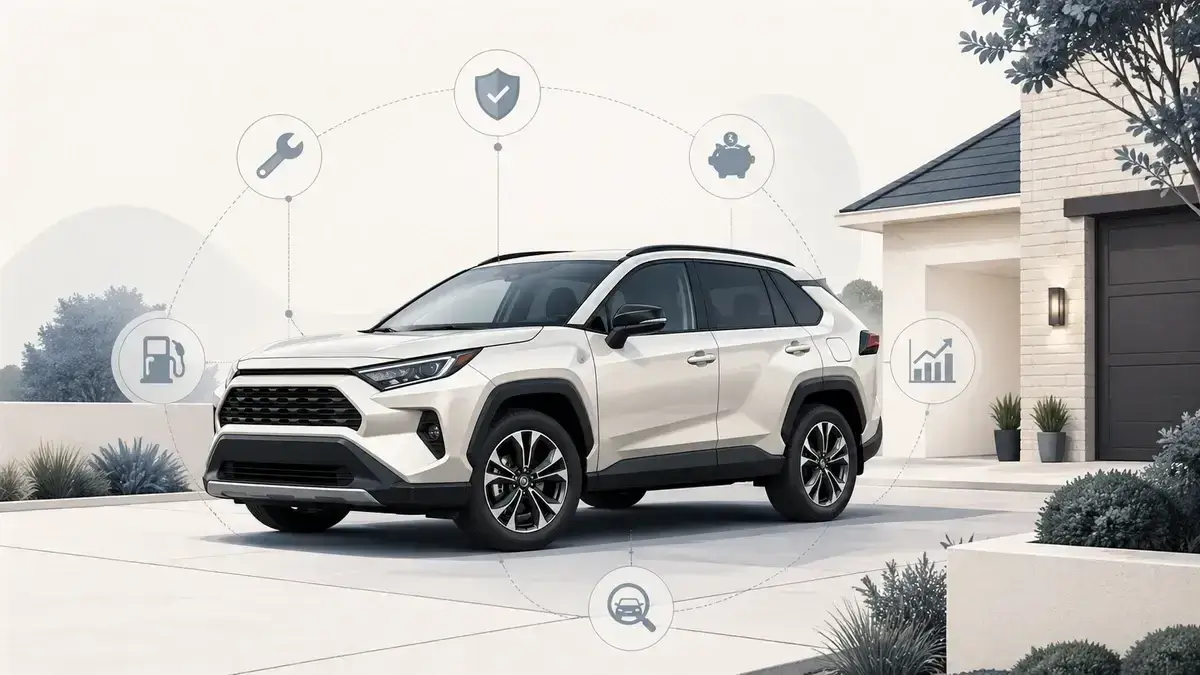
Toyota RAV4 reliability is one of the main reasons used SUV buyers keep it on their shortlist. The better question is not whether the RAV4 has a strong reputation. It does. The better question is whether a specific used RAV4 is worth buying once you factor in mileage, service history, model year, powertrain, repair risk, fuel cost, and resale value.
The short answer: a well-maintained used Toyota RAV4 is usually one of the safer compact SUV choices for long-term ownership. It is not an automatic buy. A neglected RAV4, an overpriced example, or a hybrid with unclear battery and service history can still become a poor deal.
Quick verdict: buy, be careful, or skip?
| Decision | Best fit |
|---|---|
| Buy | Clean service records, fair price, smooth test drive, no open recall surprises, no major warning signs |
| Be careful | High mileage, missing records, older hybrid, visible wear, unclear repair history |
| Skip | Warning lights, rough shifting, leaks, accident-history mismatch, seller pressure, or top-dollar pricing on a weak example |
The RAV4’s best case is simple: practical, reliable, easy to own, and strong on resale. Its weak case is just as clear: buyers often pay a premium because of the badge, and that premium is not worth it if the vehicle itself has poor records or hidden repair risk.
Is the Toyota RAV4 reliable enough to buy used?
A used RAV4 is worth shortlisting if you want practical space, predictable ownership, good resale strength, and lower repair anxiety than many compact SUVs.
RepairPal lists the Toyota RAV4’s average annual repair and maintenance cost at $429 and notes that costs vary by age, mileage, location, and shop. That supports the RAV4’s reputation as a lower-stress ownership choice, but it should still be treated as a baseline, not a promise for every vehicle.
That does not mean every used RAV4 is safe. Toyota reliability lowers the risk, but it does not erase poor maintenance, accident damage, rust, bad tires, worn brakes, skipped fluid service, warning lights, or seller neglect.
The strongest used RAV4 buy is usually one with clean service records, no open recall surprises, no accident-history red flags, a smooth test drive, and a price that does not erase the value advantage.
Toyota RAV4 cost to own: what buyers should budget for
Toyota RAV4 cost to own depends heavily on age, mileage, trim, powertrain, state, insurance profile, financing, and whether the vehicle was maintained properly.
Do not trust one ownership-cost number without checking its assumptions. Newer-model cost calculators can help you understand the buckets, but they do not predict the exact cost of a used RAV4 you find at a dealer or private seller.
Five-year ownership calculators can help identify cost categories, but they cannot predict the exact cost of a used RAV4. Build the budget from the actual purchase price, a vehicle-specific insurance quote, local taxes and fees, the exact EPA configuration, the applicable Toyota maintenance guide, the pre-purchase inspection, and written estimates for any flagged work.
| Ownership area | What it means for a used RAV4 buyer | Risk level | What to verify before buying |
|---|---|---|---|
| Maintenance | Usually predictable if records are complete | Low to Medium | Oil changes, tire rotations, brake service, fluids |
| Repairs | Often manageable, but neglected examples change the math | Medium | Warning lights, leaks, rough shifting, suspension noise |
| Fuel | Gas models are decent; hybrids can save more for high-mileage drivers | Low to Medium | EPA rating, commute pattern, gas price, hybrid premium |
| Insurance | Can vary more by driver and location than by vehicle alone | Medium | Your quote, state, coverage level, credit profile |
| Depreciation | Resale can be a strength, but future value is not guaranteed and a high purchase price can erase the advantage | Varies | Compare the same year, mileage, trim, and condition; treat asking prices as starting points rather than transaction prices |
| Hybrid system | Can be strong, but age and warranty context matter | Medium | Battery age, warranty status, diagnostic scan |
If you are comparing the RAV4 against a cheaper compact SUV, ownership confidence is only one part of the decision. A lower-priced alternative can still make sense if the condition, service history, and inspection result are strong enough. For a direct used-SUV comparison, see our Nissan Rogue vs Toyota RAV4 guide.
For a used buyer, the right way to read cost data is simple: use estimates for direction, then price the actual vehicle in front of you.
A cheap RAV4 with poor records can cost more than a slightly more expensive one with clean maintenance. A newer hybrid can save fuel, but the purchase premium matters. A high trim can feel appealing, but depreciation, insurance, and tire cost may weaken the value case.
RAV4 reliability is one reason it stays on many under-$20,000 SUV shortlists, but the exact year and condition still decide the value. Compare it with other strong used-car picks in our best used cars under $20,000 guide.
Toyota RAV4 maintenance cost and service expectations
Toyota’s schedule is more useful than a generic annual maintenance estimate because required work depends on model year, powertrain, drivetrain, mileage, time, and operating conditions. For direct verification, use Toyota’s official guides for the 2023 gas RAV4, 2023 RAV4 Hybrid, 2024 gas RAV4, or 2024 RAV4 Hybrid. Buyers considering another year should obtain that model year’s matching guide.
The most decision-relevant differences for 2023–2024 examples are:
| Vehicle and use | Relevant Toyota interval | Why a used-car buyer should care |
|---|---|---|
| Gas and hybrid models | Scheduled checkpoints every 5,000 miles or six months; engine oil and filter normally every 10,000 miles or 12 months, but every 5,000 miles or six months under specified special operating conditions | Service records should match the vehicle’s time, mileage, and use—not merely show occasional oil-change receipts |
| Hybrid models | Inspect the hybrid-battery cooling intake filter every 5,000 miles; clean it every 20,000 miles or 24 months | Missing evidence or a blocked intake deserves inspection because cooling-system care is specific to the hybrid |
| Gas 4WD models | Replace transfer-case oil at 30,000 miles or 36 months | Confirm whether this drivetrain-specific service was completed before assuming a vehicle is fully up to date |
Table Note: Intervals are whichever comes first and apply only to the cited 2023–2024 configurations and conditions. An inspection interval does not mean automatic part replacement. Always use the guide matching the exact model year, powertrain, and drivetrain.
A used RAV4 with missing service records is not always a bad buy, but the price should reflect the uncertainty. If the seller cannot show basic maintenance, pay for a pre-purchase inspection before you treat the vehicle as a safe choice.
Toyota RAV4 Repair Cost: What is Cheap vs Expensive to Fix
Toyota RAV4 repair cost varies by model year, powertrain, diagnosis, parts choice, labor rate, location, taxes, fees, calibration needs, and related work. Treat any online estimate as a planning scenario rather than a quote, and obtain written, itemized estimates for the exact vehicle before budgeting a major repair.
Normal wear items include tires, brakes, wiper blades, filters, batteries, fluids, and alignment. These should affect negotiation, not necessarily kill the deal.
More serious concerns include persistent warning lights, drivability issues, signs of oil leaks, transmission hesitation, overheating history, heavy rust, accident damage, hybrid system warnings, and unresolved recalls.
| Issue found during shopping | How serious it is | Buyer action |
|---|---|---|
| Worn tires or brakes | Negotiable | Price it into the deal |
| Minor cosmetic wear | Low | Do not overpay for a rough interior |
| Check-engine light | Medium to High | Scan before buying |
| Rough shift or hesitation | High | Inspect before offer or walk away |
| Oil leak or low oil history | High | Require mechanic inspection |
| Hybrid warning light | High | Get diagnostic confirmation |
| Open recall | Medium | Verify repair path before purchase |
| Accident-history mismatch | High | Walk away if seller cannot explain it |
Check Toyota Coverage Before Paying for a Known Condition
Some used RAV4s may still qualify for Toyota coverage extensions tied to a particular model, drivetrain, condition, in-service date, mileage, diagnosis, or earlier campaign completion. Before approving an eligible repair, ask a Toyota dealer to run the VIN and document the result.
If a RAV4 has transfer-case, refueling, water-entry, or electrified-drivetrain repair history, CarMerit’s Manufacturer Special Coverage Lookup can help you identify the model-year Toyota programs worth checking before you build that repair into the ownership-cost estimate.
| Used RAV4 Scope | Toyota Program and Condition | Buyer Action |
|---|---|---|
| 2019–2020 Adventure and Limited AWD | 20TE03: coverage for a specified transfer-case electromagnetic clutch condition, subject to 10 years or 125,000 miles | If symptoms or service records point to this condition, verify VIN eligibility before paying for diagnosis or repair |
| 2019–2021 RAV4 Hybrid | 20TE04: coverage for the specified fuel-tank/refueling condition, subject to eight years or 100,000 miles | Confirm whether applicable work was completed and whether the vehicle remains eligible |
| 2019–2021 gas, 2020–2021 Hybrid, and 2021 RAV4 Prime | 22TE05: coverage for specified roof-rail water entry, subject to 10 years with no mileage limit | Inspect the headliner and surrounding interior for evidence of water entry and verify VIN status |
| 2020–2024 Hybrid AWD and 2021–2024 RAV4 Prime | 22TE09: coverage for specified high-voltage cable corrosion; the published term depends partly on whether campaign 25TD01 was completed by September 30, 2028 | Have Toyota verify VIN status, campaign completion, applicable term, and diagnosis before purchase or repair |
| 2019–2021 gas, 2020–2021 Hybrid, and 2021 RAV4 Prime | 24TE04: secondary coverage for a specified flow shut-off valve coolant-leak condition, subject to 10 years or 100,000 miles after the primary period | If coolant loss or a related diagnosis appears in the history, confirm eligibility before authorizing replacement |
Table Note: These are selected programs with meaningful used-buyer implications, not a complete list and not evidence that every listed vehicle will fail. VIN eligibility, in-service date, mileage, diagnosis, exclusions, and Toyota’s current program terms control.
The RAV4’s reputation can make sellers overconfident on price. Do not pay “Toyota tax” for a vehicle that needs immediate tires, brakes, fluids, and diagnostic work.
Toyota RAV4 reliability by year and generation
Toyota RAV4 reliability by year matters because broad brand reputation can hide model-year and condition differences.
The safest way to shop is to separate the RAV4 into three used-buying groups: older high-mileage examples, middle-aged examples, and newer used examples. The older the vehicle, the more the individual car matters more than the badge.
| Used RAV4 group | Buyer reality | Main risk | Best move |
|---|---|---|---|
| Older high-mileage RAV4s | Can still be good basic transportation | Maintenance gaps, rust, age-related wear | Buy only with records and inspection |
| Middle-aged used RAV4s | Often strong value if maintained | Price premium and hidden wear | Compare price against CR-V, CX-5, and Forester |
| Newer used RAV4s | Strong resale and more modern safety tech | Overpaying because demand is high | Verify market price and warranty status |
| Hybrid RAV4s | Fuel savings can be meaningful | Battery age, warranty context, purchase premium | Check warranty, records, and diagnostic health |
| RAV4 Prime / plug-in hybrid | Useful for the right commute | Higher complexity and price | Treat as a separate buying decision |
IIHS safety checks that can change the year or trim decision
IIHS results are most useful here when they expose a meaningful model-year, build-date, trim, or headlight difference—not when they are reduced to one overall score.
| Used RAV4 scope | Driver small overlap | Passenger small overlap | Headlights | Buyer check |
|---|---|---|---|---|
| 2013–2014 models built after April 2013 | P | P | — | Verify the exact model year and build date; do not assume later RAV4 results apply |
| 2015–2018 models built after November 2014 | G | P | A or M on rated 2016–2018 configurations | Confirm build date, trim, and installed headlights |
| 2019–2021 | G | G | G, M, or P depending on trim/package | Headlight configuration can materially change the result, so verify the exact equipment |
| 2022 | G | G | G on listed projector-equipped trims; M on the LE reflector configuration | Confirm trim and headlight type rather than relying only on model year |
| 2023–2025 | G | G | G on listed trims | Also read the updated moderate-overlap M and updated side A results separately from the original tests |
G = Good; A = Acceptable; M = Marginal; P = Poor.
Table Note: IIHS test criteria and displayed results changed over time, so these ratings should not be combined into one cross-year safety score. Verify the exact build date, trim, package, and headlights. RAV4 Prime/Plug-in Hybrid ratings may appear on a separate IIHS vehicle page.
Toyota lets shoppers check safety recalls and service campaigns by license plate or VIN, while NHTSA’s recall tool can show whether a specific vehicle needs recall repair. Use both before purchase.
Toyota RAV4 Recall and VIN Due-Diligence Triggers
| Recall due-diligence area | Affected years / generations | Unique campaigns | Recall rows | Buyer check |
|---|---|---|---|---|
| Tire / wheel | 2005-2012, 2016-2019, 2023-2025 (Gen 2-5) | 11 | 29 | Confirm VIN status and inspect tire/wheel equipment, labels, and related repairs. |
| Suspension component | 2006-2011, 2019-2020 (Gen 3, Gen 5) | 4 | 20 | Inspect suspension hardware, alignment, uneven tire wear, and recall completion. |
| Wiring harness | 1998-1999, 2006-2011 (Gen 1, Gen 3) | 4 | 15 | Check completed electrical/wiring repairs and any fire-risk-related campaign history. |
| Brake caliper / braking performance | 1998-2000, 2012, 2016, 2019, 2023-2025 (Gen 1, Gen 3-5) | 7 | 13 | Verify recall status and road-test braking feel before purchase. |
| Airbag / restraint | 1998-2000, 2004-2005, 2020-2021 (Gen 1, Gen 2, Gen 5) | 5 | 10 | Do not buy until open airbag or restraint recalls are resolved by VIN. |
| Steering gearbox / sticky steering | 2006-2008, 2014-2015, 2019-2020 (Gen 3-5) | 4 | 8 | Road-test steering feel and confirm campaign completion where applicable. |
| Hybrid/electrical battery-system campaigns | 2013-2018, 2021-2022 (Gen 4-5) | 2 | 8 | Verify exact powertrain, warning lights, VIN recall status, and hybrid/electrical repair history. |
Table note: Recall rows are not the same as open recalls on a specific RAV4. A campaign can cover multiple model years, so VIN-level verification is still required before purchase.
If you want a dedicated buy/avoid year decision, that belongs in a separate model-year guide. For this ownership page, the practical point is narrower: do not buy by reputation alone. Buy by year, condition, records, inspection, recall status, and price.
Toyota RAV4 NHTSA Evidence Signals and How Used Buyers Should Read Them
| NHTSA evidence signal | Count | Coverage | Buyer use | Limit |
|---|---|---|---|---|
| Owner complaints | 9,471 | 1995-2026 | Use as problem-area context before inspection. | Not a defect rate or reliability score. |
| Recall rows | 158 | 1995-2026 | Use to confirm whether recall history needs VIN follow-up. | Campaigns can repeat across model years. |
| Unique recall campaigns | 58 | 1995-2026 | Use to understand campaign variety before purchase. | Not the same as open recalls on one VIN. |
| Investigations | 28 | 1995-2026 | Use as an added due-diligence signal. | Does not prove a defect on a specific vehicle. |
| Manufacturer communications | 6,054 | 1995-2026 | Use as service-information context. | Not a defect count. |
| Crash-flag complaints | 811 | 1995-2026 | Treat as inspection urgency context. | Owner-reported flag, not verified causation. |
| Fire-flag complaints | 286 | 1995-2026 | Check recalls, leaks, wiring, fuel, and hybrid/electrical items carefully. | Owner-reported flag, not a safety rating. |
| Injury-flag complaints | 418 | 1995-2026 | Give extra attention to safety-related systems. | Owner-reported flag, not a confirmed injury finding. |
| Death-flag complaints | 11 | 1995-2026 | Do not skip VIN-level recall and safety checks. | Owner-reported flag, not a model-wide risk rate. |
Table Note: These are raw NHTSA records, not defect rates, reliability scores, or VIN-level recall results. Use them to decide what to inspect before buying, then verify the exact vehicle by VIN.
Common Toyota RAV4 problems to check before buying
Toyota RAV4 common problems should be treated as inspection targets, not panic triggers.
A problem list becomes useful only when it changes what you do before purchase. Some issues are small negotiation points. Others need a diagnostic scan, a mechanic inspection, or a walk-away decision.
Toyota RAV4 NHTSA Problem Areas and Inspection Triggers
| Problem area | Owner complaints | Years / generations | High-severity complaint rows | Inspection trigger |
|---|---|---|---|---|
| Airbags / seatbelts / structure | 1,365 | 1996-2026 (Gen 1-6) | 345 | Check VIN recall status, SRS lights, seatbelts, prior repairs, and water/structure clues. |
| Engine | 1,283 | 1996-2025 (Gen 1-5) | 84 | Check oil level history, leaks, overheating clues, scan codes, and service records. |
| Powertrain / transmission | 1,147 | 1996-2025 (Gen 1-5) | 45 | Road-test cold and warm for harsh shifts, hesitation, shudder, or abnormal drivability. |
| Electrical | 1,103 | 1996-2025 (Gen 1-5) | 150 | Check warning lights, battery/charging behavior, instrument-panel issues, and scan results. |
| Vehicle speed control | 643 | 1997-2025 (Gen 1-5) | 173 | Test low-speed response, hesitation, accelerator behavior, and software/service history. |
| Suspension / wheels | 599 | 1996-2025 (Gen 1-5) | 24 | Inspect tires, uneven wear, clunks, wheel condition, alignment, and underbody condition. |
| Brakes | 532 | 1996-2026 (Gen 1-6) | 132 | Road-test brake feel, ABS warnings, pulsing, pulling, rotor condition, and recall completion. |
Table note: Problem-area counts are owner-reported NHTSA complaint evidence. They are useful inspection triggers, not proof that every RAV4 in the listed years has the issue.
The best RAV4 is not the one with zero possible problems. That does not exist. The best one is the vehicle where the known risks have already been checked, priced, and explained.
Gas vs hybrid RAV4 reliability and cost trade-offs
Fuel economy can materially change the ownership-cost decision, but the difference depends on model year, drivetrain, and configuration. These EPA checkpoints show the major changes without treating every listed configuration as a separate buying category.
| EPA model/configuration | City MPG | Highway MPG | Combined MPG |
|---|---|---|---|
| 2016 RAV4 LE/XLE FWD | 23 | 30 | 26 |
| 2016 RAV4 AWD | 22 | 28 | 25 |
| 2016 RAV4 Hybrid AWD | 34 | 30 | 32 |
| 2019 RAV4 FWD | 26 | 35 | 30 |
| 2019 RAV4 AWD listed configurations | 25–27 | 33–34 | 28–30 |
| 2019 RAV4 Hybrid AWD | 41 | 38 | 40 |
| 2025 RAV4 FWD | 27 | 35 | 30 |
| 2025 RAV4 AWD listed configurations | 25–27 | 33–34 | 28–30 |
| 2025 RAV4 Hybrid AWD | 41 | 38 | 39 |
| 2025 RAV4 Hybrid AWD Woodland Edition | 38 | 35 | 37 |
Table Note: All figures are official rounded EPA MPG values. A range represents separate EPA-listed configurations, not an average. Confirm the exact trim and drivetrain before estimating fuel cost. EPA ratings are comparison tools, not total-cost forecasts, and real-world results vary with driving conditions and behavior.
The hybrid’s fuel advantage is largest in city-heavy driving; highway-heavy use usually narrows it. Compare the expected fuel savings with the actual price difference between otherwise similar gas and hybrid vehicles instead of assuming the hybrid is automatically the cheaper purchase.
The 2024 RAV4 Hybrid Warranty and Maintenance Guide specifies 10-year/150,000-mile defect coverage for the hybrid battery and separate eight-year/100,000-mile coverage for listed hybrid-system components. Those terms do not establish remaining coverage, battery capacity, or present condition. Verify the VIN, original in-service date, mileage, and exact model-year guide; do not automatically apply the 2024 terms to an older hybrid.
| Buyer type | Gas RAV4 fit | Hybrid RAV4 fit | Better direction |
|---|---|---|---|
| Low annual mileage | Simple and predictable | Fuel savings may not repay premium | Gas often makes more sense |
| High-mileage commuter | Decent, but fuel cost adds up | Stronger fuel-cost case | Hybrid can make sense |
| Buyer keeping SUV long-term | Lower complexity | Better MPG, but battery age matters | Depends on price and warranty |
| Older used buyer | Easier to evaluate | Needs hybrid-system check | Gas is simpler |
| City/suburban driver | Good enough | Hybrid shines in stop-and-go driving | Hybrid can be stronger |
The hybrid is not automatically better. The gas model is not automatically safer. If the hybrid costs only a modest premium, has strong records, and still has useful warranty coverage, it can be a smart buy. If it is older, overpriced, or has unclear battery history, the gas RAV4 may be the cleaner decision.
How the RAV4 compares with CR-V, CX-5, and Forester for ownership risk
The RAV4 is usually strongest for buyers who value resale, reliability reputation, fuel economy, and practical ownership over driving feel or premium cabin quality.
The Honda CR-V is the closest default rival. It can be just as sensible for many buyers, especially if the local used market makes the CR-V cheaper for similar mileage and condition.
The Mazda CX-5 may appeal more if you care about cabin feel and driving experience. Its trade-off is that space, fuel economy, and long-term ownership assumptions should be checked against the specific year and engine.
The Subaru Forester can be a better fit for buyers who prioritize visibility, standard AWD, and bad-weather confidence. Its ownership case depends on service history and the buyer’s tolerance for Subaru-specific maintenance patterns.
The right answer is not “RAV4 beats everything.” The better answer is this: choose the RAV4 if you want the safer all-around ownership bet and the price is still reasonable. Choose a rival if the RAV4 you found is overpriced, poorly maintained, or less comfortable than you need.
If the RAV4 premium pushes you toward a cheaper compact SUV, the Sportage can be worth checking, but only as a verified value play. Use the Kia Sportage Reliability and Cost to Own guide to see whether the Sportage’s price advantage is backed by clean records, completed recalls, manageable ownership cost, and no major inspection red flags.
For a direct used-SUV comparison, see Forester vs RAV4. The guide shows when the RAV4’s reliability and resale case is stronger, and when a clean Forester may be the better AWD-focused value.
Who should buy a used Toyota RAV4, and who should skip it
A used Toyota RAV4 fits buyers who want practical transportation more than excitement.
| Buyer type | Recommendation | Reason |
|---|---|---|
| Family buyer wanting low-drama ownership | Buy | Practical size, strong reputation, good resale |
| Commuter who drives many miles | Buy or consider hybrid | Fuel and maintenance matter more over time |
| Budget buyer chasing the lowest price | Be cautious | RAV4 resale can keep prices high |
| Buyer wanting a quiet, upscale cabin | Compare rivals | Some competitors may feel more refined |
| Buyer considering high mileage | Be selective | Records and inspection matter more than badge |
| Buyer looking at an older hybrid | Inspect carefully | Battery age and warranty context matter |
| Buyer found one with poor records | Skip or discount heavily | Maintenance uncertainty changes the deal |
Skip the RAV4 if the seller is asking top money for a weak example. A clean CR-V, CX-5, or Forester can be a smarter purchase than a tired RAV4 with a strong badge and bad records.
Used Toyota RAV4 buying checklist
A used Toyota RAV4 buying checklist should focus on the risks that actually change the deal.
Start with documents. Ask for maintenance records, tire/brake receipts, battery replacement history, accident history, and recall status. If the seller avoids basic questions, assume the vehicle needs deeper inspection.
Before you start judging a specific RAV4 on service history and mechanical condition, make sure the vehicle itself matches the listing you researched. Run the RAV4’s VIN through CarMerit and compare the returned vehicle details with the seller’s description and paperwork. Once those details line up, continue with the official recall check, cold-start test, hybrid-system checks where applicable, and the full pre-purchase inspection.
Then test the vehicle cold. A warmed-up car can hide rough starts, noises, idle issues, and some drivability problems.
| Check | What to look for | Deal impact |
|---|---|---|
| Toyota/NHTSA recall check | Open safety recalls or service campaigns | Fix before purchase or confirm repair path |
| Service records | Regular oil, fluids, tires, brakes | Stronger buy if complete |
| Test drive | Smooth acceleration, braking, steering, shifting | Walk away from harsh symptoms |
| Tires | Matching set, even wear, good tread | Negotiation item |
| Brakes | No pulsing, grinding, pulling | Negotiation or inspection item |
| Underbody | Rust, leaks, accident signs | Major decision point |
| Hybrid system | Warning lights, diagnostic health, battery context | Must verify before buying |
| Price | Compare against mileage, trim, condition | Avoid paying top price for average condition |
Pay for a mechanic inspection if the RAV4 is older, high-mileage, hybrid, out of warranty, missing records, or priced near the top of the market. The inspection cost is small compared with buying the wrong vehicle.
The RAV4 is one of the strongest low-risk choices in our best used compact SUVs guide.
The RAV4 is one of the strongest used SUV defaults, but buyers should still compare it against reliable sedans and smaller SUVs. Our Most Reliable Used Cars guide shows where the RAV4 fits in the broader low-risk used-car shortlist.
Final verdict: is the Toyota RAV4 worth the ownership cost?
Toyota RAV4 reliability is strong enough to make it one of the safer used compact SUV choices, but only when the specific vehicle passes the ownership checks.
The RAV4 is worth the ownership cost if you find one with clean records, fair pricing, no open recall surprises, no major inspection issues, and a powertrain that fits your driving. It is especially strong for buyers who want practical space, good resale, predictable maintenance, and lower repair anxiety.
The case weakens when the RAV4 is overpriced, poorly maintained, high-mileage with no records, rough on the test drive, or hybrid without clear battery and warranty context. In those cases, the Toyota badge is not enough.
The best move is simple: shortlist the RAV4, verify the exact vehicle, compare ownership cost against the price premium, and walk away from examples that rely on reputation instead of proof.
Reliability is only one part of the RAV4 decision. If you are comparing it against a value-focused compact SUV, our Hyundai Tucson vs Toyota RAV4 guide explains when the RAV4 premium makes sense and when the Tucson deserves a serious look.
The RAV4 is a strong family-SUV candidate, but the smartest choice still depends on space needs, budget, and daily use. See our best used family cars guide to compare the RAV4 against the CR-V, CX-5, Camry, Accord, Corolla Cross, and HR-V.
Frequently Asked Questions
Is the Toyota RAV4 reliable?
The RAV4 has a strong general reputation, but reliability varies by model year, powertrain, mileage, maintenance history, prior repairs, and current condition. Use the year-specific problem history, VIN checks, service records, and an independent pre-purchase inspection rather than relying on the nameplate alone.
Is a used Toyota RAV4 expensive to maintain?
Routine requirements are generally straightforward, but no single annual figure fits every used RAV4. Check the schedule for the exact model year and powertrain—such as Toyota’s official 2024 gas RAV4 guide or 2024 RAV4 Hybrid guide—then adjust the budget for mileage, condition, local labor rates, and overdue work.
What is the Toyota RAV4 cost to own?
It includes depreciation, financing, insurance, taxes and fees, fuel, scheduled maintenance, wear items, and repairs. Estimate it from the actual purchase price, a vehicle-specific insurance quote, the exact EPA configuration, Toyota’s applicable maintenance guide, and inspection findings rather than relying on a generic five-year total.
What are the most common Toyota RAV4 problems?
Commonly discussed RAV4 issue areas include emissions-related codes, sensor warnings, rough shifting, oil leaks or consumption concerns on some older examples, suspension wear, rust, and hybrid warning messages. Do not assume a problem applies to every RAV4. Verify the exact year, mileage, maintenance history, scan results, and inspection report.
Is the Toyota RAV4 Hybrid reliable?
A well-maintained RAV4 Hybrid can be a strong used-car choice, but reliability still depends on model year, service history, battery cooling care, mileage, and current condition. Toyota’s 2024 RAV4 Hybrid guide specifies 10-year/150,000-mile defect coverage for the hybrid battery and separate eight-year/100,000-mile coverage for listed hybrid-system components. Verify the exact vehicle’s VIN, in-service date, mileage, battery condition, and model-year terms before treating any coverage as remaining.
Is a high-mileage Toyota RAV4 worth buying?
A high-mileage RAV4 can be worth buying if it has consistent service records, no serious warning signs, a clean inspection, and a price that reflects its mileage. Avoid high-mileage examples with missing records, rough shifting, warning lights, leaks, accident-history concerns, or seller pressure.
Should I buy a gas or hybrid Toyota RAV4?
Buy the gas RAV4 if you want the simpler used purchase and do not drive enough miles to benefit from the hybrid’s fuel savings. Consider the hybrid if you drive often, the price premium is reasonable, and warranty or diagnostic checks support the battery and hybrid system. Check the exact year, drivetrain, and trim on FuelEconomy.gov before relying on fuel-savings math.