

Honda Accord reliability is still strong enough to keep the car near the top of the mainstream used-sedan shortlist. That is the broad answer.
The narrower answer is the one that protects your money. A used Accord only makes sense when the year, mileage, service history, and powertrain all line up. The reputation helps. It does not rescue a weak used example.
That is the trap. Buyers trust the badge, then discover too late that they bought condition-blind.
Is the Honda Accord reliable enough for most used buyers?
For most used buyers, yes. The Accord is still one of the easier midsize sedans to defend if your goal is practical transportation. But its ownership-cost case must be earned car by car: exact year, powertrain, service history, inspection results, due maintenance, and purchase price matter more than a model-wide cost promise.
That answer weakens quickly when the car comes from a complaint-heavy year, has thin records, or shows signs of deferred maintenance. Weak reliability pages stop at the badge. A smart buyer goes one step further and asks whether this exact Accord still deserves trust.
| Buyer type | Accord fit | Why it works | Main caution |
|---|---|---|---|
| Daily commuter who wants a safe default | Strong | Usually practical, comfortable, and easy to live with | A weak year or weak records can erase the advantage |
| Budget buyer shopping older cars | Conditional | Older Accords can still make sense if the story is documented | Cheap listings often hide transmission, electrical, or oil-use risk |
| High-mileage driver | Strong if selective | The Accord can still make sense at real miles | Mileage without maintenance proof is not value |
| Buyer who hates repair surprises | Conditional | Better years are easier to defend | Complaint-heavy years and neglected examples can break the case |
| Buyer chasing the lowest asking price | Weak fit | Reputation can keep bad Accords overpriced | Easy to overpay for a tired car |
A used Accord is usually the safer bet when the car feels boring in the right way. Clean cold start. No transmission weirdness. No electrical nonsense. No service-history mystery.
The safe default ends where the proof disappears. If you are still deciding between the two main midsize sedan defaults, the next step is to compare the Honda Accord vs Toyota Camry directly instead of judging the Accord in isolation.
What does Honda Accord ownership usually cost in the real world?
Most ownership-cost pages are directionally useful and practically incomplete.
Broad ownership tools usually roll depreciation, financing, insurance, fuel, maintenance, and repairs into one total. That helps with direction. It does not answer the real used-buyer question, because a used Accord with weak records can break the math very quickly.
For a used buyer, the important cost buckets are tighter:
- what routine maintenance is due soon
- what repairs are likely if the car was ignored
- what insurance and fuel will look like in your own situation
- whether the year and condition justify the asking price
That is why “cheap to own” needs a stricter meaning. It should mean the car stays financially reasonable after purchase. It should not mean one website printed one low-looking total.
| Cost bucket | Why it matters to a used buyer | What changes the answer |
|---|---|---|
| Routine maintenance | This is the predictable floor | Fluid history, brakes, tires, plugs, filters |
| Repairs | This is where a “deal” goes bad | Transmission behavior, electrical faults, oil use, AC issues |
| Insurance | Highly personal | ZIP code, driving record, coverage level |
| Fuel | Matters more for commuters | Real commute, not brochure logic |
| Depreciation | Still relevant, but less than on a used car than a new one | How much you overpay up front |
| Financing | Can quietly wreck a deal | Rate, term, total paid, not just monthly payment |
Cheap to own is not a magic number. It is the result of buying the right example at the right price.
A buyer who overpays for a weak Accord does not really own a cheap car. He owns a famous car with hidden costs. If the Accord’s risk profile feels too dependent on year and records, compare it with the Toyota Camry reliability and cost to own before committing.
Accord ownership can still make sense under $20,000, but only if the listing is clean and the service history is strong. For a wider budget shortlist, compare it in our best used cars under $20,000 guide.
Which Honda Accord years are safer bets and which need more caution?
This section works best as a shortlist filter, not as a blind buy-or-avoid chart.
Broad used-year guides still tend to treat older complaint-heavy zones and some early-2010s edge cases with more caution than the better-defended mid-2000s, early-2010s, and many later well-kept examples. But the edges are not clean enough to justify absolute language.
The safer way to read the Accord market is this: some year bands are easier to defend, some deserve more caution, and service history can still override both. For a deeper year-by-year filter, use the dedicated guide to Honda Accord years to avoid.
| Year range | Starting view | Why |
|---|---|---|
| Late 1990s to mid-2000s | High caution for most buyers | Older transmission and complaint-heavy patterns show up too often to treat casually |
| 2006 to 2007 | Easier to defend | Better used-buy reputation than the earlier run |
| Late 2000s | Caution | Repeated complaint patterns make these cars harder to buy lazily |
| 2011 to 2012 | Stronger shortlist zone | Usually easier to defend than the years around them |
| 2013 to 2014 | High caution context | Screen carefully and use the dedicated years-to-avoid guide before shortlisting |
| Many later examples | More defensible if documented | Better starting point, but lower raw NHTSA counts on newer years do not prove better reliability. |
IIHS safety differences that matter when shortlisting years
IIHS evidence answers a different question from reliability records: how tested crash protection, headlights, and crash-avoidance performance changed across Accord sedan generations. The useful comparison is the change point—not a list of every available sub-rating.
| Tested Accord sedan years | Buyer-useful IIHS distinction | What it means for the shortlist |
|---|---|---|
| 2006–2007 | Good in the original moderate-overlap front and side tests, but Poor for head restraints and seats. | These easier-to-defend reliability years are not uniformly strong on every safety measure. |
| 2011–2012 | Both years were Good in the original moderate-overlap, side, and head-restraint tests. Roof strength was Acceptable for 2011 and Good for 2012. | The 2012 sedan closes a meaningful distinction within this otherwise similar shortlist band. |
| 2013–2015 | Good across the listed crashworthiness tests; the optional vehicle-to-vehicle front crash-prevention system was rated Basic. | Reliability caution around some early-2010s cars should not be confused with poor IIHS crashworthiness, but crash avoidance remained equipment-dependent. |
| 2016–2017 | Good across the listed crashworthiness tests. Most trims had Acceptable headlights, Touring was Marginal, and the optional Honda Sensing vehicle-to-vehicle system was rated Superior. | Verify trim and equipment instead of assuming every 2016–2017 Accord has the same lighting or crash-avoidance performance. |
| 2018–2020 | Strong results in the listed legacy crashworthiness tests, but Marginal in the updated side test. Headlights were Acceptable on most trims and Marginal on Touring; standard vehicle-to-vehicle front crash prevention was Superior. | Newer does not mean perfect, and trim still affects nighttime visibility. |
| 2021–2022 | The updated side result remained Marginal. Headlights improved to Good on Sport, Sport SE, EX-L, Touring, and applicable hybrid variants; LX and Hybrid were Acceptable. | Headlight performance is a real trim-level tie-breaker within this generation. |
| 2023–2024 | Good in the small-overlap, updated moderate-overlap, and updated side tests, with Good headlights on all trims. | These years remove several earlier test and trim qualifications, although condition and price still decide the used-car purchase. |
Table Note: IIHS test names and evaluation criteria changed over time. Apply each result only to the tested sedan scope shown by IIHS; these ratings are not reliability findings, crash probabilities, or a basis for combining IIHS and NHTSA evidence into one score.
A better rule beats a cleaner chart: use the year to set your risk baseline, then let service history decide whether the car survives the shortlist.
Here is the practical version.
Do
- start with year bands
- narrow to cars with believable records
- let inspection break ties between similar listings
Avoid
- treating “good years” as permission to skip diligence
- assuming “later is always better”
- buying a weaker car just because the year looks safer on paper
Proof
- if a seller cannot support the car with records, the year alone is not enough
- if a supposedly safer-year car drives poorly or shows obvious neglect, treat it like the weaker side of the range, not the stronger side
The year should guide the first cut. It should not make the final decision for you.
Honda Accord NHTSA records by generation: ownership-risk context
| Accord generation / years | NHTSA years represented | Owner complaints | Unique recall campaigns / investigations / manufacturer communications | Buyer-useful check |
|---|---|---|---|---|
| Gen 1 / 1976-1981 | 1979, 1981 | 2 | 1 / 2 / 0 | Historical context only; condition matters more than raw count. |
| Gen 2 / 1982-1985 | 1982-1985 | 8 | 3 / 5 / 0 | Treat mainly as age, parts, rust, and documentation risk. |
| Gen 3 / 1986-1989 | 1986-1989 | 95 | 3 / 11 / 0 | Use as old-car context, not a modern used-buy signal. |
| Gen 4 / 1990-1993 | 1990-1993 | 353 | 14 / 7 / 42 | Verify restraint, lighting, and age-related service history. |
| Gen 5 / 1994-1997 | 1994-1997 | 1,128 | 17 / 2 / 185 | Inspection proof needs to be strong before considering one. |
| Gen 6 / 1998-2002 | 1998-2002 | 5,162 | 30 / 30 / 1,151 | Be strict on transmission, electrical, airbag, and recall history. |
| Gen 7 / 2003-2007 | 2003-2007 | 4,644 | 33 / 24 / 1,067 | Do not treat all years alike; verify transmission and recall status. |
| Gen 8 / 2008-2012 | 2008-2012 | 3,484 | 15 / 7 / 432 | Check oil use, brakes, powertrain behavior, and maintenance proof. |
| Gen 9 / 2013-2017 | 2013-2017 | 4,191 | 9 / 13 / 791 | Screen electrical, starting, ADAS, and recall records closely. |
| Gen 10 / 2018-2022 | 2018-2022 | 3,510 | 11 / 12 / 1,168 | Newer-tech checks matter; do not assume newer automatically means safer. |
| Gen 11 / 2023-2026 | 2023-2026 | 513 | 8 / 2 / 250 | Too young for reliability conclusions; use mainly for recall and inspection checks. |
Table Note: Unique recall campaigns are deduplicated across affected model years. Raw NHTSA complaint and manufacturer-communication counts are not defect rates, reliability scores, or sales-adjusted comparisons. Newer generations have had less time to collect reports.
What common Honda Accord problems matter most for used buyers?
The Accord does not have one universal problem pattern. It has clusters that matter more or less depending on the year and example.
The patterns that matter most are not all equal. Some are nuisance issues. Some are budget breakers. Buyers do not need a longer list. They need a severity ladder.
| Problem pattern | Decision impact |
|---|---|
| Transmission slipping, failure, or obvious shift behavior | Walk away unless the repair story is unusually strong and the price fully reflects it |
| Heavy oil use or oil-loss signs | High caution, especially without documentation |
| Repeat no-start, starter, ignition, or battery complaints | Medium to high caution for a daily driver |
| Door-lock, radio, or display issues | Usually nuisance-level unless they arrive with bigger neglect |
| Brake vibration or steering oddities | Medium caution, but stack risk matters if other deferred work is present |
| AC or comfort-system faults | Usually survivable, but they can turn a “cheap” Accord into a worse deal than it looks |
The mistake many buyers make is reading common-problems pages like horror stories. The better question is simpler: which issues should change my buying decision right now?
That is the real difference between a problem list and a useful buying guide. A problem list tells you what exists. A useful guide tells you what should stop the deal.
Most-reported NHTSA owner-complaint themes to turn into inspection checks
| Owner-report theme | Complaint records | Years appearing | Generations appearing | Used-buyer check |
|---|---|---|---|---|
| Airbag / seatbelt / structural safety issues | 4,617 | 1984-2025 | Gen 2-11 | Verify SRS lights, open recalls, seatbelt function, and prior crash repair. |
| Electrical / infotainment / software issues | 3,285 | 1982-2026 | Gen 2-11 | Test starting, ignition, displays, locks, warning lights, and battery/charging behavior. |
| Powertrain / transmission issues | 3,134 | 1987-2025 | Gen 3-11 | Cold and warm test-drive carefully; reject harsh shifts, flare, hesitation, or missing service history. |
| Engine issues | 2,439 | 1986-2025 | Gen 3-11 | Check oil level, oil history, leaks, idle quality, warning lights, and cooling-system condition. |
| Brake performance issues | 2,385 | 1984-2025 | Gen 2-11 | Test brake vibration, pedal feel, ABS lights, and brake-service records. |
| Steering issues | 1,206 | 1988-2025 | Gen 3-11 | Check pull, wandering, noises, steering assist behavior, and suspension wear. |
Table note: These are owner-report themes from NHTSA complaint records. They are inspection triggers, not proof that one specific car is bad or that one model year is automatically better.
How expensive is maintenance and repair over time?
Do not budget a used Accord from a model-wide annual repair number. Use the inspection and service records to identify work due now, then obtain local written quotes for that exact car. The available public repair-cost sources do not support a single reliable Accord-wide repair-cost total.
The important question is not whether an older Accord will need maintenance. It is whether the maintenance story is orderly or sloppy. A documented car with little immediate catch-up work is easier to budget for; a car with overdue fluids, worn brakes or tires, warning lights, or unresolved drivability and electrical problems can stack costs quickly.
| Ownership stage | What usually matters most |
|---|---|
| Right after purchase | Fluid baseline, brakes, battery, tires, catching deferred work |
| Mid ownership | Brake fluid, transmission fluid, plugs, filters, cooling-system upkeep |
| Higher mileage | Whether routine work was done on time and whether known weak spots were ever actually fixed |
Short scenario
- Do: pay more for the Accord with a clear maintenance story.
- Avoid: assuming a lower asking price offsets deferred fluid service, brakes, tires, and electrical fixes.
- Proof: if the seller cannot explain recent service with receipts or a believable timeline, treat the car as higher-risk even if it drives fine today.
A cheap Accord stops being cheap when you inherit neglected fluid service, tired brakes, weak tires, unresolved electrical weirdness, and a transmission story nobody can document.
Factory coverage adjustments that can still affect the exact-car decision
A few Accord-specific factory coverage adjustments may still matter depending on the VIN and original purchase date. Treat them as questions to verify before purchase—not as proof that the condition is common or that coverage remains available.
If an Accord’s A/C, lighting, or plug-in-hybrid battery history could affect your budget, run the model year through CarMerit’s Manufacturer Special Coverage Lookup before pricing that repair into the deal; Honda should still confirm the exact VIN and current eligibility.
| Exact vehicle scope | Original factory adjustment | What the buyer should verify |
|---|---|---|
| 2016–2017 Accord and 2017 Accord Hybrid | Honda extended coverage for an eligible failed daytime-running-light LED or affected headlight lens to 10 years from the original purchase date with unlimited mileage. See Honda bulletin A19-042. | Check the VIN, original purchase date, title status, whether the DRL condition is present, and whether the term has already expired. |
| 2014 Accord Plug-In Hybrid | Eligible high-voltage battery-pack deterioration received a total term of 12 years or 200,000 miles from the original purchase date, whichever comes first. See Honda bulletin A21-038. | Confirm that the car is the Plug-In Hybrid—not the regular Accord Hybrid—and verify VIN eligibility, mileage, purchase date, diagnosis, and current status. |
| 2018–2020 Accord and 2018–2021 Accord Hybrid | Honda extended eligible A/C-condenser manufacturing or corrosion leaks to 10 years from the original purchase date with unlimited mileage. See the Accord bulletin and Accord Hybrid bulletin. | Coverage is limited to the stated condenser condition. Verify the VIN, purchase date, diagnosis, title status, and whether damage came from an excluded outside object. |
Table Note: These are the original adjustment terms, not proof of remaining warranty. Coverage depends on the exact VIN, original purchase date, mileage where applicable, covered diagnosis, title history, exclusions, and Honda’s current eligibility determination.
How do hybrid, 1.5T, 2.0T, and CVT variants change the risk?
Variant choice matters. It just should not outrank year and records.
The hybrid can make a lot of sense for buyers who will actually use the fuel savings. It makes less sense for a buyer stretching to pay more up front while ignoring condition and service history. A good hybrid is still a good Accord. A weak hybrid is still a weak used car.
EPA fuel-economy differences that can change the variant decision
Official EPA estimates make the variant trade-off more concrete when two Accords are otherwise equally strong. The comparison must stay tied to the exact model year, engine, transmission, and trim.
| Model year | Exact EPA configuration | City MPG | Highway MPG | Combined MPG |
|---|---|---|---|---|
| 2018 | Accord 1.5L with CVT | 30 | 38 | 33 |
| 2018 | Accord 2.0T with 10-speed automatic | 23 | 34 | 27 |
| 2018 | Accord Hybrid | 47 | 47 | 47 |
| 2021 | Accord 1.5L with CVT | 30 | 38 | 33 |
| 2021 | Accord 2.0T Sport/Touring with 10-speed automatic | 22 | 32 | 26 |
| 2021 | Accord Hybrid | 48 | 48 | 48 |
| 2021 | Accord Hybrid Sport/Touring | 44 | 41 | 43 |
| 2023 | Accord 1.5L with CVT | 29 | 37 | 32 |
| 2023 | Accord Hybrid | 51 | 44 | 48 |
| 2023 | Accord Hybrid Sport/Touring | 46 | 41 | 44 |
The 2.0T configurations shown give up 6–7 combined mpg to the comparable 1.5L configurations. The standard hybrid configurations add 14–16 combined mpg over the 1.5L, but hybrid trim also matters: Sport/Touring is rated 5 combined mpg lower than the standard hybrid for 2021 and 4 mpg lower for 2023.
That can materially affect a high-mileage commuter’s choice, but it does not overrule purchase price, condition, service history, or inspection results.
Table Note: These are official rounded EPA city, highway, and combined estimates for the exact U.S. configurations shown. They are not guaranteed real-world results or total ownership-cost figures. Verify the exact listing using FuelEconomy.gov’s official data.
The 1.5T versus 2.0T debate gets exaggerated online. For used buyers, the safer rule is simpler: buy the powertrain with the cleaner documentation, cleaner inspection, and calmer ownership story. Do not pay for internet preference if the actual car is weaker.
The same goes for the CVT. Fear alone is not analysis. Missing transmission-service history is analysis. If the car drives cleanly and the records are real, the case stays alive. If the drive shows hesitation, flare, or inconsistent response, it is fine to move on.
Three buyer-facing rules
- Hybrid commuter rule: If you drive enough miles to use the fuel savings and the ownership story is strong, the hybrid deserves a serious look. If the hybrid premium is stretching your budget, the math weakens fast.
- Turbo rule: When you are comparing 1.5T and 2.0T examples, buy records and condition first, engine second.
- CVT rule: If there is no believable transmission-service history and the test drive feels inconsistent, stop trying to rationalize the listing.
One more rule helps. If two Accords look equally clean, variant can break the tie. If they do not, variant should not overrule condition.
What should buyers check before purchasing a used Honda Accord?
This section should save buyers the most money.
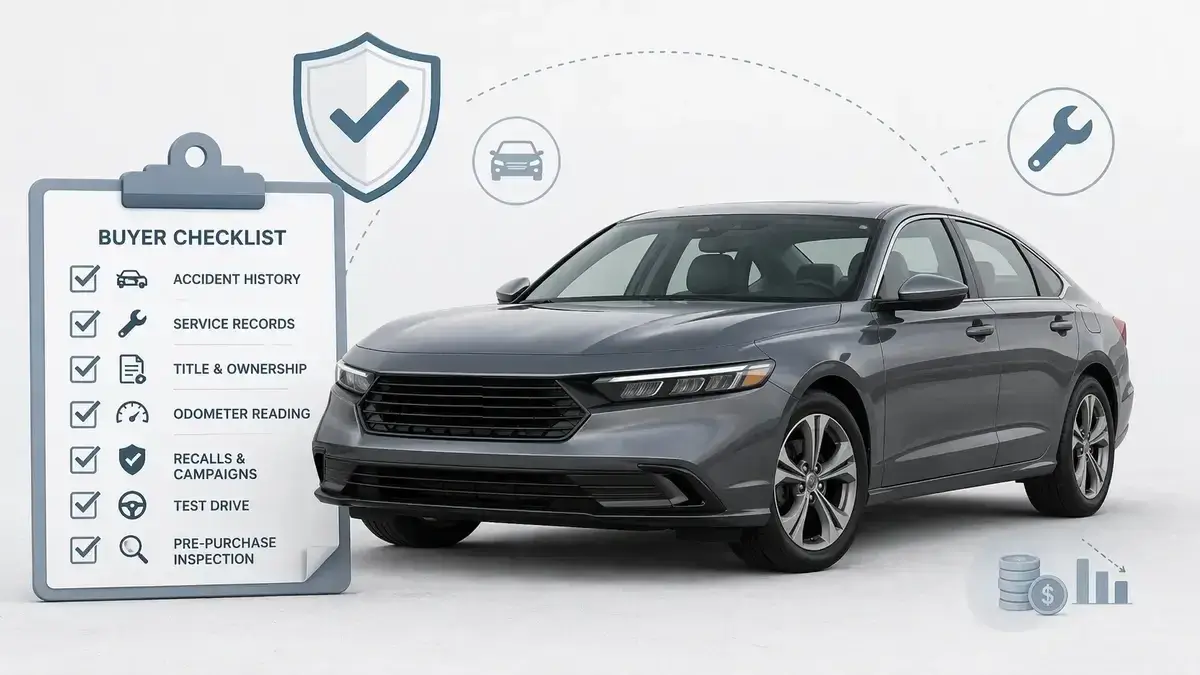
Start with records, not with charm. A used Accord does not need a perfect paper trail, but it needs enough history to prove that maintenance happened on time and not just when something broke.
Then match the records to the car. A seller who says the car was babied should be able to show more than a story. A lower-mileage Accord with neglected fluids, old tires, and glitchy electronics can still be a worse buy than a higher-mileage one with careful service history.
Use this rule-out list:
- verify oil and fluid history
- ask directly about transmission-fluid service
- check cold-start behavior
- test brakes for vibration
- test steering for pull or odd feedback
- run every major cabin electrical function
- check AC performance
- scan recall status and warning lights
- pay for a pre-purchase inspection if the car is not priced like a throwaway
Quick check
- Do: let inspection and paperwork break ties between two similar cars.
- Avoid: buying the cheapest Accord on reputation alone.
- Proof: if the seller leans on “it’s a Honda” more than receipts, the burden of proof is still unmet.
The bad buy is rarely the one with the highest mileage. It is usually the one with the weakest proof.
Honda Accord recall/VIN due-diligence checks from NHTSA records
| Recall/VIN check area | Affected years in records | Generations appearing | Unique campaigns / fire-risk flags | Buyer action |
|---|---|---|---|---|
| Airbag / seat-belt / restraint | 1986-2024 | Gen 3-11 | 37 / 0 | Verify every airbag and restraint recall is closed on the exact VIN. |
| Fuel / electrical / engine / speed-control | 1982-2026 | Gen 2, Gen 3, Gen 5-11 | 26 / 7 | Treat fuel pump, battery, wiring, engine-related, and accelerator-pedal / speed-control recalls as must-check items. |
| Lighting / camera / visibility | 1990-2020 | Gen 4-7, Gen 10 | 20 / 1 | Test lights, camera systems, visibility equipment, and recall status. |
| Powertrain / steering / suspension / braking | 1976-2023 | Gen 1, Gen 5-11 | 12 / 1 | Check shifting, steering assist, leaks, brake feel, and suspension noises before buying. |
| Tire / wheel | 1994-2006 | Gen 5, Gen 7 | 2 / 0 | Inspect tire age, wheel condition, and any tire/wheel recall history. |
Table Note: This is not a full recall campaign list. It tells shoppers where the VIN recall check and pre-purchase inspection should focus before purchase. Always verify recall completion on the exact VIN.
Who should buy a used Honda Accord, and who should skip it?
The Accord is a good fit for buyers who want a mainstream sedan with practical comfort and a used-car case that can be verified through year, service history, inspection, and price.
It is strongest for commuters and value-focused households willing to compare exact cars instead of buying the badge. A documented Accord with little immediate catch-up work can be a defensible choice; an overpriced or neglected one can erase the model’s reputation advantage.
It is a weaker fit for buyers who want the absolute cheapest used midsize sedan on the board, or buyers who refuse to sort years, records, and condition. Those buyers often pay Honda money for a problem-car experience.
| Buyer profile | Fit | Why |
|---|---|---|
| Wants a practical long-run commuter | Strong | This is where the Accord usually makes sense |
| Wants a family sedan with manageable ownership risk | Strong | Good fit if the example is selective, not random |
| Wants the cheapest possible used sedan | Weak | The cheapest Accord is often not the best-value Accord |
| Wants zero maintenance uncertainty | Conditional | Better years help, but any older used car still carries risk |
| Wants to buy on reputation alone | Poor fit | The Accord’s biggest trap is over-trusting the badge |
The Accord works best for selective buyers, not lazy buyers. That line sounds blunt because it is true.
If you are deciding whether the Accord is the right used sedan or just the better-priced option, read our best used midsize sedans guide. It compares the Accord’s value case against the Camry’s safer-default ownership case.
The Accord can be a strong family sedan if you do not need SUV cargo height. Our best used family sedans and SUVs guide shows where it fits against the Camry, CR-V, RAV4, CX-5, Corolla Cross, and HR-V.
Final verdict: when the Honda Accord is the smart used buy
Honda Accord reliability is still strong enough to keep the car among the better mainstream used-sedan bets. That is the headline.
The sharper verdict is more useful. Buy the Accord when the year is defensible, the maintenance story is real, the inspection is clean, and the seller can prove more than “it’s a Honda.” Skip it when the seller leans on reputation instead of documentation, the transmission or electrical behavior feels off, or the price assumes the Honda badge should excuse risk.
If you are still stuck after that, the next question usually is not whether the Accord is reliable in general. It is whether you need deeper help on best years, years to avoid, maintenance cost, or hybrid-versus-gas ownership trade-offs. If you are cross-shopping Toyota instead, start with the best years for Toyota Camry before comparing individual listings.
The Accord can be a strong reliable sedan, but year and powertrain discipline matter. If you are comparing it with Camry, Corolla, Civic, and reliable SUVs, start with our Most Reliable Used Cars shortlist.
Frequently Asked Questions
Is the Honda Accord actually reliable enough to buy used?
Usually, yes. The broad model-level case is still strong. The limit is that model-wide reputation does not judge the exact used example you are considering.
How many miles can a Honda Accord last if it was maintained well?
A well-kept Accord can run a very long time, but mileage by itself is the wrong buying rule. Records matter more than folklore. A documented high-mileage car can be safer than a lower-mileage car with weak maintenance proof.
Which Honda Accord years are safest for used buyers?
Broad used-year guidance tends to be kinder to 2006 to 2007, 2011 to 2012, and many later well-kept examples than it is to older complaint-heavy zones and some early-2010s edge cases. But year guidance should narrow your shortlist, not replace inspection and service-history review.
What are the most common Honda Accord problems?
NHTSA owner reports most often point buyers toward airbag/restraint checks, electrical and ignition issues, powertrain or transmission behavior, engine concerns, brakes, and steering. No-start, display, climate-control, and door-lock issues still belong on the inspection list, but they should sit inside the broader electrical and comfort-system check.
Is the Honda Accord expensive to maintain?
Not automatically. The available official evidence does not support one Accord-wide annual maintenance-and-repair figure. Use the inspection and service records to identify due work, then obtain local quotes for the exact car. A documented example with little catch-up work may be easier to budget for; a neglected one can become expensive quickly.
Before you price the maintenance and catch-up work on a specific Accord, make sure the listing accurately identifies the car you are evaluating. Run the Accord’s VIN through CarMerit and compare the returned vehicle details with the seller’s description and paperwork. Once those details match, use the service records, inspection findings, and local repair quotes to estimate what that particular Accord may need.
Does Accord reliability change a lot by engine, hybrid, or transmission?
It can. The safer rule is not to assume one favorite setup automatically makes the car safe. Treat hybrid, turbo, and transmission choices as part of the risk picture, then let records, inspection, and year quality decide the final answer.
Should I buy a high-mileage Accord with great records or a lower-mileage one with poor records?
In many cases, the high-mileage car with strong records is the better bet. Mileage tells you how much the car has lived. Records tell you how it lived.
When does a cheap Accord stop being cheap to own?
It stops being cheap when the low purchase price hides transmission risk, electrical fixes, overdue fluid service, weak tires, or unresolved maintenance. That is when you start paying for someone else’s neglect instead of benefiting from the Accord’s reputation.