

Toyota Corolla reliability is strong enough that this car still deserves shortlist status for many U.S. used buyers. But that should not turn into a blanket rule. A Corolla is usually a smart used buy only when the year, service history, and condition line up.
That is the real decision here. Not whether the badge has a good reputation, but whether the specific car in front of you has earned trust. Get that right, and the Corolla usually makes sense as a low-drama daily driver. Get it wrong, and you can still end up with an overpriced or neglected car hiding behind a strong nameplate.
For most buyers, the Corolla’s appeal is simple. It is usually easier to live with than many mainstream alternatives. That does not make it exciting. It makes it practical, which is what a lot of used buyers actually need.
Is the Toyota Corolla Actually Reliable for Used Buyers?
Yes, but not blindly. For a used buyer, the Corolla usually makes sense because it offers what most mainstream shoppers care about: dependable commuting, manageable upkeep, and fewer nasty surprises than a lot of ordinary alternatives. That is the real value here. It is not personality. It is predictability.
The weak version of the Corolla argument sounds like this: “It’s a Toyota, so it’ll be fine.” That logic is exactly how buyers overpay for rough cars. The Corolla badge helps. It does not erase bad years, poor records, or ugly mechanical behavior. The right question is not whether Corollas are reliable in general. It is whether this Corolla is reliable enough to trust with your money.
Toyota Corolla NHTSA Ownership-Risk Context by Generation
| Generation / available years | Owner complaints | Unique recall campaigns | Mfr. Comms. | Inspection / VIN check |
|---|---|---|---|---|
| Gen 4, 1980-1983 | 6 | 1 | 60 | Age and parts history dominate; verify basic safety and maintenance records. |
| Gen 5, 1984-1985, 1987 | 7 | 2 | 51 | 1986 is not in available rows; verify VIN, records, and parts support. |
| Gen 6, 1988-1992 | 61 | 3 | 119 | Age-related wear matters more than raw count; inspect brakes, fuel, and safety items. |
| Gen 7, 1993-1997 | 314 | 11 | 180 | Older safety campaigns and age make VIN and repair-history checks important. |
| Gen 8, 1998-2002 | 683 | 8 | 371 | Inspect airbag, seatbelt, brake, fuel, and age-related wear items. |
| Gen 9, 2003-2008 | 4,037 | 19 | 857 | Large record pool supports careful safety, brake, powertrain, and VIN checks. |
| Gen 10, 2009-2013 | 3,928 | 20 | 1,776 | Use closer inspection for steering, brakes, engine, powertrain, and recall status. |
| Gen 11, 2014-2019 | 1,205 | 8 | 1,615 | Check safety systems, service records, and manufacturer-service history. |
| Gen 12, 2020-2026 | 741 | 10 | 764 | Records are younger; verify open recalls, warranty history, and service records. |
Table Note: Counts are raw NHTSA records for available gas Corolla years, not defect rates or reliability scores. Older generations have had more time to collect reports, so lower newer-generation counts should not be read as proof of better reliability.
Toyota Corolla IIHS Safety Turning Points by Model Year
NHTSA records and IIHS ratings answer different questions. The NHTSA tables above show record volume and issue areas; the selected IIHS ratings below show crashworthiness changes that can materially affect an older-versus-newer Corolla decision. They are safety context only, not reliability or buy/avoid scores.
| Gas sedan model years | Material IIHS results | Buyer takeaway |
|---|---|---|
| 2003-2004 | Moderate overlap original: G; side original: P; head restraints: A | The Poor side-test result is the main limitation in this older band. |
| 2005-2008 | Moderate overlap original: G; side original: A with optional side airbags and P without them; head restraints: P | Verify that optional side airbags are actually fitted; do not assume them from the model year alone. |
| 2009-2013 | Moderate overlap original, side original, roof strength, and head restraints: G | This band shows a more consistently strong group of tested crashworthiness results. |
| 2014-2016 | Small overlap driver-side: M; moderate overlap original, side original, roof strength, and head restraints: G | The Marginal driver-side small-overlap result is the main trade-off. |
| 2017-2019 | Small overlap driver-side: G; moderate overlap original, side original, roof strength, and head restraints: G | The driver-side small-overlap result improves to Good. |
| 2020-2022 | Small overlap driver- and passenger-side: G; updated side: A | Strong small-overlap results, with an Acceptable result under the newer side test. |
| 2023-2024 | Small overlap driver- and passenger-side: G; moderate overlap updated: M; updated side: A | The updated tests reveal limits that older test families do not show. |
| 2025-2026 | Small overlap driver- and passenger-side: G; moderate overlap updated: M; updated side: G | The updated side result improves to Good, while updated moderate overlap remains Marginal. |
Table Note: G = Good; A = Acceptable; M = Marginal; P = Poor. “Original” and “updated” identify different IIHS test families and criteria, so they must not be read as one continuous rating scale. This table applies only to Corolla four-door sedans; hatchback results are separate. Each year-range link opens the official IIHS page for the final year shown, so check the exact model-year page before purchase. No 2000-2002 row is shown because the checked IIHS pages did not display a rating; a missing rating is not a Poor rating.
Toyota Corolla Reliability by Year: Better Years, Caution Years, and Years to Avoid
The most useful way to think about Corolla reliability is by risk bands, not by model reputation alone. For exact year targeting, treat the dedicated best-years guide as the controlling shortcut: cleaner 2011-2013 and 2017-2019 cars are usually stronger starting points, while 2009 and 2014 deserve more caution unless records, condition, and price make a strong case.
That is not a guarantee. It is a practical used-car filter based on the broader risk pattern in the research. Newer cars can still be bad buys if records are weak, and older cars can still work if the history is unusually strong. But the starting assumptions should be different.
One more point matters here: condition can beat the year label, but only up to a point. A clean, well-documented caution-year car can beat a neglected “safer” year. Still, weaker years should have to prove themselves harder.
| Model years | General risk level | Practical verdict | Main watch-outs |
|---|---|---|---|
| 2005-2008 | Stronger older-value band | Worth considering for budget buyers if records, mileage, rust, and inspection results are strong | Age, mileage, suspension wear, oil leaks, brakes, tires, rust, service history |
| 2009 | High caution | Usually not the best starting point unless records, condition, and price make a strong case | Oil use, transmission behavior, cooling issues, recall history |
| 2010 | Caution / compare carefully | Not as weak as 2009, but still compare closely against cleaner 2011-2013 cars | Service history, age, mileage, maintenance gaps |
| 2011-2013 | Lower / stronger default | Usually one of the safer starting bands for most mainstream used buyers if the car is clean and documented | Do not skip inspection just because the year band is stronger |
| 2014 | Caution | Better than the roughest years, but not a clean default because it is a first-year redesign | First-year-of-generation risk, interior complaints, electronics complaints, service history |
| 2015-2016 | Moderate | Worth considering if inspection and maintenance history are both solid | Mileage-related wear, weak upkeep hiding behind Toyota reputation |
| 2017-2019 | Lower / newer strong band | Usually one of the safer newer-feeling starting points for used Corolla buyers | Do not overpay just because demand is strong |
| 2020-2022 | Lower, but newer-data caution | Usually a good late-model starting point if priced fairly and records are clean | Shorter long-term history than older cars, price premium risk, open recalls |
| 2023-2026 | Newer-data caution | Too new to judge like older used Corolla years; buy mainly on warranty, records, VIN recall status, and price | Limited long-term data, warranty status, recall/VIN check, depreciation risk |
The cleanest reliability-page rule is this: use this guide for ownership-risk and inspection context, but use the dedicated Corolla best-years guide for exact year targeting. Clean 2011-2013 and 2017-2019 cars are stronger starting points, while 2009 and 2014 deserve more caution unless records, condition, and price make a strong case.
This Corolla reliability guide is useful for gas-model context, but Corolla Hybrid shoppers need a separate model-year check. Before choosing a used hybrid sedan, use the Toyota Corolla Hybrid years to avoid and best years to buy guide to review recall status, 12V battery checks, hybrid inspection points, and safer used-year targets.
Common Toyota Corolla Problems That Actually Matter
The right way to use common-problem data is not to panic. It is to separate expensive or decision-changing issues from the smaller annoyances that belong in negotiation, not immediate rejection.
On weaker years, the big issues are the ones that can actually change the buying decision: oil consumption, transmission trouble, and cooling-related risk. Those are the problems that can move a used Corolla from “safe daily driver” to “bad buy with a good badge.” Smaller complaints like trim wear, rattles, or older electronics irritation matter far less.
Toyota Corolla Common NHTSA Complaint Areas to Inspect
| Problem area | Owner complaints | Share of complaints | Evidence scope | Inspection trigger |
|---|---|---|---|---|
| Airbags / Seatbelts / Structure | 4,839 | 44.1% | Full available complaint data | Check warning lights, seatbelt function, crash repair, and recall completion. |
| Engine | 1,020 | 9.3% | Full available complaint data | Look for oil use, smoke, rough cold starts, heat issues, and leaks. |
| Steering | 965 | 8.8% | Full available complaint data | Test for pull, vibration, warning lights, noises, and uneven tire wear. |
| Vehicle speed control | 881 | 8.0% | Full available complaint data | Check idle stability, throttle response, cruise behavior, and hesitation. |
| Brakes | 584 | 5.3% | Full available complaint data | Inspect pedal feel, ABS lights, rotor/pad condition, and braking vibration. |
| Electrical | 573 | 5.2% | Full available complaint data | Test lighting, charging, battery age, locks, windows, and dash warnings. |
| Powertrain / Transmission | 492 | 4.5% | Full available complaint data | Check shifting, hesitation, fluid condition, and drivability. |
Table note: Problem areas use the primary listed NHTSA complaint component only. Percentages show share of owner complaints in the available data, not confirmed defect rates.
Use this filter:
- Walk away if the car shows overheating signs, ugly transmission behavior, smoke, or obvious oil-use trouble.
- Negotiate if the issue is mostly cosmetic, minor, or age-typical.
- Demand proof if the seller says a known weaker year is “perfect” but the records are thin.
- Treat rough cold starts, unstable idle, fresh cleanup around problem areas, and unresolved warning lights as real signals.
The strongest Corolla problem filter is not “what complaints exist.” It is “which complaints actually change the buying decision.”
How Expensive Is a Toyota Corolla to Maintain?
Routine upkeep is one reason the Corolla keeps winning mainstream used-buyer attention. In normal ownership, it tends to stay manageable. What destroys that advantage is deferred maintenance.
That is the key distinction. Toyota Corolla maintenance cost is usually reasonable when the car has been maintained on schedule and the previous owner did not turn routine service into backlog. Once that backlog builds, the car stops feeling cheap, even if the model still has a strong reputation.
The maintenance pattern itself is not complicated, but late-model records need to match the correct factory schedule. Toyota’s official 2022 Corolla Warranty & Maintenance Guide and 2025 Corolla Warranty & Maintenance Guide support the 2022-2024 and 2025-2026 gas-car schedules. They set maintenance checkpoints at 5,000 miles or six months, while normal-use oil-and-filter service reaches 10,000 miles or 12 months.
The shorter oil interval and a 60,000-mile transmission-fluid replacement are condition-specific rather than universal. On a high-mileage listing, look for the first coolant service by 100,000 miles or 10 years and spark-plug replacement by 120,000 miles. Missing proof should affect inspection and price, not be treated as evidence that failure is likely.
| Ownership reality | Usually manageable when | Gets expensive when |
|---|---|---|
| Oil and filter service | Intervals were respected and records exist | Oil use or skipped service history suggests deeper neglect |
| Brakes and tires | Wear was handled normally | Buyer inherits multiple overdue wear items at once |
| Filters and routine items | Small services were done on time | Minor neglect points to broader neglect |
| Cooling and transmission checks | Symptoms were handled early | The seller ignored heat, shifting, or drivability changes |
| High-mileage upkeep | Age-related wear was addressed gradually | The car has a long deferred-maintenance backlog |
The sharper conclusion is this: a Corolla is cheap to maintain when it has already been maintained. It is not cheap just because it is a Corolla.
Toyota Corolla Cost to Own: What Reliability Does Not Cover
Reliability helps. It does not cancel out the rest of the ownership equation.
Toyota Corolla cost to own still includes purchase price, insurance, tires, brakes, fuel, depreciation, and the cost of buying the wrong car at the wrong price. That is where buyers make the wrong assumption. “Less likely to turn into a disaster” does not automatically mean “cheap in every way.”
The clearest rule is this: a Corolla is a smart cost-to-own play only when purchase price, records, and year risk all line up. Miss one of those, and the financial advantage shrinks fast. A reputation-priced car with weak history is not a value play. It is just an expensive mistake with a safer badge.
EPA Fuel-Economy Turning Points for Gas Corolla Sedans
Fuel is one recurring ownership cost that changes by exact Corolla configuration. EPA/FuelEconomy.gov records show a meaningful efficiency step with the 2014 CVT era, while engine and transmission choices can still change the result within the same model year.
| Model years | Selected gas-sedan configuration | City | Highway | Combined |
|---|---|---|---|---|
| 2000 | 1.8L, four-speed automatic, FWD | 25 | 34 | 28 |
| 2001-2002 | 1.8L, four-speed automatic, FWD | 26 | 36 | 30 |
| 2003-2004 | 1.8L, four-speed automatic, FWD | 25 | 34 | 28 |
| 2005-2008 | 1.8L, four-speed automatic, FWD | 26 | 35 | 29 |
| 2009 | 1.8L, four-speed automatic, FWD | 27 | 35 | 30 |
| 2010-2012 | 1.8L, four-speed automatic, FWD | 26 | 34 | 29 |
| 2013 | 1.8L, four-speed automatic, FWD | 26 | 33 | 29 |
| 2014-2016 | 1.8L CVT, FWD | 29 | 37 | 32 |
| 2014-2019 | Corolla LE Eco, 1.8L CVT, FWD | 29-30 | 38-40 | 33-34 |
| 2017-2019 | 1.8L CVT, FWD | 28 | 36 | 32 |
| 2020-2022 | 1.8L CVT, FWD | 30 | 38 | 33 |
| 2020-2022 | 2.0L AV-S10 automatic, FWD | 31 | 40 | 34 |
| 2023-2024 | 2.0L AV-S10 automatic, FWD | 31-32 | 40-41 | 34-35 |
| 2025-2026 | 2.0L automatic/CVT, FWD | 31-32 | 38-41 | 34-35 |
Table Note: All figures are MPG and use EPA/FuelEconomy.gov revised estimates. Ranges represent multiple distinct official configurations, not averages. Exact trim, transmission, and official vehicle entry can change the rating. The table covers selected mainstream automatic gas sedans plus LE Eco; it is not an exhaustive transmission list. Corolla Hybrid and Corolla Hatchback are separate. EPA annual fuel cost is not total ownership cost, and no current fuel-price estimate is used here.
A used Corolla Hybrid can be a smart low-risk choice for commuters, but it still needs a clean inspection, service records, recall check, and fair price. Before shortlisting one, read the full Toyota Corolla Hybrid reliability and cost-to-own guide so the fuel savings do not hide weak ownership math.
A regular Corolla is the simpler ownership choice, but some buyers may still prefer the Prius for stronger fuel savings and hatchback practicality. If you are deciding whether the hybrid trade-off is worth it, compare the Corolla against the Toyota Prius reliability and cost-to-own guide before choosing the safer long-term fit.
Prices vary by year, trim, mileage, condition, and location. Verify local listings before buying.
How Many Miles Is Too Many for a Used Toyota Corolla?
Mileage matters less than buyers think. Service history matters more.
A six-figure odometer reading is not an automatic no. A higher-mileage Corolla with clear records can still be safer than a lower-mileage car with weak ownership history and obvious neglect. Mileage alone is not the right filter.
The better question is whether the miles were healthy miles. That means regular oil service, normal brake and tire replacement, stable cooling-system history, and no signs the transmission has been masking trouble for a long time.
For long-distance driving or road-trip use, the same logic applies. A well-kept Corolla can still make plenty of sense. A neglected one is not saved by the badge.
What to Check Before Buying a Used Toyota Corolla
A Corolla is easiest to buy well when you inspect the risks the reputation can hide.
A strong Corolla reputation should not make you skip verifying the individual car. Before you start weighing service records and mechanical condition, check the Corolla’s VIN with CarMerit and compare the returned vehicle details with the seller’s listing and paperwork. If those details do not line up, resolve the discrepancy first; recall status, title history, maintenance, and the pre-purchase inspection remain separate checks.
Start with service history. Then drive the car cold. Then make the inspection focus on the known weak points that matter for used ownership: oil-use signs, cooling health, transmission behavior, and evidence of deferred maintenance. The Corolla does not need a dramatic shopping strategy. It needs a disciplined one.
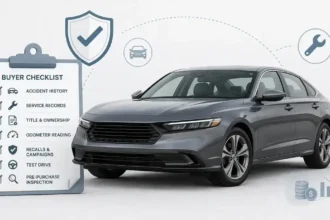
Use this checklist:
- Verify service history and ownership pattern.
- Check recall completion if the year is known for safety-related trouble.
- Look for oil-use clues, cooling neglect, and signs of overheated operation.
- Pay close attention to transmission behavior on the test drive.
- Watch for warning lights, smoke, rough idle, or hard starting.
- Check brakes, tires, steering feel, and suspension noise.
- Confirm A/C, electronics, and basic cabin functions work normally.
- Get a pre-purchase inspection if anything feels even slightly off.
The cleanest buying rule is blunt: if the seller wants Toyota money, make the car prove Toyota-level condition.
Who Should Buy a Used Toyota Corolla — and Who Should Skip It?
This decision gets easier once you stop asking whether the Corolla is “good” and start asking whether it is the right kind of good for you.
The Corolla fits best when you want calm ownership, dependable commuting, and a lower chance of nasty surprises. It fits worst when you want the most engaging drive, the richest interior feel, or more space and refinement than a practical compact sedan usually delivers.
Name the downside honestly. The Corolla can feel more sensible than special. That is a feature for the right buyer and a drawback for the wrong one.
| Buyer type | Corolla fit | Why |
|---|---|---|
| Daily commuter | Strong | Predictable, practical, and low-drama |
| First-time used buyer | Strong | Easier default if the car is clean and documented |
| Budget-focused household | Strong | Usually makes sense when you avoid weaker years and overpriced listings |
| Long-distance driver | Good with conditions | Strong if maintenance history is clean and the car is not hiding deferred work |
| Driver who wants fun first | Weak | Civic or Mazda3 usually make more sense |
| Buyer wanting more space or comfort | Mixed | A larger sedan or crossover may fit better |
The decisive version is simple: buy a Corolla for predictability, not personality. If personality matters more, shop elsewhere.
Reliability is only one part of the buying decision. If you are cross-shopping a lower-priced compact sedan, read Hyundai Elantra vs Toyota Corolla. It explains when the Corolla is the simpler ownership default and when a clean, well-priced Elantra can be the smarter value play.
If a Nissan Sentra is also on your shortlist, our Nissan Sentra vs. Toyota Corolla comparison shows how to evaluate the two used sedans by documented condition, inspection findings, and actual asking prices rather than badge reputation alone.
Toyota Corolla vs Honda Civic and Mazda3 on Reliability
This section only matters if the buyer is choosing among low-drama mainstream defaults, not between a proven candidate and a random alternative.
Choose the Civic if you still care a lot about ownership confidence but know you will regret the Corolla’s plainer personality. The Civic becomes the better answer when you want a more balanced all-rounder instead of the simplest appliance-like default.
Choose the Corolla if you want the simplest mainstream ownership default and the easiest path to a confident used-car decision. It is usually the cleanest answer for the buyer who values ownership simplicity first.
Choose the Mazda3 if cabin feel, design, and a slightly richer driving experience matter enough that you are willing to move away from the simplest default answer. It is not the pick for the buyer who wants the least complicated used-car decision.
| Factor | Toyota Corolla | Honda Civic | Mazda3 |
|---|---|---|---|
| Primary ownership appeal | Simplicity and predictability | Balance of practicality and enjoyment | Cabin and driving feel |
| Ownership predictability | Strong | Good | Good |
| Driving feel | Fair | Better | Better |
| Cabin flair | Fair | Good | Strong |
| Best-fit buyer | Value-first commuter | Buyer wanting balance | Buyer willing to trade simplicity for style and feel |
If you are torn, use this tie-breaker:
- Pick Corolla for the cleanest ownership case.
- Pick Civic for the best balance between practicality and enjoyment.
- Pick Mazda3 only if feel and cabin quality matter enough to move away from the simplest ownership default.
Corolla is the low-risk pick for many buyers, but Civic and Mazda3 may fit different priorities. Compare all three in our reliable used compact cars guide.
Final Verdict: Is the Toyota Corolla a Smart Used Buy?
Yes. For many U.S. used buyers, the Toyota Corolla is still one of the smartest mainstream compact-sedan defaults.
But that answer needs discipline attached to it. Buy the right years, insist on real records, and stop treating the badge like a substitute for inspection. For exact year targeting, use the dedicated Corolla best-years guide: 2005-2008 can be the older-value play, 2011-2013 is the safer default starting band, and 2017-2019 is the stronger newer-feeling band. 2015-2016 and 2020-2022 can still work with the right proof, while 2000-2003, 2009, and 2014 deserve more caution.
The Corolla is one of the strongest low-risk used cars under $20,000, but the exact listing still matters. For a broader budget comparison, see our best used cars under $20,000 guide.
The Corolla remains a low-drama compact choice, especially for buyers who value simple ownership. For a wider reliability shortlist across sedans, compact cars, and SUVs, see our Most Reliable Used Cars guide.
Buy confidently if the car sits in a lower-risk year range, the records are clear, and the inspection supports the story. Buy with conditions if the price is favorable but the year, mileage, or upkeep history needs harder scrutiny. Walk away if the seller wants premium Toyota money for a car with missing records, bad mechanical behavior, or obvious neglect.
The cleanest final rule is this:
- Best fit: commuter, first-time used buyer, value-first household
- Best starting point: 2011-2013 for safest default, 2017-2019 for newer feel, 2005-2008 for older value
- Worth considering with proof: 2010, 2015-2016, 2020-2022
- Deserves more caution: 2000-2003, 2009, 2014
- Walk away: weak records, ugly shifting, oil-use clues, overheating signs, or reputation-priced junk
Frequently Asked Questions
Is Toyota Corolla reliability still strong on older used cars?
Yes, but the answer gets narrower as the cars get older. Older Corollas can still make sense when maintenance history is strong and the inspection is clean. The problem is not age by itself. The problem is age combined with neglect.
What are the most reliable Toyota Corolla years for used buyers?
For most mainstream buyers, clean 2011-2013 cars are usually the safest default starting band, while 2017-2019 makes sense for a newer-feeling daily driver. Budget buyers can still consider 2005-2008 if records, condition, mileage, and inspection results are strong. 2020-2022 can also work, but the record is younger, so price, warranty status, and VIN recall checks matter.
Which Toyota Corolla years should buyers avoid?
Use the most caution with 2000-2003, 2009, and 2014. They are not automatic trash, but most buyers should not start there when stronger alternatives are easier to defend. Treat 2010 as compare-carefully rather than a top default.
What are the main downsides of owning a Toyota Corolla?
The biggest downside is that the Corolla can feel more sensible than rewarding. The second downside is financial: the strong reputation can make average used examples feel overpriced for what they really are.
Is a high-mileage Toyota Corolla still a safe buy?
It can be. High mileage is not the deal-breaker. Weak maintenance history is. A higher-mileage car with clean records can be safer than a lower-mileage car with warning signs and poor upkeep.
Is a Toyota Corolla reliable enough for road trips or long-distance commuting?
Usually yes, if the car has been maintained properly and does not show signs of deferred work. For long-distance use, pay extra attention to tires, brakes, cooling health, and transmission behavior.
How expensive is a Toyota Corolla to maintain over time?
Routine upkeep is usually manageable. The ownership story gets expensive when a buyer inherits neglected maintenance, buys a weaker year without realizing it, or overpays upfront for a car that only looks safe on paper.
Does Corolla reliability beat Honda Civic reliability for most used buyers?
For many value-first buyers, Corolla is the simpler ownership default because its ownership case is easier to evaluate. Civic becomes the better answer when you want more balance and know the Corolla’s plainness will bother you enough to regret choosing the simpler default.