

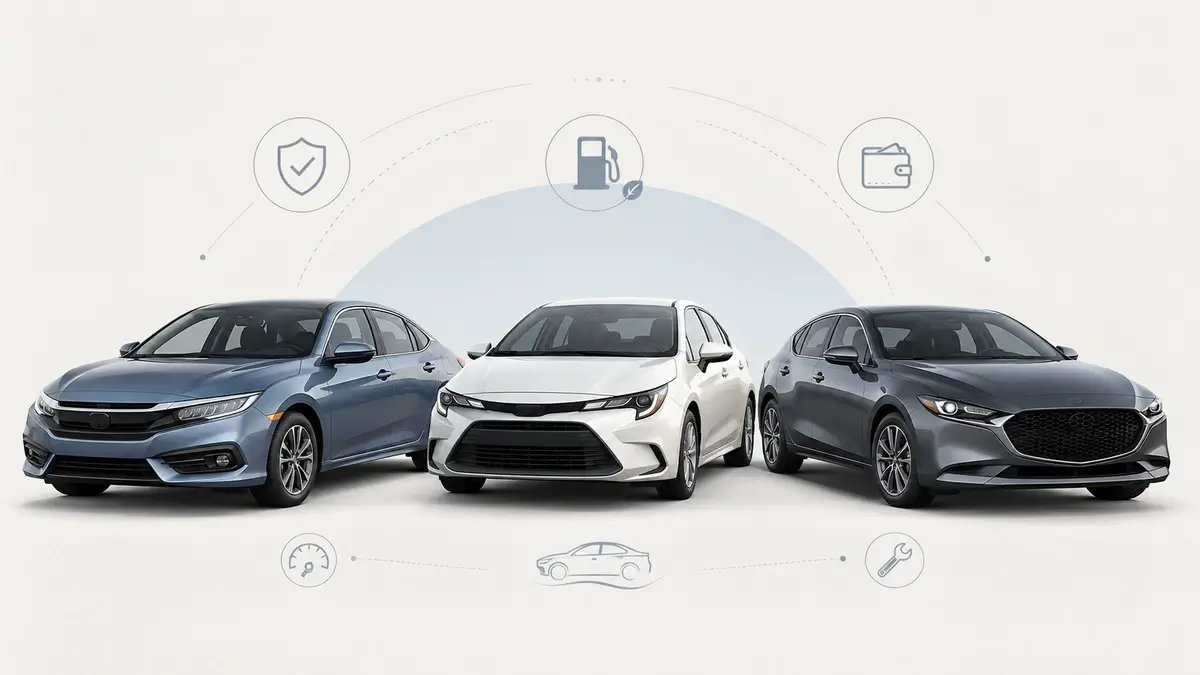
The best used compact cars are not always the newest, cheapest, or highest-rated cars on a list. For most used buyers, the smarter shortlist starts with three names: Honda Civic, Toyota Corolla, and Mazda3.
This guide is CarMerit’s focused used compact-car shortlist, not a market-wide ranking of every compact car sold in the U.S.
The goal is simple: help you decide whether the Civic, Corolla, or Mazda3 is the better next car to compare, inspect, or buy.
If you want better fuel economy and lower running costs, compact cars are a strong starting point. But if you need more rear-seat comfort or highway space, compare this list with our best used midsize sedans guide before deciding.
These three compact cars solve different problems. The Civic is usually the best all-around pick. The Corolla is the safest low-risk ownership choice.
The Mazda3 is the better choice if you want sharper driving feel, a nicer cabin, or stronger value when the price is right.
If your budget is around $20,000, compact cars are often the safest place to start because they can offer newer year bands and cleaner histories. For a wider shortlist that includes sedans and SUVs too, use our best used cars under $20,000 guide.
Quick Verdict
- Best overall used compact car: Honda Civic
- Best low-risk ownership pick: Toyota Corolla
- Best value alternative: Mazda3
- Best for driving feel: Mazda3
- Best for first-time buyers: Toyota Corolla
- Best for commuters: Honda Civic or Toyota Corolla
- Best final answer: buy the cleanest, best-documented example at the fairest local price
If you want the fastest path, start with Honda Civic vs Toyota Corolla, then compare Mazda3 directly against each one using Mazda 3 vs Honda Civic and Mazda 3 vs Toyota Corolla.
Quick Comparison
A used compact car can look good on paper and still be the wrong buy. What matters is how the car fits your budget, commute, ownership risk, and willingness to inspect carefully.
The Civic, Corolla, and Mazda3 all have strong used-market cases. The difference is priority. Civic gives the strongest balance. Corolla gives the cleanest low-risk logic. Mazda3 gives the most enjoyable drive for the money.
Use this table as a starting point, not the final answer. The exact year, trim, mileage, service history, title history, and local price still decide whether the car deserves your money.
| Buyer factor | Honda Civic | Toyota Corolla | Mazda3 |
|---|---|---|---|
| Best overall fit | Strongest all-around pick | Strong low-risk pick | Best alternative if priced well |
| Ownership risk | Good, but year and setup matter | Usually the safest default | Good, but trim, year, and records matter |
| Driving feel | Polished and balanced | Simple and predictable | Sharpest and most enjoyable |
| Fuel-economy logic | Strong; exact engine and transmission matter | Strong; the Hybrid is the clear efficiency outlier | Exact engine, body style, drivetrain, and Turbo setup matter |
| Cabin feel | Usually stronger than Corolla | Practical, not premium | Often the nicest-feeling cabin |
| Rear-seat practicality | Usually strong | Practical enough for most buyers | Can be tighter depending on body style |
| Best buyer | Balanced used-car shopper | Low-risk or first-time buyer | Buyer who wants value plus driving feel |
| Main caution | Do not overpay for the badge | Do not assume every year is equally safe | Do not buy Turbo/AWD/high trim for low-cost ownership |
EPA Same-Year Fuel-Economy Snapshot
| Model Year | Configuration | City | Highway | Combined |
|---|---|---|---|---|
| 2021 | Honda Civic 4-door, 2.0L, automatic with variable gear ratios, FWD | 30 | 38 | 33 |
| 2021 | Toyota Corolla, 1.8L, automatic with variable gear ratios, FWD | 30 | 38 | 33 |
| 2021 | Mazda3 4-door 2WD, 2.0L, 6-speed automatic, FWD | 28 | 36 | 31 |
| 2021 | Toyota Corolla Hybrid, 1.8L hybrid, automatic with variable gear ratios, FWD | 53 | 52 | 52 |
Table Note: City, highway, and combined values are MPG. EPA estimates shown are for exact 2021 U.S. configurations, not model-wide averages. Other engines, transmissions, body styles, and drivetrains can differ. Fuel economy is not total ownership cost.
In this same-year snapshot, the gasoline Civic and Corolla examples tie at 33 combined MPG, while the Mazda3 example returns 31 and the Corolla Hybrid reaches 52. For a high-mileage commuter, the hybrid represents the only major efficiency jump here. Other buyers should compare the exact configuration and purchase-price difference before treating fuel economy as the deciding factor.
Best Overall Choice: Honda Civic
The Honda Civic is the best overall used compact car for buyers who want one car that does many things well. It usually gives you a strong blend of cabin quality, rear-seat usability, daily comfort, and driving polish.
A Civic is still the safer default for many used compact-car buyers, but it is not always the best value. If you are comparing it against a cheaper Hyundai option, read Hyundai Elantra vs Honda Civic before deciding.
The Elantra can be worth considering when budget matters, but it is more year-sensitive than the safest compact-car picks. Use the Hyundai Elantra years to avoid before adding one to your shortlist.
That does not make every Civic a safe buy. The Civic’s reputation can create lazy shopping. Some buyers see the badge, assume reliability, and stop checking the year, setup, service history, and transmission behavior.
The safer Civic approach is simple: buy a clean, well-documented car from a stronger year band, and do not pay extra for a rougher example just because it says Civic on the trunk.
For model-year guidance, start with Best Years for Honda Civic and the Ones to Avoid. For ownership risk, use Honda Civic Reliability: What Used Buyers Should Actually Know.
Best Low-Risk Ownership Pick: Toyota Corolla
The Toyota Corolla is the best used compact car for buyers who want the least complicated ownership case. It is not usually the most exciting car in this group, and that is part of the point.
A used Corolla makes the most sense when your priorities are simple transportation, lower ownership stress, strong fuel economy, and fewer reasons to second-guess the purchase. It is especially strong for first-time buyers, commuters, and value-first shoppers.
The Corolla Hybrid is worth considering if you want the Corolla’s practical compact-car feel with stronger fuel economy. Check the full Toyota Corolla Hybrid reliability and cost-to-own guide before paying the hybrid premium, because battery checks, 12V history, inspection results, and annual mileage decide whether it is the better deal.
The Corolla Hybrid can make sense if you want Corolla practicality with stronger fuel-saving logic, but model year still matters. Before shortlisting one, check the Toyota Corolla Hybrid years to avoid and best years to buy guide for the safer years, caution years, recall checks, and used-buy inspection priorities.
The weak Corolla decision is buying one only because “Corollas are reliable.” That is too broad. Some years deserve more caution, and service history still matters. A neglected Corolla can still be the wrong car.
The Corolla is the safer default for many compact-car buyers, but it is not the only smart used sedan. For a direct value-versus-risk comparison, read Hyundai Elantra vs Toyota Corolla. That comparison helps buyers decide whether paying more for Corolla confidence beats choosing a cleaner or better-equipped Elantra.
For the year-by-year shortlist, use Best Years for Toyota Corolla and the Years to Avoid. For ownership reality, read Toyota Corolla Reliability: Best Years, Common Problems, and Ownership Reality.
Best Value Alternative: Mazda3
The Mazda3 is the compact car to shortlist when you want something more enjoyable than a Corolla and the specific listing is meaningfully cheaper than a comparable Civic. It can be the best value in this group when the condition, year, trim, and price line up.
Its biggest strength is feel. The Mazda3 often gives you sharper steering, a nicer cabin, and a more premium daily-drive experience than buyers expect from a compact car. That makes it attractive if you do not want your used car to feel like basic transportation.
Its caution is ownership complexity. Higher trims, Turbo models, AWD, rough high-mileage examples, and weak service history can reduce the value case quickly. If your top goal is the lowest possible ownership cost, do not treat the Mazda3 Turbo or an overpriced premium trim as the default smart buy.
Start with Mazda 3 Years to Avoid and Best Years to Buy Used, then check Mazda3 Reliability: Ownership Costs, Common Problems, and Used-Buy Risk. If you are comparing trims, use Best Mazda 3 Trims to Buy Used.
Reliability and Ownership Cost
Reliability is not just about which badge has the best reputation. Used buyers need to know which car is easiest to buy correctly.
The Corolla has the cleanest low-risk argument. The Civic is still very strong, but year and setup matter. The Mazda3 can be reliable and rewarding, but it asks for more discipline around trim, drivetrain, and condition.
This is why the “most reliable used compact car” question can mislead buyers. The real answer is not just model name. It is model plus year, condition, records, inspection, and price.
| Ownership priority | Best choice | Why |
|---|---|---|
| Lowest-stress default | Toyota Corolla | Easiest value and reliability case for most buyers |
| Best overall balance | Honda Civic | Strong mix of reliability, comfort, and daily usability |
| Best fun-to-own value | Mazda3 | Stronger cabin and drive feel when bought carefully |
| Lowest complexity | Corolla or simpler Civic | Avoids unnecessary trim and drivetrain risk |
| Best if you enjoy driving | Mazda3 | More engaging than the typical compact car |
| Best if buying older | Corolla or Civic | Mazda3 can work, but inspection discipline matters more |
A clean Mazda3 can beat a neglected Corolla. A well-kept Civic can beat both. The right used car is the one where the records, condition, price, and model-year logic all point in the same direction.
Reliability should matter more than features when buying used. Before picking a specific model year, check our guide to most reliable used cars to see which vehicles have the strongest low-risk ownership case.
Best Years and Used-Buying Risk
Model year matters because compact cars often stay on the road for a long time. That creates a wide used-market spread: older bargain cars, middle-value cars, newer tech-heavy cars, and high-mileage examples with very different risk levels.
Treat these year bands as starting points, not guarantees.
For Civic, the safer starting point is usually 2013 to 2015 for many buyers, with 2009 to 2011 as an older budget play and 2019 to 2021 as the cleaner newer path. Years like 2001, 2006 to 2008, and 2016 deserve more caution.
For Corolla, cleaner 2005 to 2008, 2011 to 2013, and 2017 to 2019 cars are the better places to start. Years like 2000 to 2003, 2009, and 2014 deserve more scrutiny.
Older Corolla buyers need one extra safety check. On IIHS’s 2005, 2006, 2007, and 2008 Corolla sedan pages, the original side test was rated Acceptable with the optional side airbags and Poor without them; head restraints and seats were rated Poor. This does not overturn the wider used-buy case for a clean 2005–2008 Corolla, but it does mean reliability reputation alone is not enough—confirm the exact car’s side-airbag equipment before shortlisting it.
For Mazda3, 2017 to 2018 is the strongest value-and-maturity zone for many buyers. Newer 2020 to 2023 non-turbo examples can work well if priced fairly. Older 2012 to 2013 cars can be budget picks with strong records. Be more careful with 2004 to 2009, 2010 to 2011, 2014, 2019, and any rough high-mileage example.
The key rule is simple: do not buy a “good year” with bad history. A stronger year band only gets you into the right search zone. The exact car still has to earn your money.
Which One Should You Buy?
Choose the Honda Civic if you want the best all-around used compact car and the price premium is reasonable. It is the strongest default if you care about comfort, rear-seat usability, daily polish, and a car that feels more complete than basic transportation.
Choose the Toyota Corolla if low-risk ownership matters most. It is the better fit if your priorities are commuting, first-time ownership, fuel economy, and lower ownership stress.
Choose the Mazda3 if you want a compact car that feels more engaging and upscale without jumping into a more expensive class. It is the right pick if the specific car is clean, fairly priced, and not a high-risk trim or drivetrain choice for your budget.
Many compact cars make sense because they stay affordable without feeling disposable. If price is your main limit, our best used cars under $20,000 guide can help you compare compact cars against SUVs and sedans in the same budget range.
Walk away from any of them if the records are weak, the inspection raises concerns, or the price only makes sense because you are ignoring risk.
If the Civic is much more expensive than a similar Corolla, the Corolla may be the smarter buy. If the Mazda3 is cleaner and meaningfully cheaper than both, it may be the best value. If all three are close in price and condition, Civic is usually the best all-around pick, Corolla is the low-risk pick, and Mazda3 is the more enjoyable alternative.
The Civic is one of the safest compact-car defaults, but it is not always the best value for every buyer. If you are cross-shopping a cheaper alternative, our Kia Forte vs Honda Civic comparison shows when the Forte’s lower price is worth considering.
A used Forte can make sense as a lower-cost compact sedan, but only if the year and condition support the price. Before adding one to your shortlist, check the Kia Forte years to avoid guide so you know which older, engine-risk, and first-redesign examples need extra caution.
Best Choice by Buyer Type
Most compact-car buyers do not need the “best” car in theory. They need the best car for their use case.
A commuter who drives long distances has a different priority than someone who wants a nicer cabin. A first-time buyer should not make the same choice as an enthusiast-leaning buyer. A budget buyer should not chase a high-trim car if it sacrifices condition.
Use this table to narrow the decision before opening the deeper guides.
| Buyer type | Best starting point | Why |
|---|---|---|
| First-time used buyer | Toyota Corolla | Cleanest ownership logic and easiest value case |
| Daily commuter | Honda Civic or Toyota Corolla | Civic feels better; Corolla keeps the decision simpler |
| Tight-budget buyer | Toyota Corolla or Mazda3 | Corolla for low risk, Mazda3 if priced better and clean |
| Buyer who wants comfort | Honda Civic | Better all-around daily feel than Corolla |
| Buyer who wants driving feel | Mazda3 | Most enjoyable compact here |
| Buyer who wants lowest drama | Toyota Corolla | Strongest simple ownership case |
| Buyer who wants one safe default | Honda Civic | Best balance if records and price are right |
| Buyer considering higher trims | Mazda3, carefully | Preferred is usually the smart Mazda3 trim target |
Used Compact Car Buying Checklist
Before you buy any Civic, Corolla, or Mazda3, check the exact car. Do not let a strong model reputation do the inspection for you.
Use the VIN to verify open recalls through the NHTSA recall lookup. Use the EPA fuel economy tool if fuel cost is part of your decision. Then check the exact model year and body style in IIHS vehicle ratings, because crash-test, headlight, and equipment results do not automatically carry across every Civic, Corolla, or Mazda3. These checks do not replace an inspection, but they reduce avoidable blind spots.
Then filter the listing with these questions:
- Does the seller have believable maintenance records?
- Does the title history look clean?
- Does the car drive normally from cold start through highway speed?
- Are there warning lights, rough shifting, hesitation, leaks, or uneven tire wear?
- Does the price still make sense after likely tires, brakes, fluids, or immediate repairs?
- Does the year band support the purchase, or are you making excuses for the deal?
- Would a pre-purchase inspection make you more confident or reveal that the car only looked cheap?
If two or more answers make you uneasy, keep shopping.
If you like the price and efficiency of a compact car but want a taller driving position, a small SUV may fit better. Our best used small SUVs guide covers options that feel more practical for city use without jumping to a full compact SUV.
If you need more space than a compact sedan offers, compare larger options in our best used midsize sedans guide.
Related CarMerit Guides
If you are deciding between the two safest mainstream defaults, start with Honda Civic vs Toyota Corolla. That guide helps you decide whether Civic polish or Corolla simplicity matters more.
If Mazda3 is on your shortlist, compare it directly against the Civic in Mazda 3 vs Honda Civic, then compare it against the Corolla in Mazda 3 vs Toyota Corolla.
If ownership risk is your main concern, use the model-specific reliability guides: Honda Civic Reliability, Toyota Corolla Reliability, and Mazda3 Reliability.
If model-year risk is your deciding factor, go deeper with Best Years for Honda Civic, Best Years for Toyota Corolla, and Mazda 3 Years to Avoid.
If you are leaning Mazda3 and comparing equipment, use Best Mazda 3 Trims to Buy Used before paying more for a higher trim.
Final Recommendation
The Honda Civic is the best used compact car for most buyers who want the strongest all-around answer. It is comfortable, practical, polished, and easy to justify when the price and history are right.
The Toyota Corolla is the best choice for buyers who want the simplest low-risk ownership path. It is not the most exciting option, but it is the one many buyers should choose when dependable transportation matters more than cabin feel or driving enjoyment.
The Mazda3 is the best alternative if you want more personality, a nicer-feeling cabin, or stronger value from the right listing. It is not the automatic lowest-cost choice, but it can be the smartest buy when the trim, year, condition, and price are aligned.
The cleanest decision is this: start with Civic if you want balance, Corolla if you want low-risk ownership, and Mazda3 if you want value plus driving feel. Then let the exact car’s records, inspection, and price make the final call.
Compact cars are often the smartest low-cost reliability play, especially Corolla, Civic, and Mazda3. For the broader shortlist that also includes sedans and SUVs, see our Most Reliable Used Cars guide.
Frequently Asked Questions
What is the best used compact car to buy?
For most buyers, the Honda Civic is the best all-around used compact car. The Toyota Corolla is the safer low-risk ownership pick, while the Mazda3 is the better choice if you want sharper driving feel and stronger value from the right listing.
What is the most reliable used compact car?
The Toyota Corolla is usually the safest low-risk answer, but reliability still depends on year, maintenance history, mileage, and inspection results. A clean Civic or Mazda3 can beat a neglected Corolla.
Is the Honda Civic better than the Toyota Corolla used?
The Civic is usually better if you want a more polished daily driver, stronger cabin feel, and better all-around usability. The Corolla is usually better if you want lower-risk ownership, simpler value, and less buying drama.
Is the Mazda3 a good used compact car?
Yes, the Mazda3 can be a strong used compact car if you choose the right year, trim, and condition. It is especially good for buyers who care about driving feel and cabin quality. Avoid treating Turbo, AWD, or high trims as the default low-cost choice.
Which used compact car is best for commuting?
The Civic and Corolla are the safest starting points for commuting. Choose Civic if comfort and daily polish matter. Choose Corolla if lower ownership stress and simple dependability matter more.
Should I buy a used compact sedan or hatchback?
Buy a sedan if you want a simpler value play and do not need extra cargo flexibility. Buy a hatchback if cargo access and style matter. With Mazda3 especially, body style can affect price and practicality, so compare the exact listing.
What should I check before buying a used compact car?
Check service records, title history, recall status, tire wear, brakes, fluids, warning lights, transmission behavior, accident history, and local price comparisons. A pre-purchase inspection is still one of the best ways to avoid buying the wrong car.