

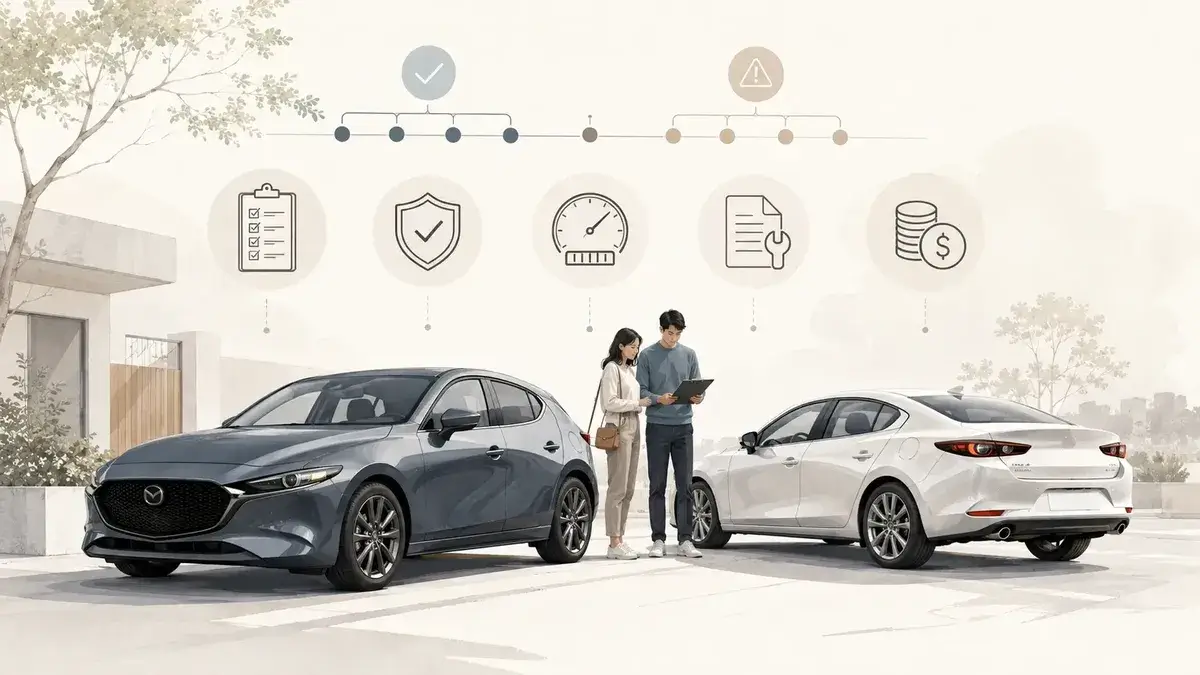
The mazda 3 years to avoid are mostly older, poorly maintained, rusty, early-generation, or first-year redesign examples. The Mazda3 itself is not a bad used compact car. The weak buys usually come from the wrong year, weak records, high wear, unresolved recalls, or buying by price alone.
For most used buyers, the safest shortcut is simple: prioritize a clean 2017–2018 Mazda3 for value, look at 2020–2023 if you want a newer car, and be careful with 2004–2009, 2010–2011, 2014, and 2019 unless the condition and history are strong.
This guide is built for U.S. used-car buyers. It does not rank years to create drama. It shows which Mazda3 years make the strongest case, which ones need more caution, and what to check before you pay.
CarMerit reliability tool
Check any Mazda3 year — NHTSA-backed verdict
Pick a model year to see complaint, recall, investigation, and manufacturer-communication counts from NHTSA, plus CarMerit’s verdict on whether that year is a safe used buy. 2024–2026 have too little data yet for a confident reliability read.
Owner complaints
…
NHTSA, CarMerit snapshot
Safety recalls
…
NHTSA, CarMerit snapshot
Investigations
…
NHTSA, CarMerit snapshot
Manufacturer communications
…
NHTSA, CarMerit snapshot
Most-reported problem areas
Complaint counts are raw owner reports filed with NHTSA and are not adjusted for sales volume — popular years naturally generate more reports. Verdicts combine this data with CarMerit’s own research. Data source: NHTSA.gov. Always verify a specific vehicle’s history before buying.
Quick Answer: Best Mazda3 Years to Buy and Avoid
A used Mazda3 can be a sharp buy if you choose by year, condition, and service history together. The mistake is treating every “good year” as automatically safe.
The table below gives the fast decision. Use it as a shortlist, not as a substitute for a VIN recall check, pre-purchase inspection, and test drive.
| Mazda3 year group | Buy / inspect / avoid label | Main reason | Best-fit buyer | Inspection priority |
|---|---|---|---|---|
| 2017–2018 | Best buy | Mature third-generation years with strong value logic and fewer age-related concerns than older cars | Value-focused buyer who wants a reliable, fun compact car | Infotainment, service records, tires, brakes, accident history |
| 2020–2023 non-turbo | Best newer used pick | Newer fourth-generation cars with more modern cabin and safety structure | Buyer with higher budget who wants a newer compact car | Recall status, electronics, tires, maintenance history |
| 2012–2013 | Good older budget pick | Better budget years than many earlier examples, but age and maintenance now matter heavily | Tight-budget buyer who can inspect carefully | Rust, suspension, transmission/clutch, service records |
| 2015–2016 | Acceptable with checks | Can be good value, but infotainment and condition checks matter | Buyer who finds a clean, fairly priced third-gen car | Mazda Connect behavior, brakes, records, body condition |
| 2014 | Inspect harder | First year of the third generation, with early-tech and condition checks needed | Buyer getting a strong price on a clean car | Mazda Connect, recalls, service records, test-drive behavior |
| 2019 | Inspect harder | First year of the fourth-generation redesign, with model-specific recall history to verify | Buyer who wants newer design but accepts extra checking | VIN recall check, electronics, driver-assist behavior, records |
| 2021+ Turbo / AWD | Buy for performance, not lowest cost | More power and AWD add appeal, but also more cost exposure | Buyer who values performance and traction | Tires, brakes, fuel use, turbo/AWD service history |
| 2004–2009 | Avoid unless unusually clean | Age, rust risk, older safety tech, and maintenance uncertainty are now the main concerns | Budget buyer with inspection discipline | Rust, recalls, suspension, engine leaks, title history |
| 2010–2011 | Inspect harder | Early second-generation cars can be fine, but condition matters more than reputation | Budget buyer choosing carefully | Clutch/manual behavior, suspension, service records, recall status |
The best Mazda3 years are not always the newest or cheapest. For most buyers, the better target is a clean middle-ground car with records, reasonable miles, no rust, and no unresolved recalls.
How We Judged Mazda3 Model Years
Year rankings are only useful when the logic is clear. A bad example from a good year can still be a bad buy. A clean example from a caution year can sometimes make sense if the price reflects the risk.
For this guide, the main filters are reliability patterns, recall risk, complaint signals, generation changes, known problem areas, maintenance burden, used-market logic, and buyer fit.
Before buying any used Mazda3, run the VIN through the NHTSA recall lookup and Mazda’s official recall page. NHTSA’s recall page helps owners check whether a vehicle has a safety recall, and Mazda’s recall page asks for a VIN to show pending Mazda recalls and available recall repair support.
This guide does not claim every model year has the same amount of public evidence. It also does not treat forums as proof. Owner reports can reveal useful inspection questions, but final buying advice needs safer wording unless supported by official or stronger secondary evidence.
Best Mazda3 Years to Buy Used
The best Mazda3 years to buy used are the ones that combine a mature platform, reasonable ownership risk, decent safety, good fuel economy, and enough used-market availability to avoid overpaying.
The strongest picks split into three groups: best overall value, best newer used, and best older budget. Each has a different trade-off.
Best Mazda3 Buyer Targets With NHTSA Evidence Scope
| Buyer need | Best Mazda3 years to start with | NHTSA evidence scope | Owner complaints | Safety recalls | Why it makes sense | Main trade-off |
|---|---|---|---|---|---|---|
| Best overall used value | 2017–2018 | 2017–2018, all body styles/trims | 190 | 6 | Mature third-generation cars with strong value logic and less age exposure than older examples | Still inspect infotainment, brakes, tires, and service records |
| Best newer used choice | 2020–2023 non-turbo first; include 2024–2026 only when shopping nearly new examples | 2020–2026, all trims/drivetrains in available NHTSA records | 133 | 7 | Newer fourth-generation cars with a more modern cabin and safety structure | Higher price, and newer low complaint counts do not prove long-term reliability yet |
| Best older budget choice | 2012–2013 | 2012–2013, all trims | 343 | 2 | Lower-cost compact car option if records and inspection are strong | Age, rust, and maintenance history matter more than reputation |
| Best hatchback value | 2017–2018 hatchback | Body style not separately tracked in the available NHTSA records | Not separately tracked; 2017–2018 all-body total is 190 | Not separately tracked; 2017–2018 all-body total is 6 | Good mix of utility, style, and mature third-generation mechanics | Hatchbacks may cost more than sedans |
| Best for AWD shoppers | 2020–2026 AWD, carefully checked | AWD not separately tracked in the available NHTSA records | Not separately tracked; 2020–2026 all-trim total is 133 | Not separately tracked; 2020–2026 all-trim total is 7 | AWD availability adds traction appeal in newer cars | More tire, drivetrain, and fuel-cost exposure |
| Best for performance buyers | 2021–2026 Turbo | Turbo not separately tracked in the available NHTSA records | Not separately tracked; 2021–2026 all-trim total is 102 | Not separately tracked; 2021–2026 all-trim total is 5 | Stronger engine and available AWD appeal to performance-focused buyers | Not the lowest-cost Mazda3 to own |
Table Note: Complaint and recall counts are NHTSA records, not defect rates or reliability scores. Hatchback, Turbo, and AWD versions are not separated, so those rows should be read as all-trim Mazda3 evidence.
A clean Mazda3 can be one of the best value picks under $20,000, especially in the right year band. Compare it with Corolla, Civic, Camry, and used SUVs in our best used cars under $20,000 guide.
2017–2018 Mazda3: Best Overall Used Pick
For most buyers, 2017–2018 is the cleanest Mazda3 sweet spot. These are late third-generation cars, so they avoid the earliest-year caution of the 2014 redesign while still feeling modern enough for daily use.
This recommendation is based on late-cycle maturity, avoided first-year redesign risk, and used-value logic. Cars.com notes the 2014–2018 Mazda3 generation was redesigned for 2014, then received a 2017 refresh with updated styling and interior changes; that makes 2017–2018 a more mature point in the third-generation run.
This is the first range to check if you want a used Mazda3 that balances price, reliability, fuel economy, and driving feel. The main caveat is condition. A neglected 2018 is still worse than a well-kept older car.
For the 2017 model year specifically, Mazda’s official schedule calls for spark-plug replacement every 75,000 miles and the first FL-22 coolant replacement at 120,000 miles or 10 years, whichever comes first. Ask for service receipts instead of assuming these higher-mileage items were completed.
2020–2023 Mazda3: Best Newer Used Pick
The 2020–2023 Mazda3 is the better target if you want a newer compact car with a nicer cabin, available modern driver-assistance equipment, and available AWD depending on configuration. IIHS lists separate sedan and hatchback pages within the 2019 redesign family, so use the rating page for the body style, model year, and configuration you are buying.
For lower ownership risk, start with non-turbo examples. They are less exciting than the Turbo, but they keep the used Mazda3 closer to its practical compact-car role.
On 2019–2023 candidates, especially Turbo examples, it is also worth checking CarMerit’s Manufacturer Special Coverage Lookup for Mazda-issued coverage records tied to that model year before you let a known repair history change your buy/inspect decision.
2012–2013 Mazda3: Best Older Budget Pick
A clean 2012–2013 Mazda3 can still make sense for a tight-budget buyer. The catch is age. At this point, the maintenance record matters more than the model-year reputation.
Do not buy one just because it is cheap. Look for service history, clean title, smooth shifting, no major rust, no unresolved recalls, and no dashboard warning lights.
Mazda 3 Years to Avoid or Approach Carefully
The Mazda 3 years to avoid are not all automatic walk-away years. A better way to read the used market is this: some years are safer to shop broadly, while others need a bigger discount and a stricter inspection.
Avoiding a bad Mazda3 is mostly about refusing weak examples. Rust, unresolved recalls, vague service history, poor test-drive behavior, and neglected wear items should matter more than a seller’s claim that “Mazdas are reliable.”
Mazda3 Years to Avoid or Inspect Harder Using NHTSA Evidence
| Mazda3 year/group and caution level | Owner complaints | Safety recalls | Investigations | Mfr. Comms. | Why to be careful | Buy only if |
|---|---|---|---|---|---|---|
| 2004–2009 — High | 1,048 | 18 | 3 | 1,309 | Age, rust risk, older safety tech, recall exposure, and many years of possible neglect | It is rust-free, cheap enough, well maintained, and passes inspection |
| 2010–2011 — Medium | 817 | 5 | 2 | 567 | Early second-generation examples need harder checks; 2010 carries a large complaint concentration | It has clean history, smooth drivetrain/steering behavior, and strong maintenance proof |
| 2014 — Medium | 137 | 4 | 0 | 879 | First year of the third-generation redesign; electronics, infotainment, charging-system, recall, and record checks matter | The price is right and Mazda Connect, recalls, and records check out |
| 2015–2016 — Moderate | 233 | 10 | 0 | 1,405 | Usually more acceptable than 2014, but the available NHTSA records still show recall and manufacturer-communication volume to verify | The car is clean, fairly priced, and not hiding electronics, fuel-system, brake, or camera issues |
| 2019 — Medium | 73 | 6 | 0 | 809 | First year of the fourth-generation redesign, with a clustered recall history to verify | The VIN recall check is clean and electronics/driver-assist features work correctly |
| 2021–2026 Turbo/AWD — Conditional | Not separately tracked; all-trim 2021–2026 total is 102 | Not separately tracked; all-trim 2021–2026 total is 5 | 0 | Not separately tracked; all-trim 2021–2026 total is 1,767 | More power and AWD can raise tire, brake, fuel, and drivetrain exposure | You want performance/traction and accept higher running costs |
Table Note: Use this table as an inspection guide, not a buy/avoid verdict by itself. Older years have had more time to collect complaints, so newer lower counts do not automatically mean better reliability.
Why Older 2004–2009 Mazda3s Need the Most Caution
The first-generation Mazda3 can be fun and cheap, but most examples are now old enough that condition dominates everything. Rust, suspension wear, neglected maintenance, and unresolved recalls can turn a low purchase price into a bad buy.
There is also a serious recall angle for older vehicles. NHTSA says tens of millions of Takata air bags have been recalled because inflators can explode during deployment, and Mazda’s recall tools should be used to verify whether a specific VIN has any open recall. That does not mean every old Mazda3 is affected, but it does mean a VIN recall check is non-negotiable.
Why 2014 Needs Extra Attention
The 2014 Mazda3 was fully redesigned, which is not automatically bad. Cars.com describes the 2014–2018 Mazda3 as a redesigned generation with a longer wheelbase, wider stance, Skyactiv engines, and newly available safety features.
The infotainment concern is vehicle-specific, not a blanket defect finding. Mazda’s CSP13 customer service program covers listed 2014–2018 Mazda3 VIN and production ranges. It provides a 24-month limited warranty extension with no mileage limit for specified Mazda Connect software updates and, when necessary, connectivity master unit repair or replacement.
For eligible vehicles already outside the New Vehicle Limited Warranty, the program period runs from February 17, 2025. Eligible vehicles still inside that warranty receive the additional 24 months after it expires. Ask a Mazda dealer to verify the VIN and CSP13 status in Mazda’s eMDCS system. This is a warranty extension, not a recall, and it does not cover unrelated infotainment issues.
For 2014 specifically, Mazda’s official maintenance schedule calls for spark-plug replacement every 75,000 miles. FL-22 coolant is first due at 120,000 miles or 10 years, whichever comes first. Ask for receipts and confirm the coolant type because other coolant has a different schedule.
During inspection, test the screen, Bluetooth, backup camera, audio controls, and system responsiveness. A good price does not offset an infotainment system that freezes, reboots, or behaves inconsistently during the test drive.
Why 2019 Should Be Inspected Harder
The 2019 Mazda3 started the fourth generation. Mazda’s own safety announcement describes the Mazda3 as redesigned for the 2019 model year, and IIHS noted the 2019 Mazda3 hatchback and sedan earned Top Safety Pick recognition in that context.
The caution is not that every 2019 Mazda3 is bad. The issue is that first-year redesigns deserve a stricter VIN check and electronics check. Mazda issued a recall statement for certain 2019 Mazda3 vehicles involving a wheel lug nut concern, noting that lug nuts could loosen and, in the worst case, lead to wheel detachment. Mazda also stated that no field cases of wheel separation, accidents, injuries, or deaths had been reported for that concern.
Separate from recalls, Mazda’s SSPD8 warranty extension covers the specified fail-safe-thermostat concern on certain 2019–2023 Mazda3s equipped with the suspected coolant-control valve. Coverage for the specific repair extends to 15 years or 150,000 miles from the original warranty start date, whichever comes first.
Eligibility and the current repair procedure depend on the VIN, production range, engine and build information, diagnosis, and SSPD8 status in Mazda’s eMDCS system. Ask a Mazda dealer to verify the exact car before purchase. This does not mean every 2019–2023 Mazda3 has the condition or that unrelated cooling-system repairs are covered.
IIHS Safety Checkpoints by Mazda3 Year
IIHS results are most useful here as configuration checkpoints, not as one overall safety ranking. Body style, trim, equipment, build date, and test criteria can change what applies to an individual Mazda3.
| Model years | IIHS scope | Material finding | What to verify before buying |
|---|---|---|---|
| 2005–2008 | Sedan models built after August 2004 | The original side test is rated Poor, but the tested vehicle was a 2005 Mazda3 i four-door without optional side airbags. | Confirm the build date and presence of side airbags. Do not apply this result to hatchbacks or differently equipped cars. |
| 2012–2013 | Listed sedan and hatchback pages | The original moderate-overlap, original side, roof-strength, and head-restraint results are rated Good. | Use the applicable body-style page and do not compare these older test results directly with later test families. |
| 2014 | Sedan and hatchback | The driver-side small-overlap and original side results are rated Good. Optional Smart City Brake Support is rated Advanced. | Confirm whether the Technology Package and applicable crash-prevention equipment are actually installed. |
| 2017–2018 | Sedan and hatchback | The driver-side small-overlap result is rated Good. Headlights range from Acceptable to Marginal. Front crash prevention ranges from Advanced to Superior depending on model year and equipment. | Verify the exact trim, headlight configuration, and safety package rather than relying on model year alone. |
| 2019 | Sedan and hatchback | Driver- and passenger-side small-overlap results are rated Good. Headlights are rated Acceptable. Optional Smart Brake Support is rated Superior. | Confirm that Smart Brake Support is installed; IIHS lists it as optional on Select, Preferred, and Premium trims. |
| 2020–2023 | Sedan and hatchback | Driver- and passenger-side small-overlap results are rated Good. Headlights range from Good to Acceptable by configuration. Standard Smart Brake Support is rated Superior in the listed vehicle-to-vehicle and daytime-pedestrian evaluations. | Confirm the exact headlight configuration. The 2023 updated-side result is separate from the original side test used for earlier years. |
Table Note: IIHS test criteria have changed over time. Do not treat these results as one directly comparable cross-year safety score or use them alone to change the article’s reliability-based buy and avoid verdicts.
Key Mazda3 NHTSA Recall Checks by Model Year Range
| Recall check area | Campaign number(s) | Model years in NHTSA records | Fire risk shown | Buyer action |
|---|---|---|---|---|
| Airbag and restraint checks | 04V468000, 04V559000, 21V494000, 25V357000 | 2004–2007; 2024–2025 | No | Verify completion on older cars and nearly new 2024–2025 examples before treating the VIN as cleared |
| Steering, stability, and wiper checks | 09V187000, 10V374000, 11V329000 | 2007–2009 | No | Pay extra attention to steering assist, ESC-related repairs, and wiper function on first-generation cars |
| Fuel-system recalls | 15V621000, 16V684000, 16V685000 | 2014–2016 | Yes | Require VIN recall proof and inspect for fuel odor, leaks, hard starts, or stall complaints |
| Brake, wheel, and sudden-braking checks | 17V393000, 19V425000, 19V907000, 20V346000 | 2014–2020 | No | Verify recall completion and test braking feel, wheel/tire condition, and driver-assist braking behavior |
| Visibility, camera, and sensing-system checks | 19V272000, 23V487000, 23V718000, 24V649000 | 2014–2018; 2024 | No | Test wipers, rear camera, front/side camera display, automatic braking, lane assist, and headlight behavior |
| 2019 first-year redesign cluster | 19V363000, 19V497000, 19V514000, 19V558000 | 2019 | No | Do not skip the VIN check on 2019 cars; verify indicator lights, software updates, seats, mirrors, and engine behavior |
| Newer tire and airbag software checks | 21V101000, 25V357000 | 2021; 2024–2025 | No | Confirm tire-valve and airbag software/remedy completion on affected VINs |
Table Note: A recall check must be VIN-specific. A listed recall range does not mean every car in that year is affected, and it also does not prove the repair was completed.
Do not reject every 2019 automatically. Reject the specific car if the VIN has unresolved recalls, warning lights, poor electronic behavior, rough driver-assist operation, or weak service records.
Mazda3 NHTSA Evidence by Generation
Generation context helps, but it should not replace model-year judgment. A good generation can still have weaker early years. A caution generation can still have clean examples.
| Gen | Years included | Owner compls. | Compls. per model-year | Safety recall rows / unique camps. | Inv. | Mfr. Comms. | Owner-reported severity flags | Used-buyer read |
|---|---|---|---|---|---|---|---|---|
| First generation | 2004–2009 | 1,048 | 174.7 | 18 / 7 | 3 | 1,309 | Crash: 123 (11.7%); fire: 13 (1.2%); injury: 68 (6.5%); death: 0 (0.0%) | Cheap but old; inspect rust, steering, suspension, airbag/recall status, and maintenance history hard |
| Second generation | 2010–2013 | 1,160 | 290.0 | 7 / 3 | 4 | 1,510 | Crash: 46 (4.0%); fire: 10 (0.9%); injury: 25 (2.2%); death: 0 (0.0%) | Higher relative complaint rate in the available NHTSA records, heavily affected by the 2010 spike; inspect drivetrain, steering, seats, suspension, and records |
| Third generation | 2014–2018 | 560 | 112.0 | 20 / 9 | 0 | 3,249 | Crash: 37 (6.6%); fire: 4 (0.7%); injury: 19 (3.4%); death: 1 (0.2%) | Best value zone overall, but 2014 needs more checking and 2014–2018 camera/infotainment/recall checks matter |
| Fourth generation | 2019–2026 | 206 | 25.8 | 13 / 11 | 0 | 3,283 | Crash: 13 (6.3%); fire: 4 (1.9%); injury: 6 (2.9%); death: 1 (0.5%) | Newer and lower in raw complaints, but still young; check 2019 first-year recalls and 2024–2025 camera/airbag software recalls |
Table Note: These figures help compare broad generation-level risk, but they are not reliability rankings. Newer generations have less time on the road, so lower complaint totals should be treated carefully.
The third generation is usually the easiest recommendation for used shoppers because 2017–2018 sit late in the cycle. The fourth generation is more upscale, but the 2019 first year deserves more checking than later examples.
Common Mazda3 Problems Used Buyers Should Check
A problem list is only useful if it changes your inspection. Do not use common issues as fear content. Use them as a checklist before buying.
RepairPal gives the Mazda3 a 4.0 out of 5.0 reliability rating and ranks it 9th out of 36 compact cars in its dataset. It also lists an average annual repair cost of $433, compared with $526 for compact cars and $652 for all vehicle models. Treat those numbers as a broad ownership signal, not a guarantee for a specific used car.
Before this table, remember one rule: a used car with strong records and clean inspection can beat a newer car with hidden neglect.
| Area to check | Why it matters | What to do before buying | Walk-away sign |
|---|---|---|---|
| Rust and body condition | Older Mazda3s can lose value quickly if rust is structural | Inspect rockers, wheel arches, underbody, doors, hatch area | Heavy structural rust or fresh undercoating hiding corrosion |
| Recalls | Open recalls can create safety risk and ownership hassle | Run the VIN through NHTSA and Mazda recall lookup | Seller refuses to provide VIN |
| Infotainment / Mazda Connect | Some 2014–2018 vehicles are tied to settlement coverage | Test screen, audio, Bluetooth, backup camera, controls | Freezing, rebooting, dead screen, camera failure |
| Suspension and steering | Older compact cars often show wear here | Listen for clunks, rattles, uneven tire wear | Noises over bumps, steering pull, visible tire damage |
| Brakes | Mazda3s are often commuter cars, so brake wear is common | Check pad/rotor condition and brake feel | Pulsation, grinding, uneven braking |
| Transmission / clutch | Manual cars and older automatics need closer checks | Test cold start, shifts, clutch bite, hesitation | Slipping clutch, harsh shifts, grinding, delayed engagement |
| Tires | AWD and turbo examples can punish neglected tire maintenance | Check matching tires and tread depth | Mismatched tires on AWD or uneven wear |
| Service records | Records prove care better than seller claims | Ask for maintenance history and receipts | “No records, but it runs great” |
Most-Reported NHTSA Complaint Areas by Generation
| Generation | Top 3 actionable NHTSA complaint areas | “Unknown / other” share | Inspection priority |
|---|---|---|---|
| First generation (2004–2009) | Steering: 266 (25.4%) → Airbags/seatbelts/structure: 162 (15.5%) → Suspension/wheels: 162 (15.5%) | 26 (2.5%) | Steering assist, suspension/wheel wear, airbag/seatbelt lights, VIN recall status |
| Second generation (2010–2013) | Airbags/seatbelts/structure: 245 (21.1%) → Seats: 137 (11.8%) → Suspension/wheels: 102 (8.8%) | 114 (9.8%) | Airbag/seatbelt warnings, seat function, suspension noise, tire wear |
| Third generation (2014–2018) | Electrical: 107 (19.1%) → Brakes: 66 (11.8%) → Driver-assist/ADAS: 57 (10.2%) | 114 (20.4%) | Mazda Connect/electrical behavior, brake feel, rear camera, driver-assist functions |
| Fourth generation (2019–2026) | Airbags/seatbelts/structure: 38 (18.4%) → Driver-assist/ADAS: 27 (13.1%) → Engine: 26 (12.6%) | 16 (7.8%) | Restraint warning lights, camera/ADAS operation, engine behavior, recall status |
Table Note: These complaint areas show what buyers should inspect first, not guaranteed defects. “Unknown / other” is a catch-all category, so it should not be treated as a specific problem area.
Sedan vs Hatchback, Engine, and Trim Factors
The right Mazda3 year can still be the wrong Mazda3 configuration. Body style, drivetrain, engine, and trim can change ownership cost.
This matters more in the used market because buyers often compare two cars by year and mileage while ignoring the equipment that can change long-term cost.
| Choice | Better for | Risk or trade-off | Best used-buy rule |
|---|---|---|---|
| Sedan | Lower price, simpler commute use | Less cargo flexibility than hatchback | Choose it if value matters more than cargo |
| Hatchback | Cargo flexibility and style | Often more desirable, sometimes priced higher | Worth it if space and resale appeal matter |
| Manual | Driver involvement and simpler feel | Clutch wear depends heavily on previous owner | Buy only after a careful clutch test |
| Automatic | Easier daily driving | Still needs smooth shift behavior | Avoid harsh shifts or delayed engagement |
| Non-turbo | Lower running-cost exposure | Less power | Best default choice for most used buyers |
| Turbo / AWD | Performance and traction | More tire, brake, fuel, and drivetrain exposure | Buy for enjoyment, not cheapest ownership |
| Higher trim | Better features and cabin feel | More electronics and repair-cost exposure | Choose only if the features still work correctly |
Mazda’s 2021 Mazda3 Turbo reveal says the 2.5 Turbo came with standard i-Activ AWD and different output depending on whether premium or regular fuel is used. That makes the Turbo appealing, but it also moves the car away from the lowest-cost used Mazda3 formula.
For the 2021 model year specifically, Mazda schedules spark-plug replacement every 40,000 miles on the 2.5T, compared with every 75,000 miles on engines other than the 2.5T. Check the service records carefully because the turbo’s shorter interval can create a more frequent maintenance expense.
Certain 2021–2022 Mazda3 2.5T vehicles may also qualify for Mazda’s SSPD5 valve-stem-seal warranty extension. It covers oil-consumption-related repairs for that specific condition for 7 years or 84,000 miles from the original warranty start date, whichever comes first.
Eligibility depends on the VIN, production range, engine, and SSPD5 status in Mazda’s eMDCS system. Ask a Mazda dealer to verify the exact car before purchase. This is a warranty extension, not a recall, and it does not mean every 2021–2022 Turbo is affected or that unrelated powertrain repairs are covered.
Ownership Cost, Maintenance, and Resale Reality
The Mazda3 has a good cost case compared with many compact cars, but that does not make every used example cheap to own. Age, mileage, tires, brakes, rust, and electronics can change the real cost fast.
Before choosing by year alone, compare the model-year advice with the Mazda3 reliability guide so ownership cost, common problems, maintenance risk, and inspection needs all point in the same direction.
RepairPal’s Mazda3 reliability page lists the model’s average annual repair cost at $433 across its dataset, compared with $526 for compact cars and $652 for all vehicle models. That is useful context, but your real cost still depends on the exact car’s age, mileage, maintenance, location, and repair history.
| Cost area | Buyer impact | What to check |
|---|---|---|
| Routine maintenance | Usually manageable if records are strong | Oil changes, fluids, filters, spark plugs, service receipts |
| Tires | Higher trims, larger wheels, AWD, and turbo models can cost more | Matching tires, tread depth, uneven wear |
| Brakes | Normal commuter wear can become a near-term expense | Rotor condition, pedal feel, service receipts |
| Fuel economy | Varies by engine, transmission, AWD, and turbo setup | Check the exact year/trim on FuelEconomy.gov before buying |
| Resale value | Clean later third-gen and newer fourth-gen cars hold appeal | Avoid salvage titles, rust, poor records |
| Repairs | Older cars can need suspension, electronics, or clutch work | Pre-purchase inspection before commitment |
Fuel economy should be checked by exact year, body style, drivetrain, and transmission because Mazda3 ratings vary by configuration. Use the official FuelEconomy.gov vehicle search before comparing two listings.
The EPA figures below show how the article’s main buy targets compare in representative configurations:
| Article target | EPA configuration scope | City MPG | Highway MPG | Combined MPG | Buyer takeaway |
|---|---|---|---|---|---|
| 2012–2013 budget pick | 2.0L direct-injection automatic, FWD sedan and hatchback | 28 | 37–39 | 31–32 | Strong fuel economy is available in this specific older configuration |
| 2017–2018 best overall | 2.0L automatic, FWD sedan and hatchback | 28 | 37 | 31–32 | Body style and model year change the exact combined rating |
| 2020–2023 newer non-turbo pick | Selected 2.0L or 2.5L automatic, FWD sedan and hatchback configurations, depending on year | 26–28 | 34–37 | 29–31 | Newer does not automatically mean more efficient |
| 2021–2023 Turbo/AWD | 2.5L turbo automatic, AWD sedan and hatchback | 23 | 31–32 | 26–27 | The performance configuration carries a clear fuel-economy trade-off |
Table Note: These are exact EPA configuration values or the displayed minimum-to-maximum range across the configurations named, not model-year averages. Other engines, transmissions, body styles, and drivetrains may differ. EPA estimates are not guaranteed real-world results.
Used-Listing Price-Gap Rule
A clean Mazda3 is worth paying more for, but only within reason. Before choosing a year, compare real local listings across three groups: older budget cars, 2017–2018 cars, and newer 2020–2023 cars.
This is not a price prediction. It is a rule for avoiding bad value.
| Listing comparison | Better decision rule |
|---|---|
| 2012–2013 vs 2017–2018 | Choose the older car only if the savings are meaningful and the inspection is strong |
| 2017–2018 vs 2020–2023 | Choose the newer car if the price gap is fair and you want newer safety/cabin features |
| 2019 vs 2020–2021 | Do not buy the 2019 unless the recall check, condition, and price make sense |
| Turbo/AWD vs non-turbo | Pay more only if performance or traction matters to you |
| Hatchback vs sedan | Pay the hatchback premium only if cargo flexibility matters |
This check prevents a common mistake: buying a riskier year because it looks cheaper, then spending the difference on repairs.
Best Mazda3 Year for Different Buyers
There is no single best year for every Mazda3 shopper. The right pick depends on budget, risk tolerance, mileage, and how much you value driving feel over maximum practicality.
Use this matrix to narrow the decision before looking at listings.
| Buyer type | Best Mazda3 year range to start with | Why | Skip if |
|---|---|---|---|
| Lowest-risk used buyer | 2020–2023 non-turbo | Newer, modern, less age-related risk | Price is too close to better alternatives |
| Best value buyer | 2017–2018 | Mature third-gen sweet spot | Records are weak or infotainment acts up |
| Tight-budget buyer | 2012–2013 | Better older-budget target than many first-gen cars | Rust, title, or service history is questionable |
| Hatchback buyer | 2017–2018 hatchback | Practical, stylish, still reasonably modern | Hatchback premium is too high |
| Performance buyer | 2021+ Turbo | Stronger power and AWD | You want lowest ownership cost |
| First-time buyer | 2017–2018 sedan | Simple, usable, balanced | Insurance or repair history looks risky |
| Civic/Corolla cross-shopper | 2017–2018 or 2020–2023 non-turbo | More style and driving feel than appliance-like rivals | You want maximum rear-seat room or lowest-risk ownership |
The Mazda3 makes the most sense for buyers who care about driving feel and cabin quality. It is weaker if your top priority is rear-seat space, maximum cargo room, or the lowest-risk compact-car ownership path.
If Mazda3 is on your shortlist, compare it against Civic and Corolla in our guide to the best used compact cars before making the final call.
Used Mazda3 Inspection Checklist Before You Buy
A clean Mazda3 is worth paying more for. A neglected Mazda3 is not a bargain just because it has the “right” model year.
Use this checklist before you negotiate. It is especially important for older cars, first-year redesigns, Turbo/AWD models, and anything with high mileage.
| Checkpoint | What to verify | Why it matters |
|---|---|---|
| VIN recall check | Run the VIN through NHTSA and Mazda | Confirms open safety recalls on that exact vehicle |
| Title history | Avoid salvage, flood, rollback, and major accident history | Protects resale and reduces hidden repair risk |
| Service records | Look for oil, fluids, brakes, tires, battery, and major repairs | Good records reduce uncertainty |
| Rust inspection | Check underbody, wheel arches, rocker panels, hatch area | Rust can erase the value of cheap older Mazda3s |
| Cold start | Listen for rough idle, warning lights, smoke, hesitation | Catches issues hidden after warm-up |
| Test drive | Check shifting, braking, steering, suspension, and road noise | Reveals problems a listing cannot |
| Infotainment | Test screen, Bluetooth, camera, audio, navigation if equipped | Important for 2014–2018 Mazda Connect cars |
| Tires and alignment | Check matching tires and even wear | Especially important on AWD examples |
| Pre-purchase inspection | Use an independent mechanic | Best defense against hidden repairs |
Simple VIN-Check Callout
Before seeing the car, ask the seller for the VIN.
Then check it in two places:
Before you go deeper into that specific Mazda3, use the CarMerit VIN Lookup to confirm the vehicle details returned for its VIN against the seller’s listing and paperwork. Keep the official NHTSA and Mazda checks separate for open recalls; the goal here is to make sure you are evaluating the exact Mazda3 the seller claims it is.
If the seller will not provide the VIN, move on. That is not a Mazda3-specific rule. It is a used-car buying rule.
Final Recommendation: Which Mazda3 Year Should You Buy?
Start with 2017–2018 if you want the best balance of value, reliability, and used-car maturity. That is the strongest all-around used Mazda3 range for most shoppers because it sits late in the third generation, avoids the 2014 first-year redesign caution, and usually costs less than newer fourth-generation examples.
Choose 2020–2023 non-turbo if your budget allows a newer car and you want a more modern cabin. Be more careful with 2019 because it is the first year of the redesign and needs a clean VIN recall check.
Look at 2012–2013 only if your budget is tight and the car has strong records. Be cautious with 2004–2009 unless the example is unusually clean, rust-free, well maintained, and priced low enough to justify its age.
The real Mazda 3 years to avoid are not just a list. Avoid rusty cars, neglected cars, cars with open recalls, cars with weak service history, cars with bad test-drive behavior, and expensive configurations that do not match your budget.
A used Mazda3 is a good fit if you want a compact car with more personality than a Corolla and more style than many rivals. It is not the right pick if you want the lowest-risk, lowest-effort used compact car. In that case, compare the Civic and Corolla before committing.
After narrowing the safer Mazda3 years, compare it against other reliable used cars before buying. Our Most Reliable Used Cars guide shows where the Mazda3 fits in the broader shortlist.
Frequently Asked Questions
What Mazda 3 years should I avoid?
The main Mazda 3 years to avoid or inspect harder are 2004–2009, 2010–2011, 2014, and 2019. That does not mean every car from those years is bad. It means you should demand stronger records, better condition, a cleaner inspection, and a better price.
What is the best used Mazda3 year to buy?
For most buyers, 2017–2018 is the best used Mazda3 range. These years sit late in the third generation, which makes them a strong mix of value, maturity, and daily usability.
What are the best Mazda3 years for the money?
The best Mazda3 years for the money are usually 2017–2018. If your budget is tighter, a clean 2012–2013 can work. If you want a newer car, look at 2020–2023 non-turbo models.
Is the Mazda3 reliable by year?
Yes, but the pattern is not equal across every year. Later third-generation cars, especially 2017–2018, are the easiest used recommendation. Newer 2020–2023 cars are also strong candidates, while older and first-year redesign examples need more inspection.
Which Mazda3 generation is most reliable?
For used buyers, the late third generation is the safest value target because it is mature, modern enough, and usually cheaper than newer fourth-generation cars. The fourth generation is more upscale, but 2019 needs extra checking because it is the first redesign year.
Are older Mazda3 models still worth buying?
Older Mazda3 models can be worth buying only if they are clean, rust-free, well maintained, and cheap enough. Age matters. A cheap first-generation Mazda3 with rust, weak records, or unresolved recalls is not a smart buy.
How many miles can a Mazda3 last?
A Mazda3 can last a long time with proper maintenance, but mileage alone is not enough to judge one. For example, a higher-mile Mazda3 with records, clean title, no rust, and smooth driving behavior can be safer than a lower-mile car with poor history.
Is a high-mileage Mazda3 worth buying?
A high-mileage Mazda3 is worth considering only when the price is fair, the maintenance history is strong, and an independent inspection is clean. Avoid high-mileage cars with rust, warning lights, rough shifting, infotainment failures, or missing service records.
What are the most common Mazda3 problems to check?
Check for rust, suspension noise, brake wear, infotainment glitches, warning lights, clutch or transmission issues, uneven tire wear, and unresolved recalls. Do not rely on a quick test drive alone.
Is a used Mazda3 better than a used Civic or Corolla?
The Mazda3 is better if you value steering feel, style, and a nicer cabin for the money. A Civic or Corolla may be better if you want more rear-seat practicality, easier resale confidence, or a lower-risk appliance-like compact car.