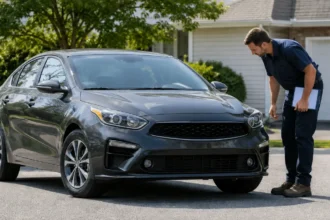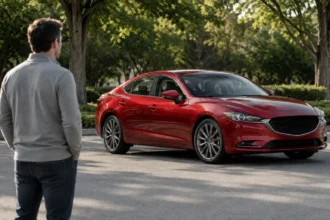


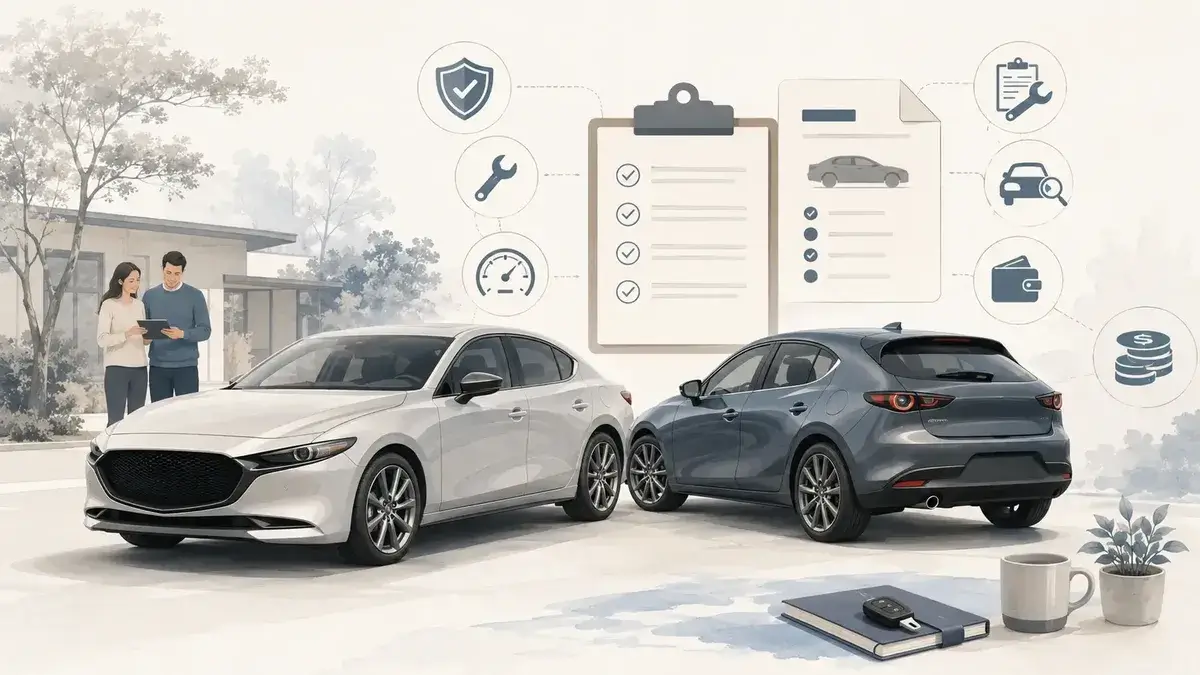
The Mazda3 is one of the stronger used compact cars for buyers who want more than basic transportation. It has a good reliability reputation, a more premium feel than many economy compacts, and ownership costs that can stay reasonable when the car has been maintained properly.
The risk is not the Mazda3 nameplate. The risk is buying the wrong example. A neglected Mazda3 with missing records, unresolved warning lights, rough high mileage, accident history, or an expensive turbo AWD setup can erase the value advantage fast. A clean, naturally aspirated, front-wheel-drive Mazda3 with strong service history is much easier to recommend.
The short answer: a used Mazda3 is worth shortlisting if the records, mileage, model year, inspection result, and price all line up. If you want the simplest low-risk compact car and do not care much about driving feel, also compare it against a Toyota Corolla or Honda Civic before buying.
Is the Mazda3 Reliable Enough to Buy Used?
The Mazda3 is reliable enough to buy used, but it is not a “buy any year, any condition” car. The best examples are simple, well-maintained cars with clean titles, no warning lights, no major rust, and no seller resistance to an independent inspection.
One broad repair-cost average cannot tell you what a specific used Mazda3 will cost. Service records, warning lights, tire and brake condition, and an independent inspection are more useful because they expose the work the car may need immediately after purchase.
The smarter question is not just “is Mazda3 reliable?” It is: is this specific used Mazda3 reliable enough for the price being asked?
Use the quick verdict below before going deeper into costs and problems.
| Buyer question | Practical answer |
|---|---|
| Is the Mazda3 generally reliable? | Yes, especially when maintained properly and bought in a lower-risk setup. |
| Is it the cheapest compact car to own? | Not always. It can be reasonable, but Civic and Corolla may still feel safer for ultra-conservative buyers. |
| Best used setup | Naturally aspirated engine, front-wheel drive, clean service records, no warning lights, no accident damage. |
| Higher-risk setup | Turbo, AWD, higher-feature trims, neglected maintenance, missing records, rough high-mileage examples. |
| Main buying rule | Buy the condition and service history first, then judge model year and trim. |
| Walk-away signal | Transmission symptoms, engine warning lights, major rust, poor repair history, or seller avoiding inspection. |
Mazda3 Ownership Cost: What You Should Budget For
A Mazda3 is not usually expensive in the way a luxury or performance car can be expensive. But “not expensive” does not mean “nothing to worry about.”
Separate the real cost buckets before buying: maintenance, repairs, fuel, insurance, depreciation, tires, brakes, taxes, fees, and financing. A cheap asking price can still become a weak deal if the car needs tires, brakes, suspension work, overdue fluids, or diagnostic repairs immediately after purchase.
Do not combine repair averages, maintenance forecasts, and new-car ownership estimates into one used-car cost figure. For a specific Mazda3, separate the purchase price from immediate tires, brakes, diagnostics, and overdue service, then account for fuel, insurance, taxes and fees, depreciation, routine maintenance, and unexpected repairs. Quote insurance using the exact VIN and match fuel-economy evidence to the car’s actual engine, drivetrain, transmission, and body style.
| Cost bucket | Mazda3 ownership reality | Buyer action |
|---|---|---|
| Maintenance | Usually manageable if service was done on time. | Ask for oil-change, tire, brake, battery, and fluid-service records. |
| Repairs | The specific car’s condition and deferred work matter more than a broad annual average. | Scan warning lights, inspect the car, and price any immediate work before agreeing to buy. |
| Fuel | Non-turbo front-drive versions are easier to justify for commuters. | Avoid turbo/AWD if fuel cost is a major concern. |
| Insurance | Varies by ZIP code, driver profile, coverage, model year, and trim. | Quote the exact VIN before buying. |
| Depreciation | Newer and higher-trim cars can lose more dollars even if the percentage looks normal. | Compare total out-the-door cost, not just monthly payment. |
| Tires and brakes | Normal compact-car wear items, but wheel size and driving style can raise cost. | Check tire brand, tread depth, brake feel, and service invoices. |
| Taxes and fees | State and local costs can change the real ownership number. | Add these before comparing Mazda3 to Civic or Corolla. |
The practical takeaway: Mazda3 ownership cost is usually reasonable when you buy a clean, simple car at the right price. It becomes less attractive when a seller prices a rough or expensive configuration like a clean low-risk example.
Mazda3 Maintenance Cost and Repair Risk
Maintenance history matters more than a generic 10-year forecast. Ask whether the seller followed the schedule for the exact model year, engine, and operating conditions; a neighboring model year is not a safe substitute.
One powertrain difference is material to a used-buyer budget: Mazda’s 2021 Mazda3 schedule lists spark-plug replacement at 40,000 miles for the 2.5T engine and 75,000 miles for the non-turbo engine. On a turbo car near or beyond that point, ask for proof that the service was completed and budget for it if the record is missing. For a 2022 car, use the official 2022 Mazda3 scheduled-maintenance guide. These schedules define required service; they do not prove reliability or show that the seller completed the work.
| Maintenance or repair area | What to check | Why it matters |
|---|---|---|
| Oil service | Records showing regular oil changes | Skipped oil service weakens the reliability case quickly. |
| Transmission behavior | Smooth shifts, no hesitation, no harsh engagement | Transmission symptoms should be treated seriously before purchase. |
| Brakes | Pad life, rotor condition, pedal feel, vibration | Brake work is normal, but neglected brakes reveal poor care. |
| Tires | Matching quality tires, even wear, correct size | Uneven wear can point to alignment, suspension, or accident issues. |
| Battery and electrical health | Clean starts, no low-voltage symptoms, no warning lights | Modern electronics can behave badly when voltage is weak. |
| Suspension | Clunks, wandering, uneven ride height, worn bushings | A tired suspension can make a “good deal” expensive. |
| Fluids | Coolant, brake fluid, and transmission fluid condition where serviceable | Old or dirty fluids suggest broader maintenance neglect. |
| Pre-purchase inspection | Independent mechanic review before payment | The inspection is cheaper than discovering major repairs later. |
The safest Mazda3 to own is not always the newest one. It is usually the one with the cleanest maintenance trail.
Mazda3 can be a smart under-$20,000 choice when condition and service history are strong. If you want to compare it against other budget-friendly used cars, start with our best used cars under $20,000 guide.
Common Mazda3 Problems Used Buyers Should Check
Problem lists can mislead buyers. They often make every issue sound equally serious, which is not how used-car buying works.
A better approach is to sort problems into three groups: normal used-car wear, price-negotiation items, and deal-breaker signals. A Mazda3 with worn tires is not the same risk as one with transmission symptoms, major rust, or unresolved warning lights.
Recall status also belongs in the checklist. NHTSA’s recall tools let buyers check a specific VIN and review broader year, make, and model safety information. Use that before treating any newer used Mazda3 as fully cleared.
NHTSA Owner-Report Patterns to Inspect Before Buying
| NHTSA owner-report pattern | Complaint count | Mazda3 years / generation to check | Main component basis | Used-buyer inspection trigger |
|---|---|---|---|---|
| Airbag / seatbelt / structural safety reports | 481 | 2004-2025 / Gen 1-Gen 4 | Air bags, body structure, seat belts | Check SRS/airbag lights, seatbelt function, body repairs, and recall status. |
| Steering reports | 328 | 2004-2026 / Gen 1-Gen 4 | Steering, electric power assist, column, pump | Test steering feel, warning lights, pull, assist behavior, and noise. |
| Suspension / wheel reports | 288 | 2004-2025 / Gen 1-Gen 4 | Wheels, tires, suspension, TPMS | Inspect tire wear, wheel damage, clunks, alignment, and suspension play. |
| Electrical / infotainment / software reports | 281 | 2004-2024 / Gen 1-Gen 4 | Electrical system, instrument cluster, wiring | Test screen, camera, Bluetooth, key fobs, warning lights, and controls. |
| Brake performance reports | 223 | 2004-2024 / Gen 1-Gen 4 | Service brakes, hydraulic brakes, pads, rotors | Check pedal feel, grinding, vibration, parking brake behavior, and brake records. |
| Engine reports | 203 | 2004-2023 / Gen 1-Gen 4 | Engine, engine cooling | Scan warning lights, check leaks, idle quality, overheating history, and service records. |
| Powertrain / transmission reports | 189 | 2004-2024 / Gen 1-Gen 4 | Power train, automatic transmission, manual transmission, clutch | Test for hesitation, harsh shifts, clutch slip, fluid history, and diagnostic codes. |
Table note: These are owner-reported NHTSA complaint patterns, not defect rates, reliability scores, or proof that a specific Mazda3 has the issue. Use them to set inspection priorities before purchase.
| Problem area | Buyer impact | What to do |
|---|---|---|
| Infotainment or electronics glitches | Annoying and sometimes costly, depending on part and diagnosis | Test screen, audio, Bluetooth, camera, controls, key fobs, and all warning lights. |
| Suspension noise | Can be normal wear or a sign of neglected components | Listen over bumps and inspect struts, links, bushings, and tires. |
| Brake vibration or grinding | Usually fixable, but it costs money immediately | Price the repair before buying or ask the seller to address it. |
| Rust or body corrosion | More serious on older or salt-state cars | Inspect wheel wells, underbody, door edges, trunk area, and repair history. |
| Engine warning lights | Potential deal-breaker without diagnosis | Do not accept “it just needs a sensor” without a scan and repair quote. |
| Transmission hesitation or harsh shifts | High-risk purchase signal | Walk away unless a trusted mechanic verifies it is minor and priced accordingly. |
| Poor interior condition | May signal rough ownership | Treat it as a clue, not just a cosmetic issue. |
| Missing service records | Raises uncertainty across every cost category | Discount the car or keep shopping. |
VIN recall check before buying:
Find the 17-character VIN on the windshield, driver-side doorjamb, registration, or insurance documents. Enter it into the official NHTSA recall lookup. If an open recall appears, confirm the repair status before purchase or make the repair part of the buying plan.
Mazda3 Recall / VIN Due-Diligence Areas
| Recall due-diligence area | Mazda3 years / generation to check | Unique campaign count | Fire-risk flag shown? | Buyer check |
|---|---|---|---|---|
| Airbag / restraint checks | 2004-2007 / Gen 1; 2024-2025 / Gen 4 | 4 | No | Run the VIN before buying and verify any airbag or restraint recall is closed. |
| Fuel system / fuel pump checks | 2014-2018 / Gen 3 | 4 | Yes | Treat open fuel-system recalls as a pre-purchase repair-status item, not a “fix later” detail. |
| Brake / parking brake / AEB / caliper checks | 2014-2016 / Gen 3; 2019-2020 / Gen 4 | 3 | No | Verify parking brake, brake caliper, and automatic emergency braking recall status where applicable. |
| Camera / driver-assist sensing checks | 2014-2018 / Gen 3; 2024 / Gen 4 | 3 | No | Test rear camera and driver-assist behavior, then confirm VIN recall status. |
| Steering / EPS / stability checks | 2007-2009 / Gen 1 | 2 | No | Pay close attention to steering assist, warning lights, steering feel, and recall completion. |
Table note: This is a VIN-check priority table, not a full recall catalog. It groups recall areas by buyer-useful inspection relevance so shoppers know what to verify on the exact car.
One recent example shows why this matters. A 2025 NHTSA recall report lists certain 2024-2025 Mazda3 vehicles built in Mexico and Japan as affected by a Sophisticated Air Bag Sensor issue. Mazda’s statement says the issue can occur when the battery becomes completely depleted after leaving the ignition switch in the “ON” position for two hours or more without the engine running.
That does not make every newer Mazda3 a bad buy. Older Mazda3 examples also need VIN-level recall checking, especially for airbag, steering, fuel-system, brake, and camera-related campaigns shown in NHTSA records. It means recall status is part of the used-car decision, especially on newer vehicles.
Manufacturer Coverage Programs Worth Checking
Some Mazda3s may qualify for issue-specific coverage that can materially change out-of-pocket risk. These programs are not recalls or evidence that every affected-year car has a defect.
Before paying for a Mazda Connect, coolant-control-valve, or qualifying 2.5T oil-consumption repair, search the Mazda3’s model year in CarMerit’s Manufacturer Special Coverage Lookup to see whether Mazda issued coverage worth verifying for that exact car.
| Official Mazda program | Potentially affected Mazda3s | Buyer-relevant coverage | What to verify |
|---|---|---|---|
| Mazda Connect CSP13 | Certain 2014–2018 vehicles within the listed VIN and production ranges | A 24-month limited extension with no mileage limit for specified Mazda Connect software and necessary connectivity master-unit work. The start date depends on whether the vehicle was still within its New Vehicle Limited Warranty. | Confirm the VIN and CSP13 status in Mazda’s eMDCS system. |
| Coolant-control-valve SSPD8 | Certain 2019–2023 vehicles with specified SKYACTIV-G 2.0L or 2.5L engines | Coverage for the specified fail-safe thermostat or coolant-control-valve repair extends to 15 years or 150,000 miles from the original warranty start date, whichever comes first. | Confirm VIN, engine, production scope, original warranty start date, mileage, and SSPD8 status. |
| 2.5T valve-stem-seal SSPD5 | Certain 2021–2022 Mazda3 2.5T vehicles within the listed VIN and build ranges | Coverage for qualifying valve-stem-seal oil-consumption repairs extends to 7 years or 84,000 miles from the original warranty start date, whichever comes first. | Confirm VIN, build range, engine, mileage, original warranty start date, and SSPD5 status. |
Table Note: A model-year or engine match alone does not establish eligibility or remaining coverage. Ask a Mazda dealer to verify the exact VIN, build and engine scope, mileage, original warranty start date, and eMDCS status before relying on any program.
Mazda3 Reliability by Generation and Model Year
Mazda 3 reliability by year matters, but it should not become a shortcut that replaces inspection. A “good year” with poor records can be worse than a less-hyped year with complete maintenance history.
Older Mazda3 examples need more attention to rust, suspension wear, electronics, prior accident repairs, and deferred maintenance. Mid-age examples can be strong values if service records are complete. Newer used examples can feel more refined, but higher trims, AWD, turbo engines, and electronics can increase ownership exposure.
The 2014 and 2019 redesigns are useful IIHS evidence boundaries, but IIHS results are not reliability scores and should not be read as one cross-generation safety ladder. The buyer-useful question is which results and equipment distinctions apply to the exact body style and model year being considered.
| Model-year group | Selected IIHS evidence | Used-buyer takeaway |
|---|---|---|
| 2005–2008 sedans | Good in the original moderate-overlap test; Poor in the original side test for the tested sedan without optional side airbags; Marginal head-restraint rating. | Preserve the tested configuration’s limits. Do not transfer the side result to untested equipment or to hatchbacks. |
| 2010–2013 sedans and hatchbacks | Good ratings displayed for original moderate overlap, original side, and head restraints. | IIHS has separate sedan and hatchback page scopes from 2010, so verify the exact body and year. |
| 2014–2018 sedans and hatchbacks | Good ratings displayed for driver-side small overlap, original moderate overlap, and original side. For 2017–2018, headlights were Acceptable or Marginal depending on equipment. | Crash-test results and headlight equipment are separate considerations; verify the exact configuration. |
| 2019–2022 sedans and hatchbacks | Good ratings displayed for driver- and passenger-side small overlap, original moderate overlap, and original side. Headlights were Acceptable or Good depending on year and equipment. | The 2019 redesign added a new evidence family, but equipment-specific lighting differences still matter. |
| 2023–2026 sedans and hatchbacks | Good results are displayed for the updated side test from 2023 and the updated moderate-overlap test from 2024, alongside Good driver- and passenger-side small-overlap results. Headlights remain Good or Acceptable depending on equipment. | Check the exact year, body style, test family, and headlights rather than relying on a model-wide safety claim. |
Table Note: IIHS uses G for Good, A for Acceptable, M for Marginal, and P for Poor. Ratings apply only to the listed body style, model-year scope, test family, and equipment. Test protocols change over time, so this table is not a direct cross-era ranking; a missing rating is not a negative rating.
| Mazda3 age group | Reliability risk profile | Buyer action |
|---|---|---|
| Older high-mileage examples | Can still be useful, but condition dominates everything. | Inspect rust, suspension, transmission behavior, leaks, and service history. |
| Well-kept mid-age examples | Often the strongest value zone if the price is fair. | Prioritize records, clean title, tires, brakes, and no warning lights. |
| Newer used examples | More refined and safer-feeling, but not automatically cheaper to own. | Check recalls, insurance, depreciation, electronics, and warranty status. |
| Turbo or AWD examples | More appealing to drive, but may cost more in fuel, tires, and repair exposure. | Buy only if the price and maintenance history justify the extra complexity. |
| Any year with poor records | Higher risk regardless of reputation. | Discount heavily or walk away. |
The useful rule is simple: model year can guide your search, but service history decides the car.
Mileage, Service History, and Inspection Red Flags
Mileage is a signal, not a verdict. A 95,000-mile Mazda3 with regular maintenance can be safer than a 55,000-mile car that sat neglected, missed oil changes, or had poor accident repairs.
The strongest used Mazda3 listings usually show service records, matching tire wear, clean title history, no warning lights, and a seller who allows an inspection. The weakest listings rely on vague claims like “runs great” while hiding maintenance gaps.
Use mileage as a trigger for deeper checks.
| Mileage range | What to check | Buyer decision |
|---|---|---|
| Under 60,000 miles | Tires, brakes, warranty status, recall status, early electronics issues | Good range if records are clean and price is not inflated. |
| 60,000 to 100,000 miles | Fluids, brakes, tires, battery, suspension, spark plugs where applicable | Strong value zone only if maintenance is documented. |
| Over 100,000 miles | Rust, leaks, suspension wear, engine behavior, transmission feel, cooling system | Still possible, but inspection becomes non-negotiable. |
| Any mileage with no records | Unknown maintenance risk | Treat as a price penalty or walk away. |
| Any mileage with warning lights | Active diagnostic risk | Do not buy without scan results and repair estimates. |
Walk away faster if the seller refuses an independent inspection, says warning lights are “nothing,” cannot explain accident repairs, or pressures you before verification.
A Mazda3 can be a long-lasting daily driver, but fixed lifespan claims are weak without context. The better question is: does this car have enough proof to trust the next several years of ownership?
How to Judge a Real Used Mazda3 Listing
A listing does not need to be perfect. It needs enough proof to justify the price.
Use this quick listing filter before you schedule a test drive. It gives you the same benefit as real listing examples without inventing market data.
| Listing pattern | What it usually means | Buyer action |
|---|---|---|
| Lower-mileage base or mid-trim car with records | Strong shortlist candidate | Verify title, maintenance, recalls, tires, brakes, and inspection. |
| Cheap high-mileage car with no records | Risk may be hidden in the price | Only consider if inspection is clean and repair budget is realistic. |
| Turbo AWD car priced close to simpler trims | Tempting, but ownership exposure may be higher | Check fuel cost, tire condition, service records, and insurance quote. |
| Clean-looking car with warning lights | Seller may be minimizing a real issue | Require diagnosis before negotiating. |
| “Mechanic special” or “needs minor work” | Often not minor for normal buyers | Avoid unless you are prepared for repair risk. |
| Dealer listing with vague service history | Presentation may be cleaner than the car’s history | Ask for records and do not skip inspection. |
When adding real examples later, use only live listings. Include model year, trim, mileage, asking price, title/service notes, and a short “buy, inspect, or skip” judgment.
Sedan vs Hatchback, Engine, and Trim Factors That Affect Cost
Sedan versus hatchback should not decide reliability by itself. It mostly changes cargo use, pricing, visibility, insurance, and used-market availability.
The bigger cost split is setup. A naturally aspirated front-wheel-drive Mazda3 is the cleaner ownership bet. A turbo AWD Mazda3 can be more enjoyable, but it can also bring higher fuel cost and more complexity.
EPA estimates show two buyer-useful patterns: some later efficient front-wheel-drive configurations improved substantially over older automatics, while AWD and turbo setups can give back part of that advantage. These selected exact configurations—not model-year averages—show the differences without turning fuel economy into a reliability verdict.
| Model year and exact EPA configuration | City MPG | Highway MPG | Combined MPG |
|---|---|---|---|
| 2009 Mazda 3, 2.0L, FWD, four-speed automatic | 22 | 30 | 25 |
| 2012 Mazda 3 DI 4-Door, 2.0L, FWD, six-speed automatic | 28 | 39 | 32 |
| 2019 Mazda 3 5-Door, 2.5L, FWD, six-speed automatic | 26 | 35 | 30 |
| 2019 Mazda 3 5-Door, 2.5L, AWD, six-speed automatic | 24 | 32 | 27 |
| 2025 Mazda 3 4-Door, 2.5L, FWD, six-speed automatic | 27 | 37 | 31 |
| 2025 Mazda 3 4-Door, 2.5L turbo, AWD, six-speed automatic | 23 | 32 | 27 |
Table Note: These are EPA label estimates for selected exact configurations; real-world results vary. Each row is a configuration-level rating, not a Mazda3 model-year average. Fuel economy is one operating-cost input and does not measure reliability or total ownership cost.
| Setup | Ownership profile | Best for | Caution |
|---|---|---|---|
| Sedan, naturally aspirated, FWD | Simplest cost case | Commuters, first-time buyers, budget-sensitive shoppers | Check rear-seat practicality if you carry adults often. |
| Hatchback, naturally aspirated, FWD | More cargo-friendly, still sensible | Buyers who want practicality without turbo/AWD complexity | Used prices may be higher in some markets. |
| AWD | Better bad-weather confidence | Snow-belt buyers who value traction | More drivetrain parts, tire condition matters more, fuel economy may drop. |
| Turbo | Stronger performance | Buyers who accept higher fuel and ownership exposure | Not the best low-cost ownership choice. |
| Higher trims | More comfort and tech | Buyers keeping the car longer and valuing features | More electronics and higher purchase price can weaken value. |
The simplest Mazda3 is not always the most exciting one. It is usually the easiest one to recommend to a cost-conscious used buyer.
Mazda3 vs Civic and Corolla for Long-Term Ownership
The Mazda3 should be compared against the Honda Civic and Toyota Corolla because most compact-car buyers are already considering those alternatives.
The Mazda3’s strongest argument is that it can feel more premium and more engaging while still keeping ownership costs reasonable. That matters if you drive often and care about steering, cabin feel, and daily enjoyment.
The Civic and Corolla still make stronger sense for buyers who want the lowest-friction ownership path. If your only goal is minimizing worry, the Mazda3 needs to win on condition, price, service records, and inspection result.
| Buyer priority | Mazda3 | Civic | Corolla |
|---|---|---|---|
| Driving feel | Stronger case | Strong | Usually less engaging |
| Lowest decision friction | Good if records are strong | Strong | Very strong |
| Used value | Strong when priced below comparable Honda/Toyota examples | Often holds value well | Often holds value well |
| Repair anxiety | Usually reasonable, but inspect carefully | Usually low if maintained | Usually low if maintained |
| Interior feel | Often a Mazda3 advantage | Depends on year and trim | Practical, less premium-feeling in many years |
| Best buyer | Wants value plus a better drive | Wants balanced ownership and resale | Wants simple, conservative ownership |
Use this section as ownership context, not a full head-to-head verdict. Compare exact used listings in a dedicated Civic or Corolla comparison before choosing.
The Mazda3 is not the automatic winner. It is the better pick when it gives you a cleaner car, better price, stronger records, or a driving experience you value enough to accept more decision work.
Who Should Buy a Used Mazda3 and Who Should Skip It
A used Mazda3 is best for buyers who want a practical compact car without the dullest ownership experience. It makes sense if you care about cabin feel, steering, style, and a more polished daily drive.
It is weaker for buyers who want the most conservative compact choice with the least homework. If you do not want to think about trim, drivetrain, records, inspection, or common problems, the Mazda3 may not be your easiest path.
Match the car to the buyer before making the final call.
| Buyer type | Mazda3 fit | Reason |
|---|---|---|
| Daily commuter | Strong | Good fuel economy in simpler trims and a more enjoyable drive than many compact cars. |
| First-time used-car buyer | Good with inspection | Sensible if records are clean, but do not skip the pre-purchase inspection. |
| Budget-sensitive buyer | Good in simple trims | Best with naturally aspirated FWD examples, not expensive turbo/AWD trims. |
| Snow-belt buyer | Conditional | AWD can help, but rust, tire quality, and maintenance matter more than badging. |
| High-mileage shopper | Conditional | Worth considering only with strong records and clean inspection results. |
| Buyer wanting lowest-risk compact | Maybe | Compare Corolla and Civic closely before deciding. |
| Buyer wanting sporty feel without luxury costs | Strong | This is where the Mazda3 makes the most sense. |
| Buyer ignoring service records | Poor fit | Mazda3 reputation cannot protect you from a neglected car. |
The best used Mazda3 is not the one with the most features. It is the one that gives you the cleanest ownership proof for the price.
Testing Methodology and Evidence Limits
The evidence in this guide stays in separate lanes. EPA figures are configuration-specific fuel-economy estimates, IIHS results are test- and equipment-specific safety evidence, Mazda schedules define required service, and Mazda coverage programs apply only to eligible vehicles and specified conditions. None is a reliability score or a complete cost-to-own figure, and they are not combined into one score.
NHTSA complaint counts in this guide are raw owner reports, not sales-adjusted defect rates or reliability scores, so use them as inspection priorities rather than standalone proof that one year or generation is better.
That is why this guide does not treat one number as the final answer. A used Mazda3’s real cost depends on model year, mileage, location, trim, drivetrain, insurance profile, service history, and the price you pay.
Before buying, verify:
- VIN-based recall status through NHTSA or Mazda.
- Maintenance schedule for the exact model year.
- Service records, not just seller claims.
- Tire, brake, suspension, battery, and fluid condition.
- Warning lights with an OBD scan.
- Accident history and title status.
- Insurance quote for the exact VIN.
- Independent mechanic inspection before purchase.
Because Mazda3 ownership cost can change with model year, trim, drivetrain, and powertrain, confirm those basics on the exact car before applying the broader reliability evidence in this guide. Run the Mazda3’s VIN through CarMerit and compare the returned vehicle details with the seller’s listing and paperwork. Keep NHTSA or Mazda recall status, accident and title history, service records, and the independent inspection as separate checks before you buy.
The biggest evidence limit is common with all used cars: public reliability ratings cannot fully judge the specific car in front of you. A clean inspection beats a broad reputation claim.
Mazda3 can be a strong value pick when bought carefully. To compare it against Civic and Corolla, use our best used compact cars for value guide.
Final Verdict: Is the Mazda3 Costly or Reliable Enough to Own?
The Mazda3 is reliable enough to buy used, and it can be cost-sensible when bought carefully. The strongest case is a naturally aspirated front-wheel-drive sedan or hatchback with complete service records, clean title history, no warning lights, and a fair price.
The case weakens with missing records, high mileage without proof of maintenance, turbo or AWD complexity, rough previous ownership, rust, transmission symptoms, or inflated pricing. A Mazda3 with those issues is not a bargain just because the model has a good reputation.
Final call: shortlist the Mazda3 if you want a compact car that feels better to drive than the basic choices and you are willing to verify condition carefully. Skip it if you want the simplest, lowest-risk compact ownership path and a comparable Corolla or Civic is available with better records or a cleaner inspection.
The Mazda3 is a strong reliable compact if you want better feel than a basic commuter car. To compare it with Corolla, Civic, Camry, and reliable SUVs, use our Most Reliable Used Cars shortlist.
Frequently Asked Questions
Is the Mazda3 reliable?
Yes, the Mazda3 is generally reliable when maintained well. The strongest used-buy case is a car with complete service records, no unresolved warning lights, a clean inspection, and a price that reflects its condition. The model’s reputation cannot protect a buyer from deferred maintenance or an abused example.
Is the Mazda3 expensive to maintain?
Usually no, but condition and configuration matter. A well-documented naturally aspirated front-wheel-drive car is the simpler cost case, while neglected cars and turbo or AWD examples can raise exposure. Check the Mazda schedule for the exact year and engine, then price any overdue service and immediate wear before buying.
What are the most common Mazda3 problems to check before buying?
Check infotainment and electronics, steering feel, suspension noise, brake vibration, SRS/airbag or seatbelt warning lights, rust, engine warning lights, and transmission behavior.
Is a used Mazda3 reliable after 100,000 miles?
It can be, but only with proof. At 100,000 miles or more, service history, fluid care, suspension condition, rust, accident history, and inspection results matter more than the badge. Avoid high-mileage examples with vague seller claims or no records.
Which Mazda3 setup is best for lower ownership risk?
A naturally aspirated front-wheel-drive Mazda3 is usually the cleanest low-risk setup. Turbo, AWD, and higher-feature trims can be worth it for the right buyer, but they are not the best choice if your priority is lowest cost and simplicity.
Is the Mazda3 hatchback more expensive to own than the sedan?
Not automatically. Condition, price, mileage, insurance, tire condition, and service history matter more than sedan versus hatchback alone. Choose the hatchback if you need the cargo shape, but do not overpay just for body style.
Is the Mazda3 cheaper to own than a Honda Civic or Toyota Corolla?
Not always. The Mazda3 can be a strong value if it is priced better and has cleaner records, but Civic and Corolla may still appeal more to buyers who want the lowest-friction compact-car decision. Compare the exact used cars, not just the nameplates.
How long can a Mazda3 last?
A well-maintained Mazda3 can be a long-term daily driver, but fixed lifespan claims are weak without context. Mileage, maintenance records, rust exposure, driving conditions, and repair history decide more than a broad mileage promise.
Should I buy a turbo Mazda3 used?
Only if you want the performance and accept the likely trade-offs. Turbo AWD versions can cost more in fuel and may carry more complexity than a simpler front-drive model. If your goal is low-cost ownership, the non-turbo setup is the safer default.
What should make me walk away from a used Mazda3?
Walk away from active warning lights with no diagnosis, transmission symptoms, major rust, poorly documented accident repairs, missing service records, seller resistance to inspection, or pricing that ignores obvious repair needs.