

CR-V vs RAV4 vs CX-5: compare family use, reliability, resale value, cost, and driving feel. The best used compact SUVs are not always the highest-ranked models on a generic list.
For real buyers, the sharper question is which used SUV actually fits your budget, space needs, model-year risk, and long-term ownership plan.
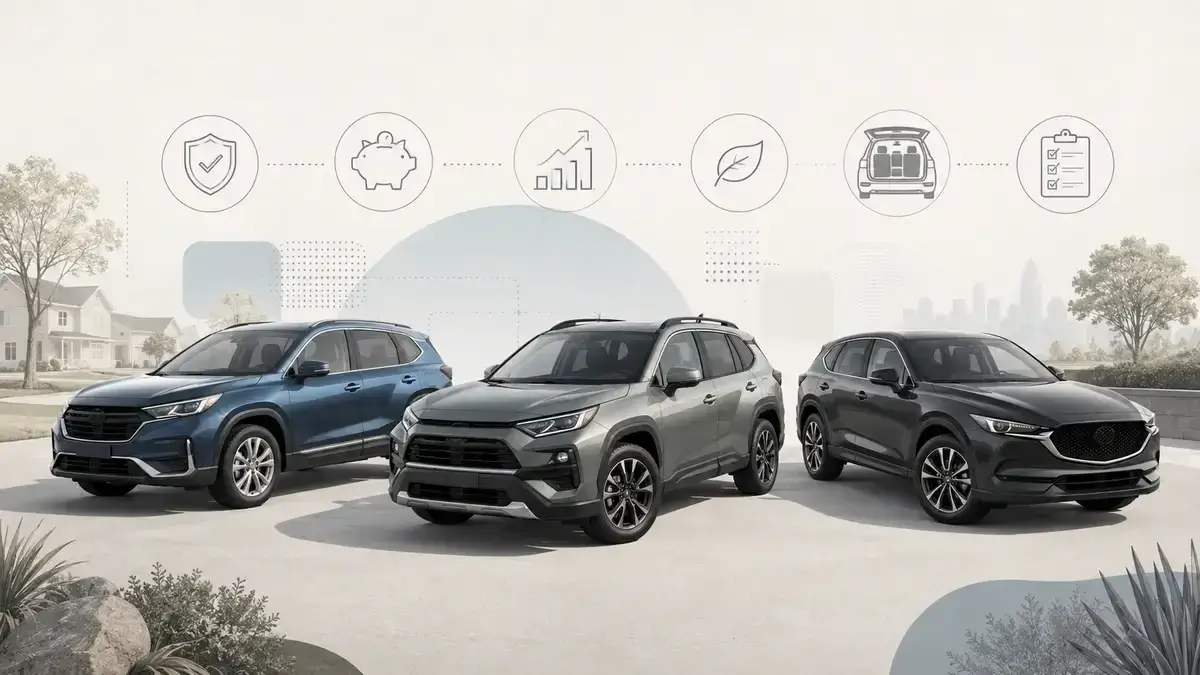
For most used compact SUV shoppers, the strongest three-model shortlist starts with the Honda CR-V, Toyota RAV4, and Mazda CX-5. They all make sense, but they do not solve the same problem.
If you are still deciding whether a compact SUV is the right size, compare this list with our guide to best used small SUVs. Smaller SUVs can be easier to park and cheaper to buy, but they usually give up cargo space and highway comfort.
The Honda CR-V is the best all-around choice for most families and daily drivers. The Toyota RAV4 is the better low-risk pick if resale strength and hybrid availability matter most. The Mazda CX-5 is the best value-and-driving-feel choice if you want a nicer cabin and sharper road manners without moving into luxury-SUV ownership.
Quick Verdict
- Best overall: Honda CR-V
- Best low-risk ownership pick: Toyota RAV4
- Best value pick: Mazda CX-5
- Best for families: Honda CR-V
- Best for hybrid shoppers: Toyota RAV4 Hybrid
- Best for driving feel: Mazda CX-5
- Best if you hate overpaying: Mazda CX-5 or Honda CR-V, depending on local prices
The simplest answer: start with the CR-V if you want the safest all-around family decision. Move to the RAV4 if resale value, Toyota demand, and hybrid efficiency matter more.
Choose the CX-5 if you want a used compact SUV that feels more refined and enjoyable than the usual practical choices.
That does not mean every CR-V beats every RAV4 or CX-5. A clean RAV4 with strong records can beat a neglected CR-V. A fairly priced CX-5 with lower mileage can be smarter than an overpriced Toyota.
The exact year, trim, drivetrain, mileage, service history, accident history, recall status, and inspection result still matter more than the badge.
Compact SUVs can work under $20,000, but this budget usually pushes buyers toward older, cleaner examples. Compare CR-V, RAV4, and CX-5 against sedans and compact cars in our best used cars under $20,000 guide.
Quick Comparison
This table is not a spec sheet. It is a buyer-decision filter.
The point is to help you decide which SUV deserves your time first. A used compact SUV should be judged by how it fits your life, not just by cargo numbers, brand reputation, or search rankings.
Use this table to narrow the field. Then use the deeper CarMerit guides to check reliability, model-year risk, ownership cost, and trim choice before you buy.
| Buyer Question | Honda CR-V | Toyota RAV4 | Mazda CX-5 |
|---|---|---|---|
| Best overall used pick? | Strongest all-around choice | Strong if resale matters most | Strong if value and feel matter |
| Best for families? | Best fit | Good fit | Good, but not as roomy-feeling |
| Best low-risk ownership choice? | Very strong | Best default | Good with records |
| How should market value be judged? | Compare matched local listings | Do not pay an unverified Toyota premium | A lower asking price helps only when year, mileage, trim, condition, and records match |
| Best driving feel? | Smooth and easy | Practical and firm | Best to drive |
| Best value used? | Good if priced below RAV4 | Good, but often expensive | Strongest value case |
| Best hybrid fit? | Strong hybrid alternative | Strongest efficiency-first case | No hybrid configuration in current EPA CX-5 records |
| Biggest used-buy risk | Paying too much for a weak example | Overpaying for Toyota reputation | Buying a rough turbo/AWD example |
| Best next guide | CR-V vs RAV4 | RAV4 reliability guide | CX-5 trim guide |
Table Note: Resale and value are not guaranteed model-wide outcomes. Asking price is not transaction price, so compare the same model year, mileage range, drivetrain, trim, condition, and local market.
Some buyers may also cross-shop the Subaru Forester if they want standard AWD and practical space. Before adding it to your shortlist, check the Subaru Forester reliability guide to understand its service-history, recall, CVT, and ownership-cost risks.
If you are choosing between a safer default and a lower-priced value play, the Nissan Rogue vs Honda CR-V comparison breaks down the trade-off clearly.
Best Overall Choice: Honda CR-V
The Honda CR-V is the best overall used compact SUV for most buyers because it balances comfort, cargo usability, family practicality, reliability, and easy daily driving better than the others.
Its strongest case is not excitement. It is usefulness. The CR-V is the SUV you buy when you want a simple daily vehicle that works for commuting, kids, groceries, road trips, errands, and long-term ownership without forcing a complicated decision.
The CR-V is also worth comparing against the Subaru Forester if AWD, snow confidence, and outdoor usability matter more than a simple mainstream default. For that decision, see our Honda CR-V vs Subaru Forester comparison before choosing between comfort, efficiency, and standard-AWD confidence.
Compared with the RAV4, the CR-V usually feels calmer and more comfortable. Compared with the CX-5, it usually gives you the easier family layout and cargo-use case. That is why it deserves the first test drive for most practical shoppers.
The main risk is assuming every CR-V is a safe buy. It is not. Some years need extra inspection, and a neglected CR-V can still become expensive. Before you buy one, read the Honda CR-V years to avoid and best years to buy and the used Honda CR-V reliability and cost-to-own guide.
If this SUV will be your main family vehicle, also compare it with our guide to best used family cars. Some families may be better served by a midsize sedan or a roomier SUV depending on seating, cargo, and daily-use needs.
Buy the CR-V if you want:
- A comfortable daily compact SUV
- Strong family practicality
- Useful cargo space
- Low-drama ownership
- A safer all-around recommendation than a sportier alternative
- A vehicle that is easy to live with, not just easy to rank
Skip or compare harder if the CR-V is overpriced, poorly documented, rough on the test drive, or missing maintenance records.
Best Low-Risk Ownership Pick: Toyota RAV4
The Toyota RAV4 remains the best low-risk ownership pick when hybrid efficiency, a broader used-hybrid selection, and resale priorities matter more than cabin comfort. Here, “low-risk” is a shortlist judgment—not proof that every RAV4 will be more reliable or cheaper to repair.
Its clearest evidence-backed advantage is hybrid breadth. FuelEconomy.gov records include RAV4 Hybrid AWD beginning with the 2016 model year, while CR-V Hybrid AWD begins with 2020. That gives used shoppers more RAV4 Hybrid model years to search; the matched EPA table below shows the efficiency difference without turning it into a reliability or value verdict.
Do not pay extra just because it is a Toyota. Asking prices are not transaction prices, and resale is not guaranteed across every year and configuration. Compare the same model year, mileage, drivetrain, trim, condition, title history, local listings, and inspection results before paying a Toyota premium.
The RAV4 is not the only compact SUV worth cross-shopping. If you are also considering a lower-priced, feature-rich alternative, compare Hyundai Tucson vs Toyota RAV4 before deciding whether Toyota’s resale and reliability premium is worth paying.
If you are comparing the RAV4 directly with Honda’s alternative, start with the Honda CR-V vs Toyota RAV4 comparison. If you are already leaning Toyota, use the Toyota RAV4 reliability and cost-to-own guide and the Toyota RAV4 years to avoid and best years to buy before choosing a listing.
Buy the RAV4 if you want:
- Strong resale confidence
- A proven compact SUV reputation
- A strong hybrid option
- Practical cargo and daily usability
- A more rugged-feeling alternative to the CR-V
- A used SUV that is easy to resell later
Be careful if the seller is asking a high Toyota premium without clean records. Brand demand helps owners, but it can punish buyers.
If you are also considering Subaru, compare Forester vs RAV4 before deciding. The Forester can make more sense for AWD confidence and visibility, while the RAV4 stays stronger for resale, hybrid availability, and lower-risk ownership.
Best Value and Driving Feel Pick: Mazda CX-5
The Mazda CX-5 is the best choice if you want a used compact SUV that feels more refined and enjoyable than the usual practical options.
It is not the roomiest pick here. It is not the strongest resale bet. It is not the best hybrid choice. But it can be the smartest buy when you want a better cabin feel, sharper steering, a more premium daily experience, and a lower used price than a comparable RAV4.
Budget matters heavily in this segment, especially once mileage and trim level are considered. If your ceiling is fixed, use our best used cars under $20,000 guide to compare compact SUVs against other strong used-car choices.
That is the CX-5’s real opportunity. Many buyers overfocus on Honda and Toyota, which can keep CR-V and RAV4 prices firm. A clean CX-5 can sometimes give you more car for the money if the maintenance history, mileage, trim, and inspection all check out.
If your shortlist is down to the Mazda CX-5 vs Subaru Forester, compare them directly before choosing. The CX-5 is stronger for comfort and cabin feel, while the Forester is stronger for visibility, cargo access, and bad-weather confidence.
The safest CX-5 path is usually a clean non-turbo mid-level trim. Turbo trims can be fun, but they deserve stricter inspection because power, fuel cost, and maintenance sensitivity matter more on used examples.
Before choosing one, compare the Mazda CX-5 vs Honda CR-V and Mazda CX-5 vs Toyota RAV4. Then check the Mazda CX-5 reliability and cost-to-own guide, Mazda CX-5 years to avoid and best years to buy, and Mazda CX-5 trim levels guide.
Buy the CX-5 if you want:
- Better driving feel
- A more upscale cabin for the money
- Strong value when priced below Honda/Toyota rivals
- A compact size that still works for daily life
- A smart non-turbo trim with clean records
- A used SUV that feels less appliance-like
Skip or negotiate hard if the CX-5 has missing service history, mismatched tires on AWD models, warning lights, rough shifting, oil or coolant concerns, or a turbo trim with weak maintenance proof.
Reliability and Ownership Cost
Reliability is one of the biggest reasons buyers search for the best used compact SUVs. But this is where many shoppers make a bad assumption.
A reliable model is not the same thing as a reliable vehicle. The exact SUV you buy matters more than the nameplate. A clean, well-maintained Mazda CX-5 can be smarter than a rough RAV4. A fairly priced CR-V can be better than an overpriced Toyota. A neglected Honda can still be a bad purchase.
The RAV4 is the safer default for many used compact SUV buyers, but it is not always the best value. If a Nissan Rogue is meaningfully cheaper and checks out cleanly, it may be worth comparing directly. See our Nissan Rogue vs Toyota RAV4 breakdown before paying the RAV4 premium.
The Nissan Rogue can still make sense for the right buyer, but model year matters more than with some rivals. Before shortlisting one, check the Nissan Rogue years to avoid so you can separate cleaner used years from higher-risk CVT and recall-sensitive examples.
The RAV4 has the strongest low-risk reputation. The CR-V is close and often easier to live with. The CX-5 is reliable enough to belong on the shortlist, but it needs more condition discipline because its best value comes from buying the right example, not just any example.
The Rogue belongs here only for buyers who are willing to inspect condition, model year, maintenance history, and transmission behavior more carefully than they might with a CR-V or RAV4. Before adding one to your shortlist, use the Nissan Rogue reliability guide to understand where the Rogue makes sense and where ownership risk gets higher.
| Ownership Factor | Best Pick | Why |
|---|---|---|
| Lowest-risk reputation | Toyota RAV4 | Strong resale demand and ownership confidence |
| Best comfort-to-risk balance | Honda CR-V | Strong reliability case plus family-friendly usability |
| Best value if clean | Mazda CX-5 | Can cost less than Honda/Toyota rivals while feeling nicer |
| Best hybrid logic | Toyota RAV4 Hybrid | Strong efficiency and resale appeal |
| Best inspection discipline needed | Mazda CX-5 | Turbo, AWD, and maintenance history matter |
| Best high-mileage rule | Depends on records | Service history beats brand reputation |
EPA Fuel-Economy Check: Matched 2021 AWD Examples
Fuel economy can materially change the shortlist, but only when model year, drivetrain, and powertrain are aligned. This matched 2021 AWD snapshot separates gas and hybrid configurations instead of using model-wide averages.
| Model | Exact EPA Configuration | City | Highway | Combined |
|---|---|---|---|---|
| Honda CR-V | AWD, 1.5L gas, automatic with variable gear ratios | 27 | 32 | 29 |
| Toyota RAV4 | AWD, 2.5L gas, 8-speed automatic, stop-start | 27 | 33 | 29 |
| Mazda CX-5 | 4WD, 2.5L non-turbo gas, 6-speed automatic | 24 | 30 | 26 |
| Honda CR-V Hybrid | AWD, 2.0L hybrid, automatic with variable gear ratios | 40 | 35 | 38 |
| Toyota RAV4 Hybrid | AWD, 2.5L hybrid, automatic | 41 | 38 | 40 |
Table Note: Values are EPA MPG estimates for the exact listed 2021 configurations, not model-wide averages. Ratings can change by configuration. Verify the exact vehicle on FuelEconomy.gov; real-world fuel economy varies.
Before buying any of these SUVs, check the VIN through the NHTSA recall lookup, confirm fuel economy for the exact year and drivetrain on FuelEconomy.gov, and get a pre-purchase inspection. Those three checks can save more money than choosing the “right” badge.
For buyers who care more about long-term dependability than size alone, our most reliable used cars guide is worth checking next. It helps narrow the field to lower-risk used vehicles before you focus on body style.
Best Years and Used-Buying Risk
Model year matters because redesigns, powertrains, safety tech, infotainment, recalls, and known issue patterns change over time.
For the CR-V, many used buyers should pay close attention to cleaner older choices and later fifth-generation examples, while inspecting certain turbo-era years more carefully. The Honda CR-V model-year guide explains where to start and which years need more proof.
For the RAV4, late fourth-generation examples and carefully chosen newer models are often easier to justify, while some older or early-redesign years need closer checks. The Toyota RAV4 years guide breaks down the safer years, higher-caution years, and hybrid-specific concerns.
For the CX-5, the best choice depends heavily on generation, trim, engine, and records. A well-maintained non-turbo model is usually the safer default. The Mazda CX-5 years guide and CX-5 trim guide are the better next steps before choosing a listing.
IIHS Safety Checkpoints That Can Change the Shortlist
IIHS ratings are not timeless model-wide scores. These three checkpoints show why the exact year, build date, trim, and equipment can matter when narrowing the shortlist.
| Model | Buyer-Relevant IIHS Checkpoint | What the Buyer Should Do |
|---|---|---|
| Honda CR-V | For 2020–2022, gas LX, EX, EX-L, and Special Edition headlights were M; certain Hybrid EX and EX-L headlights were A; Touring and Hybrid Touring headlights were G. | If night driving matters, verify the exact trim and headlight configuration rather than relying on the model year alone. |
| Toyota RAV4 | Driver-side small-overlap was P for 2013–2014 models built after April 2013, then G for 2015–2018 models built after November 2014. Passenger-side small-overlap remained P for 2013–2018. | Check the certification-label build date and do not treat the improved driver-side result as an all-position safety verdict. |
| Mazda CX-5 | Driver-side small-overlap was M for 2013–2014 models built before November 2013 and G for 2014–2016 models built after October 2013. | When two early CX-5s are otherwise comparable, verify the build date before choosing between them. |
Table Note: G = Good, A = Acceptable, M = Marginal, and P = Poor. These are model-specific shopping checkpoints under their applicable IIHS test scopes—not a complete safety profile or a cross-model safety ranking.
Do not buy by year alone. Use year as a filter, then judge:
- Mileage
- Maintenance records
- Accident history
- Title status
- Tire condition
- Brake condition
- Warning lights
- Transmission behavior
- Hybrid-system health, if applicable
- Recall completion
- Price compared with similar local listings
A “good year” with bad records is still a weak buy. A cautious year with full proof can sometimes make sense if the price reflects the risk.
Best Used Compact SUV by Buyer Type
| Buyer Type | Best Pick | Why |
|---|---|---|
| Family buyer | Honda CR-V | Comfort, cargo usability, and rear-seat practicality |
| Low-risk ownership buyer | Toyota RAV4 | Resale confidence and strong used-market demand |
| Value buyer | Mazda CX-5 | Often gives a nicer feel for the money |
| Hybrid shopper | Toyota RAV4 Hybrid | Strongest hybrid ownership case |
| Comfort-focused commuter | Honda CR-V | Calm daily driving and easy usability |
| Driving-feel buyer | Mazda CX-5 | Best road manners of the three |
| Budget-sensitive buyer | Mazda CX-5 or CR-V | Depends on local price and condition |
| Long-term keeper | Toyota RAV4 or Honda CR-V | Stronger long-term confidence |
| Buyer avoiding boring SUVs | Mazda CX-5 | More premium feel and sharper drive |
| Buyer who wants easiest resale | Toyota RAV4 | Strongest used-market demand |
If you are split between a sedan and SUV, compare the sedan side with our best used midsize sedans guide before moving to compact SUVs.
The Subaru Forester can be a smart used compact SUV, but the model year matters more than the badge. Newer Foresters are usually easier to recommend, while older examples need closer checks for records, oil use, rust, and inspection results. Before shortlisting one, review the best Subaru Forester years.
Compact SUV vs Small SUV vs Crossover: Do the Terms Matter?
Search results often mix “compact SUV,” “small SUV,” and “crossover SUV.” That does not mean every result serves the same buyer.
This guide focuses on mainstream used compact SUVs and compact crossovers that can work for families, commuters, and long-term daily use. The CR-V, RAV4, and CX-5 sit in that practical middle: bigger and more useful than many subcompact SUVs, but easier to own and park than midsize or three-row SUVs.
If a full compact SUV feels larger than you need, start with Subaru Crosstrek vs Honda HR-V. That comparison is useful for buyers deciding between a rugged small crossover and a simpler city-friendly Honda before moving up to larger compact SUVs.
That matters because a buyer looking at a Honda HR-V, Toyota Corolla Cross, Subaru Crosstrek, or Hyundai Kona may have a different space and budget question. Those smaller SUVs can make sense, but they are not direct replacements for a CR-V, RAV4, or CX-5 if rear-seat space, cargo room, and family usability matter.
For this bridge page, keep the decision tight: CR-V for overall practicality, RAV4 for low-risk ownership and hybrid value, CX-5 for value and driving feel.
If reliability is your top priority, compact SUVs are only one part of the bigger used-car decision. Compare RAV4, CR-V, CX-5, Camry, Corolla, Civic, and more in our Most Reliable Used Cars guide.
Which One Should You Buy?
Choose the Honda CR-V if you want the safest all-around answer. It is the easiest recommendation for families, commuters, and buyers who want comfort and cargo usability without overthinking the decision.
Choose the Toyota RAV4 if resale value, Toyota demand, hybrid efficiency, and long-term ownership confidence matter more than cabin polish or ride comfort. It is the strongest low-risk pick when the price premium is fair.
Choose the Mazda CX-5 if you want a compact SUV that feels better to drive and nicer inside, and you are willing to check records carefully. It is the strongest value play when the individual vehicle is clean and priced right.
The Honda CR-V remains one of the safer compact SUV defaults, but it is not the only practical choice. If you are comparing value against long-term confidence, read Kia Sportage vs Honda CR-V before deciding.
If CR-V, RAV4, and CX-5 feel too large or expensive, compare smaller used SUV alternatives before stepping down in size.
Hyundai and Kia shoppers should not choose by badge alone. If you are comparing these two related compact SUVs, read Kia Sportage vs Hyundai Tucson before you decide whether value, warranty status, cabin layout, or condition matters more.
The Sportage can be a smart value pick, but the year matters more than the nameplate. Before adding one to your compact SUV shortlist, use the Kia Sportage years to avoid and best years to buy guide to filter risky years, recall-sensitive examples, and cleaner used options.
The Sportage belongs on this broader compact SUV shortlist only when the exact vehicle proves it is clean, documented, and fairly priced. Before treating it as the value alternative to a CR-V, RAV4, or CX-5, read the Kia Sportage Reliability and Cost to Own guide to check ownership risk, recall status, common problems, and inspection priorities.
This comparison is especially useful if the Sportage or Tucson is cheaper than a CR-V, RAV4, or CX-5 in your local market.
A lower-priced Tucson can be a valid alternative, but its model year and powertrain can change the ownership case. Before shortlisting one, check our Hyundai Tucson years to avoid and best years to buy guide for the engines, transmissions, recalls, and VIN checks that need attention.
The Tucson can be a smart compact-SUV value play, but it needs more verification than the safest default picks. Before choosing one over a cleaner RAV4, CR-V, or CX-5, check the Hyundai Tucson reliability and cost-to-own guide for year risk, recalls, maintenance records, engine checks, and inspection priorities.
Here is the sharper rule:
- If all three are clean and fairly priced, start with the CR-V.
- If the RAV4 Hybrid is clean and the premium is reasonable, it may be the best long-term commuter buy.
- If the CX-5 is cleaner, cheaper, and better equipped, do not ignore it just because it is not a Honda or Toyota.
- If any listing has missing records, accident concerns, warning lights, open recalls, or seller pressure, walk away or negotiate hard.
The best used compact SUV is not the one with the loudest reputation. It is the one that fits your use case and proves its condition.
If you are also considering a used Forester for standard AWD and all-weather confidence, check Subaru Forester reliability before adding it to your shortlist. That guide explains the ownership risks, inspection points, and maintenance trade-offs that matter before buying.
Related CarMerit Guides
Use these deeper guides before choosing a specific used SUV:
- Honda CR-V vs Toyota RAV4: Which Used Compact SUV Makes More Sense?
- Mazda CX-5 vs Honda CR-V: Which Used SUV Fits You?
- Mazda CX-5 vs Toyota RAV4: Which Used SUV Fits?
- Used Honda CR-V Reliability and Cost to Own Guide
- Toyota RAV4 Reliability: What It Costs to Own and Maintain
- Mazda CX-5 Reliability and Cost to Own: Used Buyer Guide
- Honda CR-V Years to Avoid and Best Years to Buy
- Toyota RAV4 Years to Avoid and Best Years to Buy
- Mazda CX-5 Years to Avoid and Best Years to Buy
- Mazda CX-5 Trim Levels: Best Trims to Buy Used
Compact SUVs are often the easiest starting point for family buyers, but they are not the only smart option. Our best used family cars guide compares compact SUVs with sedans and smaller SUVs by real family use.
Frequently Asked Questions
What is the best used compact SUV to buy?
For most buyers, the Honda CR-V is the best overall used compact SUV because it balances comfort, cargo space, family practicality, and ownership confidence. The Toyota RAV4 is better if resale strength and hybrid availability matter most. The Mazda CX-5 is better if you want stronger value and a better driving feel.
Is the Toyota RAV4 better than the Honda CR-V?
The RAV4 is better for resale confidence and hybrid shoppers. The CR-V is better for comfort-first family buyers who want easier daily practicality. If both are clean and fairly priced, the better choice depends on your priority: comfort and cargo for the CR-V, resale and hybrid value for the RAV4.
Is the Mazda CX-5 a good used compact SUV?
Yes, the Mazda CX-5 is a good used compact SUV when the service records, inspection, mileage, and price are strong. It is especially good for buyers who want a nicer cabin and better driving feel. It is weaker if you need maximum cargo space, the strongest resale confidence, or the simplest hybrid option.
Which used compact SUV is most reliable?
No model name alone settles reliability. The Toyota RAV4 and Honda CR-V remain strong reputation-led starting points, but that does not prove lower failure rates for every model year or individual vehicle. A clean Mazda CX-5 can be a better purchase than a neglected RAV4 or CR-V.
Compare the exact model year, powertrain, service history, recall completion, warning signs, and inspection results. Before choosing a listing, use the Honda CR-V reliability guide, Toyota RAV4 reliability guide, and Mazda CX-5 reliability guide.
Which used compact SUV is best for families?
The Honda CR-V is usually the best family pick because it prioritizes comfort, cargo usability, and daily ease. The RAV4 is also practical, especially if hybrid efficiency matters. The CX-5 can work for smaller families, but it is not the roomiest choice in this three-SUV shortlist.
Should I buy a gas or hybrid used compact SUV?
Buy gas if you want a simpler used-buying process and the price is better. Buy hybrid if you drive enough miles to benefit from fuel savings, the price premium is reasonable, and the hybrid system checks out. Among these three, the RAV4 Hybrid has the strongest used hybrid case.
What should I check before buying a used compact SUV?
Check the VIN for recalls, review maintenance records, inspect tires and brakes, test all electronics, road-test for rough shifting or suspension noise, check title and accident history, and get a pre-purchase inspection. For hybrids, also verify hybrid-system health and warranty context.