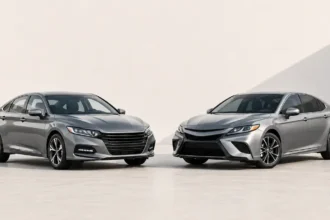


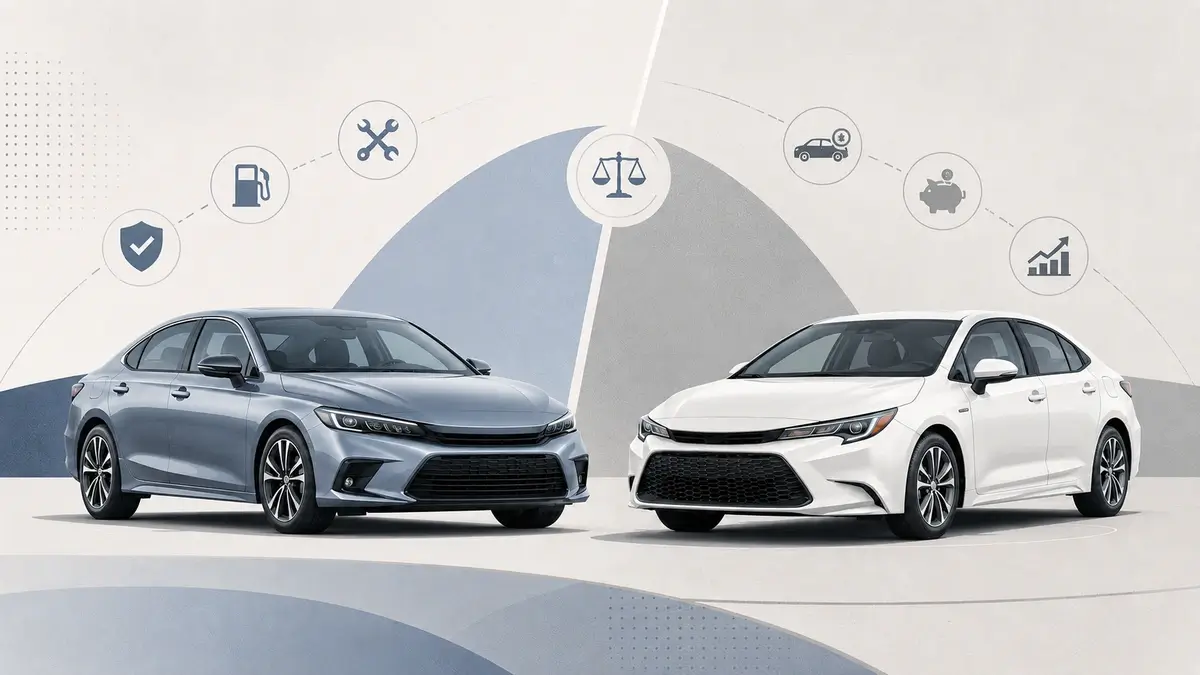
Honda Civic vs Toyota Corolla is one of the cleanest used-car decisions in the compact-sedan market, but most pages answering this query are still built for new-car shoppers.
Used buyers need a simpler answer: which one is the better buy for the money, the commute, and the ownership risk they are willing to accept.
The short version is straightforward. Buy the Civic if you want the better all-around car and the price gap is reasonable. Give the Corolla the stronger value case when a comparable example is meaningfully cheaper, or when its broader 2020–2024 Hybrid shopping lane better fits what you need.
That answer only works when you compare like with like. A clean Corolla can be a better buy than a rough Civic. A well-priced Civic can also make a cheaper Corolla feel like the compromise you will notice every day.
CarMerit reliability comparator
Honda Civic vs Toyota Corolla: 2001-2026 NHTSA snapshot
Owner-complaint and recall counts from NHTSA for 2001-2026, each model’s best used-year lane, and which buyer each one fits.
| 13,929 | complaints (2001-26) | 10,161 |
| 216 | recalls (2001-26) | 144 |
Airbags / seatbelts / structureSteeringPowertrain / transmissionEngine | top issues | Airbags / seatbelts / structureSteeringEngineVehicle speed control |
Honda Civic
Best used year: 2014
Best overall 2013-2015; budget 2009-2011; newer 2019-2021; use more caution with 2001, 2006-2008, and 2016.
Best for: Buyers who want the better all-around car, with nicer cabin feel, rear-seat comfort, and a more polished daily drive.
Toyota Corolla
Best used year: 2013
Safest default 2011-2013; best value 2005-2008; newer 2017-2019; use more caution with 2000-2003, 2009, and 2014.
Best for: Value-first buyers when the specific Corolla is meaningfully cheaper at similar age, mileage, condition, and history.
Quick take: The Civic is the stronger all-around default when prices and condition are close. The Corolla becomes the stronger value play when a comparable example is meaningfully cheaper. Choose the Honda Civic when daily comfort, cabin polish, and rear-seat usefulness matter most. Do not crown either car from raw NHTSA counts alone.
Complaint counts are raw owner reports filed with NHTSA, not adjusted for sales volume, so they should guide inspection rather than crown a winner. The quick comparator above uses a 2001-2026 overlapping NHTSA snapshot for both models; both models have older NHTSA history before 2001, but those years are excluded here to keep the comparison balanced. Always inspect the specific vehicle before buying.
IIHS Safety Checkpoints Worth Verifying
IIHS evidence is most useful here when it changes what you should verify on the exact used car. These are selected model-specific checkpoints, not an overall Civic-versus-Corolla safety score.
| Vehicle / model years | Selected IIHS checkpoint | Rating | What it means for the buyer |
|---|---|---|---|
| Honda Civic sedan, 2018–2019 | Headlights | P | Verify the exact lighting equipment rather than assuming every Civic from this period has the same nighttime-safety result. |
| Honda Civic sedan, 2022–2023 | Updated moderate overlap / updated side | A / A | Keep these newer test results separate from the older original-test ratings. |
| Toyota Corolla sedan, 2025–2026 | Updated moderate overlap | M | This applies to the stated sedan scope and should not be extended to other body-style or powertrain scopes. |
| Toyota Corolla sedan, 2026 | Updated side | G | Treat this as an exact model-year and test-family result, not as a rating for older Corolla years. |
Table Note: G = Good; A = Acceptable; M = Marginal; P = Poor. Ratings apply only to the stated model years, body styles, equipment/applicability scopes, and IIHS test families. Original and updated IIHS tests should not be merged into one score. A rating not shown here should not be interpreted as poor.
The useful takeaway is not that one badge is safer overall. Exact model year, equipment, body style, and IIHS test family can matter when you narrow the actual car you are considering.
Choose the Civic if:
- You care about cabin feel, rear-seat comfort, or a more polished daily drive.
- You plan to keep the car long enough to feel the upgrade.
- The price premium is modest, not stretched.
Choose the Corolla if:
- A comparable Corolla is meaningfully cheaper after matching year, mileage, condition, history, and configuration.
- Its 2020–2024 Hybrid availability better fits the years you are shopping.
- The specific Corolla is the cleaner or better-documented car.
Avoid either one if:
- Service history is weak.
- The trim looks impressive but does not improve your real use case.
- You are comparing mismatched body styles, powertrains, or generations.
What goes wrong if you pick wrong: you either overpay for a Civic that does not justify its premium, or choose a cheaper Corolla and end up wishing you had paid more for the better daily-driver fit.
Fastest safe default: pick the cleaner, better-maintained example unless the price gap is big enough to change the value story.
A quick matrix makes the split easier before you go deeper. The Civic usually makes the stronger case when daily comfort matters. The Corolla makes the stronger value case when the specific comparable listing is meaningfully cheaper.
The point is not to force one universal winner. It is to stop the wrong kind of buyer from making the wrong kind of purchase.
| Factor | Honda Civic | Toyota Corolla |
|---|---|---|
| Best fit for | Buyers who want the better all-around car | Buyers who find the stronger specific-listing value |
| Main strength | More polished daily-driver feel | Can make the stronger budget case when a comparable listing is cheaper |
| Main weakness | Easier to overpay for | Easier to undershoot on comfort |
| Best for first-time buyers | Strong when price and condition are close | Strong when the specific car is cleaner, better documented, or meaningfully cheaper |
| Best for long commutes | Strong when comfort matters most | Depends on exact EPA configuration and comfort priorities |
| Best for budget pressure | Can work when the listing justifies it | Strong when the comparable listing is meaningfully cheaper |
Which One Should Most Used Buyers Choose?
Here you will decide which one makes more sense for your actual daily use, not just for a spec sheet.
For most used buyers, the Civic makes the stronger all-around case when prices and condition are close. The Corolla makes the stronger value case when the specific comparable listing is meaningfully cheaper.
The Civic usually earns its edge through cabin quality, rear-seat comfort, and a more complete everyday feel. If you commute often, carry passengers, or want the car to feel less basic, that matters.
The Corolla’s case gets stronger when the actual listing is cheaper without giving up condition, service history, or the equipment you need.
If you are cross-shopping two clean listings under a tight budget, give the Corolla the value edge only when the like-for-like asking-price gap is genuinely meaningful. If the Civic costs only a little more and clearly feels like the nicer place to spend time, the answer gets harder for the Corolla to win.
Do:
- Start by deciding whether you care more about value or daily comfort.
- Compare condition first, badge second.
- Treat the price gap as the main decision lever.
Avoid:
- Acting like “better car” and “better buy” mean the same thing.
- Letting trim names decide the answer by themselves.
- Using brand reputation as a shortcut.
When the Civic Wins and When the Corolla Wins
Here you will decide what actually flips the recommendation.
The Civic wins when you will feel the difference every week. Better cabin feel, better rear-seat usefulness, and a more polished daily drive are the usual reasons buyers stretch for it.
The Corolla wins when the specific listing gives you a meaningful price or Hybrid-availability advantage without sacrificing condition, service history, or the features you need.
The Civic case gets stronger when the premium is modest. The Corolla case gets stronger when the Civic starts asking meaningfully more money without giving you a matching real-world gain.
If you commute daily and care more about comfort than squeezing the lowest entry price, the Civic usually makes more sense. If budget pressure is the priority, give the Corolla the edge when the actual like-for-like listing is meaningfully cheaper.
What you gain with the Civic:
- Better day-to-day feel
- More room to notice the upgrade
- A stronger case for buyers who care about comfort
What you give up with the Civic:
- Lower purchase simplicity
- Some value edge
- Less room for a bad listing to still make sense
What you gain with the Corolla:
- A stronger value case when a comparable listing is meaningfully cheaper
- A broader Hybrid shopping lane for 2020–2024 used buyers
- A stronger budget case when condition, history, and configuration remain comparable
What you give up with the Corolla:
- Less cabin polish
- Less of that “I’m glad I paid extra” feeling
- A weaker case if comfort is one of your top filters
Comparison Baseline and Assumptions
Here you will decide whether you are comparing the same kind of used car or two listings that only look comparable.
This page is for mainstream U.S. used buyers comparing Civic and Corolla as practical compact cars. It is not a performance comparison, a new-car shopping tool, or a trim-by-trim spec sheet.
Before you compare anything, lock the baseline:
- sedan vs hatchback
- gas vs hybrid
- similar generation or not
- similar mileage band or not
- real trim level, not just seller headline language
A gas sedan and a hybrid hatchback are not answering the same buyer question. Neither are two cars separated by a wide generation gap.
If one listing is much newer, much cleaner, or much better documented, stop pretending the comparison is even. Fix the baseline first.
Methodology and assumptions:
- U.S. used-market buyer lens
- mainstream Civic and Corolla listings only
- hybrid and hatchback versions can change the answer
- exact prices are omitted here because used values move by year, mileage, trim, condition, and location
- date checked: April 15, 2026
Price and Value: What You Usually Get for the Money
Used Civic and Corolla prices move too much by model year, mileage, trim, powertrain, condition, service history, location, and the individual listing to name a permanent price winner.
The useful question is not simply which badge usually costs less. It is whether the price difference on the two cars you are actually considering is large enough to outweigh differences in condition, history, equipment, and how well each car fits your needs.
| Buyer situation | Better approach |
|---|---|
| Similar price and condition | Choose based on the car you prefer to live with rather than assuming the Corolla is automatically the better value. |
| Corolla is meaningfully cheaper | The Corolla deserves a stronger value case if mileage, condition, history, and configuration are genuinely comparable. |
| Civic is cleaner or better documented | Paying more can make sense if the extra money buys a materially better used car. |
| Tight budget | Compare total condition and immediate needs, not asking price alone. A cheaper car can stop being the better value if it needs work immediately. |
Value is the gap between what you pay and what you actually gain. Compare the specific listings rather than assigning the price advantage to either nameplate in advance.
When your Civic-versus-Corolla decision comes down to two actual listings, make sure you are comparing the vehicles the ads claim they are. Run each VIN through the CarMerit VIN Lookup and compare the returned vehicle details with the seller’s listing and paperwork. Then let condition, service history, equipment, and the actual price difference decide which of the two used cars is the better buy.
Reliability, Maintenance, and Ownership Reality
Neither a factory maintenance schedule nor warranty coverage proves that one of these cars will be more reliable than the other as a used vehicle.
At this stage, the condition and history of the individual car matter more. A well-maintained Civic with clear records can be the lower-friction purchase than a neglected Corolla, and the reverse is equally possible.
Before choosing either car, put more weight on:
- documented maintenance and repair history;
- the exact model year and powertrain;
- current leaks, warning lights, noises, and drivability;
- evidence of neglected or overdue work;
- accident and ownership history; and
- a pre-purchase inspection when the purchase is significant enough to justify one.
Fuel Economy, Hybrids, and Daily Running Costs
EPA data makes this comparison more configuration-dependent than a blanket Corolla fuel-economy win. Model year, engine, transmission, drivetrain, and Hybrid configuration can all change the result.
The selected examples below are useful used-car checkpoints rather than averages for an entire model year.
Honda Civic EPA Fuel Economy
| Model Year | Configuration | City | Highway | Combined |
|---|---|---|---|---|
| 2014 | 1.8L CVT FWD | 29 | 37 | 33 |
| 2019 | 2.0L CVT FWD | 30 | 38 | 33 |
| 2023 | 2.0L CVT FWD — selected EPA configuration | 31 | 40 | 35 |
| 2025 | 2.0L automatic FWD — selected EPA configuration | 32 | 41 | 36 |
| 2025 | 2.0L Hybrid CVT FWD | 50 | 47 | 49 |
Toyota Corolla EPA Fuel Economy
| Model Year | Configuration | City | Highway | Combined |
|---|---|---|---|---|
| 2014 | 1.8L CVT FWD | 29 | 37 | 32 |
| 2019 | 1.8L CVT FWD | 28 | 36 | 32 |
| 2023 | 2.0L automatic FWD — selected EPA configuration | 32 | 41 | 35 |
| 2025 | 2.0L automatic FWD — selected EPA configuration | 32 | 41 | 35 |
| 2025 | 1.8L Hybrid CVT FWD — selected EPA configuration | 53 | 46 | 50 |
Table Note: EPA/FuelEconomy.gov city, highway, and combined MPG for the specific configurations shown. These are selected comparison checkpoints, not model-year averages or complete configuration coverage. Other engines, transmissions, trims/equipment combinations, drivetrains, and official EPA records can differ. Verify the exact configuration of the car you are considering.
The gas-car results show why the Corolla should not receive an automatic fuel-economy win across every year. The advantage can change or disappear once exact configurations are compared.
Hybrid availability also matters. Civic Hybrid models appear in the earlier used market through 2015 and return for 2025, while Corolla Hybrid coverage begins with the 2020 model year. That gives the Corolla a much broader Hybrid shopping lane for buyers looking specifically at 2020–2024 used cars.
For 2020-and-newer Corolla Hybrid models, Toyota states a 10-year/150,000-mile Hybrid Battery Warranty from the original in-service date, whichever comes first. Verify remaining eligibility on the specific vehicle; this is defect coverage, not a battery-capacity guarantee.
The 2025 Hybrid examples are also close enough that buyers should compare the exact EPA configuration rather than treating either badge as the universal efficiency winner.
Trims and Variants That Change the Decision
Here you will decide whether the trim sweet spot is where the real value lives.
This is one of the easiest places to overpay. Buyers often move too high in the trim range because the listing looks attractive, not because the trim solves a real problem.
For many used Civics, the better value often sits in the middle of the range. For many used Corollas, the same rule holds. The top trim is not automatically the smart trim.
That matters because the Corolla can lose its value edge when you keep moving up the ladder. The Civic can also become weak value if you are paying premium money for features you will barely notice.
Trim names and feature bundles change by year. Verify exact equipment before buying.
Pay up only if:
- the higher trim materially improves comfort
- it adds useful safety or convenience
- it still fits the value case after the price premium
Stop lower if:
- the upgrade mainly changes the look
- it pulls the car too close to a better rival listing
- the seller is pricing emotion, not equipment
A trim should either improve the daily experience, improve resale appeal, or reduce compromise. If it does none of those, it is probably not worth chasing.
| Trim question | Honda Civic | Toyota Corolla |
|---|---|---|
| Best value usually lives in | Mid trims | Mid trims |
| Top trims worth it by default? | No | No |
| Easy way to overpay | Buying premium feel you will not use | Buying extra features that erase the value edge |
| Hybrid worth paying for? | Only if the exact Hybrid year, price premium, and driving pattern support it | Often easier to defend for 2020–2024 used-Hybrid shoppers, but the exact configuration and price premium still matter |
| Hatchback worth paying for? | Stronger case if cargo flexibility matters | Depends more on listing quality and pricing |
If you already know you want one model, the next step is not “buy the nicest listing.” It is to narrow the best-value trim before spending more than you need to.
Model Years and Generation Shifts That Matter
Here you will decide when year and generation changes are strong enough to flip the answer.
This is where many comparisons stay too broad. The right answer is not fixed across every used Civic and Corolla.
Start with the safest rule: compare within similar generation bands first. If one car is a full generation newer, treat it as a different value question, not the same-car question.
A newer Civic often makes a stronger case if cabin quality, comfort, and overall polish matter to you. A newer Corolla can make sense when its exact EPA configuration, Hybrid availability, or listing price better fits your target. Neither point means newer automatically wins.
Use these filters before paying a newer-car premium:
- Did the newer version materially improve comfort, efficiency, or equipment for your use case?
- Is the older car clean enough that the savings are still worth it?
- Are you paying for real improvement, or just for being newer?
Slow down if:
- one listing is much older but looks cheaper for a reason
- one listing is newer but pushes beyond your budget comfort zone
- hybrid availability changes between the two cars
- you are comparing across large mileage gaps
A clean older example can still be the better purchase if it saves real money without creating extra ownership risk. A newer example deserves the premium only when the improvement is meaningful, not just newer on paper.
If you are down to one model, your next step should be year-specific research. This comparison can tell you which model makes more sense. It should not replace a dedicated year-by-year check before you buy.
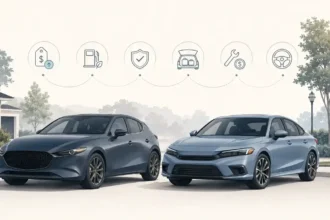
For a wider compact-car shortlist, compare this matchup with Mazda3 in our guide to the best used compact cars. It helps you decide whether Civic, Corolla, or Mazda3 fits your budget and ownership priorities better.
If your budget is capped near $20,000, both Civic and Corolla can still make sense, but the right year band matters. For a wider budget-based shortlist, compare them with other options in our best used cars under $20,000 guide.
Final Recommendation by Buyer Type
Here you will decide which one to buy based on what you actually need.
The Corolla becomes especially compelling when the specific car is meaningfully cheaper at comparable age, mileage, condition, and history. It also has the more relevant Hybrid used-car selection for shoppers concentrating on 2020–2024 model years.
If you are still comparing Corolla against other used compact sedans, Hyundai belongs on the shortlist too. Read Hyundai Elantra vs Toyota Corolla before making the final call. It gives you another value-focused compact-sedan comparison before you commit to the Corolla.
The Civic remains the stronger all-around choice when prices and condition are close and you care more about cabin usability, rear-seat space, and a more polished daily drive.
Choose the cleaner example over the preferred badge if condition and history clearly separate the two. A materially better-maintained car can matter more than the model-level preference.
If you are still split, use this filter. If you will notice comfort, space, and day-to-day polish every week, lean Civic. If the comparable Corolla is meaningfully cheaper or you specifically want the broader 2020–2024 Hybrid shopping lane, lean Corolla.
If you like the Civic but want another compact-sedan alternative, add Hyundai to the shortlist. The Hyundai Elantra vs Honda Civic comparison shows how the Civic’s all-around strengths compare with the Elantra’s value-focused case.
Do not assume the Corolla is automatically cheaper to own or that the Civic is automatically safer. EPA results change with the exact configuration, IIHS results change with model year, equipment, body style, and test family, and used-car value changes with the actual listing.
If you want to widen the search beyond these two models, use our Most Reliable Used Cars guide as another shortlist-building resource.
Many compact-sedan shoppers also consider the Mazda3, so it is worth seeing how it compares with both finalists in Mazda 3 vs Honda Civic and Mazda 3 vs Toyota Corolla.
Frequently Asked Questions
For honda civic vs toyota corolla, which is the better used buy?
For many buyers, the better used buy depends on the exact cars being compared. If prices and condition are close, the Civic makes the stronger all-around case when cabin usability, rear-seat comfort, and a more polished daily drive matter most. The Corolla becomes the stronger value play when a comparable example is meaningfully cheaper, or when its Hybrid availability better fits the years you are shopping. On used examples, condition and service history can matter more than the badge-level preference.
Why would someone choose the Civic over the Corolla?
Most buyers choose the Civic because it usually feels more complete. The cabin often feels less basic, the rear seat is easier to live with, and the overall driving experience tends to feel more polished. That matters if you commute a lot, carry passengers, or plan to keep the car for years.
Does the Corolla make more sense for first-time or value-first buyers?
It can, especially when the specific Corolla is meaningfully cheaper than a comparable Civic. But first-time buyers should not assume the Corolla is automatically the better value. Compare year, mileage, condition, service history, powertrain, and immediate needs first. If prices and condition are close, choose based on which car better fits your daily use.
Which one is more reliable over the long term?
Both have strong reputations, but used-car reliability is really a condition question. Service history, mileage, and overall care matter more than badge-level assumptions. If you are shopping older or higher-mileage cars, focus less on online reputation and more on records, warning lights, transmission behavior, and proof of regular upkeep.
Which one is cheaper to maintain and run?
There is no reliable badge-level maintenance or repair-cost winner here. For fuel use, compare the exact EPA configuration. For maintenance and repairs, compare the individual car’s service history, current condition, model year, powertrain, immediate needs, and any applicable remaining manufacturer coverage. A cleaner, better-maintained example can be the cheaper ownership decision regardless of which badge is on it.
Which trims usually make the most sense used?
For both cars, the better used value usually sits in sensible middle trims rather than at the top of the ladder. Pay up only when the extra equipment clearly improves comfort, convenience, or long-term satisfaction. If the higher trim mainly looks better, it is usually not enough reason to stretch.
Do hatchback or hybrid versions change the answer?
Yes. Hatchbacks change the practicality case, while Hybrid availability and EPA fuel economy can change the running-cost case. Corolla Hybrid gives buyers a broader Hybrid shopping lane for 2020–2024, while Civic Hybrid appears in earlier years through 2015 and returns for 2025. Compare the exact body style, model year, and EPA configuration rather than assuming one Hybrid result applies across the whole nameplate.
Which years matter most when comparing a used Civic and Corolla?
The years matter most when they cross a generation change, shift the available trims, or change the hybrid story enough to affect value. If one listing is a generation newer, much lower mileage, or built around a different powertrain, the answer can flip fast. Compare like with like first, then narrow by year.