

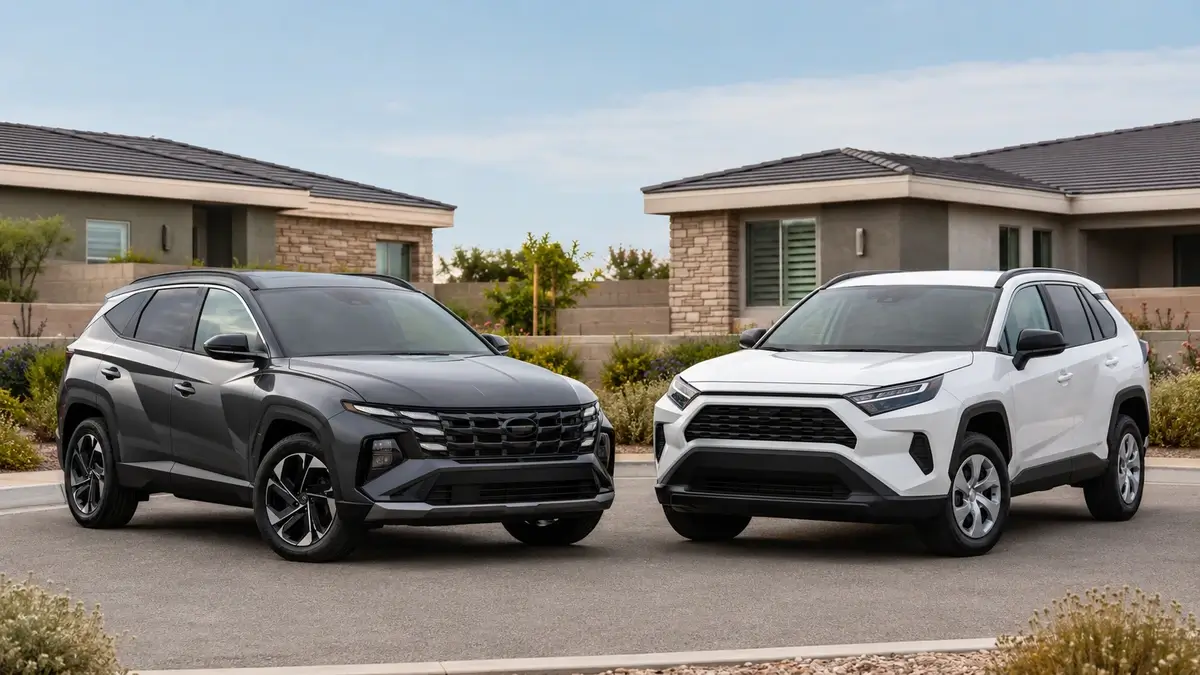
The Hyundai Tucson vs Toyota RAV4 decision is not just a spec comparison. For used SUV buyers, the real question is risk.
The RAV4 is usually the easier default if you want stronger resale confidence, broad used-market demand, and less second-guessing after purchase. The Tucson can be the smarter value buy if the price gap is real, the service history is clean, and the warranty situation still helps you.
This guide is for U.S. used-car buyers. It focuses on ownership reality, not new-model hype. If you are still building a wider shortlist, start with our guide to the best used compact SUVs.
CarMerit reliability comparator
Hyundai Tucson vs Toyota RAV4: 2005-2024 NHTSA snapshot
Owner-complaint and recall counts from NHTSA for 2005-2024, each model’s best used-year lane, and which buyer each one fits.
| 5,997 | complaints (2005-24) | 7,903 |
| 59 | recalls (2005-24) | 137 |
EnginePowertrain / transmissionBrakesAirbags / seatbelts / structure | top issues | Airbags / seatbelts / structureEngineElectricalUnknown / other |
Hyundai Tucson
Best used year: 2020
Simpler 2019-2021 six-speed automatic range; avoid unresolved or symptomatic 2016 1.6T DCT; verify affected 2017 2.0 GDI Recall 209.
Best for: Value buyers who want more features for the money and a lower purchase price when the deal is clearly better and well documented.
Toyota RAV4
Best used year: 2016
Shortlist 2016-2018 and 2020-2022 gas; older budget 2009-2012; use more caution with 2005, 2006-2008, 2013-2015, and some 2019-2022 hybrid / Prime cases.
Best for: Long-term buyers who want stronger resale, broad used-market demand, and the lower-uncertainty conservative choice.
Quick take: The RAV4 is the easier default when prices are close because resale confidence and lower decision risk matter. Choose the Tucson when it is clearly cheaper, better equipped, cleaner, and better documented. Lean RAV4 when the price gap is small; consider Tucson only when the value gap is real. Do not crown either SUV from raw NHTSA counts alone.
Complaint counts are raw owner reports filed with NHTSA, not adjusted for sales volume, so they should guide inspection rather than crown a winner. The quick comparator above uses a 2005-2024 overlapping NHTSA snapshot for both models; if one model has older NHTSA history before 2005, those model-only years are excluded here to keep the comparison balanced. Always inspect the specific vehicle before buying.
Hyundai Tucson vs Toyota RAV4: Quick Used-Buyer Verdict
Choose the Toyota RAV4 if you plan to keep the SUV for years, care about resale value, and want the lower-risk choice when prices are close.
Choose the Hyundai Tucson if you want more features for the money, a more comfortable value package, and a lower purchase price.
Avoid making the decision from mileage alone. A clean, well-maintained Tucson can be a better buy than an overpriced or neglected RAV4.
The safest simple rule is this: lean RAV4 when the price gap is small. Consider the Tucson seriously when it is clearly cheaper, better equipped, and better documented.
What goes wrong if you pick poorly? You either overpay for Toyota confidence you did not need, or you chase Tucson value and accept more resale and ownership uncertainty than you expected.
| Buyer Type | Better Fit | Why |
|---|---|---|
| Long-term owner | Toyota RAV4 | Better default when resale confidence and lower decision risk matter |
| Value shopper | Hyundai Tucson | Often gives more features for less money |
| Family buyer | Depends on year and trim | Tucson can feel comfortable and well-equipped, while RAV4 is easier to trust long term |
| Low-risk buyer | Toyota RAV4 | Better choice if both SUVs are similarly priced and documented |
| Tech and comfort buyer | Hyundai Tucson | Better chance of finding strong equipment value |
| Hybrid-focused buyer | Toyota RAV4 Hybrid, usually | Strong default if the price premium is reasonable |
| Short ownership cycle | Hyundai Tucson | Lower entry cost can matter more if bought well |
Hyundai Tucson vs Toyota RAV4 Comparison Snapshot
The Tucson and RAV4 both make sense as used compact SUVs. They solve different buyer problems.
The RAV4 is the conservative choice. It is the one to buy when you care more about lower long-term uncertainty than getting the most features for your money.
The Tucson is the value choice. It is the one to buy when price, comfort, condition, warranty context, and equipment matter more than Toyota’s stronger used-market pull.
| Factor | Hyundai Tucson | Toyota RAV4 |
| Best overall used-buyer fit | Value-focused buyers | Long-term, low-risk buyers |
| Purchase price | Usually the stronger value case | Often carries a higher used price |
| Resale value | More price-sensitive | Usually the stronger resale case |
| Reliability confidence | More year-sensitive | Stronger default reputation |
| Maintenance risk | Depends heavily on year and records | Still needs records, but easier to justify long term |
| Warranty angle | Strong only when remaining coverage applies | Less headline warranty, but strong ownership confidence |
| Fuel economy | Good, with hybrid options available | Strong, especially in hybrid form |
| Interior and comfort | Often better feature value | Practical and easy to live with |
| Cargo and family use | Competitive and often roomy | Strong all-around family utility |
| Best reason to buy | More SUV for the money | Lower decision risk |
| Main reason to skip | Resale and year-sensitive risk | Higher purchase price |
Price, Value, and Used-Market Position
The Tucson’s strongest argument is value. Used examples can look attractive because you may get newer styling, more equipment, and a lower price than a similar RAV4.
That does not automatically make the Tucson better. A cheaper SUV is only better if it stays cheaper after repairs, depreciation, insurance, fuel, and resale.
The RAV4’s case is different. You usually pay more up front, but that premium can make sense if the specific vehicle has clean records and the higher resale case still applies in your local market.
Do not treat any national resale claim as a substitute for checking the actual market in front of you. Compare local listings by year, trim, mileage, title status, accident history, drivetrain, and condition. For depreciation context, use a clean comparison tool such as this Tucson vs RAV4 depreciation comparison, then verify against real local listings before buying.
A small price gap is usually not enough to make the Tucson the better buy. A larger gap can change the answer if the Tucson is cleaner, better equipped, and properly maintained.
Use this filter before deciding:
| Price Situation | Better Move |
| RAV4 and Tucson are priced close | Lean RAV4 |
| Tucson is clearly cheaper and cleaner | Consider Tucson seriously |
| RAV4 has better records and similar mileage | Lean RAV4 |
| Tucson has better trim, remaining warranty context, and lower price | Tucson may be the smarter buy |
| RAV4 is overpriced for its condition | Do not pay the Toyota tax blindly |
| Tucson has weak records or accident history | Walk away unless deeply discounted |
Prices vary by year, mileage, trim, condition, accident history, drivetrain, and location. Verify local listings before treating either SUV as the better value.
Reliability and Long-Term Ownership Risk
The hyundai tucson vs toyota rav4 reliability decision favors the RAV4 as the lower-risk default, but that does not mean every RAV4 is clean or every Tucson is risky.
Toyota’s advantage is buyer confidence. The RAV4 has strong used-market demand and a long-running ownership reputation, which matters if you plan to keep the SUV for a long time. For deeper model-specific context, read our Toyota RAV4 reliability guide.
The Tucson can still make sense if it is cleaner, cheaper, and better documented than the RAV4 you are comparing it against. Before letting the lower price decide the outcome, use the Hyundai Tucson reliability and cost-to-own guide to check the exact risks that matter on a used Tucson.
The Tucson’s risk is more conditional. It can be a good used SUV, but the exact year, engine, service history, warranty status, and prior ownership matter more.
Do not use forums as proof. Owner complaints are useful for finding concerns, but they are not enough to prove broad reliability by themselves.
For either SUV, check recalls by VIN through the NHTSA recall lookup. Recall status can change by year, build date, drivetrain, and repair history.
For the Tucson, be stricter about service records. A clean maintenance history matters because the value case weakens fast if major repairs appear early.
For the RAV4, do not overpay just because it is a Toyota. A neglected RAV4 with poor records is not the smart buy.
Maintenance Cost, Repairs, and Cost to Own
The tucson vs rav4 cost of ownership decision is about more than routine maintenance. It includes resale, repair exposure, fuel use, warranty status, insurance, tires, brakes, and how long you plan to own the SUV.
The RAV4 usually makes more sense for buyers who want the more predictable long-term choice. The Tucson makes more sense for buyers who can buy at a real discount and verify the vehicle carefully.
Warranty can affect the value of a recent used SUV, but only when the exact vehicle remains within the applicable time, mileage, ownership, and eligibility limits.
| 2024 Original Factory Coverage | Hyundai Tucson | Toyota RAV4 | Used-Buyer Meaning |
|---|---|---|---|
| New-vehicle/basic coverage | 5 years or 60,000 miles | 3 years or 36,000 miles | Coverage begins with the vehicle’s original delivery or first-use date |
| Powertrain coverage | 10 years or 100,000 miles; original owner only | 5 years or 60,000 miles; follows the vehicle subject to the written terms | Do not assume Hyundai’s headline 10-year/100,000-mile term transfers to a subsequent owner |
| Before treating coverage as active | Confirm ownership status, VIN, original date, mileage, and exclusions | Confirm VIN, in-service date, mileage, covered component, and exclusions | The used purchase date does not restart either warranty |
Table Note: These are original factory terms for the 2024 model-year scope. Older model years may have different terms. Warranty length does not prove reliability, vehicle condition, remaining coverage, or claim approval.
Some used examples may also qualify for vehicle-specific manufacturer coverage programs. These checks can matter more than the headline factory warranty on an older SUV:
If a Tucson’s engine or airbag history is being weighed against a RAV4’s water-entry, coolant, or electrified-drivetrain history, check both model years in CarMerit’s Manufacturer Special Coverage Lookup before deciding which SUV carries the more manageable repair exposure.
| Vehicle and Exact Scope | Program | Covered Condition or Component | Program Term | What the Buyer Must Verify |
|---|---|---|---|---|
| Certain 2010–2013 Tucson 2.4L MPI and 2014–2021 Tucson 2.0L GDI models | TXXM | Certain engine repairs caused by connecting-rod-bearing failure | 15 years or 150,000 miles from original delivery or first use | VIN qualification, applicable KSDS or recall status, ownership eligibility, and exclusions |
| Certain 2014–2015 and 2018–2019 Tucson 2.4L models | TXXI | Certain engine long-block repairs involving excessive connecting-rod-bearing damage | 10 years or 120,000 miles from original delivery or first use | VIN qualification, covered condition, diagnosis, and program exclusions |
| Certain 2016–2017 Tucson models | TXXQ | Airbag Control Unit replacement under the specified warning-light and diagnostic-code condition | 15 years with unlimited mileage from original delivery or first use | VIN qualification, exact diagnostic condition, and exclusions |
| Certain 2019–2021 RAV4 gas, 2020–2021 RAV4 Hybrid, and 2021 RAV4 Prime vehicles | 22TE05 | Water entry at the roof-rail attachment points and covered resulting damage | 10 years from first use, regardless of mileage | VIN and production eligibility, leak path, resulting damage, and Toyota authorization |
| Certain 2020–2024 RAV4 Hybrid and 2021–2024 RAV4 Prime vehicles | 22TE09 | Corrosion involving the high-voltage floor-under-wire harness and rear-motor cable connector | Expanded to 10 years with unlimited mileage if the applicable service campaign is completed by September 30, 2028; otherwise 8 years or 100,000 miles after the campaign expires | VIN, AWD/electrified scope, campaign completion, diagnosis, and current program status |
| Certain 2019–2021 RAV4 gas, 2020–2021 RAV4 Hybrid, and 2021 RAV4 Prime vehicles | 24TE04 | Specified flow shut-off valve coolant-leak condition | The primary window ended November 30, 2025; secondary coverage may continue for 10 years or 100,000 miles from first use | VIN, exact configuration, covered condition, mileage, first-use date, and Toyota authorization |
Table Note: These are later manufacturer coverage programs, not recalls, failure-rate evidence, or proof that a specific vehicle qualifies. Confirm current status and eligibility directly with the manufacturer using the VIN before purchase.
| Ownership Factor | Tucson Risk | RAV4 Risk | Buyer Takeaway |
| Routine maintenance | Manageable if records are clean | Manageable if records are clean | Records matter more than brand reputation |
| Repairs | More reason to verify year-specific history | Still possible on neglected examples | Do not skip inspection |
| Depreciation | Bigger concern if resale matters | Usually the stronger value-retention case | RAV4 is easier for resale-minded buyers |
| Warranty | Helpful only if coverage applies | Less of a used-buy selling point | Confirm coverage before buying |
| Long ownership | Needs stronger documentation | Usually the safer bet | RAV4 wins if prices are close |
| Short ownership | Can work if bought cheaply | Higher entry cost may hurt value | Tucson can make sense if the discount is real |
A pre-purchase inspection is worth doing on both. It matters even more on a Tucson that is being bought mainly for value.
Fuel Economy and Powertrain Choices
Fuel economy can change the decision, especially if you commute daily. But do not compare one random trim against another random trim.
Use FuelEconomy.gov to compare the exact year, drivetrain, and powertrain you are shopping. Gas, hybrid, all-wheel drive, and plug-in versions can change the answer.
For recent used models, the exact powertrain and drivetrain materially change the EPA comparison:
| Model Year | Compared Configurations | Tucson City MPG | Tucson Highway MPG | Tucson Combined MPG | RAV4 City MPG | RAV4 Highway MPG | RAV4 Combined MPG |
|---|---|---|---|---|---|---|---|
| 2019 | Gas FWD: Tucson 2.0L/6-speed automatic; RAV4 2.5L/8-speed automatic | 23 | 30 | 26 | 26 | 35 | 30 |
| 2022 | Gas FWD: both 2.5L/8-speed automatic | 26 | 33 | 29 | 27 | 35 | 30 |
| 2022 | Tucson Hybrid AWD; RAV4 Hybrid AWD | 37 | 36 | 37 | 41 | 38 | 40 |
| 2024 | Gas FWD: both 2.5L/8-speed automatic | 25 | 32 | 28 | 27 | 35 | 30 |
| 2024 | Tucson Hybrid AWD; RAV4 Hybrid AWD | 37 | 36 | 37 | 41 | 38 | 39 |
Table Note: These are EPA estimates for the exact configurations shown. Real-world mileage varies. Do not apply these figures to gas AWD models, Tucson Hybrid Blue, RAV4 Woodland Edition, Tucson Plug-in Hybrid, RAV4 Prime, or other configurations not listed.
The RAV4 Hybrid is often the stronger default for used buyers who want fuel savings with long-term confidence, especially if the price premium is reasonable.
The Tucson Hybrid can still be worth considering. It becomes more interesting when it is priced well, has strong records, and gives you the features you want without pushing close to RAV4 Hybrid money.
Do not let hybrid interest take over the whole decision. A hybrid saves money only if the purchase price, battery warranty, mileage, fuel cost, and ownership horizon make sense.
Hybrid coverage also requires exact model-year matching. For a 2022 Tucson Hybrid, Hyundai’s model-year warranty lists 10 years or 100,000 miles for the hybrid/electric battery and specified hybrid-system components, covering original and subsequent owners within the stated term.
For a 2024 RAV4 Hybrid, Toyota lists 8 years or 100,000 miles for specified hybrid-system components and 10 years or 150,000 miles for defects in the hybrid battery.
These terms cover different model years and are not a warranty ranking. Confirm the VIN, original in-service date, mileage, exclusions, and exact covered component. Warranty terms do not prove battery condition, capacity retention, reliability, claim approval, or remaining coverage.
Interior Space, Cargo Room, and Daily Practicality
The Tucson often has a strong comfort and space case in recent used examples. It can feel modern, roomy, and well-equipped for the money.
The RAV4 feels more familiar and straightforward. It is not always the flashiest choice, but it works well for commuting, errands, road trips, and family duty.
If you carry adults in the rear seat often, sit in both SUVs before deciding. Rear-seat comfort can matter more than a small cargo-space difference.
If you carry bulky gear, strollers, tools, or sports equipment, test the cargo area with real items. Numbers help, but opening shape, floor height, seat-folding behavior, and load height also matter.
You can compare current factory dimensions through Hyundai’s Tucson specifications and Toyota’s RAV4 specifications. For used buying, still verify the exact model year and trim because current specs may not apply to older examples.
The Tucson is better if you want a nicer-feeling cabin for the price. The RAV4 is better if you want practical utility with stronger long-term confidence.
Safety, Driver Assistance, and Confidence Features
Safety is year-specific. Do not assume one Tucson or RAV4 has the same crash-test results, headlights, or driver-assistance features as another year.
Review the IIHS Hyundai Tucson ratings and IIHS Toyota RAV4 ratings, then match the applicable rating notes to the exact used SUV you are considering.
Selected IIHS results show why the model year, trim, equipment, test type, and sometimes build date must be checked:
| Used Model | Selected IIHS Crashworthiness Evidence | Headlight Evidence | What the Buyer Should Verify |
|---|---|---|---|
| 2019–2021 Tucson | Good in the driver- and passenger-side small-overlap and original moderate-overlap tests; Marginal in the updated side test; the 2021 updated moderate-overlap result was Poor | Ratings ranged from Good to Poor depending on trim and, for some 2019 vehicles, build date | Confirm the model year, trim, headlight type, and certification-label build date |
| 2019–2021 RAV4 | Good in the driver- and passenger-side small-overlap and original moderate-overlap tests; Acceptable in the updated side test; the updated moderate-overlap rating applying from 2021 was Marginal | Ratings ranged from Good to Poor depending on trim and package | Confirm the exact trim, gas or hybrid configuration, and headlight package |
| 2022 Tucson | Good in the listed driver- and passenger-side small-overlap and original moderate-overlap tests | Good for the Limited trim; Acceptable for the listed SE, SEL, and N-Line trims | Do not infer an updated-test result from a rating that is not listed |
| 2022 RAV4 | Good in the driver- and passenger-side small-overlap and original moderate-overlap tests; Marginal in the updated moderate-overlap test and Acceptable in the updated side test | Good for listed projector-headlight trims; Marginal for the LE reflector-headlight configuration | Do not assign one headlight rating to every trim |
| 2024 Tucson | Good in the small-overlap, original moderate-overlap, and updated side tests; the Good updated moderate-overlap rating applies only to vehicles built after March 2024 | Acceptable for the listed configurations | Check the certification-label build date before applying the updated moderate-overlap result |
| 2024 RAV4 | Good in the small-overlap and original moderate-overlap tests; Marginal in the updated moderate-overlap test and Acceptable in the updated side test | Good for all trims shown on the 2024 IIHS page | Keep original and updated test results separate |
Table Note: Good, Acceptable, Marginal, and Poor are IIHS ratings. IIHS procedures and rating criteria changed over time. An unlisted rating is not evidence of poor performance. Do not combine these results into one safety score or use them alone to declare either SUV safer overall.
Do not trust dealer claims like “more standard safety” without checking the actual trim. Blind-spot monitoring, rear automatic braking, parking sensors, adaptive cruise control, and upgraded headlights may depend on year, trim, package, or build date.
The RAV4 is the easier recommendation if you want a simple low-stress default. The Tucson can still be a strong safety value if the exact year and trim have the equipment you need.
Before you compare the safety equipment or final value of a specific Tucson and RAV4, make sure both listings accurately identify the SUVs in front of you. Run each VIN through the CarMerit VIN Lookup and compare the returned vehicle details with the seller’s description and paperwork. Then verify the actual trim-specific features, official recall status, accident history, service records, and condition separately before choosing between the two.
Before buying either SUV, verify:
- Open recalls by VIN
- IIHS rating for the model year
- NHTSA safety information through NHTSA safety issue search
- Actual driver-assistance features on the vehicle
- Tire condition and brake condition
- Any accident history or structural repair
Safety tech is useful only when it is actually present and working.
Model Years, Generations, and Used-Buying Caution
This comparison should not become a full years-to-avoid guide. Still, model year matters.
The RAV4’s used-market strength comes from broad buyer trust, not from every year being automatically perfect. If you are narrowing by year, use our Toyota RAV4 years to avoid guide before paying a Toyota premium.
The Tucson’s value case is more sensitive to year and ownership history. A newer Tucson with clean records can make sense, but an older or poorly maintained example can lose its advantage fast.
The Tucson’s year-by-year risk changes enough that this broad comparison cannot settle the purchase alone. Check our Hyundai Tucson years to avoid and best years to buy guide before deciding whether its lower price offsets the model-year and powertrain uncertainty.
| Used-Buying Check | Tucson | RAV4 |
| Service records | Essential | Essential |
| Recall status | Check by VIN | Check by VIN |
| Accident history | Can weaken value sharply | Can weaken value sharply |
| Warranty status | Verify carefully | Verify carefully |
| Hybrid condition | Check battery and service history | Check battery and service history |
| Trim equipment | Confirm in person | Confirm in person |
| Price vs condition | Must be clearly favorable | Do not overpay for reputation |
Mileage should not be the only filter. A higher-mileage SUV with excellent records can be safer than a lower-mileage one with gaps.
For the Tucson, look harder at maintenance proof and warranty status. For the RAV4, look harder at whether the price premium is justified by condition.
Other Compact SUVs to Compare Before Buying
The Tucson and RAV4 are not the only practical compact SUV choices. If you are still unsure, compare the RAV4 against close alternatives before buying.
The Honda CR-V vs Toyota RAV4 comparison is the most important next stop if you want another low-risk compact SUV. The CR-V is often the RAV4’s closest used-market rival.
The Mazda CX-5 vs Toyota RAV4 comparison matters if driving feel and interior quality are part of your decision. The CX-5 can be more enjoyable, while the RAV4 is usually the safer practicality play.
The Nissan Rogue vs Toyota RAV4 comparison is useful if you want a cheaper alternative but still need family-friendly space. The Rogue can be tempting on price, but it needs stricter used-buyer caution.
The Forester vs RAV4 comparison is worth reading if all-weather confidence and visibility matter. The Forester has a different personality, while the RAV4 keeps the stronger Toyota value case.
If you are leaning Hyundai mainly for value, compare the Kia Sportage vs Hyundai Tucson before deciding. These two often overlap closely on price, features, and used-buyer appeal.
Which One Should You Buy?
Buy the Toyota RAV4 if you want the lower-risk used compact SUV choice. It is the better fit for long-term ownership, stronger resale confidence, and a simpler decision when prices are close.
Buy the Hyundai Tucson if you want better value for the money. It makes sense when the exact vehicle is cheaper, cleaner, better equipped, and properly documented.
The RAV4 is not automatically worth any price. If the Toyota is overpriced, poorly maintained, or accident-damaged, walk away.
The Tucson is not automatically the bargain. If the discount is small, the records are weak, or the warranty context is unclear, its value case falls apart.
For most used buyers comparing Hyundai Tucson vs Toyota RAV4, the best answer is this:
Choose the RAV4 if prices are close. Choose the Tucson if it is clearly the better deal and passes a stricter inspection.
Final Verdict
The Toyota RAV4 wins for most used compact SUV buyers because it is the lower-risk long-term default. It is easier to recommend when ownership confidence, resale value, and reduced decision risk matter most.
The Hyundai Tucson is the better value pick when the numbers are right. It can give you a newer-feeling cabin, strong comfort, useful features, and a lower purchase price.
Do not buy either one from reputation alone. Buy the specific SUV that has the right year, clean title, strong service records, fair price, no unresolved recall issue, and a clean inspection.
If you want the lowest-stress answer, buy the RAV4. If you want the better deal and can verify the details, the Tucson deserves a serious look.
If reliability is your top concern across the whole shortlist, also compare this decision with our guide to the most reliable used cars. If family practicality is the bigger issue, use our best used family cars guide next.
Frequently Asked Questions
Which is more reliable, the Hyundai Tucson or Toyota RAV4?
The Toyota RAV4 is usually the safer reliability default for used buyers, but the exact year, mileage, maintenance history, and condition still matter.
Is a used Hyundai Tucson cheaper than a used Toyota RAV4?
A used Hyundai Tucson is often the stronger value play, but local prices vary by year, trim, mileage, condition, title history, and market demand.
Is the Toyota RAV4 worth paying more for than the Hyundai Tucson?
The Toyota RAV4 is worth paying more for if you plan to keep it long term and care about resale, ownership confidence, and lower decision risk.
Which has lower maintenance costs, Tucson or RAV4?
The RAV4 is usually the safer bet for predictable long-term ownership, but both SUVs need clean service records and a pre-purchase inspection.
Which is better for families, the Tucson or RAV4?
The Tucson can feel more comfortable and feature-rich for the money, while the RAV4 is the stronger family pick for buyers who prioritize long-term confidence.
Is the Hyundai Tucson bigger than the Toyota RAV4?
Recent Tucson models can feel roomier in some areas, but the better choice depends on the exact model year, seating comfort, cargo shape, and family use.
Should I compare the Tucson Hybrid with the RAV4 Hybrid?
Yes, if fuel savings matter to you, but compare exact model years, purchase price, mileage, battery warranty, and service history before choosing.
Which SUV has better resale value?
The Toyota RAV4 usually has the stronger resale-value case, which is one reason it often costs more on the used market.
What should used buyers check before choosing a Tucson or RAV4?
Check the VIN for recalls, service records, accident history, tire and brake condition, warranty status, hybrid system condition, and a pre-purchase inspection.
Is the Hyundai Tucson a good alternative to the Toyota RAV4?
Yes, the Hyundai Tucson is a good RAV4 alternative when it is priced clearly lower, properly maintained, and equipped with the features you actually need.