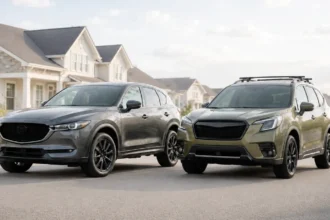


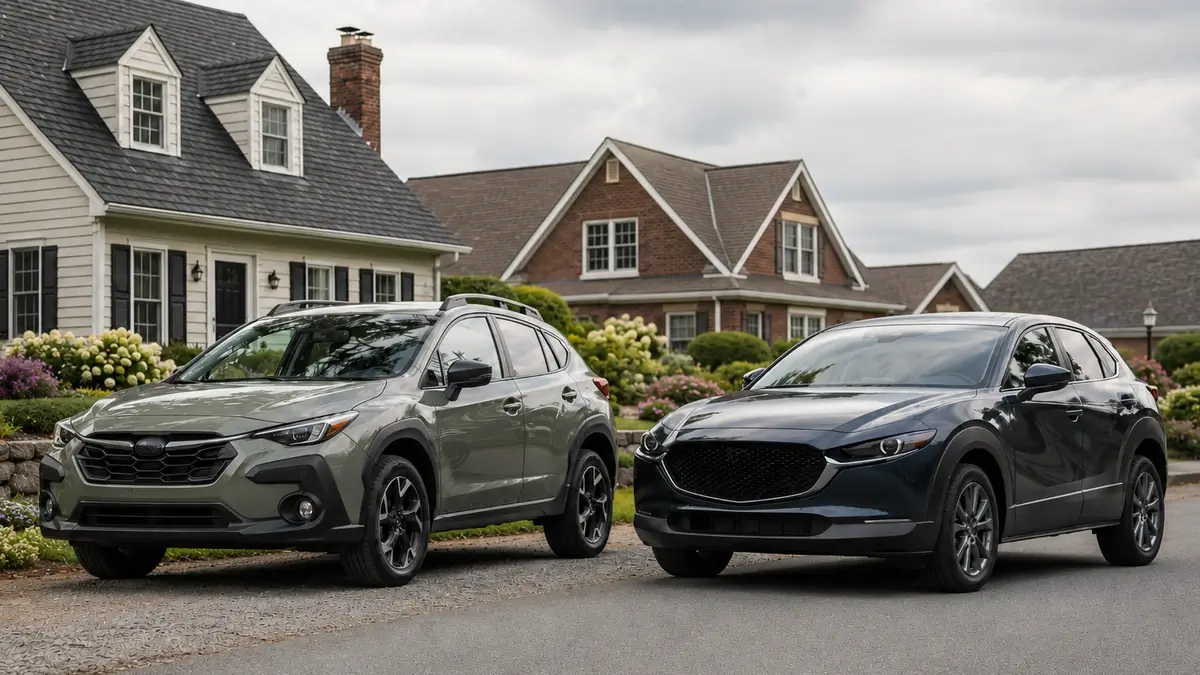
The Subaru Crosstrek vs Mazda CX-30 decision is not really about which small SUV is better on paper.
It is about which one fits your daily life as a used buyer.
Choose the Subaru Crosstrek if you want more visibility, easier cargo use, standard AWD confidence, and a more practical small SUV for snow, pets, light trails, rough roads, or outdoor gear.
Choose the Mazda CX-30 if you want a quieter cabin, sharper road manners, nicer interior feel, and a more refined daily driver for commuting, city driving, and highway use.
Fastest safe default: buy the Crosstrek if utility matters first. Buy the CX-30 if comfort matters first.
What goes wrong if you pick wrong: the CX-30 can feel too tight for utility-heavy buyers, while the Crosstrek can feel too plain for buyers who want a polished cabin.
CarMerit reliability comparator
Subaru Crosstrek vs Mazda CX-30: 2020-2025 NHTSA snapshot
Owner-complaint and recall counts from NHTSA for 2020-2025, each model’s best used-year lane, and which buyer each one fits.
| 379 | complaints (2020-25) | 234 |
| 3 | recalls (2020-25) | 10 |
Visibility / wipersUnknown / otherElectricalDriver-assist (ADAS) | top issues | EngineElectricalBrakesAirbags / seatbelts / structure |
Subaru Crosstrek
Best used year: 2022
Stronger start 2020 gas and 2022 gas; consider 2023 with lower confidence; treat 2024-2025 as too new for a confident long-term verdict.
Best for: Utility-and-outdoor buyers who want visibility, cargo flexibility, and standard AWD for snow, light trails, and rough roads.
Mazda CX-30
Best used year: 2023
Best practical starting point 2023 non-turbo; best value 2022 non-turbo; avoid 2020 for most buyers unless discounted, inspected, and recall-complete.
Best for: Refinement-first buyers who want a quieter cabin, sharper road manners, and a more premium daily driver for city and highway use.
Quick take: Choose the Crosstrek for visibility, utility, standard AWD, and rough-road confidence. Choose the CX-30 for refinement, sharper road manners, and a more premium daily feel. The CX-30 is the cleaner city-focused pick; the Crosstrek is the stronger utility pick. Do not crown either SUV from raw NHTSA counts alone.
Complaint counts are raw owner reports filed with NHTSA, not adjusted for sales volume, so they should guide inspection rather than crown a winner. The quick comparator above uses a 2020-2025 overlapping NHTSA snapshot for both models; if one model has older NHTSA history before 2020, those model-only years are excluded here to keep the comparison balanced. Always inspect the specific vehicle before buying.
Quick Verdict: Subaru Crosstrek vs Mazda CX-30
Use this table as the fast decision filter before comparing specs or trims.
| Buyer Type | Better Choice | Why |
|---|---|---|
| Snow, rain, gravel roads, or outdoor use | Subaru Crosstrek | Better visibility, strong AWD identity, and more utility-focused packaging |
| Daily commuting and city driving | Mazda CX-30 | Quieter feel, nicer cabin, and more polished road manners |
| Small family or pet owner | Subaru Crosstrek | Easier rear-seat and cargo use in real life |
| Solo driver or couple | Mazda CX-30 | More premium cabin feel without needing extra space |
| Buyer who values comfort over utility | Mazda CX-30 | Better refinement and more upscale driving feel |
| Buyer who values function over polish | Subaru Crosstrek | More practical shape and better rough-road confidence |
Best default choice: Buy the Subaru Crosstrek if you need practical utility first.
Buy the Mazda CX-30 if you want a nicer daily-driving experience and do not need maximum space.
If you are also considering other small SUVs, compare this decision with the Honda HR-V vs Toyota Corolla Cross before you narrow your shortlist.
Comparison Snapshot
This snapshot shows where each SUV has the clearer real-world advantage for used buyers.
The main split is simple. The Crosstrek acts more like a practical tool, while the CX-30 feels more like a refined daily driver.
| Category | Subaru Crosstrek | Mazda CX-30 | Better Fit |
| Overall personality | Practical, outdoorsy, utility-focused | Refined, stylish, comfort-focused | Depends on use case |
| Daily driving | Easy to see out of and relaxed | Smoother, quieter, more premium | Mazda CX-30 |
| Bad-weather confidence | Very strong fit | Strong, but more road-focused | Subaru Crosstrek |
| Rear-seat usability | More practical shape | Tighter rear-seat feel | Subaru Crosstrek |
| Cargo flexibility | Easier for gear and pets | Usable, but less flexible with seats folded | Subaru Crosstrek |
| Interior quality | Functional | More upscale | Mazda CX-30 |
| Fuel economy | Competitive, varies by engine and trim | Competitive non-turbo, lower with turbo | Depends on configuration |
| Used-buyer risk | Check CVT behavior and model year | Check trim, turbo history, and visibility fit | Tie |
| Best buyer | Utility-first driver | Comfort-first driver | Depends on buyer |
This is not a one-winner-for-everyone comparison.
The better used SUV depends on whether you want space and utility or comfort and refinement.
Which One Is Better for Daily Driving?
The Mazda CX-30 is usually the better daily driver if your routine is mostly commuting, errands, parking lots, and highway driving.
It feels more polished from behind the wheel. The cabin has a more premium design, road noise is generally better controlled, and the driving feel is more composed than the Crosstrek.
That matters if you spend most of your time alone or with one passenger.
In that use case, the CX-30 feels less like a basic crossover and more like a small near-premium SUV.
The Subaru Crosstrek is easier to live with if visibility and simple usability matter more than cabin polish.
You sit in a practical, open-feeling cabin. The shape makes it easier to judge the corners, see out, and load awkward items.
That matters if you drive in tight neighborhoods, park outside often, carry pets, use a roof rack, or regularly deal with snow and uneven roads.
Daily-driver verdict: Choose the CX-30 for comfort and refinement. Choose the Crosstrek for visibility, utility, and everyday practicality.
If you are comparing the Crosstrek against more city-focused small SUVs, also read Subaru Crosstrek vs Honda HR-V. That comparison is useful if you like the Crosstrek’s AWD confidence but want to see whether the HR-V’s simpler daily usability fits better.
Subaru Crosstrek vs Mazda CX-30 AWD and Bad-Weather Use
For AWD and bad-weather use, the Subaru Crosstrek vs Mazda CX-30 comparison favors the Crosstrek if winter roads or rough surfaces are a major part of your buying decision.
Subaru gives the Crosstrek a utility-first setup. The Subaru 2024 Crosstrek brochure lists 8.7 inches of ground clearance on standard trims, while Subaru’s 2024 Crosstrek trim comparison lists 9.3 inches for the Wilderness trim.
That extra clearance matters if you deal with snowbanks, rutted driveways, gravel roads, rural lanes, or uneven trailhead parking lots.
The Mazda CX-30 also offers strong AWD confidence. Mazda’s 2024 CX-30 pricing and packaging materials show AWD as standard for that model year, and Mazda’s 2024 CX-30 specification deck lists 8.0 inches of unladen ground clearance.
The difference is personality. The CX-30 is more road-focused. The Crosstrek feels more purpose-built for poor weather, rough pavement, and light outdoor use.
Tires still matter. A Crosstrek on worn all-season tires will not feel as secure as a well-maintained CX-30 with the right winter or all-weather tires.
AWD verdict: Pick the Crosstrek if winter roads, gravel, or outdoor use are normal for you. Pick the CX-30 if you mostly want AWD confidence on pavement.
Interior, Rear Seat, Cargo, and Visibility
The Mazda CX-30 has the nicer cabin.
The dashboard design, materials, seating feel, and controls give it a more premium atmosphere than the Crosstrek.
That is the CX-30’s biggest advantage. If you care about how the cabin feels every day, Mazda makes the stronger case.
The Crosstrek answers with better practical usability.
It feels airier, visibility is stronger, and the shape is easier to work with when loading gear.
For 2024 examples, Subaru’s Crosstrek brochure lists 19.9 cubic feet of cargo volume behind the rear seats and 54.7 cubic feet with the rear seatbacks folded on most trims.
Mazda’s 2024 CX-30 specification deck lists 20.2 cubic feet behind the rear seats and 45.2 cubic feet with the rear seat folded.
That means the CX-30 can look competitive behind the second row. The Crosstrek has the stronger maximum-cargo case when you fold the seats.
This is where used buyers should be honest. If you rarely carry bulky items, the CX-30’s nicer cabin may matter more.
If you carry pets, strollers, bikes, camping gear, or big grocery runs, the Crosstrek’s shape is easier to use.
Interior verdict: Choose the CX-30 for cabin quality. Choose the Crosstrek for rear visibility, cargo flexibility, and practical shape.
Fuel Economy and Cost of Ownership
The Subaru Crosstrek vs Mazda CX-30 cost-of-ownership decision is close, but trim and engine choice matter.
FuelEconomy.gov lists the 2024 Subaru Crosstrek AWD 2.0-liter automatic at 27 city, 34 highway, and 29 combined MPG. It lists the 2024 Crosstrek AWD 2.5-liter automatic at 26 city, 33 highway, and 29 combined MPG.
The Crosstrek Wilderness is lower, at 25 city, 29 highway, and 27 combined MPG.
For the 2024 Mazda CX-30 4WD, FuelEconomy.gov lists the non-turbo 2.5-liter at 26 city, 33 highway, and 29 combined MPG. The turbo version drops to 22 city, 30 highway, and 25 combined MPG.
That makes the non-turbo CX-30 and most Crosstrek trims broadly similar on fuel economy.
The biggest change comes when you move into the CX-30 Turbo or the Crosstrek Wilderness.
Ownership cost is not only fuel. It also depends on tires, maintenance history, repair records, insurance, driving conditions, and whether the vehicle was used gently or hard.
This section should be read as a fuel-economy and ownership-variable comparison, not a full proof that one SUV is cheaper to own overall.
A used Crosstrek that spent years on rough roads may need a different inspection than a lightly driven commuter CX-30.
A turbo CX-30 may be more appealing to drive. It also asks the buyer to accept lower fuel economy and check service records carefully.
Ownership-cost verdict: Do not assume either SUV is automatically cheaper to own. Compare the exact engine, trim, mileage, service history, tire condition, and recall status.
For broader shortlist context, the most reliable used cars guide can help you compare this decision against other practical used-car choices.
Subaru Crosstrek vs Mazda CX-30 Reliability and Used-Buyer Risk
The Subaru Crosstrek vs Mazda CX-30 reliability question should not be answered with brand reputation alone.
Both can be good used buys when condition, maintenance, mileage, and model year are right.
Both can also become weak buys if the specific vehicle has poor service history, accident damage, neglected tires, or unresolved recall work.
For a used Crosstrek, pay close attention to the model year, CVT behavior, maintenance records, tire wear, suspension condition, and signs of rough-road use.
Model year can materially change the Crosstrek side of this comparison. Review the Subaru Crosstrek years to avoid and best years to buy before choosing a specific vehicle, then verify its recall history, CVT behavior, and service records.
For a used CX-30, pay close attention to trim level, engine choice, maintenance records, visibility comfort, tire condition, and whether the previous owner kept up with service.
The non-turbo CX-30 is usually the easier used-buying default because it avoids the turbo model’s fuel-economy penalty and extra performance complexity.
That does not prove it is automatically more reliable. It simply gives a cautious used buyer fewer ownership variables to inspect.
The Crosstrek is the better fit if you need utility and are willing to inspect carefully.
The CX-30 is the better fit if you want refinement and can live with less cargo flexibility.
If you are leaning Mazda, read the Mazda CX-30 years to avoid guide before choosing a model year.
Reliability verdict: Buy the better-maintained vehicle, not just the better badge. Condition and service history matter more than the logo.
Safety and Driver-Assistance Checks
Both SUVs can be strong safety choices, but used buyers should verify the exact model year and trim.
The IIHS lists the 2024 Mazda CX-30 as a Top Safety Pick+ and shows strong crashworthiness and crash-prevention results for that model year.
The IIHS page for the 2024 Subaru Crosstrek also shows strong results in several tested areas and lists standard EyeSight front crash prevention for that model year.
Do not apply those 2024 examples to every older used Crosstrek or CX-30 without checking the exact vehicle.
Safety ratings, driver-assistance features, trim equipment, headlights, and crash-prevention results can vary by model year and configuration.
This is especially important if you are shopping older used examples. Check whether the exact vehicle has blind-spot monitoring, adaptive cruise control, lane support, rear cross-traffic alert, and the safety features you expect.
Before buying, also check open recalls through the NHTSA recall lookup. Recall status is vehicle-specific, so use the VIN when possible.
Safety verdict: Both can work well, but verify the exact year, trim, equipment, IIHS result, and recall status before you pay.
Best Trims and Years to Shortlist
Trim choice changes this comparison.
Do not shop by trim name alone. A higher trim with poor service history is not a better deal than a lower trim with clean records.
| Buyer Goal | Better Direction | What to Watch |
| Lowest-risk practical used buy | Crosstrek Premium or Sport, depending on year | Service history, CVT feel, tire wear |
| More refined daily driver | CX-30 Preferred or Premium | Rear-seat comfort, visibility, trim features |
| Stronger acceleration | CX-30 Turbo | Fuel economy and service history |
| Outdoor-focused use | Crosstrek Sport, Limited, or Wilderness | Condition, underbody wear, tires |
| Best simple commuter | Non-turbo CX-30 | Check visibility and rear-seat needs |
| Best utility pick | Crosstrek | Check model year and maintenance records |
The safest used-buying move is to avoid shopping by trim name alone.
A well-kept base or mid-trim example can be the smarter buy if it has better records, better tires, and fewer ownership red flags.
For many buyers, a non-turbo CX-30 or a well-maintained Crosstrek Premium, Sport, or Limited will make more sense than chasing the most expensive version.
Trim verdict: Prioritize condition and service history first. Then choose the trim that fits your actual use case.
When the Subaru Crosstrek Is the Better Used SUV
Choose the Subaru Crosstrek if you want a small SUV that feels practical before it feels fancy.
It is the better fit for drivers who deal with snow, gravel, pets, outdoor gear, roof racks, rough driveways, or regular cargo needs.
The Crosstrek’s AWD advantage is strongest when the specific car has been maintained well. Before choosing one over the CX-30, read the full Subaru Crosstrek reliability and cost to own guide to check CVT behavior, tire condition, service history, recalls, and inspection risk.
It also makes more sense if visibility matters to you.
The Crosstrek’s cabin shape gives it a more open, functional feel than the CX-30.
The Crosstrek is not the more premium choice. It can feel less refined, less upscale, and less polished than the Mazda.
That trade-off is acceptable if your priority is utility.
Buy the Crosstrek if: you want a practical, AWD-first, easy-to-use small SUV and do not need the nicest cabin in the class.
Skip the Crosstrek if: you mainly want a quiet, polished, premium-feeling daily driver and rarely need extra utility.
When the Mazda CX-30 Is the Better Used SUV
Choose the Mazda CX-30 if you want a small SUV that feels more upscale and enjoyable in normal driving.
It is the better fit for commuters, city drivers, couples, solo drivers, and buyers who care about cabin feel more than maximum cargo space.
The CX-30 feels more refined than the Crosstrek. It is quieter, more polished, and more premium inside.
That is a buyer-feel advantage, not proof that every used CX-30 is the better buy.
The trade-off is space and visibility. Rear-seat room and cargo flexibility are not its strongest points.
The CX-30 can be the better choice if you want a sharper, more upscale small SUV, but condition and ownership cost still matter. Use the full Mazda CX-30 reliability and cost to own guide before buying so you can check maintenance records, tires, recalls, turbo risk, and inspection issues before choosing it over the Crosstrek.
If you regularly carry adults in the back seat, bulky gear, pets, or outdoor equipment, the CX-30 may feel tight.
Buy the CX-30 if: you want refinement, comfort, and a more premium daily driver, and you can live with less practical space.
Skip the CX-30 if: you need maximum cargo flexibility, open outward visibility, or more rough-road practicality.
What to Check Before Buying Either One Used
Do not buy either SUV only because it ranks well in a comparison.
A specific used vehicle can be a smart buy or a bad buy depending on its condition.
Before buying a used Crosstrek or CX-30, check:
- Service records
- Accident history
- Open recalls through the NHTSA recall lookup
- Tire brand, tread depth, and uneven wear
- Brake condition
- Suspension noise
- AWD warning lights
- Transmission behavior
- Oil leaks or fluid seepage
- Rust or underbody damage
- Interior water stains
- Infotainment and camera functions
- Driver-assistance features
- Two working key fobs
- Pre-purchase inspection results
For a Crosstrek, pay special attention to CVT behavior, tire matching, suspension noise, and signs of rough-road use.
For a CX-30, pay special attention to visibility comfort, rear-seat fit, turbo service history if applicable, tire condition, and whether the trim has the features you expect.
Used-buying rule: The better-maintained vehicle is often the better buy, even if the other model wins on paper.
Final Verdict: Mazda CX 30 vs Subaru Crosstrek
The Mazda CX 30 vs Subaru Crosstrek decision comes down to what you want your used small SUV to do best.
Buy the Subaru Crosstrek if you want utility, visibility, cargo flexibility, standard AWD confidence, and better rough-road practicality.
Buy the Mazda CX-30 if you want comfort, refinement, a nicer cabin, and a more polished daily-driving experience.
The Crosstrek is the better choice for buyers who treat their small SUV like a tool.
The CX-30 is the better choice for buyers who want their small SUV to feel more premium every day.
Final recommendation: For most utility-first used buyers, choose the Subaru Crosstrek. For most comfort-first used buyers, choose the Mazda CX-30.
If you are still building a small SUV shortlist, the best used small SUVs guide is the better next step.
If you want a larger compact-SUV comparison, the Mazda CX-5 vs Subaru Forester comparison may fit your next decision better.
Frequently Asked Questions
Is the Subaru Crosstrek better than the Mazda CX-30?
The Subaru Crosstrek is better if you want utility, visibility, cargo flexibility, and rough-road confidence.
It is the safer default for buyers who need their small SUV to handle snow, pets, gear, and uneven roads more often than polished commuting.
Is the Mazda CX-30 better than the Subaru Crosstrek?
The Mazda CX-30 is better if you want a nicer cabin, smoother daily driving, and a more refined small SUV.
It makes the most sense when rear-seat space, maximum cargo flexibility, and rough-road use are not major priorities.
Which is better for snow, the Crosstrek or CX-30?
The Subaru Crosstrek is usually the better snow-country choice because it is more utility-focused and has stronger rough-road practicality.
Tires still matter more than the badge, so check tire type, tread depth, and wear before trusting either SUV in winter conditions.
Which is more comfortable, the Crosstrek or CX-30?
The Mazda CX-30 is usually more comfortable and refined for commuting, city driving, and highway use.
The Crosstrek is easier to see out of and more practical, but it does not feel as upscale inside.
Which has more cargo space, the Subaru Crosstrek or Mazda CX-30?
The Crosstrek has the stronger maximum-cargo case when the rear seats are folded.
The CX-30 can be competitive behind the rear seats, but the Crosstrek’s shape is easier for bulky gear, pets, and outdoor equipment.
Is the Mazda CX-30 Turbo worth buying used?
The Mazda CX-30 Turbo can be worth it if you want stronger acceleration.
Check fuel economy, service records, oil-change history, tire condition, and warranty status before paying extra for one.
Which used SUV should I buy, Subaru Crosstrek or Mazda CX-30?
Buy the Crosstrek if practicality, visibility, cargo flexibility, and bad-weather usefulness matter more.
Buy the CX-30 if comfort, cabin quality, and refinement matter more, and always let condition and maintenance history break the tie.