

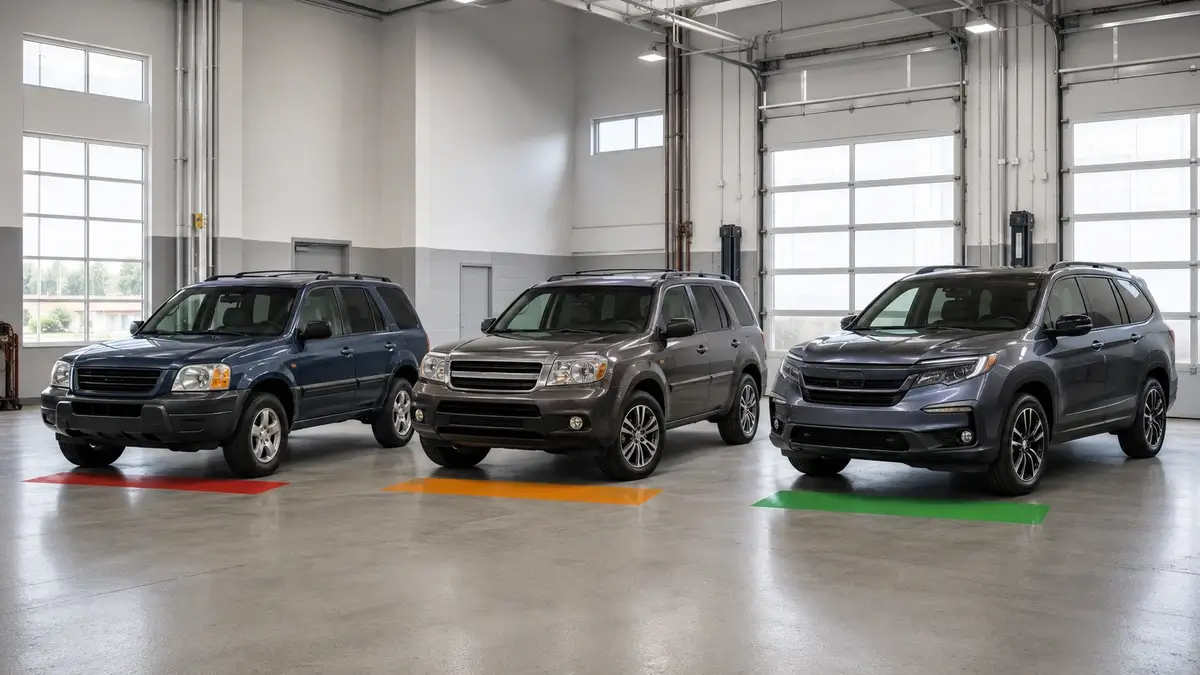
For a risk-averse buyer, the Honda Pilot years to avoid first are 2003–2004 and 2016. Treat 2009–2013 and 2017–2020 as caution years.
The 2014–2015 and 2021–2022 ranges are stronger starting points. However, official records do not prove every vehicle from those years is more reliable.
Recalls, investigations, warranty extensions, and service bulletins identify defined risks. They do not establish a failure rate for an entire model year.
A documented repair can improve a caution-year Pilot. It cannot erase unrelated risk, missing records, warning signs, or a poor inspection.
CarMerit reliability tool
Check any Pilot year – NHTSA-backed snapshot
Pick a model year to see Honda Pilot complaint, recall, investigation, and manufacturer-communication counts from the article’s NHTSA snapshot, plus CarMerit’s used-buy verdict for that year band.
Owner complaints
…
NHTSA, CarMerit snapshot
Recall records
…
NHTSA, CarMerit snapshot
Investigations
…
NHTSA, CarMerit snapshot
Manufacturer communications
…
NHTSA, CarMerit snapshot
Most-reported problem areas
Complaint counts and manufacturer communications are raw NHTSA records, not defect rates or reliability scores. Older model years have had more time to collect reports, so lower counts on newer years do not prove better reliability. Verdicts come from CarMerit’s article guidance. Data source: NHTSA.gov. Always verify VIN recall status, service records, cold start, diagnostic scan, warm road test, underbody condition, warning lights, corrosion, leaks, accident history, maintenance records, and independent inspection results before buying.
Which Honda Pilot Years Should You Avoid?
The safest approach separates hard rule-outs, conditional purchases, relative better buys, and years with immature evidence.
| Model years | Classification | Main evidence or concern | Confidence | Buyer action |
|---|---|---|---|---|
| 2003–2004 | Avoid | Automatic-transmission safety recall plus substantial age exposure | High | Skip unless recall and repair records are exceptional |
| 2005 | Caution | Very old first-generation vehicle without the same recall-based rule-out | Medium | Consider only with complete records and a strong inspection |
| 2006–2008 | Better Buy, relative | Later first-generation starting point outside the 2003–2004 transmission recall | Medium-low | Consider only with documented age-related maintenance |
| 2009–2013 | Caution | Misfire and piston-ring warranty extension; limited 2013 piston recall | High | Verify codes, oil history, eligibility, and completed repairs |
| 2014–2015 | Better Buy, relative | Outside the 2009–2013 warranty-extension range and before the 2016 redesign | Medium | Use as an older starting point, not a reliability guarantee |
| 2016 | Avoid | Redesign-year exposure plus engine, injector, transmission, recall, and investigation evidence | High | Remove first unless documentation and inspection are exceptional |
| 2017–2020 | Caution | Engine evaluation plus VIN-specific fuel-pump, seat-sensor, subframe, and other campaigns | High | Require full VIN checks, scan data, records, and specialist inspection |
| 2021–2022 | Better Buy, relative | Outside the engine-evaluation range, but still subject to several VIN-specific recalls | Medium | Verify rear-camera, seat-sensor, and salt-belt subframe recall status |
| 2023–2025 | Too Early to Judge | Limited history plus powertrain-software, brake-pedal, fuel-system, and investigation checks | High | Buy by VIN, warranty, recall status, and condition |
| 2026–present | Too Early to Judge | Insufficient accumulated age and mileage | High | Do not treat newness as proven durability |
“Better Buy” is a relative label here. It means a cleaner starting point within the official evidence reviewed.
It does not mean Honda or NHTSA has certified those years as the most reliable Honda Pilot years.
NHTSA Year-by-Year Evidence Snapshot
| Year (generation) | Complaints | Recalls | Investigations | Manufacturer communications |
|---|---|---|---|---|
| 2003 (Gen 1) | 720 | 14 | 5 | 306 |
| 2004 (Gen 1) | 544 | 13 | 5 | 234 |
| 2005 (Gen 1) | 679 | 15 | 7 | 149 |
| 2006 (Gen 1) | 266 | 10 | 3 | 62 |
| 2007 (Gen 1) | 211 | 9 | 3 | 53 |
| 2008 (Gen 1) | 132 | 9 | 1 | 38 |
| 2009 (Gen 2) | 134 | 9 | 0 | 72 |
| 2010 (Gen 2) | 111 | 10 | 0 | 82 |
| 2011 (Gen 2) | 291 | 11 | 0 | 76 |
| 2012 (Gen 2) | 170 | 9 | 0 | 62 |
| 2013 (Gen 2) | 270 | 6 | 0 | 89 |
| 2014 (Gen 2) | 116 | 3 | 0 | 84 |
| 2015 (Gen 2) | 107 | 4 | 1 | 85 |
| 2016 (Gen 3) | 1,655 | 8 | 4 | 365 |
| 2017 (Gen 3) | 895 | 4 | 4 | 181 |
| 2018 (Gen 3) | 424 | 7 | 4 | 140 |
| 2019 (Gen 3) | 855 | 13 | 4 | 223 |
| 2020 (Gen 3) | 464 | 11 | 4 | 149 |
| 2021 (Gen 3) | 398 | 10 | 1 | 99 |
| 2022 (Gen 3) | 125 | 5 | 1 | 93 |
| 2023 (Gen 4) | 112 | 5 | 2 | 89 |
| 2024 (Gen 4) | 96 | 6 | 2 | 42 |
| 2025 (Gen 4) | 152 | 4 | 1 | 34 |
| 2026 (Gen 4) | 8 | 0 | 0 | 0 |
Table note: These are raw NHTSA record counts from the NHTSA records. Older years have had more time to collect complaints and manufacturer communications, so lower counts on newer years do not prove better reliability.
Years to avoid
The clearest avoid-first group is 2003–2004 and 2016.
The 2003–2004 vehicles combine documented transmission safety history with more than two decades of age. The 2016 has several overlapping third-generation concerns.
Years to approach with caution
Treat 2009–2013 and 2017–2020 as conditional purchases.
The 2009–2013 range has a defined Honda warranty extension for eligible vehicles. The 2017–2020 range carries several separate VIN-specific checks.
Neither range should be rejected without checking the VIN, configuration, repair history, symptoms, and inspection results.
Better used Honda Pilot starting points
The 2014–2015 and 2021–2022 ranges are the strongest relative starting points in this evidence set.
Buyers accepting more age and maintenance exposure can also consider 2006–2008. These are comparative recommendations, not population-wide reliability findings.
What can change a model-year verdict
A model-year label is only the first filter.
A caution-year Pilot can become defensible with VIN-matched invoices, completed recalls, clean scan results, complete records, and a strong inspection.
A relative better-buy year should still be rejected for warning lights, rough running, poor shifting, corrosion, leaks, missing records, or neglected maintenance.
Honda Pilot Reliability by Year: How the Risk Labels Work
Honda Pilot reliability by year should be judged through an evidence hierarchy.
| Evidence type | What it proves | What it does not prove |
| Safety recall | A safety-related defect was identified in a defined population | Every vehicle from that model year is affected |
| Federal investigation | Regulators found enough concern to investigate scope and severity | A defect has been confirmed in every covered vehicle |
| Honda campaign or warranty extension | Honda recognized a defined condition and repair process | The condition affects every vehicle |
| Technical service bulletin | Honda documented symptoms, diagnosis, or repair guidance | A population-wide failure rate |
| Owner complaints | Symptoms and buyer concerns have been reported | How often the problem occurs across all vehicles |
| Inspection and records | The individual vehicle has or lacks visible risk | Future reliability with certainty |
| Comparative editorial judgment | One range has fewer overlapping official risk signals | Proven superior reliability |
Complaint totals are not failure rates. Older vehicles have more exposure, while newer vehicles have had less time to develop problems.
NHTSA Generation Evidence Rollup
| Generation / years | Total complaints | Complaints per model-year | Unique recall campaigns | Manufacturer communications |
|---|---|---|---|---|
| Gen 1 / 2003-2008 | 2,552 | 425.3 | 21 | 842 |
| Gen 2 / 2009-2015 | 1,199 | 171.3 | 14 | 550 |
| Gen 3 / 2016-2022 | 4,816 | 688.0 | 23 | 1,250 |
| Gen 4 / 2023-2026 | 368 | 92.0 | 7 | 165 |
Table note: Generation totals help compare official record concentration, but they are not failure rates. Gen 4 is young, so its lower raw count should not be treated as proven durability.
The article uses four labels:
- Avoid: The downside is too high for a normal risk-averse buyer.
- Caution: The vehicle may work, but it requires more proof.
- Better Buy, relative: A cleaner starting point within the reviewed evidence, not a guarantee.
- Too Early to Judge: Long-term reliability evidence is not mature enough.
First-Generation Honda Pilot (2003–2008): Risky and Better Choices
The first generation divides into an early transmission-risk group and later vehicles with heavy age-related exposure.
Early transmission-risk years
Honda issued an automatic-transmission safety recall for 2003 and certain 2004 Pilots. Heat buildup around second gear could damage the gear and, rarely, cause lockup.
That history makes 2003–2004 poor default choices. A completed recall does not remove age-related exposure involving seals, cooling parts, mounts, suspension, fluids, and corrosion.
The 2005 Pilot is outside that recall group. It still deserves caution because condition and maintenance now matter more than reputation.
Better first-generation candidates
The 2006–2008 Pilots are better relative first-generation starting points, not proven low-risk vehicles.
The purchase only works with major-service documentation, stable fluids, no overheating history, no transmission warnings, and a clean diagnostic scan.
Age, mileage, and service-history limits
Low mileage is not enough. A lightly used older Pilot can still have old rubber, stale fluids, corrosion, leaks, and deferred service.
Walk away when several age-related needs are arriving together. A low purchase price does not remove accumulated maintenance.
Second-Generation Honda Pilot (2009–2015): Risky and Better Choices
The second generation contains a documented 2009–2013 misfire concern and a cleaner relative starting point in 2014–2015.
Why 2009–2013 need caution
Honda issued a powertrain warranty extension for eligible 2009–2013 Pilots. It addresses misfire codes linked to spark-plug fouling and piston-ring movement.
This does not mean every 2009–2013 Pilot will develop the condition. Buyers should require:
- A true cold start
- A full diagnostic scan
- Oil-level and oil-use history
- Records for piston-ring, spark-plug, or misfire repairs
- Clean exhaust and stable idle
A limited number of 2013 Pilots were also included in a piston safety recall. Check the VIN rather than applying it to every 2013.
Better second-generation candidates
The 2014–2015 Pilots are stronger relative older starting points. They fall outside the 2009–2013 warranty-extension range and precede the 2016 redesign.
That is not proof of a lower failure rate. Verify timing-belt-related service, transmission fluid, cooling-system condition, all-wheel-drive service, leaks, mounts, and suspension wear.
When maintenance history changes the answer
A repaired 2012 with complete invoices may be safer than a neglected 2015.
Favor verifiable work, stable oil level, smooth operation, clean scan results, and no unresolved misfire history. The year label only narrows the field.
Third-Generation Honda Pilot (2016–2022): Risky and Better Choices
This generation needs careful separation because official evidence changes by year, VIN, transmission, region, and system.
Why 2016 needs separate scrutiny
The 2016 Pilot is the weakest default purchase in this generation.
For certain 2016–2017 Pilots, Honda extended coverage for listed PGM-FI/A/T software and/or fuel-injector repairs to 10 years or 150,000 miles from the original purchase date, whichever comes first. Certain 2016–2017 Pilots also received 9-year/125,000-mile coverage for the engine start/stop switch when the specified keyless-start condition applies.
Honda also published judder guidance for 2016–2017 six-speed models. VIN applicability, diagnosis, original purchase date, mileage, and documented repair history still matter; do not assume remaining coverage without checking the individual vehicle.
Selected 2016 Pilots were included in NHTSA recall 23V-751 for connecting-rod-bearing risk. The recall did not cover every 2016 Pilot.
NHTSA later opened preliminary evaluation PE25008. It covers 2016–2020 Pilots and other Honda and Acura vehicles with the 3.5-liter V6.
The evaluation concerns reported engine failures outside the earlier recall scope. It does not prove that every covered Pilot has a defect.
Certain 2016–2022 Pilots sold in specified salt-belt states and Washington, D.C., are also covered by rear-subframe recall 26V365. Corrosion can weaken suspension mounting points and affect handling.
For a normal family buyer, the combined downside makes 2016 an avoid-first choice. A discount is not enough without exceptional documentation and inspection.
Why 2017–2020 are caution years
The 2017–2020 Pilots should not receive the same hard verdict as 2016. However, they need more evidence than later third-generation years.
For certain 2017–2019 Pilots, Honda extended fuel-injector coverage to 10 years or 150,000 miles from the original purchase date, whichever comes first. Certain 2019–2020 Pilots also received 5-year/60,000-mile coverage for MOST bus network connectors when specified symptoms such as popping or crackling audio, no sound, a Network Loss message, or display problems applied.
Selected 2018–2019 Pilots were included in the connecting-rod-bearing recall. Confirm VIN applicability, original purchase date, mileage, diagnosis, and completed repair history rather than assuming any program still applies.
The full 2017–2020 range was included in PE25008. Certain vehicles also fall under several separate safety recalls.
The 2017–2020 Pilot fuel-pump recall covers defined VINs. An affected pump can cause hard starting, power loss, or stalling.
Certain 2017–2022 Pilots are covered by front-passenger seat-weight-sensor recall 26V332. The SRS light may illuminate, and the passenger-airbag indicator may stay off.
The salt-belt rear-subframe recall also covers certain 2016–2022 Pilots. Original sale region and VIN therefore matter.
Honda’s 2023 bulletin for 2016–2020 six-speed Pilots addresses a transmission-temperature warning linked to degraded fluid under high-load use.
A proper inspection should include:
- Transmission identification
- Fluid and software history
- A cold start and fully warmed road test
- A complete module scan
- Fuel-pump recall verification
- SRS and passenger-airbag indicator checks
- Rear-subframe inspection where region or VIN applies
- Careful listening for abnormal engine noise
Configuration-specific Auto Idle Stop coverage also matters across this generation. For certain 2016–2021 Pilots with the 9-speed automatic and Idle Stop, Honda extended coverage for valve adjustment and starter replacement related to a no-restart-after-Idle-Stop condition to 10 years from the original purchase date with no mileage limit.
Certain 2021–2022 9-speed/Idle Stop Pilots received a separate 10-year/unlimited-mile valve-adjustment extension for the same no-restart condition.
Confirm VIN status and whether product update 23-008 must be completed before relying on either program. These are coverage records, not evidence that every covered Pilot will develop the problem.
Before treating a caution-year Pilot’s injector, start/stop, network, or Idle Stop history as an automatic deal-breaker, check CarMerit’s Manufacturer Special Coverage Lookup to see which Honda coverage records overlap that model year, then verify the VIN, diagnosis, and current program terms with Honda.
Why 2021–2022 are stronger relative choices
The 2021–2022 Pilots remain stronger relative third-generation starting points because they fall outside PE25008’s Pilot year range.
That does not mean they have a clean official-risk profile. Several VIN-specific recalls still require confirmation.
The 2019–2022 Pilot rear-camera recall addressed network-connector failure that could interrupt the camera image.
Certain 2021–2022 Pilots may also fall under the seat-weight-sensor recall. Salt-belt vehicles may fall under the rear-subframe recall.
Verify every applicable remedy. Test the camera, audio, displays, passenger-airbag indicator, and SRS system.
Inspect the rear subframe on vehicles with salt-belt history. Reject abnormal suspension noise, vibration, handling changes, or unexplained warning lights.
Fourth-Generation Honda Pilot (2023–Present): What Is Too Early to Judge
The fourth-generation Pilot is too new for a confident long-term reliability ranking.
Newer vehicles have accumulated less age and mileage. Fewer reports can reflect lower exposure rather than better durability.
Current official actions make a VIN-specific check essential:
- Honda issued a 2023–2025 Pilot PGM-FI software recall. Improper programming could cause hesitation, power loss, or stalling.
- NHTSA recall 25V-391 covers certain 2023–2025 Pilots with an improperly secured brake-pedal pivot pin.
- Certain 2023–2025 Pilots were recalled for a fuel-filler tube connection that could separate during a collision.
- NHTSA opened an evaluation into rear passenger seat-belt warning accuracy on 2023–2024 Pilots.
These actions do not make every fourth-generation Pilot a bad purchase. They do make recall completion and warning-system testing essential.
High-mileage and towing-use fourth-generation Pilots also need service proof. For 2023, 2025, and 2026, Honda’s Maintenance Minder code 4 includes spark-plug and timing-belt replacement plus water-pump inspection. Honda specifies timing-belt replacement every 60,000 miles when the vehicle is regularly operated above 110°F, below −20°F, or used for towing.
On AWD Pilots used for trailer towing or mountainous driving at very low speeds, rear-differential fluid is due at 7,500 miles and then every 15,000 miles. Ask for service records that match how the SUV was actually used.
Buy these years for condition, warranty, features, and verified recall status. Do not treat the newest generation as proven reliable.
IIHS safety differences that can change the shortlist
Reliability and safety are separate. IIHS results should not rewrite the buy/avoid labels by themselves, but they can break a tie between otherwise acceptable Pilots.
| Model years | Material IIHS evidence | Buyer use |
|---|---|---|
| 2006–2008 | Original moderate-overlap, original side, and head-restraint ratings: Good | Useful context for an older candidate, although age and maintenance exposure still dominate the purchase decision. |
| 2009–2015 | Driver-side small overlap: Poor. Original moderate overlap and original side: Good. Roof strength: Marginal for 2009–2011, Good for 2012–2015. | 2014–2015 remain stronger relative reliability starting points in this article, but that should not be interpreted as an across-the-board safety verdict. |
| 2016–2021 | Driver-side small overlap: Good; passenger-side small overlap: Acceptable; updated side: Marginal. Headlight results are configuration-dependent: Poor to Acceptable for 2016–2018 and Acceptable to Good for 2019–2021. The 2019–2021 daytime pedestrian evaluation received No Credit. | Exact year, trim, headlights, and safety-system configuration matter. |
| 2022 | Driver-side small overlap: Good; passenger-side small overlap: Acceptable; updated side: Marginal; updated moderate overlap: Poor; seat-belt reminders: Poor; daytime pedestrian evaluation: No Credit for all 2022 models; nighttime pedestrian evaluation: No Credit for EX-L, Special Edition, TrailSport, and Sport trims. | 2022 can remain a stronger relative reliability starting point while still having specific IIHS weaknesses buyers should know about. |
| 2023–2024 | Driver- and passenger-side small overlap: Good; updated side: Good; headlights: Good for all trims; updated moderate overlap: Marginal. | Stronger results in several named IIHS areas do not establish long-term reliability. |
| 2025–2026 | Driver- and passenger-side small overlap: Good; updated side: Good; headlights: Good for all trims; updated moderate overlap: Acceptable after second-row seat-belt changes. | Treat the updated moderate-overlap improvement as a safety change point, not durability proof. |
Table Note: IIHS test families and display methods changed over time. Original and updated moderate-overlap tests, original and updated side tests, and separate versus combined small-overlap results are not one continuous cross-year scale. Use each result only for the stated model years, trims, equipment, and test family.
Honda Pilot Problems That Should Change Your Buying Decision
Not every Honda Pilot common problem deserves equal weight. Engine, transmission, suspension, airbag, fuel-system, and brake risks should lead the decision.
NHTSA Complaint Problem Areas by Generation
| Generation / years | NHTSA complaint area | Complaint count | Share of generation complaints | Reader use |
|---|---|---|---|---|
| Gen 1 / 2003-2008 | Airbags / Seatbelts / Structure (safety) | 624 | 24.5% | Use this to verify SRS lights, seatbelts, structure, and safety-related repairs. |
| Gen 1 / 2003-2008 | Powertrain / Transmission | 508 | 19.9% | Use this to focus the road test on shifting, judder, hesitation, and drivetrain warnings. |
| Gen 1 / 2003-2008 | Electrical | 223 | 8.7% | Use this to test screens, modules, sensors, lights, battery behavior, and stored codes. |
| Gen 1 / 2003-2008 | Engine | 208 | 8.2% | Use this to prioritize cold-start, oil-use, warning-light, and repair-history checks. |
| Gen 2 / 2009-2015 | Airbags / Seatbelts / Structure (safety) | 296 | 24.7% | Use this to verify SRS lights, seatbelts, structure, and safety-related repairs. |
| Gen 2 / 2009-2015 | Engine | 237 | 19.8% | Use this to prioritize cold-start, oil-use, warning-light, and repair-history checks. |
| Gen 2 / 2009-2015 | Brakes | 134 | 11.2% | Use this to check pedal feel, vibration, braking stability, and recall records. |
| Gen 2 / 2009-2015 | Suspension / wheels | 105 | 8.8% | Use this to inspect subframe, suspension noise, vibration, wheels, and tire wear. |
| Gen 3 / 2016-2022 | Engine | 1,363 | 28.3% | Use this to prioritize cold-start, oil-use, warning-light, and repair-history checks. |
| Gen 3 / 2016-2022 | Electrical | 1,192 | 24.8% | Use this to test screens, modules, sensors, lights, battery behavior, and stored codes. |
| Gen 3 / 2016-2022 | Fuel system | 504 | 10.5% | Use this to verify hard-start, stalling, pump, filler, and fuel-system recall status. |
| Gen 3 / 2016-2022 | Unknown / other | 478 | 9.9% | Use this as a reminder to read full complaint context, not just category labels. |
| Gen 4 / 2023-2026 | Airbags / Seatbelts / Structure (safety) | 52 | 14.1% | Use this to verify SRS lights, seatbelts, structure, and safety-related repairs. |
| Gen 4 / 2023-2026 | Steering | 49 | 13.3% | Use this to check steering feel, alignment behavior, warning lights, and related repairs. |
| Gen 4 / 2023-2026 | Driver-assist (ADAS) | 45 | 12.2% | Use this to test camera, sensor, warning, and driver-assist functions. |
| Gen 4 / 2023-2026 | Brakes | 40 | 10.9% | Use this to check pedal feel, vibration, braking stability, and recall records. |
Table note: Problem-area shares use the first-listed NHTSA complaint component only, so one complaint is not counted across multiple categories.
| Issue family | Main scope | Warning signs | Decision severity | Best response |
| Connecting-rod-bearing or engine-failure concern | PE25008 covers 2016–2020; selected earlier recall vehicles | Knock, warning light, reduced power, stalling, replacement-engine history | Very high | Verify VIN, engine history, recall work, and cold-start behavior |
| Rear-subframe corrosion | Certain 2016–2022 vehicles sold in specified salt-belt states and D.C. | Rear noise, vibration, handling change, visible corrosion | Very high | Verify VIN and original region; inspect and complete the recall remedy |
| Automatic-transmission gear risk | 2003–2004 recall population | Noise, harsh engagement, slipping, repair history | Very high | Prefer another year unless proof and condition are exceptional |
| Fuel-pump failure | Certain 2017–2020 recall vehicles | Hard starting, MIL, intermittent power loss, stalling | High | Verify recall completion and reject unresolved symptoms |
| Passenger seat-weight sensor | Certain 2017–2022 recall vehicles | SRS light, passenger-airbag indicator remains off | High | Verify VIN and completed sensor replacement |
| Transmission judder or temperature warning | Certain 2016–2020 six-speed vehicles | Vibration, delayed shifts, warning message, poor fluid history | High | Complete a warm road test and verify fluid and software history |
| Misfire and piston-ring concern | Eligible 2009–2013 vehicles | Misfire codes, fouled plugs, oil use, rough cold start | High | Scan cold, inspect records, and reject unresolved symptoms |
| Fuel-injector concern | Certain 2016–2019 vehicles | Misfire codes, rough running, warning light | Medium-high | Confirm eligibility and completed repair documentation |
| Rear-camera and network concern | 2019–2022 recall population | Popping audio, flickering display, camera loss | Medium-high | Verify recall completion and test every networked function |
| Fourth-generation official actions | Certain 2023–2025 vehicles | Stalling, brake-pedal movement, recall notices, warning faults | High when present | Verify the VIN and complete every applicable remedy |
| Deferred age-related maintenance | Mainly older vehicles | Leaks, vibration, worn suspension, old fluids, corrosion | Medium-high | Price the full repair burden or reject the vehicle |
An investigation does not prove a defect in every vehicle. It does increase the proof a cautious buyer should demand.
Owner-Reported Severity Flags by Generation
| Generation / years | Crash-flag complaints | Fire-flag complaints | Injury-flag complaints | Death-flag complaints |
|---|---|---|---|---|
| Gen 1 / 2003-2008 | 152 | 48 | 116 | 5 |
| Gen 2 / 2009-2015 | 92 | 18 | 53 | 0 |
| Gen 3 / 2016-2022 | 82 | 26 | 52 | 0 |
| Gen 4 / 2023-2026 | 13 | 1 | 11 | 0 |
Table note: These are owner-reported NHTSA complaint flags, not verified crash outcomes, safety ratings, or defect rates.
Transmission, fuel, suspension, and electrical symptoms may appear only under certain conditions. A brief showroom drive is not enough.
When a “Year to Avoid” Can Still Be Worth Buying
There is no universal override rule. Different evidence changes the purchase in different ways.
A completed recall remedy
A completed recall can address the specific defect covered by that recall.
Verify the work through the VIN, dealer records, and invoices. One completed recall does not resolve unrelated engine, transmission, suspension, or electrical risk.
A documented repair on a caution-year vehicle
A caution-year Pilot becomes more reasonable when invoices show:
- The correct VIN
- Vehicle mileage
- Repair date
- Parts and work performed
- The dealer or qualified shop
- Follow-up operation without recurring symptoms
A verbal statement that “Honda fixed it” is not sufficient.
A broader or separately scoped concern
A recall repair does not close a separate investigation or prove that another system is safe.
For 2016–2020 Pilots, inspect the broader engine concern separately from completed connecting-rod-bearing recall work.
For 2016–2022 salt-belt vehicles, inspect the rear subframe even when other recalls are complete.
No unresolved symptoms
Reject any Pilot with:
- Engine knock
- Unexplained stalling or hard starting
- Active or pending misfire codes
- Transmission-temperature warnings
- Harsh engagement or slipping
- Rear suspension noise or handling changes
- Repeated camera or display failure
- An illuminated SRS light
- Abnormal passenger-airbag indicator behavior
- Missing documentation for a major repair
Do not accept a seller’s claim that the problem “only needs software.” Diagnosis should come before purchase.
A deal that justifies the remaining uncertainty
Do not accept extra repair uncertainty unless the total deal compensates for it. Compare similar mileage, trim, drivetrain, condition, and records.
There is no universal discount percentage. The decision depends on the vehicle and the cost of the remaining uncertainty.
Strong inspection results
A pre-purchase inspection should include a cold start, complete scan, warm road test, underbody review, leak check, fluid assessment, and recall verification.
Used Honda Pilot Pre-Purchase Checklist
Use this checklist before buying any used Honda Pilot.
Because several Honda Pilot checks depend on the exact model year and vehicle configuration, confirm which Pilot you are evaluating before working through the VIN-specific recall and campaign checks below. Use the CarMerit VIN Lookup to compare the vehicle details returned for that VIN with the seller’s listing and paperwork. Once they match, continue with the official Honda and NHTSA VIN checks for recalls, campaigns, and completed repair status.
Recall and VIN verification
- Run the VIN through the official Honda recall lookup.
- Check the same VIN through the NHTSA recall database.
- Ask a Honda dealer to print completed and outstanding campaigns.
- Ask the dealer to check VIN applicability and repair history for relevant Honda warranty extensions, especially fuel-injector, keyless-start, MOST-network, and 9-speed/Idle Stop programs. Do not assume a historical extension still provides remaining coverage without checking the original purchase date, mileage, configuration, and applicable terms.
- Verify the fuel-pump recall on applicable 2017–2020 vehicles.
- Verify the seat-weight-sensor recall on applicable 2017–2022 vehicles.
- Verify the subframe recall for applicable 2016–2022 salt-belt vehicles.
- Match major repair invoices to the VIN and recorded mileage.
- Recheck the VIN shortly before purchase because recall records can change.
Cold-start and engine behavior
- Start the vehicle after it has sat for several hours.
- Listen for knocking, prolonged rattling, or uneven running.
- Watch for warning lights, reduced-power messages, or unstable idle.
- Check for difficult starting, intermittent power loss, or stalling history.
- Check the oil level and ask whether oil is added between services.
- Investigate any replacement-engine history.
Transmission and road test
- Check engagement into Drive and Reverse.
- Accelerate lightly through the 20–60 mph range.
- Check for judder, flare, slipping, hesitation, or harsh shifts.
- Drive long enough to reach operating temperature.
- Watch for transmission-temperature warnings.
- Listen for rear suspension noise or vibration.
- Note any handling change during braking or normal turns.
- Confirm fluid service and applicable software updates.
Electronics, airbags, brakes, and safety systems
- Test the rear camera repeatedly.
- Operate the audio, touchscreen, displays, and steering-wheel controls.
- Check for popping speakers, flickering displays, or network-loss messages.
- Confirm the SRS light completes its normal startup check and turns off.
- Check the passenger-airbag indicator for abnormal behavior.
- Verify the seat-belt warning system in every seating position.
- Check the brake pedal for abnormal lateral movement on applicable recent vehicles.
- Scan for stored and pending codes when no warning light is visible.
Maintenance records and physical condition
- Confirm timing-belt-related service appropriate to age and mileage.
- Check transmission and rear-differential fluid history where applicable.
- Inspect for oil, coolant, and transmission leaks.
- Inspect rear-subframe mounting areas for corrosion on salt-belt vehicles.
- Review the cooling system, suspension, mounts, brakes, tires, and general corrosion.
- Require an independent inspection from a Honda-experienced shop.
Best Honda Pilot Years by Budget and Risk Tolerance
The best used Honda Pilot starting point depends on age, maintenance burden, repair uncertainty, and technology needs.
| Buyer type | Best starting point | Why it may fit | Trade-off accepted |
| Lower-budget buyer with a repair reserve | 2006–2008 | Later first-generation relative starting point | High age and maintenance exposure |
| Buyer seeking an older family SUV | 2014–2015 | Cleaner relative official-risk profile than 2009–2013 | Older safety, technology, and wear exposure |
| Buyer wanting a newer third generation | 2021–2022 | Outside PE25008’s Pilot year range | Rear-camera, seat-sensor, and salt-belt subframe recall checks |
| Risk-tolerant buyer considering 2017–2020 | Only a thoroughly documented example | May pass deeper vehicle-specific scrutiny | Engine, fuel-pump, seat-sensor, subframe, and inspection burden |
| Buyer seeking the newest design | 2023–present | Newer equipment and possible warranty coverage | Long-term reliability is not established |
Fuel economy is a configuration tie-breaker, not a year verdict
EPA/FuelEconomy.gov estimates show enough variation within the same model year that drivetrain and transmission should be matched before comparing Pilots.
| Model year/configuration | EPA City MPG | EPA Highway MPG | EPA Combined MPG |
|---|---|---|---|
| 2014–2015 2WD | 18 | 25 | 20 |
| 2014–2015 4WD | 17 | 24 | 20 |
| 2016 2WD, 9-speed | 20 | 27 | 23 |
| 2016 2WD, 6-speed | 19 | 27 | 22 |
| 2016 4WD, 9-speed | 19 | 26 | 22 |
| 2016 4WD, 6-speed | 18 | 25 | 21 |
| 2017–2020 FWD, 9-speed | 20 | 27 | 23 |
| 2017–2020 FWD, 6-speed | 19 | 27 | 22 |
| 2017–2020 AWD, 9-speed | 19 | 26 | 22 |
| 2017–2020 AWD, 6-speed | 18 | 26 | 21 |
| 2021–2022 FWD, 9-speed | 20 | 27 | 23 |
| 2021–2022 AWD, 9-speed | 19 | 26 | 22 |
| 2022 AWD TrailSport, 9-speed | 19 | 25 | 21 |
| 2023–2026 FWD, 10-speed | 19 | 27 | 22 |
| 2023–2026 AWD, 10-speed | 19 | 25 | 21 |
| 2023–2026 AWD TrailSport, 10-speed | 18 | 23 | 20 |
Table Note: The 2016–2020 transmission split is important because 6-speed and 9-speed Pilots should not be treated as one configuration for fuel economy or transmission-related checks. Match the model year, drivetrain, and transmission before comparing EPA estimates. Fuel economy should only break a tie after reliability evidence, VIN history, condition, maintenance, and inspection results are acceptable.
For most buyers seeking an older Pilot, 2014–2015 is the cleaner place to begin shopping. It is not an automatic purchase recommendation.
The 2021–2022 years remain the stronger later-third-generation starting point. Their VIN, recall completion, electronic operation, and regional corrosion exposure still require verification.
A 2006–2008 Pilot can work for buyers who accept age-related repairs. It is a poor fit without a maintenance reserve.
The 2017–2020 range is not the safe default. Consider one only with unusually strong records and a deeper Honda-specialist inspection.
Buyers unsure whether the Pilot is the right model should compare the Honda Pilot vs Toyota Highlander.
Final Verdict: Which Used Honda Pilot Years Make the Most Sense?
The Honda Pilot years to avoid first are 2003–2004 and 2016. Those years carry the strongest combined downside for a normal family buyer.
Treat 2009–2013 and 2017–2020 as caution years. They can work, but only with VIN checks, repair records, scanning, and specialist inspection.
The 2021–2022 recommendation remains relative. Verify rear-camera, seat-weight-sensor, and salt-belt subframe recall status before purchase.
The 2006–2008 range can suit buyers who accept substantial age-related maintenance exposure.
Treat 2023 and newer Pilots as too early to judge. Check every applicable recall, campaign, and investigation record.
Condition can outweigh a broad reputation label. It cannot erase missing records, unrelated risk, unresolved symptoms, or a failed inspection.
Choosing the right model year is only one part of the used-buy decision. Before committing to a specific SUV, use the Honda Pilot reliability and cost-to-own guide to check maintenance records, transmission behavior, recall status, timing-belt proof, and ownership-cost risk.
Shoppers considering the main alternative should review the Toyota Highlander years to avoid. Broader family choices appear in CarMerit’s best used family cars guide.
Frequently Asked Questions
What Honda Pilot years should you avoid?
Risk-averse buyers should remove 2003–2004 and 2016 from the shortlist first. Treat 2009–2013 and 2017–2020 as caution years.
What are the best years for a used Honda Pilot?
Start with 2014–2015 for an older Pilot or 2021–2022 for a later third-generation vehicle.
These are relative starting points, not proven failure-free years. Buyers accepting more age-related maintenance can also consider 2006–2008.
Is the 2016 Honda Pilot a bad year to buy?
The 2016 Pilot is a weak default purchase for a risk-averse buyer.
It combines redesign-year exposure with several campaigns, selected recalls, transmission guidance, an engine evaluation, and a regional subframe recall.
Which Honda Pilot years had transmission problems?
The strongest official transmission warning applies to 2003 and certain 2004 Pilots through a safety recall.
Honda also issued judder and temperature-warning guidance for specific 2016–2020 six-speed configurations. Do not apply those issues to every trim or transmission.
Are the 2021 and 2022 Honda Pilots years to avoid?
Not automatically. They remain stronger relative third-generation starting points because they fall outside PE25008’s Pilot year range.
Buyers must still verify rear-camera, seat-weight-sensor, and salt-belt rear-subframe recall status where applicable.
What should you inspect before buying a used Honda Pilot?
Check the VIN, recalls, cold-start behavior, stored codes, oil history, transmission operation, rear subframe, electronics, SRS indicators, brakes, leaks, and corrosion.
Always use an independent Honda-experienced inspector.
Can a high-mileage Honda Pilot still be worth buying?
Yes, when maintenance records are complete and the vehicle passes a thorough inspection.
A maintained high-mileage Pilot can be safer than a lower-mileage example with deferred service and missing records.
Can a repaired Pilot from a year-to-avoid list be a good purchase?
Sometimes. Require VIN-matched invoices, confirmation of applicable recall work, no unresolved symptoms, and an independent inspection.
A repair for one condition does not resolve unrelated risks or prove the rest of the vehicle is sound.