

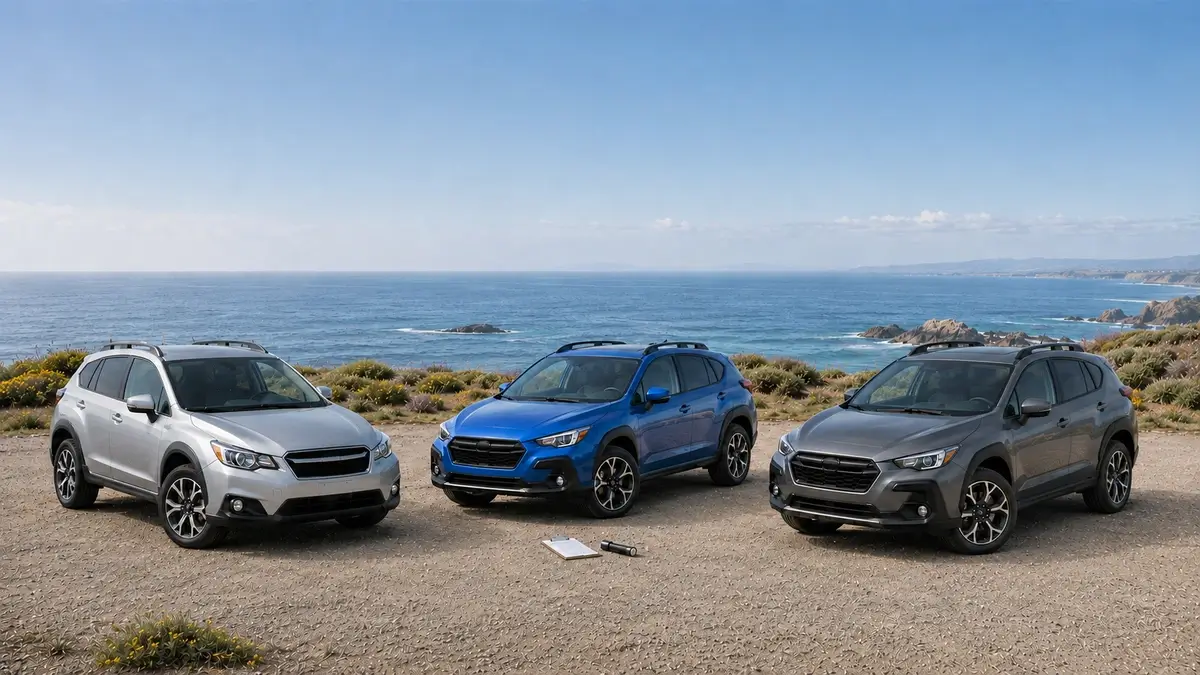
The Subaru Crosstrek years that deserve the strongest caution are 2013 and 2018. They are not automatic rejects, but each carries a heavier combination of official actions, repair-history uncertainty, or age-related risk than nearby alternatives.
The 2019 gas and 2021 gas models belong in a Caution tier. The 2016–2017 models can be sensible older candidates, but their 2.0-liter CVTs were covered by a separate Subaru warranty extension. They should not be treated as exempt from CVT scrutiny.
For most buyers, the clearest places to start are a documented 2020 gas model or 2022 gas model. These are stronger starting points within the available evidence, not proven universal reliability winners.
- Usually place 2013 near the bottom of the shortlist unless recall completion, oil use, and engine condition are unusually well documented.
- Apply a similarly high standard to 2018 because several important campaigns affected certain vehicles.
- Inspect a 2016–2017 CVT carefully and review its transmission history.
- Start with 2020 when you want a 2.0-liter second-generation gas model.
- Start with 2022 when you want the available 2.5-liter engine.
- Do not rank 2024 and newer vehicles as the most reliable simply because they have less ownership exposure.
A practical place to begin your search is a documented 2020 or 2022 gas Crosstrek with a clean VIN check, complete service records, normal powertrain behavior, and an independent pre-purchase inspection.
CarMerit reliability tool
Check any Crosstrek year – NHTSA-backed snapshot
Pick a model year to see Subaru Crosstrek complaint, recall, investigation, and manufacturer-communication counts from the article’s NHTSA snapshot, plus CarMerit’s used-buy verdict for that year band.
Owner complaints
…
NHTSA, CarMerit snapshot
Recall records
…
NHTSA, CarMerit snapshot
Investigations
…
NHTSA, CarMerit snapshot
Manufacturer communications
…
NHTSA, CarMerit snapshot
Most-reported problem areas
Complaint counts and manufacturer communications are raw NHTSA records, not defect rates or reliability scores. Older model years have had more time to collect reports, so lower counts on newer years do not prove better reliability. Verdicts come from CarMerit’s article guidance. Data source: NHTSA.gov. Always verify VIN recall status, Subaru recall status, service records, CVT behavior, cold start, oil level, tire matching, corrosion, warning lights, accident or flood history, and independent inspection results before buying. Confirm the exact configuration too: gas, hybrid, manual, CVT, 2.0-liter, and 2.5-liter Crosstreks can have different official-action scopes.
Subaru Crosstrek Years to Avoid: Quick Answer
A model year should narrow your search. It should not replace an evaluation of the actual vehicle.
In this guide:
- Highest scrutiny means most buyers have easier alternatives unless the vehicle has exceptional documentation and condition.
- Caution means the year can work, but configuration-specific checks are necessary.
- Stronger starting point means the year has a cleaner position within the evidence reviewed, not that every example is reliable.
- Too new to judge means long-term evidence remains insufficient.
| Model year or range | Classification | Main verified reason or scope | Best buyer action |
|---|---|---|---|
| 2013 | Highest scrutiny | Valve-spring recall, oil-consumption coverage, first-year age, and repair-history uncertainty | Consider only with completed work, stable oil use, and exceptional inspection results |
| 2014–2015 | Caution | CVT warranty coverage, transmission-specific oil-use scope, age, and early hybrid complexity | Confirm the exact configuration and review full powertrain records |
| 2016–2017 | Conditional older candidate | Separate 2.0-liter CVT warranty extension, brake-lamp recall exposure, and age-related wear | Inspect CVT behavior, corrosion, tires, and service history carefully |
| 2018 | Highest scrutiny | PCV, ignition-coil, and rear stabilizer campaign exposure on certain vehicles | Prefer another year unless every applicable action and engine condition are clearly documented |
| 2019 gas | Caution | Ignition-coil and stabilizer campaigns plus separate 2.0-liter CVT warranty coverage | Verify VIN status and inspect acceleration and CVT operation |
| 2019–2022 Hybrid | Caution | Hybrid-specific inverter-connector corrosion campaign and added system complexity | Require campaign completion and a hybrid-qualified inspection |
| 2020 gas | Stronger starting point, moderate confidence | Cleaner position than the identified 2018–2019 and 2021 action groups | Prioritize complete records, normal CVT behavior, and clean condition |
| 2021 gas | Caution | Thermo control valve coverage and an applicable inhibitor-switch recall | Confirm repair history, VIN status, and cooling-system condition |
| 2022 gas | Stronger starting point, moderate confidence | Later second-generation year with available 2.5-liter Sport and Limited configurations | Strong shortlist candidate when records and condition are good |
| 2023 gas | Consider, lower confidence | Final second-generation year but with less long-term exposure | Consider it without paying for an unproven reliability reputation |
| 2024–2026 | Too new to judge | Limited ownership exposure; 2024 has two NHTSA recall records in the inserted snapshot, while 2025–2026 remain too new for a confident long-term verdict. | Check the VIN and evaluate the vehicle rather than relying on low complaint counts |
These classifications apply to U.S.-market vehicles. A recall, warranty extension, or service action may cover only certain production dates, engines, transmissions, or hybrid configurations.
Use the NHTSA recall lookup and Subaru recall lookup for the exact VIN.
Subaru Crosstrek NHTSA Year-by-Year Counts
| Model year | Gen | Complaints | Recalls | Investigations |
|---|---|---|---|---|
| 2012 | Gen 1 | 2 | 0 | 0 |
| 2013 | Gen 1 | 121 | 3 | 0 |
| 2014 | Gen 1 | 96 | 1 | 0 |
| 2015 | Gen 1 | 94 | 2 | 0 |
| 2016 | Gen 1 | 134 | 1 | 0 |
| 2017 | Gen 1 | 97 | 1 | 0 |
| 2018 | Gen 2 | 193 | 5 | 0 |
| 2019 | Gen 2 | 278 | 7 | 0 |
| 2020 | Gen 2 | 68 | 0 | 0 |
| 2021 | Gen 2 | 107 | 1 | 0 |
| 2022 | Gen 2 | 28 | 0 | 0 |
| 2023 | Gen 2 | 32 | 0 | 0 |
| 2024 | Gen 3 | 104 | 2 | 0 |
| 2025 | Gen 3 | 40 | 0 | 0 |
| 2026 | Gen 3 | 3 | 0 | 0 |
Table note: These are raw NHTSA counts, not defect rates or reliability scores.
Subaru Crosstrek NHTSA Issue Snapshot and Buyer Notes
| Model year | Mfr. comms | Crash / fire / injury flags | Top complaint areas | Buyer-use note |
|---|---|---|---|---|
| 2012 | 158 | 0 / 0 / 0 | Engine (2) | The available NHTSA records include a 2012 complaint row, with no recall rows shown for that model year. |
| 2013 | 412 | 6 / 4 / 2 | Engine (40), Powertrain / Transmission (16), Electrical (14) | Supports highest scrutiny; engine and powertrain records matter. |
| 2014 | 334 | 10 / 2 / 5 | Powertrain / Transmission (17), Electrical (16), Unknown / other (14) | Older caution year; inspect powertrain, electrical history, and records. |
| 2015 | 357 | 5 / 1 / 3 | Engine (17), Unknown / other (15), Electrical (14) | Older caution year; do not buy without service and inspection proof. |
| 2016 | 344 | 4 / 3 / 1 | Electrical (32), Unknown / other (29), Powertrain / Transmission (13) | Conditional older candidate; CVT and age checks still matter. |
| 2017 | 323 | 6 / 2 / 2 | Visibility / wipers (24), Unknown / other (19), Electrical (17) | Conditional older candidate; verify brake-lamp recall and condition. |
| 2018 | 457 | 10 / 1 / 1 | Visibility / wipers (67), Electrical (29), Unknown / other (29) | Supports highest scrutiny; recall completion is critical. |
| 2019 | 468 | 6 / 3 / 4 | Visibility / wipers (120), Electrical (46), Unknown / other (38) | Highest complaint count; caution rating is justified. |
| 2020 | 336 | 6 / 0 / 3 | Visibility / wipers (34), Electrical (8), Powertrain / Transmission (7) | Cleaner official-action profile; still inspect condition and records. |
| 2021 | 265 | 8 / 2 / 4 | Visibility / wipers (32), Unknown / other (19), Engine (12) | Caution year; inhibitor-switch recall and repair history matter. |
| 2022 | 236 | 3 / 0 / 1 | Unknown / other (8), Visibility / wipers (6), Driver-assist (ADAS) (3) | Stronger article starting point, but low counts do not prove reliability. |
| 2023 | 187 | 4 / 0 / 3 | Visibility / wipers (7), Unknown / other (7), Engine (3) | Consider with lower confidence due to shorter exposure. |
| 2024 | 188 | 8 / 2 / 3 | Unknown / other (28), Visibility / wipers (19), Exterior lighting (11) | Too new to judge, but VIN checks already matter. |
| 2025 | 58 | 2 / 0 / 1 | Visibility / wipers (10), Unknown / other (9), Driver-assist (ADAS) (8) | Too new to judge; low exposure limits confidence. |
| 2026 | 12 | 0 / 0 / 0 | Driver-assist (ADAS) (2), Airbags / Seatbelts / Structure (safety) (1) | Too new to judge; data is very early. |
Table note: Complaint and manufacturer-communication counts accumulate over time, so lower counts on newer years do not prove better long-term reliability.
Best Subaru Crosstrek Years to Buy Used
No Crosstrek year is a proven universal winner. A stronger starting point still needs good records, normal mechanical behavior, and a clean inspection.
Stronger 2.0-liter starting point: 2020 gas model
The 2020 gas model is one of the cleaner places to begin within the second generation.
It sits outside the specific 2018–2019 PCV, ignition-coil, stabilizer, and 2019 CVT action groups discussed in this guide. It also avoids the 2021-specific thermo control valve and inhibitor-switch concerns.
That does not prove a lower failure rate across every vehicle. It means the 2020 has a less complicated official-action profile within this comparison.
The 2.0-liter engine is adequate for normal commuting and light-duty use. Buyers who regularly carry passengers, merge into fast traffic, or drive in steep terrain may prefer the later 2.5-liter option.
Stronger 2.5-liter starting point: 2022 gas model
The 2022 gas model is a sensible place to start when the 2.5-liter engine matters.
Subaru’s official 2022 trim information shows the 2.5-liter engine on Sport and Limited models. The larger engine improves the Crosstrek’s performance margin, but it does not reduce the need for a proper inspection.
The 2022 model also avoids the specific 2021 thermo control valve and inhibitor-switch actions used in this classification.
A neglected 2022 is still a worse purchase than a documented 2020. Condition remains the final filter.
Older candidates: 2016–2017
The 2016 and 2017 models can be reasonable choices for buyers comfortable with an older vehicle.
They should not be described as free from CVT-related official history. Subaru issued a separate warranty extension covering certain 2016–2017 2.0-liter CVT Crosstreks and the 2016 Crosstrek Hybrid. Subaru stated that the extension was not issued in response to one specific condition.
That distinction matters. The extension is not proof that every covered CVT will fail, but it supports closer review of:
- Delayed engagement
- Shuddering or surging
- Warning lights or stored codes
- Leaks
- Previous transmission repairs
- Service history
At this age, corrosion, suspension wear, oil leaks, brakes, tires, and neglected maintenance may matter more than the year badge.
Newer alternative: 2023 gas model
The 2023 gas model can be a reasonable newer candidate.
It was the final model year of the second generation, but it has less long-term exposure than 2020 or earlier vehicles. Treat it as a model worth considering, not as proven to be the most reliable Crosstrek year.
Is there a best Crosstrek Hybrid year?
There is no defensible blanket winner among the hybrid years covered here.
Certain 2019–2022 Crosstrek Hybrids were included in an official campaign addressing corrosion at the 12-volt inverter connector. Hybrid candidates also add charging, high-voltage, and specialized-repair considerations that do not apply to standard gas models.
A completed remedy and a hybrid-qualified inspection are minimum requirements.
How We Classify a Crosstrek Model Year as Risky
A classification should reflect more than the number of recalls or complaints attached to a year.
This guide weighs:
- Severity of the potential consequence
- Exact configuration and production scope
- Availability and completion of a remedy
- Remaining risk after the remedy
- Vehicle age and ownership exposure
- Repair and maintenance documentation
- Condition of the actual vehicle
Official action does not equal universal failure
A recall confirms an identified safety defect in a defined population. It does not mean every vehicle from the model year has the defect.
A warranty extension also needs careful interpretation. Subaru’s CVT warranty bulletins expanded coverage but stated that the extensions were not issued in response to one specific condition.
The correct buyer response is closer verification, not a claim that every covered transmission is defective.
For any warranty extension or coverage adjustment discussed in this guide, ask an authorized Subaru retailer to check the exact VIN in Subaru’s Vehicle Coverage Inquiry system. Model year alone does not establish eligibility or remaining coverage. The original warranty start date, mileage, configuration, installed equipment, and exact program terms may also control.
For a broader model-year screen, use CarMerit’s Manufacturer Special Coverage Lookup to see which manufacturer-issued warranty extensions or special coverage programs may match a Crosstrek before confirming final VIN-specific eligibility with Subaru.
IIHS safety evidence that can change the shortlist
A reliability classification and a crash-test result answer different questions. That matters with the Crosstrek because a stronger reliability starting point does not automatically mean stronger results in every IIHS test.
| Model year / scope | IIHS evidence that matters | Buyer takeaway |
|---|---|---|
| 2018 base Crosstrek | Good in the driver- and passenger-side small-overlap tests, original moderate-overlap test, and original side test. It received Poor in the updated side test, while headlight ratings varied by trim and equipment. | Do not treat the 2018 reliability warning as a blanket crash-safety grade. Verify the exact headlights and equipment on the vehicle. |
| 2022 base Crosstrek (non-PHEV) | Good in both small-overlap tests and the original moderate-overlap and side tests. It received Poor in the updated moderate-overlap and updated side tests, while headlights varied by trim and equipment. | A stronger reliability starting point is not automatically a stronger safety result under newer tests. |
| 2024 base Crosstrek | Good in the small-overlap and original moderate-overlap tests and for headlights. It received Marginal in the updated moderate-overlap test and Acceptable in the updated side test. | The third generation is too new for a confident long-term reliability verdict, but its available crash-test evidence still matters. |
Table Note: Different IIHS test families and protocols changed over time. Do not treat these ratings as one simple cross-year safety score.
Subaru Crosstrek NHTSA Recall Campaigns to Check by VIN
| NHTSA campaign | Affected years | Main issue / theme | Buyer check |
|---|---|---|---|
| 13V061000 | 2013 | Equipment / remote-start key fob risk | Confirm recall completion if the vehicle had the affected accessory. |
| 15V366000 | 2015 | Forward-collision / pre-collision braking issue | Verify campaign completion on EyeSight-equipped vehicles. |
| 17V701000 | 2018 | Floor-mat retention / pedal interference risk | Confirm recall completion before considering a 2018. |
| 18V772000 | 2013 | Valve-spring / engine-stall risk | Major 2013 check: require proof of completion and clean engine behavior. |
| 19V065000 | 2019 | Electric power steering assist risk | Confirm VIN status and steering repair history. |
| 19V149000 | 2013-2017 | Brake-lamp switch issue | Important first-gen recall; verify completion on 2013-2017 vehicles. |
| 19V404000 | 2019 | Rear-door window glass issue | Check campaign completion on affected 2019 vehicles. |
| 19V743000 | 2018-2019 | ECM / ignition-coil software issue | Verify remedy and misfire/stall history. |
| 19V744000 | 2018 | PCV valve / possible engine damage risk | Key reason 2018 deserves highest scrutiny. |
| 19V856000 | 2019 | PCV valve issue | Verify completion and engine condition on affected 2019 vehicles. |
| 20V189000 | 2019 | Rear seat-belt locking issue | Confirm campaign completion on affected 2019 vehicles. |
| 21V263000 | 2018-2019 | Rear stabilizer bracket bolts | Verify completion and inspect suspension noise/condition. |
| 21V264000 | 2018-2019 | ECM / ignition-coil software issue | Confirm completion; do not rely only on seller statement. |
| 23V080000 | 2019-2022 (Hybrid) | 12V battery issue on Crosstrek Hybrid | Hybrid-specific: verify 12V battery recall completion on 2019-2022 Hybrid by VIN. |
| 23V551000 | 2024 | Instrument-panel wiring harness / short-circuit risk | VIN check required on 2024 models. |
| 23V754000 | 2024 | Front driveshaft crack / loss-of-drive risk | VIN check required on 2024 models. |
| 23V755000 | 2021 | Inhibitor switch / reverse-light and camera risk | Supports 2021 caution; confirm repair status. |
| 26V106000 | 2026 (Hybrid) | Fuel-tank filler issue on Crosstrek Hybrid | Verify on 2026 Crosstrek Hybrid by VIN. |
Table Note: These recall campaigns come from NHTSA records for the Subaru Crosstrek. A recall does not mean every vehicle from that year has the defect. Always check the exact VIN through the NHTSA or Subaru recall lookup.
Configuration changes the answer
The same year may include:
- Manual and CVT models
- 2.0-liter and 2.5-liter engines
- Gas and hybrid versions
- Different trim and production-date coverage
A concern affecting a 2.0-liter CVT must not be applied automatically to a manual, hybrid, or later 2.5-liter configuration.
Newer vehicles have less exposure
A recent model may have fewer complaints because it has accumulated fewer years and miles.
Low complaint volume is not the same as proven durability. This is why the 2024 and newer Crosstreks remain in the Too New to Judge category.
The individual vehicle decides the purchase
The model year establishes the starting level of scrutiny.
Service records, completed repairs, accident history, corrosion, warning lights, fluid condition, tire condition, and inspection results determine whether the specific vehicle deserves further consideration.
A preferred year cannot overcome an active mechanical problem.
First-Generation Crosstrek: Risk and Buying Guidance
First-generation buyers need to separate early powertrain evidence from the age-related condition of later vehicles.
These Crosstreks are old enough that maintenance quality and corrosion can outweigh small differences between nearby model years.
2013: Highest scrutiny
The 2013 Crosstrek carries the heaviest first-generation burden in this guide.
Certain vehicles were included in a valve-spring safety recall. A fractured valve spring could cause engine malfunction or stalling.
Subaru’s oil-consumption warranty extension also covered defined 2013 Crosstrek configurations. The exact scope differed by transmission and VIN range.
Age, mileage, possible prior oil use, and uncertainty around earlier repairs now add to the decision.
A 2013 is not automatically defective. Consider one only when:
- Every applicable recall is complete
- Oil level remains stable
- Cold-start behavior is normal
- Engine repair history is clear
- The vehicle passes a comprehensive inspection
Most buyers have easier first-generation alternatives.
2014–2015: Configuration-specific caution
Subaru’s early CVT warranty extension covered certain 2013–2015 Crosstrek configurations, including separately defined hybrid vehicles.
The bulletin did not identify one universal failure condition. Buyers should treat it as a reason to examine transmission behavior and repair history, not as proof that every CVT is defective.
Oil-consumption coverage also differed by transmission and VIN. Avoid applying one configuration’s scope to every 2014 or 2015 Crosstrek.
For a CVT model, check:
- Engagement from Park or Reverse
- Low-speed smoothness
- Acceleration under load
- Warning lights and diagnostic codes
- Leaks and previous repair invoices
For a manual model, check clutch engagement, gearbox operation, oil level, and maintenance history.
2016–2017: Conditional older candidates
The 2016 and 2017 models remain reasonable older candidates, but the original draft overstated their distance from CVT-related official history.
Subaru issued a separate CVT warranty extension covering certain 2016–2017 2.0-liter CVT Crosstreks and the 2016 Crosstrek Hybrid. For qualifying vehicles, the specified CVT coverage was extended from 5 years/60,000 miles to 10 years/100,000 miles, whichever occurs first.
Subaru stated that the extension was not issued in response to one specific condition. Verify the exact VIN and powertrain with Subaru rather than assuming that every vehicle qualifies or that coverage remains.
Certain 2013–2017 Crosstreks were also included in a brake-lamp switch recall.
A clean 2016 or 2017 may still be a better purchase than a neglected newer model. The correct classification is conditional older candidate, not automatic safer year.
Age, corrosion, tires, and previous repairs
Inspect:
- Underbody and suspension mounting areas
- Brake lines and exhaust components
- Wheel bearings and bushings
- Fluid leaks
- Previous collision repairs
- All four tires
All four tires should match in size and be close in tread depth. Treat a major mismatch as a condition issue that should be corrected before purchase.
Do not pay extra for a preferred year when the actual vehicle has serious rust, uneven tires, weak records, or recently cleared warning lights.
Second-Generation Crosstrek: Risk and Buying Guidance
The second generation requires separate treatment for 2018, 2019, later gas models, and hybrids.
Calling every 2018–2023 Crosstrek equally reliable would hide meaningful configuration and campaign differences.
2018: Highest scrutiny, not an automatic rejection
Certain 2018 Crosstreks were included in a PCV valve recall. A separated valve component could allow engine oil into the combustion chamber and potentially damage the engine.
Certain 2018–2019 Crosstreks were also included in an ignition-coil recall. The identified condition could cause a loss of motive power.
A separate rear stabilizer bracket recall covered certain 2018–2019 Crosstreks and separately defined hybrid vehicles.
These actions do not prove that every 2018 is unreliable. They create a higher burden of proof than buyers face with several nearby years.
Consider a 2018 only when:
- Every applicable campaign is complete
- Repair documentation is available
- Engine oil level and condition are normal
- No abnormal engine noise is present
- Power delivery is smooth
- An independent inspection finds no related damage
2019 gas: Caution for multiple configuration-specific reasons
The 2019 gas model shares the ignition-coil and rear stabilizer campaign exposure with certain 2018 vehicles.
It does not share the same gas-model PCV recall scope used to classify the 2018 year. That supports a Caution rating rather than placing both years in an identical category.
The 2019 2.0-liter gas CVT also received a separate warranty extension. It excludes the Hybrid and applies only to qualifying Original or Genuine Subaru CVTs; salvage vehicles and unapproved rebuilt units are excluded.
For eligible vehicles, coverage was extended from 5 years/60,000 miles to 10 years/100,000 miles, whichever occurs first. A separate blanket period for vehicles over 100,000 miles ended June 30, 2026. Subaru stated that the extension was not issued in response to one specific condition. Verify the VIN, mileage, installed CVT, and current eligibility with Subaru.
A 2019 gas Crosstrek can still be acceptable. Verify the exact configuration, campaign completion, CVT history, and smooth power delivery before deciding.
2020 gas: Cleaner starting point within this evidence set
The 2020 gas model sits outside the specific 2018–2019 PCV, ignition-coil, and rear-stabilizer campaign groups and the 2021 thermo control valve and inhibitor-switch actions used in this guide.
It should not, however, be treated as free of separate Subaru coverage programs. Subaru’s low-pressure fuel-pump warranty extension includes certain 2018–2020 Crosstreks in its “Additional Vehicles” population. The affected production-date range is July 5, 2017 through August 5, 2019, but exact VIN eligibility controls.
For qualifying vehicles, fuel-pump coverage was extended to 15 years with unlimited mileage from the original warranty start date, with one qualifying replacement. This population uses a different coverage basis from recall-affected vehicles, so confirm the exact classification and coverage with Subaru.
The 2020 still remains a cleaner place to begin a second-generation search within this article’s classification. Check the VIN and production date, and do not treat that classification as proof that every 2020 is more reliable than every surrounding year.
Require:
- Complete service records
- Normal cold-start behavior
- Smooth CVT engagement
- No stored powertrain codes
- Clean underbody and suspension
- Compatible tires
- Independent inspection
2021 gas: Caution
Subaru issued a thermo control valve warranty extension for certain 2021 Crosstreks after identifying a condition involving coolant vapor intrusion and related diagnostic codes. For qualifying vehicles, coverage for the thermo control valve was extended to 15 years/150,000 miles, whichever occurs first.
Verify the exact VIN and eligibility with Subaru. The extension does not prove that the valve was replaced or that coverage remains on a particular vehicle.
Certain 2021 models were also included in an inhibitor-switch recall.
A documented 2021 can still be a reasonable purchase. Confirm:
- Whether the thermo control valve was replaced
- Whether updated parts were used
- Whether coolant or temperature warnings occurred
- Whether the inhibitor-switch recall applies
- Whether any related diagnostic codes remain
2022 gas: Stronger starting point for the 2.5-liter engine
Subaru’s official 2022 trim comparison lists the 2.5-liter engine on Sport and Limited models.
The 2022 model avoids the specific 2021 thermo control valve and inhibitor-switch actions used in this guide. It also has more ownership exposure than the 2023 model.
That supports a moderate-confidence stronger-starting-point classification. It does not prove that every 2022 has a lower failure rate.
2023 gas: Consider with lower confidence
The 2023 model was the final year of the second generation.
It can be a sensible newer candidate, but its shorter exposure makes a strong long-term reliability claim premature. Judge the vehicle by its records, inspection results, and purchase condition.
2.0-liter versus 2.5-liter configurations
The 2.0-liter engine can work well for commuting and buyers who do not prioritize acceleration.
The 2.5-liter engine provides more performance margin for merging, hills, passengers, and cargo. It does not remove transmission, maintenance, or condition risk.
EPA fuel economy for the stronger gas starting points
| Model year / configuration | City MPG | Highway MPG | Combined MPG |
|---|---|---|---|
| 2020 2.0-liter automatic AWD | 27 | 33 | 30 |
| 2022 2.0-liter automatic AWD | 28 | 33 | 30 |
| 2022 2.5-liter automatic AWD | 27 | 34 | 29 |
Table Note: Apply these figures only to the listed gas, automatic, AWD configurations. Do not extend them to manual-transmission or Hybrid/PHEV Crosstreks
For buyers choosing between the stronger gas starting points in this guide, the EPA difference is small. The 2022 2.5-liter automatic is rated just 1 mpg lower combined than the 2022 2.0-liter automatic, while the 2020 2.0-liter automatic is also rated at 30 mpg combined.
That makes the 2.5-liter option less of an EPA fuel-economy trade-off than the engine-size difference might suggest. Actual fuel economy still varies with driving conditions, vehicle condition, and use.
Choose the engine that fits your use, then choose the cleanest documented vehicle.
Hybrid-specific evidence boundaries
Certain 2019–2022 Crosstrek Hybrids were included in an inverter-connector corrosion campaign.
The condition could prevent the 12-volt battery from recharging and lead to a loss of motive power.
Do not apply this hybrid-specific evidence to gas models. A hybrid-qualified technician should verify campaign completion, charging behavior, warning-light history, and high-voltage system condition.
FuelEconomy.gov also lists a separate 2023 Crosstrek Hybrid AWD plug-in hybrid, so the 2023 gas classification above should not be applied to that vehicle. The 2019–2022 Hybrid caution in this guide is tied to the inverter-connector campaign scope, not to every Crosstrek PHEV model year.
Subaru separately extended Federal Emissions defect warranty coverage for the front exhaust pipe on eligible 2019–2023 Crosstrek PHEVs from 8 years/80,000 miles to 15 years/150,000 miles, whichever comes first. For otherwise expired eligible vehicles, a separate blanket period runs through November 17, 2026.
For a 2023 PHEV, verify the exact VIN, PHEV identity, Federal Emissions eligibility, repair history, and Subaru coverage status rather than carrying over the gas-model recommendation.
Third-Generation Crosstrek: What Is Too New to Judge
The 2024 and newer Crosstreks have not accumulated enough long-term mileage and ownership exposure for a confident reliability ranking.
Few complaints on a recent vehicle may reflect limited time on the road.
2024 official actions
Certain 2024 Crosstreks received an instrument-panel wiring harness recall. Insufficient clearance could damage wiring and potentially create a short circuit or loss of power.
A separate front driveshaft recall covered certain 2024 Crosstreks. The affected component could crack and cause a loss of motive power.
These actions do not establish broad third-generation unreliability. They make VIN verification necessary.
2025 and 2026 models
The 2025 model remains too recent for a durable long-term verdict.
The 2025 and 2026 models remain too recent for a durable long-term verdict. In the inserted NHTSA snapshot, 2025 shows 40 complaints and 0 recall records, while 2026 shows 3 complaints and 0 recall records. Do not treat those low counts as proof of long-term reliability. Always verify the exact VIN before buying.
What would justify a stronger future verdict
Reclassification would require:
- More accumulated mileage
- Longer ownership exposure
- Repair and failure patterns
- Updated official actions
- Configuration-specific evidence
- Evidence that separates isolated defects from recurring ownership risk
Until then, newer means less proven, not automatically safer.
Problems That Can Change the Recommendation
The same issue can have different importance depending on model year, transmission, engine, hybrid status, repair completion, and current condition.
| Issue | Most relevant scope | What to inspect | Decision effect |
| Valve-spring history | Certain 2013 models | Recall completion, engine noise, repair records, and cold-start behavior | Reject unresolved work or questionable engine condition |
| Engine oil use | Defined 2013–2015 configurations | Oil level, leaks, smoke, service intervals, and top-off history | Reject active or unexplained oil loss |
| CVT behavior | All CVTs, with extra attention to covered 2013–2017 and 2019 configurations | Engagement, shuddering, surging, leaks, warning lights, codes, and repair invoices | Reject active symptoms or unclear major repair history |
| PCV-related engine risk | Certain 2018 vehicles | Recall completion, oil condition, engine noise, and previous engine work | High concern when records are incomplete |
| Ignition-coil campaign | Certain 2018–2019 gas models | Completion status, acceleration, misfire history, and warning lights | Caution until remedy and normal operation are confirmed |
| Thermo control valve | 2021 gas model | Repair invoice, updated part, coolant history, and diagnostic codes | Accept only with clear repair and current condition |
| Hybrid electrical corrosion | Certain 2019–2022 Hybrids | Campaign completion, connector work, charging operation, and warning lights | Hybrid-qualified inspection required |
| Corrosion and suspension wear | Mainly older first-generation vehicles | Underbody, bushings, bearings, brakes, exhaust, and prior repairs | Serious corrosion overrides a preferred-year label |
| Tire mismatch | Every AWD Crosstrek | Size, tread depth, wear pattern, and compatibility | Correct before purchase or reject a serious mismatch |
| Driver-assistance warnings | Equipped vehicles | Dashboard warnings, windshield history, camera operation, and calibration records | Diagnose before purchase |
A windshield replacement alone does not make a model year unreliable. It becomes relevant when sealing, camera operation, sensors, or calibration were affected.
Do not accept a seller’s explanation for a warning light without a diagnostic scan.
When a Riskier Year Can Still Be Worth Buying
A Caution-year vehicle can become acceptable when the evidence around the actual example is unusually strong.
A highest-scrutiny year needs a substantially higher standard. A discount does not neutralize an unresolved engine, transmission, safety, or corrosion problem.
| Vehicle evidence | What it means | Role of price | Buyer action |
| Complete records, completed campaigns, normal road test, and clean inspection | Major known concerns have been checked and reduced | A normal market price may be justified | Consider the vehicle |
| One major documented repair with correct parts and follow-up service | A specific concern may have been addressed | Compare with a cleaner surrounding year | Consider only after independent verification |
| Missing records but no obvious symptoms | Risk remains unknown rather than absent | A discount does not establish value | Inspect further or walk away |
| Active oil loss, CVT symptoms, overheating, or warning lights | A current mechanical problem exists | No ordinary discount is enough | Reject |
| Structural corrosion or questionable collision repair | Long-term integrity may be compromised | Price should not override the risk | Reject |
| Stronger year with poor maintenance and mismatched tires | The model-year advantage has been lost | Do not pay extra for the year label | Reject or require correction |
What valid repair documentation should show
A useful invoice should identify:
- The original complaint
- Diagnostic findings
- Parts used
- Labor performed
- Vehicle mileage
- Repairing facility
- Follow-up work where applicable
A seller’s verbal statement is not repair documentation.
When a discount is not enough
Walk away from:
- Unresolved safety recalls
- Active transmission symptoms
- Unexplained oil loss
- Overheating
- Severe corrosion
- Persistent warning lights
- Unverified engine damage
- Questionable collision repair
Use a discount to compensate for ordinary age or cosmetic condition, not to hide a major unresolved defect.
Used Subaru Crosstrek Inspection Checklist
Complete these checks before negotiating the final purchase price.
Crosstrek checks can change with the exact model year, powertrain, and configuration, so first confirm that the vehicle matches what the seller is advertising. Run the Crosstrek’s VIN through CarMerit and compare the returned vehicle details with the listing and paperwork. Once they line up, continue with the official NHTSA and Subaru VIN checks, service history, CVT behavior, tire matching, and the independent inspection.
- Check the VIN twice. Use both the NHTSA and Subaru recall tools.
- Match completed campaigns to repair records. Do not rely only on the seller’s statement.
- Review the complete service history, including oil changes, cooling-system work, fluid service, and mileage consistency.
- Start the engine cold. Listen for abnormal tapping, knocking, prolonged cranking, or unstable idle.
- Check the engine-oil level and condition. Investigate low oil, smoke, deposits, or repeated top-off entries.
- Road-test the CVT from cold and after warming up. Check engagement, low-speed behavior, acceleration, hills, and reversing.
- Scan all vehicle modules. Recently cleared codes may hide a fault that has not completed another diagnostic cycle.
- Confirm that dashboard warning lights illuminate during startup and turn off normally.
- Test driver-assistance equipment where fitted. Review windshield-replacement and calibration records.
- Inspect the underbody for corrosion, leaks, damaged shields, bent suspension parts, and poor repairs.
- Compare all four tires for size, tread depth, compatibility, even wear, and sidewall condition.
- Listen for wheel-bearing, brake, and suspension noises on different road surfaces.
- Arrange an independent pre-purchase inspection with a shop familiar with Subaru vehicles or the exact hybrid system involved.
A history report can help verify title, mileage, and reported accident information. It cannot replace a physical inspection or diagnostic scan.
Who Should Buy a Used Crosstrek and Who Should Skip It
A used Crosstrek makes sense for buyers who will benefit from its standard all-wheel drive, compact dimensions, hatchback practicality, and useful ground clearance.
It is less compelling when those qualities do not matter or when the buyer wants the simplest possible ownership experience.
Buy a used Crosstrek when:
- You regularly drive through snow, rain, gravel, or poor road surfaces.
- You want compact dimensions with useful cargo access.
- You accept moderate performance in return for all-weather capability.
- You are willing to verify recalls, records, tire condition, and powertrain behavior.
- You have access to a competent Subaru technician.
Skip it when:
- You want strong acceleration but cannot find a clean 2.5-liter model.
- You strongly dislike CVT driving behavior.
- You do not need all-wheel drive or extra ground clearance.
- You want the lowest possible mechanical complexity.
- You plan to buy without an independent inspection.
- Available vehicles have unclear records, rust, warning lights, or mismatched tires.
A buyer who prioritizes sharper road manners should compare the Subaru Crosstrek with the Mazda CX-30.
If the Crosstrek’s AWD strength is useful but not essential, compare its used-year risk with the Mazda CX-30 years to avoid guide before choosing.
A buyer who wants a simpler city-focused alternative should compare the Subaru Crosstrek with the Honda HR-V.
For most shoppers researching Subaru Crosstrek years to avoid, the practical path is clear:
- Apply the highest scrutiny to 2013 and 2018.
- Treat 2019 gas and 2021 gas as configuration-specific Caution years.
- Treat 2016–2017 as conditional older candidates, not exempt from CVT scrutiny.
- Begin the second-generation search with 2020 gas or 2022 gas.
- Do not assign a long-term reliability crown to 2024 or newer models yet.
The final decision belongs to the individual vehicle. A strong year with weak records is not a strong used-car purchase.
A clean model year is only part of the decision. Before buying, check the full Subaru Crosstrek reliability and cost to own guide so you can judge service history, CVT behavior, tire matching, recall status, inspection results, and ownership-cost risk together.
Frequently Asked Questions
What Subaru Crosstrek years should I avoid?
The 2013 and 2018 Crosstreks deserve the strongest caution.
They are not automatic rejects, but most buyers have easier alternatives unless the vehicle has completed all applicable actions, has strong documentation, and passes a thorough inspection.
What is the best year for a used Subaru Crosstrek?
The 2020 gas model is a stronger starting point for buyers who want a 2.0-liter second-generation Crosstrek.
The 2022 gas model is a stronger starting point for buyers who want the available 2.5-liter engine.
Neither should be treated as a universal reliability winner. Condition and records still control the purchase.
Which Subaru Crosstrek year is most reliable?
The available evidence does not justify naming one universally most reliable Crosstrek year.
The 2020 and 2022 gas models occupy cleaner positions within the official-action history reviewed, but that is not the same as a proven lower failure rate across every vehicle.
Should I avoid the 2018 or 2019 Subaru Crosstrek?
The 2018 deserves more scrutiny because certain vehicles were affected by PCV, ignition-coil, and stabilizer-related actions.
The 2019 gas model does not share the same PCV scope, but it still has ignition-coil and stabilizer campaign exposure plus separate CVT warranty coverage for the 2.0-liter gas CVT.
Is the Subaru Crosstrek CVT reliable?
There is no safe universal answer across all years.
Subaru issued different CVT warranty extensions covering defined 2013–2017 and 2019 Crosstrek configurations. Those extensions do not prove that every covered CVT will fail, but they support a careful road test, diagnostic scan, and repair-history review.
Are 2016 and 2017 Crosstreks good used buys?
They can be sensible older candidates when condition and records are strong.
Their 2.0-liter CVTs were included in a separate warranty extension, so buyers should inspect transmission behavior and documentation rather than treating these years as automatically safer.
Does the 2.5-liter engine change the recommendation?
Yes. Buyers who want the 2.5-liter engine should begin with a clean 2022 Sport or Limited.
A documented 2021 may still work, but its thermo control valve and inhibitor-switch history needs closer verification.
Are Subaru Crosstrek Hybrid years riskier?
They are more configuration-sensitive, not automatically unreliable.
Certain 2019–2022 Hybrids were included in a campaign involving corrosion at the 12-volt inverter connector. A hybrid-qualified inspection is necessary.
How many miles can a Subaru Crosstrek last?
There is no responsible universal mileage ceiling.
Maintenance history, oil control, cooling-system condition, CVT behavior, corrosion, accident history, and previous repairs matter more than a generalized lifespan claim.
Can a well-maintained riskier year still be worth buying?
Sometimes.
Complete records, finished campaigns, documented repairs, normal diagnostic results, and a clean inspection can justify considering a Caution-year example.
A 2013 or 2018 requires a higher standard. Active safety or powertrain problems should end the purchase.