

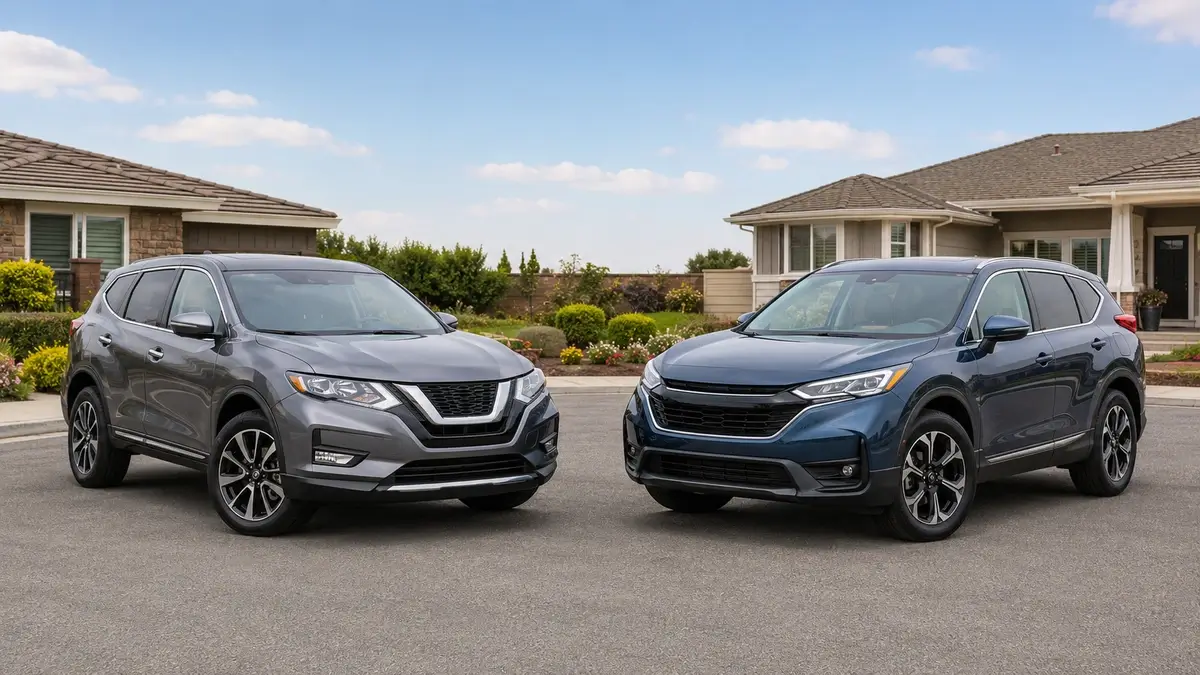
The Honda CR-V is the safer default for most used compact SUV buyers. It usually makes more sense if you want stronger long-term confidence, better resale support, and less uncertainty around ownership risk.
The Nissan Rogue can still be a smart value buy, but only under tighter conditions. The year needs to make sense. The price gap needs to be real. The maintenance history needs to be strong. The pre-purchase inspection needs to be clean.
Pick wrong and you may either overpay for a CR-V or save too little on a Rogue to justify the added risk.
Fastest safe default: buy the cleanest Honda CR-V you can afford unless a well-vetted Rogue is meaningfully cheaper.
CarMerit reliability comparator
Nissan Rogue vs Honda CR-V: 2007-2026 NHTSA snapshot
Owner-complaint and recall counts from NHTSA for 2007-2026, each model’s best used-year lane, and which buyer each one fits.
| 7,056 | complaints (2007-26) | 13,027 |
| 83 | recalls (2007-26) | 131 |
Powertrain / transmissionAirbags / seatbelts / structureEngineUnknown / other | top issues | Airbags / seatbelts / structureEngineElectricalSteering |
Nissan Rogue
Best used year: 2020
Shortlist 2019-2021; inspect 2017-2018 hard; avoid 2008-2016 unless records, price, mileage, CVT behavior, and inspection results are strong.
Best for: Value-play buyers who get a meaningful price gap and a specific Rogue with clean records, no unresolved recalls, and normal CVT behavior.
Honda CR-V
Best used year: 2016
Shortlist 2016 and 2020-2022; check 2015 and 2017-2018 harder for vibration, oil-history, and cold-climate-use proof. Treat 2023-2026 as still maturing.
Best for: Long-term buyers who want the lower-drama default with stronger resale, ownership confidence, and one-SUV-for-years predictability.
Quick take: The CR-V is the safer default for most used compact-SUV buyers: stronger resale, ownership confidence, and fewer unknowns. Choose the Rogue only when the savings are large enough to cover the added uncertainty, with clean records, no unresolved recalls, and normal CVT behavior. Buy the CR-V when prices are close.
Complaint counts are raw owner reports filed with NHTSA, not adjusted for sales volume, so they should guide inspection rather than crown a winner. The quick comparator above uses a 2007-2026 overlapping NHTSA snapshot for both models; CR-V has older NHTSA history before 2007, but those CR-V-only years are excluded here to keep the comparison balanced. Always inspect the specific vehicle before buying.
Nissan Rogue vs Honda CR-V: Quick Verdict for Used Buyers
The Nissan Rogue vs Honda CR-V decision is not just about size, features, or fuel economy. For used buyers, the real question is whether the Rogue’s lower price and feature value are enough to offset the CR-V’s stronger ownership-confidence case.
The CR-V is the better fit for most long-term used buyers. It is the easier recommendation for families, commuters, and shoppers who want fewer unknowns after purchase.
The Rogue is not an automatic no. It becomes interesting when you find a clean example with service records, no unresolved recall issues, no transmission symptoms, and enough price savings to matter.
| Factor | Honda CR-V | Nissan Rogue | Used-buyer takeaway |
|---|---|---|---|
| Best overall used-buy default | Stronger | Conditional | CR-V is the safer starting point for most buyers. |
| Value for the money | Good, but often pricier | Stronger when discounted | Rogue needs a meaningful price gap to win. |
| Reliability confidence | Stronger, but still year-dependent | More condition-sensitive | Rogue needs closer inspection and service-history review. |
| Maintenance and repair-risk comfort | Better overall confidence | Acceptable only with records | Rogue ownership risk depends heavily on history. |
| Resale value | Stronger directionally | Weaker directionally | CR-V is easier to justify if you plan to sell later. |
| Fuel economy | Strong, especially hybrid models | Strong for gas models | CR-V hybrid can be the better fuel-saver. Rogue gas models are efficient. |
| Cargo and family practicality | Slight edge in maximum space | Still practical | Both work for families, but CR-V feels safer as a one-car household pick. |
| Best buyer | Long-term owner, family, reliability-first shopper | Budget-first buyer with inspection discipline | Rogue is a deal-driven choice, not the safer default. |
Which One Should You Buy?
Choose the Honda CR-V if you want the lower-drama used compact SUV. It is the better match if you plan to keep the vehicle for years, carry family often, or care about resale value.
Choose the Nissan Rogue only if the deal is strong enough. A small discount is not enough if the Rogue has weak records, higher mileage, unresolved recalls, or any transmission concern.
Skip either SUV if the condition is poor. A neglected CR-V is not better than a well-maintained Rogue just because the badge is stronger.
| Buyer type | Better choice | Why |
| Reliability-first buyer | Honda CR-V | It carries less used-buying uncertainty for most shoppers. |
| Long-term owner | Honda CR-V | Resale, ownership confidence, and practicality make it easier to trust. |
| Family buyer | Honda CR-V | It is the safer default if this will be the main household vehicle. |
| Budget-first buyer | Nissan Rogue | Only if the discount is meaningful and the vehicle passes inspection. |
| Feature-per-dollar shopper | Nissan Rogue | Used Rogues can offer strong equipment value for the price. |
| High-mileage shopper | Honda CR-V | The Rogue case weakens faster without excellent records. |
| Buyer comparing risk vs price | Depends | Rogue needs the cleaner file and stronger price advantage. |
The simplest rule is this: buy the CR-V when prices are close. Consider the Rogue when the savings are large enough to cover the added uncertainty.
Reliability and Used-Buying Risk
The CR-V has the stronger reliability-confidence case, but it still needs a year, mileage, and service-history check. Do not buy one blindly.
Start with CarMerit’s Used Honda CR-V Reliability and Cost to Own Guide before choosing a higher-mileage CR-V. Then check the specific model year in the Honda CR-V Years to Avoid and Best Years to Buy guide.
The Rogue requires more caution. That does not mean every used Rogue is a bad buy, but it does mean the inspection standard should be higher.
If you are considering one, use CarMerit’s Nissan Rogue Reliability: Common Problems, Best Years, and Used Buyer Advice and Nissan Rogue Years to Avoid as next-step checks.
The main Rogue issue is not just “CVT” as a scary label. The real issue is whether the specific SUV has the right year, documented maintenance, clean driving behavior, and no warning signs.
Walk away from a Rogue if it has delayed engagement, shuddering, whining, slipping, harsh low-speed behavior, missing service records, or a seller who avoids inspection.
On newer examples, service history should match the vehicle’s actual service system—not just show a stack of receipts:
- CR-V: For 2023–2024 CR-V Hybrid and 2025–2026 gasoline or hybrid models, Honda Maintenance Minder uses codes A, B, and 1–7. Confirm that invoices document the work tied to past displayed codes. Code 6 applies only to vehicles equipped with the applicable AWD rear differential.
- Rogue: For 2021–2026 models equipped with the 1.5-liter KR15DDT engine, Nissan’s Oil Control System calculates oil-and-filter timing from driving conditions. If the replacement indicator appears, Nissan specifies service within two weeks or less than 500 miles. Confirm documented oil-and-filter service rather than relying on one generic mileage interval.
- Either SUV: Match records to the exact model year, engine, drivetrain, and official schedule. A task marked “inspect” is not the same as a required replacement.
Ownership Costs, Maintenance, and Resale Value
The Honda CR-V has the better ownership-cost case when you include repair confidence and resale direction. RepairPal’s CR-V vs Rogue comparison lists the CR-V with a lower average annual repair cost than the Rogue.
Do not treat that as a guarantee for your exact vehicle. A used SUV’s real cost depends on mileage, maintenance, local labor rates, prior ownership, and what has already been repaired.
Resale value also favors the CR-V directionally. iSeeCars lists lower five-year depreciation for the Honda CR-V resale value than for the Nissan Rogue resale value.
That matters if you plan to sell or trade in within a few years. The Rogue’s lower purchase price can help, but the discount must be real enough to survive depreciation and repair-risk differences.
| Ownership factor | Better used-buy position | Why it matters |
| Lower uncertainty | Honda CR-V | Easier to recommend for long-term ownership. |
| Lower purchase price | Nissan Rogue | Useful only when the savings are meaningful. |
| Maintenance confidence | Honda CR-V | Better fit for buyers who dislike repair surprises. |
| Feature value | Nissan Rogue | Higher trims may cost less used than a comparable CR-V. |
| Resale support | Honda CR-V | Stronger case if you will resell later. |
| Risk-adjusted value | Depends | Rogue wins only when price, year, records, and inspection all support it. |
The Rogue should not win just because it is cheaper. It should win only when the cheaper price is paired with a clean vehicle history.
Fuel Economy, Engines, and Hybrid Availability
Both SUVs can be efficient for compact SUVs. The difference is how they get there.
Newer Rogue gas models post strong EPA numbers. FuelEconomy.gov lists the 2025 Nissan Rogue FWD at 33 mpg combined, with AWD and upper trims rated lower.
The CR-V is competitive as a gas model and stronger when you consider hybrid availability. FuelEconomy.gov lists the 2025 Honda CR-V FWD gas model at 30 mpg combined and the 2025 Honda CR-V FWD hybrid at 40 mpg combined.
That makes the CR-V hybrid the better pick if fuel savings are a priority and the purchase price still makes sense.
2025 EPA Estimates by Exact Configuration
| Vehicle and configuration | City MPG | Highway MPG | Combined MPG |
|---|---|---|---|
| Honda CR-V gas FWD | 28 | 34 | 30 |
| Honda CR-V gas AWD | 26 | 31 | 28 |
| Honda CR-V hybrid FWD | 43 | 36 | 40 |
| Honda CR-V hybrid AWD | 40 | 34 | 37 |
| Nissan Rogue FWD | 30 | 37 | 33 |
| Nissan Rogue FWD SL/Platinum | 29 | 36 | 32 |
| Nissan Rogue AWD | 28 | 35 | 31 |
| Nissan Rogue AWD SL/Platinum | 28 | 34 | 31 |
| Nissan Rogue AWD Rock Creek | 27 | 32 | 29 |
Table Note: These are EPA estimates for exact 2025 configurations. Actual mileage varies with driving conditions, weather, load, maintenance, and driving style. MPG alone does not establish total ownership cost.
Fuel economy should not override inspection. A cheaper SUV with drivetrain concerns is not a smart fuel-saving move.
Interior Space, Cargo Room, and Family Practicality
Both the Honda CR-V and Nissan Rogue are practical five-seat compact SUVs. Either one can handle commuting, school runs, groceries, weekend luggage, and small-family use.
The CR-V has a small edge as the family default. Honda’s official CR-V specifications list up to 76.5 cubic feet of cargo volume with the rear seat folded on several trims.
The Rogue is still roomy. Nissan’s official Rogue feature page lists up to 74.1 cubic feet of maximum cargo capacity with the second-row seats folded.
For most families, the bigger difference will not be one or two cubic feet. It will be seat comfort, visibility, rear-door opening, child-seat fit, cargo-floor shape, and how clean the used example is.
Choose the CR-V if you want the easier family recommendation. Choose the Rogue if it feels good in person and the price advantage is strong.
Comfort, Technology, and Safety Features
Used-trim reality matters here. Do not assume every used CR-V or Rogue has the same safety tech, infotainment setup, heated seats, blind-spot monitoring, or driver-assist package.
A higher-trim Rogue may offer more features for less money than a similar CR-V. That is one of the Rogue’s best arguments.
The CR-V’s argument is different. It is not always the cheapest way to get features, but it remains the easier overall ownership recommendation for buyers who prioritize long-term confidence. That does not mean the CR-V wins every IIHS test. Safety results vary by model year, test family, and equipment.
Check safety ratings by exact model year before buying. IIHS publishes separate rating pages for the Honda CR-V and Nissan Rogue, and results can vary by generation, year, test type, and trim equipment.
2025 Model-Year IIHS Results Worth Checking
| IIHS measure | Honda CR-V | Nissan Rogue | Specific-test takeaway |
|---|---|---|---|
| Updated moderate overlap front | P — applies to 2023–2026; IIHS notes a February 2024 criteria adjustment | A — applies to 2025–2026 | Rogue has the higher rating in this specific test for the 2025 model year. |
| Updated side test | G — applies to 2023–2026 | A — applies to 2021–2025 | CR-V has the higher rating in this specific test for the 2025 model year. |
| Headlights | G — all trims; applies to 2023–2026 | G — all trims; applies to 2021–2026 | Both have a Good rating in the listed configurations. |
| Vehicle-to-vehicle front crash prevention 2.0 | A — standard system; applies to 2023–2026 | A — standard system; applies to 2025–2026 | Both are Acceptable in this test. |
| Pedestrian front crash prevention | A — standard system with high-beam-assist credit; applies to 2024–2026 | G — standard system with high-beam-assist credit; applies to 2025–2026 | Rogue has the higher rating in this specific test for the 2025 model year. |
| Seat-belt reminders | G — front and second rows; applies to 2023–2026 | G — front and second rows; applies to 2025–2026 | Both are Good for the listed years. |
Table Note: G means Good, A means Acceptable, M means Marginal, and P means Poor. This is a 2025-model-year snapshot, not an all-years safety ranking. Results apply only to the listed test families, years, systems, and equipment. IIHS criteria change over time, so do not combine these rows into an overall safety score.
Also check recalls by VIN before purchase. Use the official NHTSA recall lookup, Honda recall lookup, or Nissan recall lookup.
Model Years and Used-Buying Red Flags
A good answer to honda crv vs nissan rogue cannot ignore model-year risk. These are used vehicles, not spec-sheet objects.
The Rogue is more year-sensitive. Certain 2023 to 2025 Rogue models with the 1.5-liter VC-Turbo engine also need a careful recall check, since NHTSA has published recall documentation for affected 2023 to 2025 Rogue vehicles.
Some 2024 to 2025 Rogue models with the same engine also appear in separate NHTSA recall documentation tied to the electronic throttle body. That does not mean every newer Rogue should be rejected. It means the VIN check, service history, and inspection matter more.
The CR-V still needs its own model-year review. Some years and engines carry different ownership considerations, and no CR-V should be bought without maintenance records.
Factory Warranty Extensions to Verify in the Service History
If the Rogue’s CVT history or the CR-V’s engine or A/C repair history is becoming the deciding factor, check both model years in CarMerit’s Manufacturer Special Coverage Lookup first to identify any manufacturer coverage record that deserves VIN-specific confirmation before you compare the remaining repair risk.
| Vehicle and affected scope | Factory coverage record | Stated coverage change | Used-buyer action |
|---|---|---|---|
| Certain 2017–2018 Honda CR-Vs | Engine-oil-dilution drivability warranty extension covering camshafts and rocker-arm assemblies | Extended from 5 years/60,000 miles to 6 years with unlimited miles from the original sale date | Verify VIN eligibility, diagnosis history, and whether covered work was completed. Do not assume coverage remains active. |
| 2017–2022 Honda CR-V 1.5T | A/C compressor shaft-seal warranty extension | Extended from the original 3-year term to 10 years from the original purchase date, with no mileage limit | Confirm the 1.5T configuration, VIN status, original purchase date, diagnosis, previous repair, and current written coverage status. |
| 2008–2010 Nissan Rogue equipped with a CVT | CVT limited-warranty extension | Extended to 10 years/120,000 miles, whichever came first, for covered CVT repairs, replacement, and related towing only | Treat this mainly as a service-history check. Verify whether CVT diagnosis, repair, or replacement occurred; do not presume current coverage. |
| 2014–2018 Nissan Rogue T32 and 2015 Rogue Select S35; Rogue Hybrid excluded | CVT warranty extension covering specified CVT components and related work | Extended from 60 months/60,000 miles to 84 months/84,000 miles, whichever came first | Verify VIN, settlement opt-out status, service history, and any completed CVT work. Do not assume coverage remains. |
Table Note: These are warranty extensions or coverage adjustments, not recalls. They do not establish failure rates or prove that coverage remains active. Eligibility depends on the exact vehicle, VIN, original in-service or purchase date, mileage, diagnosis, and written program terms.
| Red flag | Why it matters | Best action |
| Missing maintenance records | Raises ownership-risk uncertainty | Prefer another example. |
| Unresolved recalls | Safety or repair issue may remain open | Check VIN before purchase. |
| Rogue transmission symptoms | Can turn a bargain into a costly mistake | Walk away unless inspected and resolved. |
| Very small Rogue discount | Does not compensate for added risk | Buy the CR-V instead. |
| Overpriced CR-V | Can erase the CR-V value case | Compare local listings before buying. |
| Poor inspection result | Condition beats badge reputation | Skip either SUV. |
| High-mileage example with weak history | Risk rises sharply | Demand proof or move on. |
The wrong used example matters more than the wrong nameplate. A clean Rogue can beat a neglected CR-V. A clean CR-V is still the safer default.
Price and Value: When the Rogue Makes Sense
The Rogue makes sense when the savings are meaningful enough to change the total ownership picture. A small discount does not do enough.
A Rogue should beat the CR-V on price by enough to justify its extra verification burden. Before treating that discount as a real advantage, run both VINs through the CarMerit VIN Lookup and compare the returned vehicle details with each seller’s listing and paperwork. Once the SUVs are correctly identified, let service history, CVT condition on the Rogue, overall vehicle condition, recall status, and the pre-purchase inspection decide whether the savings are actually worth taking.
A strong Rogue case usually looks like this:
- The model year checks out.
- The VIN has no unresolved recall issue.
- The maintenance history is complete.
- The transmission behavior is clean.
- The pre-purchase inspection finds no major concern.
- The price is meaningfully below a comparable CR-V.
- You plan to keep enough cash aside for maintenance.
That is when the Rogue can be the smarter value buy.
The CR-V premium is worth paying when you want the safer long-term bet. It is also easier to justify if you plan to keep the SUV for several years or resell it later.
If you are also considering Toyota, compare this choice with the Honda CR-V vs Toyota RAV4 and Nissan Rogue vs Toyota RAV4 guides after you finish this decision.
For broader shortlisting, use CarMerit’s Best Used Compact SUVs guide.
Final Recommendation
Buy the Honda CR-V if you want the safer used compact SUV choice. It is the better fit for reliability-first buyers, family buyers, long-term owners, and shoppers who care about resale confidence.
Buy the Nissan Rogue only when the value case is strong. It needs to be cheaper, clean, well-maintained, properly inspected, and free of unresolved VIN-level issues.
The CR-V is the better default. The Rogue is the better deal only when the individual vehicle proves it.
Final used-buying rule: when prices are close, choose the CR-V. When the Rogue is meaningfully cheaper and passes every check, it deserves a serious look.
Buyers comparing the CR-V against the Rogue usually look at its other rivals too — see how it fares in Mazda CX-5 vs Honda CR-V and Kia Sportage vs Honda CR-V.
Frequently Asked Questions
Which is more reliable, Honda CR-V or Nissan Rogue?
The Honda CR-V is the safer reliability default for most used buyers. The Nissan Rogue can still be reliable when the year, maintenance history, and inspection result are strong, but it needs closer checking.
Should I buy a used Nissan Rogue or a used Honda CR-V?
Buy the Honda CR-V if you want long-term confidence and stronger resale support. Buy the Nissan Rogue only if it is meaningfully cheaper and has clean records, no red flags, and a strong inspection result.
Is the Honda CR-V bigger than the Nissan Rogue?
They are close in real-world size. The CR-V usually has the edge as a family-practical default, but the Rogue is still roomy enough for most compact SUV buyers.
Is the Nissan Rogue cheaper to maintain than the Honda CR-V?
Not usually as the safer assumption. RepairPal’s comparison gives the CR-V the lower average annual repair-cost figure, but actual costs depend on age, mileage, maintenance, and local labor rates.
Which has better resale value, the Rogue or CR-V?
The Honda CR-V has the stronger resale-value case. That is one reason it can be worth paying more upfront, especially if you plan to sell or trade later.
Is Nissan Rogue CVT reliability a deal-breaker?
Not automatically. It is a deal-breaker if the Rogue has symptoms, weak service records, high mileage without proof of care, or a seller who avoids inspection.
Does the Rogue or CR-V get better fuel economy?
It depends on the year and powertrain. Newer Rogue gas models are efficient, but the CR-V hybrid has the stronger fuel-economy case if the used price still makes sense.
Which is better for families, the Nissan Rogue or Honda CR-V?
The Honda CR-V is the better family default. The Rogue can still work well for families, but the CR-V is easier to recommend as the main household SUV.
Is the Nissan Rogue a good used SUV compared with the CR-V?
It can be, but it is more conditional. A well-priced, well-maintained Rogue can be a smart buy, but the CR-V is the safer all-around recommendation.
When is the Nissan Rogue a better value than the Honda CR-V?
The Rogue is better value when it is meaningfully cheaper, has strong maintenance records, passes inspection, has no unresolved recall issue, and gives you enough savings to justify choosing it over the CR-V.