

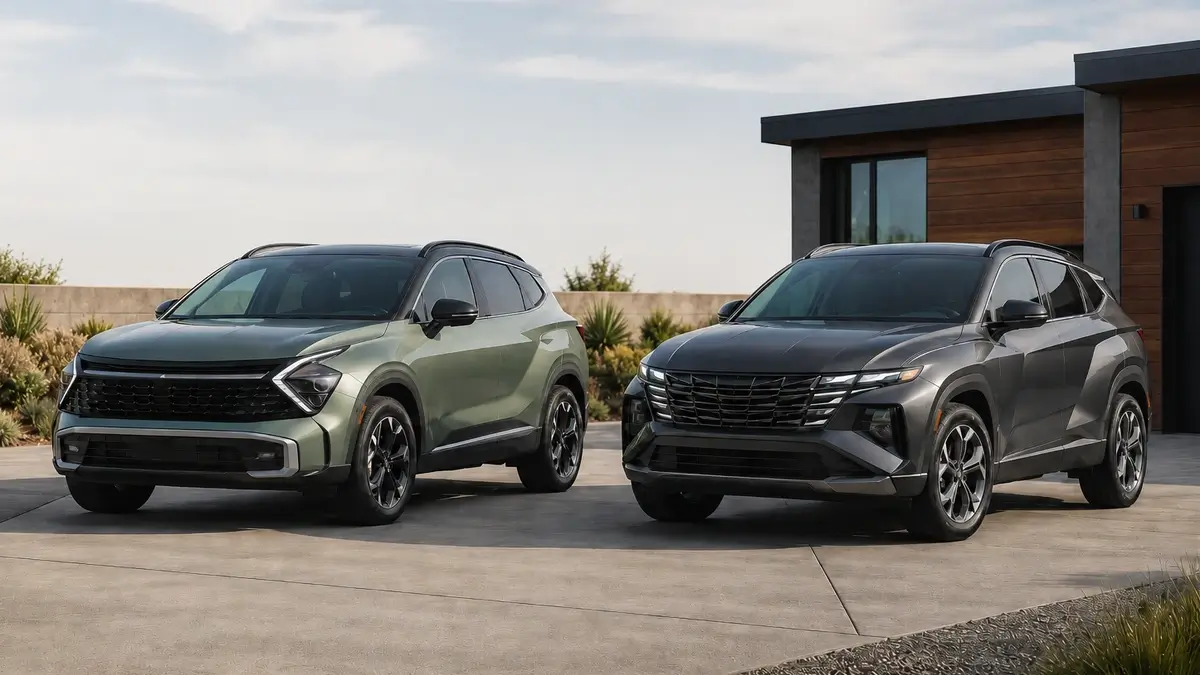
The Kia Sportage vs Hyundai Tucson decision is close on paper. That is exactly why used buyers should not treat it like a simple spec battle.
The better choice depends on year, mileage, trim, warranty status, and maintenance history. A clean Tucson can be the smarter value buy. A clean Sportage can be the better feature buy.
The short answer: start with the Hyundai Tucson if two similar examples cost about the same. It gives you a strong used compact SUV package, good space, and a calmer ownership case.
Choose the Kia Sportage if the specific example is cleaner, newer, better equipped, or better protected by warranty. Do not pay extra just because the cabin looks more modern.
If neither one feels like the right fit, compare them against CarMerit’s best used compact SUVs before you buy.
CarMerit reliability comparator
Kia Sportage vs Hyundai Tucson: 2011-2024 NHTSA snapshot
Owner-complaint and recall counts from NHTSA for 2011-2024, each model’s best used-year lane, and which buyer each one fits.
| 2,583 | complaints (2011-24) | 5,494 |
| 45 | recalls (2011-24) | 35 |
EngineElectricalBrakesUnknown / other | top issues | EnginePowertrainBrakesUnknown / other |
Kia Sportage
Best used year: 2022
Best 2022; budget 2019-2020 with proof; avoid first 2011-2013; verify recalls on 2014-2021 and 2023 examples.
Best for: Feature-first buyers who find a cleaner, newer, better-equipped, or better-protected example at the same money.
Hyundai Tucson
Best used year: 2020
Simpler 2019-2021 with six-speed automatic; avoid 2016 1.6T DCT and VIN-confirmed affected 2017 2.0 GDI examples without Recall 209 proof.
Best for: Value-first buyers who prioritize space, comfort, warranty paperwork, and family practicality.
Quick take: When two similar examples cost about the same, start with the Tucson because it gives you a strong, calm used compact-SUV package with good space and a value-friendly ownership case. Choose the Sportage when the specific car is cleaner, newer, better equipped, or better protected by warranty. Do not pay extra just for a more modern cabin, and check recall-sensitive years on both.
Complaint counts are raw owner reports filed with NHTSA, not adjusted for sales volume, so they should guide inspection rather than crown a winner. The quick comparator above uses a 2011-2024 shopping-window snapshot; older records have had more time to collect reports, so use the figures as inspection signals, not rankings. Always inspect the specific vehicle before buying.
Kia Sportage vs Hyundai Tucson: Quick Used-Buyer Verdict
The Hyundai Tucson is the better first stop for many used buyers. It usually makes the most sense when value, comfort, warranty paperwork, and family practicality matter more than style.
The Kia Sportage is still a strong alternative. It is the better choice when you find a cleaner example with the right trim, good service records, and no open recall issues.
| Buyer type | Better first choice | Why |
|---|---|---|
| Value-focused used buyer | Hyundai Tucson | Strong all-around package and an earlier current-generation used-year window |
| Feature-focused buyer | Kia Sportage | Often feels more modern inside, especially in better trims |
| Family buyer | Slight edge Tucson | Spacious cabin, easy daily use, and practical cargo layout |
| Commuter | Tie | Fuel economy depends more on engine, drivetrain, and hybrid availability |
| Reliability-focused buyer | Tie, inspect the exact SUV | Neither should win without service records and recall checks |
| Hybrid shopper | Separate comparison needed | Hybrid pricing, warranty, and EPA ratings can change the answer |
| Low-risk shopper | Best-condition example | The cleanest history beats the better badge |
The biggest mistake is choosing one model as “better” without checking the actual used vehicle.
A high-mileage Tucson with weak records is not lower-risk than a clean Sportage. A loaded Sportage with accident history is not better than a simple Tucson with clean maintenance.
Use this rule: condition first, model second, trim third.
The Tucson also needs to be compared against Toyota’s stronger used-market default. Before choosing mainly on value, read Hyundai Tucson vs Toyota RAV4 to see when the Tucson discount is enough to beat the RAV4’s resale and ownership-confidence case.
What These SUVs Have in Common
The Hyundai Tucson and Kia Sportage compete in the same mainstream compact SUV space. They appeal to many of the same buyers.
Both are practical five-seat SUVs. Both can work for commuting, small families, road trips, and everyday errands.
They also share the same basic buyer problem. A used shopper is not just choosing between two vehicles. They are choosing between two ownership risks.
Both models can look attractive because Hyundai and Kia offer strong headline warranty coverage. Used buyers need to slow down here.
The warranty story depends on whether the SUV is original-owner, certified pre-owned, still inside basic coverage, or sold as a normal used vehicle. Kia’s warranty page and Hyundai’s warranty page both separate headline coverage from the details buyers need to verify.
That makes paperwork important. Ask for the in-service date, remaining warranty terms, CPO status, recall completion, and service history before comparing features.
Reliability and Known Problem Patterns
Do not use reputation alone to decide this comparison. Hyundai and Kia vehicles vary by engine, year, recall history, maintenance, and ownership care.
The safest reliability answer is not “Tucson is better” or “Sportage is better.” The lower-risk answer is to verify the exact year and VIN.
The Tucson side of this comparison should be judged by condition, records, recalls, and drivetrain behavior, not just price or features. If the Tucson is the one you are leaning toward, use the Hyundai Tucson reliability and cost-to-own guide to pressure-test the ownership risk before buying.
| Reliability factor | Hyundai Tucson | Kia Sportage | Used-buyer action |
| Brand reputation | Mixed by year and powertrain | Mixed by year and powertrain | Do not rely on brand memory |
| Current-generation overlap | 2022 and newer Tucson is the closer modern comparison | 2023 and newer Sportage is the closer modern comparison | Compare similar generations |
| Recall exposure | Must be checked by VIN | Must be checked by VIN | Use the NHTSA recall lookup and dealer records |
| Maintenance history | More important than trim level | More important than trim level | Ask for oil-change and repair records |
| Pre-purchase inspection | Strongly recommended | Strongly recommended | Inspect engine, transmission, brakes, suspension, electronics, and leaks |
IIHS Crash-Test Change Points
IIHS ratings are most useful here as model-year and test-program checkpoints, not as one combined safety score.
| Model and IIHS applicability | Selected IIHS ratings | Official source page |
|---|---|---|
| Hyundai Tucson, 2010–2015 | Driver-side small overlap: P; moderate overlap, original test: G; side, original test: G | 2011 Hyundai Tucson ratings |
| Hyundai Tucson, 2016–2021 | Driver- and passenger-side small overlap: G; moderate overlap, original test: G; side, original test: G; side, updated test: M | 2016 Hyundai Tucson ratings |
| Hyundai Tucson, newer test scopes | Small overlap: G for 2022–2026; moderate overlap, original test: G for 2022–2024; moderate overlap, updated test: G for 2024–2026 models built after March 2024; side, updated test: G for 2024–2026; 2024 headlights: A | 2024 Hyundai Tucson ratings |
| Kia Sportage, 2011–2016 | Driver-side small overlap: P; moderate overlap, original test: G; side, original test: G under separate 2011 and 2012–2016 applicability scopes | 2011 Kia Sportage ratings |
| Kia Sportage, 2017–2022 | Driver- and passenger-side small overlap: G; moderate overlap, original test: G; side, original test: G; side, updated test: M | 2017 Kia Sportage ratings |
| Kia Sportage, newer test scopes | Small overlap: G for 2023–2026; moderate overlap, original test: G for 2023–2025; side, updated test: G for 2024–2026; 2024 headlights: A | 2024 Kia Sportage ratings |
Table Note: G = Good; A = Acceptable; M = Marginal; P = Poor. Original and updated IIHS tests use different criteria and should not be treated as one continuous rating scale. Each result applies only to the years, build dates, body style, and equipment specified by IIHS. An unlisted result does not mean a Poor rating.
A used compact SUV with clean maintenance can beat a newer one with gaps. This is especially true if the vehicle has passed through multiple owners.
If the Sportage is still on your shortlist, do not judge it only by price or features. Before choosing it over a Tucson, check the Kia Sportage years to avoid and best years to buy guide so you can verify recall-sensitive years, safer shortlist years, and inspection points.
Year risk is only part of the Sportage decision. Before choosing it over a Tucson, use the Kia Sportage Reliability and Cost to Own guide to check Sportage-specific maintenance cost, recall exposure, common problems, drivetrain checks, and inspection red flags.
Look for warning signs before you negotiate. Oil sludge, transmission hesitation, electrical glitches, warning lights, poor tire wear, and incomplete recall work should all reduce your offer.
A certified pre-owned example can be worth more here. It does not make the SUV perfect, but it can reduce uncertainty if the warranty terms are real and clearly documented.
Kia’s Certified Pre-Owned program says eligible vehicles must pass a 165-point inspection and can include additional limited warranty coverage. Hyundai Certified Used Vehicles benefits should be checked the same way before treating a used Tucson as lower risk.
Used Years and Generation Differences to Watch
Model year matters more than most Kia Sportage vs Hyundai Tucson comparisons admit.
The current Hyundai Tucson generation began earlier than the current Kia Sportage generation. That gives Tucson shoppers a wider current-generation used-year window to compare.
For the closest modern comparison, look at 2022 and newer Tucson models against 2023 and newer Sportage models. Older examples may still be good buys, but they are a different decision.
The Tucson side needs its own year and powertrain check because risk is not uniform across generations. Before shortlisting one, use our Hyundai Tucson years to avoid and best years to buy guide to verify the exact engine, transmission, recall status, and inspection priorities.
| Used-buy scenario | Better move |
| Comparing current-generation examples | Match 2022+ Tucson against 2023+ Sportage |
| Shopping older budget examples | Research each model year separately |
| Considering a first-year redesign | Be stricter on service records and recalls |
| Buying a hybrid or plug-in hybrid | Check battery warranty, charging use, and exact EPA rating |
| Choosing from dealer inventory | Compare by VIN, not just model name |
Do not turn this comparison into a fake years-to-avoid list. That needs separate model-year research.
For this page, the practical rule is simple. Avoid weak histories, open recalls, accident damage, neglected maintenance, and overpriced loaded trims.
A lower-trim SUV with excellent records can be the better used buy. A loaded SUV with unclear history can become the expensive mistake.
Ownership Cost, Maintenance, and Warranty Reality
The Tucson and Sportage are close enough that ownership cost should be judged by the exact vehicle.
Do not assume one is automatically cheaper to own. The better buy is usually the SUV with fewer miles, cleaner service records, better tires, fewer open issues, and stronger remaining warranty.
Headline warranty numbers are not the same as remaining coverage on a used SUV. Check the original in-service date, mileage, ownership status, certified pre-owned status, VIN, and exact model-year warranty guide before assigning value to warranty coverage.
| Coverage category | Hyundai Tucson | Kia Sportage | Used-buyer meaning |
|---|---|---|---|
| New-vehicle/basic coverage | 5 years/60,000 miles. Hyundai’s 2020–2022 guides state that original and subsequent owners can receive coverage within the applicable term. | 5 years/60,000 miles. Kia’s public 2008–2026 program summary does not state the basic-coverage transfer rule. | Confirm the in-service date, mileage, applicable model-year guide, exclusions, and transfer status. |
| Powertrain coverage | 10 years/100,000 miles for the original owner. In the reviewed 2020–2022 guides, a subsequent owner’s powertrain protection falls under the 5-year/60,000-mile new-vehicle term. | 10 years/100,000 miles for the original purchaser and a Kia Certified Pre-Owned purchaser under Kia’s public program summary. | A normal used sale does not automatically include the headline 10-year/100,000-mile powertrain benefit. |
| Hybrid/PHEV system coverage | The 2022 Tucson guide states 10 years/100,000 miles for the hybrid/electric battery and specified hybrid-system components for original and subsequent owners within the term. | The available public Kia summary did not establish an exact Sportage HEV/PHEV model-specific term. Check the applicable warranty manual and VIN. | Do not assume that the two brands have identical electrified-system coverage or transfer rules. |
Table Note: These are U.S.-market warranty limits. Time and mileage limits generally apply whichever comes first. Exact components, exclusions, owner eligibility, and remaining coverage are controlled by the applicable warranty guide and vehicle record. Warranty length does not prove reliability. See Hyundai warranty resources and Kia warranty information.
Warranty Extensions and Coverage Programs to Verify by VIN
Some Tucson and Sportage vehicles fall within later manufacturer or settlement coverage programs. Model year alone does not establish eligibility.
Because both SUVs have year-specific manufacturer programs, run the Sportage and Tucson model years through CarMerit’s Manufacturer Special Coverage Lookup before deciding that one has the cleaner repair history; use the result only as a screening step, then verify the exact VIN and program terms.
| Vehicle and affected scope | Program | Coverage that may apply | What the buyer must verify |
|---|---|---|---|
| Tucson, 2011–2021 with specified 2.4-liter MPI or 2.0-liter GDI engines | TXXM | Up to 15 years/150,000 miles for certain engine repairs caused by connecting-rod-bearing failure | VIN, exact engine, covered failure, ownership eligibility, and KSDS completion; stated Recall 198/209 exceptions may apply |
| Tucson, certain 2014–2015 and 2018–2019 2.4-liter vehicles | TXXI | 10 years/120,000 miles for qualifying engine long-block repairs involving excessive connecting-rod-bearing damage | VIN, engine/component eligibility, covered condition, and program exclusions |
| Tucson, certain 2016–2017 vehicles | TXXQ | 15 years/unlimited miles for the airbag control unit under the specified DTC and warning-light condition | VIN, diagnostic code, warning-light condition, and exclusions |
| Tucson, certain 2017–2021 vehicles with qualifying factory-applied white paint | Z05 | 10 years/unlimited miles for qualifying peeling or bubbling on listed exterior metal panels | VIN, original paint color, affected panel, qualifying condition, and exclusions |
| Sportage, 2011–2018 and certain 2019 vehicles with a genuine Theta II 2.0-liter or 2.4-liter GDI engine | Kia Engine Settlement | A lifetime powertrain-warranty benefit or lifetime short-block coverage may apply to qualifying vehicles and failures | VIN/class eligibility, exact engine, KSDS completion, covered condition, and current settlement terms |
| Sportage, 2011–2013 with a Theta II 2.4-liter MPI engine | Engine Litigation II/SC200SL1 | 15 years/150,000 miles for qualifying engine damage caused by connecting-rod-bearing failure | VIN, covered failure, KSDS completion except where stated exceptions apply, and program exclusions |
| Sportage, certain 2017 vehicles | WTY020 door-latch program and WTY027 airbag program | Door-latch coverage up to 10 years/unlimited miles; specified airbag-warning-light repairs up to 15 years/unlimited miles | VIN and the exact condition or diagnostic-code requirements for each separate program |
| Sportage, qualifying 2014–2021 vehicles with a covered HECU recall repair | Kia HECU Settlement | Branch-specific future ABS-module coverage: 12 years from original delivery/first use or five years from the applicable program event | Class and VIN eligibility, completed recall repair, applicable warranty-status branch, parts-availability history, and controlling start date |
Table Note: These programs are condition-, component-, VIN-, and sometimes campaign-dependent. They do not establish that every vehicle from a listed year is covered, that coverage remains today, or that the described condition is common. Obtain written VIN-specific confirmation from the manufacturer or an authorized dealer before purchase.
| Cost factor | What matters most |
| Warranty | Original in-service date, CPO status, transfer limits, and paperwork |
| Maintenance | Oil changes, brake condition, tire age, fluids, and inspection results |
| Repairs | Vehicle condition matters more than brand confidence |
| Depreciation | Compare real local listings by year, mileage, trim, and condition |
| Insurance | Get quotes before buying if budget is tight |
| Hybrid costs | Check battery warranty and hybrid system coverage |
The Tucson often makes sense if it is priced lower with similar mileage and condition. The Sportage makes sense if it gives you more equipment without raising risk.
Do not overpay for a trim that only adds comfort features. Spend more only if the vehicle also has better condition, better records, or stronger warranty coverage.
If reliability is your top filter, compare both models against CarMerit’s most reliable used cars shortlist before stretching your budget.
Fuel Economy, Hybrid Options, and Daily Driving Costs
Fuel economy should not decide the gas-model comparison by itself. The gas Tucson and gas Sportage are too close for that in many real shopping cases.
Hybrid versions are different. A Tucson Hybrid or Sportage Hybrid can cut fuel use for the right driver, especially in city-heavy use.
That does not mean every buyer should pay extra for a hybrid. You still need to compare purchase price, mileage, warranty, battery coverage, and expected ownership length.
If you mostly drive short city trips, the hybrid case becomes stronger. If you mostly drive highway miles, the payback may be weaker.
Plug-in hybrid versions need even more care. A plug-in only makes sense if you can charge regularly and the used price is not inflated.
Use FuelEconomy.gov and EPA fuel economy guidance with the exact model-year listing before deciding. Do not compare a front-wheel-drive gas model against an all-wheel-drive hybrid and call it a fair result.
For a current-generation reference, the following EPA estimates compare the first model years of the two redesigns used in this article: the 2022 Tucson and 2023 Sportage.
| Gas or hybrid configuration | City MPG | Highway MPG | Combined MPG |
|---|---|---|---|
| 2022 Hyundai Tucson gas FWD | 26 | 33 | 29 |
| 2022 Hyundai Tucson gas AWD | 24 | 29 | 26 |
| 2022 Hyundai Tucson Hybrid AWD | 37 | 36 | 37 |
| 2022 Hyundai Tucson Hybrid Blue AWD | 38 | 38 | 38 |
| 2023 Kia Sportage gas FWD | 25 | 32 | 28 |
| 2023 Kia Sportage gas AWD | 23 | 28 | 25 |
| 2023 Kia Sportage Hybrid AWD | 38 | 38 | 38 |
| 2023 Kia Sportage Hybrid FWD | 42 | 44 | 43 |
Table Note: These are EPA estimates for the exact configurations shown, not invented model-year averages. Drivetrain and hybrid configuration materially affect the comparison. Confirm the exact used vehicle at FuelEconomy.gov.
Plug-in hybrids require separate gasoline-operation and electric-operation metrics:
| Plug-in hybrid configuration | Charge-sustaining MPG, city/highway/combined | Charge-depleting MPGe, city/highway/combined | EPA electric range | 240-volt charge time |
|---|---|---|---|---|
| 2022 Hyundai Tucson Plug-in Hybrid AWD | 35/35/35 | 87/74/80 | 33 miles | 1.7 hours |
| 2023 Kia Sportage Plug-in Hybrid AWD | 36/35/35 | 88/79/84 | 34 miles | 2.0 hours |
Table Note: MPG describes gasoline charge-sustaining operation; MPGe is the energy-equivalent rating for charge-depleting operation. These units and operating modes should not be merged. Range and charge time are EPA estimates for the configurations shown.
The fuel-cost rule is simple: buy the hybrid for your driving pattern, not for the badge.
Interior Space, Cargo Room, and Family Practicality
Both SUVs are practical enough for most compact SUV buyers. The difference is not large enough to ignore condition or price.
The Tucson has a roomy, straightforward cabin. It is the more conventional family pick if you want easy daily use and a less polarizing interior.
The Sportage feels more expressive. It can be the better fit if you like a tech-forward cabin and find a trim that does not cost too much more.
| Practical need | Better fit |
| Rear-seat comfort | Tie |
| Cargo practicality | Close, compare exact year and measurement method |
| Simple family use | Slight edge Tucson |
| Cabin style | Sportage |
| Low-distraction layout | Tucson |
| Road-trip cargo flexibility | Compare exact year and trim |
For current-generation reference, Kia lists the Sportage at 39.6 cubic feet behind the rear seat and 74.1 cubic feet with the rear seat folded on its official Sportage specs page.
Hyundai lists the Tucson at 41.2 cubic feet by its maximum measure, with SAE cargo figures also shown on the official Tucson specs page.
Those figures are close enough that real use matters more. Bring your stroller, child seat, dog crate, luggage, or sports gear before buying.
Family buyers should also test rear-door access, rear-seat height, visibility, and blind spots. For a broader family shortlist, use CarMerit’s best used family cars guide before you settle on either SUV.
Safety, Visibility, and Driver Assistance
Do not choose either SUV from a generic safety claim. Safety depends on model year, build date, trim, headlights, and driver-assistance equipment.
The current Tucson and Sportage are closely related enough that some crash-test ratings are connected across both models. IIHS notes rating applicability by model year on both the Tucson safety page and the Sportage safety page.
That helps the comparison, but it does not make every used example equal. You still need to check the exact year, build date, and trim.
Check these before buying:
- Open recalls by VIN
- IIHS rating for the exact model year
- NHTSA rating and complaints for the exact model year
- Headlight rating where available
- Blind-spot monitoring availability
- Forward collision warning and automatic emergency braking
- Lane-keeping and adaptive cruise functionality
- Camera clarity and parking visibility
Do not overpay just to get every driver-assistance feature. Pay for the features you will actually use.
For many used buyers, blind-spot monitoring, rear cross-traffic alert, and a clear backup camera matter more than a long list of rarely used features.
Best Trims and Used-Market Value
The best trim is usually not the base model or the fully loaded model. It is the trim that gives you the useful features without pushing the price too high.
For the Hyundai Tucson, a mid-trim used example often makes the most sense. Look for the right mix of safety tech, comfort features, warranty status, and clean history.
For the Kia Sportage, the same logic applies. A better-equipped Sportage can feel more premium, but it is not worth paying extra if the history is weaker.
| Used-market choice | Smart move |
| Base trim with clean history | Good budget option if safety equipment is adequate |
| Mid trim with records | Best balance for most buyers |
| Loaded trim with high price | Buy only if condition and warranty justify it |
| Sporty or appearance trim | Treat as style, not automatic value |
| Hybrid trim | Compare fuel savings against price premium |
| CPO example | Worth considering if warranty protection is real |
Avoid trim tunnel vision. A cleaner mid-trim Tucson can beat a loaded Sportage. A cleaner mid-trim Sportage can beat a loaded Tucson.
Used value is not decided by MSRP. It is decided by actual local price, mileage, service history, warranty terms, accident history, tires, brakes, and demand.
Before making an offer, compare at least three similar listings. Match year, mileage, drivetrain, trim, accident history, CPO status, and dealer fees.
Which One Should You Buy?
Buy the Hyundai Tucson if you want the more conservative used-SUV choice. It is the better first shortlist for many buyers who want space, comfort, value, and a calmer daily-use feel.
Buy the Kia Sportage if you want a more expressive cabin and find a cleaner example at the right price. It can be the better deal when trim, mileage, and warranty line up.
The Sportage is not only a Tucson alternative. It also competes with safer resale-focused choices like the CR-V. If you want the broader value-versus-risk decision, read Kia Sportage vs Honda CR-V.
Skip the Tucson if the example has poor records, accident damage, open recalls, or an inflated price. The badge does not fix weak history.
Skip the Sportage if the seller wants a premium for style alone. A modern cabin is not enough reason to accept higher mileage, weaker records, or less warranty protection.
Shop a Toyota RAV4, Honda CR-V, or Mazda CX-5 instead if your main priority is lower uncertainty. Start with Honda CR-V vs Toyota RAV4 if you want the safer mainstream benchmark.
You can also compare Mazda CX-5 vs Toyota RAV4 if you want a more value-and-driving-focused alternative.
The final decision should not be Tucson or Sportage in the abstract. It should be the best exact SUV in front of you.
When that choice comes down to a specific Tucson and Sportage, verify that both SUVs match the listings you used to compare them. Run each VIN through the CarMerit VIN Lookup and compare the returned vehicle details with the seller’s description and paperwork. Then let recall status, service history, remaining warranty coverage, condition, and the actual deal determine which of the two deserves your money.
Use this order before buying:
- Compare similar model years.
- Check VIN recalls.
- Review service history.
- Confirm warranty status.
- Inspect tires, brakes, fluids, suspension, and electronics.
- Compare local listings.
- Test both on the same roads.
- Buy the cleaner vehicle, not the louder spec sheet.
For most used buyers, the best answer is Tucson first, Sportage if the deal is stronger.
Frequently Asked Questions
Which is better, the Kia Sportage or Hyundai Tucson?
The Hyundai Tucson is the better first shortlist for many used buyers. The Kia Sportage is better if the specific used example is cleaner, better equipped, or better priced.
Is a used Kia Sportage or Hyundai Tucson more reliable?
Neither model should win on reputation alone. Reliability depends on model year, maintenance history, recall completion, mileage, ownership care, and inspection results.
Is the Kia Sportage or Hyundai Tucson cheaper to maintain?
There is no safe blanket answer without year, mileage, engine, and condition. Compare service records, warranty status, tires, brakes, and inspection findings before deciding.
Which has better fuel economy, the Sportage or Tucson?
Gas models are often close enough that fuel economy should not decide the whole purchase. Hybrid and plug-in hybrid versions need exact EPA checks by year and drivetrain.
Should I buy a used Tucson or Sportage hybrid?
Consider one if you drive many city miles and can confirm warranty coverage. Do not overpay unless fuel savings, condition, and battery coverage support the price.
Which has more cargo space, the Tucson or Sportage?
Both are roomy compact SUVs. Current-generation specs are close, but their measurement methods can differ, so test your real cargo needs before buying.
Is the Tucson or Sportage better for families?
The Tucson is the better first pick for many family buyers because it feels calm and practical. The Sportage can work just as well if its cabin layout, condition, price, and verified warranty status better fit your family.
Which used years of the Hyundai Tucson should I avoid?
Do not rely on a generic avoid-year answer inside this comparison. Check recalls, complaints, service history, and model-year research before buying.
Which used years of the Kia Sportage should I avoid?
Treat this as a separate model-year decision. Verify the exact year, engine, recall history, and maintenance record before choosing a used Sportage.
Should I compare the Tucson and Sportage against the RAV4, CR-V, or CX-5?
Yes, especially if reliability confidence matters more than price or features. The RAV4, CR-V, and CX-5 are useful backup comparisons before you commit.