

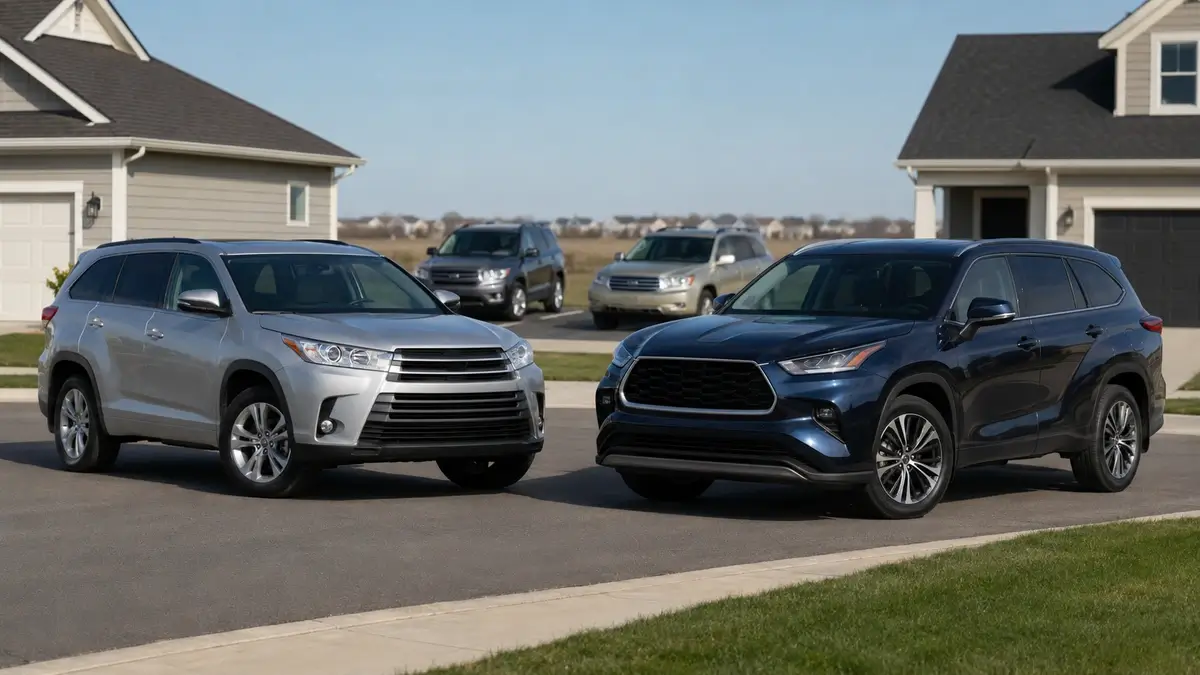
The Toyota Highlander years to avoid are not a simple blacklist. The clearest high-risk choices are 2017 and 2018 gas V6 models with the eight-speed automatic when their transmission history cannot be verified.
The 2008 V6 also deserves serious caution, but for a different reason. Toyota issued a replacement campaign for a specific VVT-i oil hose and a separate warranty enhancement for oil-cooler pipe leakage. Those programs did not require the same repair on every vehicle.
For buyers building a shortlist, the 2013, 2016, 2019, and 2022 are reasonable starting points based on the available evidence. They are not proven to be the four most reliable Highlander years in every situation.
The 2016 is the most defensible all-around starting point for a buyer who wants a traditional gas Highlander with a longer ownership history. The 2022 is the newer alternative, but it has a shorter long-term evidence window and still requires recall and powertrain-specific checks.
CarMerit reliability tool
Check any Toyota Highlander year: NHTSA-backed snapshot
Pick a model year to see Toyota Highlander complaint, recall, investigation, and manufacturer-communication counts from the article’s NHTSA snapshot, plus CarMerit’s used-buy verdict for that year band.
Owner complaints
…
NHTSA, CarMerit snapshot
Safety recalls
…
NHTSA, CarMerit snapshot
Investigations
…
NHTSA, CarMerit snapshot
Manufacturer communications
…
NHTSA, CarMerit snapshot
Main NHTSA complaint areas for this generation
Complaint counts and manufacturer communications are raw NHTSA records, not defect rates or reliability scores. Older model years have had more time to collect reports, so lower counts on newer years do not prove better reliability. Verdicts come from CarMerit’s article guidance. Data source: NHTSA.gov. Always verify VIN-level recalls, service records, cold-start behavior, transmission feel, oil or coolant leakage, hybrid-system codes where applicable, seat operation, and inspection results before buying.
Quick Answer: Toyota Highlander Years to Avoid and Best Years to Buy
Use the model year as a screening tool, not the final purchase decision.
- High confidence: An official Toyota or NHTSA document directly identifies the year, configuration, and decision-changing concern.
- Medium confidence: Useful official evidence exists, but the affected population is limited or the comparison with nearby years remains incomplete.
- Low confidence: There is not enough year-specific evidence for a strong buy or avoid verdict.
| Model years / powertrain | Main verified concern or advantage | Risk / severity | Buyer verdict | Required verification |
|---|---|---|---|---|
| 2001–2007 gas and early hybrid | Age, corrosion, maintenance history, and current condition now matter more than a clear year-specific pattern. | Condition-dependent | Case by case — low confidence | Require exceptional service records, check carefully for corrosion, and complete a full pre-purchase inspection. |
| 2008 V6 | VVT-i oil-hose campaign exposure plus possible oil-cooler pipe leakage. | Potentially major | High caution — high confidence for program exposure | Verify VVT-i campaign completion and inspect carefully for active or previous oil leakage. |
| 2009–2011 V6 gas and certain 2011 hybrids | Possible oil-cooler pipe seepage or leakage. | Moderate to major if ignored | Caution — medium confidence | Require a dry inspection and credible service history. |
| 2012–2013 gas and hybrid | Later second-generation choices without the earlier VVT-i campaign exposure. | Lower identified year-specific risk | Preferred older starting range — medium confidence | Check maintenance history, corrosion, mileage, and hybrid-system condition where applicable. |
| 2014 gas and hybrid | Certain vehicles may have VIN-specific fuel-pipe and seat-related recall exposure. | Safety-related but repairable | Caution, not an automatic avoid — medium confidence | Confirm all applicable recall work has been completed and documented. |
| 2015–2016 gas and hybrid | Post-redesign years before the 2017 gas transmission change. | Lower identified year-specific risk | Preferred starting range — medium confidence | Require complete service records and confirm smooth, normal powertrain operation. |
| 2017–2018 gas V6 | Certain vehicles with the UA80 eight-speed automatic may develop transmission whine, harsh shifts, reduced power, warning lights, or internal transmission damage. | Major | Strong avoid unless fully verified — high confidence | Verify production range, repair history, eligibility, scan results, and performance during a complete test drive. |
| 2017–2018 hybrid | Not subject to the gas V6 UA80 eight-speed transmission concern. | Powertrain-specific verification needed | Consider with verification — medium confidence | Complete a hybrid-system scan, review service records, and check VIN-specific recall status. |
| 2019 gas and hybrid | Later third-generation candidate; certain vehicles may be included in the fuel-pump recall. | Safety-related but repairable | Consider after recall verification — medium confidence | Confirm closed recall status and normal fuel-system operation. |
| 2020 gas | Some vehicles received a shift-flare software bulletin during the first fourth-generation model year. | Moderate | Caution — medium confidence | Confirm the latest calibration has been installed and acceleration is smooth. |
| 2020–2022 Hybrid AWD | Certain vehicles entered a customer-support program for rear motor cable corrosion. | Potentially major | Consider with targeted verification — high confidence for program scope | Confirm program eligibility, scan for warning codes, inspect the connector, and review repair history. |
| 2021 gas with UA80E or UA80F transmission | Whine or grinding concerns may affect transmissions within specified serial-number ranges. | Potentially major | Caution — high confidence for covered range | Verify the transmission serial range, confirm there are no symptoms, and review repair history. |
| 2021–2024 gas and hybrid | Certain vehicles may be included in the second-row seat-recliner safety recall. | Safety-related | Consider after VIN check — high confidence for recall scope | Check current remedy availability and require documented recall completion. |
| 2022 gas and hybrid | Later fourth-generation starting point with less long-term history than older years. | Evidence still maturing | Preferred newer starting point — medium confidence | Verify recall status, inspect the hybrid cable where applicable, and complete a pre-purchase inspection. |
| 2023–2024 gas and hybrid | Limited long-term evidence plus possible second-row seat-recliner recall exposure. | Evidence-limited | Insufficient evidence for a strong best-year verdict — low confidence | Complete a VIN check, verify recall status, and require full service records. |
| 2025 and newer gas and hybrid | Ownership history remains too limited for a durable reliability ranking. | Evidence-limited | Insufficient evidence — low confidence | Wait for more ownership data, accumulated mileage, and model-year-specific evidence. |
Simple buying rule: Start with a clean 2016 when lower uncertainty matters most. Consider a 2013, 2019, or 2022 when its age, price, records, and powertrain fit your needs. Avoid an unverified 2017–2018 gas V6. Treat a 2008 V6 as high caution rather than an automatic rejection.
VIN-specific recall note: Recall exposure does not automatically make every Highlander from that model year a bad purchase. Check the individual VIN and require documented completion of every applicable recall before buying.
Toyota Highlander NHTSA Year-by-Year Evidence Snapshot
| Model Year / Gen | Owner Complaints | Safety Recalls | Investigations | Manufacturer Communications |
|---|---|---|---|---|
| 2008, Gen 2 | 600 | 14 | 5 | 302 |
| 2009, Gen 2 | 174 | 10 | 3 | 312 |
| 2010, Gen 2 | 238 | 11 | 3 | 350 |
| 2011, Gen 2 | 186 | 5 | 3 | 335 |
| 2012, Gen 2 | 190 | 2 | 3 | 340 |
| 2013, Gen 2 | 209 | 3 | 3 | 381 |
| 2014, Gen 3 | 135 | 5 | 1 | 437 |
| 2015, Gen 3 | 190 | 2 | 1 | 333 |
| 2016, Gen 3 | 115 | 3 | 1 | 284 |
| 2017, Gen 3 | 262 | 4 | 1 | 282 |
| 2018, Gen 3 | 259 | 5 | 1 | 267 |
| 2019, Gen 3 | 467 | 3 | 1 | 178 |
| 2020, Gen 4 | 303 | 5 | 1 | 232 |
| 2021, Gen 4 | 483 | 5 | 1 | 228 |
| 2022, Gen 4 | 222 | 6 | 1 | 195 |
| 2023, Gen 4 | 170 | 9 | 0 | 148 |
| 2024, Gen 4 | 39 | 7 | 0 | 86 |
| 2025, Gen 4 | 7 | 3 | 0 | 38 |
| 2026, Gen 4 | 1 | 0 | 0 | 19 |
Table note: Older years have had more time to collect owner complaints and manufacturer communications. Lower counts on newer years do not prove better long-term reliability.
How We Judge a Toyota Highlander Model Year
A recall, technical bulletin, customer-support program, and owner complaint answer different questions. None should create a year-level verdict by itself.
1. Evidence strength
Toyota campaigns, NHTSA recalls, and model-specific technical bulletins carry more weight than forums, reputation lists, or raw complaint totals.
Owner feedback can reveal questions worth investigating. It should not establish a best-year ranking on its own.
Top NHTSA Complaint Areas by Highlander Generation
| Generation | Complaint Area | Complaint Count | Share of Generation Complaints | Buyer Check |
|---|---|---|---|---|
| Gen 2, 2008-2013 | Brakes | 312 | 19.5% | Check brake performance, pedal feel, ABS warnings, and brake-service history. |
| Gen 2, 2008-2013 | Airbags / Seatbelts / Structure | 224 | 14.0% | Verify restraint recalls, seat operation, and collision-repair records. |
| Gen 2, 2008-2013 | Steering | 181 | 11.3% | Check steering feel, noises, warning lights, and prior steering repairs. |
| Gen 3, 2014-2019 | Powertrain / Transmission | 290 | 20.3% | Test shifting, driveline behavior, warning lights, and prior transmission work. |
| Gen 3, 2014-2019 | Unknown / other | 194 | 13.6% | Use this as a prompt for a broader inspection, not a single-system diagnosis. |
| Gen 3, 2014-2019 | Electrical | 169 | 11.8% | Scan for codes and test battery, sensors, infotainment, and warning lights. |
| Gen 4, 2020-2026 | Powertrain / Transmission | 336 | 27.4% | Test shifting, driveline behavior, warning lights, and prior transmission work. |
| Gen 4, 2020-2026 | Airbags / Seatbelts / Structure | 273 | 22.3% | Verify restraint recalls, seat operation, and collision-repair records. |
| Gen 4, 2020-2026 | Unknown / other | 147 | 12.0% | Use this as a prompt for a broader inspection, not a single-system diagnosis. |
Table note: Percentages show the share of owner-filed NHTSA complaints within each generation. They are not defect rates or reliability scores.
2. Ownership consequence
A software update or minor inconvenience does not deserve the same weight as rapid oil loss, reduced power, a transmission replacement, a no-start condition, or a safety-related defect.
The strongest avoid verdicts require both credible evidence and a meaningful ownership consequence.
3. Affected scope
Some programs apply only to particular engines, production dates, transmission serial ranges, seating configurations, or AWD hybrid systems.
A VIN, component number, in-service date, or repair-history check can therefore matter more than the model year printed in a listing.
4. Powertrain differences
Gas and hybrid Highlanders can share body hardware and recalls while using different drivetrains.
A problem tied to the gas eight-speed automatic should not be transferred automatically to the hybrid.
5. Evidence maturity
Recent Highlanders have had less time to accumulate high mileage and age-related failures.
A low complaint total on a newer model can reflect limited exposure rather than proven long-term reliability. Recent years therefore receive lower-confidence classifications.
Toyota Highlander NHTSA Evidence by Generation
| Generation | Model Years | Total Owner Complaints | Complaints per Model-Year | Why It Matters |
|---|---|---|---|---|
| Gen 2 | 2008-2013 | 1,597 | 266.2 | Includes the 2008 oil-line concern period and higher accumulated evidence than newer generations. |
| Gen 3 | 2014-2019 | 1,428 | 238.0 | Includes both preferred starting years and the 2017-2018 gas V6 transmission concern period. |
| Gen 4 | 2020-2026 | 1,225 | 175.0 | Newer years have a shorter evidence window, so lower counts should be treated cautiously. |
Table note: Generation totals help compare evidence density, but age changes the picture. Newer Highlanders have had less time on the road.
Toyota Highlander Years to Avoid by Generation
First generation: 2001–2007
There is not enough current year-specific evidence to call one first-generation year the clear model to avoid.
Age is now the larger risk. Cooling-system neglect, hardened rubber parts, suspension wear, corrosion, fluid history, and previous repairs can outweigh the original model-year reputation.
Consider one only when its condition and maintenance history are unusually strong.
Second generation: 2008–2013
The 2008 V6 is the most complicated second-generation choice.
Toyota issued a limited service campaign for the VVT-i oil supply hose on certain 2008 V6 Highlanders. The rubber portion could degrade and leak oil, and eligible vehicles received a replacement hose.
Toyota separately issued an engine oil-cooler pipe warranty enhancement covering certain 2008–2011 Highlanders and certain 2011 Highlander Hybrids. That program covered repair when seepage or leakage was verified. It was not a preventive replacement requirement for every vehicle.
A 2008 V6 therefore needs two answers:
- Was the vehicle eligible for the VVT-i hose campaign, and was the work completed?
- Is the oil-cooler pipe currently dry, or is there documented repair history for a verified leak?
Avoid the vehicle when campaign status cannot be established, active leakage is present, or the seller cannot provide credible history.
The 2009–2011 years deserve caution rather than blanket rejection. Inspect for oil-cooler pipe leakage and review related records.
The 2012 and 2013 are better older starting points. A 2013 may deserve priority when its price and condition are comparable to a 2012, but its final-year position is not proof of superior reliability.
Third generation: 2014–2019
Toyota introduced the all-new third-generation Highlander for 2014.
Certain 2014 gas Highlanders received a fuel-delivery pipe recall because an insufficient weld could allow a fuel leak.
Certain 2014 Highlanders also received a second-row seat-track recall. These actions make 2014 a caution year, not a universal avoid year.
The 2015 and 2016 are more straightforward starting points because they followed the redesign and arrived before Toyota changed the gas V6 transmission for 2017.
The main third-generation warning applies to 2017 and 2018 gas V6 Highlanders with the eight-speed automatic.
Toyota’s UA80 transmission customer-support program describes possible whine, harsh shifting, reduced power, warning lights, and transmission damage on certain vehicles.
A related Toyota technical bulletin provides a transmission replacement procedure when the production and symptom requirements are met.
Before buying one, ask a Toyota dealer to check:
- VIN applicability
- transmission production information
- original in-service date
- previous claims or replacement history
- remaining customer-support eligibility
- current diagnostic codes
The program’s secondary coverage runs for 10 years from the vehicle’s date of first use, so eligibility can differ between two vehicles from the same model year.
The 2019 is a reasonable later third-generation candidate, but certain 2017–2019 Highlanders are included in Toyota’s amended fuel-pump recall.
A completed recall does not make the vehicle unreliable. An unknown or open recall means the buyer still has verification work to do.
Fourth generation: 2020 and newer
Toyota described the 2020 Highlander as a ground-up fourth-generation redesign.
Some 2020 vehicles received a shift-flare bulletin for an engine-speed increase during the second-to-third upshift. Toyota’s repair procedure used updated engine-control software.
This supports a careful test drive, not a universal avoid verdict.
Certain 2021 gas Highlanders require a different check. A Toyota transmission bulletin covers whine or grind noise on UA80E or UA80F transmissions within specified serial ranges.
Certain 2020–2022 Highlander Hybrid AWD vehicles also entered a Toyota customer-support program for rear motor cable corrosion. Excessive corrosion could produce warning indicators, radio interference under certain conditions, or a no-start condition.
That program is condition-based. It does not mean every Hybrid AWD in the year range is defective.
Toyota’s March 2026 announcement for the second-row seat-recliner recall said the remedy was being prepared for certain 2021–2024 Highlanders and Highlander Hybrids. Because availability can change, buyers should verify the current VIN status and dealer scheduling before purchase.
The 2022 is a useful newer starting point because it sits beyond the initial redesign year. It is not proven to be the generation’s most reliable year.
For 2023 and newer Highlanders, long-term evidence remains less mature. Do not label the newest model year the safest merely because it has accumulated fewer reports.
For a 2023 or 2024 gas Highlander with the T24A-FTS engine, Toyota lists spark-plug replacement at 40,000 miles or 48 months, whichever comes first. Toyota also states that this service is required under the Emissions Control Warranty. Verify that it was completed when due. Do not apply this interval to other Highlander engines.
Best Toyota Highlander Years to Buy Used
The best years for Toyota Highlander buyers depend on budget, desired age, powertrain, and tolerance for uncertainty.
The following years are preferred starting points based on the available evidence, not guaranteed winners.
2013: Preferred older starting point
The 2013 falls outside the 2008–2011 range listed in Toyota’s oil-cooler pipe program.
Its main disadvantage is age. Inspect carefully for corrosion, cooling-system neglect, leakage, suspension wear, and incomplete maintenance.
A clean 2012 can be equally sensible. Give the 2013 priority only when condition, records, and price are comparable.
Year choice is only one part of the used Highlander decision. Before you commit to a specific listing, use the Toyota Highlander reliability and cost to own guide to judge maintenance history, hybrid risk, inspection items, and real ownership-cost exposure.
2016: Most defensible all-around starting point
The 2016 is the strongest starting point for many risk-conscious gas Highlander buyers, but it is not a proven universal winner.
It followed the 2014 redesign and arrived before the 2017 gas V6 adopted the transmission involved in Toyota’s UA80 program.
Choose the 2016 when you want a third-generation gas Highlander with a longer evidence history and fewer identified year-specific concerns than the surrounding 2014 and 2017–2018 gas choices.
If you are considering a 2016 Hybrid, use a separate check. Certain 2014–2016 Highlander Hybrids fall within Toyota Customer Support Program 24TE01, which addresses internal brake-booster and brake-booster-pump malfunctions when specified diagnostic codes are verified.
The program’s primary coverage period ended March 31, 2025. Secondary coverage is limited to 10 years or 150,000 miles from the vehicle’s date of first use, whichever comes first. Ask a Toyota dealer to verify VIN and production eligibility, in-service date, mileage, title status, diagnostic codes, and prior claim or repair history.
If a 2014–2016 Highlander Hybrid is part of your shortlist, CarMerit’s Manufacturer Special Coverage Lookup can flag the brake-booster support program tied to that model year before you decide whether its braking history changes the car’s place on your list.
2019: Later third-generation candidate
The 2019 suits buyers who want a newer third-generation Highlander.
It falls outside the specific 2017–2018 transmission-support year range, but certain vehicles are included in the fuel-pump recall population.
Require a clean VIN check, documented recall completion where applicable, and normal fuel-system operation.
2022: Preferred newer starting point
The 2022 is a practical place to begin when fourth-generation packaging and newer technology matter.
It has less long-term history than the 2016 and may require:
- seat-recliner recall verification
- a Hybrid AWD rear motor cable program check
- gas- or hybrid-specific inspection
- confirmation of completed Toyota campaigns
Choose it for its newer design and age, not because it has been proven to be the most reliable Highlander year.
Why Certain Highlander Years Carry More Risk
Oil leakage can become an engine-level risk
The 2008 VVT-i hose concern matters because substantial oil loss can damage an engine if it is not detected.
The separate oil-cooler pipe program identifies another possible leakage point on covered vehicles, but it does not prove that every vehicle required replacement.
Transmission concerns can create major repair exposure
The 2017–2018 gas V6 warning carries more weight than a minor drivability complaint because Toyota documented conditions that could require transmission replacement.
Whine, harsh shifting, reduced power, warning lights, or unexplained transmission work justify rejecting the vehicle until the cause and repair history are established.
The 2021 concern is narrower because it applies to specified transmission serial ranges.
Recall status and reliability are different questions
A recall identifies a safety or compliance issue within an affected population. It does not automatically prove that every vehicle from that year is an unreliable used buy.
Article-Relevant NHTSA Recall Groups to Verify
| NHTSA Campaign | Affected Model Years / Gen | Recall Theme | Fire-Risk Flag | Why It Matters |
|---|---|---|---|---|
| 08V181000 | 2008, Gen 2 | Third-row seat belt locking | No | Child-seat restraint locking may not work as intended in certain third-row positions. |
| 10V017000 | 2010, Gen 2 | Accelerator pedal operation | No | A sticky or slow-return accelerator pedal can increase crash risk. |
| 10V023000 | 2008-2010, Gen 2 | Floor mat / accelerator pedal interference | No | A trapped accelerator pedal can make the vehicle difficult to stop. |
| 14V274000 | 2014, Gen 3 | Second-row seat track | No | A seat that does not fully lock can increase injury risk in a crash. |
| 14V576000 | 2014, Gen 3 | Fuel delivery pipe | Yes | Fuel may leak in the engine compartment, so VIN completion matters. |
| 20V682000 | 2017-2019, Gen 3 | Fuel pump | No | Fuel-pump failure can stall the engine while driving. |
| 20V162000 | 2020, Gen 4 | Fuel supply programming | No | Improper fuel supply during stop-start operation can cause a stall. |
| 26V128000 | 2021-2024, Gen 4 | Second-row seat recliner | No | Seat backs may fail to lock during adjustment, increasing crash injury risk. |
| 25V872000 | 2024-2025, Gen 4 | Third-row seat belt anchor | No | The third-row center seat belt may not properly restrain an occupant. |
Table note: Recall exposure is VIN-specific. A listed model year is not automatically bad, but open or unclear recall status should be verified before purchase.
The buyer needs to know:
- whether the VIN is affected
- whether the remedy is available
- whether the work was completed
- whether related symptoms remain
Recent years can look better than the evidence supports
Newer vehicles have had less time to accumulate mileage, wear, and long ownership histories.
That creates a reporting advantage, not necessarily a reliability advantage.
Gas vs Hybrid Highlander Years
Gas and hybrid Highlanders can share recalls and general wear concerns. Their drivetrains require different checks.
The gas transmission warning does not automatically apply to hybrids
The UA80 concern documented for certain 2017–2018 Highlanders involves the gas model’s eight-speed automatic.
The Highlander Hybrid uses a different drive system. A buyer should not reject a 2017 or 2018 Hybrid solely because of the gas-transmission program.
Some Hybrid AWD models have a separate cable concern
Certain 2020–2022 Highlander Hybrid AWD vehicles entered Toyota’s customer-support program for rear motor cable corrosion.
Check for:
- program eligibility
- hybrid-system warning messages
- stored diagnostic codes
- prior cable or harness repair
- corrosion around the applicable connection
Some recalls affect both powertrains
The second-row seat-recliner recall includes certain gas and hybrid Highlanders from model years 2021–2024.
Always check the individual VIN rather than assuming a powertrain is excluded.
Hybrid condition matters more as the vehicle ages
Ask for hybrid-system service history and records for battery, inverter, cable, or high-voltage repairs.
A qualified inspection should check warning codes, battery behavior, cooling intake, corrosion concerns, and evidence of previous electrical work.
Do not accept a universal battery-life claim. Climate, storage, use, maintenance, and prior repairs can change the result.
For 2020-and-newer Highlander Hybrids, Toyota lists hybrid battery coverage of 10 years or 150,000 miles, whichever comes first. Toyota separately states that hybrid-related components are covered for 8 years or 100,000 miles, whichever comes first.
These are defect-coverage terms, not proof of battery health, capacity retention, or present vehicle condition. On a used Highlander, remaining coverage depends on the exact in-service date, mileage, vehicle eligibility, and written warranty terms, so verify the individual vehicle before treating either warranty as current protection.
When the hybrid makes sense
A Highlander Hybrid can suit a buyer who drives frequently in city or mixed traffic and plans to keep the vehicle.
The case becomes weaker when the hybrid system is poorly documented, warning codes remain unresolved, or the vehicle carries a purchase premium that does not fit the buyer’s use.
EPA fuel-economy estimates make the gas-versus-hybrid trade-off clearer when AWD is matched with AWD:
| Model year / configuration | EPA city MPG | EPA highway MPG | EPA combined MPG |
|---|---|---|---|
| 2016 Highlander AWD, 3.5L V6 | 18 | 24 | 20 |
| 2016 Highlander Hybrid AWD | 27 | 28 | 28 |
| 2016 Highlander Hybrid AWD LE Plus | 28 | 28 | 28 |
| 2022 Highlander AWD, 3.5L V6 | 20 | 27 | 23 |
| 2022 Highlander Hybrid AWD | 35 | 35 | 35 |
| 2022 Highlander Hybrid AWD LTD/PLAT | 35 | 34 | 35 |
Table Note: EPA estimates are standardized comparison values; real-world MPG varies. These are separate official configurations, not one model-year average. Do not average them together or use fuel economy alone as a buy/avoid verdict.
First-Year Redesigns vs Late-Generation Highlanders
A redesign year deserves additional review because it can introduce a new platform, revised electronics, different powertrains, or changed production processes.
It is not automatically a bad year.
The Highlander illustrates the correct rule:
- The 2008 deserves caution because of specific oil-line evidence.
- The 2014 deserves caution because of VIN-specific recalls.
- The 2020 deserves a targeted transmission-behavior check.
- The 2019 benefits from later-generation maturity but still requires fuel-pump recall verification.
Use generation timing as context. The documented model-year evidence must control the verdict.
Best Highlander Year for Different Buyers
The most reliable Toyota Highlander year cannot be established from model-year reputation alone. A practical recommendation must match the buyer’s budget, desired age, powertrain, and willingness to verify the individual vehicle.
| Buyer priority | Preferred starting point | Why it fits | Main trade-off |
| Older used candidate | 2013 | Later second-generation placement without the earlier listed oil-line program exposure | Age-related wear and corrosion |
| Lower practical uncertainty | 2016 | Post-redesign model before the 2017 gas transmission change | Older cabin and technology |
| Later third-generation vehicle | 2019 | Newer than the 2016 and outside the 2017–2018 support-program year range | Fuel-pump recall verification |
| Newer design and family use | 2022 | Later fourth-generation starting point | Higher price and shorter long-term history |
| Older hybrid shopper | 2016 Hybrid | Mature third-generation placement | Hybrid-system inspection required |
| Newer hybrid shopper | 2022 Hybrid | Fourth-generation packaging | Cable-program, recall, and hybrid-system checks |
| Risk-averse long-term owner | Clean 2016 | Longer evidence window and no identified surrounding-year transmission change | Older vehicle age and equipment |
IIHS adds useful safety context to the same four shortlist years, but the test protocols and award criteria changed over time.
| Year | IIHS evidence that matters | Important limitation or check |
|---|---|---|
| 2013 | 2013 Top Safety Pick; Good original moderate-overlap, original side, and roof-strength ratings. | Older award criteria were used, so later small-overlap and updated-test results should not be assumed. |
| 2016 | 2016 Top Safety Pick+ with optional front crash prevention; the driver-side small-overlap rating is Good beginning with 2016 models after structural reinforcement. | Passenger-side small overlap for the 2014–2019 body is Acceptable. |
| 2019 | 2019 Top Safety Pick; driver-side small overlap is Good, passenger-side small overlap is Acceptable, headlights are Acceptable, and standard vehicle-to-vehicle front crash prevention is Superior. | Do not treat the award label as directly equivalent to awards earned under different-year criteria. |
| 2022 | 2022–2023 Top Safety Pick+; driver- and passenger-side small overlap are Good, and the updated side test is Good. The updated moderate-overlap test is Marginal. | Platinum and Hybrid Platinum headlights are Good; listed non-Platinum trims are Acceptable. |
Table Note: IIHS test protocols, rating scales, and award criteria changed over time. Do not treat these entries as one cross-year safety score, and do not treat missing newer-test results on older models as poor ratings.
Buyers still choosing between two three-row SUVs should also compare the Honda Pilot vs Toyota Highlander.
Families who are not committed to one model can use the best used family cars guide to compare practical alternatives.
Buyers considering the Honda alternative should compare its model-year risk before changing shortlists. The Honda Pilot years to avoid and best years to buy guide explains which years deserve caution and which are stronger relative starting points.
What to Inspect Before Buying Any Used Highlander
A model-year shortlist reduces risk. It does not replace vehicle-specific verification.
A Highlander can fall within one of the better year ranges and still be the wrong individual SUV if the listing details do not match the vehicle. Before checking recalls and service campaigns, run the Highlander’s VIN through CarMerit and compare the returned vehicle details with the seller’s ad and paperwork. Then use the official NHTSA and Toyota VIN tools separately for recall and campaign status before moving on to maintenance records and inspection.
Check the VIN twice
Use the NHTSA recall lookup and Toyota’s recall and service-campaign lookup.
Save the results and ask a Toyota dealer to confirm unclear recall, campaign, or customer-support status.
Review maintenance and repair records
Look for regular oil changes, cooling-system maintenance, transmission service where applicable, brake work, and hybrid-system records.
For a 2008 V6, verify VVT-i campaign applicability and inspect the oil-cooler pipe area for current or previous leakage.
For a 2017–2018 gas V6, request the complete transmission history and dealer eligibility check.
Start the engine cold
A warm engine can conceal startup noise, smoke, rough operation, and some leaks.
Arrange the inspection before the seller starts the vehicle and check underneath it for fresh oil or coolant residue.
Test the transmission fully
Drive at low speed, in stop-and-go traffic, and during light and moderate acceleration.
Reject a 2017–2018 gas V6 showing whine, harsh shifting, delayed engagement, reduced power, or warning lights until the cause is established.
A 2020 needs attention during the second-to-third upshift. A 2021 gas model needs a serial-range and noise check.
Inspect the cooling system
Look for dried coolant residue, low fluid, damaged hoses, overheating history, or signs of neglected repair work.
Scan hybrid models properly
Use a technician who can read Toyota hybrid-system codes and evaluate battery operation.
On a 2020–2022 Hybrid AWD, also check eligibility and condition related to the rear motor cable program.
Test the second-row seats
Verify that the seats slide, recline, latch, and lock correctly.
For a 2021–2024 Highlander, check whether the VIN is included in the seat-recliner recall and whether the remedy is currently available or completed.
Pay for an independent pre-purchase inspection
Use a shop that does not represent the seller.
The inspection should cover:
- engine and transmission operation
- oil and coolant leakage
- suspension and brakes
- corrosion
- diagnostic codes
- previous collision repairs
- tires
- hybrid components where applicable
Walk away when the seller refuses an independent inspection.
When a Weaker Highlander Year Can Still Be Worth Buying
A weaker year qualifies only when the reason for its downgrade has been resolved, ruled out, or shown not to apply to that vehicle.
A low price alone is not enough.
A 2008 V6 needs precise oil-system verification
Confirm whether the VVT-i hose campaign applied and whether the replacement was completed.
Inspect the oil-cooler pipe area for leakage. The absence of a pipe-repair invoice is not automatically a failure when no leak was diagnosed.
A 2017–2018 gas V6 needs transmission verification
Acceptable evidence can include:
- confirmation that the transmission falls outside the affected production range
- documentation of a qualifying transmission repair
- a Toyota dealer eligibility and claim-history check
- a clean professional scan
- normal cold and warm operation
Do not accept a discount in place of transmission certainty.
A recall year needs a current remedy plan
A recall-affected Highlander may still be a reasonable purchase when the VIN-specific recall situation is understood.
An open recall does not always require rejecting the vehicle, but the buyer should confirm the safety consequence, remedy availability, dealer scheduling, and whether the seller will complete the work before the sale.
Strong maintenance history can improve a borderline choice
Complete records reduce uncertainty around neglected fluids, overheating, warning lights, and unfinished repairs.
They cannot erase an active leak, transmission symptoms, unresolved hybrid codes, or an unsupported major repair history.
Walk away when the remaining risk is uncontrolled
Reject the vehicle when:
- major repair documentation is missing
- transmission symptoms appear
- warning lights were recently cleared without explanation
- the seller refuses a VIN check or independent inspection
- active oil or coolant leakage is present
- a hybrid has unresolved system codes
- an affected seat does not lock correctly
- the discount is small compared with the possible repair exposure
Bottom line: The clearest Toyota Highlander years to avoid are unverified 2017–2018 gas V6 models with the eight-speed automatic. Treat the 2008 V6 as high caution and reject it when campaign status, leakage condition, or service history cannot be established.
The 2016 is the most defensible all-around starting point. The 2013, 2019, and 2022 can also make sense when their age, powertrain, recall status, records, and inspection results fit the buyer.
Frequently Asked Questions
What Toyota Highlander years should used buyers avoid?
Avoid an unverified 2017 or 2018 gas V6 Highlander with the eight-speed automatic.
Treat a 2008 V6 as high caution and walk away when the VVT-i campaign status is unknown, active oil leakage exists, or records are weak.
What is the most reliable Toyota Highlander year?
No single model year can be proven to be the most reliable from the available evidence.
The 2016 is the most defensible starting point for many buyers because it followed the 2014 redesign and preceded the 2017 gas transmission change.
What are the best Toyota Highlander years to buy used?
The 2013, 2016, 2019, and 2022 are preferred starting points.
Each represents a different balance of age, evidence maturity, powertrain risk, recall exposure, and purchase price.
Which Toyota Highlander years have transmission problems?
Certain 2017–2018 gas V6 Highlanders with the eight-speed automatic are covered by Toyota documents addressing whine, harsh shifting, reduced power, warning lights, and related damage.
Separate bulletins apply to some 2020 vehicles and certain 2021 gas Highlander transmission serial ranges.
Are Toyota Highlander Hybrid years different from gas-model years?
Yes.
The 2017–2018 gas UA80 transmission concern should not be transferred directly to the hybrid. Certain 2020–2022 Hybrid AWD vehicles instead require checks related to Toyota’s rear motor cable corrosion program.
Is the first year of a Highlander generation usually riskier?
It deserves additional review, but it is not automatically bad.
The 2008, 2014, and 2020 each have different evidence. Judge the documented issue and affected configuration rather than rejecting every first-year model.
Is the 2017 Toyota Highlander a good used buy?
A 2017 Hybrid may be considered after a proper hybrid-system and recall inspection.
A 2017 gas V6 with the eight-speed automatic should be avoided unless its production information, transmission history, current operation, and Toyota program status are fully verified.
Is the 2021 Toyota Highlander a good used buy?
It can be, but the answer depends on the powertrain.
A gas model requires a UA80E or UA80F serial-range and noise check. A Hybrid AWD requires a rear motor cable program check. Both may require a current seat-recliner recall check.
How do buyers verify Highlander recall and campaign work?
Use both the NHTSA and Toyota VIN lookup tools.
Then ask a Toyota dealer to check completed recalls, manufacturer campaigns, customer-support programs, in-service dates, and prior claims.
Does mileage matter more than the model year?
Mileage matters, but it does not replace year-specific evidence.
A lower-mileage 2017 gas model with uncertain transmission history may carry more risk than a well-maintained 2016 with higher mileage.