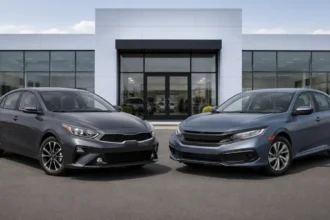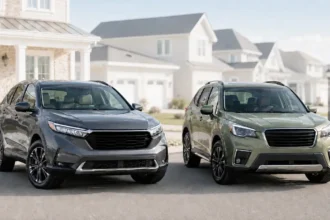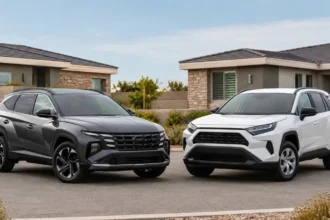


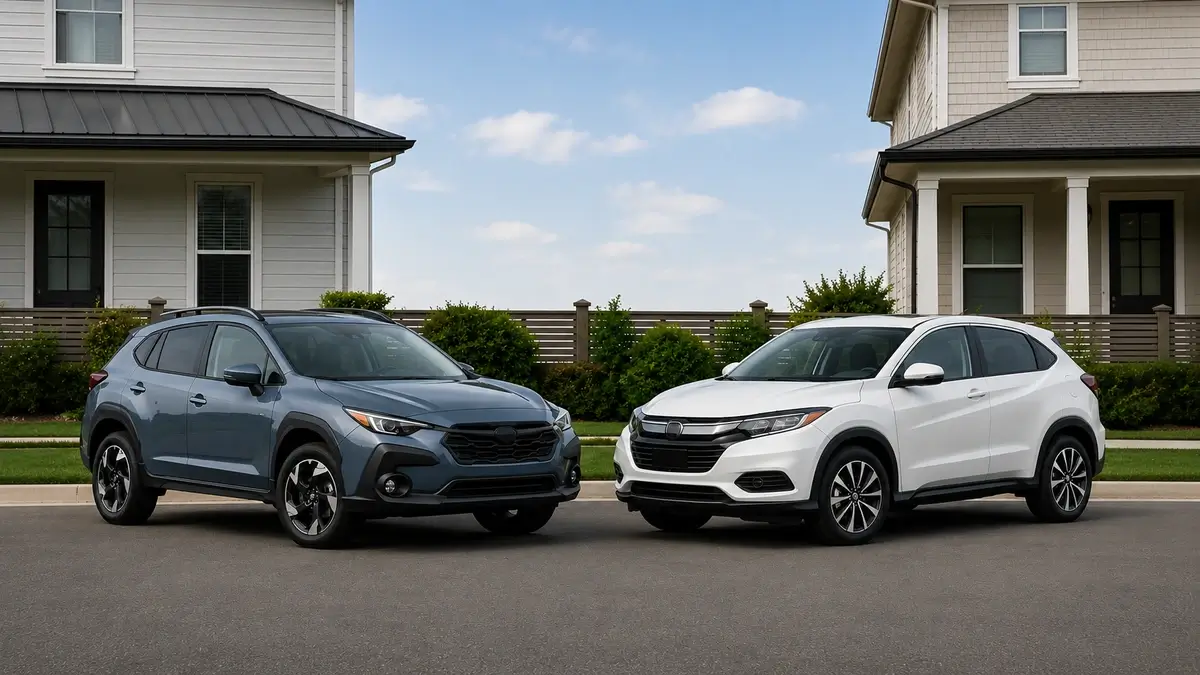
The Subaru Crosstrek vs Honda HR-V decision is really about where you drive.
Choose the Subaru Crosstrek if you want standard AWD confidence, more bad-weather security, better rough-road comfort, and light outdoor flexibility.
Choose the Honda HR-V if you spend most of your time in the city and want a small SUV that feels easier, simpler, and more practical for daily use.
The wrong choice is not usually a bad vehicle. It is buying capability you do not need, or skipping capability you will miss every winter.
Fastest safe default: buy the Crosstrek for snow, gravel, hills, and outdoor use. Buy the HR-V for city driving, errands, and easier urban use.
CarMerit reliability comparator
Subaru Crosstrek vs Honda HR-V: 2016-2026 NHTSA snapshot
Owner-complaint and recall counts from NHTSA for 2016-2026, each model’s best used-year lane, and which buyer each one fits.
| 1,084 | complaints (2016-26) | 1,769 |
| 17 | recalls (2016-26) | 32 |
Visibility / wipersElectricalEnginePowertrain / transmission | top issues | Visibility / wipersElectricalAirbags / seatbelts / structureSteering |
Subaru Crosstrek
Best used year: 2022
Stronger start 2020 gas and 2022 gas; caution 2016-2017, 2019, and 2021; too new to judge 2024-2026.
Best for: Snow-and-outdoor buyers who want standard AWD, ground clearance, and rough-road comfort for gravel, hills, and light trails.
Honda HR-V
Best used year: 2022
Best 2020-2022; value 2019; high caution 2016-2018; inspect 2023-2025 carefully.
Best for: City-first buyers who want easier daily driving, tight-space parking, and a choice between FWD and AWD.
Quick take: Choose the Crosstrek for snow, gravel, hills, and outdoor use. Choose the HR-V for city driving, errands, and easier urban use when Subaru-style capability is not needed. Do not overpay for AWD you will not use, but do not skip it if you will miss it every winter. Do not crown either SUV from raw NHTSA counts alone.
Complaint counts are raw owner reports filed with NHTSA, not adjusted for sales volume, so they should guide inspection rather than crown a winner. The quick comparator above uses a 2016-2026 overlapping NHTSA snapshot for both models; if one model has older NHTSA history before 2016, those model-only years are excluded here to keep the comparison balanced. Always inspect the specific vehicle before buying.
Quick Verdict: Subaru Crosstrek vs Honda HR-V
The Crosstrek is the better used small SUV for drivers who face snow, rain, poor roads, steep driveways, or weekend outdoor use.
The HR-V is the better used small SUV for buyers who mostly commute, park in tight spaces, carry groceries or small-family gear, and do not need Subaru-style capability.
The Crosstrek can be the better pick if AWD matters, but that does not make every used example a safer buy.
Neither one should win on brand reputation alone. Used condition, model year, mileage, tires, accident history, and service records matter more than the badge.
| Factor | Subaru Crosstrek | Honda HR-V |
|---|---|---|
| Best overall fit | Weather, rough roads, outdoor use | City driving, daily errands, practical cabin use |
| Main strength | Standard AWD and ground-clearance confidence | Simple daily usability and useful cargo layout |
| Main trade-off | Standard AWD and extra ground clearance may be unnecessary for a city-only buyer | Less rugged, and AWD depends on listing configuration |
| Best buyer | Snow-belt driver or outdoor-focused buyer | City commuter or small-family daily driver |
| Fuel economy | Competitive, but varies by engine and version | Usually efficient enough, especially FWD versions |
| Used-buying risk | Check tires, suspension, AWD service, and CVT behavior | Check transmission feel, recalls, safety tech, and trim features |
| Best answer | Buy it if you will use the capability | Buy it if daily practicality matters more |
For shoppers comparing more small SUVs, CarMerit also covers Subaru Crosstrek vs Mazda CX-30 and Honda HR-V vs Toyota Corolla Cross.
Best Choice by Buyer Type
The right answer changes quickly once you define the buyer.
The Crosstrek looks stronger when the driving environment is difficult. The HR-V looks stronger when the job is normal daily transportation.
| Buyer type | Better pick | Why |
| Snow-belt commuter | Subaru Crosstrek | Standard AWD and ground clearance matter more |
| Urban driver | Honda HR-V | Easier daily fit if AWD is not essential |
| Small family | Honda HR-V | Practical cabin and cargo use are strong daily advantages |
| Outdoor weekend buyer | Subaru Crosstrek | Better fit for trailheads, gravel roads, and poor weather |
| Budget-sensitive buyer | Depends on listing | Compare mileage, trim, tires, and service history first |
| Front-drive city buyer | Honda HR-V FWD | A direct fit when AWD and extra ground clearance are not priorities |
| Long-term keeper | Depends on condition | Buy the cleaner, better-maintained example |
Table Note: These recommendations describe buyer fit and drivetrain availability. They do not establish a universal maintenance-cost, repair-cost, or reliability advantage for either model.
Do not overpay for the Crosstrek just because AWD sounds safer. AWD helps traction, but it does not replace good tires.
Do not buy the HR-V just because it feels more sensible. If you regularly drive in snow, on steep roads, or on rough rural routes, the HR-V may feel under-equipped.
Used-Buyer Baseline: What This Comparison Assumes
This is a used-buyer comparison, not a new-car spec sheet.
A used 2017 HR-V, a used 2021 Crosstrek, and a newer 2025 example are not the same buying decision. Safety tech, drivetrain setup, cargo layout, engine output, infotainment, and resale value can shift by year and trim.
Before choosing either one, verify five things:
- model year and trim
- AWD or front-wheel drive
- accident and title history
- service records and open recalls
- tire condition and test-drive behavior
Before deciding whether a Crosstrek’s AWD capability is worth more to you than an HR-V’s city-friendly simplicity, confirm that the actual listings have the year, drivetrain, and configuration you think they do. Run both VINs through the CarMerit VIN Lookup and compare the returned vehicle details with each seller’s description and paperwork. Then use the official NHTSA VIN search separately for open recalls before comparing condition, service history, and price.
Use NHTSA’s recall search before buying either vehicle. Check the exact VIN, not just the model name.
For fuel economy, use the exact model year on FuelEconomy.gov. EPA numbers can change by engine, drivetrain, and trim.
Driving, AWD, and Ground-Clearance Trade-Offs
This is where the Crosstrek builds its strongest case.
Late-model Crosstrek examples are built around Subaru’s standard Symmetrical AWD. Subaru also gives the Crosstrek useful ground clearance for snow, ruts, gravel roads, and rough parking areas.
That does not make it a serious off-road SUV. It makes it a small SUV that handles bad roads and bad weather better than most city-first rivals.
The HR-V is different. Honda offers available Real Time AWD on newer HR-V trims, but the HR-V still feels more like a practical urban crossover than a rugged small SUV.
| Driving need | Crosstrek advantage | HR-V advantage |
| Snow and slush | Stronger default choice | Works if AWD-equipped and tires are good |
| Rainy commuting | AWD confidence helps | Fine for normal roads |
| Gravel or trailhead roads | Better fit | Acceptable only for light use |
| City parking | Still compact, but more rugged-focused | Easier daily-use fit |
| Highway commuting | Comfortable enough | More conventional daily-driver feel |
| Tire sensitivity | Very important | Still important, but AWD mismatch is less central |
AWD is not magic. A front-drive HR-V with excellent tires can be safer than a neglected Crosstrek on worn tires.
Still, if your weekly driving includes snow, hills, or rough roads, the Crosstrek gives you more margin.
Space, Comfort, and Daily Practicality
The HR-V makes its best case when life is ordinary.
It works well for errands, commuting, tight parking, grocery runs, and light family duty. Newer HR-V examples also have useful cargo room for a small SUV.
The Crosstrek is practical too, but its appeal is broader than cargo. It gives you hatchback-like size with SUV traction and clearance.
| Practical need | Better fit | Why |
| Rear-seat adults | Depends on generation | Sit in both before deciding |
| Child seats | Honda HR-V often feels easier | Cabin shape and access matter |
| Groceries and errands | Honda HR-V | Cargo area is easy to use |
| Outdoor gear | Subaru Crosstrek | Better match for muddy or snowy access roads |
| Tight urban parking | Honda HR-V | City-first feel helps |
| Visibility and confidence | Subaru Crosstrek | Upright, outdoorsy driving feel appeals to many buyers |
Do not buy based only on cargo-volume numbers. Cargo shape, rear-seat fold, load height, and hatch opening matter more in real life.
Bring your stroller, dog crate, folding chairs, or work gear to the test drive. That reveals more than a spec table.
Fuel Economy and Ownership Cost Reality
Fuel economy should be compared by exact configuration, not by badge. Comparable automatic versions can be close, but manual Crosstreks, Wilderness models, engine choices, and FWD-versus-AWD HR-Vs can shift the EPA result.
FuelEconomy.gov shows why used buyers should match the exact model year, engine, transmission, and drivetrain. These are the official rounded gasoline ratings for the configurations covered by this comparison.
| Subaru Crosstrek (MPG) | Honda HR-V (MPG) | ||||||||
|---|---|---|---|---|---|---|---|---|---|
| Model Year | Configuration | City | Highway | Combined | Model Year | Configuration | City | Highway | Combined |
| 2016 | 2.0L AWD; manual or automatic | 23–26 | 30–33 | 26–29 | 2016 | 1.8L FWD manual; FWD or AWD automatic | 25–28 | 32–34 | 28–31 |
| 2017 | 2.0L AWD; manual or automatic | 23–26 | 30–33 | 26–29 | 2017 | 1.8L FWD manual; FWD or AWD automatic | 25–28 | 31–34 | 28–31 |
| 2018 | 2.0L AWD; manual or automatic | 23–27 | 29–33 | 25–29 | 2018 | 1.8L FWD manual; FWD or AWD automatic | 25–28 | 31–34 | 28–31 |
| 2019 | 2.0L AWD; manual or automatic | 23–27 | 29–33 | 25–29 | 2019 | 1.8L FWD or AWD automatic | 26–28 | 31–34 | 28–30 |
| 2020 | 2.0L AWD; manual or automatic | 22–27 | 29–33 | 25–30 | 2020 | 1.8L FWD or AWD automatic | 26–28 | 31–34 | 28–30 |
| 2021 | 2.0L AWD manual or automatic; 2.5L AWD automatic | 22–28 | 29–34 | 25–30 | 2021 | 1.8L FWD or AWD automatic | 26–28 | 31–34 | 28–30 |
| 2022 | 2.0L AWD manual or automatic; 2.5L AWD automatic | 22–28 | 29–34 | 25–30 | 2022 | 1.8L FWD or AWD automatic | 26–28 | 31–34 | 28–30 |
| 2023 | 2.0L AWD manual or automatic; 2.5L AWD automatic | 22–28 | 29–34 | 25–30 | 2023 | 2.0L FWD or AWD automatic | 25–26 | 30–32 | 27–28 |
| 2024 | 2.0L or 2.5L AWD automatic; Wilderness included | 25–27 | 29–34 | 27–29 | 2024 | 2.0L FWD or AWD automatic | 25–26 | 30–32 | 27–28 |
| 2025 | 2.0L or 2.5L AWD automatic; Wilderness included | 25–27 | 29–34 | 27–29 | 2025 | 2.0L FWD or AWD automatic | 25–26 | 30–32 | 27–28 |
| 2026 | 2.5L AWD automatic; Wilderness included | 24–26 | 29–33 | 26–29 | 2026 | 2.0L FWD or AWD automatic | 25–26 | 30–32 | 27–28 |
Table Note: Each range shows the lowest and highest official rounded EPA estimate among the gasoline configurations listed for that model year; it is not an average, and intermediate values are not necessarily available. Crosstrek Hybrid, plug-in-hybrid, and MPGe records are excluded. The 2016 HR-V figures reflect the current revised historical estimates. Compare the exact engine, transmission, and drivetrain on FuelEconomy.gov before deciding. Actual mileage varies with driving, weather, maintenance, and vehicle condition.
| Ownership factor | Subaru Crosstrek | Honda HR-V |
| Fuel economy | Competitive, but version-dependent | Competitive, especially FWD examples |
| Tire cost sensitivity | Higher if AWD tire matching is ignored | Less AWD-sensitive on FWD examples |
| Maintenance burden | Check AWD, suspension, CVT service history | Check CVT behavior and routine service |
| Resale/value | Compare same-year, same-trim Crosstrek listings by drivetrain, mileage, condition, title status, and seller type | Apply the same filters to HR-V listings; do not infer a winner from unmatched asking prices |
| Best cost-control move | Avoid neglected AWD examples | Avoid poor-service, high-mileage examples |
Table Note: Asking prices are not transaction prices. Any future resale comparison should use public listings collected from the same market and date window, with matching model year, trim, drivetrain, mileage band, condition, title status, and seller type.
The cheapest listing is not automatically the cheapest ownership choice.
A slightly more expensive Crosstrek with clean service records can beat a cheaper one with worn tires and accident history. The same applies to the HR-V.
Reliability, Common Problems, and Model-Year Risk
Do not use forums as proof that one vehicle is reliable or unreliable.
Owner discussions are useful because they show what buyers worry about. They are not enough to make a hard reliability claim.
For a used Crosstrek, pay close attention to AWD behavior, tire wear, suspension noise, CVT feel, oil-change history, and whether all four tires match closely in brand, size, and tread depth.
Model year can materially change the Crosstrek’s risk profile. Use the Subaru Crosstrek years to avoid and best years to buy to narrow stronger starting points and identify the recall, CVT, and inspection checks that apply before purchase.
For a used HR-V, check CVT behavior, maintenance records, steering feel, brake wear, recalls, and whether safety features work as expected.
| Used-buying check | Subaru Crosstrek | Honda HR-V |
| Service records | Important | Important |
| Tires | Very important for AWD health | Important, especially AWD models |
| Transmission feel | Check for shudder, delay, or roughness | Check for shudder, delay, or roughness |
| Suspension noise | Watch on rough roads | Watch on rough roads |
| Recalls | Check exact VIN | Check exact VIN |
| Accident history | Can change the decision | Can change the decision |
Manufacturer Coverage Programs Worth Checking
Some manufacturer programs can materially change a used-car repair or inspection conversation, but model year alone does not establish eligibility. Ask an authorized dealer to check the VIN, original in-service or purchase date, mileage, installed equipment, diagnosis requirements, and repair history.
If a Crosstrek’s CVT, fuel-pump, or Thermo Control Valve history is being weighed against an HR-V’s CVT or keyless-start history, check both model years in CarMerit’s Manufacturer Special Coverage Lookup before deciding which SUV presents the easier repair-risk picture.
| Vehicle and affected scope | Covered component or condition | Official program boundary and buyer check |
|---|---|---|
| 2016-17 and 2019 Subaru Crosstrek | Specified CVT | Coverage was extended to 10 years/100,000 miles from the original warranty start date, whichever comes first. The 2016 program includes specified gasoline and Hybrid CVTs; the 2017 program applies to the specified 2.0L CVT; the 2019 program applies to the 2.0L gasoline model, excludes the Hybrid, and requires an original or genuine Subaru CVT. Verify the VIN and Vehicle Coverage Inquiry status. |
| 2016-17 Subaru Crosstrek | Electric power-steering gearbox | Coverage was extended to 10 years with unlimited mileage for the specified qualifying gearbox crack. VIN eligibility, dealer confirmation, and the exact diagnosed condition control. |
| 2018-20 Subaru Crosstrek | Low-pressure fuel pump | For qualifying “Additional Vehicles” produced from July 5, 2017, through August 5, 2019, coverage was extended to 15 years with unlimited mileage from the original warranty start date. Exact VIN and production-date eligibility apply, and the program permits one qualifying replacement. |
| 2019-23 Subaru Crosstrek with Gen 3.1 infotainment | Qualifying infotainment head unit | Coverage was extended to 8 years/150,000 miles, whichever comes first. Physical damage, speakers, amplifiers, and wiring are excluded; reprogramming may be required before replacement. Verify the installed equipment, VIN, diagnosis, and authorization requirements. |
| 2021 Subaru Crosstrek | Thermo control valve | Coverage was extended to 15 years/150,000 miles, whichever comes first. Exact VIN eligibility and a qualifying diagnosis are required. |
| 2016-23 Subaru Crosstrek with specified equipment | Selected EyeSight and reverse automatic braking components | The program added 1 year/12,000 miles beyond the original 3-year/36,000-mile coverage. Subaru pays 75% during the additional period, subject to the exact component, VIN, diagnosis, and exclusions. |
| 2019-23 Subaru Crosstrek PHEV | Front exhaust pipe | Federal Emissions defect-warranty coverage was extended to 15 years/150,000 miles, whichever comes first. A separate blanket period for otherwise expired eligible vehicles ends November 17, 2026. Verify the VIN, PHEV identity, Federal Emissions eligibility, and current program status. |
| 2016-18 Honda HR-V with NH-788P white paint | Covered factory-painted exterior panels with qualifying peeling | Coverage was extended to 7 years from the original purchase date with no mileage limit. Verify the paint code, VIN eligibility, title status, affected factory-painted panel, prior repairs, and whether the time term has expired. |
| 2016-18 Honda HR-V EX and EX-L | Engine start/stop switch for the specified keyless-start error | Coverage was extended to 9 years/125,000 miles from the original purchase date, whichever comes first. Exact VIN eligibility and the applicable diagnosis are required. |
| 2016-20 Honda HR-V with CVT | Qualifying premature CVT drive-belt deterioration | Coverage was extended to 7 years/150,000 miles from the original purchase date, whichever comes first. The required PCM update and CVT inspection precede a qualifying replacement; verify the VIN, diagnosis, and current status. |
Table Note: These are component-specific manufacturer programs, not blanket warranties, recalls, failure-rate evidence, or proof that a particular vehicle still has coverage. Remaining coverage cannot be calculated without the VIN, original in-service or purchase date, mileage, equipment, diagnosis, title status, and current program terms. Some older time-based programs may already have expired; verify both current eligibility and prior repair completion with an authorized dealer.
If you want HR-V-specific risk guidance, read Best Honda HR-V Years to Buy and Years to Avoid and Honda HRV Reliability and Cost to Own.
The best reliability move is not choosing a brand. It is buying the cleaner vehicle with the better history.
Safety, Driver Assistance, and Used-Car Checks
Safety depends on model year and trim.
Do not assume every HR-V or Crosstrek listing has the same driver-assistance features. Blind-spot monitoring, adaptive cruise control, lane support, and automatic braking can vary by year and trim.
Check the exact listing against official specs, the window sticker if available, and the vehicle’s actual dashboard menus.
| Safety or tech item | What to verify |
| Crash-test ratings | Check IIHS and NHTSA by model year |
| Open recalls | Search the VIN on NHTSA |
| Blind-spot monitoring | Confirm on the actual vehicle |
| Adaptive cruise control | Confirm by trim and test drive |
| Automatic emergency braking | Verify by year and package |
| Backup camera and sensors | Test during inspection |
| Tires and brakes | Inspect condition, not just age |
IIHS award history changes by criteria year and can depend on equipment, headlights, build date, body style, and powertrain. The checked award pages show the following history:
| IIHS criteria year | Subaru Crosstrek award-page entry | Honda HR-V award-page entry |
|---|---|---|
| 2016 | 2016 Top Safety Pick+ with optional front crash prevention | Not listed |
| 2017 | 2017 Top Safety Pick with optional front crash prevention; 2018 Top Safety Pick+ with optional front crash prevention, specific headlights, and a build date after October 2017 | Not listed |
| 2018 | 2018 Top Safety Pick+ with optional front crash prevention, specific headlights, and a build date after April 2018 | Not listed |
| 2019 | 2019-20 Top Safety Pick+ with optional front crash prevention and specific headlights; 2019-20 Plug-In Hybrid Top Safety Pick+ | 2019-20 Top Safety Pick with optional front crash prevention and specific headlights |
| 2020 | 2020-21 gasoline model Top Safety Pick with optional front crash prevention and specific headlights; 2020-21 Plug-In Hybrid Top Safety Pick+ | Not listed |
| 2021 | 2021-22 gasoline model Top Safety Pick with optional front crash prevention and specific headlights; 2021-22 Plug-In Hybrid Top Safety Pick+ | Not listed |
| 2022 | 2022-23 gasoline model Top Safety Pick with optional front crash prevention and specific headlights; 2022-23 Plug-In Hybrid Top Safety Pick+ | 2023 Top Safety Pick+ |
| 2023 | 2024 Top Safety Pick | 2023-24 Top Safety Pick+ |
| 2024 | Not listed | 2024-25 Top Safety Pick+ |
| 2025 | Not listed | 2025-26 Top Safety Pick+ |
| 2026 | 2026 Crosstrek Hybrid Top Safety Pick+ | 2026 Top Safety Pick+ |
Table Note: IIHS changes its award criteria over time, and the Crosstrek and HR-V appear in different IIHS vehicle classes. This is award-page history, not a direct safety ranking. An award may apply only to the listed model years, equipment, headlights, build dates, body style, or powertrain. “Not listed” means no applicable entry appeared on the checked criteria-year award page; it does not mean the vehicle is unsafe.
Check the exact model year on the IIHS vehicle pages for the Subaru Crosstrek and Honda HR-V.
For recalls, do not rely on seller promises. Use the VIN.
Trim and Feature Value When Buying Used
Used trim value is simple: pay for features you will actually use.
For the Crosstrek, useful features include AWD-related confidence, roof rails, winter-friendly equipment, blind-spot monitoring, adaptive cruise, heated seats, and a clean service history.
For the HR-V, useful features include safety tech, blind-spot monitoring, adaptive cruise, easy smartphone integration, good tires, and a clean ownership record.
| Feature | Worth paying for? | Buyer logic |
| AWD | Yes, if weather or roads justify it | Do not buy AWD just for image |
| Blind-spot monitoring | Usually yes | Helpful in daily traffic |
| Adaptive cruise control | Yes for highway commuters | Less important for short city trips |
| Roof rails | Yes for outdoor users | Skip if you never carry gear |
| Larger wheels | Sometimes no | Can add tire cost without much benefit |
| Leather or moonroof | Only if priced fairly | Nice, but not a core used-buy reason |
| Clean service history | Yes | More important than many features |
Avoid a high-trim used example if it has poor tires, missing service records, accident history, or unresolved recalls.
A clean mid-trim is usually smarter than a loaded neglected one.
Which One Should You Buy?
Buy the Subaru Crosstrek if your driving life includes snow, rain, rough pavement, gravel roads, trailheads, hills, or outdoor gear.
It is the stronger choice when capability is not just a nice extra. It makes sense when you will actually use AWD and ground clearance.
Buy the Honda HR-V if your driving life is mostly commuting, errands, city parking, and normal family use.
It is the cleaner choice when you want a practical small SUV without paying extra for ruggedness you do not need.
| Final decision | Choose this |
| Best for winter states | Subaru Crosstrek |
| Best for city errands | Honda HR-V |
| Best for rough roads | Subaru Crosstrek |
| Best for simple daily use | Honda HR-V |
| Best for outdoor lifestyle | Subaru Crosstrek |
| Best if condition is much better | The cleaner vehicle, regardless of badge |
| Best if both are equal | Crosstrek for capability, HR-V for daily practicality |
Skip the Crosstrek if you do not need AWD, dislike a rugged ride feel, or find a poorly maintained example.
Skip the HR-V if AWD confidence, ground clearance, and rough-road ability are important to you.
For broader shopping context, use CarMerit’s Best Used Small SUVs to Buy and Best Used Compact SUVs to Buy guides.
Frequently Asked Questions
Which is better, Subaru Crosstrek or Honda HR-V?
The Subaru Crosstrek is better for AWD confidence, bad weather, rough roads, and outdoor use. The Honda HR-V is better for city driving, daily practicality, and buyers who do not need extra capability.
Should I buy a used Subaru Crosstrek or a used Honda HR-V?
Buy the used Crosstrek if road conditions matter more than simple daily comfort. Buy the used HR-V if your priority is commuting, errands, parking ease, and practical cabin use.
Is the Crosstrek better than the HR-V in snow?
Usually, yes, if the Crosstrek has good tires and has been maintained well. The HR-V can work in snow when equipped with AWD and proper tires, but the Crosstrek is the more natural snow-belt choice.
Is the Honda HR-V better for city driving than the Crosstrek?
Yes, for many buyers. The HR-V makes more sense if your driving is mostly urban, short-trip, parking-heavy, and low-speed. The Crosstrek’s capability matters less in that use case.
Does the Honda HR-V have AWD like the Crosstrek?
Some HR-V models offer AWD, but it is not the same buying proposition as the Crosstrek’s standard AWD identity. Always confirm the exact used HR-V listing. Do not assume every HR-V has AWD.
Which has better fuel economy, Crosstrek or HR-V?
It depends on year, trim, drivetrain, and engine. Recent EPA examples show both can be competitive. Check the exact model year on FuelEconomy.gov before deciding.
Which has more useful cargo space, Crosstrek or HR-V?
The HR-V often has a strong everyday cargo case, especially for errands and city use. The Crosstrek is better if your cargo needs include muddy gear, snow trips, roof accessories, or outdoor equipment.
Is the Subaru Crosstrek more reliable than the Honda HR-V?
Do not make that decision from reputation alone. Compare the exact year, mileage, service history, recalls, inspection results, and test-drive behavior. A clean HR-V can beat a neglected Crosstrek, and the reverse is also true.
Which one has better resale value, Crosstrek or HR-V?
Neither model has a universal resale-value win. Compare same-market listings for the same model year, trim, drivetrain, mileage band, condition, title status, and seller type. Treat advertised prices as asking prices rather than completed transaction values.
What should I check before buying either one used?
Check the VIN for recalls, review service records, inspect tires and brakes, test the transmission, confirm safety features, and compare the exact trim to official specs. Do not skip the pre-purchase inspection. It matters more than the badge.