

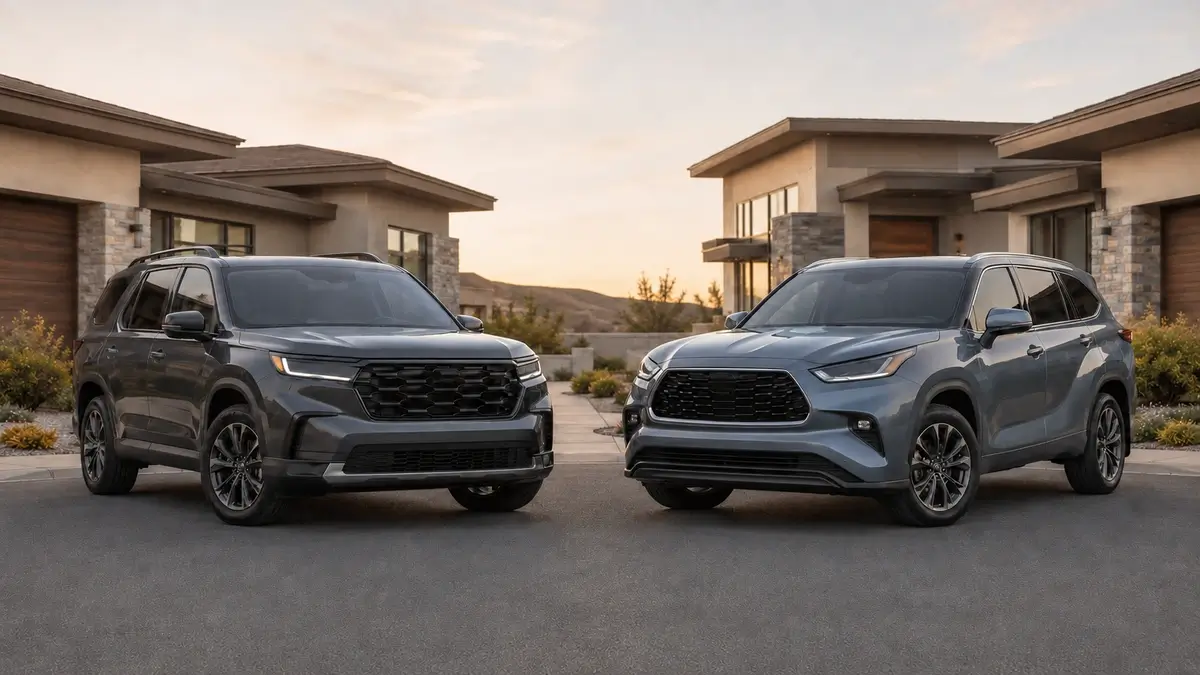
The Honda Pilot vs Toyota Highlander choice comes down to one practical question: do you need more family space, or do you want the easier fuel-cost and ownership case?
Choose the Honda Pilot if you need a roomier three-row SUV for kids, passengers, cargo, and road trips.
Choose the Toyota Highlander if fuel economy, hybrid availability, and easier two-row daily use matter more.
The wrong choice is not usually a bad SUV. It is buying the one that does not match your daily use.
Fastest safe default: buy the cleanest, best-maintained example with the right model year, verified service history, working safety tech, and no open safety recall.
CarMerit reliability comparator
Honda Pilot vs Toyota Highlander: 2008-2026 NHTSA snapshot
Owner-complaint and recall counts from NHTSA for 2008-2026, each model’s best used-year lane, and which buyer each one fits.
| 6,515 | complaints (2008-26) | 4,250 |
| 134 | recalls (2008-26) | 102 |
EngineElectricalUnknown / otherAirbags / seatbelts / structure | top issues | Powertrain / transmissionAirbags / seatbelts / structureBrakesUnknown / other |
Honda Pilot
Best used year: 2015
Starting points 2014-2015 and 2021-2022; avoid first 2003-2004 and 2016; treat 2009-2013 and 2017-2020 as caution years.
Best for: Space-first families who need a roomier third row and more cargo usefulness for kids, passengers, and road trips.
Toyota Highlander
Best used year: 2016
Starting points 2013, 2016, 2019, and 2022; avoid unverified 2017-2018 gas V6 models; treat 2008 V6 as high caution.
Best for: Efficiency-first buyers who want stronger hybrid availability and better fuel-economy options.
Quick take: Choose the Pilot if you need a roomier three-row SUV and will actually use the third row often. Choose the Highlander if fuel economy, hybrid availability, and easier two-row daily use matter more. The better SUV depends on how often the third row is used and how clean the exact vehicle is. Do not crown either SUV from raw NHTSA counts alone.
Complaint counts are raw owner reports filed with NHTSA, not adjusted for sales volume, so they should guide inspection rather than crown a winner. The quick comparator above uses a 2008-2026 overlapping NHTSA snapshot for both models; if one model has older NHTSA history before 2008, those model-only years are excluded here to keep the comparison balanced. Always inspect the specific vehicle before buying.
Quick Verdict: Which Used SUV Should You Buy?
The Pilot is the stronger used SUV for families who actually use all three rows. The Highlander is the stronger used SUV for buyers who prioritize fuel economy and hybrid availability.
| Buyer Priority | Better Pick | Why It Matters |
|---|---|---|
| Frequent third-row use | Honda Pilot | The Pilot is easier to justify when older kids, teens, or adults use the back row often. |
| Fuel economy | Toyota Highlander | The Highlander Hybrid gives Toyota a major advantage if the right used example fits your budget. |
| Maximum family space | Honda Pilot | The Pilot has the stronger case for road trips, gear, and larger families. |
| Towing with gas models | Tie, depending on setup | Both can work, but drivetrain, trim, and equipment must be verified. |
| High-mileage used buy | Either—vehicle condition decides | Service history, inspection results, mileage, and unresolved recalls matter more than the badge. |
| Best all-around family hauler | Honda Pilot | The Pilot gives up fuel economy, but it wins on practical space. |
The used-buyer answer is not the same for everyone.
If your family often fills every seat, the Pilot’s space advantage matters every week. If you mostly use two rows and want lower fuel costs, the Highlander is the smarter shortlist.
Honda Pilot vs Toyota Highlander: Key Differences
The biggest differences are space, fuel economy, hybrid availability, and third-row usefulness. Raw specs matter only when they change the buying decision.
| Factor | Honda Pilot | Toyota Highlander |
| Main strength | Family space and third-row usability | Fuel economy, hybrid option, and easy daily use |
| Main weakness | Fuel economy is not its strongest case | Third row can feel tighter for frequent use |
| Best used buyer | Larger families and road-trip buyers | Efficiency-focused families and commuters |
| Hybrid availability | Not the main reason to shop Pilot | Major advantage for Highlander |
| Cargo practicality | Stronger for bigger family loads | Good, but less generous in regular Highlander form |
| Reliability rule | Verify the exact year, service history, VIN coverage, and inspection | Verify the exact year, service history, VIN coverage, and inspection |
| Used-buying risk | Condition, mileage, transmission feel, and recalls matter | Hybrid condition, service history, and recalls matter |
The Pilot makes its case through space. The Highlander makes its case through efficiency and long-term cost control.
That means the better SUV depends on how often you use the third row. A buyer who rarely uses it may not benefit enough from the Pilot’s size.
Space, Seating, and Cargo Practicality
Space is the first real separator in this comparison. The Pilot is easier to recommend if the third row is part of normal life, not an emergency backup.
Honda’s official 2024 Pilot specifications list 18.6 cubic feet of cargo room behind the third row, with higher figures by Honda’s alternate measurement method. Honda also lists up to 113.7 cubic feet behind the first row on some trims through that method.
Toyota’s official 2024 Highlander brochure lists 84.3 cubic feet behind the front row, 48.4 cubic feet behind the second row, and 16.0 cubic feet behind the third row. Measurement methods can vary, so always compare the exact model year you are shopping.
For a used buyer, the practical takeaway is simple: recent official specs support the Pilot’s stronger cargo and third-row case. The regular Highlander is still family-friendly, but it is less convincing if the third row will carry bigger passengers often.
| Practical Space Need | Better Pick | Buyer Note |
| Two kids plus cargo | Either | Choose based on fuel cost, trim, and condition. |
| Three kids plus luggage | Honda Pilot | The Pilot gives you more flexibility. |
| Adults in third row often | Honda Pilot | Test the third row before buying any three-row SUV. |
| School runs and light cargo | Toyota Highlander | The Highlander is easier to justify if you rarely max it out. |
| Road trips with all rows used | Honda Pilot | Cargo room with all seats up matters more here. |
Do not buy either SUV from cargo numbers alone. Bring the stroller, car seat, sports bags, or cooler you actually use.
The Pilot’s advantage gets stronger as your family load grows. The Highlander makes more sense when the third row is occasional.
Reliability and Model-Year Risk
Neither badge is a reliability shortcut. A clean Pilot with complete records can be a better buy than a neglected Highlander, and the reverse is also true. Verify the exact model year, service history, VIN-specific coverage, recall status, and results of an independent pre-purchase inspection.
If your Pilot-versus-Highlander decision has reached two specific SUVs, first confirm that each listing represents the vehicle accurately. Run both VINs through the CarMerit VIN Lookup and compare the returned vehicle details with each seller’s description and paperwork. That gives you a cleaner basis for comparing the right model years and configurations before service history, special coverage, recall status, and inspection results decide which SUV is the safer buy.
Official warranty extensions and support programs can affect the economics of a specific VIN. They are not proof that a problem is common, and the listed model years do not mean every vehicle qualifies.
If your choice comes down to specific Pilot and Highlander model years, run each one through CarMerit’s Manufacturer Special Coverage Lookup so you can spot relevant Honda or Toyota coverage records before comparing repair exposure; final eligibility still needs VIN-specific dealer confirmation.
VIN and Coverage Checks That Matter
| Vehicle | Official coverage record | Used-buyer action |
|---|---|---|
| 2016–19 Honda Pilot | Honda issued two fuel-injector-related extensions. Certain 2016–17 vehicles received coverage for listed software and injector repairs, while certain 2017–19 vehicles received injector coverage. Both use a 10-year/150,000-mile limit from the original purchase date, whichever comes first. | Check the VIN, applicable diagnostic codes, and dealer diagnosis against the 2016–17 notice and 2017–19 notice. |
| 2016–22 Honda Pilot with 9-speed automatic and Idle Stop | For certain 2016–21 Pilots, Honda extended specified starter-replacement and valve-adjustment coverage related to a no-auto-restart condition to 10 years with no mileage limit. A separate notice applies valve-adjustment coverage to certain 2021–22 Pilots on the same term. | Confirm the transmission, Idle Stop equipment, VIN status, diagnosis, and any required product update under the 2016–21 notice and 2021–22 notice. |
| 2020-and-newer Toyota Highlander Hybrid | Toyota states that the hybrid battery is covered for 10 years or 150,000 miles and hybrid-related components for 8 years or 100,000 miles, whichever comes first. | Use Toyota’s warranty and owner-manual portal to verify the exact component list, in-service date, mileage, and remaining coverage. |
| Certain 2014–16 Toyota Highlander Hybrid vehicles | Toyota Customer Support Program 24TE01 covers specified brake-booster and brake-booster-pump internal malfunctions. Its primary coverage ended March 31, 2025; secondary coverage is vehicle-specific and runs for 10 years or 150,000 miles from the date of first use, whichever comes first. | Ask a Toyota dealer to check the VIN, production date, in-service date, mileage, title status, and applicable diagnostic codes C1391, C1252, C1253, or C1256 against the official program document. |
Table Note: Coverage records are not failure-rate or reliability evidence. Remaining eligibility depends on the exact VIN, original in-service date, mileage, configuration, diagnosis or DTCs, title status, and controlling program terms. Have an authorized dealer confirm the VIN before purchase.
For the Pilot, use the Honda Pilot reliability and cost-to-own guide and Honda Pilot years to avoid and best years to buy before shortlisting a specific year.
For the Highlander, use the Toyota Highlander reliability and cost-to-own guide and Toyota Highlander years to avoid and best years to buy before comparing a specific gas or hybrid model year.
Before buying either SUV, enter the VIN in the NHTSA recall lookup. A warranty extension or customer-support program is separate from a safety recall and may require a dealer VIN check.
If reliability is your first filter, compare this matchup with CarMerit’s guide to the most reliable used cars. In every case, a well-documented vehicle with clean inspection results should beat a badge-level assumption.
Ownership Costs, Fuel Economy, and Maintenance
Fuel economy is where the Highlander can pull ahead. The Highlander Hybrid is the biggest reason efficiency-focused buyers should not default to the Pilot.
The current FuelEconomy.gov data shows that fuel economy changes by model year, drivetrain, engine, transmission, and configuration. Identical model years are grouped below, while every different official configuration is identified separately.
Honda Pilot EPA Fuel Economy
| Model years | FWD configurations — EPA MPG (city/highway/combined) | AWD configurations — EPA MPG (city/highway/combined) |
|---|---|---|
| 2008 | 5-speed automatic — 16/22/18 | 5-speed automatic — 15/20/17 |
| 2009–11 | 5-speed automatic — 17/23/19 | 5-speed automatic — 16/22/18 |
| 2012–15 | 5-speed automatic — 18/25/20 | 5-speed automatic — 17/24/20 |
| 2016 | 6-speed automatic — 19/27/22 9-speed automatic — 20/27/23 | 6-speed automatic — 18/25/21 9-speed automatic — 19/26/22 |
| 2017–20 | 6-speed automatic — 19/27/22 9-speed automatic — 20/27/23 | 6-speed automatic — 18/26/21 9-speed automatic — 19/26/22 |
| 2021 | 9-speed automatic — 20/27/23 | 9-speed automatic — 19/26/22 |
| 2022 | 9-speed automatic — 20/27/23 | Standard AWD, 9-speed automatic — 19/26/22 AWD TrailSport, 9-speed automatic — 19/25/21 |
| 2023–26 | 10-speed automatic — 19/27/22 | AWD and AWD Touring/Elite/Black Edition, 10-speed automatic — 19/25/21 AWD TrailSport, 10-speed automatic — 18/23/20 |
Table Note: Each line represents a separate official EPA configuration, not a duplicate or an average. Model-year ranges are used only where the displayed configurations and MPG ratings remain identical. Verify the exact drivetrain, transmission, and trim before applying a rating to a vehicle.
Toyota Highlander Gas EPA Fuel Economy
| Model years | Gas FWD configurations — EPA MPG (city/highway/combined) | Gas AWD configurations — EPA MPG (city/highway/combined) |
|---|---|---|
| 2008 | 3.5L V6, 5-speed automatic — 18/24/20 | 3.5L V6, 5-speed automatic — 17/23/19 |
| 2009–10 | 2.7L four-cylinder, 6-speed automatic — 20/27/22 3.5L V6, 5-speed automatic — 18/24/20 | 3.5L V6, 5-speed automatic — 17/23/19 |
| 2011–13 | 2.7L four-cylinder, 6-speed automatic — 20/25/22 3.5L V6, 5-speed automatic — 18/24/20 | 3.5L V6, 5-speed automatic — 17/22/19 |
| 2014–16 | 2.7L four-cylinder, 6-speed automatic — 20/25/22 3.5L V6, 6-speed automatic — 19/25/21 | 3.5L V6, 6-speed automatic — 18/24/20 |
| 2017–19 | 2.7L four-cylinder, 6-speed automatic — 20/24/22 3.5L V6, 8-speed automatic without stop-start — 20/27/23 3.5L V6 LE/XLE/SE/Limited with stop-start — 21/27/23 | 3.5L V6, 8-speed automatic without stop-start — 19/26/22 3.5L V6, 8-speed automatic with stop-start — 20/26/22 Highlander AWD LE — 20/27/23 |
| 2020–22 | 3.5L V6, 8-speed automatic without stop-start — 20/28/23 3.5L V6, 8-speed automatic with stop-start — 21/29/24 | 3.5L V6, 8-speed automatic — 20/27/23 |
| 2023–24 | 2.4L turbo four-cylinder without stop-start — 21/28/24 2.4L turbo four-cylinder with stop-start — 22/29/25 | 2.4L turbo four-cylinder, 8-speed automatic — 21/28/24 |
| 2025 | 2.4L turbo four-cylinder without stop-start — 21/28/24 2.4L turbo four-cylinder with stop-start — 22/29/25 | 2.4L turbo four-cylinder, 8-speed automatic — 21/28/24 |
| 2026 | Not listed | 2.4L turbo four-cylinder, 8-speed automatic — 21/28/24 |
Table Note: Each line represents a separate official EPA configuration, not a duplicate or an average. Model-year ranges are used only where the displayed configurations and MPG ratings remain identical. “Not listed” means no matching configuration appears in the current FuelEconomy.gov data; it is not a negative finding or a claim about production history. Verify the exact engine, drivetrain, stop-start equipment, and trim before applying a rating to a vehicle.
Toyota Highlander Hybrid EPA Fuel Economy
| Model years | Hybrid FWD configurations — EPA MPG (city/highway/combined) | Hybrid AWD configurations — EPA MPG (city/highway/combined) |
|---|---|---|
| 2008 | Not listed | 3.3L V6 Highlander Hybrid AWD — 27/25/26 |
| 2009–10 | Not listed | 3.3L V6 Highlander Hybrid AWD — 27/25/26 |
| 2011–13 | Not listed | 3.5L V6 Highlander Hybrid AWD — 28/28/28 |
| 2014–16 | Not listed | 3.5L V6 Highlander Hybrid AWD — 27/28/28 3.5L V6 Highlander Hybrid AWD LE Plus — 28/28/28 |
| 2017–19 | Not listed | 3.5L V6 Highlander Hybrid AWD — 29/27/28 3.5L V6 Highlander Hybrid AWD LE Plus — 30/28/29 |
| 2020–22 | 2.5L four-cylinder Highlander Hybrid FWD — 36/35/36 | 2.5L four-cylinder Highlander Hybrid AWD — 35/35/35 2.5L four-cylinder Highlander Hybrid AWD Limited/Platinum — 35/34/35 |
| 2023–24 | 2.5L four-cylinder Highlander Hybrid FWD — 36/35/36 | 2.5L four-cylinder Highlander Hybrid AWD — 35/35/35 2.5L four-cylinder Highlander Hybrid AWD Limited/Platinum — 35/34/35 |
| 2025 | Not listed | 2.5L four-cylinder Highlander Hybrid AWD — 35/35/35 2.5L four-cylinder Highlander Hybrid AWD Limited/Platinum — 35/34/35 |
| 2026 | Not listed | 2.5L four-cylinder Highlander Hybrid AWD — 35/35/35 2.5L four-cylinder Highlander Hybrid AWD Limited/Platinum — 35/34/35 |
Table Note: Each line represents a separate official EPA configuration, not a duplicate or an average. Model-year ranges are used only where the displayed configurations and MPG ratings remain identical. “Not listed” means no matching configuration appears in the current FuelEconomy.gov data; it is not a negative finding or a claim about production history. Verify the exact drivetrain and trim before applying a rating to a vehicle.
| Ownership-Cost Factor | Better Pick | Why |
| Daily commuting fuel cost | Toyota Highlander Hybrid | The hybrid advantage can matter over many miles. |
| Gas-model fuel economy | Toyota Highlander, depending on year and configuration | EPA ratings overlap in some years and favor certain Highlander configurations in others. |
| Larger-family practicality per dollar | Honda Pilot | Space may justify higher fuel use. |
| Long road trips with full cabin | Honda Pilot | Comfort and space can matter more than mpg. |
| Hybrid fuel savings | Toyota Highlander | Only works if the used price premium is reasonable. |
The Highlander Hybrid is not automatically the best deal. You still need to compare purchase price, mileage, battery condition, and service records.
The Pilot’s cost case weakens if you drive many city miles and rarely need its extra space. The Highlander’s case weakens if you regularly fill all seats and cargo space.
Used Price and Value
A used Honda Pilot vs Highlander price comparison must be local. National averages can mislead because trim, mileage, accident history, and region change the answer fast.
The Highlander may justify a higher price only when condition, service history, fuel savings, and the exact trim support it. Do not pay extra for a badge alone.
The Pilot can be the better value when it gives you more usable family space for similar money. That only works if the inspection and service records are strong.
| Used-Buying Scenario | Better Value Lean | What To Check |
| Similar price, similar mileage | Honda Pilot if you need space | Third-row comfort and service history |
| Highlander Hybrid priced fairly | Toyota Highlander | Battery age, service records, and fuel savings |
| Highlander priced far above Pilot | Honda Pilot | Make sure the lower price is not hiding neglect |
| High-mileage example | Either—condition decides | Maintenance history, inspection results, and unresolved recalls |
| Large family on a fixed budget | Honda Pilot | Space, tire condition, brakes, and suspension |
Prices vary by year, mileage, trim, condition, and location. Verify local listings before buying.
Do not pay a Highlander premium for the badge alone, and do not buy a cheaper Pilot unless the inspection and maintenance file support it.
Comfort, Driving Feel, and Daily Use
The Pilot feels more like the better family tool. The Highlander feels more like the easier everyday compromise.
The Pilot’s size helps on road trips, airport runs, and weekends with gear. It can feel like more vehicle than some buyers need in tight parking or city use.
The Highlander is easier to justify for mixed driving. It works well when most trips involve one or two rows, not a fully loaded cabin.
If you are choosing between honda pilot or toyota highlander for daily commuting, start with your real usage. Fuel cost and parking matter more when the third row stays folded most days.
If you are choosing for family hauling, test the third row with real passengers. For broader family-oriented options, use CarMerit’s guide to the best used family cars.
A short test drive with empty seats will not expose the daily annoyance. Load the SUV the way your family actually uses it.
Safety, Tech, and Features by Model Year
Safety and tech should be checked by model year, not assumed by nameplate. This is where many used buyers make a bad shortcut.
IIHS results are model-year, test-family, and sometimes trim-specific. The following checkpoints preserve those distinctions instead of combining unlike evaluations into a single safety score.
| Used-year lane | Honda Pilot checkpoints | Toyota Highlander checkpoints |
|---|---|---|
| 2008 | 2008 Pilot: original moderate overlap G; original side G. | 2008 Highlander: original moderate overlap G; original side G; roof strength G. |
| 2009–13 | 2009 Pilot: driver-side small overlap P; original moderate overlap G; original side G. Roof strength was M for 2009–11 and G for 2012–13. | 2009 Highlander: original moderate overlap G; original side G; roof strength G. |
| 2014–15 | 2014 Pilot: driver-side small overlap P; original moderate overlap G; original side G; roof strength G. | 2014 Highlander: driver-side small overlap A; passenger-side small overlap A; original moderate overlap G; original side G; roof strength G. |
| 2016–18 | 2016 Pilot: driver-side small overlap G; passenger-side small overlap A; original moderate overlap G; original side G; roof strength G. Headlights were A on Elite and P on the other listed trims. | 2016 Highlander: driver-side small overlap G; passenger-side small overlap A; original moderate overlap G; original side G; roof strength G. Headlights were A for the listed 2017–18 trims. |
| 2019 | 2019 Pilot: driver-side small overlap G; passenger-side small overlap A; original moderate overlap G; original side G; updated side M; headlights G or A by trim. | 2019 Highlander: driver-side small overlap G; passenger-side small overlap A; original moderate overlap G; original side G; roof strength G; headlights A. |
| 2020–21 | 2020 Pilot: driver-side small overlap G; passenger-side small overlap A; original moderate overlap G; original side G; updated side M; headlights G or A by trim. | 2020 Highlander: driver- and passenger-side small overlap G; original moderate overlap G; original and updated side G. In 2020, headlights ranged from G to P by trim; in 2021, they were G or A by trim. |
| 2022 | 2022 Pilot: driver-side small overlap G; passenger-side small overlap A; updated moderate overlap P; updated side M; headlights G or A by trim. | 2022 Highlander: driver- and passenger-side small overlap G; updated moderate overlap M; updated side G; headlights G or A by trim. |
| 2023–24 | 2024 Pilot: driver- and passenger-side small overlap G; updated moderate overlap M; updated side G; headlights G on all trims. | 2024 Highlander: driver- and passenger-side small overlap G; updated moderate overlap M; updated side G; headlights G on Platinum and Hybrid Platinum and A on the other listed trims. |
| 2025–26 | 2025 Pilot: driver- and passenger-side small overlap G; updated moderate overlap A following second-row seat-belt changes; updated side G; headlights G on all trims. | 2025 Highlander: driver- and passenger-side small overlap G; updated moderate overlap M; updated side G; headlights G on Platinum and Hybrid Platinum and A on the other listed trims. |
Table Note: G = Good, A = Acceptable, M = Marginal, and P = Poor. Original and updated IIHS tests are separate test families and should not be merged into one longitudinal score. A test not shown for a model-year lane is not a poor rating. Headlight results can be trim-specific.
Driver-assist performance also changes by year. IIHS lists the Pilot’s vehicle-to-vehicle front crash-prevention system as optional and Superior for 2016–18, then standard and Advanced for 2019–22. The 2019–22 Pilot received No Credit in the daytime pedestrian test. The 2023 Pilot received Superior ratings in the day and night pedestrian tests, while the 2024–26 Pilot received G in the later combined pedestrian test.
IIHS lists the Highlander’s vehicle-to-vehicle front crash-prevention system as optional and Advanced for 2014–16, then standard and Superior for 2017–23. Daytime pedestrian prevention is Superior for 2020–26, nighttime pedestrian prevention is Superior for the listed 2022–26 trim lines, and the 2024–26 Highlander is G in the later combined pedestrian test. These ratings belong to their stated IIHS test regimes and should not be converted into an overall safety winner.
| Feature Area | Used-Buyer Rule |
| Crash ratings | Check IIHS and NHTSA by model year. |
| Open recalls | Check the exact VIN before purchase. |
| Driver-assist features | Confirm trim and year, not just model name. |
| Smartphone connectivity | Test it during the inspection. |
| Family safety setup | Confirm car-seat fit and second-row access. |
Do not assume a newer trim has the exact safety setup you want. Used inventory often mixes packages, options, and missing features.
The best safety choice is the clean vehicle with verified ratings, working safety tech, no open recall, and tires and brakes in good condition.
Best Fit by Buyer Type
The right answer gets clearer when you match the SUV to the buyer.
| Buyer Type | Better Pick | Reason |
| Larger family | Honda Pilot | More flexible space and stronger third-row usefulness. |
| Small family with occasional third-row use | Toyota Highlander | Easier to justify on efficiency and daily-use value. |
| Fuel-cost-sensitive commuter | Toyota Highlander Hybrid | The hybrid changes the cost equation. |
| Road-trip family | Honda Pilot | Passenger and cargo flexibility matter more. |
| High-mileage used shopper | Either—vehicle condition decides | Records and inspection results matter more than the badge. |
| Buyer towing small loads | Depends | Verify drivetrain, equipment, and owner’s manual limits. |
Choose the Pilot if your family will punish a tight third row. That is the simplest reason to buy it.
Choose the Highlander if you mostly use two rows and prioritize fuel economy. That is especially true if a clean Hybrid fits your budget.
Final Recommendation
The Honda Pilot is the better used SUV if you need a real three-row family hauler. It gives you the stronger case for passengers, cargo, and road-trip flexibility.
The Toyota Highlander is the better used SUV if you want stronger fuel-economy options and usually use only two rows. It is especially strong when a Highlander Hybrid is priced fairly and checks out mechanically.
For most buyers, the tie-breaker is simple.
Pick the Pilot if space solves a real weekly problem. Pick the Highlander if fuel economy and hybrid availability matter more than maximum cabin flexibility.
A clean example beats a famous badge. Buy the SUV with the better records, cleaner inspection, right trim, and no unresolved recall.
Frequently Asked Questions
Which is better, Honda Pilot or Toyota Highlander?
The Honda Pilot is better for space and family hauling. The Toyota Highlander is better for fuel economy, hybrid availability, and easier two-row daily use.
Which is more reliable, Honda Pilot or Toyota Highlander?
Neither badge guarantees the more reliable used SUV. Compare the exact model year, service history, VIN-specific coverage, recall status, and pre-purchase inspection. A well-maintained Pilot can be the safer buy than a neglected Highlander, and vice versa.
Is the Honda Pilot bigger than the Toyota Highlander?
The Honda Pilot generally has the stronger space case, especially for third-row use and family cargo. Still, compare the exact model year and trim before buying.
Is the Toyota Highlander Hybrid worth it?
The Highlander Hybrid is worth strong consideration if the price premium is reasonable. It makes the most sense for buyers who drive enough miles to benefit from better fuel economy.
Should I buy a high-mileage Honda Pilot or Toyota Highlander?
Only buy a high-mileage Pilot or Highlander with strong service records and a clean inspection. If everything else is equal, keep comparing until one vehicle has the better maintenance file, inspection results, recall status, and price.
Is the Toyota Grand Highlander part of this comparison?
No. The Toyota Grand Highlander is a larger Toyota model and belongs in a separate comparison. This article compares the regular Toyota Highlander with the Honda Pilot, so shoppers do not mix two different Toyota SUV size classes.
What should I check before buying either SUV used?
Check the VIN for recalls, confirm service records, inspect tires and brakes, test every seat, test all safety tech, and verify that the trim has the features you need.