

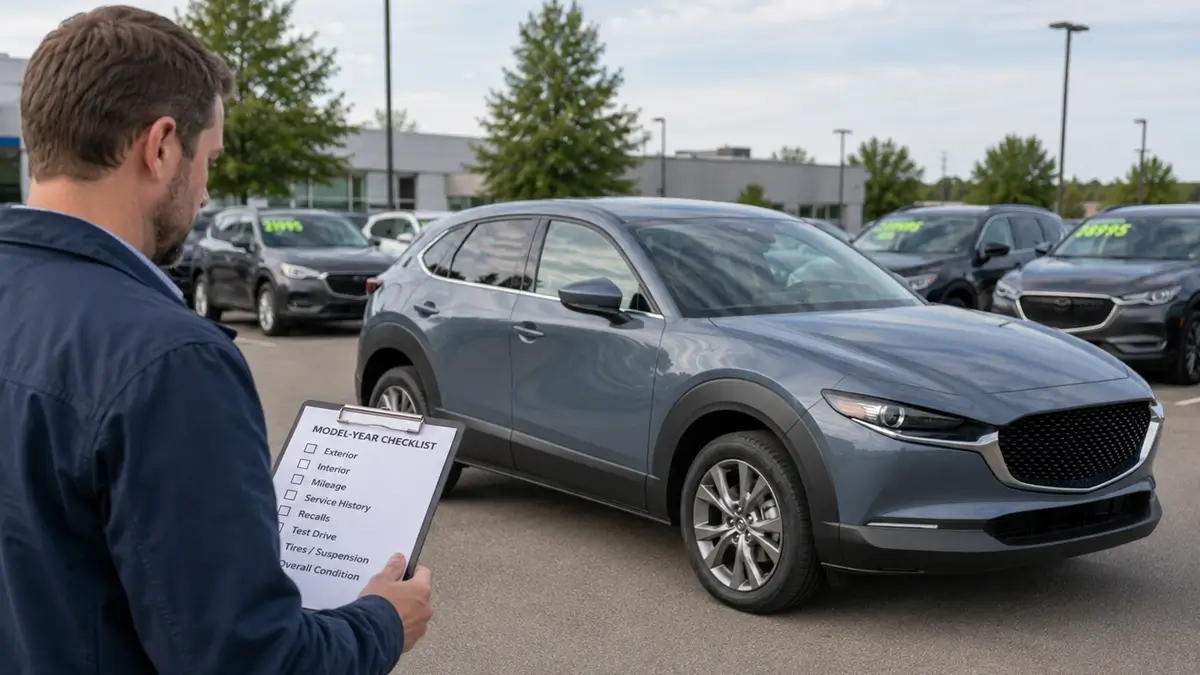
The Mazda CX-30 years to avoid are not all “bad years.” The sharper answer is that 2020 deserves the most caution, 2021 needs careful checking, and later years depend on recall status, engine choice, and service history.
The Mazda CX-30 can still be a strong used small SUV. It feels more upscale than many rivals, drives well, and fits buyers who want a compact footprint.
The mistake is buying one only because it looks clean. A used CX-30 needs a model-year check first, then a VIN recall lookup, then a service-history review.
Fastest safe default: shortlist a well-documented 2022 or 2023 non-turbo CX-30 after confirming there are no open recalls.
What goes wrong if you pick wrong: you may buy a cheaper early CX-30 that needs recall work, oil-use diagnosis, battery or warning-light troubleshooting, or brake-system verification.
CarMerit reliability tool
Check 2020-2025 Mazda CX-30 years – live NHTSA data
Pick a model year to see Mazda CX-30 complaint, recall, investigation, and manufacturer-communication counts from the article’s NHTSA snapshot, plus CarMerit’s used-buy verdict for that year band.
Owner complaints
…
NHTSA, CarMerit snapshot
Recall records
…
NHTSA, CarMerit snapshot
Investigations
…
NHTSA, CarMerit snapshot
Manufacturer communications
…
NHTSA, CarMerit snapshot
Most-reported problem areas
Complaint counts and manufacturer communications are raw NHTSA records, not defect rates or reliability scores. Newer model years have had less time to collect reports, so lower counts do not prove better reliability. Verdicts come from CarMerit’s article guidance. Data source: NHTSA.gov. Always verify VIN recall status, Mazda recall status, service records, oil-change history, low-oil warnings, warning lights, battery behavior, brake feel, transmission behavior, driver-assistance functions, accident or flood history, and independent inspection results before buying. For 2021-2022 turbo models, require stronger oil-history and dealer-repair proof.
Quick Verdict: Mazda CX-30 Years to Avoid and Safer Years to Shortlist
The cleanest used-CX-30 strategy is simple. Treat 2020 as the riskiest year, treat 2021 with caution, and do not assume newer years are proven just because they have fewer visible complaints.
For most used buyers, the best CX-30 is not the newest one or the cheapest one. It is the one with clean records, completed recalls, no warning lights, normal test-drive behavior, and the right price for its risk.
| Model Year | Verdict | Main Used-Buyer Risk | Evidence Status | Buyer Note |
|---|---|---|---|---|
| 2020 | Avoid for most buyers | First U.S. model year plus AWD fuel-system recall exposure | Official recall support exists | Buy only if discounted, inspected, and recall-complete |
| 2021 | Caution | Turbo oil-use concern on affected 2.5T vehicles | Strong support exists for affected turbo vehicles | Safer if non-turbo with strong records |
| 2022 | Caution to safer shortlist | Turbo VIN checks and possible ABS recall exposure | Official recall and turbo support exists | Good candidate if non-turbo and VIN-cleared |
| 2023 | Safer shortlist with recall check | Possible ABS HCU recall on affected vehicles | Official recall support exists | Stronger used candidate after recall lookup |
| 2024 | Safer but still young | Possible SAS airbag recall exposure on affected vehicles | Official recall support exists | Good if repaired and priced well |
| 2025 | Too new for strong used reliability judgment | Possible SAS airbag recall exposure on affected vehicles | Official recall support exists | Treat as near-new, not proven used |
| 2026 | Too new to judge | Limited used ownership history | Evidence maturity is thin | Do not rank as a proven used year yet |
Years to Avoid
The 2020 CX-30 is the main year to avoid if you want the lowest-risk used purchase. It was the first U.S. model year and has the clearest early-production caution signal.
That does not mean every 2020 CX-30 is unsafe or a bad car. It means the burden of proof is higher.
A 2020 model should be considered only if the price is meaningfully better than a later year. It also needs a clean VIN recall check, strong service records, and a calm test drive.
Years to Approach With Caution
The 2021 CX-30 deserves caution, especially in 2.5 Turbo form. The turbo engine made the CX-30 more appealing, but it also adds more inspection risk.
Only specified Mexico-built 2021–2022 CX-30 2.5 Turbo vehicles fall within Mazda’s SSPD5 VIN and build-date scope, so do not extend the valve-stem-seal concern to every turbo. For a vehicle in the affected range, require exact VIN and build-date confirmation, written Mazda-dealer eligibility status, oil-change records, low-oil-warning history, and repair paperwork.
Judge the oil-service records against Mazda’s official U.S. schedule. Under normal use, service is due when the maintenance monitor indicates and no later than 10,000 miles or 12 months. If the vehicle was operated mainly under a listed severe-use condition, the oil and filter interval is every 5,000 miles or 6 months, whichever comes first.
The 2022 model year also needs a careful VIN check. It can be a good used year, but turbo status and recall status matter.
Safer Years to Shortlist
The 2023 CX-30 is one of the cleaner used-year candidates, but it is not a blind buy. Some 2022–2023 vehicles were affected by the ABS Hydraulic Control Unit recall, so the VIN check still matters.
The 2024 CX-30 can also make sense for buyers who want newer equipment and lower age. The catch is that 2024–2025 vehicles may be affected by the SAS airbag recall.
A safer shortlist is not the same as a perfect year. It means the model year gives you a better starting point.
Buy-Only-If Conditions
Buy an early CX-30 only if the seller can prove the important items. You want recall completion, oil-change records, no repeated warning lights, and no odd braking or transmission behavior.
Skip the car if the seller says “Mazdas are reliable” but cannot show records. Brand reputation is not a substitute for proof.
Why Some Mazda CX-30 Years Carry More Used-Buyer Risk
The Mazda CX-30 is still a relatively young nameplate. That makes model-year judgment harder than it is for older used SUVs with a long complaint history.
Used buyers should not treat thin data as proof of reliability. They should treat it as a reason to verify harder.
First U.S. Model-Year Risk
The 2020 CX-30 was the first model year in the U.S. First-year vehicles often deserve extra caution because early production issues, recalls, and owner feedback are still developing.
For the CX-30, the 2020 AWD fuel-system recall is the big official signal. It does not condemn every 2020 vehicle, but it does make recall completion non-negotiable.
Complaint Patterns vs Proven Defects
Complaints can reveal patterns, but they are not final proof by themselves. A few owner stories can point you toward what to inspect, not what to assume.
Model-year risk is only one part of the used-buying decision. Before choosing a specific year, also check the broader Mazda CX-30 reliability and cost to own picture so you understand maintenance history, tire condition, recall status, ownership cost, and inspection risks together.
Use complaints to build your checklist. Use official recalls, service records, and a real inspection to make the buying decision.
Why Forum Reports Are Not Final Proof
Reddit, Facebook groups, YouTube comments, and owner forums are useful for finding anxiety signals. They are weak proof for model-year verdicts.
A forum post can tell you what one owner experienced. It cannot prove that every CX-30 from that year has the same problem.
That is why this guide separates official recalls, service-program support, owner concerns, and buyer inspection steps.
2020 Mazda CX-30: Main Risks to Check Before Buying
The 2020 Mazda CX-30 is the highest-caution year because it combines first-year status with a safety recall affecting certain AWD vehicles.
For a risk-averse buyer, skipping 2020 is the cleanest move. For a value buyer, a 2020 can still work only when the evidence is unusually strong.
Recall and Complaint Check
Start with the VIN. Confirm whether the 2020 CX-30 has any open recalls and whether prior recall work was completed.
Do not rely on the seller’s memory. Ask for paperwork, dealer service history, or a recall-completion record.
Battery and Warning-Light Concerns
Warning lights matter more on a used CX-30 than a seller may admit. If the car shows battery, emissions, engine, airbag, braking, or driver-assistance warnings, pause the deal.
Some warning lights may be minor. Others may point to a bigger inspection need.
A good 2020 CX-30 should start cleanly, idle smoothly, and show no active warning messages.
Brakes, Fuel Delivery, and Test-Drive Checks
The 2020 AWD fuel-system recall makes the test drive important. Watch for fuel smell, rough running, hesitation, stalling, or any emissions-system warning.
The braking check should also be simple. The pedal should feel consistent, the car should stop straight, and there should be no grinding, pulsing, or warning lights.
If the seller resists a proper test drive, walk away.
When a 2020 CX-30 Can Still Make Sense
A 2020 CX-30 can make sense if it is priced well below comparable later years. It also needs low ownership ambiguity.
The strongest case is a clean-title, non-abused car with completed recalls, full maintenance records, and a trusted pre-purchase inspection.
Even then, it is a buy-only-if year, not the safest default.
2021 Mazda CX-30: What Improved and What Still Needs Checking
The 2021 CX-30 is not as simple as “avoid” or “buy.” It depends heavily on engine choice, VIN range, oil history, and service records.
This is the year where buyers must separate normal CX-30 ownership from turbo-specific risk.
Engine and Oil-Use Concern Check
The 2021 CX-30 Turbo is the version that needs the closest oil-history review. Ask whether the low-oil warning ever appeared and whether valve-stem-seal-related repair work was performed.
A non-turbo 2021 CX-30 is usually the calmer used buy. It has fewer turbo-specific inspection concerns.
Do not reject every 2021 automatically. Reject the ones with weak records, unresolved warning lights, or unclear oil history.
Transmission Feel and Drivability Check
The CX-30 uses a conventional automatic, not a CVT. That is a positive for buyers who dislike rubber-band CVT behavior.
Still, the test drive matters. Shifts should feel predictable, not harsh, delayed, or confused.
Pay close attention during low-speed driving, rolling stops, hill starts, and highway merging. Those situations reveal more than a short smooth-road drive.
Recall Completion and Service History
For 2021, the service history matters as much as the model year. Look for consistent oil changes and any dealer notes tied to warning lights, drivability, or recall work.
A clean vehicle-history report is helpful, but it is not enough. You want maintenance detail, not just ownership history.
When to Walk Away
Walk away from a 2021 CX-30 if it has repeated low-oil warnings, unclear turbo repair history, active warning lights, or a seller who cannot explain maintenance.
Also skip it if the price is too close to a cleaner 2022 or 2023. There is no reason to accept extra risk without savings.
2020–2021 IIHS Headlight and Build-Date Check
IIHS rated the 2020 base, Select, and Preferred headlight configuration Good, but the adaptive headlights on the 2020 Premium trim Poor.
For 2021, the Premium configuration built before October 2020 was rated Poor; the later Premium build and the other listed configurations were rated Good. IIHS’s 2021 Top Safety Pick+ listing applies only to vehicles built after September 2020. These are trim- and build-date-specific results, not an overall model-year safety score.
Later Mazda CX-30 Years: Better Shortlist Candidates or Still Too New?
Later CX-30 years can be better used candidates, but “newer” does not automatically mean “proven.” Some issues need time, mileage, and owner volume before patterns become clear.
The best approach is to shortlist later years while still doing the same VIN and service checks.
2022 and Newer Ownership Maturity
The 2022 CX-30 has a stronger used-buyer case because it moved further away from the first U.S. model year. It also became simpler for shoppers because AWD became standard.
That does not make every 2022 a low-risk buy. Turbo models still need oil-history checks, and affected vehicles need recall verification.
Why Newer Does Not Automatically Mean Proven
A 2024 or 2025 CX-30 may have fewer complaints mainly because it has less time on the road. Low complaint visibility is not the same as long-term proof.
Newer years can still be a smart choice. Just judge them as newer used vehicles, not proven long-term winners.
2023 Should Not Be Labeled an Avoid Year Without Proof
Some pages online may create caution around 2023, but the safer position is more precise. The 2023 CX-30 should not be labeled an avoid year without stronger evidence.
The official concern to check is the ABS HCU recall that affected certain 2022–2023 CX-30 vehicles. If the VIN is clear or repaired, 2023 stays a reasonable shortlist year.
IIHS adds separate crash-test context. The updated side rating is Good for 2023–2026 models, while the updated moderate-overlap rating is Good for 2024–2026 models. These are different test families from the older side and moderate-overlap tests, so do not treat them as one simple cross-year safety score.
2025–2026: Too New for Strong Reliability Claims
The 2025 and 2026 CX-30 are too new for a strong used-reliability verdict. They may be good buys as lightly used or near-new vehicles, but they are not mature used-car proof points yet.
For 2024–2025, the SAS airbag recall check is important. For 2026, the issue is mainly limited ownership history.
Best Mazda CX-30 Years to Buy Used
The best Mazda CX-30 years are the ones that balance lower age, cleaner records, completed recalls, and enough used-market depreciation.
For most buyers, that means starting with 2022 and 2023, then checking 2024 if the price makes sense.
| Buyer Type | Best Fit | Avoid or Caution Trigger | Why It Works |
| Lowest-risk used buyer | 2023 non-turbo | Open ABS recall, weak records | Mature enough to shop used, newer than early years |
| Value buyer | 2022 non-turbo | Turbo oil concern, affected VIN, open recall | Can cost less than newer years while avoiding first-year risk |
| Near-new buyer | 2024 | Open SAS airbag recall | Newer age and equipment if recall-complete |
| Budget shopper | 2020 or 2021 only with proof | Missing records, warning lights, unresolved recall | Works only when discount is real |
| Risk-averse buyer | Later non-turbo | Turbo with unclear oil history | Simpler ownership profile |
Best Starting Point for Lower Risk
A 2023 non-turbo CX-30 is the strongest practical starting point if the VIN has no open recall. It avoids the first-year issue and gives more ownership maturity than 2024–2026.
Do not skip the inspection just because 2023 is a better starting point. A neglected 2023 is worse than a well-kept 2021.
Best Value Starting Point
A 2022 non-turbo CX-30 can be the better value play. It may cost less than a 2023 while still avoiding the earliest model year.
The catch is verification. Check recall status, service records, and any sign of oil or warning-light issues.
Best for Newer Features
A 2024 CX-30 makes sense if you want newer tech, less age, and a more current ownership feel. It is not the best choice if you want a long used-history record.
Buy it if the SAS airbag recall status is clean and the price gap over a 2023 is reasonable.
Best to Skip Unless Discounted
Skip 2020 unless it is clearly cheaper and unusually well documented. Also be careful with 2021 turbo models unless the oil-history paper trail is strong.
A cheap CX-30 stops being cheap if you inherit unresolved warning lights, recall work, or drivability concerns.
Mazda CX-30 Reliability by Year: Complaints, Recalls, and Real Evidence
Mazda CX-30 reliability by year should be judged with a proof hierarchy. Official recalls carry more weight than forum posts, and service history matters more than a seller’s confidence.
The goal is not to prove that one year is perfect. The goal is to avoid taking hidden risk.
Mazda CX-30 NHTSA year-by-year evidence
| Model year | Owner complaints | Safety recalls | Manufacturer communications | Buyer-useful reading |
|---|---|---|---|---|
| 2020 (Gen 1) | 31 | 3 | 668 | First-year row has multiple official recall actions; VIN recall completion matters before price. |
| 2021 (Gen 1) | 98 | 2 | 597 | Highest complaint count in the available NHTSA complaint records; service history and warning-light checks matter. |
| 2022 (Gen 1) | 31 | 1 | 402 | Lower than 2021, but still needs VIN screening for ABS recall exposure. |
| 2023 (Gen 1) | 22 | 1 | 300 | Lowest complaint count in the available NHTSA complaint records, but ABS recall lookup still matters. |
| 2024 (Gen 1) | 27 | 2 | 220 | Newer row with camera and SAS airbag recall checks to verify. |
| 2025 (Gen 1) | 25 | 1 | 130 | Newer row with less road time; verify SAS airbag recall status before buying. |
Table note: These are raw NHTSA counts for 2020-2025, not defect rates or reliability scores. Official investigations are 0 for every listed year, and newer years have had less time to collect complaints.
NHTSA and Mazda Recall Lookup
Run two checks before buying. Use the NHTSA recall search and Mazda’s recall lookup with the VIN.
The NHTSA year, make, and model search helps you see general recall history. The VIN search is better for the specific vehicle.
On a CX-30, identifying the exact vehicle matters because some of the concerns in this guide apply to particular model years, turbo configurations, AWD vehicles, or recall scopes rather than every CX-30. Use the CarMerit VIN Lookup to compare the vehicle details returned for that VIN with the seller’s listing and paperwork. Then use the official NHTSA and Mazda VIN checks separately to confirm open recalls and completed recall work.
Mazda CX-30 NHTSA recall campaigns to verify by VIN
| Affected year | Campaign | Recall theme | Fire risk | Buyer check |
|---|---|---|---|---|
| 2020 (Gen 1) | 20V346000 | Brake caliper bolts may be loose | No | Confirm brake recall completion and normal brake feel. |
| 2020 (Gen 1) | 20V347000 | AWD fuel-system vent hose may allow fuel leak | Yes | Confirm fuel-system recall completion; check fuel smell, stalling, or hesitation. |
| 2020-2021 (Gen 1) | 21V086000 | Power liftgate may lower unexpectedly | No | Confirm liftgate software or drive-unit repair if equipped. |
| 2021 (Gen 1) | 21V101000 | Tire air valve may leak suddenly | No | Confirm valve recall completion and tire service record. |
| 2022-2023 (Gen 1) | 23V275000 | ABS hydraulic control unit may reduce braking ability | No | Confirm VIN repair status and test brake feel. |
| 2024 (Gen 1) | 24V649000 | Forward sensing camera may affect AEB, lane keep, and headlight assist | No | Check driver-assist warnings and recall completion. |
| 2024-2025 (Gen 1) | 25V357000 | SAS airbag sensor software may deactivate airbags | No | Confirm SAS software or replacement repair before purchase. |
Table note: Recall campaigns may apply by VIN, build date, equipment, or trim, so the year alone is not enough. Run the exact VIN before buying.
Mazda’s recall lookup can also show open recall and service-program information tied to that VIN.
Mazda Coverage Programs to Verify by VIN
Recall completion is only one VIN check. Mazda also lists separate coverage programs for certain CX-30 vehicles:
When a CX-30’s model year falls into one of these coverage windows, use CarMerit’s Manufacturer Special Coverage Lookup to identify the Mazda program worth checking before you decide whether that year’s repair history should change your shortlist.
| Official Mazda program | Potential CX-30 scope | What it means for a buyer |
|---|---|---|
| SSPD5 valve-stem-seal settlement program | Specified Mexico-built 2021–2022 CX-30 2.5T vehicles within Mazda’s VIN and build-date range | Mazda states a 7-year/84,000-mile total powertrain term from the original warranty start date, whichever comes first. The temporary additional valve-stem-seal coverage period has expired. Verify VIN, build date, mileage, campaign status, and repair history. |
| SSPD8 engine-temperature and heater-performance program | Certain 2020–2023 CX-30 vehicles equipped with the suspected coolant control valve and listed in Mazda’s dealer system | Mazda states coverage for the qualifying repair for 15 years/150,000 miles from the original warranty start date, whichever comes first. Diagnosis and vehicle-specific eligibility are required. |
| CSP12 low-pressure fuel-pump program | Certain 2020 CX-30 “Additional Vehicles”; not every vehicle within the published VIN range qualifies | Mazda states coverage for a confirmed in-tank low-pressure fuel-pump failure for 15 years/150,000 miles from the vehicle’s in-service date, whichever comes first. Confirm program status and diagnosis with a Mazda dealer. |
Table Note: These are vehicle-specific coverage programs, not safety recalls and not proof that every CX-30 in the listed years has the condition. Exact VIN, build date, in-service date, mileage, diagnosis, exclusions, campaign status, and current written terms control eligibility.
Complaint Counts Are Signals, Not Full Verdicts
Complaint counts can be useful, but they can mislead when used alone. Older years have more time to collect complaints, and newer years may look cleaner because they have fewer miles.
Use complaints to ask better questions. Do not use them as a one-number verdict.
Owner Forums as Concern Discovery Only
Forums are useful for finding what owners worry about. They can highlight warning lights, battery behavior, oil-use concerns, or driver-assistance complaints.
They should not decide the model-year ranking by themselves. The final call should come from recall status, service records, inspection results, and test-drive behavior.
Strong Source Hierarchy for Used-Buyer Decisions
For high-risk claims, use this order:
- Official recall records and manufacturer recall statements.
- Mazda service-program, settlement, or dealer repair documentation.
- Strong secondary automotive references.
- Owner forums only as concern discovery.
That hierarchy keeps the article from turning into a rumor summary.
Mazda CX-30 Turbo vs Non-Turbo: Which Used Version Is Safer?
For a risk-averse used buyer, the non-turbo CX-30 is the safer default. It is simpler, cheaper to evaluate, and avoids the main turbo-specific oil-history concern.
The turbo is not automatically bad. It just requires more proof.
EPA Fuel Economy and Scheduled-Maintenance Trade-Off
| Model year(s) | Powertrain | Drivetrain | EPA city MPG | EPA highway MPG | EPA combined MPG |
|---|---|---|---|---|---|
| 2021 | 2.5L non-turbo | FWD | 25 | 33 | 28 |
| 2021 | 2.5L non-turbo | AWD | 24 | 31 | 26 |
| 2021 | 2.5L turbo | AWD | 22 | 30 | 25 |
| 2022 | 2.5L non-turbo | AWD | 24 | 31 | 26 |
| 2022 | 2.5L turbo | AWD | 22 | 30 | 25 |
| 2023–2025 | 2.5L non-turbo | AWD | 26 | 33 | 29 |
| 2023–2026 | 2.5L turbo | AWD | 22 | 30 | 25 |
| 2026 | 2.5L non-turbo | AWD | 24 | 31 | 27 |
All rows use regular gasoline and a six-speed automatic. EPA estimates are standardized comparison figures; actual fuel economy varies with driving, weather, speed, vehicle condition, and load.
Official Mazda maintenance adds one concrete powertrain difference: spark plugs are scheduled every 40,000 miles on the 2.5T, versus every 75,000 miles on the non-turbo 2.5L. That is a scheduled-maintenance difference, not proof that the turbo is unreliable.
Turbo Risk Should Stay Conditional
The CX-30 Turbo is quicker and more satisfying if you care about acceleration. That benefit comes with more inspection responsibility.
A used turbo model should have clean oil-change records, no low-oil warnings, and no unclear repair history.
If those records are missing, skip it.
Oil Consumption and Drivability Concerns Need Proof
Do not assume every turbo CX-30 has an oil issue. Also do not ignore the issue if the vehicle falls into an affected range.
Ask direct questions. Has the low-oil warning appeared? Was any valve-seal work done? Are there dealer invoices?
A seller who cannot answer those questions should price the car accordingly.
Non-Turbo May Be the Safer Default for Risk-Averse Buyers
The non-turbo CX-30 is the cleaner choice for most used buyers. It gives up speed, but it lowers inspection complexity.
That trade-off is usually worth it if your priority is dependability, predictable ownership, and lower used-buying stress.
Do Not Turn This Into a Turbo Reliability Article
Turbo reliability deserves its own deeper guide if the topic expands. Inside this article, the key point is simpler.
If you want the safest used CX-30 path, start with non-turbo years and verify the VIN.
Used Mazda CX-30 Buying Checklist
A used Mazda CX-30 buying checklist should focus on CX-30-specific risk, not generic used-car advice. The goal is to catch the problems that change the deal.
Use this checklist before you negotiate, not after you fall in love with the car.
| Risk Area | What to Check | Proof Needed | Walk-Away Trigger |
| Recalls | Run VIN through NHTSA and Mazda | No open safety recalls or proof of completed repair | Seller refuses VIN or recall status is unresolved |
| Service history | Oil changes and dealer visits | Receipts, service records, or dealer history | Missing records on turbo model |
| Warning lights | Engine, oil, battery, airbag, braking, driver-assist lights | Clean startup and no active warning | Active warning light during inspection |
| Turbo oil use | Low-oil warnings or valve-seal repair | Dealer invoice or clear service note | Repeated low-oil history with no repair |
| Braking | Pedal feel and stopping behavior | Normal test drive and inspection | Long pedal travel, warning lights, or odd feel |
| Transmission feel | Low-speed shifts and highway merge | Smooth, predictable operation | Harsh, delayed, or inconsistent shifting |
| Driver assistance | AEB, sensors, adaptive cruise, alerts | No malfunction messages | System warnings or disabled functions |
Recall Lookup Before Test Drive
Ask for the VIN before seeing the car. Run the recall lookup first.
If the seller refuses to share the VIN, move on. There are too many CX-30 listings to accept that risk.
Service Records and Oil History
Oil history matters most on turbo models. It still matters on every used CX-30.
Look for mileage-appropriate oil changes and any dealer notes about low-oil warnings. Gaps are not always fatal, but they reduce confidence.
Warning Lights and Battery Behavior
The CX-30 has enough electronics that warning lights deserve respect. Battery-related issues can also trigger confusing symptoms.
A weak battery may not mean the car is bad. But an active airbag, engine, braking, or driver-assistance warning should stop the deal until diagnosed.
Transmission and Braking Feel
The test drive should include city traffic, parking-lot speeds, a few stop-and-go cycles, and a short highway merge.
You are checking for smooth shifting, steady braking, no strange delay, and no warning messages.
Do not accept “they all do that” from a seller.
Driver-Assistance Feature Check
Check that driver-assistance features turn on, display normally, and do not show malfunction alerts.
A sensor issue may be simple. It may also be expensive or tied to prior damage.
If the car had front-end damage, inspect this area harder.
Walk-Away Triggers
Walk away from a CX-30 with active warning lights, unresolved recalls, missing turbo oil history, poor brake feel, repeated battery issues, or a seller who avoids inspection.
Also walk away when the price does not reflect the risk. A risky year needs a risk-adjusted price.
Who Should Buy a Used Mazda CX-30, and Who Should Skip It?
A used CX-30 is best for buyers who want a small SUV that feels more premium than basic transportation. It is not the best fit for every household.
The right buyer accepts compact space and chooses the cleanest year, not just the lowest price.
Best For
Buy a used Mazda CX-30 if you want sharp handling, a nicer cabin feel, available AWD, and easy city size.
It is strongest for singles, couples, small families, commuters, and buyers who do not need maximum rear-seat or cargo room.
Buy With Caution If
Buy with caution if you are shopping 2020, 2021 turbo, or any vehicle with unclear recall history.
You should also be careful if the listing is cheap but the seller has no service records. A discount without proof is not value.
Skip If
Skip the CX-30 if you need generous rear-seat space, a large cargo area, or the lowest possible ownership uncertainty.
Also skip early or turbo examples if you hate inspection work. Those cars demand more diligence before purchase.
Better Alternatives to Compare Next
Compare the CX-30 with the Mazda CX-5 if you want more space. Compare it with the Subaru Crosstrek if standard AWD and outdoor practicality matter more.
Compare it with the Honda HR-V or Toyota Corolla Cross if you prefer a calmer ownership profile and do not care as much about driving feel.
Final Recommendation: Which Mazda CX-30 Year Should You Choose?
The best practical used Mazda CX-30 starting point is a 2023 non-turbo with clean records, no open recalls, and normal test-drive behavior. A 2022 non-turbo can be the better value if the VIN and service history check out.
The year to avoid for most buyers is 2020. It can still be bought, but only as a discounted, inspected, recall-complete example.
Best Practical Choice
Choose a 2023 non-turbo CX-30 first. It gives the best mix of lower early-year risk, used availability, and ownership maturity.
If the 2023 is overpriced, check a 2022 non-turbo. Make sure recall status is clean.
Best Value Choice
The best value pick is usually a clean 2022 CX-30. It should cost less than a 2023 or 2024 while avoiding the riskiest first-year position.
Do not choose value by price alone. Choose it by price plus proof.
Highest-Risk Choice
The 2020 CX-30 is the highest-risk pick. Treat it as avoid for most buyers unless the condition, documents, inspection, and discount are strong.
The 2021 turbo is also a caution pick. It is not a blanket avoid year, but it needs oil-history proof.
Final Buyer Rule
For the Mazda CX-30 years to avoid, the safest answer is not just a list of years. Avoid weak evidence, unresolved recalls, missing service records, and warning lights.
A later year with poor records is not safer than an early year with complete proof. But when all else is equal, start with 2022–2023 non-turbo models and move up from there.
After you narrow the safer CX-30 years, compare the Subaru Crosstrek vs Mazda CX-30 if you are still deciding whether Mazda is the right small SUV. The CX-30 is the more refined pick, but the Crosstrek may fit better if you need more visibility, utility, and rough-road confidence.
If you are comparing an earlier CX-30 with a Crosstrek, remember that AWD became standard on the CX-30 for 2022. Use the Subaru Crosstrek years-to-avoid guide to compare the exact model years you are considering.
Frequently Asked Questions
What Mazda CX-30 year should I avoid?
Most used buyers should avoid the 2020 Mazda CX-30 unless it is discounted, recall-complete, well maintained, and inspected.
Is the 2021 Mazda CX-30 a bad year?
The 2021 Mazda CX-30 is not automatically bad, but 2.5 Turbo models need extra oil-history and warning-light checks.
What is the best Mazda CX-30 year to buy used?
A clean 2023 non-turbo CX-30 is the strongest practical used starting point for most buyers.
Are Mazda CX-30 transmission issues common?
Transmission concerns should be treated as a test-drive and inspection item, not a blanket reason to reject every CX-30.
Is a used Mazda CX-30 a good buy?
A used Mazda CX-30 can be a good buy if the VIN is recall-clean, records are strong, and the compact space fits your needs.
Is the Mazda CX-30 Turbo reliable?
The CX-30 Turbo can be worth buying, but it needs stronger oil-service proof than the non-turbo version.
Should I buy a Mazda CX-30 or Mazda CX-5 used?
Buy the CX-30 if you want smaller size and easier city driving. Compare the CX-5 if you need more rear-seat and cargo space.