

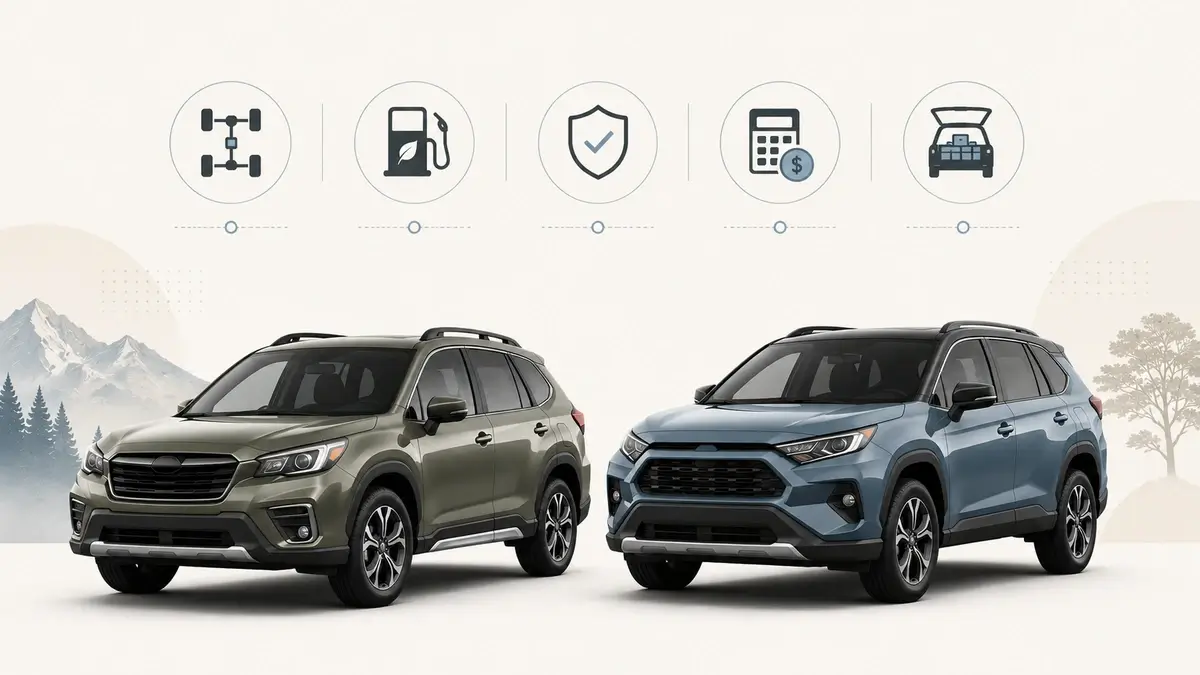
If you are comparing forester vs rav4 as used compact SUVs, the Toyota RAV4 is the lower-risk first shortlist for most buyers.
It usually makes the stronger case if you care most about resale confidence, fuel economy options, and predictable long-term ownership.
The Subaru Forester is not the weak choice. It is the better fit if standard AWD confidence, outward visibility, useful ground clearance, and winter-road comfort matter more than maximum resale strength or hybrid fuel economy.
The mistake is treating this like a simple brand matchup. A clean, well-maintained Forester can be a smarter buy than an overpriced or neglected RAV4.
A strong RAV4 can also be the better long-term ownership play if you want fewer question marks.
CarMerit reliability comparator
Subaru Forester vs Toyota RAV4: 2001-2026 NHTSA snapshot
Owner-complaint and recall counts from NHTSA for 2001-2026, each model’s best used-year lane, and which buyer each one fits.
| 6,094 | complaints (2001-26) | 9,285 |
| 112 | recalls (2001-26) | 143 |
Visibility / wipersAirbags / seatbelts / structureEngineElectrical | top issues | Airbags / seatbelts / structureEnginePowertrain / transmissionElectrical |
Subaru Forester
Best used year: 2021
Shortlist 2021-2024; value 2019-2020; older budget 2016-2018; use more caution with 2011-2015.
Best for: Snow-belt and visibility-first buyers who want standard AWD confidence, strong outward visibility, useful ground clearance, and bad-weather composure.
Toyota RAV4
Best used year: 2016
Shortlist 2016-2018 and 2020-2022 gas; older budget 2009-2012; use more caution with 2001-2008, 2013-2015, and some 2019-2022 hybrid / Prime cases.
Best for: Mainstream-value buyers who want stronger resale confidence, hybrid fuel-economy options, and the more predictable ownership case.
Quick take: The RAV4 is the safer mainstream choice for most used compact SUV buyers. Choose the Subaru Forester when standard AWD confidence, outward visibility, ground clearance, and bad-weather composure matter more, or when a clean Forester is priced below an overpriced RAV4. Do not crown either SUV from raw NHTSA counts alone.
Complaint counts are raw owner reports filed with NHTSA, not adjusted for sales volume, so they should guide inspection rather than crown a winner. The quick comparator above uses a 2001-2026 overlapping NHTSA snapshot for both models; if one model has older NHTSA history before 2001, those model-only years are excluded here to keep the comparison balanced. Always inspect the specific vehicle before buying.
Quick Verdict: Forester vs RAV4 for Used SUV Buyers
Choose the Toyota RAV4 if you want the safer mainstream used choice, stronger fuel-economy options, and a more predictable resale/value case.
Choose the Subaru Forester if you want standard AWD confidence, strong visibility, useful ground clearance, and a more planted feel in bad weather.
What goes wrong if you pick wrong: you can overpay for the RAV4’s reputation, or you can buy a Forester without checking the exact year, service history, and condition closely enough.
Fastest safe default: shortlist the RAV4 first, then compare any clean Forester that has the right year, mileage, maintenance history, and price.
The comparison is close enough that a table helps. Do not read this as a universal winner table. Read it as a fast buyer-fit filter.
The right answer changes by use case. A commuter trying to reduce fuel cost has a different decision than a snow-belt buyer who values AWD every week.
| Factor | Subaru Forester | Toyota RAV4 |
|---|---|---|
| Best overall used default | Good if condition and year check out | Stronger default for most buyers |
| AWD confidence | Strong advantage because Forester is AWD-focused | Available on many trims, but not always standard on gas used models |
| Fuel economy upside | Good for a gas AWD compact SUV | Stronger if you find the right RAV4 Hybrid |
| Used-market price signal | Can be the lower asking-price option; verify current local listings and the exact vehicle’s condition. | Can ask more in the used market, but a higher asking price alone does not prove stronger resale retention. |
| Cargo and family use | Practical, upright, visibility-focused | Practical, broad appeal, strong cargo usability |
| Winter driving | Strong fit for buyers who prioritize AWD | Good with AWD, especially with the right trim and tires |
| Biggest caution | Verify year, maintenance, tire condition, and known issues | Avoid overpaying just because it is a RAV4 |
How This Comparison Was Judged for Used Buyers
This comparison is built for used-car buyers, not shoppers deciding only between new models. A new-model comparison can help with broad layout and feature context, but it does not answer the real used-buying question.
For used buyers, the answer depends on model year, trim, mileage, maintenance history, and price. If those are weak, the badge on the hood will not save the deal.
Use this page as a shortlist filter. Before buying either SUV, check the VIN through the NHTSA recall lookup, verify safety ratings by model year through IIHS, and confirm fuel economy for the exact powertrain through FuelEconomy.gov. NHTSA says its recall tool can check by VIN, license plate, or year/make/model, while IIHS ratings are tied to specific model-year ranges and test versions.
If you are still choosing among compact SUVs, compare this page with CarMerit’s Best Used Compact SUVs to Buy guide before narrowing your final shortlist.
Price, Resale Value, and Total Cost to Own
Used-market asking price is not the same thing as resale retention or depreciation. In a dated U.S. snapshot checked on May 23, 2026, CarGurus showed average asking prices of $25,840 for the 2022 Subaru Forester, $27,720 for the 2022 Toyota RAV4, and $30,880 for the 2022 Toyota RAV4 Hybrid. Those figures show how that source’s 2022 asking-price lanes differed on that date; they do not prove a like-for-like premium, final transaction price, or future resale advantage.
That still matters when shopping. A Forester can become more attractive when a similar RAV4 is priced higher, while a higher-priced RAV4 may still make sense if its condition, trim, powertrain, and service history justify the difference. Compare local listings with similar mileage, drivetrain, trim, title history, and condition before treating any price gap as meaningful.
The ownership-cost decision is not one number. It is purchase price plus maintenance, fuel cost, repairs, tires, resale, insurance, and the risk of buying the wrong year or trim.
If the Forester is still on your shortlist, reliability should be checked separately from the head-to-head comparison. Use the Subaru Forester reliability guide to review common risks, maintenance-cost signals, recall checks, and pre-purchase inspection points.
RAV4 has a stronger fuel-cost argument if you are considering a Hybrid. The Forester has a stronger value argument when you want AWD confidence and can find the right used example at a lower price.
For deeper Toyota-specific ownership context, compare this section with Toyota RAV4 Reliability: What It Costs to Own and Maintain.
Use this table as a directional market check, not a fixed pricing rule. Local inventory, mileage, accident history, trim, title status, and maintenance records can move the real number.
The table uses one same-year example to reduce factual risk. Broader price ranges should be added only after checking multiple live listing sources.
| Used year example | Forester | RAV4 gas | RAV4 Hybrid | What it means |
|---|---|---|---|---|
| 2022 | $25,840 | $27,720 | $30,880 | Forester had the lower average asking price in this dated source snapshot; RAV4 Hybrid had the highest. This is not a matched premium or transaction-price result. |
Table Note: These are dated average asking prices from one source, not transaction prices, depreciation rates, or matched like-for-like premiums. Mileage, trim, drivetrain, condition, title history, and local inventory can change the comparison.
Reliability, Common Problems, and Model-Year Risk
Do not buy either SUV based on brand reputation alone. That is lazy buying.
The biggest issue with the Forester is not that it should be avoided. The issue is that the buyer must be more disciplined. Check the year, service records, tire condition, transmission behavior, oil service history, and any open recalls.
If you are shopping a 2014–2020 Forester with a CVT, check Subaru’s vehicle-specific coverage history before assuming every transmission issue is simply out-of-pocket. Subaru issued manufacturer-authored coverage extensions that moved eligible Forester CVT powertrain coverage to 10 years/100,000 miles for 2014–2015, 2016–2017, 2018, and 2019–2020 vehicles within the stated program criteria.
If that CVT history is making you lean toward the RAV4 instead, check the Forester’s model year in CarMerit’s Manufacturer Special Coverage Lookup first to see whether Subaru issued coverage worth verifying before you compare the two SUVs’ repair exposure.
That does not mean a used Forester is still covered today. VIN, in-service date, mileage, exact CVT applicability, and Subaru’s Vehicle Coverage Inquiry control current eligibility. The separate grace period recorded for eligible 2019–2020 vehicles ended June 30, 2026.
The biggest issue with the RAV4 is overconfidence. A RAV4 with neglected maintenance, accident history, poor tires, or a stretched price can still be a weak deal.
Safety and recall checks should be model-year specific. The 2024 Subaru Forester IIHS page notes that the Forester was redesigned for the 2019 model year and lists rating applicability for 2019–24 models in several test areas. The 2025 Toyota RAV4 IIHS page states that the RAV4 was redesigned for the 2019 model year and lists rating applicability by model-year range. That is why you should check the exact year, not just the model name.
A simple rule helps: if a seller cannot show maintenance records, tire history, title status, and recall status, treat the vehicle as higher risk even if the model has a strong reputation.
If you are leaning toward the Toyota, check Toyota RAV4 Years to Avoid and Best Years to Buy before you decide on a specific used model year.
Daily Use: Rear Seat, Cargo Space, Visibility, and Comfort
The Forester’s daily-use case is simple: it feels open, upright, and easy to see out of. That matters if you drive in traffic, park often, carry family, or dislike compact SUVs with heavy blind spots.
If the Forester still looks like the better fit, check Subaru Forester reliability before buying. That deeper ownership guide explains common problems, maintenance cost, inspection checks, and when a used Forester is worth skipping.
The RAV4 feels more mainstream and polished for many buyers. It has broad appeal because it balances cargo space, fuel economy options, reliability reputation, and resale strength without demanding a niche use case.
Cargo numbers can help, but they should not decide the whole purchase. What matters more is whether your stroller, luggage, tools, sports gear, pet crate, or weekly shopping actually fits.
Before buying, test the rear seat and cargo area with your real use case. Sit behind your own driving position. Open the hatch. Fold the seats. Check the cargo floor height. A spec sheet cannot tell you whether the SUV fits your life.
The RAV4 can have different drivetrain setups depending on year and trim, including FWD, AWD, Hybrid AWD, and Plug-in Hybrid versions in recent model years. Toyota’s 2024 RAV4 brochure shows how fuel economy, drivetrain, and trim details can vary, which is why the exact used example matters before making a final decision.
If you are mainly comparing practical compact SUVs for family use, also read Honda CR-V vs Toyota RAV4 and Mazda CX-5 vs Toyota RAV4.
AWD, Fuel Economy, Hybrid Options, and Winter Driving
This is where the Forester earns its strongest argument. Recent Subaru Forester material emphasizes standard Subaru Symmetrical All-Wheel Drive, and Subaru’s 2025 Forester brochure lists 8.7 inches of ground clearance. Verify the exact model year and trim before treating that as a buying fact for a specific used vehicle.
That does not mean the Forester automatically wins in snow. Tires, driver behavior, road conditions, and maintenance still matter. AWD helps you get moving and maintain traction, but it does not replace good tires or safe braking distance.
EPA estimates change by model year and configuration. To keep the used-car comparison practical, the tables below focus on selected 2020–2025 AWD configurations rather than averaging incompatible engines, trims, or powertrains together. RAV4 Prime/PHEV is kept separate because EPA reports MPG and MPGe under different operating modes.
Subaru Forester EPA Fuel Economy — Selected 2020–2025 AWD Configurations
| Model Year | Configuration | City | Highway | Combined |
|---|---|---|---|---|
| 2020 | 2.5L AWD, Automatic (AV-S7) | 26 | 33 | 29 |
| 2021 | 2.5L AWD, Automatic (AV-S7) | 26 | 33 | 29 |
| 2022 | 2.5L AWD, Automatic (AV-S7) | 26 | 33 | 29 |
| 2022 | Wilderness AWD, 2.5L, Automatic (AV-S8) | 25 | 28 | 26 |
| 2023 | 2.5L AWD, Automatic (AV-S7) | 26 | 33 | 29 |
| 2023 | Wilderness AWD, 2.5L, Automatic (AV-S8) | 25 | 28 | 26 |
| 2024 | 2.5L AWD, Automatic (AV-S8) | 26 | 33 | 29 |
| 2024 | Wilderness AWD, 2.5L, Automatic (AV-S8) | 25 | 28 | 26 |
| 2025 | 2.5L AWD, Automatic (AV-S8) | 26 | 33 | 29 |
| 2025 | Sport/Touring AWD, 2.5L, Automatic (AV-S8) | 25 | 32 | 28 |
| 2025 | Wilderness AWD, 2.5L, Automatic (AV-S8) | 25 | 28 | 26 |
| 2025 | Hybrid AWD, 2.5L, Automatic (AV-S6) | 35 | 34 | 35 |
Table Note: EPA city/highway/combined MPG for the exact Forester configurations shown. These are not model-wide averages; Wilderness, Sport/Touring, and Hybrid configurations are separated where EPA lists different values. Actual fuel economy varies with driving and operating conditions. Source: FuelEconomy.gov official data.
Toyota RAV4 EPA Fuel Economy — Selected 2020–2025 AWD Configurations
| Model Year | Configuration | City | Highway | Combined |
|---|---|---|---|---|
| 2020 | AWD LE, 2.5L, Automatic (S8) | 27 | 34 | 30 |
| 2020 | Hybrid AWD, 2.5L, Automatic (AV-S6) | 41 | 38 | 40 |
| 2021 | AWD LE, 2.5L, Automatic (S8) | 27 | 34 | 30 |
| 2021 | Hybrid AWD, 2.5L, Automatic (AV-S6) | 41 | 38 | 40 |
| 2022 | AWD LE, 2.5L, Automatic (S8) | 27 | 34 | 30 |
| 2022 | Hybrid AWD, 2.5L, Automatic (AV-S6) | 41 | 38 | 40 |
| 2023 | AWD LE, 2.5L, Automatic (S8) | 27 | 34 | 30 |
| 2023 | Hybrid AWD, 2.5L, Automatic (AV-S6) | 41 | 38 | 40 |
| 2024 | AWD LE, 2.5L, Automatic (S8) | 27 | 34 | 30 |
| 2024 | Hybrid AWD, 2.5L, Automatic (AV-S6) | 41 | 38 | 39 |
| 2025 | AWD LE, 2.5L, Automatic (S8) | 27 | 34 | 30 |
| 2025 | Hybrid AWD, 2.5L, Automatic (AV-S6) | 41 | 38 | 39 |
Table Note: EPA city/highway/combined MPG for the exact RAV4 configurations shown. Gas AWD LE and Hybrid AWD are separate configurations. RAV4 Prime/PHEV is intentionally excluded because EPA reports separate MPG and MPGe operating-mode metrics that should not be averaged with these rows. Actual fuel economy varies with driving and operating conditions. Source: FuelEconomy.gov official data.
In these recent configurations, the mainstream Forester is rated at 29 mpg combined, while Wilderness is rated at 26 mpg combined. The 2025 Forester Hybrid raises the Forester side to 35 mpg combined. The RAV4 AWD LE is rated at 30 mpg combined, while RAV4 Hybrid AWD is rated at 40 mpg combined through 2023 and 39 mpg combined for 2024–2025.
The RAV4 Hybrid therefore keeps the stronger fuel-economy case in this recent used-year window, but the newest Forester comparison is no longer gas-only because the 2025 Forester Hybrid creates a separate efficiency option.
For many buyers, this is the cleanest split:
- Pick the Forester if winter roads, standard AWD confidence, visibility, and light outdoor use matter most.
- Pick the RAV4 Hybrid if fuel cost, resale confidence, and lower ownership uncertainty matter more.
- Pick the gas RAV4 if you want a simpler mainstream used SUV and the price is reasonable.
- Skip both if the specific vehicle has weak maintenance records, bad tires, accident history, or open recall issues.
Used Trim Value: Which Versions Make the Most Sense?
The best used trim is not always the highest trim. Higher trims can add comfort, tech, and appearance features, but those features are not worth much if the vehicle has the wrong year, weak service history, or a stretched price.
For the Forester, prioritize the basics first: clean maintenance records, good tires, smooth transmission behavior, functional AWD systems, and safety-feature availability for the exact model year. AWD confidence is the main advantage. Do not pay extra for appearance or adventure styling unless you actually use it.
For the RAV4, first decide whether you want gas, Hybrid, or Plug-in Hybrid. That choice affects price, fuel economy, driving feel, and resale. A used RAV4 Hybrid can be the smartest version for fuel-cost-sensitive buyers, but only if the price premium, condition, and hybrid-system health make sense.
If you are considering a 2020–2025 RAV4 Hybrid, Toyota’s original U.S. warranty terms add another useful check. The hybrid battery has defect coverage for 10 years/150,000 miles, while the listed hybrid-system components have 8 years/100,000 miles of defect coverage.
Do not read those original terms as proof that a used RAV4 Hybrid still has coverage. Remaining coverage depends on the VIN, original in-service date, mileage, vehicle eligibility, and the exact written terms. The hybrid-battery warranty is also defect coverage, not a guarantee that the battery will retain a specific percentage of its original capacity.
Safety and driver-assist features need trim and year verification. Do not assume the vehicle has a feature because a review page, dealer listing, or newer brochure mentions it.
Before paying more for a trim, verify three things: safety tech, drivetrain, and service history. If those do not support the premium, the higher trim is not really better for a used buyer.
A better used-buy rule is blunt: pay for condition, service history, safety features you will use, and the right powertrain. Be careful paying heavily for cosmetics, large wheels, premium audio, or trim badges.
Who Should Buy the Forester and Who Should Buy the RAV4?
This is the section that matters most if you are actually buying.
The Forester and RAV4 both make sense. They just make sense for different people.
Use this as a rule-out matrix, not a hype table. If your buyer profile fits one side clearly, do not overthink the other side unless the price difference is large.
If your buyer profile is split, the exact vehicle condition should decide. A clean, fairly priced Forester can beat a tired RAV4. A clean RAV4 can beat a cheaper Forester that has questionable history.
| Buyer type | Better choice | Why |
|---|---|---|
| Lower-risk used buyer | Toyota RAV4 | Stronger default if you want resale confidence and broad ownership predictability |
| Snow-belt commuter | Subaru Forester | AWD confidence, visibility, and ground clearance strengthen its case |
| Fuel-cost-sensitive buyer | Toyota RAV4 Hybrid | Hybrid fuel economy can make a real difference over time |
| Budget/value shopper | Depends on local price | Forester can win if priced well and well maintained |
| Family buyer | Depends on fit test | Both work, but test rear seat, cargo space, and visibility before deciding |
| Outdoor/light trail buyer | Subaru Forester | Better fit if AWD and ground clearance matter more than fuel economy |
| High-mileage used buyer | Toyota RAV4 | Usually the easier default to justify, but only with clean service history |
The Forester is a strong RAV4 alternative for visibility and all-weather confidence. If your decision is more about value, features, and long-term risk, compare Hyundai Tucson vs Toyota RAV4 as another practical compact SUV matchup.
Final Recommendation: Which Used Compact SUV Is the Better Buy?
For most used buyers, the Toyota RAV4 is the better first shortlist. It is the more predictable pick if you want a mainstream compact SUV with strong resale confidence, good practicality, and better fuel-economy options through hybrid versions.
The Subaru Forester is the better pick if your driving life makes its advantages matter. If you live with snow, bad weather, steep roads, rougher surfaces, or tight parking where visibility helps, the Forester’s AWD-focused setup and upright feel are real strengths.
The RAV4 case weakens when the used price is inflated, the service history is thin, or the vehicle is a gas model priced too close to a better hybrid option.
The Forester case weakens when the year is questionable, maintenance records are weak, tire condition is poor, or the buyer is choosing it only because it is cheaper.
Best practical answer: start with the RAV4 as the lower-risk first shortlist, then let price, condition, model year, powertrain, and your actual driving needs decide whether a clean Forester deserves to beat it.
If you are not fully sold on either one, compare this decision with our Mazda CX-5 vs Honda CR-V guide before finalizing your shortlist.
If the Forester wins you over, narrow down the right generation with our best Subaru Forester years to buy used guide before you start shopping listings.
Final Buying Checks Before You Choose Either One
Before buying a used Forester or RAV4, check:
- VIN recall status through NHTSA.
- IIHS safety ratings for the exact model year.
- EPA fuel economy for the exact engine, drivetrain, and hybrid setup.
- Whether the RAV4 is gas, Hybrid, or Plug-in Hybrid.
- Tire brand, tire age, tread depth, and matching tire condition.
- Forester tire condition carefully, because AWD systems are more sensitive to mismatched tires.
- Maintenance records.
- Accident history.
- Title status.
- Rust or flood signs.
- Hybrid battery condition if shopping a RAV4 Hybrid or Plug-in Hybrid.
- Feature availability by trim and year.
- Local used pricing for similar mileage and condition.
When your Forester-versus-RAV4 decision reaches two specific listings, confirm that each SUV is actually the vehicle the ad describes before comparing the final deal. Run both VINs through the CarMerit VIN Lookup and compare the returned vehicle details with the sellers’ paperwork and advertised configurations. Then keep NHTSA recall status, accident and title history, maintenance records, hybrid checks where applicable, and the pre-purchase inspection as separate verification steps.
If any of these checks fail, do not let the badge or reputation carry the deal.
Frequently Asked Questions
Is a used Subaru Forester better than a used Toyota RAV4?
A used Subaru Forester is better if standard AWD confidence, visibility, ground clearance, and winter usability matter most. A used Toyota RAV4 is better for most buyers who want the safer default, stronger resale confidence, and better fuel-economy options.
Which is more reliable, the Forester or RAV4?
The RAV4 is usually the easier reliability default to justify for a mainstream used buyer, but the exact year, mileage, maintenance history, and inspection result matter more than the badge. Do not buy either one without checking recalls, service history, and model-year-specific issues.
Which costs less to maintain, the Forester or RAV4?
There is no reliable one-number maintenance-cost winner for every used Forester and RAV4. The official service schedules also differ enough that maintenance should be checked by exact model year rather than treated as a generic brand comparison.
For a 2024 example, Subaru lists Forester engine oil and filter service plus tire rotation/inspection at 6,000 miles or six months under the normal schedule. Toyota uses 5,000-mile/six-month maintenance checkpoints and tire rotations for 2023–2024 RAV4s, with engine oil and filter replacement at 10,000 miles or 12 months under normal conditions when the specified oil requirements are met. The RAV4 Hybrid also adds regular inspection of the high-voltage battery cooling intake filter.
Those schedule differences are not repair-cost or reliability verdicts. For the used vehicle in front of you, compare service records, current condition, a pre-purchase inspection, and written local estimates for any work the inspection identifies.
Is the Subaru Forester better than the RAV4 in snow?
The Forester has a strong snow-belt case because AWD is central to its appeal and the SUV has useful ground clearance. But snow performance still depends heavily on tires, road conditions, and driver behavior. A RAV4 AWD with good winter tires can also be capable.
Should I compare a RAV4 Hybrid separately before choosing a Forester?
Yes. The RAV4 Hybrid should be treated as a separate efficiency lane from the gas RAV4, and RAV4 Prime/PHEV should be separated again because EPA reports different MPG and MPGe operating-mode metrics for the plug-in version.
The 2025 Forester Hybrid also changes the newest used-year comparison. EPA rates that configuration at 35 mpg combined, so the choice is no longer simply gas Forester versus RAV4 Hybrid. The 2025 RAV4 Hybrid remains higher at 39 mpg combined in the configurations shown above.
Compare the exact EPA configuration, asking price, battery and vehicle condition, and any remaining warranty eligibility rather than assuming the hybrid badge settles the decision.
Which is better for families, Forester or RAV4?
Both can work for families. The Forester is strong if visibility, easy entry, and AWD confidence matter. The RAV4 is strong if you want a more common mainstream choice with strong resale and hybrid options. Test the rear seat and cargo area before deciding.
Which should I buy for high-mileage used ownership?
Start with the RAV4 if you want the easier default for high-mileage ownership. Still, a well-maintained Forester with the right year and clean records can be a smart buy. Condition and maintenance history should decide the final call.