

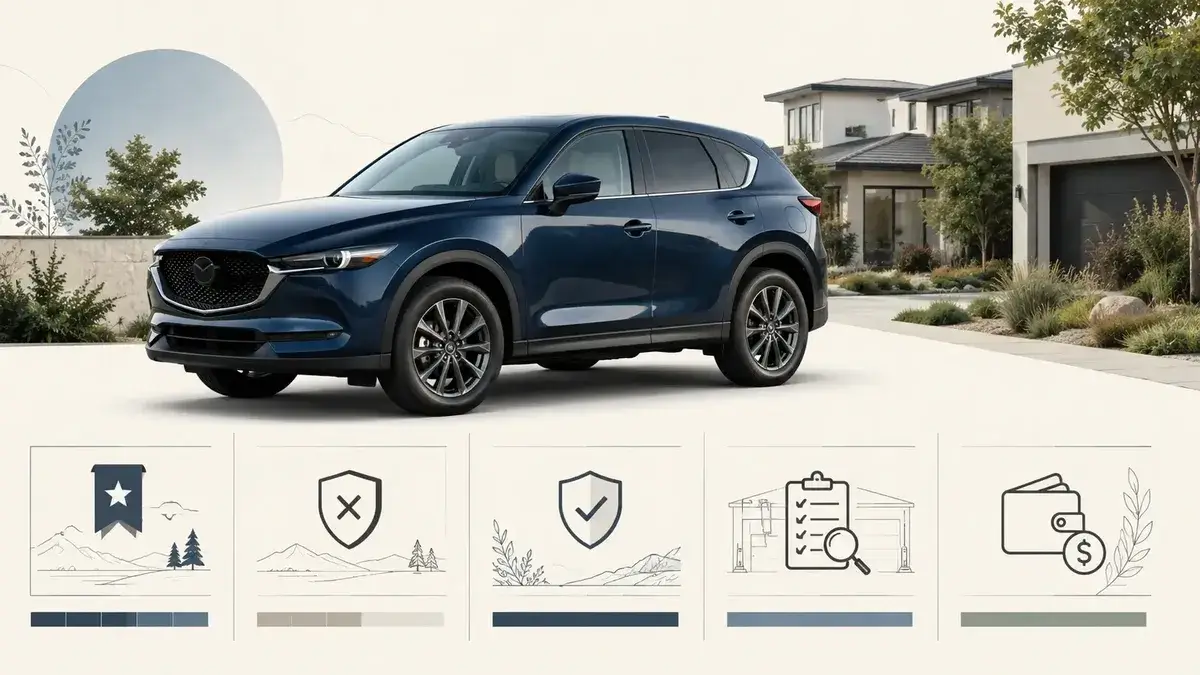
The Mazda CX-5 years to avoid are not all automatic deal-breakers. The better used-buying answer is more practical: avoid weak examples of the riskiest years, inspect several middle-risk years harder, and prioritize cleaner second-generation models when the price makes sense.
For most used buyers, the best Mazda CX-5 years are later second-generation models with strong maintenance records, completed recalls, clean title history, and no signs of engine, lighting, infotainment, brake, tire, or AWD neglect. The years that deserve the most caution are 2016, 2014, 2018, and 2019.
The practical rule is simple: buy the condition, not only the year. But do not ignore the year. Some CX-5 years have clearer complaint, recall, and inspection-risk signals than others.
CarMerit reliability tool
Check any CX-5 year — live NHTSA data
Pick a model year to see current complaint, recall, investigation, and manufacturer-communication counts from NHTSA, plus our verdict on whether that year is a safe used buy.
Owner complaints
…
NHTSA, CarMerit snapshot
Safety recalls
…
NHTSA, CarMerit snapshot
Investigations
…
NHTSA, CarMerit snapshot
Manufacturer communications
…
NHTSA, CarMerit snapshot
Most-reported problem areas
Complaint counts are raw owner reports filed with NHTSA and are not adjusted for sales volume — popular years naturally generate more reports. Verdicts combine this data with CarMerit’s own research. Data source: NHTSA.gov. Always verify a specific vehicle’s history before buying.
Mazda CX-5 Years to Avoid and Best Years: Quick Answer
A used CX-5 is usually more appealing when you want a compact SUV that feels sharper and more premium than the average mainstream option. That does not make every year equally safe.
The useful way to shop is to separate CX-5 years into three buckets: shortlist first, inspect harder, and avoid weak examples. This gives you a better buying filter than a simple “good years” and “bad years” list.
| Mazda CX-5 model years | Used-buying verdict | Why it matters | Buy-if condition |
|---|---|---|---|
| 2023–2025 | Newer safety-hardware shortlist, with an important limitation | IIHS rates the updated moderate-overlap test and seat belt reminders Good, but vehicle-to-vehicle front crash prevention 2.0 Poor. | Best for buyers who value newer restraint hardware and understand that the IIHS results are mixed |
| 2021–2022 | Strong newer-used shortlist, with a rear-passenger safety limitation | These are lower-age second-generation models, but IIHS rates the updated moderate-overlap evaluation Poor and the seat belt reminder evaluation Marginal for 2021–2022. | Buy with good records, a clean inspection, completed recalls, and an informed comparison with 2023–2025 if rear-seat protection matters. |
| 2017–2020 | Good value range, inspect by year | IIHS notes the CX-5 was redesigned for 2017, making this the start of the second-generation used range. | Best when records are strong and 2018/2019 examples are inspected carefully |
| 2015 | Lower-budget option if records are strong | Older first-generation value, but it sits close to the 2014–2016 fuel-filler recall range | Only with completed recalls, clean records, and a strong inspection |
| 2016 | Inspect hardest or avoid weak examples | CarComplaints lists 2016 as the worst CX-5 model year in its complaint dataset, and official recall materials confirm a 2016 daytime-running-light safety issue. | Buy only if recalls are complete, lights work correctly, records are strong, and price reflects risk |
| 2014 | Inspect hard | Older first-generation model with recall exposure and higher complaint signals than cleaner later years | Only if the car is clean, well documented, and priced as an older-risk vehicle |
| 2013 | Caution for age and early-design limits | First model year, older age, and early-generation safety nuance | Better as a low-budget choice only after a careful inspection |
| 2018–2019 | Inspect-priority years, not blanket avoids | These are second-generation models, but secondary complaint data shows enough owner-reported issues to justify stronger inspection. | Good choice only if no engine, oil/coolant, brake, infotainment, or AWD symptoms appear |
Table Note: IIHS test families and criteria changed over time. Do not treat these results as one cross-year safety score or use a crash-test rating as a reliability verdict.
Best newer-used shortlist: 2021–2025
Best value range: 2017–2020
Lower-budget option if records are strong: 2015
Inspect hardest: 2016
Do not blindly reject: 2018–2019
Walk away if: weak records, open recalls, warning lights, poor inspection results, or seller resistance.
Walk away from any CX-5, even a recommended year, if the seller cannot prove recall status, service history, title condition, and inspection access.
The best year for Mazda CX-5 buyers depends on budget. If you want the safer modern choice, start with 2021–2025. If you want value, shop 2017–2020, but treat 2018 and 2019 as inspection-priority years, not automatic avoid years.
The Mazda CX-5 years to avoid are mostly years to avoid in poor condition. A well-maintained caution year can beat a neglected “good” year.
Choosing the right CX-5 year matters, especially if you are looking at turbo, AWD, or higher-mileage examples. For the broader reliability picture, compare it with other picks in our Most Reliable Used Cars guide.
How We Judged Mazda CX-5 Model Years
Year lists are weak when they do not explain the evidence. A Reddit thread, dealer blog, or owner complaint page can reveal useful risk signals, but none of them should be treated as final proof by itself.
The safer method is to weigh official recall and safety information first, then use complaint concentration, generation changes, and used-car inspection risk as supporting signals.
| Evidence signal | How it affects the recommendation | Why it matters |
|---|---|---|
| Official recalls | Raises inspection priority and confirms a known repair campaign | A completed recall may reduce risk, but an open recall is a buying red flag |
| IIHS crash-test data | Helps separate safety-focused years from older compromises | Safety changes can make a newer year worth paying for |
| Complaint concentration | Shows which years deserve closer inspection | Complaint data is useful, but it is not the same as a controlled reliability study |
| Common problem pattern | Turns vague risk into specific checks | Buyers need to know what to inspect, not just what to fear |
| Maintenance records | Can improve or weaken any model-year recommendation | A clean caution year may be safer than a neglected recommended year |
| Mileage and use history | Changes repair-risk exposure | City use, poor tires, rough roads, and skipped service can matter as much as the year |
| Trim and engine choice | Affects complexity and value | Turbo, AWD, and higher-feature trims add inspection points |
Recall status matters because it applies to the specific vehicle, not just the model year. A 2016 CX-5 with completed recall work is a different buying risk than one with no proof of repair.
The same logic applies to complaint data. A complaint-heavy year deserves stronger screening, but the final decision still depends on the exact vehicle’s records, title history, inspection results, and test drive.
Before you apply the CX-5’s year-level risk picture to a specific listing, confirm that the vehicle itself matches what the seller is advertising. Run the VIN through the CarMerit VIN Lookup and compare the returned vehicle details with the listing and paperwork. If something does not line up, resolve that first; service history, title history, condition, and the pre-purchase inspection still need to be checked separately.
NHTSA Complaint and Recall Snapshot by CX-5 Model Year
| Model year | Owner complaints | Safety recalls | Mfr. Comms. | Evidence context |
|---|---|---|---|---|
| 2013 (Gen 1) | 194 | 1 | 822 | Earliest CX-5 model year covered here; use as an inspection signal only. |
| 2014 (Gen 1) | 377 | 4 | 787 | Higher complaint and recall count than most nearby years; verify records and recall completion. |
| 2015 (Gen 1) | 133 | 4 | 601 | Lower complaint count than 2014 and 2016, but multiple recall rows still matter. |
| 2016 (Gen 1) | 507 | 5 | 703 | Highest complaint and recall counts in the available NHTSA model-year records. |
| 2017 (Gen 2) | 147 | 1 | 569 | First second-generation model year; still needs normal VIN and record checks. |
| 2018 (Gen 2) | 342 | 3 | 631 | Higher Gen 2 complaint count plus multiple recall rows. |
| 2019 (Gen 2) | 259 | 2 | 558 | Gen 2 row with notable complaint volume and two recall rows. |
| 2020 (Gen 2) | 105 | 0 | 444 | No recall rows or investigations appear in the available NHTSA records. |
| 2021 (Gen 2) | 137 | 0 | 485 | No recall rows or investigations, but complaint count is not a reliability score. |
| 2022 (Gen 2) | 62 | 0 | 338 | Newer-year age bias applies. |
| 2023 (Gen 2) | 58 | 0 | 271 | Newer Gen 2 data is still immature. |
| 2024 (Gen 2) | 40 | 0 | 196 | Newer Gen 2 data is still immature. |
| 2025 (Gen 2) | 23 | 0 | 134 | Very new used-market data; do not treat the low count as proof. |
Table Note: Complaint and manufacturer-communication counts are raw NHTSA records, not defect rates or reliability scores. Older years naturally have more time to collect reports, so do not treat newer-year lower counts as proof of better reliability.
Best Mazda CX-5 Years to Buy Used
The best used Mazda CX-5 years are not just the newest ones. They are the years where safety, reliability signals, buyer value, and remaining useful life line up well.
For most buyers, the second-generation CX-5 is the better starting point. It began with the 2017 redesign, and the newer structure gives most used buyers a cleaner baseline than the earliest CX-5 years.
| Buyer type | Best years to start with | Why these years make sense | Main caution |
|---|---|---|---|
| Best newer-used shortlist | 2021–2025 | Newer second-generation models, stronger feature availability, and lower age-related risk | 2025 is still too new for a proven long-term used-reliability record. |
| Newer safety-hardware pick | 2023–2025 | Rear seatbelt load limiters and pre-tensioners were added beginning with 2023. IIHS rates the updated moderate-overlap test and seat belt reminders Good. | Vehicle-to-vehicle front crash prevention 2.0 is Poor, so this is not a universal safety winner |
| Best value range | 2017–2020 | Second-generation design and usually lower cost than newer examples | Inspect 2018 and 2019 more carefully |
| Lower-budget option if records are strong | 2015 | Can be cheaper than second-generation models while avoiding the strongest 2016 caution | Confirm recalls, records, and condition |
| Best cautious-buy strategy | Clean 2017+ non-abused example | Reduces age and first-generation risk | Still needs a VIN recall check and pre-purchase inspection |
If your budget is around $20,000, compare available CX-5 listings with the RAV4, CR-V, and other options in our best used cars under $20,000 guide. Judge the exact listing by its price, mileage, condition, ownership history, and equipment instead of assuming that one CX-5 year band is automatically good value.
Best newer-used shortlist: 2021–2025
If budget allows, start with 2021–2025. These years give you a clean blend of modern equipment, lower age, and second-generation refinement.
For family buyers, 2023–2025 deserve special attention because IIHS says rear seatbelt load limiters and pre-tensioners were added beginning with 2023 models. IIHS rates both the updated moderate-overlap evaluation and seat belt reminders Good for 2023–2025. However, vehicle-to-vehicle front crash prevention 2.0 is rated Poor for those same years.
This creates a stronger rear-restraint case, not proof that 2023–2025 are best in every safety measure. IIHS test families and criteria changed over time, so do not treat these ratings as one simple cross-year safety score.
Because 2025 models are still newer, treat them as lower-age candidates rather than proven long-term used-reliability picks. Do not assume any original factory warranty remains. Verify the VIN, original in-service date, mileage, ownership, and applicable written terms.
The trade-off is cost. A newer used CX-5 can be a poor value if it is priced too close to a new or certified pre-owned alternative.
Best value: 2017–2020
The 2017 redesign is the reason this range matters. It gives used buyers a second-generation CX-5 without necessarily paying the higher prices attached to newer examples.
That makes 2017–2020 a practical value range. Still, this is not a blind-buy range. Treat 2018 and 2019 as inspection-priority years because the concern is buyer-risk screening, not proof of a universal defect.
Lower-budget option: 2015
A clean 2015 CX-5 can make sense for a lower-budget buyer, but only when the records are strong. It is older, so condition matters more than reputation.
The main caution is recall proximity. Mazda recall materials cover 2014–2016 CX-5 vehicles for a fuel filler pipe issue that could lead to fuel leakage in a rear crash, and the remedy involved modifying the fuel filler pipe attachment structure. Mazda recall statement
Mazda CX-5 Years to Avoid or Inspect Harder
“Years to avoid” should not mean “never buy under any condition.” It should mean the year needs stronger proof before it earns your money.
For the CX-5, the riskier years are mostly older, more complaint-heavy, or tied to recall and common-problem patterns. If the records are weak, the seller is vague, or the test drive reveals symptoms, walk away.
| Year or range | Verdict | Main concern | Buying action |
|---|---|---|---|
| 2016 | Strongest caution | Worst model year in CarComplaints’ CX-5 complaint dataset, plus DRL recall and 2014–2016 fuel-filler recall context. | Avoid weak examples. Buy only with completed recalls and strong records |
| 2014 | Inspect hard | Older first-generation model with recall exposure and complaint signals | Avoid if service history is thin or engine symptoms appear |
| 2013 | Caution | First model year, older age, and early-design risk | Only consider if cheap, clean, and inspected |
| 2018 | Inspect hard | Secondary complaint signal is enough to justify extra checking, not enough for blanket rejection | Require strong inspection and records |
| 2019 | Inspect hard | Not a blanket avoid, but engine and ownership-risk checks matter | Do not buy with oil, coolant, overheating, or warning-light symptoms |
2016: the year to be most careful with
If you want one year to inspect hardest, it is 2016. CarComplaints lists the 2016 CX-5 as the worst model year in its complaint dataset and says it has the most overall complaints in its CX-5 dataset. CarComplaints Mazda CX-5
The 2016 CX-5 also has official recall context that used buyers should not ignore. Mazda said affected 2016 CX-5 vehicles could have LED daytime running lights that flicker or fail to illuminate, and NHTSA recall materials describe reduced vehicle visibility as the safety risk. Mazda DRL recall statement
A repaired recall does not automatically make a weak 2016 a good buy. It only removes one known safety issue from the checklist.
This does not make every 2016 CX-5 a bad car. It means a 2016 needs proof, not trust.
2014: older and worth checking carefully
The 2014 CX-5 is not an automatic reject, but it is not a relaxed buy either. It belongs in the inspect-hard bucket because it is older, first-generation, and included in the 2014–2016 fuel-filler recall range.
If you are considering a 2014 CX-5, verify its build date. IIHS rates the driver-side small-overlap test Marginal for 2014 models built before November 2013, but Good for 2014 models built after October 2013. This is a build-date-specific crash-test distinction, not a complete safety verdict. Also check records, recalls, engine behavior, leaks, warning lights, and price. If the seller cannot answer basic service questions, move on.
2018 and 2019: inspect-priority, not blanket avoid
The 2018 and 2019 CX-5 are not in the same bucket as 2016. They are second-generation models and can be good buys.
The reason for caution is narrower: secondary complaint data shows enough owner-reported issues to justify stronger inspection. That is not the same as proof that every 2018 or 2019 CX-5 is defective.
For 2018 and 2019, the risk is not strong enough for a blanket avoid label, but it is strong enough to justify a stricter inspection and a lower tolerance for weak records.
Mazda CX-5 Reliability by Year
Mazda CX-5 reliability by year is better understood by generation than by one isolated model year. The first generation is older and cheaper. The second generation is more refined and generally the safer starting point for most used buyers.
This does not mean every second-generation CX-5 is trouble-free. It means the buyer’s default shortlist should usually start there, then narrow by condition.
| Year range | Reliability direction | Best use case | Main caution |
|---|---|---|---|
| 2013–2014 | Older-risk range | Low-budget buyers who can inspect carefully | Age, recall exposure, early-design risk |
| 2015 | Lower-budget option if clean | Lower-cost used buyer | Recall completion and maintenance records matter |
| 2016 | Highest caution | Only if condition and records are unusually strong | Complaint volume and recall history |
| 2017 | Safer second-generation starting point | Buyers wanting a modern CX-5 at a lower price | First year of redesign, inspect carefully |
| 2018–2019 | Good potential, higher inspection need | Value buyers who want second-generation refinement | More screening needed than quieter newer years |
| 2020 | Solid value candidate | Buyers wanting newer second-generation feel without top pricing | Still verify records and recall status |
| 2021–2022 | Strong newer-used candidates | Buyers wanting modern features and less age risk | Watch pricing and inspect turbo/high-feature examples |
| 2023–2025 | Strong newer-used candidates | Buyers prioritizing newer rear-restraint hardware | Vehicle-to-vehicle front crash prevention 2.0 is Poor, and the newest examples have limited long-term used history |
A good CX-5 year can still be a bad purchase if the car was neglected. A caution year can still be acceptable if it has completed recalls, clean maintenance records, a clean title, and a strong pre-purchase inspection.
The strongest general shortcut is this: start with 2021–2025 if budget allows, shop 2017–2020 for value, and treat 2016, 2014, 2013, 2018, and 2019 as higher-inspection years.
After choosing the right CX-5 years, check whether it fits your family’s real space and cargo needs. Our best used family cars guide compares the CX-5 with the CR-V, RAV4, Camry, Accord, Corolla Cross, and HR-V.
Mazda CX-5 Common Problems by Year
A problem list is only useful if it changes what you do during shopping. The goal is not to memorize every owner complaint. The goal is to know what should make you negotiate, inspect harder, or walk away.
The CX-5’s risk areas are not identical across every year. Older first-generation examples need age and maintenance checks. Some complaint-heavy years need extra attention around engine, lighting, infotainment, and wear-related items.
NHTSA Primary Complaint Components to Check
| Primary NHTSA complaint component | Owner complaints | Affected years in article scope | What to inspect |
|---|---|---|---|
| Engine | 477 | 2013-2025 | Warning lights, rough running, oil or coolant loss, overheating, stalling symptoms. |
| Electrical | 363 | 2013-2023, 2025 | Infotainment resets, warning lights, camera issues, battery drain, sensor faults. |
| Brakes | 211 | 2013-2025 | Brake warning lights, pedal feel, pulsation, noise, uneven braking. |
| Exterior lighting | 205 | 2014-2024 | Headlights, DRLs, flickering lights, failed lighting, 2016 DRL recall completion. |
| Airbags / seatbelts / structure | 197 | 2013-2024 | Airbag lights, seatbelt warnings, liftgate/structure concerns, completed safety recalls. |
| Visibility / wipers | 189 | 2013-2025 | Windshield, wipers, visibility equipment, camera or sensor-related visibility issues. |
| Powertrain / transmission | 170 | 2013-2025 | Harsh shifts, hesitation, stalling, transmission warnings, drivetrain behavior. |
| Fuel system | 71 | 2013-2021, 2023-2024 | Fuel smell, leaks, fuel-pump symptoms, fuel-system recall completion. |
| Driver-assist / ADAS | 49 | 2015, 2017-2025 | False alerts, warning lights, malfunction messages, sensor/camera operation. |
| Suspension / wheels | 44 | 2013-2024 | Tire wear, clunks, vibration, wheel/tire condition, suspension noise. |
Note: Counts use the primary-listed NHTSA complaint component only, so one complaint is not double-counted across multiple categories. These are owner-filed complaint records, not confirmed defect rates or buy/avoid verdicts.
For 2016, the DRL issue is not just a casual complaint. Mazda’s recall statement says the LED daytime running lights may flicker or fail to illuminate while driving, and NHTSA recall materials say reduced visibility could increase crash risk.
For certain 2014–2016 vehicles, the fuel-filler recall is also concrete. Mazda said the fuel filler pipe could rupture during a rear collision and potentially cause fuel leakage.
NHTSA Recall Campaigns to Verify by VIN
| NHTSA campaign | Affected CX-5 years | Recall issue | Safety issue to verify | Buyer check |
|---|---|---|---|---|
| 16E002000 | 2014-2016 (Gen 1) | Replacement windshield sensor bracket | Smart City Brake Support-related safety features may be disabled if the bracket loosens. | Verify whether the vehicle had affected replacement glass and completed remedy. |
| 16V064000 | 2014-2016 (Gen 1) | Fuel filler pipe | Fuel leak and fire risk in a rear crash. | Confirm fuel filler remedy completion by VIN. |
| 16V203000 | 2014-2016 (Gen 1) | Steering / strut mounting hardware | Loss of steering-control risk if hardware loosens. | Confirm steering/strut campaign status by VIN. |
| 16V644000 | 2013-2016 (Gen 1) | Liftgate support struts | Liftgate may fall unexpectedly and injure the user. | Verify liftgate strut recall completion. |
| 17V744000 | 2017 (Gen 2) | Accessory trailer-hitch wiring | Trailer lighting may become inoperative. | Check harness routing/repair if the vehicle has the accessory trailer hitch. |
| 18V426000 | 2018 (Gen 2) | Side curtain airbags | Airbags may not deploy properly in a side impact or rollover. | Verify curtain airbag recall completion. |
| 19V497000 | 2018-2019 (Gen 2) | PCM software / engine stall | Unexpected stall risk. | Verify PCM software reprogramming was completed. |
| 20V063000 | 2016 (Gen 1) | LED daytime running lights | Reduced vehicle visibility if DRLs fail. | Verify headlight/DRL repair and test the lights. |
| 21V875000 | 2018-2019 (Gen 2) | Low-pressure fuel pump | Fuel pump failure may cause engine stall. | Verify fuel pump replacement campaign completion. |
Table Note: This recall table is a VIN-check trigger, not a buy/avoid verdict. Recall completion rates were not verified in the available NHTSA records, so the buyer must confirm recall status by VIN and service records.
Mazda coverage programs to verify before buying
Certain 2016–2025 CX-5 examples may qualify for Mazda coverage programs in addition to any applicable recall repairs.
Before downgrading a CX-5 year because of a coolant-leak, fuel-pump, infotainment, or coolant-control-valve repair history, check that model year in CarMerit’s Manufacturer Special Coverage Lookup to see whether Mazda issued a relevant coverage program that should be verified for the exact vehicle.
| Program | Affected CX-5 years | Covered condition | Official coverage term | Buyer action |
|---|---|---|---|---|
| CSP11 | 2019–2020 | Confirmed cylinder-head coolant leak around the exhaust-manifold area on specified PYT SKYACTIV-engine vehicles | 10 years or 120,000 miles, whichever comes first, from the original in-service date | Ask a Mazda dealer to confirm program eligibility and whether the required diagnosis applies |
| CSP12 | 2017–2019 | Specified Denso low-pressure fuel-pump failure within exact VIN groups | Recall-repaired vehicles: 15 years after the recall repair date or 150,000 total vehicle miles. Additional vehicles: 15 years or 150,000 miles from the in-service date | Confirm the VIN group, program status, repair history, mileage, and applicable start date |
| CSP13 | 2016–2020 | Specified Mazda Connect software update or Connectivity Master Unit replacement | 24 months with no mileage limit from the later of the New Vehicle Limited Warranty expiration or February 17, 2025 | Have a Mazda dealer confirm that CSP13 appears for the VIN and whether coverage remains |
| SSPD8 | 2018–2025 | Specified coolant-control-valve repair involving the fail-safe thermostat or dummy plug and PCM update | 15 years or 150,000 miles, whichever comes first, from the original warranty start date | Confirm the VIN and production range, program display, diagnosis, mileage, and warranty start date |
Table Note: These programs are not recalls and do not cover every CX-5 within the listed years. Eligibility is vehicle-, VIN-, production-, program-, and diagnosis-specific. Remaining coverage also depends on the applicable start date, mileage, repair history, and written program terms.
Best Mazda CX-5 Generation for Used Buyers
The second-generation CX-5 is the better default choice for most used buyers. It starts with the 2017 model year and gives you a more modern structure, better refinement, and newer feature availability.
The first generation can still work for budget shoppers, but it needs more patience. It is older, cheaper, and more likely to depend on maintenance history than model-year reputation.
| Generation | Model years | Best for | Main trade-off |
|---|---|---|---|
| First generation | 2013–2016 | Lower-budget buyers who can inspect carefully | Older safety/feature set and more caution around 2014/2016 |
| Second generation | 2017–2025 | Most used buyers | Higher price, especially 2021+ and 2023+ |
| Best value zone | 2017–2020 | Buyers balancing cost and modern design | Inspect 2018/2019 harder |
| Newer safety-hardware zone | 2023–2025 | Buyers prioritizing improved rear-restraint hardware | Mixed IIHS results and usually less affordable used |
The first generation is not useless. The problem is that many first-generation examples are now old enough that condition matters more than reputation.
The second generation is not perfect either. If you shop 2018 or 2019, do not skip the engine, infotainment, brake, tire, and AWD checks.
Which Mazda CX-5 Trim and Engine Should You Buy?
Do not pick a used CX-5 trim only because it has more features. The best trim is the one that gives you the equipment you will actually use without adding cost and complexity you do not need.
For most used buyers, a well-equipped non-turbo CX-5 is the cleaner default. It keeps the CX-5’s main strengths: good cabin feel, sharp handling, useful safety equipment, and reasonable ownership complexity.
| Choice | Best for | Why it makes sense | Caution |
|---|---|---|---|
| Non-turbo engine | Most used buyers | Simpler default choice with enough power for normal use | Still inspect maintenance records |
| Turbo engine | Buyers who value stronger performance | Makes the CX-5 feel quicker and more upscale | More complexity, inspect service history carefully |
| AWD | Snow-belt or poor-weather buyers | Useful traction benefit | Check tire matching and drivetrain noise |
| Mid-level trims | Value-focused buyers | Often better balance of comfort and cost | Verify exact features by VIN/window sticker |
| Top trims | Buyers who want luxury feel | Better cabin and tech feel | Avoid overpaying if the car is older or high-mileage |
Turbo vs non-turbo CX-5: fuel economy and service difference
| Model years | Exact gasoline configuration | EPA city MPG | EPA highway MPG | EPA combined MPG | Mazda spark-plug interval |
|---|---|---|---|---|---|
| 2019–2023 | 2.5L non-turbo, 4WD, 6-speed automatic, no start-stop | 24 | 30 | 26 | Replace every 75,000 miles |
| 2019–2023 | 2.5L turbo, 4WD, 6-speed automatic, no start-stop | 22 | 27 | 24 | Replace every 40,000 miles |
| 2024 | 2.5L non-turbo, 4WD, 6-speed automatic, no start-stop | 23 | 29 | 25 | Replace every 75,000 miles |
| 2024 | 2.5L non-turbo, 4WD, 6-speed automatic, start-stop | 26 | 31 | 28 | Replace every 75,000 miles |
| 2024 | 2.5L turbo, 4WD, 6-speed automatic, no start-stop | 22 | 27 | 24 | Replace every 40,000 miles |
| 2025 | 2.5L non-turbo, 4WD, 6-speed automatic, no start-stop | 23 | 29 | 25 | Replace every 75,000 miles |
| 2025 | 2.5L non-turbo, 4WD, 6-speed automatic, start-stop and cylinder deactivation | 26 | 30 | 28 | Replace every 75,000 miles |
| 2025 | 2.5L turbo, 4WD, 6-speed automatic, no start-stop | 22 | 27 | 24 | Replace every 40,000 miles |
Table Note: EPA ratings apply only to the exact configurations shown. Do not average different variants. Diesel configurations are not included.
The non-turbo configurations use less fuel in these matched EPA examples and have a longer official spark-plug interval. The turbo remains the stronger-performance choice. These are efficiency and maintenance differences, not proof of failure risk or total ownership cost.
A 2019 SKYACTIV-D 2.2 diesel requires separate service verification. Mazda specifies fuel-filter replacement every 20,000 miles or 3 years and air-filter replacement every 35,000 miles or 3 years, with intermediate cleaning.
Diesel exhaust fluid must be topped up annually. At the three-year check, it is topped up or replaced according to Mazda’s mileage-based rule. Glow plugs are replaced when the glow indicator remains continuously on rather than at an invented fixed interval.
Verify that a diesel example has followed the diesel-specific schedule before buying. Do not apply the gasoline maintenance table to it.
Safety and comfort features can be worth paying for, but only if they work correctly. Adaptive cruise control, blind spot monitoring, cameras, sensors, and infotainment features should all be checked during the test drive.
Do not turn a good trim into an excuse to ignore the year. A loaded 2016 with weak records is not automatically better than a simpler newer CX-5 with clean maintenance.
Used Mazda CX-5 Buying Checklist
The best used Mazda CX-5 years still need verification. A clean year on paper does not protect you from poor maintenance, accident history, skipped recalls, or hidden drivetrain problems.
Use this checklist before you commit. It is more useful than relying on a seller’s claim that “Mazdas are reliable.”
| Check | What to do | Walk away if |
|---|---|---|
| VIN recall check | Use NHTSA’s VIN recall lookup and Mazda’s owner recall tool before purchase | Open safety recall with no repair plan |
| Service records | Ask for oil changes, brake work, tire history, and major repairs | Seller has no records and cannot explain maintenance |
| Pre-purchase inspection | Use an independent mechanic, not only the seller’s shop | Seller refuses inspection |
| Engine check | Look for leaks, warning lights, rough idle, smoke, coolant loss | Any major symptom is active or unexplained |
| Test drive | Check steering, braking, shifting, highway tracking, and noise | Car pulls, shudders, overheats, or has warning lights |
| Infotainment | Test screen, backup camera, Bluetooth, navigation, and controls | System freezes or reboots repeatedly |
| AWD and tires | Confirm matching tire brand, size, and wear pattern | Mismatched tires or drivetrain vibration |
| Title/history | Check accident, flood, salvage, lemon, and odometer history | Title history is unclear or branded |
| CPO terms | Read the coverage, deductible, exclusions, and expiration | Salesperson cannot explain what is actually covered |
Match service records to the exact model year and maintenance setting. Mazda’s U.S. normal-use schedule for 2013–2015 calls for oil and filter replacement every 6 months or 7,500 miles.
For 2016, flexible oil maintenance is capped at 12 months or 10,000 miles. The fixed schedule is 6 months or 7,500 miles, while Schedule 2 is 4 months or 5,000 miles.
For 2017–2025 vehicles using flexible oil maintenance, service is due when the wrench indicator comes on and must not exceed 12 months or 7,500 miles. A vehicle operated under Mazda’s severe-use conditions may require Schedule 2 instead.
For 2013–2025 gasoline CX-5 models, Mazda specifies the first engine-coolant replacement at 10 years or 120,000 miles, followed by replacement every 5 years or 60,000 miles, whichever comes first.
For AWD CX-5 models from 2013–2025, Mazda’s 30,000-mile rear-differential-oil interval applies only under specified special-use conditions, including towing, dusty or wet roads, prolonged idling, or repeated short trips. Transfer oil is event-triggered rather than a normal fixed interval: replace it if the transfer unit has been submerged in water. Do not treat either rule as a universal normal-use schedule.
Do not judge every CX-5 against one generic interval or apply a normal-use schedule to a vehicle that should have followed more demanding requirements.
A caution year can be acceptable if the car passes this checklist. A recommended year should still be rejected if it fails it.
After you narrow the safest CX-5 years, compare it against the Subaru Forester before choosing a listing. The Mazda CX-5 vs Subaru Forester decision is useful if you are balancing comfort, cargo room, AWD confidence, and long-term ownership risk.
Use NHTSA’s recall lookup and Mazda’s owner recall tool before buying. A specific recall statement or PDF helps explain the issue, but the VIN check tells you whether that individual CX-5 still needs repair.
Who Should Buy a Used Mazda CX-5 and Who Should Skip It
The CX-5 is not the best compact SUV for every buyer. Its strongest case is not maximum space or lowest possible ownership cost. Its strongest case is a more refined, better-driving mainstream compact SUV.
That trade-off matters. If you buy it for the wrong reason, even a good year may feel like the wrong car.
| Buyer type | Buy a used CX-5 if | Skip or compare first if |
|---|---|---|
| Commuter | You want comfort, easy size, and a nicer cabin feel | You only care about the lowest possible running cost |
| Small family | You value safety, cabin quality, and driving feel | You need maximum rear-seat or cargo space |
| Snow-belt buyer | You want AWD and good road manners | You will not maintain tires properly |
| Value buyer | You find a clean 2017+ example at the right price | You are stretching budget for a risky year |
| Performance-leaning buyer | You want a sharper SUV than the average compact crossover | You want cheap, simple long-term ownership above all |
| Practical buyer | You will verify records, recalls, and inspection results | You want to buy quickly with minimal research |
For buyers who want Mazda feel in a smaller package, the CX-30 can make sense. The safer move is to compare CX-5 risk years against the Mazda CX-30 years to avoid before choosing either SUV.
The CX-5 is strongest for buyers who care about the drive as much as the utility. It is weaker for buyers who want the roomiest compact SUV, hybrid efficiency, or the most appliance-like ownership experience.
If cargo space, fuel savings, or ultra-low repair risk matter more than cabin feel and handling, compare the CX-5 against the Honda CR-V and Toyota RAV4 before buying.
Before choosing a specific CX-5 model year, compare it against the CR-V and RAV4 in our best used compact SUVs guide.
Final Verdict: Best Mazda CX-5 Years for Most Buyers
The best newer-used Mazda CX-5 shortlist is 2021–2025 if budget allows. The 2023–2025 models add newer rear-restraint hardware and earn Good IIHS ratings for the updated moderate-overlap test and seat belt reminders. However, their vehicle-to-vehicle front crash prevention 2.0 rating is Poor, so treat them as a newer-hardware shortlist rather than universal safety winners. The best value range is usually 2017–2020, but 2018 and 2019 need a stricter inspection.
The Mazda CX-5 years to avoid are best understood as caution years, not automatic rejects. The 2016 CX-5 deserves the strongest caution because CarComplaints lists it as the worst CX-5 model year in its complaint dataset, and official recall materials confirm the 2016 daytime-running-light issue.
For a safer used-buying path, start with a clean 2021–2025 or 2017–2020 example, verify recalls by VIN, review service records, and pay for a pre-purchase inspection. If the seller resists any of those steps, the model year stops mattering.
Frequently Asked Questions
What is the best year for a used Mazda CX-5?
For most buyers, 2021–2025 are the easiest newer-used years to shortlist because they are second-generation models with less age-related risk. Among them, 2023–2025 add newer rear-restraint hardware. That does not make them best in every safety measure because their IIHS results are mixed across different test families.
Which Mazda CX-5 years should I avoid?
The 2016 CX-5 is the year to inspect hardest or avoid if records are weak. The 2014, 2013, 2018, and 2019 model years also deserve extra inspection, but they are not automatic rejects if the specific vehicle is clean, well maintained, and properly priced.
Is the Mazda CX-5 reliable by year?
The CX-5 generally looks better when you focus on clean second-generation examples, especially 2021–2025 and carefully inspected 2017–2020 models. Secondary complaint data points to 2016 as the worst CX-5 model year in its complaint dataset and supports extra caution around several older or complaint-heavier years.
What are the most common Mazda CX-5 problems by year?
The problems to check include engine warning signs, oil or coolant leaks, DRL failure on certain 2016 models, infotainment glitches, brake wear, suspension noise, AWD tire mismatch, and open recalls. The exact risk depends on year, mileage, maintenance, trim, and prior use.
Is a first-generation Mazda CX-5 still worth buying used?
Yes, but only for the right price and condition. The first-generation CX-5 can work as a budget option, especially if records are strong, but older age, recall status, and complaint history make inspection more important.
Is the Mazda CX-5 turbo engine reliable?
A turbo CX-5 can be worth buying if you want stronger performance, but it should be inspected more carefully than a simpler non-turbo example. Look for clean oil-change records, no coolant or oil-loss symptoms, no warning lights, and no signs of overheating or neglected maintenance.
What mileage is too high for a used Mazda CX-5?
There is no single mileage cutoff that works for every CX-5. A lower-mileage car with poor records can be worse than a higher-mileage car with consistent maintenance. Service history, inspection results, title history, and recall completion matter more than mileage alone.
Is a certified pre-owned Mazda CX-5 worth it?
A certified pre-owned CX-5 can be worth paying more for if the warranty terms, inspection, and vehicle history are clear. Do not assume CPO automatically solves everything. Still check the VIN for recalls, read the warranty terms, and inspect the vehicle.
Which Mazda CX-5 trim is best to buy used?
For most buyers, a mid-level non-turbo trim is the safest value play. It usually gives enough comfort and safety equipment without making the used price or repair complexity harder to justify. A top trim or turbo model can make sense if records are strong and the price is fair.
Should I compare the Mazda CX-5 with the Honda CR-V or Toyota RAV4 before buying?
Yes, especially if you need more cargo space, hybrid fuel economy, or the lowest possible ownership risk. The CX-5 is strongest when you value driving feel, cabin quality, and compact size. The CR-V and RAV4 may fit better if practicality matters more than driving character.