

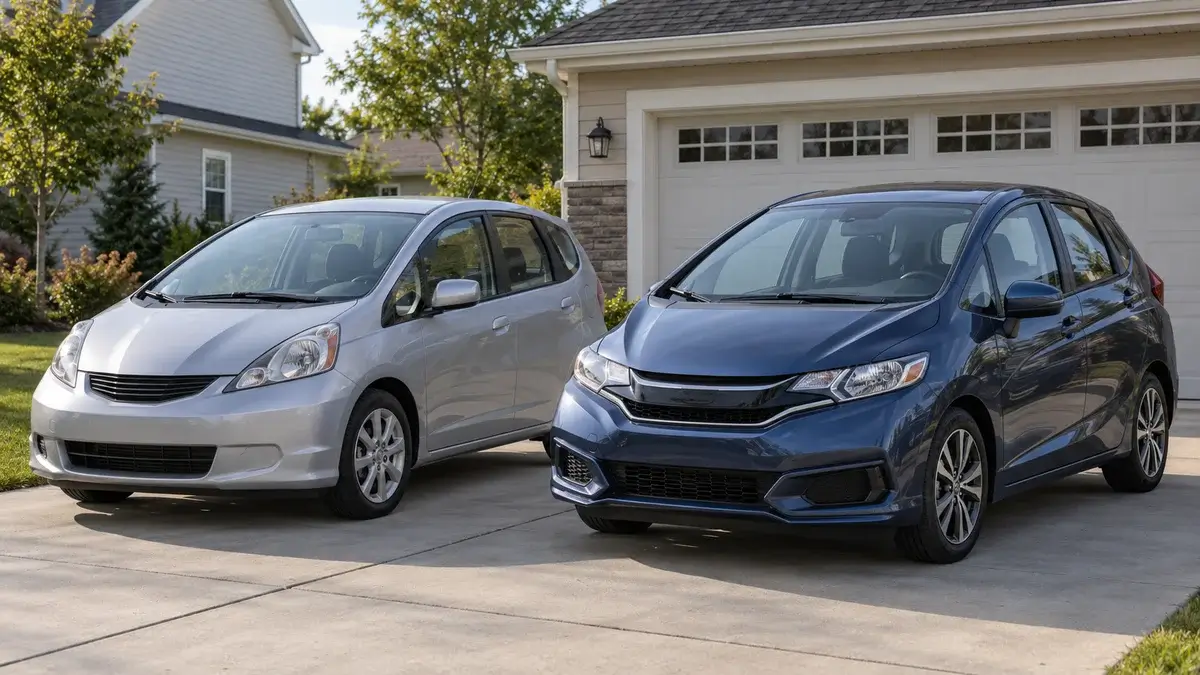
The 2015 Honda Fit deserves extra scrutiny, but it is not automatically a bad used car. Certain 2015 CVT-equipped cars were covered by a transmission-related safety recall, and some 2015–2016 Fits received a fuel-injector warranty extension. Older 2007–2013 cars bring more age-related and safety-verification concerns. A well-maintained 2017 or 2020 Fit can be worth shortlisting, although official records do not establish either as the single most reliable year.
For a U.S. buyer, the right question is not simply which Honda Fit years to avoid. It is which specific year, transmission, build, VIN and service history make a car worth buying—or walking away from.
Quick answer: Which Honda Fit years need caution?
| Model year or group | Practical used-buying position | Main reason to check | What could change the decision |
|---|---|---|---|
| 2015 | Extra scrutiny; do not buy on reputation or price alone | Certain CVT cars had a safety recall; some 2015–2016 cars have documented fuel-injector coverage issues; early build-related front bumper-beam update | Confirm applicable recall and product-update completion, service records and a clean transmission/engine inspection |
| 2007–2008 | Age-sensitive caution | Older vehicles, multiple recall campaigns and specific older IIHS test limitations | Verified recall work, structural condition, service history and a convincing inspection |
| 2009–2013 | Safety-trade-off caution | IIHS rated this generation Poor in the driver-side small-overlap front test; older examples may also require substantial age-related work | Buyer accepts the documented safety trade-off, checks recalls and verifies the actual car’s condition |
| 2016 | Consider with checks | Shares some 2015–2016 fuel-injector eligibility concerns; a low complaint count alone does not establish reliability | Verify injector-related symptoms/eligibility, applicable service history and independent inspection |
| 2017 | Conditional shortlist | Later third-generation structure and a relatively low count of recorded complaints; neither alone is a reliability score | Strong condition and maintenance documentation; verify recalls by VIN |
| 2018–2020 | Conditional shortlist with recall and service-program checks | Selected VINs face rear-camera/seat-sensor campaigns; certain 2018–2019 Fits face a fuel-pump campaign; eligible 2018–2019 CVT cars have a distinct misfire-related Honda warranty extension | Check recall completion by VIN, ask Honda about 23-042 eligibility and related repairs for 2018–2019 CVTs, confirm equipment and inspect the actual car |
Important: “Extra scrutiny” is not a blanket instruction to reject every car from a year. Likewise, “conditional shortlist” is not a guarantee. Recalls apply to particular vehicles, and a serviced high-mileage car may be a better purchase than a neglected lower-mileage one.
Honda Fit reliability by year: What the official records actually show
These records identify what deserves further investigation, not how often a Honda Fit breaks down. A complaint is an owner-submitted allegation, a recall entry connects one NHTSA campaign to a listed model year, an investigation is a regulatory action, and a manufacturer communication can concern maintenance or service procedures rather than an established defect.
| U.S. gasoline model year | Owner complaints | Recall campaign–year entries | Investigation–year entries | Manufacturer communication–year records |
|---|---|---|---|---|
| 2007 | 369 | 11 | 1 | 34 |
| 2008 | 217 | 8 | 1 | 31 |
| 2009 | 286 | 11 | 0 | 53 |
| 2010 | 183 | 12 | 0 | 54 |
| 2011 | 113 | 11 | 0 | 52 |
| 2012 | 113 | 11 | 1 | 44 |
| 2013 | 175 | 10 | 1 | 50 |
| 2015 | 281 | 4 | 1 | 139 |
| 2016 | 116 | 1 | 1 | 94 |
| 2017 | 42 | 0 | 1 | 58 |
| 2018 | 114 | 4 | 0 | 48 |
| 2019 | 132 | 6 | 0 | 29 |
| 2020 | 34 | 4 | 0 | 45 |
Source and counting scope: Historical U.S. NHTSA owner-complaint, recall, investigation and manufacturer-communication records for gasoline Fits, reconciled as a 2026 snapshot rather than a live database total. The exact source-file extraction cutoff is not established here. Columns use different counting units: a recall campaign or investigation associated with a model year is one year-linked entry, while each manufacturer-communication figure counts year-linked document records; a document associated with multiple years may appear in several rows. Those figures are not unique-bulletin totals, verified mechanical failures or defect rates.
For current recalls and individual VIN eligibility, recheck NHTSA’s vehicle safety database and Honda’s official recall search. NHTSA explains the public complaint and recall datasets.
Buyer interpretation: The 2015 model’s complaint history and confirmed CVT campaign make it a reasonable extra-check year. The 2017 or 2020 low raw complaint totals do not establish superior reliability: model-year age, sales volume, reporting behavior and source definitions differ. Nor does “zero recall campaign–year entries” mean that the individual car has never had a safety problem. Investigations and service communications must be read for their substance rather than counted as independent defects.
The U.S. standard gasoline Fit has no normal 2014 model-year counterpart in this series; limited Fit EV availability is a different propulsion scope. Compare like vehicles only.
CarMerit reliability tool
Check any Honda Fit year – NHTSA record snapshot
Select a U.S. Honda Fit gasoline model year to compare historical NHTSA owner complaints, recalls, investigations and manufacturer communications, alongside the article’s conditional buying guidance.
Owner complaints
…
NHTSA, historical snapshot
Recall campaign-year entries
…
NHTSA, historical snapshot
Investigation-year entries
…
NHTSA, historical snapshot
Manufacturer communication records
…
NHTSA, historical year-linked records
Most-reported NHTSA complaint areas
Historical U.S. NHTSA record snapshot reflected in the Honda Fit buying guide, not live totals. Owner complaints and manufacturer communications are raw records, not defect rates or reliability scores; recall and investigation counts are year-linked entries, and VIN eligibility varies. Older cars have had longer to accumulate reports. The five-segment meter reflects CarMerit’s conditional buying guidance, not measured mechanical risk. Check current NHTSA recalls, Honda dealer recall/service-program records, transmission history, title and collision history, warning lights, age-related condition and an independent pre-purchase inspection. No Honda Fit year is guaranteed reliable.
Why 2015 deserves the closest look
The 2015 redesign is a meaningful buyer checkpoint because its documented concerns are specific and verifiable, not merely an online “worst year” label.
CVT recall: Certain 2015 Fits with continuously variable transmissions were included in NHTSA campaign 15V574. Honda identified excessive stress that could fracture a transmission pulley shaft, causing loss of propulsion or potentially locking the front wheels. Honda specified a free software update as the recall remedy; its official owner notice explains the risk. Check the exact VIN and Honda completion record, then still evaluate how the transmission operates. A completed software recall does not repair unrelated mechanical wear.
Fuel injectors: Honda issued a 2015–2016 Fit fuel-injector warranty extension for specified affected cars. The written term is 10 years from original purchase or 150,000 miles, whichever comes first, including eligible subsequent owners. Injector-related misfires or a check-engine light deserve diagnosis, but the notice does not show that every Fit will experience injector failure. As of 2026, much of the time-based coverage may have elapsed; the original in-service date, mileage and Honda VIN/program eligibility control.
Early-build bumper-beam update: IIHS reports that Honda strengthened front bumper-beam welds for Fits built after June 2014 and announced a free product update for earlier-built cars. The IIHS 2015–2016 Acceptable small-overlap frontal rating was based on the improved design and also applies to earlier cars after the specified update. For an early-built 2015 example, inspect the driver-door certification label and seek Honda documentation confirming whether the update was needed and performed.
When to walk away from a 2015: An unresolved applicable safety recall, unexplained transmission behavior, recurrent misfires, missing service history or seller resistance to an inspection can outweigh a tempting asking price. A properly documented and well-inspected 2015 should not be rejected merely because it belongs to this model year.
Older Fits: The biggest concern may be safety and age, not a “bad engine”
2007–2008: These first-generation U.S. cars have older-vehicle exposure to deferred maintenance, corrosion and accident repairs. Their NHTSA history includes multiple safety campaigns, including airbag-related records. IIHS recorded Poor head-restraint performance for the tested manual-cloth-seat configuration. That rating does not replace an inspection or apply to every possible crash scenario, but it is a buyer-relevant trade-off.
2009–2013: The second-generation Fit has an important crashworthiness limitation. IIHS rated its driver-side small-overlap front performance Poor for the 2009–2013 design even though its original moderate-overlap and original side tests were rated Good. The differing outcomes are from different crash-test types; the Good results do not cancel out the Poor small-overlap result. See the IIHS 2013 Fit test detail.
The second generation is not uniformly identical across every test: the roof-strength evaluation improved from Acceptable for 2009–2011 to Good for 2012–2013. That supports a specific safety distinction, not a universal claim that 2012–2013 are the best mechanical years.
If you are choosing an inexpensive 2007–2013 Fit, make a conscious trade-off between purchase price, older safety-test performance, mileage, service work and current condition. Do not pay a premium simply because a third-party ranking declares an older year “bulletproof.”
Which Honda Fit years are better to consider?
2017 is a reasonable starting point for a conditional shortlist: its available NHTSA complaint tally is relatively small, and IIHS documents a 2017 change to the structure, driver airbag and steering column with a Good original moderate-overlap frontal rating applicable to 2017–2020. This is favorable context, but not an independent prediction of future mechanical failures.
2020 may suit someone seeking a later U.S. gasoline Fit with potentially newer equipment and less calendar-age exposure than an early-generation car. However, that advantage comes with a trade-off: later models are still subject to VIN-specific recall checks, and the supplied nationwide record counts do not show that a 2020 will cost less to maintain or has the lowest failure risk.
2016, 2018 and 2019 should not be dismissed mechanically. A 2016 requires attention to applicable injector coverage and service documentation. A 2018 or 2019 needs careful fuel-pump and other applicable campaign checks, along with verification of its actual safety features. Certain 2018–2019 Fits were named in fuel-pump recall 23V858, which addresses possible engine stalls; Honda identified the affected Fit years in its recall owner notice.
For certain 2018–2020 cars, rear-camera campaign 24V384 requires the revised software remedy even if an earlier remedy was performed. The 2026 seat-weight-sensor expansion, 26V332, also includes selected 2018–2020 Fits: Honda listed 376 potentially involved Fits across those model years, not every Fit produced in those years. These campaigns are VIN-specific; do not infer that every car has an open recall.
Separate 2018–2019 CVT service-program check: Honda Service Bulletin 23-042 (June 2, 2023) extends coverage on eligible 2018–2019 CVT-equipped Fits for intake-valve carbon buildup associated with engine misfire codes P0300–P0304. The specified remedy is intake-valve cleaning and PGM-FI software updating when Honda confirms the condition and eligibility.
Coverage is 10 years or 150,000 miles from original purchase, whichever comes first; the dealer must check the VIN and the original purchase date. Ask about prior check-engine lights or misfire diagnoses and request any Honda repair documentation. This is a warranty extension, not a safety recall, and it does not mean every 2018 or 2019 Fit has the condition or has coverage remaining.
A useful purchasing rule: Choose the better-documented car over the better-sounding year. Make condition, the correct service history, recall completion and an independent inspection the tie-breakers.
Safety differences that matter when comparing years and trims
| U.S. Fit scope | Verified IIHS distinction | Buyer implication |
|---|---|---|
| 2007–2008 | Poor head-restraint test result for the tested manual-cloth-seat setup | Recognize a dated, configuration-specific safety limitation |
| 2009–2013 | Poor driver-side small-overlap frontal result; Good original moderate-overlap and original side results | Do not call the entire car “Good” or “Poor” without naming the test |
| 2012–2013 | Good roof-strength result versus Acceptable for 2009–2011 | One improved safety test, not proof of overall reliability |
| 2015–2016 | Acceptable driver-side small-overlap result with the specified updated bumper beam | Early-build cars need product-update documentation |
| 2017–2020 | Good original moderate-overlap result on the revised 2017-onward structure | Verify the exact model year; the rating addresses this particular test |
| 2018–2020 equipment | Optional front crash prevention on equipped cars; IIHS headlight grades depend on year, trim and package | Do not assume all Fits carry the optional technology or the same headlight grade |
For example, IIHS reports Poor headlight ratings for certain 2018–2020 LX/Sport configurations, while specified 2019–2020 configurations with high-beam assist received Marginal ratings. The IIHS front crash-prevention result for equipped cars is from its earlier test protocol, not a present-day across-model safety ranking. Check the IIHS 2019 Fit equipment and safety ratings against the actual trim and installed equipment.
Check the transmission and maintenance records before paying
A Fit’s advertised year is not a substitute for evidence that its required work was done. Honda’s Maintenance Minder makes transmission-fluid replacement a service action under code 3 in the recovered official Fit maintenance guides. The correct service instructions depend on the specific year, transmission and use conditions; do not invent a universal mileage interval for every Fit.
| Vehicle or service scope | What to ask the seller to show | Why it matters |
|---|---|---|
| 2008 and 2013 gasoline Fits with applicable Honda guide | Service records for Maintenance Minder tasks, including transmission-fluid code 3 when due | Older automatics/manuals need the correct fluid and documented service, not an assumed “lifetime” fluid claim |
| 2015 CVT-equipped Fit | Recall 15V574 completion plus transmission operation and service documents | A software remedy and actual transmission condition are separate things |
| 2015–2016 affected cars | Fuel-injector diagnosis/repair history and warranty-extension eligibility | A special coverage notice does not by itself establish the present car’s condition or remaining coverage |
| 2018 Fit with recovered Honda guide | Maintenance Minder code 3 service records and other due-service history | Verify the matching Honda requirements rather than relying on a dealer’s generic interval chart |
| Eligible 2018–2019 CVT-equipped Fit | Honda dealer VIN eligibility for 23-042, any P0300–P0304 misfire diagnosis, intake-valve cleaning/software-update paperwork, and original purchase date/mileage | A 10-year/150,000-mile warranty extension for an eligible condition is not a recall, a preventive cleaning requirement, or proof that coverage remains today |
| Any model year | Oil, brake-fluid, tire, collision and corrosion inspection history | Deferred routine service and hidden damage may outweigh model-year reputation |
Honda’s recovered 2008, 2013 and 2018 guides also specify brake-fluid replacement every three years, independently of the Maintenance Minder display. For other years, confirm the rule from that car’s exact U.S. manual rather than assuming that every historic guide is identical. Original factory warranty terms and any special programs are not the same as remaining transferable coverage.
Fuel economy: Compare the transmission, not just the model year
EPA ratings help separate the ownership trade-offs of similarly priced Fits. They do not measure reliability or prove that a more efficient transmission is more durable.
| U.S. gasoline Fit configuration | EPA city / highway / combined MPG |
|---|---|
| 2012, five-speed automatic | 28 / 35 / 31 |
| 2015, six-speed manual | 29 / 36 / 32 |
| 2015, CVT configuration rated at 36 combined | 33 / 40 / 36 |
| 2017, CVT configuration rated at 36 combined | 33 / 40 / 36 |
| 2020, six-speed manual | 29 / 36 / 31 |
| 2020, CVT configuration rated at 36 combined | 33 / 40 / 36 |
These are exact gasoline configuration examples from FuelEconomy.gov’s current published/revised figures, not generic ratings for every trim. The agency also lists other automatic/CVT variants with different ratings. Different model years and revised estimate regimes should not be treated as a controlled like-for-like savings test. Fit EV MPGe is excluded because it is a different propulsion scope.
Buying implication: If fuel economy is central, identify the actual transmission/trim and use the matching EPA figure. Avoid turning a small apparent MPG difference into an invented annual fuel-cost or “best year” verdict.
Does a newer Fit offer better value?
Comparable-looking used Fits can carry overlapping asking prices even when their model years differ. The table below uses a limited October 23, 2026, U.S. marketplace comparison from CARFAX 2017 Fit LX listings and CARFAX 2020 Fit LX listings. It focuses on the two conditional shortlist years rather than treating mixed-trim model-year averages as a fair-value ranking.
| Model year | Example advertised asking price | Mileage | Public listing controls |
|---|---|---|---|
| 2017 LX automatic | $15,990 | 77,313 miles | Personal use; two owners; no accident/damage reported |
| 2017 LX automatic | $15,860 | 86,646 miles | Personal use; two owners; no accident/damage reported |
| 2020 LX automatic | $15,913 | 77,358 miles | Personal use; two owners; no accident/damage reported |
| 2020 LX automatic | $15,694 | 97,382 miles | Personal use; two owners; no accident/damage reported |
Comparison scope: Four publicly listed U.S. vehicles, two per year, within roughly 75,000–100,000 miles; same LX trim, listed automatic transmission, personal-use classification, two-owner history and no accident or damage reported to CARFAX. These are small, illustrative groups rather than a statistically representative or independently inspected sample. Physical condition, complete title/accident history, service quality, geographic market and dealer terms are not fully controlled. Listings and asking prices can change or disappear. The figures are not transaction prices, appraisals, a nationwide model-year average, or proof of a “best-value year.”
Buying implication: The advertised ranges overlap in this narrow sample. That does not prove equal market value: one vehicle’s region, actual condition, repair needs or documented service may change the decision. For any 2015-versus-2019 or 2017-versus-2020 choice, find truly local comparables matching mileage, trim/transmission, title and damage history, then verify service records and inspect the cars. A cheaper older Fit can require enough immediate work to erase the difference. Numeric repair-cost estimates remain excluded without verified, publication-safe evidence.
Used Honda Fit inspection checklist
Before committing to any year, use the same decision sequence:
- Run the VIN. Review NHTSA safety recalls and ask a Honda dealer to confirm applicable recalls, product updates and service programs, including completed work.
- Match the configuration. Record year, transmission, trim and manufacture date; do not assume a manual and CVT car share the same service risks.
- Demand maintenance proof. Check Honda-specified transmission-fluid and other due-service work. Missing receipts are a negotiating or rejection issue, not proof the work was performed.
- Check warning lights and drivability. Investigate persistent misfires, abnormal shifting, hesitation, noises, leaks or irregular braking. Do not accept a freshly cleared warning light as a repair.
- Inspect for structural and age-related issues. Ask a qualified independent mechanic to check collision repairs, corrosion, suspension, brakes, tires and fluid condition.
- Apply a walk-away rule. Reject an example when safety work cannot be verified, an important mechanical symptom remains unexplained, the title/history is suspect or the seller refuses a reasonable inspection.
A passed VIN recall search is a starting check, not a complete maintenance or safety certificate. NHTSA notes that its VIN results do not list already-completed recalls and may not show every older or newly announced campaign.
Bottom line: Buy the right Honda Fit, not an unsupported “best year” label
Start with 2017 or 2020 as conditional candidates if their condition and asking prices work for you; examine 2015 especially carefully; and treat 2007–2013 as deliberate age-and-safety trade-offs. A 2019 with completed applicable fuel-pump work, a documented 23-042 eligibility/repair check if CVT-equipped, and excellent maintenance may be preferable to a neglected 2017. A well-documented 2015 may be reasonable, while one with unresolved CVT or injector symptoms may not be.
No available official record establishes a single universal Honda Fit “worst” or “most reliable” production year. The most defensible used-buying answer comes from year-specific proof plus the individual car’s VIN, history and inspection.
Frequently Asked Questions
What Honda Fit year should I avoid?
There is no evidence-supported blanket year to avoid in every circumstance. 2015 deserves extra scrutiny, particularly the applicable CVT recall and 2015–2016 fuel-injector program. An individual Fit should be ruled out when important safety work, mechanical faults or its history cannot be verified.
What are the best years for a used Honda Fit?
2017 and 2020 are reasonable conditional shortlist years, not established statistical reliability winners. Compare their VIN-specific recalls, equipment, service records, condition and asking price against any well-kept 2016, 2018 or 2019 alternative.
What is the most important 2015 Honda Fit problem to check?
For a 2015 CVT-equipped car, verify whether NHTSA safety campaign 15V574 applied and was completed. Also check engine misfires and whether the car qualified for Honda’s 2015–2016 fuel-injector warranty extension. These are distinct issues with different applicability rules.
Is the 2009–2013 Honda Fit unreliable?
The IIHS Poor driver-side small-overlap crash-test rating for the 2009–2013 design is a documented safety limitation, not a mechanical-reliability score. Mechanical condition still requires service records and an independent inspection.
Can a Honda Fit last 20 years?
An individual car may remain usable for that long, but age alone does not provide a defensible prediction. Corrosion, collision history, service, mileage and unresolved issues determine whether a particular older Fit remains a reasonable purchase. Do not treat a lifespan anecdote as a guarantee.