

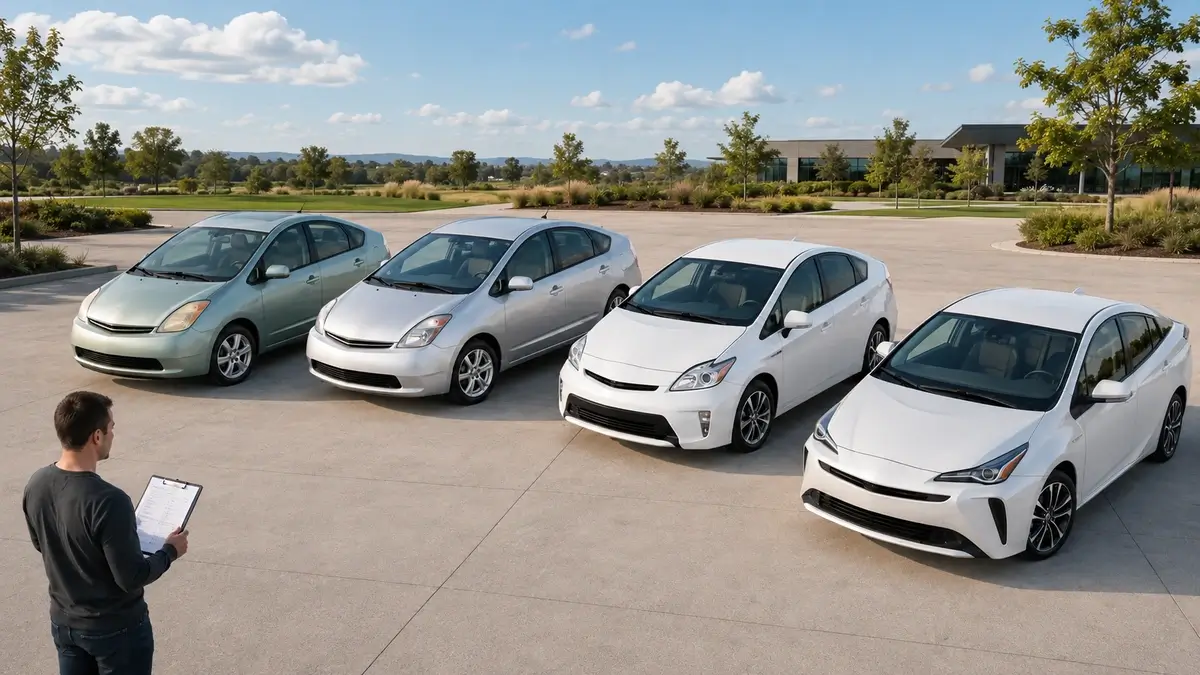
Toyota Prius years to avoid are not defined by one complaint total or recall. For most mainstream daily-driver buyers, the 2001 through 2003 Prius is the clearest range to skip because extreme age, battery uncertainty, rarity, and specialist availability dominate the decision.
The 2010 through 2014 Prius deserves Strong Caution, not a blanket Avoid verdict. Official issue scopes overlap these years, but they do not establish a comparative failure rate across the entire range.
The 2020 through 2022 Prius is the best starting range for buyers who want lower age exposure. A 2015 or 2016 through 2019 car can still work, but it needs year-specific recall checks, clean diagnostics, and strong maintenance history.
This guide covers only the standard U.S.-market Toyota Prius. It does not include the Prius c, Prius v, Prius Prime, or earlier plug-in models.
Fastest practical path: Start with a well-maintained 2020 through 2022 Prius, then verify the title, service records, hybrid-battery condition, warning-light history, and recall status before buying.
CarMerit reliability tool
Check any Prius year – NHTSA-backed snapshot
Pick a model year to see Toyota Prius complaint, recall, investigation, and manufacturer-communication counts from the article’s NHTSA snapshot, plus CarMerit’s used-buy verdict for that year band.
Owner complaints
…
NHTSA, CarMerit snapshot
Recall records
…
NHTSA, CarMerit snapshot
Investigations
…
NHTSA, CarMerit snapshot
Manufacturer communications
…
NHTSA, CarMerit snapshot
Most-reported problem areas
Complaint counts and manufacturer communications are raw NHTSA records, not defect rates or reliability scores. Older model years have had more time to collect reports, so lower counts on newer years do not prove better reliability. Verdicts come from CarMerit’s article guidance. Data source: NHTSA.gov. Always verify VIN recall status, title history, service records, hybrid-battery condition, warning-light history, full diagnostic scan, oil level, coolant condition, brake behavior, accident or flood history, and independent inspection results before buying. Confirm the exact model too: Prius c, Prius v, Prius Prime, and plug-in variants are not the standard Prius covered here.
Toyota Prius Years to Avoid: Quick Answer
The clearest mainstream skip is 2001 through 2003 because age-related uncertainty dominates. Treat 2010 through 2014 as Strong Caution / High Proof Burden, not a universal Avoid range.
Official Toyota and NHTSA documents show overlapping oil-consumption, EGR, inverter, and brake-system scopes. They justify stricter screening, but not a claim that every car in the range is unreliable.
Avoid, Strong Caution, Caution, Better Choice, and Limited-Data Tiers
| Year Band, Generation & Risk Tier | Why It Is Classified This Way | Evidence Confidence | Buyer Action |
|---|---|---|---|
| 2001–2003 · First Generation · Avoid | Extreme age, battery uncertainty, rarity, and limited specialist familiarity | Medium | Skip unless buying a specialist-maintained secondary or collector vehicle |
| 2004–2009 · Second Generation · Caution | Age, battery condition, corrosion, cooling components, rubber parts, and service-history uncertainty | High for age risk | Consider only with battery testing, complete records, and a hybrid-capable inspection |
| 2010–2014 · Third Generation · Strong Caution | Overlapping official oil-consumption, inverter, braking, and hybrid-system documentation, plus increasing age; these scopes do not establish comparative failure rates | High for stricter-screening action | Consider only with complete records, full hybrid and mechanical diagnostics, confirmed campaign status, and a repair reserve |
| 2015 · Third Generation · Caution | Later third-generation car outside the 2010–2014 oil bulletin and inverter-recall ranges, but still included in inverter and brake-support documentation | Medium | Consider only with strong records, full diagnostics, and a repair reserve |
| 2016–2018 · Fourth Generation · Caution | Early fourth-generation production with affected-VIN parking-brake and engine-wire-harness recalls | High for recall-check need | Verify recall completion and inspect warning-light, electrical, brake, and hybrid-system history |
| 2019 · Fourth Generation · Caution | Certain vehicles were included in a narrowly produced brake-booster-pump recall | High for VIN-specific caution | Check the VIN, brake operation, warning history, and full scan results |
| 2020–2022 · Fourth Generation · Better Choice | Lower age exposure and outside the older campaign scopes that drive the higher-risk classifications in this guide | Medium | Best starting range for most buyers, subject to normal inspection and battery screening |
| 2023–2026 · Fifth Generation · Limited Long-Term Data | Lowest age, shorter ownership history, and an affected-VIN rear-door switch recall | High for limited-data classification | Buy on condition, warranty position, recall status, and price rather than an assumed reliability ranking |
How the Risk Tiers Were Set
This table is a buyer-risk tool, not a defect-rate ranking.
Official recalls and Toyota technical or support documents carry the most weight. Vehicle age, repair consequences, service history, and current diagnostics shape the buyer action. Complaint totals and owner stories are discovery signals only.
Toyota Prius NHTSA Year-by-Year Evidence Snapshot
| Model year (generation) | Owner complaints | Recall rows | Investigations | Why this matters |
|---|---|---|---|---|
| 2000 (Gen 1) | 4 | 0 | 0 | Small source row; use as coverage context before normal 2001-up shopping. |
| 2001 (Gen 1) | 165 | 3 | 1 | Early first-gen year with recalls and one investigation in the record. |
| 2002 (Gen 1) | 167 | 2 | 1 | Similar first-gen complaint volume to 2001 with fewer recall rows. |
| 2003 (Gen 1) | 99 | 1 | 1 | Lower first-gen complaint volume, but aging hybrid checks still matter. |
| 2004 (Gen 2) | 610 | 6 | 3 | Start of Gen 2; complaint and recall records rise versus Gen 1. |
| 2005 (Gen 2) | 1,051 | 6 | 3 | Gen 2 complaint volume climbs with six recall rows. |
| 2006 (Gen 2) | 1,439 | 6 | 3 | High Gen 2 complaint count with repeated recall activity. |
| 2007 (Gen 2) | 2,003 | 4 | 3 | Highest Gen 2 complaint count in the available NHTSA records; use as a stronger inspection signal. |
| 2008 (Gen 2) | 1,497 | 4 | 2 | Complaint count remains elevated while recall rows are lower than 2004-2006. |
| 2009 (Gen 2) | 502 | 6 | 2 | Lower than 2007-2008 complaints, but still has six recall rows. |
| 2010 (Gen 3) | 2,825 | 10 | 4 | Largest single-year complaint count and highest recall-row count in the available NHTSA records. |
| 2011 (Gen 3) | 517 | 6 | 3 | Complaint volume falls from 2010, with continued recall and investigation records. |
| 2012 (Gen 3) | 720 | 9 | 4 | Complaint and recall records remain elevated inside Gen 3. |
| 2013 (Gen 3) | 588 | 6 | 3 | Similar Gen 3 complaint level to 2012, with fewer recall rows. |
| 2014 (Gen 3) | 324 | 6 | 3 | Lower Gen 3 complaints than 2012-2013, with continued campaign records. |
| 2015 (Gen 3) | 203 | 4 | 3 | Final Gen 3 year shows fewer complaints than earlier Gen 3 rows and four recall rows. |
| 2016 (Gen 4) | 181 | 6 | 1 | Start of Gen 4; lower complaints than Gen 3 but six recall rows. |
| 2017 (Gen 4) | 146 | 4 | 1 | Lower complaint count than 2016 with four recall rows. |
| 2018 (Gen 4) | 58 | 3 | 1 | Complaint volume drops further while recall rows remain present. |
| 2019 (Gen 4) | 36 | 4 | 1 | Low complaint count relative to older years, plus four recall rows. |
| 2020 (Gen 4) | 30 | 1 | 1 | Low complaint count with one recall row and one investigation. |
| 2021 (Gen 4) | 16 | 0 | 1 | Lowest Gen 4 complaint count, with no recall rows in NHTSA records. |
| 2022 (Gen 4) | 31 | 1 | 1 | Low complaint count but one recall row remains in the record. |
| 2023 (Gen 5) | 21 | 4 | 0 | New Gen 5 row has limited complaint history but four recall rows. |
| 2024 (Gen 5) | 33 | 4 | 0 | Gen 5 complaint count is still small, with four recall rows. |
| 2025 (Gen 5) | 17 | 2 | 0 | Very new year with limited record volume and two recall rows. |
| 2026 (Gen 5) | 9 | 1 | 0 | Smallest new-year sample; do not infer long-term reliability from low counts. |
Table Note: Counts are raw NHTSA records, not defect rates or reliability scores. Older years have had more time to collect reports. The 2000 row is included because NHTSA records contain Prius data for 2000; used-buyer guidance in this article starts at 2001.
Avoid is reserved for ranges that are poor default daily-driver choices. Strong Caution means the car can be considered only with above-normal proof and repair tolerance. Evidence confidence applies to the buyer action, not failure probability.
A completed recall also changes the individual-car decision. It removes an open campaign, but it does not prove that the rest of the vehicle is healthy.
When a Good Model Year Can Still Be a Bad Car
A 2021 Prius with collision damage, missed services, warning lights, or weak battery results can be a worse purchase than a carefully maintained older car.
The model year sets the starting risk. The individual vehicle decides whether the purchase should proceed.
Condition breaks the case for any Prius when you find:
- Missing or inconsistent maintenance records
- Persistent warning lights
- Coolant loss
- Rough cold starts or repeated misfires
- Unexplained oil loss
- Poor or inconsistent brake feel
- Weak hybrid-battery diagnostic results
- Unresolved recalls
- Flood, corrosion, or major collision damage
- A seller who refuses an independent inspection
How to Use the Risk Table While Comparing Listings
Use the tier to set the amount of proof you require.
A Better Choice year still needs a normal inspection, battery scan, and VIN check. A Caution year needs targeted checks. Strong Caution requires complete records, full diagnostics, confirmed campaign status, and a repair reserve. An Avoid year is generally a skip for mainstream daily-driver buyers.
Best Toyota Prius Years to Buy
For most used buyers, 2020 through 2022 is the best Prius range to search first. It combines lower age with later fourth-generation production and less exposure to the older campaign scopes discussed here.
One clear advantage starts with the 2020 model year. Toyota increased Prius hybrid-battery coverage from 8 years/100,000 miles to 10 years/150,000 miles.
That longer term applies to the hybrid battery. It does not extend every hybrid component to the same limit. It also does not prove that the battery itself is more reliable.
For a used Prius, verify the VIN, original in-service date, mileage, and exact warranty terms before assuming coverage remains.
The 2017 through 2019 Prius can still be a practical fourth-generation option. These years require careful VIN review because early fourth-generation recalls and the narrow 2019 brake-booster-pump campaign can affect specific vehicles.
Best Balance of Age and Known Risk
Their lower age reduces some battery-aging, corrosion, rubber-component, and long-term neglect uncertainty found in much older examples. They also have meaningful service and ownership histories.
The trade-off is price. Do not pay a newer-year premium while ignoring collision history, poor maintenance, warning lights, or weak battery diagnostics.
EPA Fuel Economy for Fourth- and Fifth-Generation Prius
EPA label estimates show why generation alone is not enough. Ratings vary by drivetrain and trim, so these configurations should not be merged into one model-year average.
| Configuration | City MPG | Highway MPG | Combined MPG |
|---|---|---|---|
| 2016–2022 Prius FWD | 54 | 50 | 52 |
| 2016–2022 Prius Eco | 58 | 53 | 56 |
| 2019–2020 Prius AWD | 52 | 48 | 50 |
| 2021–2022 Prius AWD | 51 | 47 | 49 |
| 2023–2026 Prius FWD | 57 | 56 | 57 |
| 2023–2026 Prius XLE/Limited FWD | 52 | 52 | 52 |
| 2023–2026 Prius AWD | 53 | 54 | 54 |
| 2023–2026 Prius AWD XLE/Limited | 49 | 50 | 49 |
Table Note: These are EPA label estimates for the standard hybrid Prius configurations shown above. Prius Prime and other plug-in versions are outside this article. Actual fuel economy varies.
The front-wheel-drive 2016 through 2022 Prius carries the same 54 city, 50 highway, and 52 combined MPG estimates throughout the range, while the Eco is rated at 58 city, 53 highway, and 56 combined MPG. Fifth-generation 2023 through 2026 configurations span 49 to 57 combined MPG depending on drivetrain and trim.
Compare the exact listing configuration instead of assuming that a newer model year is automatically more efficient. Lower age and warranty position may still make the newer car more attractive, but those are separate buying considerations.
Older Years That Can Still Work
A 2017 through 2019 Prius can be a sensible value purchase when its recall status, brake operation, battery condition, and service history are clean.
A 2015 Prius can work for a budget buyer who understands third-generation risk and has access to hybrid-qualified diagnostics. It should not receive the same default confidence as a later fourth-generation car.
A 2008 or 2009 Prius may still run well, but age now matters more than its original reputation. Battery condition, corrosion, seals, hoses, cooling history, prior repairs, and parts availability must justify the purchase.
Newer Years With Limited Long-Term Evidence
The 2023 through 2026 fifth-generation Prius offers lower age and newer technology, but it has not accumulated the same long-term aging evidence as earlier generations.
Certain 2023 through 2026 Prius vehicles are included in a Toyota rear-door switch recall. The recall is VIN-specific and does not justify rejecting every car in the range.
Do not call the newest generation the most reliable Prius simply because it has had less time to accumulate repairs or complaints.
| Buyer Type | Suitable Year Band | Main Advantage | Risk Accepted | Required Inspection |
| Lower-risk mainstream buyer | 2020–2022 | Lower age and later fourth-generation production | Higher purchase cost | Standard pre-purchase inspection, full scan, battery check, VIN review |
| Earlier fourth-generation shopper | 2017–2019 | Expands the Gen 4 shortlist beyond 2020–2022 | Recall and condition sensitivity | VIN confirmation, brake check, battery scan, and service-history review |
| Budget buyer with repair reserve | 2015 | Lower entry cost and final third-generation model year | Inverter, brake, battery, and age uncertainty | Hybrid-specialist inspection and complete documentation |
| Very low-budget buyer | 2008–2009 | Low purchase price | Battery age, corrosion, cooling, and aging-component risk | Strong battery report, cooling check, and documented maintenance |
| Newest-car buyer | 2023–2026 | Lowest age and remaining warranty potential | Limited long-term evidence and affected-VIN recall exposure | Warranty review, VIN recall check, and complete diagnostic scan |
Toyota Prius Reliability by Generation
Toyota has sold the standard Prius in five U.S. generations. Each generation brings a different combination of age, official campaign history, battery exposure, repair uncertainty, and purchase price.
Toyota Prius NHTSA Generation Evidence Snapshot
| Generation and years | Complaints per model-year | Unique recall campaigns | Manufacturer communications | Why this matters |
|---|---|---|---|---|
| Gen 1 (2000-2003) | 108.8 | 3 | 405 | First-gen evidence is modest beside later groups, but age remains a separate buyer issue. |
| Gen 2 (2004-2009) | 1,183.7 | 9 | 1,177 | Highest complaint-per-year group among the generations shown here; it deserves stronger condition proof. |
| Gen 3 (2010-2015) | 862.8 | 17 | 2,845 | Most recall campaigns and manufacturer communications among the generations shown here; campaign status matters. |
| Gen 4 (2016-2022) | 71.1 | 13 | 1,436 | Lower complaint density than older groups, but recall and communication records still exist. |
| Gen 5 (2023-2026) | 20.0 | 4 | 269 | Low complaint density mainly reflects limited exposure time, not long-term proof. |
Table Note: Complaint and manufacturer-communication counts accumulate over time. Gen 1 includes 2000 because NHTSA records contain a 2000 Prius row; used-buyer guidance in this article starts at 2001. Lower counts on newer Prius generations reflect shorter exposure, not proven long-term superiority.
The purpose of this section is not to rank every generation from best to worst. It is to show which risks should control the inspection.
Older Generations: Age and Battery Condition
The 2001 through 2003 Prius is now too old for most buyers seeking predictable daily transportation.
Second-generation 2004 through 2009 cars can still be usable, but their age is now the dominant risk. A reputation for durability does not override a weak battery, corrosion, old cooling components, poor records, or previous repairs of unknown quality.
Buy one only when a hybrid-capable inspection confirms that the car is stronger than its age suggests.
Third Generation: Highest Proof Burden
The third generation covers 2010 through 2015. The 2010 through 2014 range carries the highest proof burden in this guide.
Toyota published an oil-consumption technical bulletin for certain 2010 through 2014 Prius vehicles. Toyota also issued an EGR warranty-enhancement program for certain 2010 through 2012 cars.
Certain 2010 through 2014 cars were included in an inverter-related safety recall, while a later Customer Confidence Program covers certain 2010 through 2015 Prius inverter and intelligent-power-module conditions.
Toyota also issued a customer-support program for certain 2010 through 2015 brake booster and brake booster pump conditions.
These documents do not establish a defect rate or justify a blanket Avoid label. They support Strong Caution for 2010 through 2014 and a Caution classification for 2015.
Fourth Generation: Better Starting Point, Not a Guarantee
The fourth generation covers 2016 through 2022 and is usually the more practical place to begin a used search.
Early examples still need VIN-specific checks. Certain 2016 and 2017 cars were included in a parking-brake cable recall. Certain 2016 through 2018 cars were included in an engine-wire-harness recall. A limited production group of 2019 Prius vehicles was included in a brake-booster-pump recall.
A completed recall can remove a specific open risk. It does not replace battery testing, collision-history review, maintenance records, or a full diagnostic scan.
Newest Generation: Limited Long-Term Ownership Data
The fifth generation began with the 2023 model year.
Its lower age is a real advantage for buyers concerned about battery aging, corrosion, deteriorated rubber, and long-term neglect. The limitation is shorter evidence history.
Treat these cars as newer, not automatically proven. Verify the warranty position, VIN recall status, title history, and current diagnostic condition.
IIHS Safety Differences That Matter by Prius Year
IIHS ratings do not set the buy, caution, or avoid tiers in this guide. They do identify equipment, build-date, and test-result differences that a used buyer should verify.
| Model Years and Scope | Relevant IIHS Evidence | Buyer Check |
|---|---|---|
| 2004–2006 | The side rating was Good with optional side airbags and Poor without them. | Confirm whether the individual car has the optional side airbags. |
| 2007–2009 | Side airbags became standard beginning with 2007 models, and the side rating was Good. | Do not assume a 2004–2006 car has the same equipment as a 2007–2009 car. |
| 2011–2015 vehicles built after December 2010 | The roof-strength rating was Good. | Verify the build date when considering an early 2011 vehicle. |
| 2014–2015 vehicles built after November 2013 | The driver-side small-overlap rating was Acceptable. | Confirm the production date rather than applying the result to every 2014 vehicle. |
| 2016–2022 | Driver-side small overlap, original moderate overlap, side, roof strength, and head restraints were rated Good. Headlights were Poor for the listed 2016 configurations, Acceptable or Poor by configuration in 2017, and Acceptable for the applicable 2018–2022 configuration. | Check the exact model year and headlight configuration. |
| 2023–2024 | Driver- and passenger-side small overlap and the updated side test were rated Good. The updated moderate-overlap result was Acceptable, and all trims received an Acceptable headlight rating. | Keep the updated moderate-overlap result separate from the older test. |
| 2025–2026 | The updated moderate-overlap and updated side ratings were Good, while all trims received an Acceptable headlight rating. | Apply these results only to the standard hybrid Prius. |
| 2026 LE | The standard Toyota Safety Sense 3.0 system received a Good vehicle-to-vehicle 2.0 rating. | Do not extend this trim- and system-specific result to every configuration. |
Table Note: IIHS test procedures and criteria changed across these years. Each result applies only to the stated test, model-year, build-date, equipment, and trim scope. These ratings are not one cross-year safety score or a reliability ranking. Prius Prime and plug-in versions are outside this article.
Why Certain Prius Years Carry More Risk
Risk rises when several verified or age-related concerns overlap and the purchase leaves little room for error.
Official campaigns, vehicle age, maintenance history, diagnostic results, prior repairs, and the likely consequence of a failure should be considered together.
Oil Consumption and Engine-Wear Signals
The official oil-consumption bulletin applies to certain 2010 through 2014 Prius vehicles. That makes unexplained oil loss an important buying signal for this range.
Check the oil level before the test drive. Ask whether oil is added between services. Review records for repeated top-offs, engine work, or unusually short oil-change intervals.
Walk away when the seller cannot explain a low oil level, dismisses repeated oil additions, or refuses an independent inspection.
Cooling, EGR, and Head-Gasket Concerns
A rough cold start, coolant loss, white exhaust, repeated misfire codes, or unexplained cooling-system pressure needs professional diagnosis.
Toyota’s EGR program for certain 2010 through 2012 cars makes EGR-related symptoms a valid inspection priority. It does not prove that every rattle or misfire is a failed head gasket.
Do not let the seller diagnose the car for you. A hybrid-qualified technician should determine whether the issue involves ignition, EGR flow, cooling, internal engine damage, or another cause.
Brake, Inverter, and Warning-Light Concerns
A brake, ABS, traction-control, master-warning, or hybrid-system light is not a minor bargaining point.
The affected systems are complex and can be safety-relevant, so they require a full scan and a confirmed diagnosis before purchase.
For 2010 through 2015 cars, check more than recall status. Toyota has Customer Confidence Programs 23TE02 and 23TE03 for certain Prius vehicles with specific inverter or IPM conditions. Qualifying vehicles can receive coverage for 20 years from the vehicle’s date of first use, with no mileage limit. Eligibility is not automatic.
Brake support is different. Toyota’s older ZJB brake-booster program had limited coverage windows. Any remaining eligibility depends on the vehicle’s age, mileage, and program terms.
Before assuming a repair is covered, verify the VIN, in-service date, mileage, diagnostic codes, and current Toyota eligibility.
Before rejecting a 2010–2015 Prius solely because of an inverter, EGR, or brake-system repair history, check its model year in CarMerit’s Manufacturer Special Coverage Lookup to see which Toyota support records deserve VIN-specific verification.
For 2016 through 2019 cars, confirm recall status by VIN. Do not assume every vehicle in those model years was affected.
Reported Problems Versus Verified Model-Year Risk
Owner reports are useful for discovering symptoms and questions. They do not show how often a problem occurs across the entire model-year population.
Top NHTSA Complaint Component by Prius Generation
| Generation and years | Top owner-complaint component | Component complaints | Generation complaints | Why this matters |
|---|---|---|---|---|
| Gen 1 (2000-2003) | Steering | 157 (36.1%) | 435 | Steering leads the first-gen owner-report mix. |
| Gen 2 (2004-2009) | Exterior lighting | 2,948 (41.5%) | 7,102 | Lighting dominates Gen 2 owner reports in this taxonomy. |
| Gen 3 (2010-2015) | Brakes | 3,023 (58.4%) | 5,177 | Brake reports dominate Gen 3 complaint categories. |
| Gen 4 (2016-2022) | Visibility / wipers | 83 (16.7%) | 498 | Top category is much smaller and more spread out than older groups. |
| Gen 5 (2023-2026) | Electrical | 20 (25.0%) | 80 | Newest-gen counts are too young for long-term pattern certainty. |
Table Note: Percentages show each component’s share of owner-filed NHTSA complaints within that generation. Gen 1 includes 2000 because NHTSA records contain a 2000 Prius row. These percentages are not defect rates across all Prius vehicles sold.
Official recalls and Toyota documents confirm the existence and scope of specific conditions. They also do not mean every car from the named year has the problem.
The buying decision is therefore model-year proof burden plus individual-car condition.
| Issue Category | Relevant Scope | Warning Signs | Purchase Impact | Verification Step | Walk-Away Trigger |
| Oil consumption | Certain 2010–2014 cars | Low oil, frequent top-offs, smoke, engine noise | May indicate neglect, leakage, or internal wear | Check oil level, records, leaks, and consumption history | Seller cannot explain repeated oil loss |
| EGR or cold-start issue | Certain 2010–2012 cars and symptom-led third-generation checks | Rough start, rattle, misfire, EGR code | Can require diagnosis beyond routine maintenance | Cold start and complete diagnostic scan | Persistent misfire, coolant loss, or uncertain diagnosis |
| Inverter campaign history | Certain 2010–2015 cars | Hybrid warning, reduced power, fail-safe history, related codes | Can affect propulsion and purchase confidence | Confirm campaign or program status by VIN and scan hybrid modules | Active hybrid fault or incomplete diagnosis |
| Brake booster or pump concern | Certain 2010–2015 cars and narrowly affected 2019 vehicles | Brake, ABS, or traction lights; pump cycling; changed pedal feel | Can require specialist diagnosis and is safety-relevant | Scan brake modules and test system operation | Warning lights, fault codes, or poor brake response |
| Traction-battery aging | Any aging hybrid | Warning lights, abnormal charge swings, weak test results | Can erase the value of a cheap purchase | Hybrid-battery health test and replacement records | Weak battery plus no price allowance or repair reserve |
| Cooling or internal-engine concern | Symptom-led, especially older third-generation cars | Coolant loss, misfire, white exhaust, overheating history | Can turn a value purchase into a major repair | Pressure test and professional diagnosis | Internal damage cannot be ruled out |
Hybrid Battery Age and Replacement Risk
A Prius can have a durable basic design and still be a poor purchase because of battery condition.
Do not assume a high-mileage battery is automatically bad or a low-mileage battery is automatically healthy. Calendar age, heat exposure, long storage, module balance, and previous repairs also matter.
Traction Battery Versus 12-Volt Battery
The high-voltage traction battery supports hybrid propulsion. The smaller 12-volt battery powers control systems and helps the car begin its operating sequence.
A weak 12-volt battery can cause unusual electronic behavior, but replacing it does not repair a failing traction battery.
Ask the inspector to identify which battery was tested. “The battery is good” is not a useful answer without a diagnostic report.
Battery Age Versus Vehicle Mileage
Mileage shows how far the car has traveled. It does not show every condition the battery has experienced.
An older low-mileage car may have spent long periods unused. A newer high-mileage car may have accumulated steady use and regular maintenance.
Neither pattern guarantees a healthy battery. Use diagnostics, records, and current behavior rather than the odometer alone.
Diagnostic Testing and Replacement History
A useful battery assessment should review stored fault codes, module balance, charge behavior, and available service history.
Ask whether the battery is original, fully replaced, repaired with individual modules, or installed with used parts. These repairs do not carry the same value or expected durability.
A seller’s claim that the car has a “new battery” should be supported by an invoice showing the supplier, date, warranty, and work performed.
When Battery Risk Breaks the Purchase
Battery risk should end the deal when:
- Battery or hybrid warning codes remain active
- Diagnostic results show weak or inconsistent module health
- Replacement history cannot be verified
- The purchase price leaves no room for corrective work
- The seller refuses a hybrid-system inspection
- Battery weakness appears alongside engine, brake, or cooling problems
One manageable risk may be acceptable. Several unresolved systems on the same aging car usually make the purchase weak.
High-Mileage Prius: When Condition Matters More Than Year
Buying a used Prius with high mileage is not automatically a bad decision.
The wrong approach is treating 200,000 miles as either an automatic rejection point or proof that the car will keep going. Mileage must be judged with maintenance history, battery condition, cooling health, prior repairs, and price.
The 200,000-Mile Prius Decision
A Prius near 200,000 miles deserves consideration only when the seller can show how it reached that mileage.
Regular service, stable oil and coolant levels, clean brake operation, and strong hybrid diagnostics can support the case. Missing records and multiple warning signs should end it.
At this mileage, the inspection should prove that the car remains dependable. The buyer should not have to prove that an obvious problem is harmless.
Maintenance Records and Prior Major Repairs
Look for consistent oil changes, coolant service, brake work, and documented repairs.
A previous battery, brake-booster, inverter, cooling-system, or engine repair is not automatically negative. Properly completed work with clear documentation can reduce uncertainty.
Undocumented major work does the opposite. It leaves the buyer unable to judge the parts used, repair quality, or remaining warranty.
Newer High Mileage Versus Older Low Mileage
A newer Prius with higher mileage can be the stronger choice when it has complete records and consistent use.
An older low-mileage car may face greater battery aging, dried seals, deteriorated rubber, corrosion, or problems associated with long storage.
Compare the complete ownership story, not just the odometer numbers.
When High Mileage Is an Immediate Walk-Away
Reject a high-mileage Prius when several of these appear together:
- Missing or inconsistent records
- Unexplained coolant loss
- Heavy oil consumption
- Persistent cold-start misfire
- Brake or hybrid warning lights
- Weak battery results
- Major collision or flood history
- Seller resistance to an independent inspection
- A purchase price that leaves no repair reserve
Used Prius Inspection Checklist
A normal visual inspection is not enough for an older hybrid.
The pre-purchase inspection should cover the engine, cooling system, brakes, hybrid system, traction battery, electronic modules, service history, title history, and recall status.
Before those hybrid-specific checks begin, confirm that you are evaluating the exact Prius described in the listing. Run the Prius VIN through CarMerit and compare the returned vehicle details with the seller’s ad and paperwork. Once those details match, move on to battery condition, cooling-system health, service history, recall status, and the full pre-purchase inspection.
Cold-Start, Coolant, and Engine Checks
Arrange to see the car before the seller warms it.
Listen for extended rattling, rough running, knocking, or persistent misfire. Check the coolant level and look for leakage, overheating history, or unexplained coolant additions.
A brief noise does not establish the diagnosis. Persistent symptoms require professional testing.
Oil Level and Oil-Consumption Checks
Check the dipstick on level ground before the test drive.
Low oil can indicate poor maintenance, leakage, or consumption. Ask whether oil is added between changes and request supporting records.
Do not accept “they all do that” as a diagnosis.
Hybrid-Battery Diagnostic Check
Use a qualified hybrid technician or a shop familiar with Toyota hybrid systems.
Request a scan of all relevant modules, not only a basic engine-code check. The technician should review stored and pending codes, battery behavior, and system health.
Warning Lights, Brake Behavior, and Scan Results
Confirm that all dashboard warning lights illuminate during startup and switch off normally.
During the drive, check for predictable brake response, unusual pump activity, warning messages, reduced power, or changes in pedal feel.
A full scan matters because recently cleared codes or incomplete readiness information can hide uncertainty.
VIN, Recall, and Service-History Review
Use the vehicle identification number to check open recalls through the official NHTSA recall lookup.
A model year appearing in a recall notice does not prove that every vehicle is affected. Confirm the VIN and verify that applicable work was completed.
Also check:
- Clean title status
- Collision history
- Flood or corrosion evidence
- Odometer consistency
- Maintenance invoices
- Battery replacement documentation
- Previous engine, brake, inverter, or cooling repairs
- Whether major work carries any transferable warranty
Which Prius Generation Fits Your Budget and Risk Tolerance?
The cheapest Prius is rarely the lowest-risk Prius after inspection needs and repair exposure are included.
Choose the generation based on how much uncertainty you can accept, not only the purchase price.
Lowest Purchase Price and Highest Age Risk
The first and second generations usually attract buyers focused on the lowest entry price.
They also carry the greatest age-related uncertainty. Battery condition, corrosion, cooling components, rubber parts, and specialist familiarity can outweigh the initial savings.
These cars fit experienced buyers with repair reserves and access to hybrid service. They are weak choices for someone who needs predictable daily transportation.
Older Fourth-Generation Option
The 2017 through 2019 Prius can still be considered when its recall status, brake operation, battery condition, and service history are clean.
Do not assume that an older model year is automatically better value. Compare the individual car’s condition, documented work, and asking price against similar listings before deciding.
Newer Car and Lower Age Exposure
When the budget allows it, 2020 through 2022 reduces age-related uncertainty without removing the need for diagnostics.
The fifth generation offers even lower age, but its purchase case rests more on current condition, remaining warranty value, recall status, and price than on mature long-term evidence.
Repair Reserve and Specialist Availability
An aging hybrid needs access to qualified diagnostics.
Skip an older Prius when no competent hybrid shop is available nearby or when the purchase would consume the entire vehicle budget.
Fuel savings do not protect the buyer from a battery, brake, cooling, inverter, or engine problem discovered soon after purchase.
Who Should Skip a Used Toyota Prius?
A used Prius is not the right answer for every buyer.
Its fuel efficiency can be valuable, but that benefit does not excuse poor condition, missing history, weak diagnostics, or a purchase that leaves no room for repairs.
Buyers Without Access to Hybrid Diagnostics
Do not buy an older Prius based only on a short test drive and a general visual inspection.
A hybrid-qualified scan can identify risks that may not appear during a brief drive.
Buyers Without a Repair Reserve
An older Prius can be affordable to operate when it is healthy.
It becomes a poor fit when one battery, brake, cooling, inverter, or engine repair would create financial stress. Buyers with no reserve should prioritize a newer, cleaner vehicle or consider a simpler alternative.
Buyers Considering Cars With Missing Service History
Missing records do not prove neglect. They remove evidence that could justify accepting the vehicle’s age and mileage.
When the seller cannot document important maintenance or major repairs, treat the car as more uncertain. Do not pay the same price as you would for a fully documented example.
Buyers still deciding whether a Prius suits their driving and ownership priorities should compare the Toyota Prius and Toyota Corolla Hybrid.
Prius shoppers who are also considering a Corolla Hybrid should not treat both cars as the same used-buying decision. If the Corolla Hybrid is on your shortlist, check the Toyota Corolla Hybrid years to avoid and best years to buy guide before comparing model-year risk, recall status, and inspection priorities.
Final Used-Buyer Recommendation
For most mainstream daily-driver buyers, 2001 through 2003 are the clearest Toyota Prius years to avoid because age-related uncertainty dominates. Treat 2010 through 2014 as Strong Caution / High Proof Burden rather than an automatic rejection.
Treat 2015 and 2016 through 2019 as Caution ranges. They can work when recall status, diagnostics, service history, and current condition support the purchase.
Start with 2020 through 2022 when lower age exposure matters. It remains subject to the same title, maintenance, battery, diagnostic, and recall checks as any other Prius.
Do not buy a Prius because its year appears on a “best” list. Buy it when the year-level risk, title, maintenance history, battery condition, diagnostic results, recall status, and purchase price all support the same decision.
Choosing the right Prius year reduces risk, but it does not prove that a specific car is safe to buy. Before committing, use the Toyota Prius reliability and cost-to-own guide to check battery-health concerns, ownership-cost trade-offs, inspection priorities, and the buyer situations where a used Prius still makes sense.
Buyers who place lower surprise risk above hybrid fuel savings should also review CarMerit’s most reliable used cars to buy.
Frequently Asked Questions
What Toyota Prius years should you avoid?
Most mainstream daily-driver buyers should skip 2001 through 2003 because extreme age and battery uncertainty dominate. Treat 2010 through 2014 as Strong Caution rather than a universal Avoid range; consider one only with complete records, clean diagnostics, confirmed campaign status, and price protection.
What is the best year to buy a used Prius?
There is no universally best single year. The 2020 through 2022 range is the best starting point for most buyers because it combines lower age with later fourth-generation production and avoids the older campaign scopes that drive the higher-risk classifications in this guide.
Which Toyota Prius generation is the most reliable?
The available evidence does not support one universal generation-level reliability winner. For a used buyer, later fourth-generation cars are usually the lower-friction search target because of age and campaign exposure, while the individual car’s condition still controls the final decision.
Should you automatically avoid every 2010 through 2014 Prius?
No. Treat these years as Strong Caution. Consider one only when it has complete records, clean hybrid and mechanical diagnostics, no unresolved symptoms, completed applicable campaign work, a meaningful price advantage, and enough repair reserve.
Which Prius years need extra oil-consumption or cold-start checks?
The official oil-consumption bulletin applies to certain 2010 through 2014 vehicles, while Toyota’s EGR program applies to certain 2010 through 2012 cars. Any third-generation Prius with coolant loss, rough cold starts, repeated misfires, or unexplained oil use needs professional diagnosis before purchase.
How can you tell if a Prius hybrid battery is failing?
Warning lights, stored battery codes, irregular charge behavior, and weak module-balance results can indicate trouble. A professional hybrid-battery diagnostic test is more useful than mileage or a seller’s verbal assurance.
Is a Toyota Prius with about 200,000 miles worth buying?
It can be, but only with strong maintenance records, healthy battery and brake diagnostics, stable oil and coolant levels, and no unresolved warning lights. The purchase price must also leave room for age-related repairs.
What warning signs should make you walk away from a used Prius?
Walk away from persistent warning lights, coolant loss, heavy oil use, rough cold starts, weak battery results, poor brake behavior, unclear major repairs, flood evidence, or a seller who refuses an independent inspection.
Does maintenance history matter more than the model year?
The model year establishes the starting risk. Maintenance history and current condition determine whether the individual car deserves to be purchased. A neglected Better Choice year can be worse than a carefully maintained Caution-year car.
Are Prius c, Prius v, and Prius Prime included in this guide?
No. This guide covers only the standard U.S.-market Toyota Prius. The Prius c, Prius v, Prius Prime, and other plug-in variants require separate model-year research.