

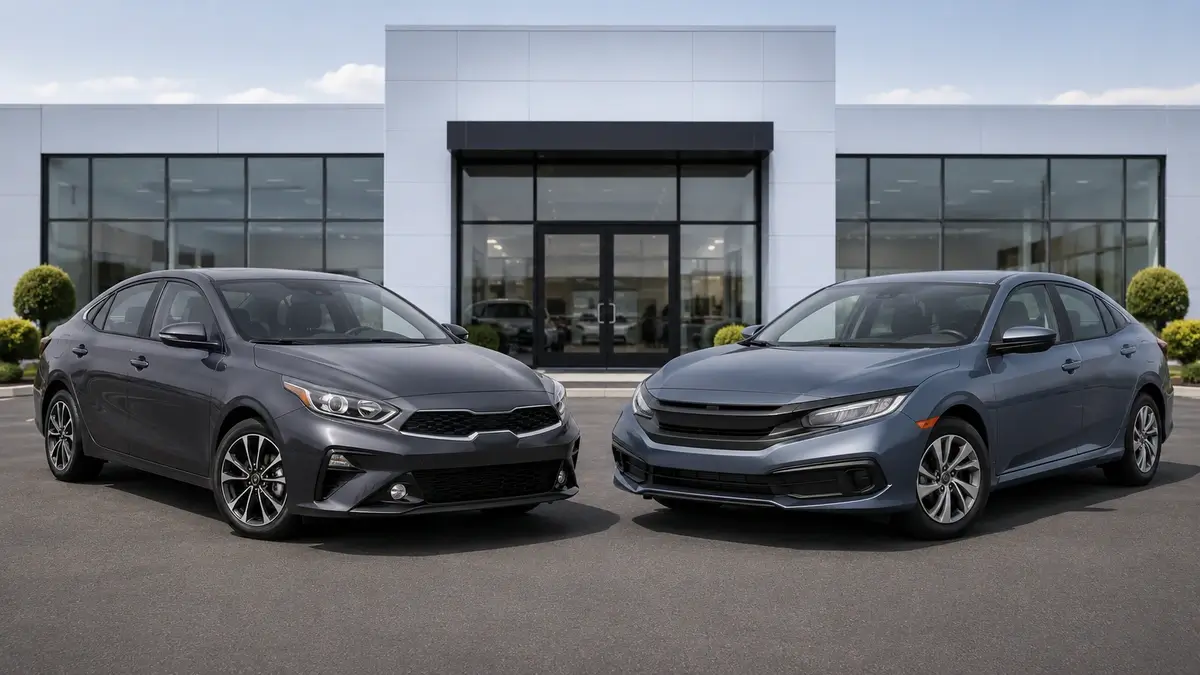
The Kia Forte vs Honda Civic decision comes down to value versus long-term confidence.
The Forte usually makes more sense if you want a lower purchase price and strong features for the money. The Civic usually makes more sense if resale confidence, refinement, and long-term demand matter more.
That does not mean every Civic is worth the premium. It also does not mean every Forte is a bargain.
A clean, well-maintained Forte can be smarter than an overpriced Civic. A neglected Forte with weak records can become false economy fast.
Use this comparison as a used-buyer filter, not a new-car spec contest.
- Choose the Kia Forte if upfront value matters most.
- Choose the Honda Civic if long-term confidence matters most.
- Avoid the Forte if records, recalls, mileage, or inspection results are weak.
- Avoid the Civic if the price premium is too high for its condition.
- The safest default is to buy the cleaner car with better records.
- The biggest mistake is simple: overpaying for reputation or saving money on the wrong example.
CarMerit reliability comparator
Kia Forte vs Honda Civic: 2010-2024 NHTSA snapshot
Owner-complaint and recall counts from NHTSA for 2010-2024, each model’s best used-year lane, and which buyer each one fits.
| 2,546 | complaints (2010-24) | 6,596 |
| 34 | recalls (2010-24) | 66 |
EngineAirbags / seatbelts / structureElectricalUnknown / other | top issues | SteeringAirbags / seatbelts / structureUnknown / otherElectrical |
Kia Forte
Best used year: 2022
Best overall 2020-2024; avoid first 2010-2013; verify engine history on 2014-2018 2.0-liter GDI examples; treat 2019 as conditional.
Best for: Value-first buyers who screen hard, want lower upfront cost and strong feature-per-dollar, and have a real price gap with clean records.
Honda Civic
Best used year: 2014
Best overall 2013-2015; budget 2009-2011; better newer pick 2019-2021; use caution with 2016 and older problem-year pockets.
Best for: Buyers who want long-term confidence, stronger resale, broader demand, and fewer ownership questions.
Quick take: The Honda Civic gives you long-term confidence: stronger resale and broader demand, with fewer questions if you plan to keep the car for years. The Kia Forte is the stronger value play, but it has to earn the choice through a meaningful price gap, clean records, and a real recall check. If both cars are clean and fairly priced, the Civic is the safer long-term pick; if the Forte saves real money and checks out, it can be the smarter buy.
Complaint counts are raw owner reports filed with NHTSA, not adjusted for sales volume, so they should guide inspection rather than crown a winner. The quick comparator above uses a 2010-2024 shopping-window snapshot; the broader NHTSA table below uses available records across each model’s longer NHTSA history. Always inspect the specific vehicle before buying.
Kia Forte vs Honda Civic: Quick Verdict for Used Buyers
The short answer is clear. The Kia Forte is the stronger used-car value play. The Honda Civic is the stronger long-term confidence play.
The right choice depends on your budget, ownership horizon, and risk tolerance.
If you plan to keep the car for many years, the Civic has the stronger case. If you need a newer-feeling compact sedan for less money, the Forte deserves a serious look.
| Decision factor | Kia Forte | Honda Civic | Buyer impact |
|---|---|---|---|
| Best core reason to buy | Lower upfront cost and feature value | Resale strength and long-term confidence | Pick based on budget versus ownership horizon |
| Best buyer fit | Value-focused used buyer | Long-term owner or resale-focused buyer | The Civic is not automatically better for every budget |
| Main trade-off | Lower resale confidence than Civic | Higher used-market premium | The cheaper Forte must be clean enough to justify the risk |
| Risk control | Needs stronger record and inspection discipline | Still needs careful condition checks | Brand reputation does not replace inspection |
| Best default | Buy only a clean, well-documented example | Worth paying more if condition supports it | Condition and records can override model preference |
The Civic is the easier recommendation for buyers who hate risk. It has the stronger reputation and usually the easier resale case.
The Forte is more situational. It can be a sharp buy when the price gap is meaningful and the car checks out cleanly.
That is the key difference. The Civic gives you confidence. The Forte has to earn it.
Who Should Buy the Kia Forte, and Who Should Buy the Honda Civic?
The Kia Forte is not trying to beat the Civic on reputation. It wins when price, equipment, and lower entry cost matter more than resale strength.
The Honda Civic wins when you want the safer long-term bet. It is the better fit if future resale and broad used-market appeal matter to you.
This buyer-fit matrix is the fastest way to choose between a Kia Forte or Honda Civic.
| Buyer type | Better fit | Why |
| Tight budget buyer | Kia Forte | Usually easier to buy newer or better equipped for the money |
| Long-term owner | Honda Civic | Stronger confidence if you plan to keep it for years |
| Resale-focused buyer | Honda Civic | Usually easier to justify if future demand matters |
| Feature-per-dollar shopper | Kia Forte | Often gives more equipment for less upfront money |
| Low-risk buyer | Honda Civic | Easier default if the price is fair and records are strong |
| Warranty-sensitive buyer | Kia Forte, if coverage is verified | Kia warranty terms can matter, but used buyers must confirm what transfers |
| First-time used buyer | Honda Civic | Simpler default if you want fewer judgment calls |
| Careful bargain hunter | Kia Forte | Best when inspection, history, and price all line up |
Kia’s public warranty page lists broad program terms for 2008-and-newer Kia vehicles: 10 years/100,000 miles for the limited powertrain warranty and 5 years/60,000 miles for the limited basic warranty, whichever comes first. However, the public page does not establish transferability or remaining coverage for the specific Forte you are buying.
Do not value a used Forte as warrantied until a Kia dealer verifies the VIN, original in-service date, current mileage, ownership status, and exact remaining coverage in writing.
Some Forte and Civic vehicles also have component-specific warranty extensions worth checking:
If either car has a clock-spring or A/C repair in its history, check the Forte or Civic model year in CarMerit’s Manufacturer Special Coverage Lookup before treating that repair as a reason to pay more for the other sedan.
| Vehicle scope | Covered component or condition | Official extension | What the buyer should verify |
|---|---|---|---|
| 2014-2015 Kia Forte/Forte Koup built from November 7, 2012 through April 10, 2015 | Driver’s front airbag clock spring | WTY017 clock-spring coverage: 15 years with unlimited mileage from the first-service date | Confirm VIN, production date, first-service date, and that the clock spring is the diagnosed cause |
| 2016-2020 Honda Civic 2-door/4-door; 2017-2021 Civic 5-door except Type R | Factory-defective A/C condenser refrigerant leak | Honda Bulletin 19-091: 10 years with unlimited mileage from the original purchase date | Confirm VIN and cause; foreign-object damage and branded or salvage vehicles are excluded |
| 2016-2021 Honda Civic 1.5T or 2.0; 2017-2021 Type R 2.0T | A/C compressor shaft-seal refrigerant leak | Honda Bulletin 23-039: 10 years with no mileage limitation from the original purchase date | Confirm VIN and exact leak source; the extension covers the shaft seal, not every compressor failure |
Table Note: These are component- and condition-specific extensions, not blanket warranties or evidence that a failure is common. Current eligibility depends on the exact vehicle and must be confirmed by VIN through an authorized dealer.
With the Civic, the issue is different. You are less likely to find a bargain, so the car must justify the premium through condition, records, mileage, and trim.
Used Price, Resale, and Value
The used Kia Forte vs Honda Civic choice is mostly a value question.
The Forte often makes sense because depreciation can push used prices lower. The Civic often makes sense because stronger demand can protect resale later.
Do not make this decision from asking price alone. A cheap Forte with poor history is not a deal. A clean Civic at a fair premium can still be the better long-term buy.
Think of the Forte as a discount opportunity. Think of the Civic as a confidence premium.
| Value question | Kia Forte answer | Honda Civic answer | What to do |
| Which is easier to buy cheaper? | Usually the Forte | Usually not the Civic | Use the Forte only if condition supports the discount |
| Which should hold value better? | Usually weaker than Civic | Usually stronger | Choose Civic if resale matters |
| Which is better for short ownership? | Forte can work if bought well | Civic may cost more upfront | Avoid overpaying if you sell soon |
| Which is better for long ownership? | Good only if inspection is strong | Stronger default | Civic premium is easier to justify over time |
| Which has more price risk? | Forte, if resale is weak later | Civic, if you overpay now | Compare local listings before buying |
External depreciation references support the same broad direction. CarEdge estimates notable five-year depreciation for the Forte in its Kia Forte depreciation reference. iSeeCars reports stronger value retention for the Civic sedan in its Honda Civic resale value data.
Treat those as directional signals, not local price quotes.
Local prices still depend on year, mileage, trim, condition, history, demand, and location. Before buying, compare actual listings near you with similar mileage and clean titles.
The Civic premium is rational when you plan to keep the car longer or sell it later. It is weak when the specific Civic is overpriced, poorly maintained, or carrying accident history.
The Forte value case is rational when you save enough upfront to offset weaker resale confidence. It is weak when the discount is small or the car has record gaps.
Reliability and Long-Term Ownership Risk
The Kia Forte vs Civic reliability question should not become lazy brand thinking.
The Civic has the stronger reputation, but the specific car still matters. The Forte can be a good used buy, but it needs closer screening.
That screening should include maintenance records, recall status, accident history, mileage, and drivetrain behavior.
A Civic with bad records is not automatically safe. A Forte with clean records is not automatically risky.
The difference is tolerance. The Civic gives buyers more room for confidence. The Forte needs a stronger proof package.
If you are leaning toward the Forte, use our Kia Forte reliability guide to check the model-specific risk picture before treating the lower price as a bargain. It covers the maintenance, powertrain, high-mileage, recall, and inspection evidence that should support the Forte side of this comparison.
For deeper Civic-specific ownership context, use CarMerit’s Honda Civic reliability guide before you buy.
For either car, check recalls by VIN before purchase. NHTSA explains that a VIN check can show whether a specific vehicle has unrepaired recall work, while year and model searches are broader through the NHTSA recall lookup.
That step matters. Recall status can change the buying decision, especially on a used car with incomplete records.
The Civic is the better fit if you want fewer questions. The Forte is the better fit only when condition, history, and price make the trade-off worth accepting.
Years and Trims to Compare Carefully Before Buying Used
Kia Forte vs Honda Civic used examples can change a lot by year, trim, engine, transmission, and equipment.
Do not judge either model only by the badge.
A base trim, sport trim, turbocharged trim, and performance trim can feel like different buying decisions.
That is why mainstream trims should control this comparison. The Forte GT and Civic Si are more performance-focused choices, so they should not decide the normal Forte versus Civic answer.
| What to check | Kia Forte | Honda Civic | Why it matters |
| Model year | Verify recall history and ownership concerns | Verify generation, recalls, and records | Year can change risk more than reputation suggests |
| Trim | Compare features against price | Avoid overpaying for badge or trim hype | Trim value affects the real deal |
| Transmission behavior | Test smoothness and service history | Test smoothness and maintenance history | A bad drivetrain feel should stop the purchase |
| Performance trims | Treat Forte GT separately | Treat Civic Si separately | These are not the default buyer path |
| Feature availability | Confirm by window sticker or build sheet | Confirm by year and trim | Listings can be wrong |
| Previous use | Watch for hard driving or neglected maintenance | Watch for hard driving or modifications | Compact sedans are often used heavily |
If you are leaning Civic, start with CarMerit’s best years for Honda Civic guide. It helps narrow the Civic side before you compare individual cars.
There is no safe shortcut for the Forte side. Until you verify the exact year and trim, keep the Forte recommendation conditional.
The Forte is strongest when it is mainstream, clean, well documented, and priced clearly below a comparable Civic. The Civic is strongest when it is clean, fairly priced, and not riding only on reputation.
If you are leaning toward the Forte, do not judge it only by price. Check the full Kia Forte years to avoid guide before buying so you can separate safer 2020-2024 examples from older or poorly documented cars that need stronger engine, recall, and inspection proof.
Driving Feel, Comfort, Space, and Daily Practicality
The Honda Civic has the stronger case for buyers who care about a more refined daily feel. That matters if you drive often, commute longer distances, or share the car with other drivers.
The Kia Forte is more about practical value. It can feel modern and useful without demanding the same used-market premium.
Do not overthink this section. For mainstream used buyers, daily comfort matters more than enthusiast driving language.
Choose the Civic if cabin feel, steering confidence, and long-term satisfaction matter to you. It is also the stronger fit if several people will use the same car.
Choose the Forte if your priority is simple transportation with useful equipment for the money. It works best when the car feels tight, quiet enough, and clean during the test drive.
Rear-seat space, trunk usefulness, and visibility should be tested in person. Published specs help, but they do not replace sitting in the car.
Bring the actual passengers, child seat, backpack, work bag, or stroller if those things matter. A compact sedan that fails your daily use case is the wrong buy, even if the price looks good.
Fuel Economy, Maintenance, and Cost-to-Own Reality
Civic vs Forte cost to own depends on more than fuel economy.
Purchase price, resale value, mileage, maintenance history, insurance, tires, and repairs all matter.
Fuel economy still matters because compact sedans are often commuter cars.
For mainstream 2.0-liter, front-wheel-drive examples with a variable-ratio automatic transmission, EPA figures provide a clearer year-by-year comparison. These are exact official configurations, not model-wide averages.
| Model year | Forte city MPG | Forte highway MPG | Forte combined MPG | Civic sedan city MPG | Civic sedan highway MPG | Civic sedan combined MPG |
|---|---|---|---|---|---|---|
| 2020 | 29 | 40 | 33 | 30 | 38 | 33 |
| 2021 | 29 | 40 | 33 | 30 | 38 | 33 |
| 2022 | 29 | 39 | 33 | 31 | 40 | 35 |
| 2023 | 28 | 39 | 32 | 31 | 40 | 35 |
| 2024 | 28 | 39 | 32 | 31 | 40 | 35 |
Table Note: These are EPA estimates for regular-gas, 2.0-liter, front-wheel-drive configurations with variable-ratio automatic transmissions. Forte FE, Forte GT, Civic 1.5-liter turbo, manual, hatchback, and performance configurations have different ratings. EPA estimates are standardized label values, not guaranteed real-world mileage. Source: EPA/FuelEconomy.gov vehicle data. Latest-year details: 2024 Kia Forte and 2024 Honda Civic.
Recent examples also use different maintenance systems, so service records should be judged against the correct owner-manual requirements rather than one universal interval.
| Exact vehicle scope | Official maintenance system | Records worth checking |
|---|---|---|
| 2024 Forte with 2.0-liter MPI engine and IVT | Fixed intervals | Under normal use, engine oil and filter are replaced every 8,000 miles or 12 months. Under Kia’s stated severe-use conditions, that becomes 5,000 miles or 6 months, and IVT fluid is replaced every 56,000 miles. |
| 2022 Civic sedan with CVT | Maintenance Minder with time and special-use overrides | If no oil-service message appears within 12 months after reset, Honda requires an annual oil change. Brake fluid has a three-year time override, while regular mountainous driving at very low speeds calls for CVT-fluid replacement every 25,000 miles. |
Table Note: These requirements apply only to the exact model-year and powertrain scopes shown. They are useful record-checking examples, not universal schedules for every Forte or Civic and not evidence that either car is more reliable or cheaper to maintain. Sources: 2024 Forte normal schedule, 2024 Forte severe-use schedule, and 2022 Civic Maintenance Minder.
The Civic has the stronger case if you want predictable ownership over a longer period. The Forte has the stronger case if the lower purchase price leaves more room for maintenance and repairs.
A cheap Forte with poor records can lose its cost advantage quickly. A Civic bought at the wrong price can also lose its advantage through overpayment.
Use this rule: the Forte should save you money upfront, not just look cheaper. The Civic should justify its premium through condition, mileage, and long-term confidence.
Features and Safety Tech That Matter on Used Examples
Kia Forte vs Honda Civic specs only matter when they change the buying decision.
A long feature list does not help if the feature is missing from the specific used car.
Focus on what you will use every week.
Apple CarPlay, Android Auto, blind-spot monitoring, adaptive cruise control, lane assistance, heated seats, keyless entry, and better headlights can all matter. Availability changes by year and trim.
Do not trust a dealer listing by itself. Verify the equipment through the original window sticker, build sheet, owner’s manual, or an in-person check.
Safety is similar. Do not assume the rating or equipment from one year applies to another year. Check the exact model year and trim before making a safety-based decision.
The 2023 IIHS four-door-sedan pages show why the exact test type matters:
| 2023 IIHS test | Kia Forte | Honda Civic |
|---|---|---|
| Small overlap front, driver side | G | G |
| Small overlap front, passenger side | G | G |
| Moderate overlap front, original test | G | G |
| Moderate overlap front, updated test | P | A |
| Side, updated test | P | A |
Table Note: G = Good, A = Acceptable, M = Marginal, and P = Poor. Original and updated tests are separate evaluations and must not be combined into one overall safety score. The Forte’s updated moderate-overlap result applies to 2022-2024 models, while the Civic’s applies to 2022-2026 models. The Forte’s updated side result applies to 2019-2024 models, while the Civic’s applies to 2022-2024 models. Ratings apply only to the IIHS-stated four-door-sedan scopes.
The Civic can be the easier feature bet when you are shopping common, well-equipped used trims. The Forte can be the better value if it gives you the features you actually want for less money.
The trap is paying for features you do not need. A cheaper Forte with the right equipment can beat a more expensive Civic with the wrong trim.
What to Inspect Before Choosing Either Car
The final kia forte vs honda civic reliability decision happens at the car level.
The model helps you shortlist. The inspection decides whether to buy.
A clean title is not enough. A good test drive is not enough. You need records and verification.
Use this checklist before choosing either car.
| Inspection item | Why it matters | Walk away if |
| Service records | Shows whether maintenance was treated seriously | Records are missing and the seller gives vague answers |
| Accident history | Affects safety, value, and future resale | Damage history is unclear or poorly repaired |
| Recall status | Unrepaired recalls can affect safety | Open recall work is unresolved before purchase |
| Transmission behavior | Drivetrain issues can be expensive to fix | Shifts, hesitation, slipping, or warning lights appear |
| Electronics | Used-car features can fail or be missing | Screens, cameras, sensors, or warnings do not work |
| Tires and brakes | Shows care level and adds immediate cost | Seller refuses inspection or hides wear |
| Pre-purchase inspection | Catches problems you may miss | Seller blocks an independent inspection |
Use the NHTSA recall lookup for either car. You can also check brand-specific recall pages through the Honda recall lookup and the Kia recall lookup.
The best used Forte is clean, fairly priced, well documented, and free from unresolved concerns. The best used Civic is clean enough to justify the premium.
Skip either car if the seller rushes you, avoids records, blocks inspection, or cannot explain the vehicle history.
Final Recommendation: Which One Should You Buy?
Buy the Kia Forte if you want the stronger value play. It makes sense when the price gap is meaningful, the trim fits your needs, and the car has clean records.
The Forte is best for buyers who care about lower upfront cost, feature-per-dollar, and practical commuting. It is not the best pick for buyers who want the easiest resale path.
Buy the Honda Civic if you want the stronger long-term confidence pick. It makes sense when the car is clean, fairly priced, and likely to be kept for several years.
The Civic is best for buyers who care about resale, broad demand, refinement, and lower perceived ownership risk. It is not the best pick if the seller is charging too much just because it is a Civic.
The strongest answer is not always brand-based. It is condition-based.
If the Civic feels too expensive, do not stop with the Forte alone. Compare another value-focused compact sedan in Hyundai Elantra vs Honda Civic.
If both cars are clean and fairly priced, choose the Civic for long-term ownership confidence. Choose the Forte if it saves enough money to make the trade-off worthwhile.
If one car has better records, better condition, fewer ownership questions, and a cleaner inspection, buy that one. In the real used market, the specific example can beat the model-level favorite.
Buyers comparing the Forte against the Civic typically benchmark the Civic against its main rivals too — see Honda Civic vs Toyota Corolla and Mazda 3 vs Honda Civic.
Frequently Asked Questions
Is a used Kia Forte better value than a used Honda Civic?
Yes, a used Kia Forte can be the better value if it costs meaningfully less and has clean records. The value case weakens fast if history, recalls, or inspection results are unclear.
Is the Honda Civic worth paying more for than a Kia Forte?
The Honda Civic is worth paying more for if you plan to keep it longer or care about resale confidence. It is not worth a blank-check premium over a cleaner Forte.
Which is more reliable, the Kia Forte or Honda Civic?
The Civic has the stronger reputation and lower-risk image. Still, the better used buy depends on maintenance records, mileage, accident history, recall status, and inspection results.
Which is cheaper to own, the Kia Forte or Honda Civic?
The Forte may cost less upfront, but that does not automatically make it cheaper to own. The Civic may cost more to buy but can make sense if resale strength and condition support the price.
Which has better resale value, the Kia Forte or Honda Civic?
The Honda Civic usually has the stronger resale case. That is one reason paying more for a clean Civic can be rational for long-term buyers.
Should I buy a Kia Forte GT instead of a Honda Civic Si?
Treat that as a separate performance-trim comparison. The Forte GT and Civic Si serve a different buyer than the mainstream Forte versus Civic shopper.
Which used years should I compare most carefully?
Compare the exact year, trim, mileage, recall status, and maintenance records for both cars. For the Civic side, use CarMerit’s Civic year guidance before narrowing specific listings.
What should I inspect before buying a used Forte or Civic?
Check service records, accident history, recall status, tires, brakes, electronics, warning lights, and drivetrain behavior. Get an independent pre-purchase inspection before committing.
If the Forte is attractive mainly because it costs less than a comparable Civic, first make sure the price comparison is actually apples to apples. Run both VINs through the CarMerit VIN Lookup and compare the returned vehicle details with each seller’s listing and paperwork. Once the cars are correctly identified, let maintenance history, condition, equipment, inspection findings, and the real price gap decide whether the Forte’s discount is worth taking over the Civic.
Is Kia Forte vs Toyota Corolla a better comparison?
It can be a useful separate comparison if you are focused on maximum reliability and low-risk ownership. For this article, the main decision is the Forte’s value case against the Civic’s stronger long-term confidence.