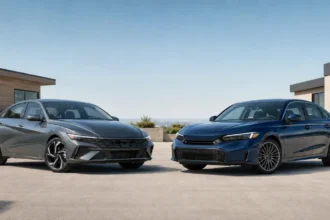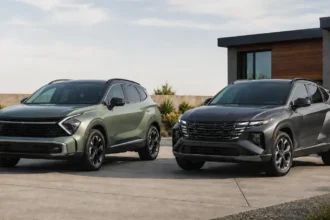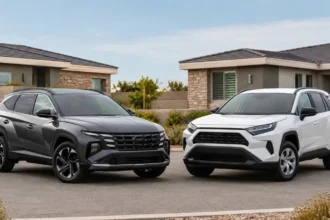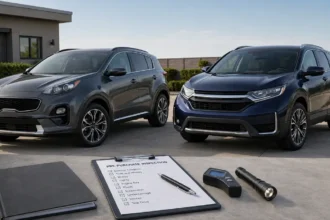


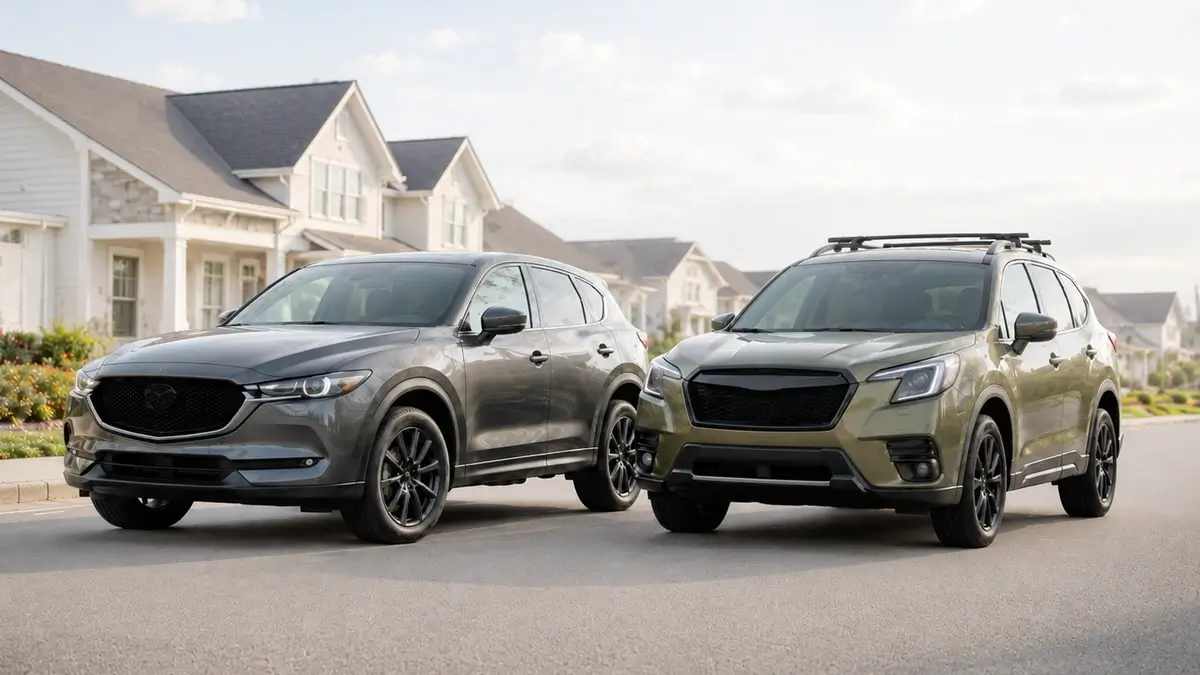
If you are comparing Mazda CX-5 vs Subaru Forester, the better used SUV depends on what you need the vehicle to solve.
The Mazda CX-5 is the stronger pick for drivers who care about cabin feel, road manners, and a more polished daily drive. The Subaru Forester is the stronger pick for buyers who want easier visibility, cargo flexibility, rear-seat usability, and more bad-weather confidence.
This is not a one-badge answer. A clean CX-5 can be the better buy. A clean Forester can be the better buy. A neglected version of either SUV can be the wrong move.
Use current specs only as reference points. For any used listing, verify the exact model year, trim, drivetrain, fuel economy, recall status, and equipment before you decide.
Fastest safe default: buy the cleaner, better-maintained example first. Then use this guide to decide whether the CX-5 or Forester fits your life better.
- Choose the Mazda CX-5 if you want a more refined, comfort-focused compact SUV.
- Choose the Subaru Forester if you need space, visibility, and rough-weather practicality.
- Avoid either one if the year, trim, maintenance history, recall status, or condition is weak.
- Do not compare a loaded trim against a base trim and call it a fair decision.
For broader shopping context, compare both SUVs against CarMerit’s Best Used Compact SUVs guide before narrowing to one listing.
CarMerit reliability comparator
Mazda CX-5 vs Subaru Forester: 2013-2025 NHTSA snapshot
Owner-complaint and recall counts from NHTSA for 2013-2025, each model’s best used-year lane, and which buyer each one fits.
| 2,384 | complaints (2013-25) | 4,453 |
| 20 | recalls (2013-25) | 33 |
EngineElectricalUnknown / otherBrakes | top issues | Visibility / wipersAirbags / seatbelts / structureElectricalUnknown / other |
Mazda CX-5
Best used year: 2017
Shortlist 2021-2025 first if budget allows; shop 2017-2020 for value; inspect 2016 hardest and treat 2018-2019 as inspection-priority years.
Best for: Comfort-and-feel buyers who want a more refined cabin, better road manners, and a more polished daily drive.
Subaru Forester
Best used year: 2021
Start with 2021-2024; consider 2019-2020 or 2016-2018 if records and price are strong; be more careful with 2013-2015.
Best for: Utility-and-weather buyers who want easier visibility, cargo flexibility, rear-seat space, and bad-weather confidence.
Quick take: Choose the CX-5 for comfort and feel, including the more refined cabin and the more satisfying daily drive. Choose the Forester for utility and weather confidence, including easier visibility, cargo and rear-seat space, and standard AWD for snow and rough roads. The better SUV is still the cleaner, better-documented vehicle. Do not crown either SUV from raw NHTSA counts alone.
Complaint counts are raw owner reports filed with NHTSA, not adjusted for sales volume, so they should guide inspection rather than crown a winner. The quick comparator above uses a 2013-2025 overlapping NHTSA snapshot for both models; if one model has older NHTSA history before 2013, those model-only years are excluded here to keep the comparison balanced. Always inspect the specific vehicle before buying.
Quick Verdict: Mazda CX-5 or Subaru Forester?
The CX-5 is usually the better used buy for drivers who want a compact SUV that feels more premium and more satisfying in normal daily driving.
The Forester is usually the better used buy for buyers who care more about utility. It makes more sense if you regularly carry passengers, load bulky cargo, drive in snow, or value open visibility over cabin polish.
Neither SUV wins for every buyer. A rough CX-5 is not better than a well-kept Forester, and a neglected Forester is not better than a clean CX-5.
Before comparing details, use this quick snapshot to set the decision frame.
| Factor | Mazda CX-5 | Subaru Forester | Used-buyer read |
|---|---|---|---|
| Best overall fit | Comfort-focused daily driver | Practical all-weather family SUV | Pick by use case, not badge |
| Driving feel | More composed and upscale | Easier, lighter, more utility-focused | CX-5 feels more polished |
| Visibility | Good, but more enclosed | Excellent open outward view | Forester helps in traffic and parking |
| Cargo use | Useful, but not the main advantage | Stronger practical cargo shape | Forester fits bulkier daily use better |
| Rear seat | Fine for many buyers | Better for frequent passengers | Forester is safer for family-space needs |
| AWD and snow | Capable when properly equipped | Core Forester strength | Tires still matter more than branding |
| Fuel economy | Depends on year, engine, trim, and AWD | Often competitive for an AWD SUV | Verify exact year and trim |
| Used value | Strong if condition and trim are right | Strong if utility matters to you | Cheapest listing is not automatically best |
Best simple answer: choose the CX-5 for comfort and feel. Choose the Forester for utility and weather confidence.
Who Should Choose the Mazda CX-5?
The Mazda CX-5 makes the most sense if you want a used compact SUV that feels less basic.
Its main advantage is not cargo math. It is the way it drives, the way the cabin feels, and the way it handles daily commuting.
Choose the CX-5 if your normal use looks like this:
- You drive mostly in the city, suburbs, or highways.
- You want a quieter, more premium-feeling cabin.
- You care about steering feel and road manners.
- You do not need maximum cargo volume.
- You usually carry one or two passengers, not a full family load.
The CX-5 also makes sense if you are moving from a sedan and do not want an SUV that feels loose or bulky.
If you are also comparing Mazda against Honda or Toyota, read CarMerit’s Mazda CX-5 vs Honda CR-V and Mazda CX-5 vs Toyota RAV4 guides before finalizing your shortlist.
Mazda lists i-Activ AWD on current CX-5 models, but used CX-5 availability can vary by model year and trim. Check the exact listing before assuming drivetrain, features, or fuel economy.
The CX-5 case gets weaker if you need easy rear-seat access, frequent child-seat use, a very open cabin, or the most cargo-friendly shape.
It also gets weaker if you are considering a high-mileage turbo model without strong service records. Extra power is useful, but condition matters more than one exciting test drive.
Who Should Choose the Subaru Forester?
The Subaru Forester is the better fit if the SUV has to work hard as a practical tool.
It is the stronger choice for buyers who value visibility, rear-seat access, cargo flexibility, and bad-weather confidence. Subaru’s current Forester pages list standard Symmetrical All-Wheel Drive and 8.7 inches or more of ground clearance on recent models, but used shoppers still need to verify the exact year and trim.
Choose the Forester if your normal use looks like this:
- You live where snow, rain, gravel roads, or steep driveways matter.
- You carry rear passengers often.
- You need easier entry and exit.
- You value outward visibility.
- You want cargo access that feels more useful in real life.
The Forester is not the automatic winner just because it has a strong AWD reputation.
If the one you are buying has worn tires, accident history, weak maintenance records, unresolved recalls, or rough CVT behavior, the badge will not save the deal.
If you are deciding between Subaru and other compact SUVs, compare this choice with CarMerit’s Forester vs RAV4 and Honda CR-V vs Subaru Forester guides.
The Forester case gets weaker if you care most about cabin polish, handling feel, and a more premium daily-drive experience.
It also gets weaker if you only need light bad-weather capability and find a cleaner CX-5 for the same money.
Price, Value, and Resale Reality
Used price is only one part of this comparison.
A cheaper listing can become the worse buy if it has poor maintenance, weak tires, accident history, worn brakes, or expensive upcoming service.
A higher-priced example can still be the better deal if it has the right trim, lower mileage, clean records, and fewer obvious inspection concerns.
When you are comparing a specific CX-5 with a specific Forester, make sure the price comparison is based on the vehicles the listings actually describe. Run both VINs through the CarMerit VIN Lookup and compare the returned vehicle details with each seller’s paperwork and advertised configuration. Then judge the real value gap using mileage, condition, equipment, service history, and inspection findings rather than the asking prices alone.
Use this matrix before deciding which listing gives better value.
| Buyer situation | Better value lean | Why it matters |
| You want the most refined daily SUV | Mazda CX-5 | Cabin feel and driving comfort carry more value |
| You need family and cargo flexibility | Subaru Forester | Space and visibility reduce daily friction |
| You drive in snow often | Subaru Forester | AWD confidence and clearance matter more |
| You found a cleaner service history | Either one | Condition can beat model preference |
| You are comparing mismatched trims | Neither yet | Compare equivalent equipment first |
| You plan to keep it long term | Cleaner example | Maintenance history matters more over time |
| You need the lowest ownership-surprise risk | Better-documented vehicle | Records reduce uncertainty |
Do not use resale value as a lazy tiebreaker.
Resale depends on local demand, mileage, trim, condition, accident history, color, drivetrain, and service documentation. Verify your local market before assuming either SUV is the stronger value.
Reliability and Common Used-Car Risks
Subaru Forester vs Mazda CX-5 reliability is not a safe one-line answer.
The right way to compare them is by model year, engine, transmission, maintenance history, and condition. A broad reputation claim is too weak for a used-car decision.
For deeper model-specific risk, use CarMerit’s Mazda CX-5 Reliability and Cost to Own and Subaru Forester Reliability guides alongside this comparison.
Use this ownership-risk table as your inspection guide.
| Risk area | Mazda CX-5 check | Subaru Forester check | Why it matters |
| Maintenance records | Oil changes, coolant, brakes, tires | Oil changes, CVT service context, tires | Poor records raise risk on either SUV |
| Drivetrain | Confirm AWD or FWD by year and trim | Confirm AWD behavior feels smooth | Drivetrain repairs can be expensive |
| Engine choice | Be more careful with turbo examples | Check for rough running or leaks | Higher-mileage examples need proof |
| Transmission feel | Watch shift quality and hesitation | Watch CVT smoothness and noise | Test-drive feel can reveal neglect |
| Recalls | Check the exact VIN | Check the exact VIN | Open recalls can affect safety and timing |
| Tires | Match brand, tread, and wear | Match brand, tread, and wear | AWD systems dislike neglected tires |
| Suspension | Listen for clunks and worn bushings | Listen for clunks and worn bushings | SUVs can hide wear until inspected |
VIN-specific factory coverage worth checking
Some used CX-5 and Forester examples may have manufacturer coverage beyond the original warranty. These selected high-impact programs are worth checking before paying for a related repair.
If a CX-5’s coolant or fuel-system history is being weighed against a Forester’s CVT or Thermo Control Valve history, check both model years in CarMerit’s Manufacturer Special Coverage Lookup before letting either repair concern decide which SUV stays on your shortlist.
| Vehicle and model years | Manufacturer program | Coverage change | What to verify |
|---|---|---|---|
| Mazda CX-5, 2019-2020 | CSP11 cylinder-head coolant-leak coverage | For qualifying PYT-engine vehicles and the specified cylinder-head coolant-leak condition, coverage extends to 10 years or 120,000 miles from the original in-service date, whichever comes first. | VIN, engine, eMDCS program status, mileage, in-service date, and qualifying diagnosis. |
| Mazda CX-5, 2017-2019 | CSP12 low-pressure fuel-pump coverage | Recall-repaired vehicles receive coverage for 15 years after the recall repair or 150,000 total vehicle miles. Additional covered vehicles receive 15 years or 150,000 miles from the in-service date. | VIN group, recall-repair date when applicable, mileage, eMDCS status, and diagnosis. |
| Certain Mazda CX-5s, 2018-2025 | SSPD8 engine-temperature and heater-performance coverage | The specified coolant-control-valve-related repair is covered for 15 years or 150,000 miles from the original warranty start date, whichever comes first. | Exact VIN and production range, eMDCS status, warranty-start date, mileage, and qualifying diagnosis. |
| Subaru Forester, 2014-2020 | CVT extensions for 2014-2015, 2016-2017, 2018, and 2019-2020 | Eligible original or approved replacement CVT assemblies receive 10-year/100,000-mile powertrain coverage. | Model year, engine and CVT applicability, original warranty date, mileage, diagnosis, and Vehicle Coverage Inquiry result. |
| Subaru Forester, 2018-2019 | Fuel-pump impeller coverage | Recall-group vehicles receive 15-year/150,000-mile coverage measured from recall completion. An additional group receives 15-year/unlimited-mileage coverage from the original warranty start date for one qualifying replacement. | VIN group, recall completion, warranty-start date, prior replacement, and Vehicle Coverage Inquiry result. |
| Subaru Forester, 2019-2021 | Thermo Control Valve coverage | The covered valve and qualifying condition receive 15-year/150,000-mile coverage. | VIN, diagnosis, mileage, applicable certification details, and Vehicle Coverage Inquiry result. |
Table Note: These are selected high-impact manufacturer coverage programs, not an exhaustive program list or evidence that every listed vehicle will develop the covered problem. Some older or mileage-limited coverage may already be expired. Eligibility and remaining coverage depend on the exact VIN, in-service or warranty date, mileage, equipment, production group, diagnosis, prior repairs, and current written terms.
Before buying, ask a Mazda dealer to check eMDCS or a Subaru dealer to run a Vehicle Coverage Inquiry. Get the result in writing before relying on any remaining coverage.
Forum and owner discussions are useful for finding worries to investigate. They are not proof that one model is always better.
Before buying either SUV, run the VIN through the NHTSA recall lookup. Then get a pre-purchase inspection from a mechanic who knows compact SUVs.
If you cannot verify service history, reduce your offer or walk away.
Ownership Costs, Maintenance, and Repair Exposure
The real cost difference between the CX-5 and Forester often comes from condition, not the badge.
Both are mainstream compact SUVs. Both can become expensive if you buy one with deferred maintenance.
The CX-5 may cost more if you chase a higher trim or turbo engine without proof of careful ownership.
The Forester may cost more if the CVT, AWD system, tires, or suspension have been neglected.
Here is the practical ownership rule: do not pay extra for capability you do not need, and do not save money on an SUV that needs immediate repairs.
What the factory schedules change for a used buyer
For 2019-2024 gasoline models, the official Mazda CX-5 maintenance schedule and Subaru warranty and maintenance resources show several meaningful differences.
| Service checkpoint | Mazda CX-5, 2019-2024 gas models | Subaru Forester, 2019-2024 gas models | Used-buyer check |
|---|---|---|---|
| Engine oil and filter | Follow the wrench indicator, but do not exceed 12 months or 7,500 miles. | Replace every six months or 6,000 miles under the normal schedule. | Check whether the records follow the correct time limit as well as the mileage limit. |
| Spark plugs | Turbo engines: 40,000 miles. Non-turbo engines: 75,000 miles. | 60 months or 60,000 miles. | Confirm the engine type, then look for proof that the applicable plug service was completed. |
| Engine coolant | First replacement at 10 years or 120,000 miles; then every five years or 60,000 miles. | First replacement at 132 months or 137,500 miles; then every 72 months or 75,000 miles. | On older or higher-mileage examples, check both vehicle age and odometer mileage. |
Table Note: These are normal U.S. schedule checkpoints for the stated model years. Severe operating conditions can shorten some intervals. A maintenance requirement is not evidence that a component is failure-prone.
For 2019-2024 Foresters, Subaru’s normal schedule also calls for CVT-fluid and front/rear differential-oil inspections at 30 months or 30,000 miles. Ask for records around those checkpoints. An inspection requirement does not mean automatic fluid replacement or prove that the CVT or AWD system is unreliable.
Fuel economy also belongs in ownership cost, but it should not dominate the decision.
Use FuelEconomy.gov to compare the exact model year, engine, trim, and drivetrain you are shopping. A one or two MPG difference matters less than buying the wrong SUV with worn tires, bad service records, or hidden accident damage.
AWD, Snow, Ground Clearance, and Bad-Weather Confidence
Forester vs CX-5 AWD is one of the clearest decision points.
The Forester is the easier recommendation for buyers who regularly face snow, unpaved roads, steep driveways, rural roads, or poor winter visibility.
The CX-5 can still be enough if your bad-weather use is moderate and the exact used example is equipped properly. Mazda lists i-Activ AWD on current CX-5 models, but older used listings still need year-and-trim verification.
Do not overrate AWD by itself.
AWD helps you move. It does not replace winter tires, brake condition, careful driving, or enough ground clearance for your roads.
The Forester is the stronger pick if you want a practical bad-weather SUV. The CX-5 is the better pick if you want a more refined SUV that can still handle normal wet or snowy commuting when properly equipped.
Skip both if you are expecting real off-road capability. This comparison is about used compact SUVs, not trail rigs.
Comfort, Cabin Space, Rear Seat, and Cargo Room
Comfort and space are where the CX-5 vs Forester decision becomes personal.
The CX-5 feels more premium from the driver’s seat. The Forester feels more open and easier to see out of.
If you carry adults, kids, pets, strollers, sports gear, or bulky cargo often, the Forester deserves serious priority.
If you mostly drive solo or with one passenger, the CX-5 may feel like the better daily vehicle.
For family-focused shopping, use CarMerit’s Best Used Family Cars guide to compare this decision against other practical used-car options.
Use this practicality matrix before choosing.
| Practical need | Better fit | Why |
| Premium cabin feel | Mazda CX-5 | More upscale daily-drive impression |
| Open outward visibility | Subaru Forester | Taller, glassier cabin feel |
| Rear-seat passengers | Subaru Forester | Easier passenger-first layout |
| Child-seat access | Subaru Forester | Better for frequent family loading |
| Cargo flexibility | Subaru Forester | More utility-focused shape |
| City commuting | Mazda CX-5 | More refined road feel |
| Long highway drives | Mazda CX-5 | Better fit if quiet comfort matters |
| Outdoor gear | Subaru Forester | Easier cargo and weather-use case |
Do not choose the Forester only because it has more utility on paper.
Choose it if you will actually use that utility every week.
Do not choose the CX-5 only because it feels nicer on a test drive.
Choose it if that feel matters more than rear-seat and cargo space.
Fuel Economy and Daily Driving Costs
Forester vs CX-5 gas mileage depends on year, engine, trim, drivetrain, tires, and driving conditions.
Official FuelEconomy.gov data shows why a single model-wide MPG number can mislead used-SUV shoppers. The table below keeps gasoline, automatic AWD configurations separate instead of averaging different engines and versions together.
EPA fuel economy by used model year
| Mazda CX-5 model year | CX-5 configuration | City MPG | Highway MPG | Combined MPG | Subaru Forester model year | Forester configuration | City MPG | Highway MPG | Combined MPG |
|---|---|---|---|---|---|---|---|---|---|
| 2013 | 2.0L | 25 | 30 | 27 | 2013 | 2.5L four-speed automatic | 21 | 26 | 23 |
| 2014-2015 | 2.0L 2.5L | 25 24 | 30 29 | 27 26 | 2014-2015 | 2.5L CVT | 24 | 31 | 27 |
| 2016 | 2.5L | 24 | 29 | 26 | 2016 | 2.5L CVT | 24 | 31 | 27 |
| 2017 | 2.5L | 23 | 29 | 26 | 2017 | 2.5L CVT | 26 | 32 | 28 |
| 2018 | 2.5L | 24 | 30 | 26 | 2018 | 2.5L automatic | 26 | 32 | 28 |
| 2019-2021 | 2.5L | 24 | 30 | 26 | 2019-2021 | 2.5L automatic | 26 | 33 | 29 |
| 2022-2023 | 2.5L | 24 | 30 | 26 | 2022-2023 | Standard 2.5L Wilderness | 26 25 | 33 28 | 29 26 |
| 2024 | 2.5L with stop-start 2.5L without stop-start | 26 23 | 31 29 | 28 25 | 2024 | Standard 2.5L Wilderness | 26 25 | 33 28 | 29 26 |
| 2025 | 2.5L with stop-start 2.5L without stop-start | 26 23 | 30 29 | 28 25 | 2025 | Standard 2.5L Sport/Touring Wilderness | 26 25 25 | 33 32 28 | 29 28 26 |
Table Note: When a cell contains multiple configurations, the City, Highway, and Combined values follow the same top-to-bottom order. Values are official rounded EPA label estimates from the FuelEconomy.gov dataset dated June 16, 2026. Turbo, premium-fuel, diesel, manual-transmission, and 2025 Forester Hybrid configurations are excluded from this gasoline automatic-AWD comparison. Actual mileage varies.
For a long commute, compare the exact model year, engine, drivetrain, and transmission you are shopping. Use fuel economy as a tiebreaker after condition, service history, and buyer fit.
Safety, Visibility, and Driver Assistance
Safety should be checked by model year, not by brand reputation.
IIHS results change materially by model year, test program, equipment, and sometimes build date. Use the model-year pages below as exact shopping checkpoints instead of treating either SUV as having one fixed safety result.
IIHS model-year safety checkpoints
| Used-model-year checkpoint | Mazda CX-5 | Subaru Forester |
|---|---|---|
| Older small-overlap boundary | The 2014 CX-5 IIHS page reports driver-side M for 2013-2014 models built before November 2013 and G for 2014-2016 models built after October 2013. | The 2014 Forester IIHS page reports driver-side G and passenger-side M for 2014-2018 models. |
| 2016 headlights | The 2016 CX-5 IIHS page reports A or M, depending on trim, package, and headlight equipment. | The 2016 Forester IIHS page reports P for all four listed headlight configurations. |
| 2021-2022 updated tests | The 2021 CX-5 IIHS page reports updated moderate overlap P, updated side G, and seatbelt-reminder M. | The 2021 Forester IIHS page reports updated moderate overlap M, updated side A, and seatbelt-reminder G. |
| 2023-2024 updated tests | The 2024 CX-5 IIHS page reports updated moderate overlap G, updated side G, and seatbelt-reminder G. | The 2024 Forester IIHS page reports updated moderate overlap M, updated side A, and seatbelt-reminder G. |
| 2025 updated tests | The 2025 CX-5 IIHS page reports updated moderate overlap G, updated side G, and seatbelt-reminder G. | The 2025 Forester IIHS page reports updated moderate overlap A and updated side G for non-Wilderness models, plus seatbelt-reminder G. |
Table Note: G = Good; A = Acceptable; M = Marginal; P = Poor. Each result applies only to the named IIHS test and stated model-year, equipment, and build-date scope. IIHS tests and evaluation criteria changed over time, so these entries should not be converted into a cross-year score or used as a stand-alone overall winner. The listed 2025 Forester updated moderate-overlap and updated-side ratings do not apply to the 2025 Forester Wilderness.
The Forester has one practical safety advantage that buyers often feel immediately: visibility.
A more open cabin and easier sightlines can reduce stress in parking lots, traffic, and bad weather. That matters for new drivers, older drivers, city drivers, and family buyers.
The CX-5 can still be the better safety fit if the specific trim has the equipment you want and the vehicle history is cleaner.
Do not assume every used example has the same driver-assist package. Confirm the trim, original equipment, and working condition before buying.
Trim and Model-Year Buying Notes
The biggest mistake in this comparison is treating every CX-5 and every Forester as the same vehicle.
They are not.
A base Forester and a loaded CX-5 do not answer the same buyer question. A clean older CX-5 and a neglected newer Forester do not belong in the same simple verdict.
Use these rules before you shortlist either SUV:
- Compare similar mileage, condition, and service history.
- Compare equivalent trims, not just model names.
- Confirm AWD, safety tech, engine, and comfort features.
- Check the exact VIN for open recalls.
- Avoid making a model-year reliability claim without proof.
- Do not let one owner comment override inspection results.
For model-year filtering, use CarMerit’s Mazda CX-5 Years to Avoid and Best Subaru Forester Years guides before picking a final listing.
For CX-5 equipment decisions, CarMerit’s Mazda CX-5 Trim Levels guide can help you avoid paying extra for the wrong trim.
Choose the CX-5 if the trim gives you the cabin feel and comfort you want.
Choose the Forester if the trim gives you the space, visibility, and all-weather confidence you need.
If you are stuck between two similar listings, buy the one with better documentation and fewer inspection concerns.
If the CX-5 and Forester feel larger than you need, compare the Subaru Crosstrek vs Mazda CX-30 next. It gives you the same Mazda-vs-Subaru decision in a smaller, easier-to-park used SUV package.
Final Recommendation: Which One Should You Shortlist?
The Mazda CX-5 vs Subaru Forester decision is not a universal winner fight.
Shortlist the Mazda CX-5 if you want a used compact SUV that feels more premium, drives better, and suits mostly daily commuting.
Shortlist the Subaru Forester if you want the more practical SUV for cargo, rear passengers, visibility, snow, rough roads, and all-weather confidence.
Skip the CX-5 if rear-seat space, open visibility, and cargo usefulness are your top priorities.
Skip the Forester if cabin polish, road feel, and a more refined daily drive matter more than utility.
Skip both if the specific used example has weak maintenance records, unresolved recalls, rough drivetrain behavior, poor tires, accident history, or a bad inspection.
The safest final answer is this: choose the SUV that fits your use case, then buy the best-maintained example you can verify.
Frequently Asked Questions
Which is better, Mazda CX-5 or Subaru Forester?
The Mazda CX-5 is better for comfort, cabin feel, and driving refinement. The Subaru Forester is better for visibility, cargo use, rear-seat practicality, and bad-weather confidence.
Is the Mazda CX-5 vs Subaru Forester comparison mostly about reliability?
No. Reliability matters, but the real used-buy decision also includes condition, maintenance history, year, trim, AWD needs, fuel economy, cargo space, and safety equipment.
Is the Subaru Forester better than the Mazda CX-5 in snow?
The Subaru Forester is usually the stronger snow-confidence pick because of its AWD-focused setup and ground-clearance advantage. Good winter tires and vehicle condition still matter more than badge reputation.
Does the Subaru Forester have more cargo space than the Mazda CX-5?
The Forester is generally the better practical cargo choice, especially if you carry bulky items often. Still, check the exact model year and trim because cargo specs can change.
Which has better gas mileage, Forester or CX-5?
The Forester can have an MPG advantage in some recent trims, but fuel economy varies by year, drivetrain, engine, trim, and tires. Compare the exact used listings on FuelEconomy.gov before deciding.
Is the Mazda CX-5 better for daily driving?
Yes, the CX-5 is usually the better daily-driving choice if you care about cabin feel, steering, ride composure, and a more premium experience.
Which one should I buy used, the Mazda CX-5 or Subaru Forester?
Buy the Mazda CX-5 if comfort and driving feel matter most. Buy the Subaru Forester if visibility, space, cargo access, and bad-weather confidence matter more.