

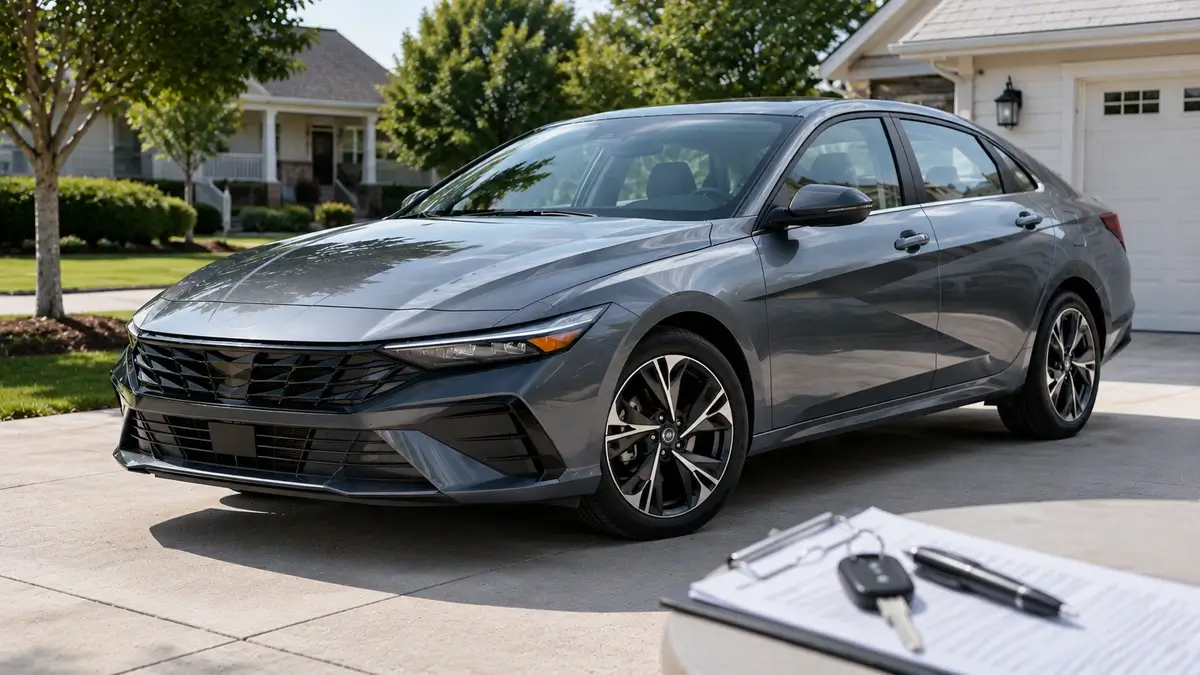
Hyundai Elantra reliability depends on the engine, model year, and condition of the individual car. A used Elantra can be worth buying when its maintenance history is credible, applicable recalls are addressed, and an independent inspection finds no unresolved major problem. A low price alone is not enough, especially when engine noise or warranty uncertainty remains unexplained.
Is the Hyundai Elantra Reliable as a Used Car?
A well-maintained Elantra can stay on your shortlist, but the buying case should rest on the specific vehicle rather than Hyundai’s reputation or a model-wide reliability score. Official records identify different concerns across engines and generations, so “Elantra engine problems” is too broad to make a purchase decision.
The practical dividing line is whether you can verify the risk:
- Keep considering it when service records, engine identification, recall status, and inspection findings agree with the seller’s description.
- Pause the purchase when engine noise, oil-loss history, warning lights, or campaign eligibility needs diagnosis.
- Walk away from that example when the seller refuses an independent inspection or a material problem remains unresolved and unpriced.
This guide focuses on U.S. Elantra sedans. Hybrid information is identified separately. Do not transfer sedan findings automatically to the Touring, GT, Coupe, or performance-focused Elantra N.
Hyundai Elantra Reliability by Generation: Where the Risk Changes
Generation evidence helps you choose what to investigate, but it cannot tell you whether an individual Elantra is sound. The useful distinction is between reported concerns, documented component-specific problems, and the condition of the car you are considering.
The following NHTSA snapshot covers model years 2000–2025. Complaint totals are unique reports within each period. Investigation and manufacturer-communication figures are summed model-year associations: the same investigation or document may appear against multiple years.
| Model-year group | Owner complaints | Investigation associations | Mfr. Comms. associations |
|---|---|---|---|
| 2000, final year of the earlier generation | 197 | 0 | 45 |
| 2001–2006 | 1,365 | 9 | 359 |
| 2007–2010 | 1,310 | 9 | 181 |
| 2011–2016 | 3,409 | 18 | 776 |
| 2017–2020 | 1,603 | 1 | 499 |
| 2021–2025, covered years of the newer generation | 547 | 3 | 297 |
These are historical records, not live totals or failure rates. Complaint filings in this snapshot extend through June 29, 2026. The figures are not adjusted for vehicle sales, mileage, or years in service. A complaint is an owner report, an investigation is not automatically a confirmed defect, and a manufacturer communication is not necessarily a repair every car needs.
For buyers, the records point toward restraint and suspension concerns in the older groups, steering checks in 2007–2010, and engine scrutiny in 2011–2020. The newer group’s lower complaint volume does not establish superior long-term durability. Its vehicles have had less time to accumulate reports.
The engine and recall details below are more useful than comparing those totals. For detailed year selection, use the separate Hyundai Elantra years to avoid and best years to buy guide.
Safety differences worth checking separately
Crash-test results answer a different question from mechanical reliability. These selected IIHS results preserve the test and vehicle scope rather than turning safety ratings into a reliability ranking.
| Sedan scope | IIHS test or equipment | Rating | Buying implication |
|---|---|---|---|
| 2011–2016, shown on the 2013 IIHS page | Driver-side small-overlap front | A | Do not assume its crash performance matches a later redesign |
| 2017–2020, built after March 2016, shown on the 2017 IIHS page | Driver-side small-overlap front | G | Check the certification label before applying the rating to an early 2017 car |
| 2021 sedan | Driver-side small-overlap front | G | This result does not establish engine durability |
| 2021 Limited, built after November 2020 | LED projector headlights | G | Confirm trim, build date, and installed equipment |
| 2021 SE, SEL, and N Line | Halogen projector headlights | P | Night-driving equipment deserves a separate check |
G = Good; A = Acceptable; M = Marginal; P = Poor. The 2021 IIHS assessment distinguishes the headlight configurations. Crashworthiness and headlight ratings measure different things, and original versus updated crash tests should not be treated as interchangeable.
If you drive frequently after dark, the headlight difference can matter even when two cars have similar mileage and service records. It is a reason to inspect equipment, not evidence that the higher trim will require fewer repairs.
Common Hyundai Elantra Problems That Matter to Used Buyers
The most useful Elantra problem checks are engine-specific and campaign-specific. Do not apply a documented 1.8-liter issue to every 2.0-liter car, or assume that a warranty extension means all eligible cars have failed.
| Documented concern | Affected scope to verify | What to check before buying |
|---|---|---|
| Piston-slap-related short-block damage | Certain 2011–2016 Elantras with the 1.8L Nu engine, Hyundai TXXK | Arrange a cold start and professional assessment of persistent engine noise; verify engine-repair history and program eligibility |
| Connecting-rod bearing failure coverage | Certain 2014–2016 Elantras with the Nu 2.0L GDI engine, Hyundai TXXM | Verify the engine, applicable knock-detection campaign completion, and any prior diagnosis or replacement |
| Improperly heat-treated piston oil rings | Certain 2019–2020 Elantras with the 2.0L Nu MPI engine, NHTSA 21V301000 | Check recall completion and inspection or engine-replacement records; the recall identifies engine damage, stalling, and fire risks |
| ABS-module electrical short and fire risk | Certain 2007–2010 sedans under 20V061000 and certain 2011–2015 sedans under 23V651000 | Check the exact campaign by VIN and obtain repair documentation |
| Driver airbag inflator rupture | Certain 2015–2016 Elantras, NHTSA 26V307000 | Verify VIN applicability and completion of the prescribed inspection or replacement |
| Steering coupling or driver airbag clock spring | Certain 2007–2015 sedans for the coupling; certain 2011–2014 Elantras for the clock spring | Have steering noises and airbag warnings diagnosed; check the separate component-specific programs |
Hyundai’s piston-slap extension concerns a defined form of short-block damage. Its connecting-rod bearing extension covers a different engine condition. Neither program establishes how likely a particular car is to fail.
On an affected vehicle with an unrepaired 23V651000 recall, follow the official instruction to park outside and away from structures until the repair is complete. Check current VIN instructions rather than relying on a seller’s statement that “the recalls were done.”
A quiet warm engine is not enough to settle a cold-start complaint. Ask the inspector to hear the engine before it has been warmed up and review any history of repeated oil top-ups, stalling, or major engine work. Symptoms require diagnosis; they do not identify the failed component by themselves.
Also test door handles and latches on a 2017 example. Hyundai documented a condition-specific latch extension for certain production ranges. Peeling factory white paint on certain 2015–2018 cars is a separate condition and value concern, not proof of a mechanical defect.
How Long Can a Hyundai Elantra Last?
There is no defensible universal lifespan for a used Elantra. Passing 100,000 miles does not automatically make it a bad buy, and being below that number does not establish reliability. The better question is whether the car has documented upkeep, acceptable current condition, and no unresolved engine or safety issue.
What changes after 100,000 miles?
Maintenance history becomes more useful when it shows completed work rather than a seller’s general assurance. Compare dated invoices and recorded mileage with the exact owner’s manual. Look for evidence of required oil service, scheduled replacement items, and any engine or transmission repairs.
Some maintenance checkpoints sit close to this mileage. For example, the 2021 2.0L gas Elantra’s normal schedule specifies spark-plug replacement every 96,000 miles. That interval does not apply automatically to an older engine or a Hybrid.
A higher-mileage car with coherent records and a satisfactory inspection may be the more defensible purchase than a lower-mileage example with unexplained engine noise. That is a condition-based judgment, not a prediction that the higher-mileage car will last longer.
What an engine replacement does and does not tell you
An engine replacement is neither an automatic rejection nor a fresh start for the entire car. Ask why it was replaced, who performed the work, what was installed, and what written warranty applies. The transmission, suspension, electrical systems, and body still retain their own age and use history.
Maintenance, Warranty, and Special-Coverage Reality
The right maintenance schedule and actual warranty eligibility matter more than Hyundai’s advertised warranty length. Match records to the exact model year, engine, and use conditions, then confirm coverage separately. A warranty does not replace an inspection or prove that the car was maintained properly.
Maintenance records that change the buying decision
These are selected normal-use requirements from Hyundai owner manuals, not a complete schedule for every Elantra. Where both time and mileage are listed, use whichever comes first.
| Exact vehicle scope | Service | OEM normal-use requirement | Record to request |
|---|---|---|---|
| 2021–2023 2.0L Atkinson gas | Engine oil and filter | Every 8,000 miles or 12 months | Dated oil-service history |
| 2021 2.0L Atkinson gas | Spark plugs | Every 96,000 miles | Replacement invoice near that mileage |
| 2021 2.0L Atkinson gas | Engine coolant | First at 120,000 miles or 120 months, then every 30,000 miles or 24 months | Evidence that both age and mileage were considered |
| 2021 Elantra 2.0L gas | Drive belts | First inspection at 48,000 miles or 72 months, then every 8,000 miles or 12 months | Inspection findings and any condition-based replacement |
| 2021 Hybrid 1.6L | Engine oil and filter | Every 7,500 miles or 12 months | Hybrid-specific service history |
| 2021 Hybrid | Hybrid starter-generator belt | Inspect every 7,500 miles or 12 months; replace every 67,500 miles or 48 months | Belt inspection and replacement records |
| 2021 Hybrid | Spark plugs | Every 102,500 miles | Correct scheduled replacement record |
Use Hyundai’s manuals and warranty resources to match the car before applying an interval. Repeated short trips, extended idling, and other severe-use conditions can change the applicable service requirements. Do not assume a lightly driven car qualifies for the normal schedule.
For an older Elantra, do not substitute this newer schedule because the service book is missing. Obtain the correct manual and assess any undocumented work as an unresolved ownership expense.
Factory warranty versus special coverage
| Coverage type | What the evidence establishes | What the used buyer must verify |
|---|---|---|
| New Vehicle Limited Warranty | A 5-year/60,000-mile factory warranty applies within the documented modern-model program | Original in-service date, remaining time/mileage, covered component, and exclusions |
| Standard powertrain warranty | The advertised 10-year/100,000-mile term carries an original-owner limitation | Do not assume an ordinary used purchase retains that term; obtain the applicable owner-class terms |
| Hybrid battery and specified hybrid components | Hyundai lists 10-year/100,000-mile coverage for original and subsequent owners within the applicable program | Exact model-year terms and remaining coverage, separately from the gas-engine warranty |
| Piston-slap extension, TXXK | Coverage differs by owner class and qualifying vehicle | VIN, 1.8L engine, state/program boundaries, in-service date, mileage, and diagnosis |
| Connecting-rod bearing extension, TXXM | Qualifying repairs can be covered to 15 years/150,000 miles from original delivery or first use | VIN, 2.0L GDI engine, eligibility exclusions, and required campaign completion |
Hyundai’s warranty information separates hybrid-system coverage from other warranty categories. Coverage limits run from the applicable original start date, not from the day you buy the used car.
For TXXK, the post-temporary-window terms are 10 years/120,000 miles for qualifying original retail purchasers, lessees, and Hyundai CPO purchasers, versus 8 years/80,000 miles for other qualifying owners. The longer temporary mileage allowances shown on the program page ended in 2021. Do not treat a still-accessible program page as proof that an older car remains covered.
For TXXM, Hyundai generally requires its Knock Sensor Detection System update. Check Campaign 966 and, where applicable, the updated Campaign 982. Hyundai identifies exceptions for vehicles recalled under Recalls 198 and 209. Eligibility still depends on the vehicle and program terms.
Other extensions address specific components. Hyundai’s steering-coupling program and clock-spring program are not general steering or airbag warranties.
CarMerit’s Manufacturer Special Coverage Lookup can help screen for relevant programs. Confirm any apparent match with Hyundai using the VIN, mileage, original in-service date, and required diagnosis before treating it as financial protection.
Fuel Economy and Running-Cost Context
Fuel economy can improve an Elantra’s running-cost case, but it does not establish reliability or offset an unresolved mechanical problem. Compare the exact EPA configuration rather than using one MPG figure for every Elantra with the same model year.
These selected EPA estimates are for front-wheel-drive vehicles using regular gasoline. They are configuration examples, not model-year averages.
| EPA configuration | City MPG | Highway MPG | Combined MPG |
|---|---|---|---|
| 2017 Elantra 2.0L, six-speed automatic | 28 | 37 | 32 |
| 2021 Elantra 2.0L, CVT, without stop-start | 31 | 41 | 35 |
| 2021 Elantra 2.0L, CVT, with stop-start | 33 | 43 | 37 |
| 2021 Elantra Hybrid 1.6L, six-speed automated manual | 49 | 52 | 50 |
| 2021 Elantra Hybrid Blue 1.6L, six-speed automated manual | 53 | 56 | 54 |
The values come from EPA/FuelEconomy.gov fuel-economy data. Actual mileage varies with driving and conditions. The two 2021 gas rows are separate EPA configurations, not an invitation to infer trim equipment from the model name alone.
The Hybrid’s fuel-economy advantage is substantial in these examples, but it brings its own maintenance and coverage checks. Do not use gas-model complaint totals to declare the Hybrid equally reliable, or use MPG alone to decide that a higher purchase price is worthwhile.
Used-Value and Ownership-Cost Reality
A used Elantra is good value only when the price makes sense after known maintenance and repair needs are considered. A discount is less useful when you cannot explain what the car needs or confirm the protection the seller claims it has.
Purchase price versus ownership risk
| Situation | What would make the purchase defensible? |
|---|---|
| Lower asking price and complete service records | A satisfactory inspection and a comparison with genuinely similar local cars |
| Lower price but overdue scheduled maintenance | Written estimates for the identified work, included in your purchase decision |
| Low price with engine noise or unexplained oil loss | Diagnosis before negotiating; the discount alone does not resolve the risk |
| Seller advertises a warranty extension | Written confirmation that the VIN, owner class, mileage, dates, and condition qualify |
Compare the same model year, trim, powertrain, mileage range, title history, and condition. An asking price is not a completed sale, and a current listing does not prove future resale value.
There is no single annual repair-cost figure here that can settle the decision. Ask the inspector to separate immediate repairs, overdue scheduled maintenance, and items to monitor. Those findings give you a more useful ownership-cost picture for the actual car than a model-wide average.
If you are weighing an Elantra against a comparable Corolla, the Hyundai Elantra vs Toyota Corolla comparison addresses that separate purchase choice.
Evidence and cost assumptions
This is a U.S. used-car assessment using NHTSA reports, exact-scope Hyundai requirements and programs, and selected IIHS/EPA evidence. Numerical data retain their stated year and configuration boundaries. The NHTSA table is a historical snapshot, while applicable VIN recalls and coverage should be checked immediately before purchase. No transaction-price estimate, depreciation forecast, annual repair budget, or total-cost calculation is assumed.
What to Inspect Before Buying a Used Hyundai Elantra
Before buying, resolve the issues that could change your decision: engine condition, recall completion, maintenance history, and coverage eligibility. A general inspection still matters, but these evidence-led checks deserve specific attention on an Elantra.
High-mileage inspection priorities
Identify the engine and exact vehicle. Match the VIN, model year, engine, and body style before applying any recall or extension.
- Identify the engine and exact vehicle. Match the VIN, model year, engine, and body style before applying any recall or extension.
- Arrange a cold-start assessment. Have the inspector evaluate abnormal noise, warning lights, leaks, and any reported oil consumption. Do not accept a seller’s diagnosis without supporting records.
- Check operation on the road. Ask the inspector to assess acceleration, transmission behavior, steering, and braking, and investigate relevant symptoms or diagnostic codes.
- Inspect the documented problem areas. Prioritize steering/restraint concerns where applicable, test door-latch operation on relevant 2017 cars, and assess suspension condition on older examples.
- Reconcile maintenance with mileage and age. Verify required work against the correct schedule, including powertrain-specific high-mileage items.
Records to verify before deciding
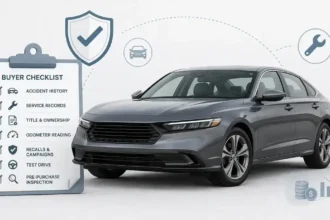
Run the VIN through NHTSA’s recall lookup and confirm campaign status with Hyundai. Obtain completion records where applicable. A recall search and a warranty-extension check answer different questions, so do both.
Ask for invoices covering major engine work and any promised warranty. If a seller cannot substantiate those claims, evaluate the purchase without assuming that the work was completed or that future repairs will be paid for.
An inspection reduces uncertainty; it cannot guarantee future reliability. If a major concern remains undiagnosed, postpone the purchase rather than assigning it an optimistic repair allowance.
Who Should Buy a Used Hyundai Elantra, and Who Should Skip It?
Buy a used Elantra when the specific car presents a convincing combination of condition, records, verified campaign status, and price. Skip an example whose attraction depends on ignoring a warning or assuming coverage that has not been confirmed.
An Elantra fits a buyer willing to check engine-specific risks and maintenance history before committing. A higher-mileage example can also make sense when its service record and inspection support the purchase, but it leaves less room for vague assurances about past care.
A car with incomplete records is a weaker proposition, especially when an expensive symptom is already present. If your budget cannot absorb unresolved work or downtime, do not let a low asking price pressure you into accepting that uncertainty. The most reliable used cars guide offers a broader shortlist to investigate.
If the Elantra clears those checks and the remaining choice is between it and a Civic, move to the Hyundai Elantra vs Honda Civic comparison.
Frequently Asked Questions
Are Hyundai Elantras reliable after 100,000 miles?
They can remain viable used purchases, but mileage alone cannot answer the question. Check the exact engine, maintenance history, current condition, and applicable campaigns. Missing service records or an unresolved engine symptom matters more than simply crossing 100,000 miles.
Can a Hyundai Elantra last 300,000 miles?
Do not treat 300,000 miles as an expected lifespan or buying assumption. An individual high-mileage example does not establish the odds for another car. Base the purchase on documented care, current inspection findings, and the ownership risk you can accept.
What are the main drawbacks of buying a used Hyundai Elantra?
The main concerns are engine-specific problems on affected vehicles, unresolved safety campaigns, uncertain maintenance history, and overestimating warranty protection. These do not apply equally to every Elantra. Match each concern to the actual engine, model year, VIN, and condition.
Does Hyundai’s 100,000-mile warranty still apply to a used Elantra?
Not automatically. The standard 10-year/100,000-mile powertrain warranty has an original-owner limitation. Hyundai CPO coverage, hybrid-component coverage, and special extensions have their own terms. Confirm the exact warranty category, owner eligibility, original start date, and remaining mileage before relying on it.