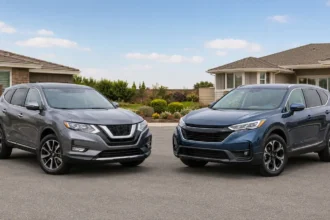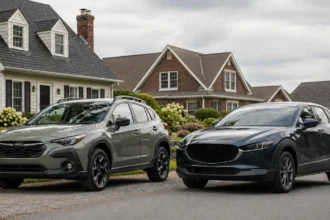


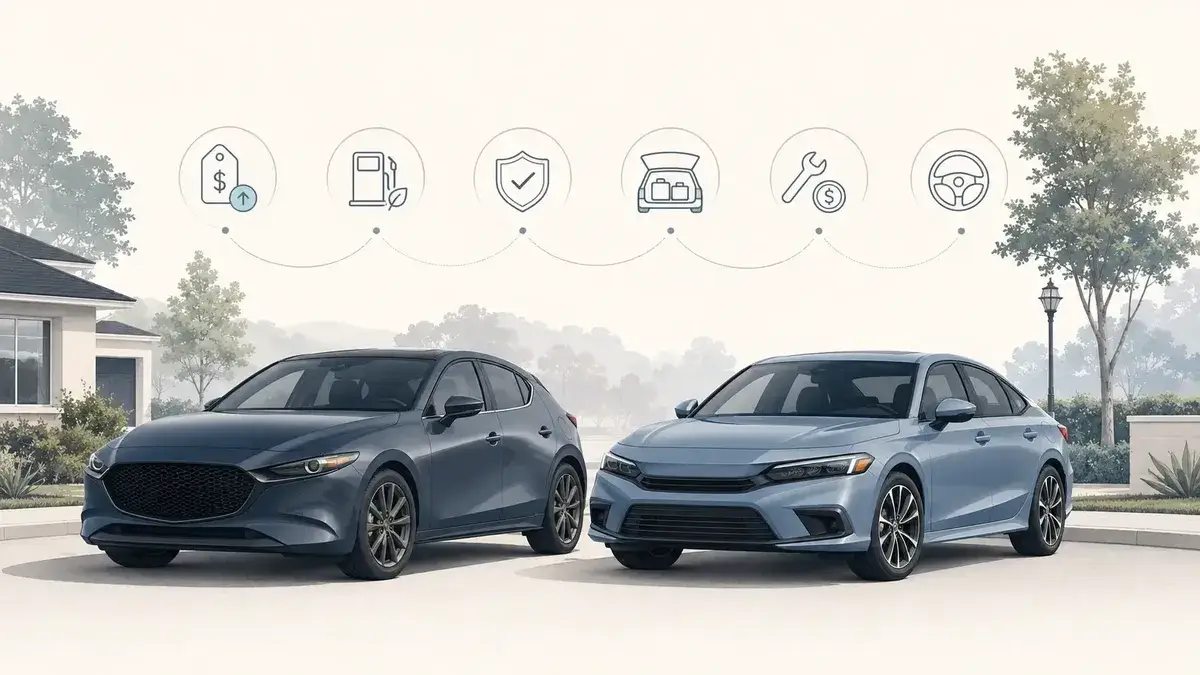
The Mazda 3 vs Honda Civic decision is not just about which compact car looks better on paper. For used buyers, the better choice depends on price, mileage, condition, trim, fuel economy, rear-seat needs, resale value, and how much you care about driving feel.
The short answer: the Honda Civic is the easier default for most used compact-car buyers, especially if you want stronger practicality, better fuel economy, and a lower-friction mainstream ownership decision.
That is the real trade-off. Civic is the low-friction choice. Mazda3 is the value-and-feel choice. Neither is automatically better in every used-car deal.
CarMerit reliability comparator
Mazda3 vs Honda Civic: 2004-2026 NHTSA snapshot
Owner-complaint and recall counts from NHTSA for 2004-2026, each model’s best used-year lane, and which buyer each one fits.
| 2,974 | complaints (2004-26) | 11,595 |
| 58 | recalls (2004-26) | 141 |
Airbags / seatbelts / structureSteeringSuspension / wheelsElectrical | top issues | SteeringAirbags / seatbelts / structureEngineSuspension / wheels |
Mazda3
Best used year: 2017
Best overall 2017-2018; best newer 2020-2023 non-turbo; budget 2012-2013; inspect harder 2004-2011, 2014, and 2019.
Best for: Value-and-feel buyers who want a more premium cabin, sharper driving feel, available AWD in newer years, and a stronger deal when the specific Mazda3 is priced and conditioned better than the Civic alternatives.
Honda Civic
Best used year: 2014
Best overall 2013-2015; budget 2009-2011; newer 2019-2021; use more caution with 2006-2008 and 2016.
Best for: Practical-first buyers who want better fuel-economy logic, stronger rear-seat usability, and a lower-friction mainstream ownership decision.
Quick take: The Civic is the easier default for most used compact-car buyers when prices are close. Choose the Mazda3 when it costs meaningfully less in similar condition, or when cabin feel, driving enjoyment, style, and available AWD matter more. Do not crown either car from raw NHTSA counts alone.
Complaint counts are raw owner reports filed with NHTSA, not adjusted for sales volume, so they should guide inspection rather than crown a winner. The quick comparator above uses a 2004-2026 overlapping NHTSA snapshot for both models; if one model has older NHTSA history before 2004, those model-only years are excluded here to keep the comparison balanced. Always inspect the specific vehicle before buying.
Mazda 3 vs Honda Civic: Quick Verdict for Used Buyers
Choose the Honda Civic if you want the easier all-around used compact car. It is usually the better fit for commuters, small families, and shoppers who want a car that is easy to recommend without many conditions.
Choose the Mazda3 if you want a compact car that feels more premium inside, drives with more personality, and may cost less than a similar Civic. It can be a smarter buy when the Civic is overpriced in your local market.
The decision gets close when both cars have similar mileage, clean titles, good service history, and fair pricing. In that case, the Civic wins for practicality and fuel economy. The Mazda3 wins for cabin feel and driving enjoyment.
| Decision point | Honda Civic | Mazda3 |
|---|---|---|
| Easier default used buy | Stronger | Good, but more condition-dependent |
| Fuel economy | Usually better, especially hybrid versions | Good, but not usually the efficiency leader |
| Rear-seat usability | Better fit for passengers | Tighter feel in many cases |
| Cargo practicality | Strong, especially hatchback | Useful hatchback, but body shape matters |
| Cabin feel | Good and practical | More premium-feeling |
| Driving feel | Easy and balanced | More engaging |
| Deal confidence | Easier default when matched prices are close | Stronger when the specific car is cleaner, better equipped, or meaningfully cheaper |
| Best buyer | Practical commuter or small-family buyer | Driver-focused value buyer |
The one-sentence answer: buy the Civic if you want the easier long-term choice; buy the Mazda3 if the condition and price gap clearly make the Civic premium hard to justify.
If you are shopping under $20,000, Mazda3 and Civic are both strong compact-car options, but they solve different buyer needs. For a wider budget shortlist, compare them in our best used cars under $20,000 guide.
Best Choice by Buyer Type
The best choice changes once you define the buyer. A single winner is too blunt for this comparison.
A daily commuter does not need the same answer as someone who wants a nicer cabin. A small family does not need the same answer as a solo driver who wants a compact car that feels sharper.
Use this matrix first, then check price, mileage, service history, title status, and inspection results.
| Buyer type | Better fit | Why |
|---|---|---|
| Daily commuter | Honda Civic | Better fuel-economy case and easy daily usability |
| Small family | Honda Civic | Better practicality bias |
| First-time used-car buyer | Honda Civic | Easier default recommendation if the car checks out |
| Driver who wants a nicer cabin | Mazda3 | More premium feel for the money |
| Driver who enjoys handling | Mazda3 | More engaging personality |
| Buyer comparing closely matched cars | Honda Civic | Easier default when price, condition, mileage, and equipment are genuinely close |
| Buyer focused on value | Mazda3 | Often easier to find at a better price than an equivalent Civic |
| Snow-belt buyer wanting AWD | Mazda3 | Available AWD can matter, but verify trim/year |
| Lowest-friction ownership | Honda Civic | Easier to recommend as a mainstream used choice |
The Civic’s strongest case is not excitement. It is practicality. It works for more people with fewer trade-offs.
The Mazda3’s strongest case is not maximum space. It is feel. It gives you a nicer, more refined compact-car experience when the price is right.
Price and Used-Car Value
Used asking prices vary by model year, mileage, sedan or hatchback body style, drivetrain, trim, accident history, service history, location, and dealer fees. An asking price is not a completed transaction or proof of future resale strength.
Compare matched listings before deciding whether a Civic premium or Mazda3 discount is real.
| Comparison control | What to match |
|---|---|
| Model year | Compare the same year whenever possible |
| Mileage | Keep both cars within a reasonably close mileage band |
| Body style | Match sedan with sedan or hatchback with hatchback |
| Powertrain | Separate Civic Hybrid, Mazda3 Turbo, and mainstream gas versions |
| Drivetrain | Do not compare an AWD Mazda3 directly with a basic FWD Civic without accounting for equipment |
| Trim and equipment | Compare similar safety, comfort, and technology content |
| Title and condition | Clean history and physical condition matter more than badge |
| Service records | Give documented maintenance real value |
| Dealer fees | Compare out-the-door numbers, not advertised prices alone |
Table Note: Asking prices are not transaction prices, appraisals, depreciation proof, or guaranteed future resale values.
When matched prices and condition are close, the Civic remains the easier default because its practicality and fuel-economy case fit more buyers. The Mazda3 becomes more convincing when the specific car is cleaner, lower-mileage, better equipped, or meaningfully cheaper.
Do not pay a premium for the badge alone. Pay more only when the specific vehicle, history, equipment, and deal justify it.
Reliability and Maintenance Risk
Both cars can provide sensible long-term service, but this comparison should not reduce reliability to one annual repair-cost average. Model year, engine, drivetrain, mileage, maintenance history, accident history, and current condition matter more than a badge-level number.
Several manufacturer programs are worth checking because they can materially change the value of a specific used car.
If a Mazda3’s coolant-control, Turbo oil-use, or infotainment history is competing against a Civic with prior A/C work, check both model years in CarMerit’s Manufacturer Special Coverage Lookup before letting either repair history decide which compact is the better value.
| Vehicle | Exact vehicle scope | Coverage item to verify | Published program term | Official source |
|---|---|---|---|---|
| Honda Civic | 2016–2020 two- and four-door; 2017–2021 five-door except Type R | Factory-defective A/C condenser refrigerant leak | 10 years from original purchase date, unlimited miles | Honda Service Bulletin 19-091 |
| Honda Civic | 2016–2021 1.5T and 2.0; 2017–2021 Type R 2.0T | A/C compressor shaft-seal refrigerant leak | 10 years from original purchase date, no mileage limitation | Honda Service Bulletin 23-039 |
| Mazda3 | Certain 2019–2023 2.0L and 2.5L vehicles | Fail-safe thermostat or coolant-control-valve concern | 15 years or 150,000 miles from original warranty start, whichever comes first | Mazda SSPD8 update |
| Mazda3 | Certain 2021–2022 2.5 Turbo vehicles | Valve-stem-seal oil-consumption-related repairs | 7 years or 84,000 miles, whichever comes first | Mazda SSPD5 notice |
| Mazda3 | Certain 2014–2018 vehicles | Mazda Connect software and eligible connectivity master unit repairs | 24-month limited extension with no mileage limit; start timing depends on original warranty status and the program terms | Mazda CSP13 notice |
Table Note: These are limited, condition-specific programs—not proof that a problem is common and not proof that a particular car remains covered. VIN, production date, engine, original in-service date, mileage, diagnosis, title status, exclusions, and manufacturer/dealer eligibility records can control coverage.
Before buying either model:
- Ask for maintenance invoices, not only a verbal claim that the car was serviced.
- Have an authorized dealer check the VIN for applicable warranty extensions or support programs.
- Confirm whether the covered condition is actually present.
- Use a pre-purchase inspection to identify immediate tires, brakes, suspension, leak, cooling-system, and drivetrain work.
- Get written local estimates for any work found during the inspection.
The cleaner, better-documented car should take priority over the badge. A neglected Civic is not a lower-risk purchase than a properly maintained Mazda3, and the reverse is also true.
Driving Feel, Comfort, and Cabin Experience
The Mazda3 has the stronger emotional case. It feels more premium than many mainstream compact cars, and it usually appeals to buyers who want a car that feels nicer than its price suggests.
The Civic is not cheap-feeling. It is just more practical in its priorities. The cabin is easier to live with, visibility is generally buyer-friendly, and the layout feels more like a daily tool than a near-premium compact.
Mazda’s official Mazda3 Sedan page says the available 2.5-liter turbo engine offers up to 250 hp and 320 lb-ft of torque with recommended premium fuel, and Mazda3 2.5 Turbo Sedan models come standard with i-Activ AWD.
That does not mean every used buyer should chase the turbo or AWD version. More performance can mean higher purchase price, higher fuel use, higher tire cost, and more expensive examples.
| Cabin and driving factor | Better fit | Why |
|---|---|---|
| Premium cabin feel | Mazda3 | More upscale impression |
| Easy daily layout | Civic | Simple, practical, familiar |
| Steering/handling feel | Mazda3 | More engaging personality |
| Long-drive practicality | Civic | Better all-around daily fit |
| Quiet/refined feel | Depends on year/trim | Test-drive both |
| Fun without going performance-heavy | Mazda3 | Stronger emotional appeal |
The Civic is the car you recommend when the buyer wants fewer compromises. The Mazda3 is the car you recommend when the buyer wants to enjoy the car more without jumping into a luxury brand.
Practicality, Cargo, Rear Seat, and Body Style
Practicality is where the Civic usually strengthens its case.
If you carry adults in the back seat, install child seats, use the car for errands, or want the easier daily compact, the Civic is usually the easier bet. The Mazda3 can work, but it is not the first choice if rear-seat space is a priority.
The hatchback decision matters too. A Honda Civic hatchback and Mazda3 hatchback are not identical just because both have rear hatches. Shape, rear visibility, cargo opening, floor height, rear-seat comfort, and roofline all matter.
| Practicality question | Better fit | Why |
|---|---|---|
| Rear-seat passengers | Honda Civic | Usually easier to live with |
| Small-family use | Honda Civic | Better practicality bias |
| Premium-feeling front cabin | Mazda3 | Stronger cabin feel |
| Cargo flexibility | Depends on body style | Compare sedan vs hatchback directly |
| City parking | Both | Size difference is not usually decisive |
| Snow-belt traction | Mazda3 if AWD equipped | Verify trim and condition |
| Visibility | Civic often easier | Test-drive both before deciding |
Do not assume the hatchback is automatically more practical for every buyer. A sedan trunk can be easier for some luggage and grocery use. A hatchback can be better for bulky items.
The right test is physical: sit behind your own driving position, check the cargo opening, fold the rear seats, and confirm visibility before negotiating.
Fuel Economy and Daily Running Costs
EPA estimates vary by model year, engine, transmission, body style, and drivetrain. The first two tables use a representative mainstream automatic-sedan configuration for each model. Hybrid, AWD, and Turbo configurations are separated afterward rather than averaged into the mainstream rows.
Honda Civic EPA Fuel Economy — Mainstream Automatic Sedan
| Model Year | Configuration | City | Highway | Combined |
|---|---|---|---|---|
| 2012 | 1.8L, 5-speed automatic, FWD | 28 | 38 | 31 |
| 2013 | 1.8L, 5-speed automatic, FWD | 28 | 39 | 32 |
| 2014 | 1.8L, CVT, FWD | 29 | 37 | 33 |
| 2015 | 1.8L, CVT, FWD | 29 | 37 | 33 |
| 2016 | 2.0L, CVT, FWD | 30 | 40 | 34 |
| 2017 | 2.0L, CVT, FWD | 31 | 40 | 34 |
| 2018 | 2.0L, CVT, FWD | 31 | 40 | 34 |
| 2019 | 2.0L, CVT, FWD | 30 | 38 | 33 |
| 2020 | 2.0L, CVT, FWD | 30 | 38 | 33 |
| 2021 | 2.0L, CVT, FWD | 30 | 38 | 33 |
| 2022 | 2.0L, CVT, FWD | 31 | 40 | 35 |
| 2023 | 2.0L, CVT, FWD | 31 | 40 | 35 |
| 2024 | 2.0L, CVT, FWD | 31 | 40 | 35 |
| 2025 | 2.0L, CVT, FWD | 32 | 41 | 36 |
Table Note: EPA city/highway/combined MPG. These rows represent the stated configurations, not every Civic trim or body style. Source: FuelEconomy.gov official data.
Honda Civic Hybrid EPA Fuel Economy
| Model Year | Configuration | City | Highway | Combined |
|---|---|---|---|---|
| 2012 | 1.5L Hybrid, CVT, FWD | 43 | 44 | 44 |
| 2013 | 1.5L Hybrid, CVT, FWD | 43 | 44 | 44 |
| 2014 | 1.5L Hybrid, CVT, FWD | 43 | 45 | 44 |
| 2015 | 1.5L Hybrid, CVT, FWD | 43 | 45 | 44 |
| 2025 | 2.0L Hybrid, CVT, FWD | 50 | 47 | 49 |
Table Note: EPA city/highway/combined MPG. Hybrid rows remain separate from gas-only Civic configurations and should not be used as the rating for every Civic.
Mazda3 EPA Fuel Economy — Mainstream Automatic Sedan
| Model Year | Configuration | City | Highway | Combined |
|---|---|---|---|---|
| 2012 | 2.0L SKYACTIV, 6-speed automatic, FWD | 28 | 39 | 32 |
| 2013 | 2.0L SKYACTIV, 6-speed automatic, FWD | 28 | 39 | 32 |
| 2014 | 2.0L, 6-speed automatic, FWD | 30 | 39 | 33 |
| 2015 | 2.0L, 6-speed automatic, FWD | 30 | 40 | 33 |
| 2016 | 2.0L, 6-speed automatic, FWD | 30 | 40 | 33 |
| 2017 | 2.0L, 6-speed automatic, FWD | 28 | 37 | 32 |
| 2018 | 2.0L, 6-speed automatic, FWD | 28 | 37 | 31 |
| 2019 | 2.5L, 6-speed automatic, FWD, without cylinder deactivation | 26 | 35 | 30 |
| 2020 | 2.5L, 6-speed automatic, FWD, without cylinder deactivation | 26 | 35 | 30 |
| 2021 | 2.0L, 6-speed automatic, FWD | 28 | 36 | 31 |
| 2022 | 2.0L, 6-speed automatic, FWD | 28 | 36 | 31 |
| 2023 | 2.0L, 6-speed automatic, FWD | 28 | 36 | 31 |
| 2024 | 2.5L, 6-speed automatic, FWD | 27 | 37 | 31 |
| 2025 | 2.5L, 6-speed automatic, FWD | 27 | 37 | 31 |
Table Note: EPA city/highway/combined MPG. These rows represent the stated sedan configurations. Other engines, cylinder-deactivation configurations, hatchbacks, AWD, and Turbo versions can differ. Source: FuelEconomy.gov official data.
Mazda3 AWD and Turbo EPA Fuel Economy
| Model Year | Configuration | City | Highway | Combined |
|---|---|---|---|---|
| 2019 | 2.5L, 6-speed automatic, AWD | 25 | 33 | 28 |
| 2020 | 2.5L, 6-speed automatic, AWD | 25 | 33 | 28 |
| 2021 | 2.5L non-turbo, 6-speed automatic, AWD | 25 | 33 | 28 |
| 2021 | 2.5L Turbo, 6-speed automatic, AWD | 23 | 32 | 27 |
| 2022 | 2.5L non-turbo, 6-speed automatic, AWD | 25 | 33 | 28 |
| 2022 | 2.5L Turbo, 6-speed automatic, AWD | 23 | 32 | 27 |
| 2023 | 2.5L non-turbo, 6-speed automatic, AWD | 26 | 35 | 30 |
| 2023 | 2.5L Turbo, 6-speed automatic, AWD | 23 | 32 | 27 |
| 2024 | 2.5L non-turbo, 6-speed automatic, AWD | 26 | 35 | 30 |
| 2024 | 2.5L Turbo, 6-speed automatic, AWD | 23 | 32 | 27 |
| 2025 | 2.5L non-turbo, 6-speed automatic, AWD | 26 | 35 | 30 |
| 2025 | 2.5L Turbo, 6-speed automatic, AWD | 23 | 32 | 27 |
Table Note: EPA city/highway/combined MPG. AWD and Turbo rows are configuration-specific and must not be averaged with the mainstream FWD rows.
For a high-mileage commuter, the matched Civic sedan generally has the stronger combined-MPG lane from 2016 onward. Mazda3 AWD and Turbo versions trade some efficiency for traction or performance. Compare the exact EPA configuration rather than assuming one rating applies to every car carrying the same badge.
Trims, Engines, and Years to Prioritize
Do not shop this comparison by model name alone. A clean, well-equipped Mazda3 can beat a tired Civic. A sensible Civic trim can beat a Mazda3 Turbo that costs too much to justify.
For most used buyers, mainstream trims make the most sense. You want the version that gives you safety features, comfort, clean service history, and reasonable ownership cost without pushing you into enthusiast pricing.
| Version or trim type | How to treat it used |
|---|---|
| Base Civic or Mazda3 | Worth considering if condition and price are strong |
| Mid-level Civic | Often the sweet spot for practical buyers |
| Mid-level Mazda3 | Often the sweet spot for value and cabin feel |
| Civic Hybrid | Strong commuter option if price premium is reasonable |
| Mazda3 AWD | Useful if traction matters, but verify fuel economy and tire costs |
| Mazda3 Turbo | Fun, but not the default value pick |
| Civic Si | Separate performance intent, not the mainstream answer |
| Civic Type R | Separate enthusiast/performance purchase |
The best-value trim is usually the one with the right safety tech, clean maintenance history, and fair price. It is rarely the cheapest listing or the highest-performance version.
Avoid choosing a trim because it looks impressive online. Choose the trim that fits your daily use and does not create extra cost you do not need.
Safety, Tech, and Used-Car Inspection Checks
Safety evidence must be matched to model year, body style, test family, and equipment. The tables below summarize official IIHS sedan-page checkpoints; they are not combined safety scores and do not prove that one model is safer overall.
Mazda3 IIHS sedan checkpoints
| Model Years | Driver Small Overlap | Passenger Small Overlap | Moderate Overlap | Side | Headlights | Official IIHS Page |
|---|---|---|---|---|---|---|
| 2012–2013 | Not displayed | Not displayed | G — original test | G — original test | Not displayed | 2013 Mazda3 sedan |
| 2014–2016 | G | Not displayed | G — original test | G — original test | Not displayed | 2014 Mazda3 sedan |
| 2017–2018 | G | Not displayed | G — original test | G — original test | A/M, depending on equipment | 2018 Mazda3 sedan |
| 2019 | G | G | G — original test | G — original test | A | 2019 Mazda3 sedan |
| 2020–2022 | G | G | G — original test | G — original test | G/A, depending on equipment | 2022 Mazda3 sedan |
| 2023 | G | G | G — original test | G — updated test | G/A, depending on equipment | 2023 Mazda3 sedan |
| 2024–2025 | G | G | G — updated test | G — updated test | G/A, depending on equipment | 2025 Mazda3 sedan |
Table Note: G = Good, A = Acceptable, M = Marginal, P = Poor. “Not displayed” does not mean a poor result; the test or rating may not have been displayed for that model year. Original and updated IIHS tests must remain separate. Headlight results can depend on trim and equipment.
Honda Civic IIHS sedan checkpoints
| Model Years | Driver Small Overlap | Passenger Small Overlap | Moderate Overlap | Side | Headlights | Official IIHS Page |
|---|---|---|---|---|---|---|
| 2012 | Not displayed | Not displayed | G — original test | G — original test | Not displayed | 2012 Civic sedan |
| 2013–2015 | G | Not displayed | G — original test | G — original test | Not displayed | 2015 Civic sedan |
| 2016–2017 | G | Not displayed | G — original test | G — original test | P | 2017 Civic sedan |
| 2018–2019 | G | G | G — original test | G — original test | P | 2019 Civic sedan |
| 2020–2021 | G | G | G — original test | G — original test | Not displayed | 2020 Civic sedan |
| 2022–2023 | G | G | G — original test; A — updated test | A — updated test | Not displayed | 2023 Civic sedan |
Table Note: G = Good, A = Acceptable, M = Marginal, P = Poor. “Not displayed” is not a negative rating. The 2022–2023 updated moderate-overlap and updated side tests use different test protocols from the older original tests and should not be merged into one score.
IIHS says the Civic was redesigned for 2022. It also states that Honda made side-structure improvements beginning with 2025 models, so the later side-impact applicability must be checked separately on the 2025 Civic sedan page.
Use these ratings to identify year-, body-, and equipment-specific checks—not to crown an overall safety winner. Accident repairs, open recalls, tires, warning lights, and the condition of the specific car still require separate verification.
Use this checklist before buying either car:
| Check | Why it matters |
|---|---|
| VIN recall lookup | Confirms open safety recalls |
| Title history | Avoids hidden salvage, flood, or rebuilt risk |
| Service records | Shows whether the car was maintained |
| Pre-purchase inspection | Finds suspension, leaks, brakes, tires, and hidden damage |
| Tire condition | Reveals alignment and ownership habits |
| Brake condition | Helps avoid immediate repair costs |
| Safety-feature check | Confirms actual trim equipment |
| Infotainment check | Screens, cameras, and sensors can be expensive annoyances |
| Test drive | Confirms steering, braking, noise, shifting, and comfort |
NHTSA’s recall tool lets buyers check recalls by VIN or search by make and model, and it explains that VIN searches show whether a specific vehicle needs repair as part of a recall.
Do not skip the VIN check. It is one of the fastest ways to avoid false confidence.
When the Mazda3-versus-Civic decision comes down to two real listings, first make sure each car matches the vehicle you think you are comparing. Run both VINs through the CarMerit VIN Lookup and compare the returned vehicle details with the seller’s listing and paperwork. Then keep official recall status, title history, service records, and the pre-purchase inspection as separate checks before deciding whether the Civic’s broader practicality or the Mazda3’s stronger driving appeal is the better deal.
Mazda 3 vs Honda Civic: Final Recommendation
For most used compact-car buyers, the Honda Civic is the better default recommendation. It is practical, efficient, easy to live with, and suitable for a wider range of buyers.
The Mazda3 is the better used buy when the deal is clearly stronger. That means lower price, similar or better condition, clean history, good service records, and a trim that gives you the comfort or driving feel you actually want.
If you are still deciding beyond these two, use our best used compact cars guide to compare Mazda3 against Civic and Corolla in one buyer-focused shortlist.
Use this final rule before you buy:
| Final buying rule | Better choice |
|---|---|
| Prices are close and both cars are clean | Honda Civic |
| Mazda3 is meaningfully cheaper in similar condition | Mazda3 |
| Rear-seat space matters often | Honda Civic |
| Cabin feel and driving feel matter more | Mazda3 |
| Fuel economy is a top priority | Honda Civic |
| AWD is important and the Mazda3 trim checks out | Mazda3 |
| Either car has weak records or title issues | Skip that specific car |
Buy the Civic if:
- You care about fuel economy.
- You carry rear-seat passengers often.
- You want the easier mainstream ownership decision.
- You want a compact car that is simple to justify.
The Mazda3 is not the only Civic alternative worth comparing. If you want a lower-price compact sedan instead of a more premium-feeling one, read Hyundai Elantra vs Honda Civic.
Buy the Mazda3 if:
- You want a nicer-feeling cabin.
- You care more about driving feel than rear-seat space.
- You find a cleaner example for less money.
- You want available AWD.
- You are not overpaying for Turbo or high-trim features you do not need.
Skip the Civic if the local price premium is too high or the available cars have poor history, high mileage, accident records, or weak maintenance documentation.
Skip the Mazda3 if you need maximum rear-seat comfort, the easiest family use, or the more mainstream all-around fit.
The cleanest answer: in Mazda 3 vs Honda Civic shopping, buy the Civic when prices are close; buy the Mazda3 when the condition and price gap clearly favor it.
If the Mazda3 edges ahead for you, check which model years to avoid before buying in our Mazda 3 years to avoid guide. And for the segment’s most-shopped pairing, the Honda Civic vs Toyota Corolla comparison rounds out your compact-sedan options.
Methodology and Assumptions
This comparison is written for U.S. used-car buyers comparing the Mazda3 and Honda Civic as mainstream compact cars.
It focuses on practical ownership decisions, not new-car hype, performance bragging, or spec-sheet completeness.
This article considers:
- Used compact-car buyer fit
- Sedan and hatchback body styles
- Mainstream trims first
- Civic Hybrid as an efficiency edge case
- Mazda3 AWD and Turbo as controlled edge cases
- Value, reliability, ownership risk, fuel economy, comfort, practicality, and resale
This article does not pretend that every trim, year, or listing behaves the same. It also does not replace a VIN recall check, vehicle history report, or pre-purchase inspection.
Use the recommendation as a decision framework, then verify the exact car in front of you.
Mazda3 and Civic both make sense if you want a reliable compact with more personality than a basic commuter. If you are still open to other low-risk options, compare them in our Most Reliable Used Cars guide.
Frequently Asked Questions
Is the Mazda3 or Honda Civic more reliable as a used car?
Both can be reliable used compact cars, but the Honda Civic is the easier default recommendation for most buyers because it has broad market familiarity and straightforward mainstream ownership support. That does not make every Civic a good buy. A neglected Civic is worse than a clean Mazda3. Buy based on condition, service history, mileage, title history, and inspection results.
Is the Honda Civic cheaper to maintain than the Mazda3?
There is no reliable one-number answer for every used Civic and Mazda3. Maintenance and repair costs vary by model year, engine, transmission, drivetrain, mileage, service history, current condition, and local labor rates.
Compare the two specific cars using maintenance records, a pre-purchase inspection, and written local estimates for any work the inspection identifies. A clean Mazda3 can be the lower-risk purchase than a neglected Civic, and vice versa.
Which holds value better, Mazda3 or Honda Civic?
There is no safe badge-only answer. Asking prices are not completed transactions or proof of future resale value. Compare local examples with the same model year, mileage band, body style, powertrain, drivetrain, equipment, title history, and condition. Treat a higher Civic asking price as justified only when the specific Civic is genuinely the better car or deal.
Which has better fuel economy, Mazda3 or Honda Civic?
The Honda Civic usually has the advantage, especially when hybrid versions are included. Honda’s official Civic Sedan specs list 50/47/49 mpg city/highway/combined for Civic Sedan Hybrid trims, while gas Civic sedan trims also post strong EPA-rated figures.
For a high-mileage commuter, the Civic’s fuel-economy edge can matter a lot.
Which has more rear-seat and cargo space, Mazda3 or Honda Civic?
The Civic is usually the easier choice for rear-seat usability and small-family practicality. The Mazda3 can work, especially as a hatchback, but its stronger appeal is front-cabin feel and driving character.
Sit behind your own driving position before buying either car. This matters more than spec-sheet numbers.
Is the Mazda3 better than the Civic for driving feel?
Yes, the Mazda3 is usually the better pick if driving feel and cabin character are priorities. It feels more premium and more engaging than many mainstream compact cars.
That advantage weakens if you need rear-seat space, easier family use, or the lowest-friction daily commuter.
Is the Honda Civic better than the Mazda3 for families?
For small-family use, the Civic is usually the easier pick. It is more practical, better suited to frequent rear-seat use, and easier to recommend for daily family errands. The Mazda3 can still work for singles, couples, or buyers who rarely carry adults in the back seat.
Should I buy a Mazda3 hatchback or Honda Civic hatchback?
Choose the Civic hatchback if practicality, fuel economy, and rear-seat usability matter more.
Choose the Mazda3 hatchback if you want a nicer-feeling cabin, sharper style, available AWD, and stronger driving feel.
Compare the exact cargo opening and rear-seat space in person. Hatchbacks are not automatically equal.
Is the Mazda3 Turbo, Mazda3 AWD, Civic Si, or Civic Hybrid worth considering?
Yes, but only if the variant fits your real use.
The Civic Hybrid is worth considering for commuters if the price premium is reasonable. Mazda3 AWD is worth considering if traction matters. Mazda3 Turbo and Civic Si are better treated as performance-leaning choices, not default used compact-car recommendations.
Is the Civic worth paying more for than a Mazda3?
Yes, if the Civic has a clean title, good service records, reasonable mileage, stronger fuel economy, and a price gap that still makes sense.
No, if the Civic is overpriced and the Mazda3 is cleaner, better equipped, lower mileage, or meaningfully cheaper. In that case, the Mazda3 can be the smarter used buy.