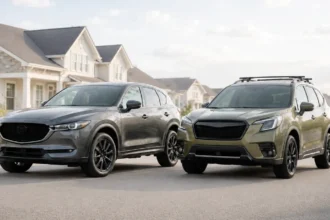


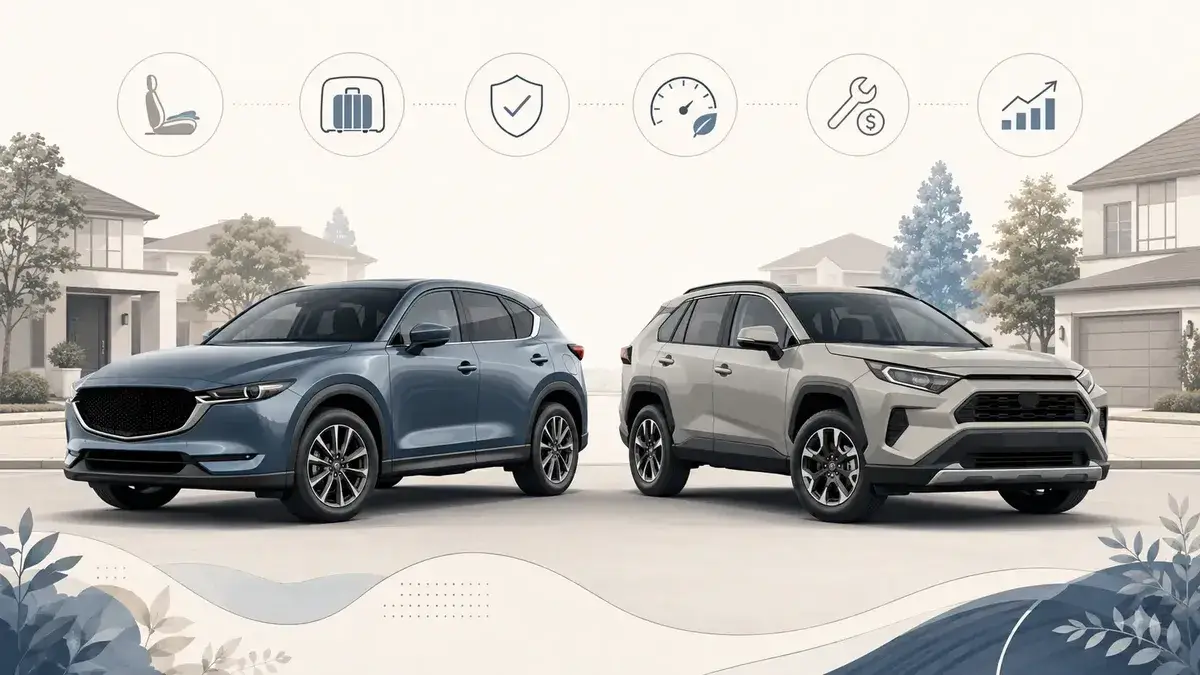
Mazda CX-5 vs Toyota RAV4 is not a simple “better SUV” question. The Toyota RAV4 is the safer default if you want cargo space, resale strength, broad used-market demand, and a lower-stress ownership path. The Mazda CX-5 is the better fit if you want a more refined cabin, better driving feel, and a used compact SUV that can feel more premium for the money.
For most practical used SUV buyers, start with the RAV4. For buyers who care more about comfort, cabin feel, and daily driving enjoyment, the CX-5 deserves a serious look.
CarMerit reliability comparator
Mazda CX-5 vs Toyota RAV4: 2012-2026 NHTSA snapshot
Owner-complaint and recall counts from NHTSA for 2012-2026, each model’s best used-year lane, and which buyer each one fits.
| 2,394 | complaints (2012-26) | 4,546 |
| 20 | recalls (2012-26) | 57 |
EngineElectricalUnknown / otherExterior lightingBrakes | top issues | ElectricalAirbags / seatbelts / structureUnknown / otherEngineFuel system |
Mazda CX-5
Best used year: 2017
Shortlist 2017-2020 and 2021-2025; inspect 2016 hardest.
Best for: Refinement-first buyers who want a nicer cabin, calmer daily feel, better driving feel, and stronger used-value appeal.
Toyota RAV4
Best used year: 2016
Shortlist 2016-2018 and 2020-2022; high caution 2001-2008.
Best for: Practical-first buyers who want more cargo, stronger resale, hybrid availability, and a lower-stress ownership path.
Quick take: Start with the RAV4 if you want the safer practical default: more cargo, stronger resale, a hybrid option, and lower-stress ownership. Choose the CX-5 when a more refined cabin, better driving feel, and a lower used buy-in matter more than maximum utility. The real decision is practicality versus refinement, not raw NHTSA counts.
Complaint counts are raw owner reports filed with NHTSA, not adjusted for sales volume, so they should guide inspection rather than crown a winner. The quick comparator above uses the same 2012-2026 overlapping NHTSA snapshot as the broader table below; RAV4 has older NHTSA history before 2012, but those RAV4-only years are excluded here to keep the comparison balanced. Always inspect the specific vehicle before buying.
The real decision is not Toyota versus Mazda. It is practicality versus refinement.
Mazda CX-5 vs Toyota RAV4: Quick Verdict for Used SUV Buyers
The right answer depends on what would frustrate you more after purchase.
Choose the Toyota RAV4 if limited cargo space, weaker resale value, or giving up a hybrid option would bother you. Choose the Mazda CX-5 if buying the more practical SUV would leave you wishing for a quieter, nicer-feeling cabin every day.
| Buyer question | Mazda CX-5 | Toyota RAV4 |
|---|---|---|
| Better for most practical used buyers? | Good, but not the default | Stronger default |
| Better cabin feel? | Stronger | More functional |
| Better cargo flexibility? | Adequate | Stronger |
| Better fuel-economy ceiling? | Good for a gas AWD SUV | Stronger, especially hybrid |
| Better resale confidence? | Good | Usually stronger |
| Better driving feel? | Stronger | More basic but easy to live with |
| Better family-first choice? | Good if space needs are moderate | Stronger |
| Biggest trade-off | Less cargo and resale pull | Less refined feel for the money |
The cleanest rule: buy the RAV4 if the SUV is mostly a tool. Buy the CX-5 if the SUV is something you want to enjoy every day.
The CX-5 is not the only alternative to a used RAV4. Buyers who want a lower buy-in price may also compare the RAV4 against the Nissan Rogue. Our Nissan Rogue vs Toyota RAV4 guide explains when the Rogue’s value case is strong enough.
How This Comparison Is Framed
A fair used-buyer comparison should not mix every RAV4 and CX-5 version into one answer.
Most used shoppers will compare gas RAV4 models against gas CX-5 models. That is the clean baseline. The RAV4 Hybrid is important, but it changes the fuel-economy and price equation enough that it should be treated as an edge case.
At the date checked, Toyota listed the RAV4 with up to an estimated 47 city / 40 highway mpg and up to 37.8 cubic feet of cargo capacity behind the rear seats. Mazda listed the CX-5 2.5 S models at an EPA-estimated 24 city / 30 highway / 26 combined mpg. Use those as late-model reference points, not as proof for every used year or trim.
Use this article as a buyer-fit filter first. Before buying, verify the exact year, trim, drivetrain, mileage, accident history, maintenance records, open recalls, and safety ratings.
When your CX-5 versus RAV4 decision narrows to two actual listings, make sure the vehicles match the descriptions you used to compare them. Run each VIN through the CarMerit VIN Lookup and compare the returned vehicle details with the seller’s listing and paperwork. Then judge the real price difference alongside condition, equipment, maintenance history, and inspection findings rather than giving either SUV a value advantage based only on the ad.
Reliability and Long-Term Ownership Risk
Reliability gives the RAV4 the easier argument, but the badge does not replace inspection.
Toyota has the stronger low-risk ownership reputation, and the RAV4’s resale demand reinforces that. If you want the less complicated answer, the RAV4 is easier to recommend.
The CX-5 should not be dismissed. iSeeCars gives the RAV4 an advantage in reliability, resale value, interior volume, and overall quality score, while the CX-5 has an advantage in new-vehicle base pricing and typical lower pricing for one- to five-year-old used examples. Use that as a directional signal, not proof that every RAV4 beats every CX-5.
A clean CX-5 with service records can be a better buy than a neglected RAV4. A clean RAV4 with the right history can be the safer long-term bet than a CX-5 bought mainly because it feels nicer.
Used-buying check: Run the VIN through NHTSA before purchase. NHTSA says a VIN or license-plate search can show whether a specific vehicle needs recall repair, while a year/make/model search can show broader recall, investigation, complaint, and manufacturer communication results.
Cost to Own, Maintenance, Fuel Economy, and Resale Value
The RAV4 usually wins the lower-stress ownership argument. The CX-5 can win the value argument.
That difference matters. The Toyota may cost more used because demand is strong, but that same demand can help resale later. The Mazda may cost less used, which can make it attractive if you plan to keep it and do not need the RAV4’s extra utility.
Pricing subject to change. Used values vary by mileage, trim, condition, history, location, dealer pricing, and date checked.
The fuel-economy gap depends heavily on which RAV4 you mean. A gas RAV4 is a fairer baseline against the CX-5. A RAV4 Hybrid can make Toyota much stronger for high-mileage drivers, but only if the higher used price still makes sense.
EPA Gas AWD Fuel Economy by Model Year
The EPA/FuelEconomy.gov official dataset shows that the gas-model comparison changes by model year and configuration.
| Mazda CX-5 Model Year | Configuration | City | Highway | Combined | Toyota RAV4 Model Year | Configuration | City | Highway | Combined |
|---|---|---|---|---|---|---|---|---|---|
| 2013 | Gas AWD automatic | 25 | 30 | 27 | 2013 | Gas AWD automatic range | 22 | 28–29 | 25 |
| 2014 | Gas AWD automatic range | 24–25 | 29–30 | 26–27 | 2014 | Gas AWD automatic range | 22 | 28 | 24–25 |
| 2015 | Gas AWD automatic range | 24–25 | 29–30 | 26–27 | 2015 | Gas AWD automatic range | 22 | 28 | 24–25 |
| 2016 | Gas AWD automatic | 24 | 29 | 26 | 2016 | Gas AWD automatic range | 22 | 28 | 24–25 |
| 2017 | Gas AWD automatic | 23 | 29 | 26 | 2017 | Gas AWD automatic range | 22 | 28 | 24–25 |
| 2018 | Gas AWD automatic | 24 | 30 | 26 | 2018 | Gas AWD automatic range | 22 | 28 | 24–25 |
| 2019 | Gas AWD automatic range | 22–24 | 27–30 | 24–26 | 2019 | Gas AWD automatic range | 25–27 | 33–34 | 28–30 |
| 2020 | Gas AWD automatic range | 22–24 | 27–30 | 24–26 | 2020 | Gas AWD automatic range | 25–27 | 32–34 | 27–30 |
| 2021 | Gas AWD automatic range | 22–24 | 27–30 | 24–26 | 2021 | Gas AWD automatic range | 25–27 | 32–34 | 28–30 |
| 2022 | Gas AWD automatic range | 22–24 | 27–30 | 24–26 | 2022 | Gas AWD automatic range | 25–27 | 32–34 | 28–30 |
| 2023 | Gas AWD automatic range | 22–24 | 27–30 | 24–26 | 2023 | Gas AWD automatic range | 25–27 | 32–34 | 28–30 |
| 2024 | Gas AWD automatic range | 22–26 | 27–31 | 24–28 | 2024 | Gas AWD automatic range | 25–27 | 32–34 | 28–30 |
| 2025 | Gas AWD automatic range | 22–26 | 27–30 | 24–28 | 2025 | Gas AWD automatic range | 25–27 | 33–34 | 28–30 |
| 2026 | Gas AWD automatic | 24 | 30 | 26 | 2026 | No gas-only configuration; hybrid/PHEV only | — | — | — |
Table Note: EPA estimates are configuration-specific and are not real-world guarantees. Ranges show the lowest-to-highest listed AWD automatic gasoline ratings for that model year; they are not averages. Mazda ranges can include turbo, non-turbo, and efficiency-package differences, while Toyota ranges can include trim-specific AWD variants. The 2026 RAV4 has no gasoline-only configuration in the official dataset.
Toyota RAV4 Hybrid EPA Fuel Economy by Model Year
| Model Year | Configuration | City | Highway | Combined |
|---|---|---|---|---|
| 2016 | Hybrid AWD | 34 | 30 | 32 |
| 2017 | Hybrid AWD | 34 | 30 | 32 |
| 2018 | Hybrid AWD | 34 | 30 | 32 |
| 2019 | Hybrid AWD | 41 | 38 | 40 |
| 2020 | Hybrid AWD | 41 | 38 | 40 |
| 2021 | Hybrid AWD | 41 | 38 | 40 |
| 2022 | Hybrid AWD | 41 | 38 | 40 |
| 2023 | Hybrid AWD, standard/Woodland range | 38–41 | 35–38 | 37–40 |
| 2024 | Hybrid AWD, standard/Woodland range | 38–41 | 35–38 | 37–39 |
| 2025 | Hybrid AWD, standard/Woodland range | 38–41 | 35–38 | 37–39 |
| 2026 | Hybrid FWD/AWD, trim/Woodland range | 41–47 | 35–40 | 38–43 |
Table Note: Ranges appear only where EPA lists more than one hybrid configuration. RAV4 Prime/PHEV figures are excluded because charge-depleting MPGe, charge-sustaining MPG, and charging data must remain separate.
| Ownership factor | Mazda CX-5 | Toyota RAV4 |
|---|---|---|
| Purchase price pressure | Often more attractive used | Often stronger demand, may cost more |
| Maintenance expectation | Manageable if maintained well | Stronger low-risk reputation |
| Fuel economy | Good for gas AWD models | Stronger, especially hybrid |
| Resale value | Good, but usually weaker than RAV4 | Stronger argument |
| Repair-risk filter | Records and condition matter | Records and condition still matter |
| Best ownership case | Buy clean, pay less, enjoy comfort | Buy clean, keep resale confidence |
If you drive few miles per year, the RAV4 Hybrid premium may not pay back quickly. If you commute heavily, fuel economy can become a bigger factor than cabin feel.
Maintenance Records That Matter Most
Do not compare maintenance by badge alone. The factory schedules use different interval logic, and powertrain or use conditions can change what should appear in the records.
| Vehicle and scope | Item | Factory schedule | What to verify |
|---|---|---|---|
| Mazda CX-5 2019–25 | Oil and filter | Replace when the wrench indicator is on; maximum 7,500 miles or 12 months | No interval was exceeded and the maintenance monitor was reset |
| Mazda CX-5 2019–25 | Spark plugs | 2.5T: every 40,000 miles; non-turbo: every 75,000 miles | The records match the vehicle’s engine |
| Mazda CX-5 AWD 2019–25 | Rear differential oil | 30,000 miles only under the stated special-use conditions | Determine whether the vehicle experienced towing, dusty or wet-road use, extended idling, or repeated short trips; do not apply this as a universal normal-use interval |
| Toyota RAV4 gas/hybrid 2023–24 | Tire rotation | Every 5,000 miles or six months | Evidence of regular service at the factory checkpoints |
| Toyota RAV4 gas 2023–24 and RAV4 Hybrid 2023–24 | Oil and filter | Every 10,000 miles or 12 months in normal service; every 5,000 miles or six months under listed special conditions or when specified oil was not used | Records for the exact model year, powertrain, oil, and operating conditions |
| Toyota RAV4 Hybrid 2023–24 | High-voltage battery cooling intake/filter | Inspect every 5,000 miles or six months; clean every 20,000 miles or 24 months | The intake and filter are clean and unobstructed |
| Toyota RAV4 gas 4WD 2023–24 | Transfer-case and rear-differential oil | Transfer case: 30,000 miles or 36 months; rear differential: 30,000 miles or 36 months when towing, using a car-top carrier, or carrying heavy loads | The drivetrain configuration, use conditions, and corresponding service records |
Table Note: Toyota intervals shown here are verified for the 2023–24 factory guides and should not be back-applied to older or newer RAV4s. Mazda’s oil and spark-plug rows apply to 2019–25; the 2026 CX-5 uses a revised framework. A maintenance schedule is not proof of reliability.
Factory Coverage Programs to Check by VIN
Some used examples may have later factory coverage that is more useful than the original warranty term. Check these programs before paying for a repair or rejecting a vehicle.
If a CX-5 or RAV4 has one of these documented repair histories, check its model year in CarMerit’s Manufacturer Special Coverage Lookup before letting that history swing the comparison; use the result to identify the program worth verifying, not as proof that the exact VIN is covered.
| Vehicle | Model years and exact scope | Program and condition | Stated coverage boundary |
|---|---|---|---|
| Mazda CX-5 | 2019–20 vehicles with the specified PYT SKYACTIV engine | CSP11: qualifying cylinder-head coolant leak | 10 years or 120,000 miles from the in-service date; eligibility and diagnosis control |
| Mazda CX-5 | 2017–19 vehicles within the specified VIN population | CSP12: Denso low-pressure fuel pump | Recall-repaired vehicles: 15 years after the recall repair or 150,000 total miles; additional eligible vehicles: 15 years or 150,000 miles from the in-service date |
| Mazda CX-5 | 2016–20 vehicles within the specified VIN/CMU population | CSP13: qualifying connectivity master unit condition | 24 months with no mileage limit from the later of the new-vehicle limited-warranty expiration or February 17, 2025 |
| Mazda CX-5 | 2018–25 vehicles within the specified VIN and production-date population | SSPD8: qualifying fail-safe thermostat/coolant-control repair | 15 years or 150,000 miles from the warranty start date |
| Toyota RAV4 | Certain 2013–17 vehicles with paint codes 070 or 040 | ZKG: qualifying factory-white paint peeling | 10 years from first use with unlimited mileage; the primary phase ended in 2022, but secondary coverage may still depend on the first-use date |
| Toyota RAV4 | Certain 2019–20 Adventure and Limited AWD vehicles | 20TE03: qualifying transfer-case electromagnetic-clutch condition | 10 years or 125,000 miles from first use |
| Toyota RAV4 Hybrid | Certain 2019–21 vehicles | 20TE04: qualifying refueling-performance condition | Eight years or 100,000 miles from first use |
| Toyota RAV4/RAV4 Hybrid | Certain settlement-class 2019–20 vehicles | 23TE05: qualifying low-pressure fuel-pump condition | 15 years from first use with unlimited mileage |
| Toyota RAV4 | Certain 2019–21 gas, 2020–21 Hybrid, and 2021 Prime vehicles | 22TE05: qualifying roof-rail water leak | 10 years from first use with unlimited mileage |
| Toyota RAV4 | Certain 2019–22 gas, 2020–22 Hybrid, and 2021 Prime vehicles | 23TE01: qualifying high-pressure fuel-pump odor or seepage | 10 years from first use with unlimited mileage |
| Toyota RAV4 Hybrid/Prime | Certain 2019–24 RAV4 Hybrid AWD and 2021–24 RAV4 Prime vehicles | 22TE09: qualifying high-voltage cable corrosion | 10 years with unlimited mileage if Limited Service Campaign 25TD01 is completed by September 30, 2028; otherwise coverage reverts to eight years or 100,000 miles when the campaign expires |
| Toyota RAV4 | Certain 2019–21 gas, 2020–21 Hybrid, and 2021 Prime vehicles | 24TE04: qualifying flow-shutoff-valve coolant leak | Primary phase expired November 30, 2025; secondary coverage is 10 years or 100,000 miles from first use |
Table Note: These are factory coverage programs, not proof that a failure is common and not proof that a specific vehicle still has coverage. Exact VIN, production date, powertrain or trim, in-service date, mileage, diagnosis, campaign completion, and current program status control.
Before purchase:
- Ask a Mazda or Toyota dealer to run the VIN through the manufacturer’s eligibility system.
- Confirm the program number, current status, mileage or time limit, and required diagnosis in writing.
- Ask whether the covered repair was already completed and request the invoice.
- Do not treat program existence as a reliability score or failure-rate estimate.
Practicality, Cargo Space, Passenger Comfort, and Daily Usability
Cargo space is one of the RAV4’s clearest advantages.
Do not rely on one 2025 maximum-cargo figure when shopping older vehicles. Compare the exact model years, then test the cargo opening, floor length, seat-folded shape, and the stroller, pet crate, luggage, or storage bins you actually carry. The EPA tables in the ownership section handle fuel economy separately by year and configuration.
Do not stop at the numbers. The question is whether the extra RAV4 space solves a real problem for you.
If you carry a stroller, sports gear, luggage, pets, or home-store items, the RAV4’s boxier space matters. If most of your driving is commuting, errands, school runs, and weekend trips for two to four people, the CX-5 may be practical enough.
| Use case | Mazda CX-5 | Toyota RAV4 | Better fit |
|---|---|---|---|
| Small family with frequent cargo | Usable | Easier | Toyota RAV4 |
| Daily commuter | More refined feel | Better fuel-economy options | Depends on priority |
| Road trips with luggage | Comfortable but tighter | More cargo flexibility | Toyota RAV4 |
| City parking | Easy enough | Easy enough | Tie |
| Comfort-focused buyer | Stronger | More basic | Mazda CX-5 |
| Utility-focused buyer | Good | Stronger | Toyota RAV4 |
| Low-risk long-term buyer | Good with clean history | Stronger default | Toyota RAV4 |
Bring your real cargo when you inspect the car. If the CX-5 fits your stroller, luggage, pet crate, or storage bins without compromise, the RAV4’s extra space may not justify a higher price.
Driving Feel, Ride Comfort, and Cabin Quality
The CX-5 wins if the SUV needs to feel good every day.
Its appeal is not only the spec sheet. The CX-5 feels more polished inside, and its steering and cabin design make it feel less like a basic utility vehicle. That is the main reason many buyers prefer it after driving both.
The RAV4 feels more practical. That is not a weakness if you want a durable, easy-to-live-with compact SUV. But if you care about cabin materials, seating feel, and the way the SUV behaves in daily driving, the CX-5 has the stronger emotional case.
If you also want to compare Korean compact SUVs, read Kia Sportage vs Hyundai Tucson. It is the better next step when warranty status, features, used price, and condition matter more than driving feel.
Use that comparison if the CX-5 feels too small, the RAV4 feels too expensive, or a clean Tucson or Sportage appears locally at a stronger price.
The mistake is overbuying the feeling. A nicer cabin does not fix poor maintenance, worn tires, accident repairs, or missing safety equipment.
Trim and Model-Year Logic for Used Buyers
The best used CX-5 or RAV4 is rarely just the newest one you can afford.
A better rule is to buy the cleanest example with the right safety equipment, reasonable mileage, documented maintenance, and a trim that gives you features you will actually use.
For the CX-5, value often comes from trims that preserve its cabin and comfort advantage without pushing the price too close to a stronger RAV4 or RAV4 Hybrid. For the RAV4, value often comes from trims that keep the Toyota ownership case intact without forcing you to pay for features that do not change daily life.
A trim badge should not distract you. A lower trim with clean history can beat a higher trim with accident damage or weak maintenance records.
| Used-buying filter | Mazda CX-5 | Toyota RAV4 |
|---|---|---|
| Best-value idea | Pay for comfort and safety features you will notice | Pay for practicality, safety, and drivetrain fit |
| Feature to verify | AWD, safety tech, seat comfort, infotainment | Hybrid system if applicable, AWD, safety tech, cargo features |
| Trim trap | Paying near-RAV4 money without enough advantage | Paying a big premium for features you do not need |
| Year caution | Verify safety-feature availability and service history | Verify drivetrain, recalls, and accident history |
| Best inspection focus | Tires, brakes, suspension feel, infotainment, records | Hybrid health if applicable, records, tires, brakes, recalls |
Shortlist by year, mileage, trim, and budget. Reject anything with unclear history before you start negotiating.
Safety, Driver Assistance, and Family Confidence
Safety is not just a rating. It is year, trim, headlights, driver-assistance equipment, tires, and whether recall work is complete.
Both SUVs can be strong family choices, but do not assume every used example has the same safety setup. Safety-feature availability can vary by year and trim.
IIHS results change materially by model year, build date, and test. The table below keeps small-overlap and updated-test results separate.
| Vehicle | IIHS applicability | Driver-side small overlap | Passenger-side small overlap | Updated moderate overlap | Updated side |
|---|---|---|---|---|---|
| Mazda CX-5 | 2013–14, built before November 2013 | M | — | — | — |
| Mazda CX-5 | 2014–16, built after October 2013 | G | — | — | — |
| Mazda CX-5 | 2017–20 | G | G | — | G |
| Mazda CX-5 | 2021–22 | G | G | P | G |
| Mazda CX-5 | 2023–25 | G | G | G | G |
| Mazda CX-5 | 2026 | G | G | G | G |
| Toyota RAV4 | 2013–14; driver rating applies to vehicles built after April 2013 | P | P | — | — |
| Toyota RAV4 | 2015–18; driver rating applies to vehicles built after November 2014 | G | P | — | — |
| Toyota RAV4 | 2019–20 | G | G | — | A |
| Toyota RAV4 | 2021–25 | G | G | M | A |
| Toyota RAV4 | 2026 — no official IIHS vehicle page found at verification | — | — | — | — |
Table Note: G = Good, A = Acceptable, M = Marginal, and P = Poor. Ratings apply only to the listed years, build dates, and test types. Updated tests are not interchangeable with earlier tests, and a dash does not mean a poor rating.
NHTSA also provides a vehicle comparison tool for 5-Star Safety Ratings and recall information. That is useful before treating any used SUV as family-ready.
Where the Toyota RAV4 Wins
The RAV4 wins when the decision is mostly practical.
It is the better fit if you want more cargo room, stronger resale confidence, broader used-market demand, and a hybrid option. It is also easier to recommend to a buyer who wants fewer ownership regrets and does not care as much about premium cabin feel.
The RAV4 case gets weaker when the used price premium is too high, the vehicle history is poor, or you do not need the extra cargo space. A rough RAV4 is not better than a clean CX-5 just because it is a Toyota.
Buy the RAV4 if these are true:
- You carry people and cargo often.
- You care about resale value.
- You want a hybrid or plug-in hybrid option.
- You prefer a simple, practical ownership path.
- You want the safer default for a family used compact SUV.
Question the RAV4 if you are paying a large premium for an average example and the CX-5 gives you better condition, better history, and a cabin you prefer.
Where the Mazda CX-5 Wins
The CX-5 wins when comfort and feel matter more than maximum utility.
It is the better fit if you want a used compact SUV that feels more refined inside, drives with more confidence, and gives you a stronger comfort-per-dollar case. It can be especially compelling when comparable RAV4 listings cost noticeably more.
The CX-5 case gets weaker when you need maximum cargo room, expect hybrid-level fuel economy, or plan to resell quickly. It also gets weaker if the used example lacks maintenance records or has been poorly cared for.
Buy the CX-5 if these are true:
- You want a nicer-feeling cabin.
- You care about steering feel and daily comfort.
- You do not need the largest cargo area.
- You found a clean example at a better used price.
- You plan to keep the SUV long enough to benefit from the lower entry cost.
Question the CX-5 if you are already worried about cargo space, resale value, or fuel economy before the test drive.
For a clearer segment-level view, see our best used compact SUVs comparison covering the CR-V, RAV4, and CX-5.
Final Recommendation: Which One Should You Buy?
For most used compact SUV buyers, the Toyota RAV4 is the better default. It is more practical, easier to justify for families, stronger on resale confidence, and more flexible if you include hybrid versions.
The Mazda CX-5 is the better choice for buyers who care more about cabin quality, daily driving feel, and getting a more refined SUV for the money. It is not the better utility tool, but it can be the more satisfying vehicle.
Buy the RAV4 if you want the safer practical bet. Buy the CX-5 if it fits your space needs and you value comfort enough to accept the resale and cargo trade-offs.
If the RAV4 is still on your shortlist, also check Forester vs RAV4. It helps separate the RAV4’s resale and hybrid strengths from the Forester’s AWD, visibility, and winter-driving advantages.
If the RAV4 still feels like the safer but pricier choice, compare it against one more value-focused option. Our Hyundai Tucson vs Toyota RAV4 guide shows when the Tucson can make more sense than paying extra for Toyota confidence.
Before choosing either one, run this final filter:
- Does the SUV have clean maintenance records?
- Does the VIN show any open recalls?
- Does the trim include the safety features you expect?
- Does the cargo area fit your real gear?
- Does the price make sense against similar local listings?
- Does the test drive reveal tire, brake, suspension, or infotainment issues?
- Would you still choose it if resale value were not part of the argument?
If the answer is still close, choose the RAV4 for lower-risk practicality. Choose the CX-5 for comfort and value.
If the CX-5 still feels right but you want a more open, utility-focused alternative, the Subaru Forester belongs on the same shortlist. Compare Mazda CX-5 vs Subaru Forester if comfort, cargo space, visibility, and bad-weather confidence are all part of your decision.
Under $20,000, the CX-5 can be the better value SUV, while the RAV4 is the lower-drama default when the listing is clean. For a wider budget shortlist, see our best used cars under $20,000 guide.
The CX-5 vs RAV4 decision often comes down to value, refinement, reliability confidence, and price. For a broader low-risk shortlist beyond these two SUVs, see our Most Reliable Used Cars guide.
The CX-5 and RAV4 solve different family needs, but they are not the only practical options. Use our best used family cars guide to compare them with the CR-V, Camry, Accord, Corolla Cross, and HR-V before buying.
Frequently Asked Questions
Is the Mazda CX-5 more reliable than the Toyota RAV4?
Not as a blanket rule. The RAV4 has the easier long-term ownership reputation, and iSeeCars gives it a slight reliability advantage in its comparison. But a clean, well-maintained CX-5 can be a better used buy than a neglected RAV4.
Is the Toyota RAV4 cheaper to own than the Mazda CX-5?
It depends on purchase price, mileage, fuel economy, maintenance history, and resale value. The RAV4 may hold value better, but it can also cost more used. The CX-5 can make more sense if the price gap is large and the vehicle history is strong.
Which cargo area works better in a used CX-5 or RAV4?
Do not apply one 2025 maximum-cargo figure to every used CX-5 and RAV4. Compare the exact model years, then load the stroller, pet crate, luggage, or storage bins you actually use. The better cargo choice is the one that fits that load without blocking rear visibility or forcing the rear seats forward.
Which is better for families, Mazda CX-5 or Toyota RAV4?
The RAV4 is usually better for families because of cargo flexibility, resale confidence, and hybrid availability. The CX-5 can still work for smaller families that value cabin feel and do not need maximum cargo room.
Is the RAV4 Hybrid a fair comparison against the Mazda CX-5?
Only if you separate it clearly. A RAV4 Hybrid can be much stronger on fuel economy, but it may cost more used. Compare gas RAV4 to CX-5 as the baseline, then treat the RAV4 Hybrid as a separate fuel-economy and budget decision.
Which used trims are better value?
For the CX-5, look for the trim that gives you the comfort and safety features you care about without pushing the price too close to a stronger RAV4. For the RAV4, look for the trim that preserves the practical Toyota case without overpaying for features you will not use.
Should I buy a used CX-5 or pay more for a used RAV4?
Pay more for the RAV4 if you need cargo room, resale confidence, hybrid fuel economy, or the lower-risk practical choice. Buy the CX-5 if it is cleaner, better priced, comfortable enough for your passengers, and you value the nicer cabin more than the RAV4’s extra utility.