

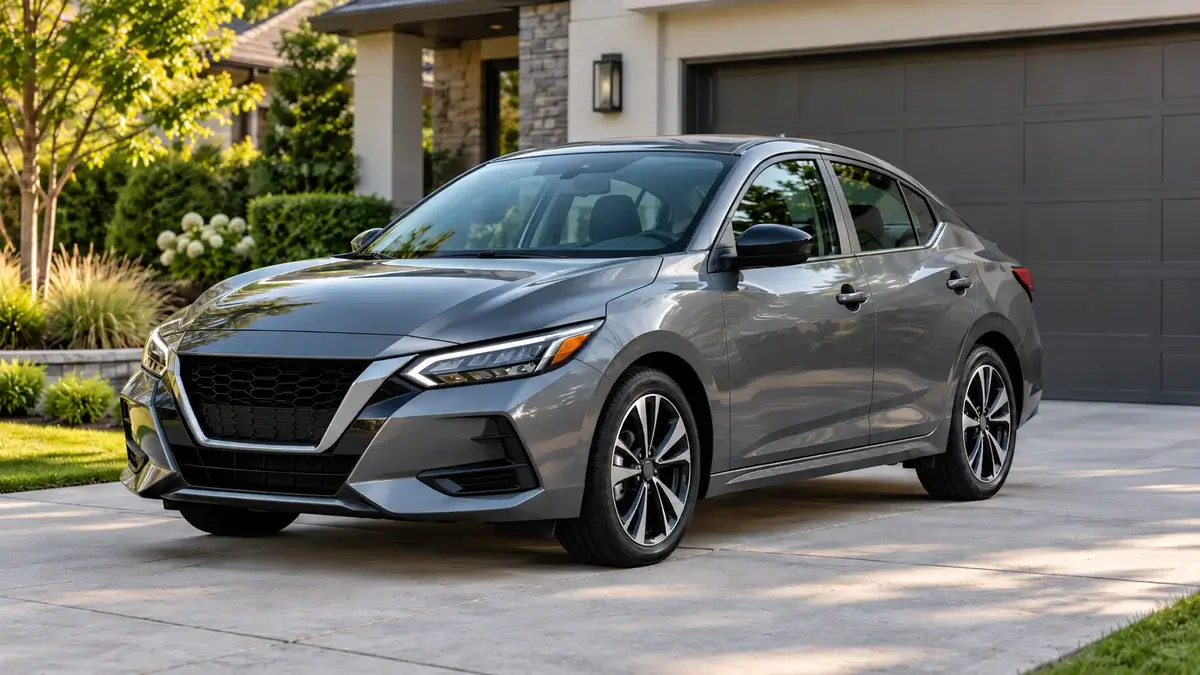
A used Nissan Sentra can be a reasonable compact-sedan purchase, but not on the strength of its nameplate reputation alone. The biggest decision is whether the particular car—especially one equipped with a continuously variable transmission (CVT)—has a credible service history, drives properly, passes an independent inspection, and is priced to reflect its condition. Nissan’s documented CVT warranty extensions justify extra scrutiny of certain older vehicles; they do not establish that every CVT fails.
A clean newer Sentra is worth evaluating, while an older example with unexplained transmission symptoms or missing maintenance evidence is a much weaker proposition. The year matters, but the actual vehicle still decides the purchase.
Is a Used Nissan Sentra Reliable Enough to Buy?
Yes, conditionally. A Sentra with consistent records, no unresolved powertrain symptoms, no outstanding safety recall work, and a clean independent inspection can remain on your shortlist. A low asking price cannot compensate automatically for a questionable transmission or a seller who will not permit proper inspection.
The Sentra’s reliability question is often reduced to a single rating. A third-party reliability rating may summarize surveyed experiences or repair observations, but it cannot tell you whether a particular used car has the correct CVT service history, an active warranty, or a developing fault. The useful question is not simply “Are Nissan Sentras reliable?” It is “What would make this specific Sentra a defensible purchase?”
For the U.S. used market, the most relevant comparison is between the 2013–2019 generation and the redesigned 2020–2025 cars. The redesigned 2026 Sentra is a separate, newer design with too little ownership exposure to support a long-term durability conclusion.
CVT and Other Common Problems: What Changes the Risk?
Transmission behavior is the highest-value mechanical check on a CVT-equipped used Sentra. Nissan’s manufacturer-issued coverage extensions for select older Sentras make CVT history a legitimate buying concern. They are not proof of an individual vehicle’s condition or of a model-year failure rate.
What to investigate on the test drive
Pay attention to persistent shuddering, unusual vibration, delayed engagement into Drive or Reverse, inconsistent acceleration, abnormal noise, warning lights, or a noticeable loss of drive. A CVT does not need to shift like a conventional stepped automatic; unusual behavior needs professional diagnosis rather than a buyer’s guess about the cause.
Test the car both cold and after it reaches operating temperature, in normal stop-and-go driving and at appropriate road speeds. If the seller reports a prior transmission repair or replacement, ask for the dated invoice, mileage, component description, and any accompanying warranty terms. A repair record is useful evidence, not an automatic guarantee that the problem is permanently solved.
What the NHTSA record does—and does not—show
NHTSA records contain owner complaints about powertrain, electrical, airbag, engine, braking and other concerns across different Sentra model years. A complaint is an allegation or report, not a confirmed defect diagnosis. Campaigns and investigations have different definitions, and some recalls cover multiple model years.
The table below uses a historical compilation of U.S. NHTSA bulk-file records prepared by July 2, 2026; generation boundaries were reviewed July 4, 2026. Because the original NHTSA file-download date is not documented, these are not current October 2026 counts or estimates of failure probability. Use them to decide which reports to investigate—not to rank the years by reliability. For newer information and the actual vehicle’s status, check NHTSA’s recall lookup and vehicle records.
| Model year | Owner complaints | Recall campaign records |
|---|---|---|
| 2013 | 638 | 6 |
| 2014 | 379 | 5 |
| 2015 | 346 | 3 |
| 2016 | 266 | 6 |
| 2017 | 228 | 3 |
| 2018 | 183 | 2 |
| 2019 | 219 | 2 |
| 2020 | 200 | 4 |
| 2021 | 127 | 3 |
| 2022 | 80 | 2 |
| 2023 | 18 | 1 |
| 2024 | 30 | 3 |
| 2025 | 25 | 3 |
| 2026 — separate redesign | 8 | 1 |
Table Note: Historical U.S. NHTSA complaint and recall-campaign entries in the July 2026 compilation; original flat-file extraction date unrecorded. The table is not a live NHTSA tally, a count of unrepaired VIN recalls, an exposure-adjusted defect rate, or a year-by-year reliability score. One campaign can apply to multiple model years, so the recall column cannot be summed to obtain unique campaigns. Older cars have had longer to accumulate reports, and the 2026 redesign has limited ownership exposure.
In these records, the 2013–2019 group accounts for 2,259 reported complaints; 2020–2025 accounts for 480. That difference does not establish that the newer vehicles are proportionally safer from mechanical failure: vehicle population, driving exposure, reporting behavior and time in service are not controlled. The appropriate action is to investigate relevant complaint descriptions for the exact model year, then have the actual car inspected.
Which complaint categories deserve closer attention?
The same historical NHTSA records allow a more specific look at reported concerns. The following categories use one primary component category per complaint so the category totals do not count the same report repeatedly. They describe what owners reported—not verified causes or failure rates.
| Used Sentra group | Leading complaint categories in this extraction | What the buyer should check |
|---|---|---|
| 2013–2019 (B17): 2,259 complaints | Powertrain/transmission 805; airbags/restraints/body safety 304; engine 233; brakes 225 | CVT behavior and service invoices; airbag or restraint warnings; braking response and engine faults |
| 2020–2025 (B18): 480 complaints | Steering 114; electrical 95; driver assistance 61; brakes 50 | Steering feel and warning lights; electrical faults; equipped driver-assistance functions; braking condition |
Category Note: Counts are historical owner-report classifications, not confirmed component failures. A powertrain-category complaint does not automatically establish a CVT defect; a steering or driver-assistance report does not prove a widespread fault. The 2026 redesign is not combined with B18 because its eight recorded complaints provide too little history for a meaningful category comparison.
Investigations are separate from complaints and recalls. For 2013–2014, the historical NHTSA record identifies three distinct investigation actions: two involving the occupant-classification/airbag system (EA15004 and RQ15001) and one involving brake-pedal travel (PE14014). These actions are associated with both model years, so year-level investigation entries must not be mistaken for six separate investigations. No investigation entries are shown for 2020–2025 in this historical extract. Neither observation establishes the present status of every possible investigation or the condition of a particular car.
Manufacturer communications are different again. NHTSA also holds manufacturer service bulletins and other technical communications. Such documents can help a mechanic investigate a matching symptom, but they are not automatically recalls or proof of a defect on the vehicle being sold. Check the applicable bulletin and VIN details rather than treating a communication listing as a repair diagnosis. The exact car’s current safety-recall status must still be checked separately.
How Reliability Context Changes Across Generations
The generation tells you which issues and records to investigate; it does not replace the inspection. Older and newer Sentras have different designs, different time in service, and different manufacturer coverage histories.
| Used Sentra group | Relevant ownership context | Practical buying implication |
|---|---|---|
| 2013–2019 (B17) | Documented CVT extension programs cover eligible 2013–2017 and 2018–2019 vehicles; manual-transmission variants existed in some years and trims | Identify the exact transmission, obtain service and repair invoices, and verify VIN-level program history before deciding |
| 2020–2025 (B18) | Redesigned for 2020; fewer accumulated years of NHTSA reporting, but continued use of CVT configurations | Do not assume the redesign eliminated transmission risk; verify the actual car’s condition and applicable maintenance schedule |
| 2026 redesign | Separately redesigned model with favorable published IIHS safety evidence but limited long-term ownership history | Treat crash-test findings as safety information, not a forecast of reliability or lifespan |
A clean, well-documented 2018 or 2019 car can be a more credible candidate than a neglected newer one, even though the older car deserves closer CVT scrutiny. Conversely, a lower-mileage 2022 or 2024 vehicle should not receive a free pass solely because its model-year complaint count is smaller.
If your primary goal is a detailed model-year buy/avoid shortlist, CarMerit’s existing Nissan Sentra Years to Avoid guide addresses that separate decision; this ownership guide focuses on evaluating the individual car.
What Nissan Maintenance and CVT Warranty Records Can Tell You
Maintenance records are valuable only when they match the car’s model year, transmission and operating conditions. An invoice saying “transmission checked” is not the same as one documenting the correct fluid replacement, and a manufacturer’s extension is not proof that the car remains covered.
| Vehicle / record | Documented official instruction or program | What the buyer needs to verify |
|---|---|---|
| 2018–2019 Sentra with CVT, standard driving conditions | CVT-fluid inspection every 10,000 miles or 12 months in Nissan’s published model-year schedule | Evidence of appropriate inspections, condition findings and any service the manufacturer/dealer recommended |
| 2018–2019 Sentra with CVT, severe driving conditions | CVT-fluid replacement every 60,000 miles in the applicable schedule, alongside inspection requirements | Whether the vehicle’s actual use meets severe conditions and whether replacement is documented |
| Eligible 2013–2017 Sentra CVT | Nissan’s 2020 extension set a total CVT term of 84 months / 84,000 miles, whichever came first | VIN eligibility, original in-service date, mileage, exclusions and whether any time remains |
| Eligible 2018–2019 Sentra CVT | Nissan’s 2023 extension set a total CVT term of 84 months / 84,000 miles, whichever came first | Written dealer confirmation of VIN eligibility, remaining coverage and previous CVT work |
| 2020–2025 Sentra | Its own model-year maintenance schedule governs; do not transplant the 2018–2019 instructions | Match oil, CVT, coolant and other service invoices to that vehicle’s actual requirements |
Table Note: The 2018 and 2019 fluid entries are specific examples, not a universal Sentra fluid-change rule. Follow the exact Nissan owner/maintenance documentation for the vehicle, its configuration and use. Calendar time and mileage can independently affect coverage; the year alone never establishes active warranty protection.
Nissan’s published 2018 and 2019 Sentra CVT maintenance instructions distinguish inspection from replacement. Before paying for a used Sentra, compare the seller’s service invoices with the exact model-year schedule and ask a Nissan service department to clarify any gaps. An undocumented interval is a reason to investigate, not independent proof of a failed transmission.
Extended CVT coverage is not the same as a recall
Nissan documented the 2013–2017 Sentra CVT extension and the later 2018–2019 Sentra CVT extension in manufacturer-issued notices. The 84-month/84,000-mile term is the total extended period, not extra coverage added on top of the original warranty. Nissan directs dealers to check the individual VIN, including applicable settlement-related exclusions.
For many older cars, the elapsed time may already have exhausted those terms, regardless of how low the odometer reads. Obtain confirmation before treating coverage as part of a deal’s value. An independent inspection is still needed even when a program once covered that year.
One narrower program is worth checking on certain 2013–2016 vehicles: Nissan’s rear oxygen sensor bulletin describes up to 20 years / 200,000 miles for a defined rear oxygen sensor short-to-ground condition on eligible 50-state-emission Sentras. It is not universal oxygen-sensor coverage, does not apply to every fault, and requires dealer confirmation of the car and condition. It should not dominate the purchase decision unless the vehicle is eligible and the issue is relevant.
Recalls and Crash-Test Results: What Still Needs Checking?
A good crash-test result does not confirm recall completion, and a recall record does not measure transmission reliability. Check both, separately, for the exact used car.
Enter the 17-character VIN into NHTSA’s official recall lookup and request documentation of any completed recall remedies. If an open safety recall appears, arrange the remedy with an authorized dealer before treating the car as cleared. The model-year recall column above cannot tell you whether that VIN still needs work.
IIHS tests answer another question: how a tested vehicle or applicable vehicle group performed under a particular crash-test protocol. Some awards depend on headlights, optional collision-avoidance equipment or production dates.
| IIHS example | Published evidence | How to interpret it |
|---|---|---|
| 2018 Sentra | 2018 Top Safety Pick, contingent on optional front crash prevention and specific headlights | Do not assume every 2018 or 2019 configuration qualifies; the 2018-criteria award is not a separate 2019 award |
| 2020 Sentra | 2020 Top Safety Pick, restricted to specific headlights and vehicles built after September 2020 | Confirm equipment and build-date restrictions before applying the award to a particular car |
| 2024 Sentra | IIHS 2024 ratings include Good small-overlap and original moderate-overlap, Acceptable updated-side, Poor headlights, and Marginal pedestrian front crash prevention | Assess the complete test profile; favorable crashworthiness grades do not erase weaker crash-avoidance or headlight results |
| 2026 Sentra | 2026 Top Safety Pick+ under updated criteria | Stronger contemporary crash-test evidence does not establish long-term powertrain reliability |
Tests and award requirements change over time. A rating from an older test family should not be ranked against a later, more demanding test as though the standards were identical. For an actual purchase, inspect the car’s accident-repair history, restraint-system warnings and safety equipment as well as the published test results.
Fuel Economy and Ownership Expense: What Can You Actually Estimate?
EPA fuel economy is a verifiable running-cost input; unexpected repair expense is not predictable from MPG. The Sentra can be economical on fuel in the configurations below, but those figures do not offset an unresolved mechanical concern.
| U.S. model-year configuration | City | Highway | Combined |
|---|---|---|---|
| 2018 Sentra, 1.8L, CVT | 29 | 37 | 32 |
| 2020 Sentra, 2.0L, CVT | 29 | 39 | 33 |
| 2024 Sentra, 2.0L, CVT | 30 | 40 | 34 |
Table Note: EPA city/highway/combined estimates in miles per gallon (MPG) for the named U.S. gasoline configurations, from current FuelEconomy.gov records. Other engines, transmissions and configurations can differ. These are laboratory-based estimates, not guarantees of real-world fuel economy or mechanical durability.
For Nissan Sentra maintenance cost, separate scheduled service from unexpected repairs. The correct schedule identifies when routine oil, filters, CVT checks and other items require attention. Invoices show what has actually been performed. An older car with overdue maintenance may need immediate work even when its purchase price appears attractive.
A credible model-wide annual repair bill or CVT replacement price cannot be established from the verified evidence used here. Obtain a written, vehicle-specific estimate from an independent shop for any diagnosed problem. Do not treat an uncited online replacement-cost figure as the expected cost for every Sentra.
Is the Asking Price Justified by This Particular Car?
Price only becomes a good deal when it compensates for the condition and risk you are actually buying. Dealer listings are asking prices, not proof of final transaction prices. A cheap example with doubtful CVT history can be worse value than a more expensive one with documented service and a clean inspection.
Compare several local listings for the same model year, transmission, trim, mileage band and seller type. Then account for accident history, tire/brake condition, overdue services, and any diagnosed issue. Do not use a price average for nearly new Sentras to value a much older car.
If you’re choosing between a Sentra and a Civic, our Nissan Sentra vs. Honda Civic comparison explains when a lower-priced Sentra makes sense and when the Civic’s condition, equipment, and inspection results justify paying more.
| What you find | How it should affect the deal |
|---|---|
| Similar asking price, complete records, clean inspection | Reasonable basis to keep negotiating, subject to local comparables |
| Lower price, missing service invoices | Investigate the gap and obtain an inspection before assigning value to the discount |
| Seller claims the transmission was replaced | Require invoice, mileage, reason, part description and any remaining repair warranty |
| Active warning, abnormal CVT behavior or refusal of inspection | Do not offset an unknown mechanical risk with an unverified discount; be prepared to walk away |
Prices vary by model year, mileage, trim, condition and location. Verify local listings before buying. No national used-Sentra transaction average or precise depreciation estimate is established here. The right comparison is a real, current local alternative—not a fabricated market midpoint.
Pre-Purchase Checks and the Final Buy-or-Skip Decision
Buy the inspected car, not the reputation. Before committing, make the seller’s claims testable and decide what evidence would change your answer.
| Buying check | Proof or action | Decision if unresolved |
|---|---|---|
| CVT operation | Cold/warm test drive; independent mechanic’s diagnosis if any unusual behavior appears | Walk away from significant unexplained symptoms or refused diagnosis |
| Service history | Dated receipts matched to model-year and usage-specific Nissan requirements | Investigate or negotiate documented overdue work; do not assume service happened |
| Previous transmission repairs | Invoice, odometer reading, exact repair and written repair-warranty terms | Investigate vague statements or incomplete records |
| Recalls and other Nissan programs | NHTSA VIN search; Nissan dealer confirmation for special coverage and remaining term | Resolve safety recall work and verify coverage before relying on it |
| Accident and general condition | Independent inspection of structure, brakes, tires, warning systems and drivability | Reject material unaddressed damage or inspection refusal |
| Asking price | Same-year, trim, transmission and mileage local comparisons plus repair estimates | Negotiate or compare another car when the risk is not reflected in the price |
A sensible buyer sequence is to obtain the VIN, inspect the available maintenance records, check recall status, confirm manufacturer-program applicability when relevant, complete an independent pre-purchase inspection, and only then judge the asking price. Do not accept a seller’s blanket “the transmission is fine” statement in place of evidence.
Final Judgment: A documented, mechanically sound used Sentra at a defensible local price deserves consideration. A CVT-equipped example with unexplained symptoms, unsupported repair claims, or denied inspection access does not. If you are deciding which Sentra model year to target, use CarMerit’s Nissan Sentra Years to Avoid guide. If you are deciding whether the Sentra is the better purchase than a Corolla, use the separate Nissan Sentra vs. Toyota Corolla comparison rather than treating either question as a reliability shortcut.
Frequently Asked Questions
Are Nissan Sentras reliable used cars?
They can be, but the answer depends on generation, transmission, actual maintenance and condition. Nissan’s CVT warranty programs make transmission records particularly important for eligible older years. A full independent inspection gives more useful purchase evidence than a single nameplate rating.
How long do Nissan Sentras last?
There is no reliable universal mileage limit. Longevity depends on the exact powertrain, prior maintenance, use, accident history and repairs. Be skeptical of any precise lifespan promise that does not account for the individual vehicle.
Do all Nissan Sentras have CVT transmission problems?
No. The existence of complaints or a manufacturer’s coverage extension does not establish that every CVT is defective. Nevertheless, transmission symptoms, missing service records and prior repairs justify targeted inspection before buying.
Is a 2018 or 2019 Sentra CVT still under the extended warranty?
Not necessarily. Nissan’s eligible 2018–2019 extension provides a total limit of 84 months or 84,000 miles, whichever comes first. By October 2026, many cars will have exceeded the time limit even at modest mileage. Nissan must confirm VIN eligibility, original in-service date, exclusions and any remaining term.
Are newer Sentras more reliable than older ones?
Newer generations have different designs and less accumulated ownership history, but that alone does not prove lower failure rates. The 2020–2025 cars and the separate 2026 redesign should be assessed using their own maintenance, complaint, safety and inspection evidence, without claiming proven long-term durability for a new model.