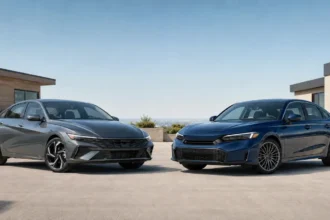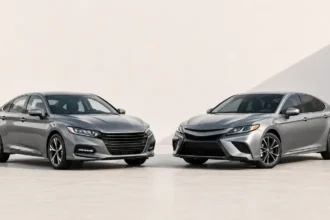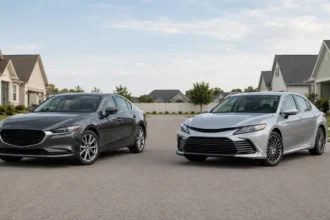


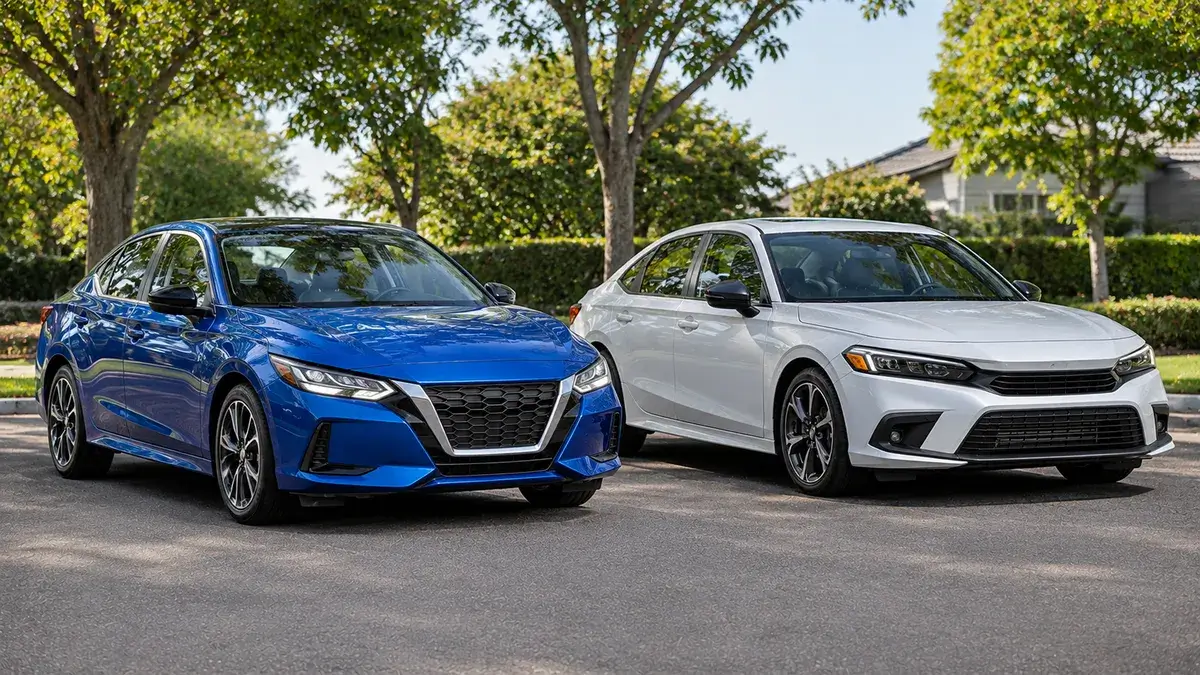
A used Nissan Sentra may be the better purchase when its lower asking price comes with strong maintenance records, a sound transmission and a clean inspection. A used Honda Civic may justify a higher price when the particular car has better documented condition, more useful space or features, and fewer unresolved concerns. Neither badge overrules a bad vehicle history, an unsafe defect or an unreasonable price.
The practical way to choose is to compare similar model years and gasoline sedan configurations, then judge what you would actually be buying. That means checking the transmission, safety results, service history, title, mileage, local asking prices and independent inspection, not choosing from new-car specifications alone.
Nissan Sentra vs. Honda Civic: Which One Fits Your Used-Car Purchase?
The Sentra is worth keeping on the shortlist if it leaves meaningful money in your budget after you account for its condition, documented upkeep and any necessary repairs. The Civic deserves consideration at a higher asking price when its specific year and condition deliver benefits you will use. If the cars are not comparably maintained, the price difference alone tells you little.
| Your situation | Sentra is worth considering when… | Civic is worth considering when… | Do not buy yet when… |
|---|---|---|---|
| You have a firm purchase budget | Its lower verified local asking price leaves a sensible reserve for maintenance and inspection | Its extra cost is affordable without sacrificing necessary repairs or insurance | The apparent saving disappears once known work is included |
| You plan to keep the car for years | Transmission behavior, service history and mechanical inspection are convincing | The actual car has stronger documented care and fits your intended mileage | A significant drivability problem or missing maintenance history cannot be resolved |
| You often carry rear passengers | The specific car has enough tested, usable space for your passengers | You benefit from the room in the particular Civic sedan | A test fit reveals inadequate room, visibility or child-seat access |
| You prioritize safety evidence | Applicable IIHS results, equipment and recall status meet your needs | The relevant Civic’s specific crash-test results and equipment better fit your priorities | An open recall, crash repair or safety-system concern remains unaddressed |
The rule: Compare the two available vehicles, then make the purchase decision. A well-kept Sentra can be a better deal than a neglected Civic; a well-kept Civic can be a stronger everyday fit than a Sentra that needs expensive work. Those are conditional buying scenarios, not model-wide reliability rankings.
Compare the Exact Used Cars, Not Just the Nameplates
A fair Sentra-versus-Civic comparison starts with the same model year, four-door sedan body style, similar mileage, comparable equipment and the real asking price. A Civic hatchback, hybrid, Si or Type R changes the equation and should not be folded into a standard gasoline-sedan matchup.
| Check | Nissan Sentra | Honda Civic | Why it matters |
|---|---|---|---|
| Vehicle type | U.S. four-door compact sedan | U.S. four-door compact sedan | Avoids mixing a sedan with a hatchback or performance model |
| Powertrain | Confirm exact engine and CVT for the listing | Confirm gasoline engine, CVT and trim; other Civic variants exist | Fuel economy, service needs and performance differ |
| Model year | Match the Civic’s model year where possible | Match the Sentra’s model year where possible | Designs, test results and equipment can change between years |
| Condition and mileage | Review service invoices, title, tires and inspection | Apply the same standard | The better-maintained car may be worth a higher price |
| Asking price | Compare real local listings and out-the-door costs | Apply the same market and listing filters | An MSRP or unmatched online average is not a used-car valuation |
For example, the 2022 Sentra S/SV and 2022 Civic LX are both U.S. gasoline automatic sedans, but the Civic LX has a different engine and equipment package. That is a useful real-world comparison, not proof that every Sentra and Civic of every year will behave the same way.
Confirm the exact specifications from the window sticker, VIN and manufacturer information before relying on a listing description. Dealer descriptions can omit options or identify trims incorrectly.
Reliability, Transmission Risk, and Model-Year Differences
There is no defensible single reliability winner for all used Sentras and Civics. The meaningful question is whether the exact year and transmission you are considering have documented service, an acceptable test drive and any unresolved symptoms. Both nameplates have used CVT-equipped gasoline versions, so treating the Civic as automatically free of transmission-maintenance concerns would be misleading.
The older Sentra deserves particular transmission scrutiny because Nissan documented CVT-related warranty programs for specific model years. The existence of a program does not establish a failure rate for every car or mean the vehicle still has coverage.
| Used-car group | Relevant documented context | What to do before purchase |
|---|---|---|
| 2013–2017 Sentra models equipped with eligible CVTs | Nissan’s 2020 CVT coverage bulletin describes an extension to 84 months/84,000 miles, whichever came first, for eligible vehicles | Ask a Nissan dealer to check the VIN, original in-service date, service/repair history and program status; historical terms do not guarantee coverage today |
| 2018–2019 Sentra models equipped with eligible CVTs | Nissan’s 2023 manufacturer bulletin describes CVT coverage extended to 84 months/84,000 miles, subject to specific terms and VIN eligibility | Obtain dealer confirmation in writing; inspect for shudder, hesitation, warning lights or transmission trouble codes |
| 2020–2025 Sentra gasoline sedans | A different Sentra generation; earlier extension terms cannot automatically be carried forward | Check the exact year’s Nissan schedule, recall records, transmission behavior and complete maintenance history |
| Civic gasoline sedans | Engine, transmission and equipment depend on model year and trim | Confirm the engine/CVT combination; review Maintenance Minder records, fluid service and any existing drivability faults |
On an older Sentra with the CVT, pay attention to delayed engagement, abnormal vibration or shudder, inconsistent acceleration, fluid leaks and stored transmission codes. None of those symptoms is a diagnosis by itself. They are reasons for a qualified mechanic to investigate before money changes hands. Evidence that a transmission was replaced is helpful only if the repair is documented and the current unit operates properly.
For the Civic, do not treat general brand reputation as a substitute for inspecting the engine, cooling system, transmission, electronics and evidence of proper servicing. A Civic with an unresolved fault, accident damage or poor records can be the weaker purchase despite an attractive model-year reputation.
Manufacturer CVT coverage and NHTSA safety recalls are different kinds of evidence. For example, the 2016–2019 Sentra stop-lamp switch and 2016–2021 Civic sedan fuel-pump recalls are VIN-dependent safety matters, not proof of which nameplate has the more reliable transmission. Their specific records and buyer actions appear in the safety section below.
Used Prices, Value, and the Cost of Choosing Wrong
The cheaper listing is not necessarily the cheaper car to own. A fair price comparison needs listings collected in the same area and time period, with close model years, trim levels, mileage and condition. Without that matched sample, a claimed national dollar advantage or long-term resale winner would be too imprecise to guide a purchase.
| Price or ownership factor | What to compare | Decision consequence |
|---|---|---|
| Purchase price | Seller’s asking price and out-the-door total for comparable cars | Establish the actual, not assumed, Sentra-to-Civic price gap |
| Immediate work | Tires, brakes, fluids, warning lights and mechanic-identified repairs | Subtract the cost of necessary work from any apparent saving |
| Maintenance proof | Dated invoices and evidence of required transmission and engine service | Strong records reduce uncertainty, though they cannot guarantee reliability |
| Insurance and fuel | Quotes for the exact VIN, plus configuration-matched EPA estimates | A lower asking price may come with different ongoing costs |
| Future major repair exposure | Inspection findings, diagnostic results and a realistic reserve | Unknown exposure is a reason to investigate or negotiate, not invent a repair-cost forecast |
Consider two same-year sedans with similar mileage: the Sentra is advertised for less, but the Civic has complete records and the Sentra has an unexplained transmission symptom. The price gap is not a genuine saving until the symptom has been diagnosed and any needed repair has been priced. Reverse the conditions, and an overpriced or poorly maintained Civic has no automatic advantage.
A useful negotiation rule: First identify work the seller can document or the inspector can substantiate. Then decide whether the seller will correct it or whether an independently obtained quote makes a lower price reasonable. Walk away if a major defect cannot be assessed. Do not treat unverified repair-cost averages or new-car five-year cost projections as a reliable bill for either used car.
Prices vary by year, mileage, trim, condition and location. Verify comparable local listings before buying.
Fuel Economy and Everyday Practicality
Both gasoline sedans can be efficient commuters, but the exact engine and trim change the answer. A same-year EPA example is more useful than saying one badge always uses less fuel.
| U.S. gasoline sedan configuration, 2022 | City | Highway | Combined |
|---|---|---|---|
| Nissan Sentra S/SV, 2.0L, automatic CVT | 29 | 39 | 33 |
| Nissan Sentra SR, 2.0L, automatic CVT | 28 | 37 | 32 |
| Honda Civic LX, 2.0L, automatic CVT | 31 | 40 | 35 |
| Honda Civic Sport, 2.0L, automatic CVT | 30 | 37 | 33 |
Table note: All figures are EPA-estimated miles per gallon (MPG), city/highway/combined, for the specified U.S. 2022 gasoline sedans. They are not owner-measured results or model-wide averages. See the EPA’s 2022 vehicle listings, the 2022 Civic fuel-economy listing and the 2022 Sentra manufacturer specifications.
In this example the Civic LX has the higher combined estimate, but the Civic Sport and Sentra S/SV are both rated at 33 combined. That is why the trim matters. A Civic hybrid is a separate powertrain choice and should not be compared as though it were the same gasoline sedan.
Size and everyday fit: Both are marketed as compact sedans, even though EPA vehicle-size categories use a different classification system. For the 2022 gasoline sedans, manufacturer specifications list 37.4 inches of rear legroom and 14.8 cubic feet of trunk space for the Civic LX, compared with 34.7 inches and 14.3 cubic feet for the Sentra. The Civic has a meaningful rear-legroom advantage on paper in this specific pairing, although actual comfort depends on the front-seat position and passenger size. Check Honda’s 2022 Civic specifications alongside Nissan’s specifications above.
If rear-seat comfort or a child seat is a deciding factor, sit in both with the front seats adjusted normally and try the actual equipment you plan to carry. A minor specification advantage is not a substitute for that test.
Safety Ratings, Recalls, and Coverage Checks
Safety comparisons must use the same test type and applicable model year. The Insurance Institute for Highway Safety (IIHS) publishes separate ratings for original and updated crash tests; a rating from one protocol cannot be compared casually with another.
| IIHS result for 2022 sedans | Nissan Sentra | Honda Civic | What a buyer should take from it |
|---|---|---|---|
| Updated moderate-overlap front test | Poor (P) | Acceptable (A) | Civic performed better in this specific updated test |
| Updated side test | Acceptable (A) | Acceptable (A) | Both received the same grade in this particular test |
| 2022 award | Top Safety Pick, with specific headlights | Top Safety Pick+ | Verify the Sentra’s headlight equipment and the award-year criteria |
The 2022 Top Safety Pick and Top Safety Pick+ awards were determined under 2022 award criteria, which used the original moderate-overlap front and original side tests. The updated moderate-overlap and updated side ratings in this table are separate, later-test results; they were not used to award the 2022 honors. Ratings apply only to the tested and IIHS-specified vehicle configurations/model years, not every older or newer Sentra or Civic. Review the IIHS 2022 award criteria, 2022 Sentra ratings and 2022 Civic ratings.
For recalls, the useful next step is a VIN-specific check, not a comparison of raw complaint totals. NHTSA complaint records are reports, not a proven probability that a defect will occur. A model-year search can identify safety campaigns and investigations, but it does not show whether the actual car’s repair has been completed.
Selected NHTSA safety campaigns show how the risks differ by year and component. These are examples, not a complete recall inventory; a campaign listing does not mean every VIN in the stated model years is affected.
| Model years and vehicle | Selected NHTSA record | What a used-car buyer should verify |
|---|---|---|
| 2016–2019 Nissan Sentra | 21V-135: stop-lamp switch could prevent brake lights from illuminating | Confirm the switch remedy in Nissan’s VIN-specific service history; check brake-light operation |
| 2016–2021 Honda Civic sedan | 23V-858: fuel-pump motor campaign covers certain four-door Civics | Confirm VIN eligibility and replacement status; investigate stalling or starting complaints rather than assuming every car is affected |
| 2020–2022 Nissan Sentra | 23V-581: tie rods may bend or break, affecting steering | Verify the final remedy was completed. For affected 2020–2021 cars, an earlier 21V-461 repair alone does not settle the expanded campaign |
| Certain 2022 Nissan Sentras | 23V-421: cowl sealing could allow water into electrical connections | Confirm dealer resealing/inspection and any necessary harness repair; investigate water intrusion or electrical warnings |
| Certain 2022 Honda Civics | 24V-744: steering gearbox can increase steering effort | Confirm the gearbox campaign remedy and inspect unexplained sticky or unusually heavy steering |
| Certain 2022 Honda Civics | 24V-064: front-passenger seat weight sensor, with 26V-332 expanding the affected population, concerns improper airbag suppression | Ask Honda to check both recall records for the exact VIN and document the required sensor remedy |
Campaign numbers link to NHTSA-hosted official material. The same vehicle may be eligible for more than one campaign, and a previous remedy may be superseded. The model-year examples do not measure defect frequency, predict failure, or replace a current VIN recall check.
| Record or coverage check | Applies to | Buyer action |
|---|---|---|
| Open NHTSA safety recall | Both exact VINs | Use the NHTSA recall lookup; ask the seller for repair documentation and confirm completion with the manufacturer |
| Past recalls or manufacturer campaigns | Both cars | Ask the dealer to inspect the vehicle’s campaign history; a clean open-recall screen does not prove no past campaigns existed |
| Sentra CVT warranty extension | Eligible older Sentra years only | Verify VIN eligibility, original in-service date, time/mileage limits and exclusions with Nissan; do not presume transferable, unexpired coverage |
| Factory warranty or servicing obligations | Both cars | Check the actual year-specific booklet and service schedule instead of assuming a used car remains under its original warranty |
Nissan’s 2018–2019 Sentra CVT bulletin describes extended coverage and directs dealers to check the individual VIN. For both historical programs, obtain Nissan’s VIN-based confirmation rather than relying on a seller’s claim; the term runs from the original in-service date, not the used-car purchase date. A warranty extension does not prove that every covered transmission will fail, and an expired extension should never be treated as current protection.
What to Inspect Before Buying Either Car
A proper independent pre-purchase inspection is the best way to turn general model concerns into evidence about the vehicle you may buy. Arrange it before making an irreversible commitment, especially if the seller cannot provide records or a transmission issue is suspected.
| Inspection item | What to verify | When to stop or walk away |
|---|---|---|
| VIN, title and history | VIN matches the car and paperwork; title status and reported accident history are explained | Title discrepancy, serious undisclosed damage or seller refusal to verify identity |
| Transmission and road test | Smooth engagement and acceleration when cold and warmed up; technician checks for codes, leaks and relevant service history | Repeatable shudder, slipping-like behavior, abnormal noise or an unresolved diagnostic finding |
| Engine and cooling | No unexplained warning lights, fluid leaks, overheating signs or abnormal operation | Major mechanical concern without a documented diagnosis and acceptable repair plan |
| Body and structural condition | Check panel repairs, corrosion, alignment and safety-system damage | Signs of substantial unresolved structural or airbag-related damage |
| Brakes, tires and suspension | Adequate condition and an estimate for any worn items | Seller will not permit inspection, or repair needs make the total purchase uneconomic |
| Recalls and coverage | NHTSA open recalls, manufacturer campaign history, relevant Nissan CVT terms | Seller cannot arrange remedy for a material recall or relies on unverified coverage promises |
Ask for dated invoices rather than a verbal assurance that the car was “always serviced.” For a Civic, consult Honda’s 2022 Civic inspection and maintenance guidance and the actual vehicle’s maintenance records; use the applicable Maintenance Minder service information and model-year instructions. For a Sentra, confirm the exact-year requirements through the Nissan maintenance schedule, including the correct engine, transmission and service conditions.
A clean test drive is useful but not conclusive. An inspection cannot guarantee future reliability either; it helps identify visible faults, overdue work and reasons not to accept the asking price.
Final Choice by Budget, Ownership Horizon, and Risk Tolerance
Choose the used Sentra when it is a genuinely better-priced comparable car, its exact-year transmission and maintenance history withstand scrutiny, and the inspection leaves no major unresolved issues. It is the weaker option when the lower price is masking drivability faults, questionable records or repairs that erase the saving.
Choose the used Civic when its condition, maintenance documentation, practical fit and relevant safety results justify what the seller is asking. It is the weaker option when you are paying a large premium only for the name, or when its own history and inspection do not justify the price.
Choose neither if the title, recall status, transmission behavior, structural condition or likely immediate repair burden cannot be verified. A sound third listing is preferable to forcing a decision between two poor ones.
The shortest defensible purchase rule is simple: match the years and configurations, verify the records, inspect both cars, and pay only for advantages that exist on the actual vehicle.
Frequently Asked Questions
Is a used Nissan Sentra as reliable as a used Honda Civic?
There is no verified single answer for every model year and individual car. Compare the specific years, powertrains and maintenance records. Older Sentras in particular warrant a careful check of CVT service and any applicable Nissan program, while a Civic also needs a thorough independent inspection.
What are the main downsides of a used Nissan Sentra compared with a Civic?
For certain older CVT-equipped Sentras, transmission documentation and eligibility checks are material buying concerns. In the 2022 comparison, the Sentra also offers less published rear legroom and earned a lower grade in the IIHS updated moderate-overlap test. These are year-specific distinctions, not blanket verdicts on every Sentra.
Is the Honda Civic the same size as the Nissan Sentra?
Both are compact sedans, but their dimensions differ by model year. In the 2022 sedan example, the Civic LX offers more published rear legroom and a slightly larger trunk. Check the exact year and try both cabins before deciding which fits your passengers or cargo.
Should I buy a cheaper Sentra or pay more for a Civic?
Buy the Sentra if the real saving survives an inspection and the vehicle’s records, condition and risk are acceptable. Pay more for the Civic only when its verified condition, safety evidence, features or practicality justify that premium. If either vehicle has a serious unresolved concern, keep shopping.