

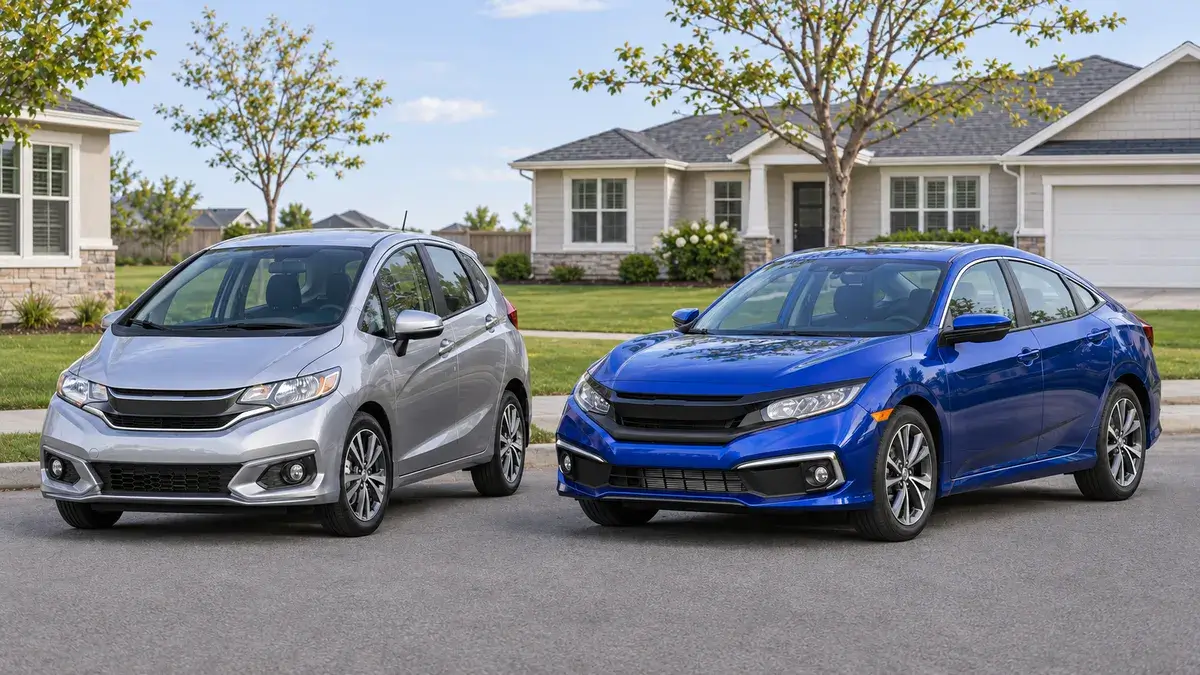
A used Honda Fit makes more sense if you need a small parking footprint and a hatchback that can carry awkward cargo. A used Honda Civic may be the better fit if you prefer a longer sedan, a particular Civic hatchback, or equipment available on the exact year and trim you are shopping for. Neither is the automatic reliability or value winner.
For a fair Honda Fit vs. Honda Civic decision, start with the actual model years, body styles, transmissions, mileage, condition and asking prices. The Fit was last sold new in the United States for the 2020 model year, so comparing it with a newer Civic requires an explicit age and equipment adjustment. Safety ratings and recall checks also need to match the individual vehicle.
Honda Fit vs. Honda Civic: Which Used Car Fits Your Needs?
The simplest way to choose is to identify the task you need the car to do, then reject any candidate whose history or inspection fails your requirements.
| Your buying priority | Used Honda Fit | Used Honda Civic |
|---|---|---|
| Tight parking, short urban trips | Strong candidate because of its compact exterior | Still workable, but a Civic sedan occupies more space |
| Bulky cargo in a small car | Fit’s tall hatch opening and folding Magic Seat are compelling | Compare with a Civic hatchback, not just a Civic sedan’s trunk |
| Traditional compact-sedan layout | Not available; the U.S. gasoline Fit is a hatchback | Civic sedan is the more direct choice |
| Driver-assistance equipment | Check exact year/trim; for example, 2020 Fit EX/EX-L have Honda Sensing | Check exact year/body; Honda Sensing was standard on 2020 Civic sedans |
| Best purchase for your money | Depends on the exact Fit’s condition, records and price | Depends on the exact Civic’s condition, records and price |
First rule-out: Do not buy either vehicle solely because of its reputation. Missing maintenance history, an unresolved material inspection problem or an unacceptable total purchase cost can overturn an otherwise good fit.
CarMerit used-car comparator
Honda Fit vs Honda Civic: 2020 Used-Car Snapshot
Compare documented 2020 U.S. gasoline configurations, exterior space, EPA ratings and buyer checks. Enter your own listing costs rather than relying on unmatched market prices.
Choose EPA configurations
Each selector changes only its model’s 2020 EPA estimates. Size and cargo measurements below remain the fixed LX hatchback vs LX sedan reference.
Honda Fit
Honda Civic sedan
| 36 | EPA combined MPG | 33 |
| 33 | EPA city MPG | 30 |
| 40 | EPA highway MPG | 38 |
EPA ratings are configuration-specific estimates, not observed fuel expenses or proof of lower repair costs. Both sides use 2020 U.S. gasoline CVT configurations.
2020 LX size and cargo reference
| 161.4 in. | Overall length | 182.7 in. |
| 67.0 in. | Overall width | 70.9 in. |
| 39.3 in. | Rear legroom | 37.4 in. |
| 16.6 cu. ft. | Cargo behind rear seats Fit cargo / Civic trunk | 15.1 cu. ft. |
The Fit also offers up to 52.7 cu. ft. with its rear seating folded. This does not have an equivalent Civic sedan hatchback-cargo measurement; a Civic hatchback is a separate comparison.
Honda Fit
Prioritize when parking and flexible cargo matter
The shorter exterior, liftgate and folding Magic Seat help with tight urban spaces and awkward cargo.
Buyer checks: Confirm model year, trim, transmission service records, VIN recall status and independent inspection. The last new U.S. Fit was 2020.
Honda Civic
Prioritize when sedan layout or equipment fit better
Choose the exact sedan or Civic hatchback body you need. Equipment, engine and fuel economy vary by trim.
Buyer checks: Confirm body style, engine, trim, maintenance, VIN recall status and inspection. A newer Civic is not a same-age Fit comparison.
Safety and recalls: check the exact vehicle
The cited 2020 IIHS original tests rated moderate-overlap, side and head-restraint categories Good for both vehicles. Front crash prevention was Superior with optional equipment on the Fit and with the standard system on the Civic sedan; headlights varied with equipment. The test sets are not identical.
Selected NHTSA campaigns: 23V-858 fuel pump and 26V-332 seat-weight sensor. Honda’s later Civic bulletin covers additional configurations beyond the original 23V-858 notice. These are selected examples, not complete recall histories. Check VIN eligibility and completed remedies.
Compare the total cost of your actual listings
Enter verified asking price, taxes/fees and immediate necessary work for each inspected car. The calculator is local to your browser and does not retrieve live dealer offers.
Honda Fit listing
Honda Civic listing
Enter all six amounts to compare your listing estimates. Do not assume that unknown costs are zero.
This is a buyer-entered estimate, not a market valuation. A lower total alone does not establish better reliability, condition or value. Verify inspection findings and fees.
Quick take: Shortlist the Fit for compact parking and flexible cargo, or the specific Civic sedan/hatchback configuration that better meets your needs. Make the final decision from the individual vehicle’s history, VIN-level safety status, independent inspection and total purchase exposure.
Sources: Honda 2020 Fit specifications, 2020 Civic sedan specifications, Civic EPA ratings, and Fit EPA record; IIHS Fit 2020 / Civic sedan 2020; NHTSA VIN recall lookup. Specifications and ratings reflect the published comparison’s November 3, 2026 source state; no NHTSA complaint totals, live asking prices or universal reliability rankings are asserted.
Compare the Same Years and Configurations First
A 2020 Fit and a 2020 Civic can be compared on consistent model-year evidence. A 2020 Fit and a 2022 Civic can still be valid shopping alternatives—but that is a different-age used-car purchase, not proof that either model is inherently better.
| Fair-comparison detail | Honda Fit | Honda Civic |
|---|---|---|
| Relevant U.S. gasoline model years | 2007–2013 and 2015–2020 | Match the Civic's actual model year to the Fit wherever possible |
| 2014 / 2021 model-year trap | No conventional U.S. gasoline 2014 Fit; no new U.S. Fit for 2021 or later | Civic continued after 2020; a later Civic is a newer-age alternative |
| Main body-style issue | Five-door hatchback | Sedan, coupe or hatchback depending on year; verify the body being compared |
| Example same-year match | 2020 Fit LX, 1.5-liter engine, CVT | 2020 Civic LX sedan, 2.0-liter engine, CVT |
| Another legitimate option | 2020 Fit EX, CVT, with its listed equipment | 2020 Civic EX sedan, 1.5-liter turbo, CVT—or a verified 2020 Civic hatchback |
Scope Note: This article compares conventional gasoline U.S.-market commuter models. The Fit EV, Civic hybrid and performance-focused Civic Si/Type R are not included in the baseline choice.
The engine and transmission matter even within one model year. For instance, a 2020 Civic LX sedan with the 2.0-liter engine is not the same fuel-economy or equipment configuration as a 2020 Civic EX sedan with the 1.5-liter turbo. The Civic hatchback also changes the cargo comparison. Check the VIN, trim, transmission and body style against the listing before interpreting any specification table.
Space, Cargo Flexibility, and Daily Driving
Is a Honda Fit bigger than a Civic? No, not in overall exterior size when comparing the 2020 Fit LX with the 2020 Civic LX sedan. But exterior length does not tell you how usefully a car carries a box, bicycle or stroller.
Here is a same-model-year, manufacturer-specified snapshot:
| 2020 U.S. measurement | Fit LX hatchback | Civic LX sedan |
|---|---|---|
| Overall length | 161.4 in. | 182.7 in. |
| Overall width | 67.0 in. | 70.9 in. |
| Rear legroom | 39.3 in. | 37.4 in. |
| Listed cargo volume, rear seats in place | 16.6 cu. ft. | 15.1 cu. ft. (trunk) |
| Cargo with rear seating folded | Up to 52.7 cu. ft. | No directly equivalent hatchback cargo specification |
These figures come from Honda's 2020 Fit specifications and 2020 Civic sedan specifications. Cargo measurements describe different body styles; they should not be used as a complete test of what fits through each opening.
The Fit advantage is packaging, not being physically larger. Its 60/40-split Magic Seat and liftgate make it easier to rearrange the rear space for tall or awkward items. For a buyer who moves boxes or bicycles but parks in tight places, that can be more useful than a longer exterior.
The Civic sedan provides a conventional trunk and a wider body. If a hatch opening is important, compare the Fit with an actual Civic hatchback: Honda lists 25.7 cubic feet behind the rear seats for the 2020 Civic hatchback LX, versus 16.6 cubic feet for the 2020 Fit. That changes the everyday cargo answer, even though seat-folded arrangements differ. Check the 2020 Civic hatchback specifications before treating a sedan's trunk as representative of every Civic.
For regular highway travel, do not decide from body size alone. Drive the actual candidates at the speeds you normally use and compare seating position, noise, acceleration, visibility and comfort. A worn Civic can be less satisfying than a well-kept Fit, and the reverse is equally possible.
Safety, Reliability Signals, and What to Inspect
Neither Honda nameplate gives you a reliable all-years safety or ownership verdict. Crash-test results apply to stated tests and model configurations; recall campaigns apply only to affected vehicles; complaints are reports, not measured failure rates.
If the Fit remains on your shortlist, our Honda Fit reliability guide explains the model-specific problems, maintenance checks, and inspection findings that can change the buying decision.
What the 2020 IIHS ratings actually show
| IIHS original-test category | 2020 Fit four-door wagon | 2020 Civic four-door sedan |
|---|---|---|
| Moderate-overlap front crashworthiness | Good | Good |
| Side crashworthiness | Good | Good |
| Head restraints and seats | Good | Good |
| Front crash prevention, vehicle-to-vehicle | Superior with optional equipment | Superior with the standard system |
| Headlight rating | Varies with equipment | Varies with equipment |
The ratings appear on IIHS's 2020 Honda Fit and 2020 Honda Civic sedan pages. The specific test vehicles and applicability years differ; the two models also do not have identical sets of published tests. Matching “Good” entries does not establish an overall tie or make every trim equally equipped. Likewise, an award that requires particular headlights must not be generalized to all used examples.
Relevant NHTSA recall checks
The following federal campaign notices identify certain model years. They do not establish that every vehicle in those years needs the repair today.
| NHTSA safety recall | Fit years named | Civic years named | Why it matters to a buyer |
|---|---|---|---|
| 23V-858 — fuel pump | 2018–2019 | 2018–2020 | Affected fuel pumps may fail and cause a stall; confirm VIN eligibility and remedy completion |
| 26V-332 — front-passenger seat weight sensor | 2018–2020 | Civic 2016–2022; Civic hatchback separately listed for 2017–2021 | An affected sensor may malfunction, changing airbag-deployment risk; verify the specific VIN and repair status |
23V-858 year-range distinction: The 2018–2020 Civic range in the table is what the linked December 2023 NHTSA notice lists, not an exhaustive list of potential Civic eligibility. Honda's later March 2024 service bulletin names certain additional 2016–2021 Civic model-year/body-style combinations under this campaign and requires a VIN check. A year or body style by itself cannot establish whether a particular car needs a recall repair.
These are selected campaign examples, not a complete list of recalls for either car. The NHTSA model-year search can reveal general recalls, investigations, complaints and manufacturer communications; its VIN recall lookup is the appropriate next check for the individual car. A completed recall repair should be verified rather than assumed from a seller's description. An open recall is a safety issue to resolve—not proof of a model-wide failure probability.
For the Honda Fit vs. Honda Civic reliability question, the most useful next evidence comes from the specific used vehicle:
- Review dated maintenance and repair invoices, especially transmission-service evidence for the exact gearbox.
- Check cold starting, smooth acceleration, warning lights, air conditioning, cooling-system condition, steering, brakes, tires and signs of fluid leaks.
- Inspect for collision or flood damage and verify that body repairs and safety systems were addressed properly.
- Have an independent mechanic inspect the car before purchase; obtain a written estimate for material findings.
Do not treat more complaints for one Civic model year than one Fit model year as a normalized defect rate. Sales volume, years in service, reporting practices and vehicle population differ, while a report alone does not establish a confirmed defect.
Fuel Economy, Maintenance, and Ownership Exposure
Fuel economy is configuration-specific, not a guaranteed Fit-versus-Civic win. The 2020 gasoline CVT examples below use EPA rounded city, highway and combined figures, checked against the supplied official vehicle records and Honda's model-year specifications.
| 2020 U.S. gasoline configuration | City | Highway | Combined |
|---|---|---|---|
| Fit LX, 1.5L, CVT | 33 | 40 | 36 |
| Fit Sport, 1.5L, CVT | 31 | 36 | 33 |
| Civic LX sedan, 2.0L, CVT | 30 | 38 | 33 |
| Civic EX sedan, 1.5L turbo, CVT | 32 | 42 | 36 |
Table Note: All figures are EPA MPG (city/highway/combined); 2020 U.S. gasoline configurations only. Actual consumption varies with driving, weather, load and maintenance. Honda's 2020 Civic sedan EPA ratings and the official 2020 Fit CVT EPA record support the specified examples.
The Fit LX CVT beats the Civic LX 2.0-liter CVT on these particular combined ratings, but the Civic EX 1.5-liter turbo CVT matches the Fit LX's 36 combined MPG. A different trim or manual transmission changes the numbers. Fuel efficiency by itself does not prove lower repairs or better used-car value.
Maintenance history matters more than a generic cost estimate
Both model lines use Honda's Maintenance Minder approach, but the correct service requirements depend on the model year and vehicle configuration.
| Item to verify | 2020 Fit | 2020 Civic sedan | Buyer action |
|---|---|---|---|
| Oil and filter service | Maintenance Minder A/B service guidance | Maintenance Minder A/B service guidance | Match service invoices to the car's mileage and dates |
| Transmission fluid | Maintenance Minder sub-item 3 | Maintenance Minder sub-item 3 | Check records for the actual manual or CVT transmission and proper fluid |
| Brake fluid | Honda guidance includes time-based replacement independent of the display | Honda guidance includes time-based replacement independent of the display | Confirm when it was last replaced, not just what the dashboard shows |
| Original warranty or special coverage | Depends on the exact vehicle and applicable Honda terms | Depends on the exact vehicle and applicable Honda terms | Verify original in-service date, mileage, VIN and any written Honda program notice |
Honda's 2020 Fit and 2020 Civic sedan owner guidance is the basis for the service-code examples. A dashboard with no maintenance message is not proof that previous work was performed. Likewise, an old original warranty booklet does not establish remaining coverage today; recalls and manufacturer special-coverage programs have their own eligibility rules.
No model-wide annual repair-cost winner is asserted here. Repair bills depend on the actual car, its service history and needed work, and the available evidence does not support a matched numerical Fit-versus-Civic repair-cost table.
How the Asking Price and Condition Change the Choice
Compare two real listings—not an old new-car MSRP or an unmatched marketplace average. A newer Civic may cost more for reasons unrelated to the Civic badge, while a cheap Fit can become a poor value if it needs major work. No trustworthy universal current used-price winner can be established without matched, publicly verifiable listings.
Use this decision sheet for the cars you are actually considering:
| Compare on the same basis | Fit listing | Civic listing |
|---|---|---|
| Year, body, trim, engine and transmission | Record exact configuration | Record exact configuration |
| Mileage, title and accident history | Verify documents and vehicle history | Verify documents and vehicle history |
| Maintenance and safety status | Check records, recalls and repair completion | Check records, recalls and repair completion |
| Local asking price | Use the actual seller's current price | Use the actual seller's current price |
| Pre-purchase inspection | Add documented work needed | Add documented work needed |
| Total purchase decision | Asking price + taxes/fees + immediate necessary work | Asking price + taxes/fees + immediate necessary work |
A simple decision example: Suppose the Fit is easier to park and meets your cargo needs, but the Civic has better service documentation and fewer costly inspection findings. The Civic may be worth choosing even if its asking price is higher. If both are equally sound and the Fit better fits your parking/cargo use, paying extra merely for the Civic name is not automatically rational. That is a conditional comparison, not a claim about today's national market prices.
Prices vary by year, mileage, trim, condition, and location. Verify local listings before buying. If the two cars are different model years, write down the age, equipment and mileage difference explicitly before deciding whether the asking-price difference is justified.
Final Used-Buyer Checklist and Choice
Shortlist the Fit when your parking constraints and flexible hatchback cargo matter more than having a conventional compact sedan, and a specific Fit has satisfactory records, safety status and inspection results. Shortlist the Civic when its exact sedan or hatchback layout, driving characteristics or verified trim equipment better meet your needs—and that individual Civic passes the same checks.
Before paying a deposit:
- Confirm U.S. model year, trim, body style, engine, transmission and VIN. Reject listings that depend on a nonexistent conventional U.S. 2014 Fit or a new U.S. 2021+ Fit.
- Check the actual VIN for open NHTSA recalls and confirm the dealer or owner has documented completed remedies as applicable.
- Review title, collision history and maintenance invoices; do not infer reliability from Honda branding or raw complaint counts.
- Drive both candidates on the routes you expect to use, and test your real passengers and cargo if possible.
- Obtain an independent pre-purchase inspection, then compare the actual asking prices plus immediate necessary work.
- Walk away from unresolved serious safety, structural or mechanical findings—regardless of whether the badge says Fit or Civic.
The right used Honda is the one that meets your daily needs and survives a fair, vehicle-specific check at a defensible total price. The Fit's packaging and the Civic's body/equipment options make both worth considering; the individual car determines the final purchase.
Frequently Asked Questions
Can I compare a 2020 Honda Fit with a 2021 or newer Civic?
Yes, as two actual used-car listings, but not as a same-year comparison. The U.S. Fit ended with the 2020 model year, so account for age, mileage, equipment, warranty history, condition and the real asking prices. A newer Civic's features do not prove an older Fit is inherently inferior.
Does an open recall automatically mean I should reject the Fit or Civic?
Not necessarily. First confirm whether the specific VIN is affected, whether a remedy is available and whether the repair has been completed. Have any unresolved safety concern addressed before purchase; if the seller will not permit verification or a safe resolution, do not proceed.
Is a Honda Fit or Civic cheaper to own?
There is no supported all-years winner. Exact engine/transmission MPG, maintenance history, tire and brake condition, existing repairs, insurance quotes and the purchase price determine your own cost. Compare both inspected cars rather than relying on model-wide repair-cost averages.