

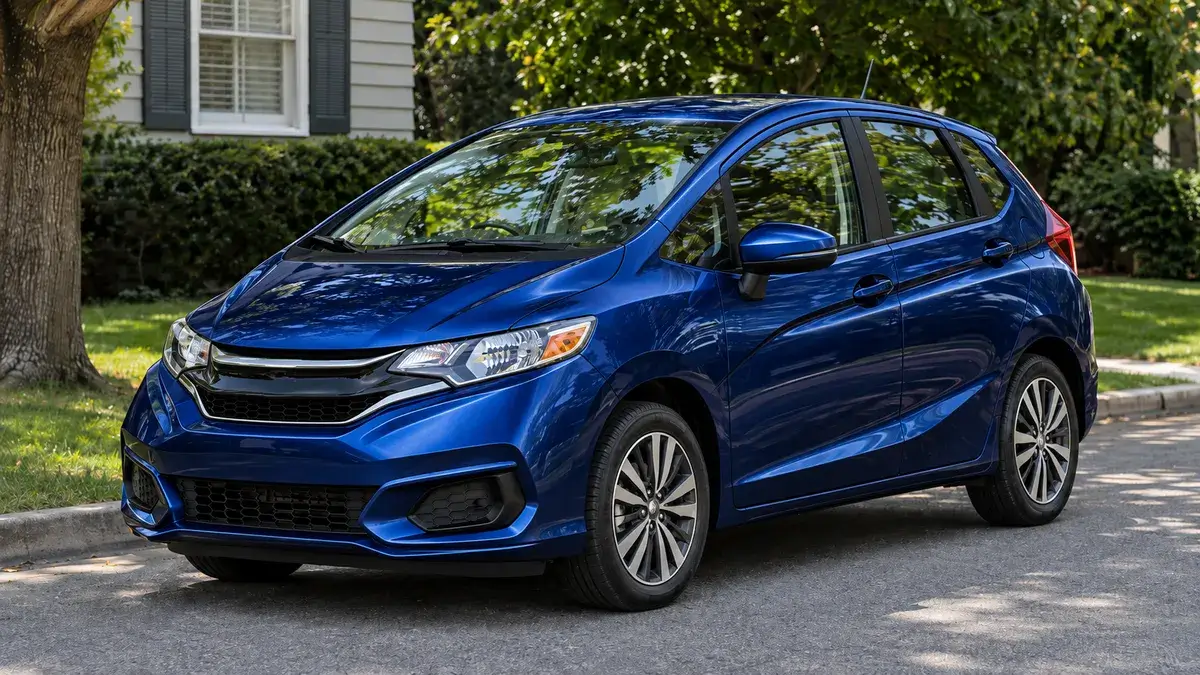
A used Honda Fit can be a sensible purchase, but its reliability depends on the specific car—not just the model’s reputation. Keep one on your shortlist if it drives properly, has credible maintenance records, passes an independent inspection, and has no unresolved applicable safety-recall work. Investigate unexplained warning lights, starting or shifting problems, and missing service history before agreeing to buy. Walk away if the seller will not let those concerns be checked or the problems cannot be resolved.
This guide covers U.S.-market gasoline Honda Fit hatchbacks from 2007–2013 and 2015–2020. It explains documented issues, differences that matter across model years, and the evidence a buyer should request. It is not a ranking of the best and worst years, and the limited Fit EV and overseas Honda Jazz are outside its scope.
Is the Honda Fit Reliable Enough to Buy Used?
The Fit deserves consideration as a practical small used hatchback, but a favorable general reliability rating cannot certify the condition of an individual example. NHTSA complaint records, Honda service information, and IIHS ratings answer different questions. None can replace a VIN-specific history check and an inspection.
| What you find on the used Fit | What it means for the buying decision |
|---|---|
| Clear service history, normal road test, no relevant open recalls, and a clean independent inspection | Shortlist: the evidence supports continuing to compare its price and condition with other cars. |
| Missing transmission or engine service records, a warning light, a known service-program symptom, or uncertain recall work | Investigate: obtain documentation and a written diagnosis before negotiating. |
| Unresolved safety work, serious unexplained drivability or steering trouble, substantial undisclosed damage, or a seller who refuses an inspection | Pass until resolved: a general reputation for dependability is not enough. |
A reliability score based on aggregated repair experience can be useful background. It does not measure the remaining life of a particular transmission, whether a previous owner followed Honda’s maintenance instructions, or whether a recall remedy was completed. Likewise, more complaints in one model year do not establish a higher failure probability without accounting for how many vehicles were sold, how long they have been on the road, and how the reports were collected.
How Reliability and Safety Context Changes Across Honda Fit Generations
Model-year context matters because the U.S. Fit changed in 2009 and again in 2015. The regular U.S. gasoline model skipped 2014. The age of an earlier Fit increases the importance of records and condition; it does not by itself prove that every older car is unreliable.
| U.S. gasoline Fit years | What changes the ownership check | What to do before buying |
|---|---|---|
| 2007–2008 | First U.S. Fit generation, with older electrical/window-switch, lighting, steering and some driveshaft campaign or service history to investigate | Verify completed recalls, steering behavior, window switches, exterior lights, corrosion and maintenance records. |
| 2009–2013 | Redesigned generation; certain engine and driveshaft campaigns are configuration/registration dependent, alongside normal age-related condition concerns | Match the actual VIN to campaigns; test engine behavior and transmission operation and inspect relevant drivetrain components. |
| 2015–2020 | Redesigned gasoline Fit with manual and CVT-equipped configurations; certain years have manufacturer coverage programs and later safety recalls | Verify engine/start-system service information, the exact transmission and fluid-service records, plus camera and passenger-airbag campaigns where applicable. |
These distinctions are inspection priorities, not a new buy/avoid ranking. A well-maintained older Fit may be a better candidate than a newer one with neglected service or unresolved faults.
Safety evidence also changes by test and equipment
IIHS crash tests evaluate specific crashworthiness and avoidance characteristics—not mechanical reliability. Their year, tested vehicle, test generation and equipment limits matter.
| IIHS evidence | Applicable Fit years / equipment | Buyer interpretation |
|---|---|---|
| Original moderate-overlap front: Good | 2007–2008, within that tested generation’s displayed applicability | A favorable result for that specific test; not a modern all-tests safety score. |
| Driver-side small-overlap front: Poor | 2009–2013 Fit | A material safety limitation to understand if evaluating this generation. |
| Driver-side small-overlap front: Acceptable | 2015–2016 Fit, based on the strengthened bumper-beam design or applicable product update | For an early-build 2015 car, check build date and whether the related update was performed. |
| Original moderate-overlap front: Good | 2017–2020 Fit, with changes to structure, driver airbag and steering column beginning in 2017 | The earlier test result should not be carried forward as though the hardware was unchanged. |
| Headlights: Poor or Marginal, depending on trim/package | 2018–2020 for the Poor configurations; 2019–2020 for the Marginal configurations | Inspect the actual headlight equipment and nighttime visibility, rather than assuming all trims were rated alike. |
The 2015 small-overlap result is tied to the strengthened bumper beam and Honda’s product-update treatment for eligible earlier builds. IIHS also uses different protocols over time; a missing test or a discontinued test is not automatically a failed result. For a specific used car, check the applicable IIHS model-year page and installed safety equipment.
Common Honda Fit Problems That Change a Used-Buying Decision
The useful question is not whether someone has ever reported a Fit problem; it is whether a documented issue could affect this car, whether the remedy or coverage applies, and what remains unresolved. NHTSA complaints are reports, while recalls are official safety actions. Honda warranty extensions are another category entirely and must not be treated as universal recalls.
| Documented concern | Model years / application boundary | What the buyer should verify |
|---|---|---|
| Driver’s power-window master switch water intrusion and possible overheating | Certain 2007–2008 Fits; the later recall revisited an earlier remedy | Confirm applicable recall completion and test the driver’s window controls. Damage, overheating signs or uncertain remedy records require follow-up. |
| Low-beam headlight-switch wiring issue | Certain 2007–2008 Fits, NHTSA campaign 10V624 | Confirm recall completion and check that both low beams operate consistently. |
| Engine VTEC spring assembly issue that could cause stalling | Certain 2009–2010 Fits, campaign 11V101 | Check the VIN and recall remedy history; unexplained stalling calls for a professional diagnosis. |
| Driveshaft corrosion/breakage concern | Certain 2007–2008 manual-transmission Fits and 2009–2013 Fits meeting the campaign’s location/registration criteria, campaign 20V770 | Check VIN eligibility and completed remedy, then have a mechanic assess driveline condition if history or symptoms are unclear. |
| Fuel injectors and engine misfire-related manufacturer coverage | Affected 2015–2016 Fits under Honda fuel-injector warranty extension; certain 2018–2019 Fits under a separate valve-cleaning/software program | Request records for any prior misfire/check-engine-light repair and ask Honda to confirm the precise VIN, original in-service date, mileage and program eligibility. |
| Fuel-pump motor may fail and cause engine stalling | Certain 2018–2019 Fits, including campaign 23V858; earlier 2019 fuel-pump campaigns also exist | Check the exact VIN against the current campaign and completed remedy, especially if the car has a history of stalling or starting trouble. |
| Rearview camera image may fail to display | Certain 2018–2020 Fits; recall 24V384 superseded an earlier camera campaign | Confirm the latest remedy was applied, even if an earlier software update appears in the history. |
| Front-passenger seat weight sensor may malfunction | Certain 2020 Fits under 24V064 and certain 2018–2020 Fits under the expanded 2026 campaign 26V332 | Run a current VIN recall check and confirm the remedy status with Honda; do not assume every Fit in those years is included. |
The 2026 NHTSA passenger-seat sensor recall notice specifically includes certain 2018–2020 Fits and describes a free sensor-replacement remedy. That campaign expands earlier coverage, so a generic model-year list or old service receipt is not a substitute for checking the VIN today. The rear-camera campaign likewise notes that some vehicles repaired under an earlier action required another software update.
Separate from these specific actions, NHTSA owner reports for the gasoline Fit include restraint/airbag, electrical, engine/cooling, steering, body/structure and powertrain concerns. Complaint categories are not defect rates. They help set inspection priorities; they do not prove every car has the reported fault or provide a reliable ranking across generations. A symptom such as hesitation, a warning light or heavy steering needs diagnosis before it can be attributed to one cause.
Does the Honda Fit have transmission problems?
Check the transmission actually fitted to the year and car. Earlier U.S. gasoline Fits included conventional automatic and manual configurations; the 2015–2020 generation included six-speed manuals and continuously variable transmissions (CVTs). It would be inaccurate to describe every automatic Fit from 2007–2020 as a CVT.
On a test drive, look for abnormal hesitation, slipping-like behavior, unusual noise, warning lights or inconsistent operation. Ask for records showing the correct transmission fluid was serviced according to the specific owner’s manual and Honda Maintenance Minder. A normal brief test does not prove the transmission’s future life, but a clear abnormal symptom or missing repair history justifies a qualified mechanic’s evaluation. Do not infer a model-wide CVT failure rate from scattered complaints.
Maintenance, Warranty and Real Ownership Exposure
The strongest ownership-cost protection is knowing what service has actually been done and which outstanding problems the buyer may inherit. Honda’s Maintenance Minder is condition-based, with year-specific additional instructions. Do not replace those instructions with an invented universal mileage interval.
Maintenance and coverage checks worth requesting
| Honda maintenance or coverage evidence | Verified application / term | What to ask for |
|---|---|---|
| Maintenance Minder oil, filter and inspection items | Codes A/B are documented in recovered U.S. 2008, 2013 and 2018 Fit guides; associated subcodes cover tasks such as tires, filters, transmission fluid, plugs/valve clearance and coolant | Itemized service invoices and the correct model-year owner’s manual; a reset maintenance reminder alone is not proof the work was done. |
| Brake fluid | The 2008, 2013 and 2018 Honda instructions specify replacement every 3 years, independently of the Maintenance Minder | Date of last documented brake-fluid change; use the particular car’s manual to resolve any different instruction. |
| Original basic and powertrain warranties | Recovered 2008, 2015 and 2020 Honda booklets specify 3 years/36,000 miles basic and 5 years/60,000 miles powertrain, whichever occurs first | Original in-service date and actual warranty booklet. These are historical factory terms, not an assertion that coverage remains. |
| Engine start/stop switch extension | Certain 2015–2017 Fits; 9 years/125,000 miles from original purchase, whichever comes first, for the covered condition | VIN eligibility, diagnostic code and whether eligible work was previously done. |
| Fuel-injector extension | Affected 2015–2016 Fits; 10 years/150,000 miles from original purchase, whichever comes first | Honda confirmation of coverage for this car, its current mileage and applicable condition. |
| Valve cleaning/software extension | Certain 2018–2019 Fits with specified misfire/carbon-buildup conditions; 10 years/150,000 miles from original purchase, whichever comes first | Service history, qualifying diagnostic findings and VIN-specific eligibility. |
| Earlier steering and paint coverage programs | Certain 2007–2008 steering systems and specified 2015–2018 paint/color situations had separate limited programs | The exact bulletin terms; do not assume an old program is still active or that unrelated damage qualifies. |
Manufacturer coverage programs are not promises to pay for every failure. An owner may be outside a time/mileage limit or the car may not meet the affected-vehicle or diagnostic criteria. Ask an authorized Honda service department to confirm the VIN-specific status in writing before counting any extension as part of the purchase budget.
Fuel economy is a useful running-cost fact, not a reliability score
The EPA provides configuration-specific estimates for the gasoline Fit. The table shows selected official examples, not an average for every car of that model year.
| U.S. Fit configuration | City | Highway | Combined |
|---|---|---|---|
| 2007, 1.5L, 5-speed automatic | 27 | 35 | 30 |
| 2013, 1.5L, 5-speed automatic | 28 | 35 | 31 |
| 2015, 1.5L, CVT configuration (EPA: variable gear ratios) | 33 | 40 | 36 |
| 2020, 1.5L, CVT configuration (EPA: variable gear ratios) | 33 | 40 | 36 |
Table Note: Figures are EPA-estimated miles per gallon (MPG) for the exact listed gasoline configurations. Actual consumption varies with conditions and maintenance. Different transmission configurations can have different ratings; the Fit EV’s MPGe is not included.
The difference matters for operating fuel use, but it does not establish which car needs fewer repairs. The asking price of a local used Fit, the condition of its tires and brakes, pending maintenance, and possible repairs can outweigh a modest fuel-efficiency advantage. There is no defensible single national used-Fit purchase price or dollar-denominated repair-cost prediction in the evidence supporting this guide, so treat any seller’s claim of “cheap to own” as something to test against that specific car’s records and an inspection estimate.
What to Inspect Before Buying a Used Honda Fit
A useful inspection is a decision sequence: identify the exact car, check its official history, test the systems linked to relevant concerns, and resolve material uncertainty before paying. Bring the VIN, model year, transmission type and service invoices together rather than evaluating them separately.
| Pre-purchase check | What should trigger a closer look | Decision if the issue remains unresolved |
|---|---|---|
| VIN and recalls | NHTSA or Honda shows an applicable unrepaired campaign, or records refer only to an earlier superseded campaign | Arrange the authorized remedy and confirm completion; do not assume an old receipt clears the latest recall. |
| Engine and warning lights | Check-engine or other warning lamps, rough running, stalling, starting problems or a history of misfire repairs | Obtain diagnostic findings and any applicable Honda coverage decision before proceeding. |
| Transmission and road test | Abnormal shifting/CVT response, driveline noise, vibration or uncertain transmission-fluid history | Independent diagnosis; decline a car with serious unexplained drivability faults. |
| Steering, lighting and electrical equipment | Heavy/intermittent steering, failed windows, lighting problems or camera display failure | Check for matching remedies or faults and require repair documentation. |
| Body, corrosion and safety equipment | Structural damage indicators, corrosion in relevant underbody/driveshaft areas, nonfunctional restraint warnings or questionable repairs | Have a qualified inspector assess the risk; do not buy on an unsupported seller assurance. |
| Service paperwork and inspection access | No credible major-service history, contradictory mileage/service entries, or refusal to allow an independent inspection | Price uncertainty conservatively; walk away when safety or mechanical condition cannot be established. |
Use the NHTSA VIN recall lookup and confirm any manufacturer-specific program with a Honda dealer. NHTSA explains that its VIN results may omit already-completed recalls, certain older recalls, or manufacturer customer-support campaigns. “Zero unrepaired recalls” is not proof that all past work was performed or that the car has no mechanical defects. Obtain actual repair records and have the vehicle inspected independently.
If the car passes these checks, compare its actual asking price and documented condition with other available examples before making an offer. If the inspection uncovers a material fault, ask for a documented repair and reinspection or move to another listing; do not rely on a speculative repair-cost estimate.
Who Should Shortlist a Used Honda Fit—and Who Should Pass?
Shortlist a Fit if you want a small gasoline hatchback and can find one with documented maintenance, compatible safety equipment for your needs, a satisfactory independent inspection and confirmed recall status. These facts make the specific car more defensible than a generic model reputation does.
Keep looking if the year or transmission does not match what you expected, the history contains unexplained repairs, or the seller cannot establish whether a relevant special-coverage or safety item applies. These are problems to resolve, not automatic evidence that every Fit from that year is bad.
Pass on that example when a consequential engine, transmission, steering or restraint issue remains unexplained, the seller refuses reasonable verification, or safety work cannot be resolved. If your needs demand different passenger space, highway comfort or equipment, evaluate a different vehicle type rather than assuming a reliable Fit must suit every buyer.
The final buying rule is straightforward: a good used Fit is a documented, inspected Fit—not simply one from a year with a favorable reputation. Use the separate model-year guide when choosing among years, and the Fit-versus-Civic comparison when deciding between those two vehicle types.
Frequently Asked Questions
Are Honda Fits reliable with high mileage?
Some higher-mileage Fits may still be reasonable used-car candidates, but no mileage figure guarantees useful life. Judge the particular car by service records, engine and transmission behavior, corrosion, recall history and an independent inspection. High mileage with clear upkeep can be preferable to lower mileage with unresolved mechanical concerns; neither is a guarantee.
Does every Honda Fit have a CVT?
No. U.S. gasoline Fits from earlier model years used manual or conventional automatic transmissions, while the 2015–2020 generation offered manual and CVT configurations. Verify the exact model year, vehicle and transmission before applying CVT-specific service or inspection advice.
What should I check first on a used Honda Fit?
Start with the VIN’s current safety-recall status, then compare the car’s maintenance and repair history with its model year and transmission. Test for warning lights, abnormal engine or transmission operation, steering problems and electrical faults. Finish with an independent inspection before committing to the purchase.
Does a Honda Fit recall or warranty extension automatically cover my car?
No. A recall must apply to the individual VIN, and its repair status must be checked. A warranty extension also has affected-vehicle, component, time, mileage and sometimes diagnostic-code conditions. Confirm eligibility directly with Honda; do not infer it from the model year alone.