

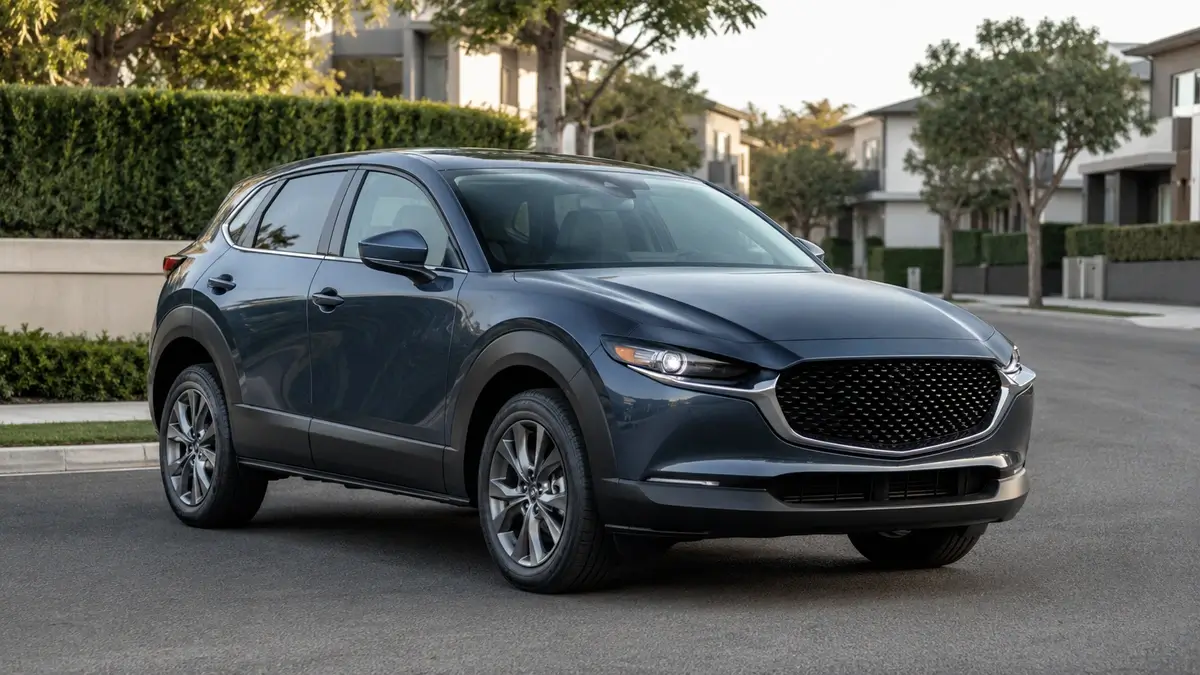
The Mazda CX-30 is a sensible used small SUV for the right buyer. It is not a blind “buy any one” choice.
Its strongest case is simple. You get a nicer cabin and sharper driving feel than many small SUVs. The trade-off is less rear-seat and cargo room than some buyers expect.
Choose the Mazda CX-30 if you want a small SUV that feels upscale, drives well, and does not need maximum family space.
Skip it if you need the roomiest rear seat, the cheapest tires, the lowest ownership cost, or a used car with very little inspection uncertainty.
The safest used-buy formula is a clean, non-turbo CX-30 with service records, matched tires, no open recall issue, and a strong pre-purchase inspection.
What goes wrong if you pick badly: you can overpay for the premium feel, then inherit tire costs, neglected maintenance, warning-light issues, recall work, or turbo-related risk that should have been priced into the deal.
Quick Verdict: Is the Mazda CX-30 Reliable?
The Mazda CX-30 is reliable enough to consider used, but the exact car matters more than the badge.
A clean, well-maintained CX-30 is a much stronger bet than a cheaper one with vague records, mismatched tires, warning lights, or accident-history questions.
Do not judge Mazda CX-30 reliability from one rating score or one owner complaint thread. Ratings help, but they do not show how one used listing was maintained.
| Used-Buyer Question | CarMerit Verdict | What to Check Before Buying |
|---|---|---|
| Is the Mazda CX-30 reliable? | Yes, with normal used-car caution. | Maintenance records, recall status, warning lights, tires, and inspection results. |
| Is it cheap to own? | Not always the cheapest in the class. | Tires, AWD setup, insurance quote, fuel economy, and service history. |
| Should you buy the turbo? | Only if performance matters enough. | Oil-change history, test-drive behavior, and price gap versus non-turbo trims. |
| Should you avoid certain years? | Some years need more careful checks. | Use the Mazda CX-30 Years to Avoid guide for model-year risk. |
| Who should skip it? | Space-first and lowest-cost buyers. | Rear-seat fit, cargo needs, tire cost, and total ownership cost. |
The CX-30’s strongest reliability case is not that it is perfect. It is that the main risks are manageable when the car has records and passes inspection.
The weak case is space and cost sensitivity. If you need more room or the lowest long-term expense, compare it with a broader list of best used small SUVs before committing.
How This Reliability Guide Was Judged
This guide is written for U.S. used Mazda CX-30 buyers, mainly 2020 and newer models. It does not rank every model year as a full years-to-avoid article.
The goal is practical risk filtering. Reliability ratings, owner complaints, maintenance needs, AWD or turbo factors, and inspection checks are treated as parts of the same buying decision.
This guide does not use exact repair-cost promises. Costs vary by mileage, location, labor rate, warranty status, trim, tire size, and prior maintenance.
| Factor | Buyer Risk Level | What It Affects | What to Check Before Buying | Proof Type Used |
| Reliability rating context | Medium | Confidence level | Compare ratings with real vehicle condition. | Rating/reference source |
| Model-year caution | Medium | Used-buy risk | Recall status, complaints, and service records. | NHTSA and year guide |
| Owner-reported complaints | Medium | Inspection focus | Repeat themes, not one-off posts. | Concern discovery only |
| Maintenance history | High | Long-term durability | Receipts, oil changes, and scheduled service. | Mazda maintenance information |
| Tires and AWD | Medium | Running cost and drivability | Matched tire wear and alignment. | Ownership logic plus official AWD context |
| Turbo engine | Medium | Cost and abuse risk | Maintenance records and test drive. | Mazda specs plus inspection |
| Fuel economy | Medium | Ownership cost | Exact year, engine, and AWD setup. | FuelEconomy.gov |
| Insurance and ownership cost | Medium | Monthly cost | Quote before buying. | Buyer-specific check |
| Pre-purchase inspection | High | Buy or walk decision | Independent inspection result. | Final condition proof |
The most important proof is still the actual vehicle. A clean inspection beats broad reputation, and weak records should reduce the price or end the deal.
Mazda CX-30 Reliability Ratings: What They Do and Do Not Prove
Reliability ratings are useful, but they are not a purchase decision by themselves.
J.D. Power lists the 2023 Mazda CX-30’s Quality & Reliability score in average territory. That supports a cautious “acceptable” verdict, not a claim that every CX-30 is trouble-free.
A higher rating should not cancel a weak inspection. A lower or average rating should not automatically kill a clean car with strong records.
| Rating Signal | What It Helps With | What It Does Not Prove | Used-Buyer Takeaway |
| J.D. Power quality and reliability | Broad owner-reported defect context | Condition of a specific used car | Useful as one signal, not the final answer. |
| Consumer and owner reviews | Real-world satisfaction themes | Frequency or severity of defects | Use them to spot concerns to inspect. |
| NHTSA recall and complaint data | Safety recalls and complaint patterns | Future repair cost for your car | Check the exact model year and VIN. |
| Service history | Actual care of the vehicle | Future reliability guarantee | Strong records improve the case. |
| Inspection result | Current condition | Long-term certainty | Best final filter before purchase. |
For a used CX-30, layer the evidence. Start with ratings, check recalls, review service records, then inspect the actual vehicle.
That is slower than trusting one score. It is also safer.
Mazda CX-30 Reliability by Year: Which Used Years Need More Care?
The CX-30 is still a relatively young model line. Model-year judgment should stay careful.
Do not treat early online complaints as proof that an entire year is bad. Also do not assume a newer year is safe if the records are weak.
The better move is to separate year risk from car condition. A newer CX-30 with poor maintenance can be a worse buy than an older one with clean records.
| Used CX-30 Group | Reliability Caution Level | Why It Matters | Best Buyer Move |
| Early 2020 models | Moderate | First-year used examples deserve closer checks. | Inspect service records, recall status, battery history, and infotainment behavior. |
| 2021 to 2022 models | Moderate | More used inventory, but condition varies widely. | Compare mileage, maintenance, tires, and accident history. |
| 2023 models | Low to moderate | Often newer, but not automatically risk-free. | Check warranty status, tires, recalls, and service records. |
| 2024 and newer models | Low to moderate | Newer age helps, but recalls can still be VIN-specific. | Use Mazda and NHTSA recall tools before buying. |
| Any turbo model | Moderate | More performance raises the inspection standard. | Verify maintenance and avoid abused examples. |
For year-specific buying advice, use the dedicated Mazda CX-30 Years to Avoid page. This reliability guide only summarizes the risk logic.
Before buying, check the exact vehicle through NHTSA’s recall lookup and Mazda’s official recall lookup. Recalls can depend on model year, build date, and VIN.
Mazda CX-30 Recall / VIN Checks That Can Affect Ownership Risk
| Recall due-diligence area | Affected model years | Recall rows | Buyer risk if unresolved | What to verify |
|---|---|---|---|---|
| Brake caliper or ABS braking checks | 2020, 2022-2023 (Gen 1) | 3 | Reduced braking performance can change the buy/walk decision. | Confirm recall completion and test brake feel before purchase. |
| AWD fuel-system vent hose | 2020 (Gen 1) | 1 | Fuel leak or stalling risk can make a cheap early CX-30 unsafe to accept without proof. | Confirm the VIN is repaired, especially on AWD examples. |
| Power liftgate lowering unexpectedly | 2020-2021 (Gen 1) | 2 | A liftgate issue may affect safety and daily usability. | Verify repair status if equipped with a power liftgate. |
| Tire valve air leak | 2021 (Gen 1) | 1 | Sudden air loss can affect control and tire safety. | Confirm recall completion and inspect tire service records. |
| Forward sensing camera | 2024 (Gen 1) | 1 | Camera faults can affect automatic emergency braking, lane-keep, and headlight assist. | Check recall status and test driver-assist warnings. |
| SAS airbag sensor software | 2024-2025 (Gen 1) | 2 | Airbags may be deactivated if the issue is unresolved. | Confirm SAS software update or replacement before buying. |
Table note: These rows are ownership-risk recall checks, not a full campaign history. Use the exact VIN because build date, equipment, and completed repairs decide whether a recall applies.
IIHS Safety Context That Matters When Shopping a Used CX-30
IIHS ratings do not tell you whether a CX-30 will be reliable or cheap to own. They are still useful when they identify a model-year, test-era, or equipment difference you can verify before buying. The 2026 IIHS CX-30 page shows the newer test families, while the 2021 IIHS CX-30 page captures the important early headlight split.
| IIHS Check | Rating | Verified Scope | Used-Buyer Meaning |
|---|---|---|---|
| Small overlap front | G | 2020–2026 | A consistent Good result across these model years under this test family. |
| Updated side test | G | 2023–2026 | Newer CX-30s have a Good result under the updated side test; do not treat it as directly comparable with the discontinued original side test. |
| Vehicle-to-vehicle front crash prevention 2.0 | A | 2025–2026 | The current IIHS vehicle-to-vehicle 2.0 result is Acceptable, so the safety picture should not be flattened into one all-Good label. |
| Headlights | P / G by configuration and build date | Early Premium: P for 2020–2021 models built before October 2020; Premium built after September 2020: G for 2021–2026; non-adaptive LED configurations listed by IIHS: G for 2020–2026 | If you are considering an early Premium, verify the build date and actual headlight configuration rather than assuming every CX-30 has the same rating. |
Table Note: IIHS ratings apply only to the exact test family, model year, equipment, and build-date scope shown. Discontinued original tests and newer updated tests should not be treated as one continuous scale. G = Good, A = Acceptable, M = Marginal, P = Poor. IIHS safety evidence is not reliability, repair-cost, or ownership-cost evidence.
The headlight split is the most useful equipment-specific check here. An early Premium trim can carry a materially different IIHS headlight result from the later configuration, so build date and equipment matter more than the trim name alone.
Common Mazda CX-30 Problems and Owner Complaints to Check
Owner complaints are useful because they show what shoppers worry about. They are not proof that every CX-30 has those problems.
Use owner feedback as an inspection list. If a concern could affect buyer confidence, test it during the drive and verify it with records.
| Concern Area | Buyer Risk Level | What It Can Affect | What to Check |
| Infotainment or electronics complaints | Medium | Daily usability | Screen behavior, controls, phone pairing, and warning messages. |
| Battery or low-voltage complaints | Medium | Starting reliability and electronics | Battery age, battery test result, service history, and warning lights. |
| Tire wear or alignment | Medium | Ownership cost | Even tread wear, matching tires, vibration, and pulling. |
| Brake feel or noise | Low to medium | Maintenance cost | Brake pad life, rotor condition, and noise on test drive. |
| AWD-related wear sensitivity | Medium | Tires and driveline smoothness | Matched tires, no binding, and no drivetrain noise. |
| Turbo wear risk | Medium | Repair exposure | Oil-change history, smoke, hesitation, rough idle, and boost behavior. |
| Interior space complaints | Not a defect | Buyer fit | Rear-seat comfort and cargo test before purchase. |
Complaints should guide inspection, not create panic. A clean inspection and service history matter more than random online noise.
Mazda CX-30 NHTSA Complaint Areas to Use as Inspection Prompts
| NHTSA owner-reported area | Complaint count | Affected years | What it can point to | Used-buyer check |
|---|---|---|---|---|
| Engine | 56 | 2020-2023, 2025 (Gen 1) | Engine behavior, low-oil concerns, warning lights, or drivability complaints | Check oil-change history, warning lights, idle quality, smoke, hesitation, and scan results. |
| Electrical | 32 | 2020-2022, 2024-2025 (Gen 1) | Electronics, software, warning messages, or usability complaints | Test infotainment, phone pairing, dash warnings, battery health, and all major controls. |
| Brakes | 26 | 2020-2025 (Gen 1) | Brake feel, stopping confidence, or brake-system concern patterns | Test brake feel, pulsing, pulling, noises, and confirm any brake-related recall work. |
| Airbags / seatbelts / structure | 22 | 2020-2024 (Gen 1) | Safety-restraint or body-related complaint patterns | Check airbag lights, seatbelt function, accident history, and recall status. |
| Driver-assist systems | 18 | 2021-2025 (Gen 1) | ADAS alerts, braking assist, lane-assist, or sensing complaints | Test driver-assist features carefully and check for warning messages. |
| Visibility / wipers | 16 | 2020-2024 (Gen 1) | Glass, mirror, wiper, or visibility-related complaints | Check windshield, mirrors, wipers, sensors, and rain/light-related functions. |
| Suspension / wheels | 10 | 2020-2023, 2025 (Gen 1) | Wheel, tire, vibration, or suspension-related complaints | Inspect tire wear, vibration, alignment, wheel damage, and suspension noise. |
Table note: These are owner-filed NHTSA complaint areas for 2020-2025 CX-30 records. Use them as inspection prompts, not defect rates or proof that every vehicle has the same problem.
Walk away if the seller dismisses warning lights, cannot explain repairs, or refuses an independent inspection. That is a bigger problem than most CX-30 reputation concerns.
Mazda CX-30 Cost to Own: Maintenance, Repairs, Tires, Fuel, and Insurance
Mazda CX-30 cost of ownership is not just repair risk. It also includes maintenance, tires, fuel, insurance, registration, and the cost of choosing AWD or turbo power.
Mazda’s official owner information includes a scheduled maintenance section, which is why records matter. Maintenance is not background paperwork. It is part of the reliability case.
| Cost Bucket | Expected Buyer Impact | Why It Matters | What to Do Before Buying |
| Routine maintenance | Normal | Oil, filters, inspections, fluids, and scheduled service keep the car healthy. | Ask for receipts and compare them with Mazda’s maintenance guidance. |
| Tires | Moderate | AWD models are more sensitive to tire matching and uneven wear. | Check tread depth and tire brand on all four corners. |
| Fuel | Configuration-dependent recurring cost | EPA ratings change by model year, drivetrain, and turbo setup. The turbo 4WD configuration is rated lower than the comparable non-turbo 4WD configuration in the 2021–2026 records. | Match the exact year and configuration through FuelEconomy.gov and use the table below instead of one CX-30-wide MPG number. |
| Insurance | Buyer-specific | Premium-feeling small SUVs may not quote the same for every driver. | Get an insurance quote before purchase. |
| Repairs | Condition-based | Used condition matters more than broad reputation. | Get an independent inspection. |
| Turbo ownership | More frequent spark-plug service plus lower EPA MPG | Across the verified CX-30 schedules, Mazda lists spark-plug replacement at 40,000 miles for the 2.5T versus 75,000 miles for the naturally aspirated 2.5L. | Verify the exact model-year Mazda scheduled-maintenance guidance, spark-plug service at the applicable mileage, oil-change history, and the exact EPA configuration before paying extra for the turbo. |
Mazda CX-30 EPA Fuel Economy: Used-Buyer Configuration Differences
For used buyers, the useful comparison is the exact drivetrain and engine, not one CX-30 average. FuelEconomy.gov shows the following decision-relevant configuration differences.
| Model Year | EPA Configuration | City | Highway | Combined |
|---|---|---|---|---|
| 2020–2021 | 2.5L 2WD | 25 | 33 | 28 |
| 2020 | 2.5L 4WD | 24–25 | 31–32 | 26–27 |
| 2021–2022 | 2.5L 4WD, non-turbo | 24 | 31 | 26 |
| 2021–2026 | 2.5L Turbo 4WD | 22 | 30 | 25 |
| 2023–2025 | 2.5L 4WD, non-turbo | 26 | 33 | 29 |
| 2026 | 2.5L 4WD, non-turbo | 24 | 31 | 27 |
Table Note: EPA city/highway/combined MPG for the exact configuration bands shown, not model-wide averages or guaranteed real-world results. The 2020 4WD range reflects separate official EPA configuration records, not an averaged value. FuelEconomy.gov labels these records 4WD; Mazda markets the system as AWD. Current fuel-price or annual-fuel-cost data is not used here, and EPA fuel economy is not total ownership cost.
On the 4WD models, the turbo configuration stays at 25 mpg combined in the EPA records from 2021 through 2026, while the non-turbo 4WD configuration ranges from 26 to 29 mpg combined depending on model year. That makes fuel economy a real recurring-cost trade-off when deciding whether the turbo’s extra performance is worth it.
The best low-friction choice is usually a non-turbo CX-30 with clean records. It gives most buyers the CX-30 experience without the extra performance-related risk.
The turbo can still be worth buying. It just needs a better maintenance trail and a stronger inspection result.
VIN-Specific Mazda Coverage That Can Change the Cost Decision
Before assuming a possible repair will be fully out of pocket, check Mazda’s VIN-specific coverage records in addition to recall status. Mazda documents show that CSP12 can cover a confirmed in-tank low-pressure fuel-pump failure for certain 2020 CX-30s for up to 15 years or 150,000 miles from the vehicle in-service date.
SSPD8 can cover a qualifying engine-temperature or heater-performance condition on certain 2020–2023 CX-30s for 15 years or 150,000 miles from the original warranty start date. SSPD5 extends powertrain coverage to 7 years or 84,000 miles for certain Mexico-built 2021–2022 CX-30 2.5T vehicles.
When one of these fuel-pump, temperature-control, or 2.5T powertrain issues appears in a CX-30’s history, CarMerit’s Manufacturer Special Coverage Lookup can help you identify the relevant model-year program before Mazda confirms whether the exact VIN and current terms qualify.
These programs do not prove that a vehicle has the covered condition, and model year alone does not establish eligibility or remaining coverage. Before assigning any value to the coverage, have a Mazda dealer verify the exact VIN and build eligibility, current mileage, original warranty or in-service date, and any required diagnosis.
Turbo, AWD, and Trim Factors That Can Change Ownership Risk
Not every CX-30 carries the same ownership risk. Engine, trim, tires, and equipment can change both cost and complexity.
Mazda’s current official CX-30 information shows standard i-Activ AWD on current CX-30 models and an available 2.5 Turbo engine. For used shopping, still verify the exact model year, trim, drivetrain, engine, and window sticker before paying a premium.
| Configuration Factor | What Changes | Best Used-Buyer Rule |
| Non-turbo engine | Lower performance, simpler ownership case | Best default for most used buyers. |
| Turbo engine | More power, higher inspection stakes | Buy only if performance matters and records are strong. |
| AWD | More traction confidence, more tire sensitivity | Check matched tires and driveline smoothness. |
| Higher trims | More features and more equipment to verify | Test every feature before paying extra. |
| Larger wheels | Often higher tire replacement cost | Price replacement tires before buying. |
| Premium interior features | Better feel, more things to inspect | Check electronics, seats, controls, and infotainment. |
Trim upgrades are not bad. The problem is paying premium money for features that do not work correctly or do not matter to your use case.
A cheaper lower trim in excellent condition can be a better buy than a loaded trim with weak records.
Used Mazda CX-30 Inspection Checklist
A used Mazda CX-30 should not be bought from reputation alone. You need a clean inspection path before the price makes sense.
Use this checklist before you commit. It targets the issues that matter most for reliability and ownership cost.
Before applying those checks to a particular CX-30, confirm that the vehicle in the listing is the one you have actually researched. Run the CX-30’s VIN through CarMerit and compare the returned vehicle details with the seller’s description and paperwork. Once they line up, use the checklist below to judge maintenance records, recall status, tires, electronics, drivetrain behavior, and the vehicle’s actual condition.
| Inspection Item | Pass Sign | Warning Sign | Buyer Action |
| Maintenance records | Receipts match mileage and time | Vague “dealer serviced” claim only | Ask for proof or discount the car. |
| Recall status | No open safety recall | Seller has not checked VIN | Check Mazda and NHTSA before purchase. |
| Tires | Matching set, even wear | Mixed tires, uneven wear, vibration | Budget for tires or walk away. |
| Battery and electronics | Starts cleanly, no warning lights | Low-voltage history or warning messages | Request battery test and scan. |
| Infotainment | Pairs phone and works normally | Freezing, lag, random disconnects | Test during the drive. |
| Engine behavior | Smooth idle and acceleration | Hesitation, smoke, rough idle | Get mechanic inspection. |
| Transmission behavior | Smooth shifts | Harsh shift, delay, flare | Avoid unless diagnosed. |
| Brakes and suspension | Quiet and stable | Clunks, pulsing, pulling | Inspect before negotiating. |
| Accident history | Clean records and even panel gaps | Paint mismatch or structural signs | Be careful even if price is low. |
| Interior fit | Seats and cargo work for you | Rear seat or cargo feels too tight | Choose a larger SUV. |
Pay special attention to tires on AWD examples. A mismatched or badly worn set can turn a good deal into an immediate cost.
For turbo models, records matter even more. A fun test drive is not enough if the oil-change history is missing.
Who Should Buy a Used Mazda CX-30 and Who Should Skip It
The CX-30 is a strong fit for the right buyer. It is a weak fit for shoppers who expect compact-SUV room from a smaller SUV.
The ownership case is best when you value cabin quality, driving feel, and a more premium small-SUV experience. It is weaker when your top priorities are room, low-cost tires, and maximum practicality.
| Buyer Type | Verdict | Why |
| Solo commuter | Good fit | Comfortable, easy to park, and nicer inside than many small SUVs. |
| Couple with light cargo needs | Good fit | Practical enough if rear-seat space is not critical. |
| Driving-feel focused buyer | Strong fit | The CX-30 feels sharper than many rivals. |
| Budget-first buyer | Mixed fit | Ownership cost can be reasonable, but not always class-cheapest. |
| Family with rear-seat needs | Weak fit | Rear space can feel tight. |
| Cargo-first buyer | Weak fit | A larger compact SUV may fit better. |
| Lowest-risk shopper | Mixed fit | Buy only with strong records and clean inspection. |
| Performance buyer | Turbo can fit | Only pay extra if maintenance history is convincing. |
If the CX-30 feels too small, do not force the decision. A larger compact SUV may be the better long-term buy.
If you are comparing alternatives, the Subaru Crosstrek vs Mazda CX-30 guide is the better next step. That comparison handles the choice directly instead of turning this reliability page into a head-to-head article.
If you are cross-shopping the CX-30 against Subaru’s small SUV, do not compare cabin feel alone. Read the Subaru Crosstrek reliability and cost to own guide to judge whether its AWD advantage, tire requirements, CVT behavior, and inspection needs fit your ownership priorities.
Final Recommendation
The Mazda CX-30 is worth buying used if you want a premium-feeling small SUV and you are willing to inspect carefully. It is not the best choice for maximum space or the lowest possible ownership cost.
The safest used-buy formula is simple: choose a clean non-turbo model, verify maintenance records, check recalls, inspect tires, and get a pre-purchase inspection.
A turbo CX-30 can still be a good buy. The bar should be higher because maintenance history and prior owner behavior matter more.
Skip the CX-30 if the records are weak, the tires are mismatched, warning lights are present, or the seller resists inspection. Those are walk-away signals, not minor details.
For a broader reliability shortlist, compare it with other options in Most Reliable Used Cars. The CX-30 can belong on the list, but only if the exact car proves it deserves to stay there.
Frequently Asked Questions
Is the Mazda CX-30 reliable as a used car?
Yes, the Mazda CX-30 is reliable enough to consider used. The safest buys have clean maintenance records, no open recall concerns, good tires, and a clean inspection.
Do not buy one from reputation alone. Used condition matters more than the badge.
Are Mazda CX-30 reliable cars?
Mazda CX-30 models can be reliable cars, but the answer depends on the exact vehicle.
Mileage, maintenance, tires, recall status, and prior owner behavior matter heavily. A well-kept CX-30 is a much better bet than a cheaper one with vague records.
What are the most common Mazda CX-30 problems to check?
Used buyers should check electronics, infotainment behavior, battery condition, tire wear, brakes, recalls, and maintenance history.
Turbo models also need closer engine and service-history checks. Treat owner complaints as inspection prompts, not proof that every CX-30 has the same issue.
Is the Mazda CX-30 expensive to maintain?
The CX-30 is not automatically expensive to maintain, but costs can differ by configuration and service history.
Turbo models deserve extra attention because Mazda specifies spark-plug replacement at 40,000 miles for the 2.5T versus 75,000 miles for the naturally aspirated 2.5L. Check the exact model-year maintenance guidance, service records, tires, and upcoming scheduled work before buying.
What does Mazda CX-30 ownership cost include?
Ownership cost includes routine maintenance, tires, fuel, insurance, repairs, registration, and inspection-related fixes after purchase.
Turbo and higher-trim models may add more cost exposure. The purchase price is only one part of the real cost.
Which Mazda CX-30 years should used buyers inspect more carefully?
Early model years and any higher-mileage or poorly documented CX-30 deserve careful inspection. Newer years still need recall and VIN checks.
Use the dedicated Mazda CX-30 years-to-avoid guide for model-year-specific advice.
Is the Mazda CX-30 AWD more expensive to own?
AWD can add tire and driveline sensitivity. The biggest practical issue is tire condition, because mismatched or unevenly worn tires can create extra cost.
Check that all four tires match and wear evenly before buying.
Is the Mazda CX-30 turbo worth the extra ownership risk?
The turbo is worth considering if the extra performance matters enough to justify higher running and maintenance demands.
EPA records rate the 2021–2026 turbo 4WD configuration at 25 mpg combined, while comparable non-turbo 4WD versions range from 26 to 29 mpg depending on model year. Mazda also specifies 40,000-mile spark-plug replacement for the 2.5T versus 75,000 miles for the naturally aspirated 2.5L.
For most used buyers, a well-maintained non-turbo CX-30 is the lower-friction ownership choice. If you want the turbo, require stronger maintenance records and a clean pre-purchase inspection.
How long can a Mazda CX-30 last?
A Mazda CX-30 can last a long time with proper maintenance, but exact lifespan claims are not safe without knowing the vehicle’s history.
Records, oil changes, climate, mileage, and driving habits all matter. Buy the condition, not a mileage promise.
Is a used Mazda CX-30 better than a Subaru Crosstrek?
The CX-30 is usually better if you want a nicer cabin and sharper driving feel. The Crosstrek is often better if you prioritize utility, rough-road confidence, and practical space.
Use the Subaru Crosstrek vs Mazda CX-30 comparison if that is your real decision.