

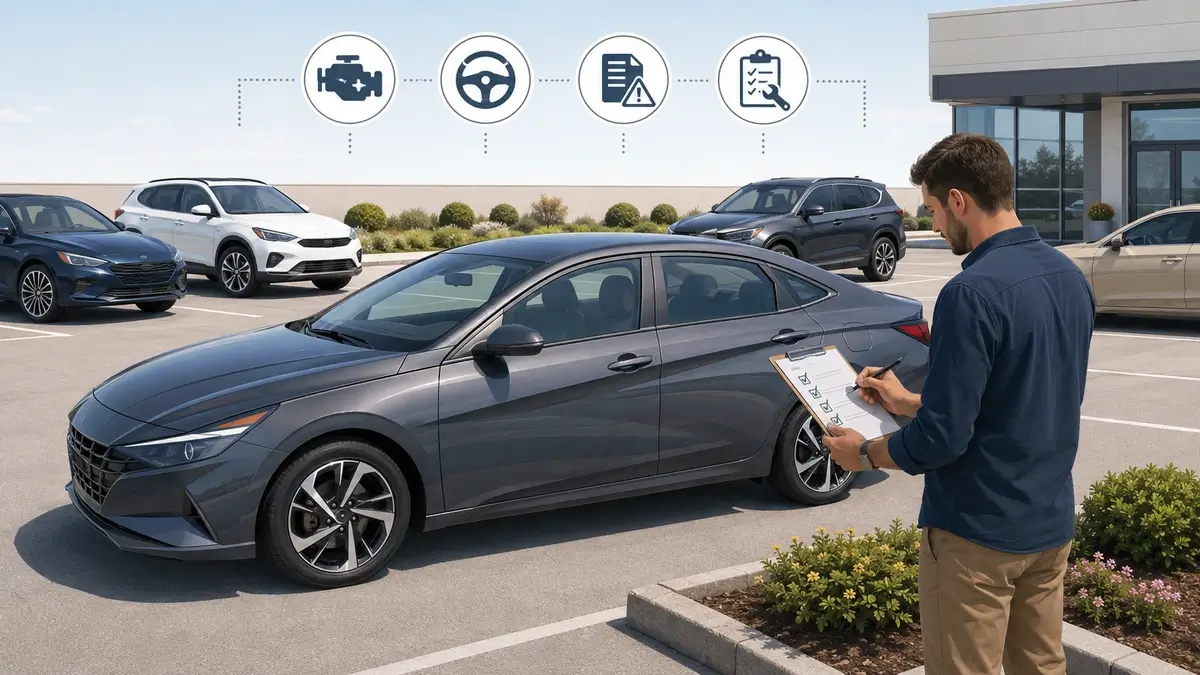
The Hyundai Elantra can be a smart used compact sedan, but the model year matters. Some used Elantras are cheap for a reason.
The Hyundai Elantra years to avoid as default picks are 2011, 2012, and 2013. These years carry the most caution because they sit in the older high-risk window and overlap with major engine, stability-control, brake-light, and recall concerns.
That does not mean every 2011–2013 Elantra is broken. It means you should not make one your first choice unless the price is excellent, the records are strong, all recalls are closed, and a pre-purchase inspection finds no warning signs.
For most used buyers, the better shortlist is 2018–2020 for value or 2023–2025 gas models if the budget allows. Those newer gas models are cleaner starting points because of age and recall profile, not because they are proven problem-free.
CarMerit reliability tool
Check any Elantra year – NHTSA-backed snapshot
Pick a model year to see Hyundai Elantra complaint, recall, investigation, and manufacturer-communication counts from the article’s NHTSA snapshot, plus CarMerit’s used-buy verdict for that year band.
Owner complaints
…
NHTSA, CarMerit snapshot
Recall records
…
NHTSA, CarMerit snapshot
Investigations
…
NHTSA, CarMerit snapshot
Manufacturer communications
…
NHTSA, CarMerit snapshot
Most-reported problem areas
Complaint counts and manufacturer communications are raw NHTSA records, not defect rates or reliability scores. Newer model years have had less time to collect reports, so lower counts do not prove better reliability. Verdicts come from CarMerit’s article guidance. Data source: NHTSA.gov. Always verify VIN recall status, Hyundai campaign status, service records, cold-start engine noise, oil condition, warning lights, steering feel, brake-light operation, rear-camera function, seat-belt recall status, accident or flood history, and independent inspection results before buying. Confirm the exact configuration too: gas Elantra, Elantra N, and Elantra Hybrid can have different recall scopes.
Quick Verdict: Hyundai Elantra Years to Avoid
Here is the clean buying rule.
Avoid 2011–2013 Hyundai Elantra models as your default used-buy choice. These are the highest-caution years in this guide.
Be careful with 2014–2017. Some examples can be worth buying, but only with clean service records, no engine noise, completed recalls, and a strong inspection.
Check 2021–2022 carefully before buying. These newer models are not automatic avoids, but seat-belt and rear-camera recall completion matters.
Shortlist 2018–2020 or 2023–2025 gas models first. These are usually better places to start if you want a lower-friction used Elantra search.
| Model years / used-buy verdict | Why it matters |
|---|---|
| 2011–2013 — Avoid as default picks | Older age, higher inspection burden, engine-related warranty-extension history, and multiple safety-related recall concerns make these years risky for most buyers. |
| 2014–2016 — Buy only if records and inspection are clean | These can be affordable, but they still sit close to the older risk window. Engine condition and recall history matter a lot. |
| 2017 — Conditional buy | Treat it as a careful-inspection year, not a casual budget pick. Do not buy one with warning lights, rough running, poor records, or unclear history. |
| 2018–2020 — Better value-focused shortlist | These are stronger used-buy candidates than the older risk years, assuming the car has clean history and passes inspection. |
| 2021–2022 — Conditional newer buy | These can be good, but check seat-belt and rear-camera recall completion before purchase. |
| 2023–2025 gas models — Cleaner newer starting point | These are newer used candidates with lower age-related risk, but they still need VIN, recall, service, and accident-history checks. |
| 2024–2026 Elantra Hybrid — Special recall check required | Certain hybrid models have a high-voltage power-control recall issue. Check the exact VIN before buying. |
Table Note: The 2023–2025 gas-model shortlist applies to the standard 2.0-liter Elantra sedan. It does not automatically extend to the Elantra N or N Line, which have different powertrains, EPA ratings, maintenance requirements, and campaign scopes.
The safest move is simple: do not chase the cheapest Elantra first. Start with the cleaner years, then use condition, records, and recall status to decide whether a specific car deserves your money.
How We Classified Risk
This guide groups Elantra years as avoid by default, conditional buys, or lower-friction starting points using official recalls and campaigns, warranty-extension history, buyer-relevant problem patterns, vehicle age, maintenance uncertainty, and inspection burden. These are ownership-risk groups, not IIHS crash-safety rankings.
2011 Hyundai Elantra
The 2011 Elantra is not the best place to start. It is old enough now that mileage, maintenance gaps, and previous repairs matter heavily.
It also sits in the older 1.8-liter engine risk window. Hyundai 1.8L Nu engine warranty-extension materials for certain 2011–2016 Elantra models make cold-start noise and engine condition major inspection priorities.
The 2011 model year was also part of Hyundai’s Electronic Stability Control recall campaign. That does not automatically make every car bad, but it adds another verification step.
Buy one only if it is unusually clean, well documented, recall-complete, and priced low enough to justify the risk.
2012 Hyundai Elantra
The 2012 Elantra belongs in the same high-caution group. It is part of the older engine-risk window and the ESC campaign group.
It is also old enough that a cheap purchase price can hide expensive catch-up maintenance. That is the trap with many budget compact sedans.
Skip a 2012 Elantra if you hear engine knocking, see warning lights, feel odd steering behavior, or cannot confirm recall completion.
2013 Hyundai Elantra
The 2013 Elantra is one of the clearest years to avoid as a default pick.
It overlaps with multiple buyer-relevant concerns. These include 1.8-liter engine-risk history, ABS-related fire-risk recall coverage for certain vehicles, and stop-lamp switch stopper pad recall coverage for certain 2013–2014 Elantra models.
The practical risk is not just one issue. It is the combined inspection burden.
A 2013 Elantra can still be usable if it has excellent records and no warning signs. But most buyers should start with cleaner years.
2014–2016 Hyundai Elantra
The 2014–2016 Elantra years are not automatic avoids. They are conditional buys.
These years can make sense if the car is clean, recall-complete, and well maintained. They become poor choices when the seller has no records or the car shows early engine, electrical, brake-light, or warning-light issues.
For 2014, pay special attention to stop-lamp recall history. For 2014–2015, confirm whether any ABS-related recall work applies to the exact VIN.
For 2016, focus heavily on engine behavior, service records, and inspection results.
2017 Hyundai Elantra
The 2017 Elantra is a careful-buy year, not a blanket hard avoid.
It was the first year of a redesigned generation. First-year redesigns can carry more buyer uncertainty because ownership patterns are still settling.
Treat a 2017 Elantra as conditional. It can be worth buying when records are strong, the inspection is clean, and the price beats cleaner alternatives.
Walk away from a 2017 if it has rough shifting, engine hesitation, steering warning lights, electrical faults, or unclear maintenance history.
2021–2022 Hyundai Elantra
The 2021–2022 Elantra years are newer, so they do not belong with the older high-risk group. But they are not automatic green lights.
These model years need recall checks before purchase. Hyundai’s Safety Recall 229 covers certain 2021–2022 Elantra and Elantra HEV vehicles for seat-belt pretensioner repair. Hyundai also issued a rear backup camera recall bulletin covering certain 2021–2022 Elantra, Elantra N, and Elantra Hybrid vehicles.
A recall-complete 2021 or 2022 Elantra can still be a good used buy. The problem is buying one casually without checking the VIN.
2024–2026 Hyundai Elantra Hybrid
The 2024–2026 Elantra Hybrid deserves a special note.
NHTSA recall materials for campaign 26V308 identify certain 2024–2026 Hyundai Elantra Hybrid vehicles with a Hybrid Power Control Unit overheating issue. Overheating in the HPCU can increase fire risk, and the listed remedy is a software update.
This warning applies to certain hybrid vehicles, not every gas-only Elantra.
Before buying a near-new Elantra Hybrid, confirm the exact VIN and recall status through official recall tools.
Best Hyundai Elantra Years to Buy Used
The best Hyundai Elantra years depend on budget. A buyer shopping under a tight budget will not be looking at the same cars as someone considering a newer used model.
For most buyers, the cleanest approach is to shortlist by risk level first, then compare individual cars.
| Buyer need / best Elantra years to shortlist | Why they make sense | Still check |
|---|---|---|
| Best value-focused used shortlist — 2018–2020 | These avoid the oldest high-caution years while staying more affordable than the newest cars. | Service records, accident history, tires, brakes, warning lights, and transmission behavior. |
| Best newer used shortlist — 2023–2025 gas models | These are newer, lower-age starting points than 2021–2022 recall-check years. | VIN recall check, warranty status, accident history, and maintenance records. |
| Budget-only option — 2014–2016 | These can be cheaper, but only make sense when the individual car is very clean. | Engine noise, oil condition, recall history, service records, and pre-purchase inspection. |
| Newer but conditional option — 2021–2022 | These can be good if the price is right and recall work is complete. | Seat-belt recall, rear-camera recall, software updates, and seller documentation. |
| Hybrid shopper option — 2024–2026 Elantra Hybrid | Potentially efficient and newer, but not a blind buy. | Hybrid-specific recall status and high-voltage system warning lights. |
EPA Fuel Economy by Exact Elantra Configuration
Fuel economy can help separate two otherwise suitable Elantras, but it does not create a best-year verdict. EPA estimates are configuration-specific, so gas, Hybrid, N Line, Elantra N, transmission, and stop-start versions should not be averaged together.
| Model year(s) | Exact Elantra sedan configuration | City MPG | Highway MPG | Combined MPG |
|---|---|---|---|---|
| 2011–2013 | 1.8L, 6-speed automatic, FWD | 28 | 38 | 32 |
| 2018–2019 | 2.0L, 6-speed automatic, FWD | 28 | 37 | 32 |
| 2020 | 2.0L, IVT, FWD | 30 | 40 | 34 |
| 2020 | Elantra SE, 2.0L, IVT, FWD | 31 | 41 | 35 |
| 2021–2022 | 2.0L, IVT, FWD | 31 | 41 | 35 |
| 2021–2022 | 2.0L, IVT with stop-start, FWD | 33 | 43 | 37 |
| 2023 | 2.0L, IVT, FWD | 30 | 40 | 34 |
| 2023 | 2.0L, IVT with stop-start, FWD | 33 | 42 | 37 |
| 2024 | 2.0L, IVT, FWD | 31 | 40 | 34 |
| 2024 | 2.0L, IVT with stop-start, FWD | 32 | 41 | 36 |
| 2025 | 2.0L, IVT, FWD | 30 | 39 | 34 |
| 2025 | 2.0L, IVT with stop-start, FWD | 32 | 41 | 36 |
| 2021–2025 | Elantra Hybrid, 1.6L hybrid, 6-speed automatic, FWD | 49 | 52 | 50 |
| 2021–2023 | Elantra Hybrid Blue | 53 | 56 | 54 |
| 2024–2025 | Elantra Hybrid Blue | 51 | 58 | 54 |
Table note: These are official EPA/FuelEconomy.gov estimates for the exact Elantra sedan configurations shown. Actual mileage varies. For 2012–2013, the current revised EPA figures control; earlier label figures are not shown. Current fuel-price assumptions and shared owner-reported My MPG data are not used. Do not average gas, Hybrid, N Line, or Elantra N figures, and do not use fuel economy alone to label a year best or worst.
If your budget allows, 2018–2020 is the better older used window. It usually gives you a better balance of age, value, and risk than 2011–2016.
If you want a newer car, 2023–2025 gas models are stronger starting points than 2021–2022. Still check the VIN, because recalls are tied to exact vehicles.
Do not pay a premium based only on a seller’s claim that the car “still has the 10-year warranty.” Hyundai’s 10-year/100,000-mile powertrain warranty is original-owner limited, and subsequent-owner terms differ. Remaining coverage can only be checked using the VIN, original in-service date, current mileage, ownership status, and exact written terms. Hyundai lists 10-year/100,000-mile coverage for named Hybrid battery and system components, but the exact model-year guide and vehicle eligibility still control.
IIHS Safety Details That Can Change Which Elantra You Buy
IIHS results can vary by equipment, headlights, annual award criteria, test family, and build date.
| Model year(s) | IIHS distinction | What the buyer should verify |
|---|---|---|
| 2017 | Specific LED projector headlights were rated Good, while other displayed headlights were rated Poor. Top Safety Pick+ eligibility for 2017–2018 under the 2017 criteria required optional front crash prevention, specific headlights, sedan body style, and a build after March 2016. | Confirm the sedan body style, build date, exact headlights, and front-crash-prevention equipment. |
| 2018 | Top Safety Pick+ eligibility under the 2018 criteria required optional front crash prevention, specific headlights, and a build after December 2017. | Check the driver-door build-date label and confirm the qualifying equipment. |
| 2019–2020 | Top Safety Pick+ eligibility for 2019–2020 under the 2019 criteria required optional front crash prevention, specific headlights, and a build after September 2018. The 2020 Top Safety Pick under the 2020 criteria also required optional front crash prevention and specific headlights. | Verify the build date, headlights, and driver-assistance equipment rather than relying on the model year alone. |
| 2021–2023 | Specific LED projector headlights were rated Good, while the displayed halogen projector headlights were rated Poor. Annual award eligibility required specific headlights. | Identify the exact trim, headlight system, and applicable driver-assistance equipment. |
| 2024 | Headlights were rated Good across all trims. The updated moderate-overlap rating was Marginal for 2024–2025 cars built before November 2024. | Keep the updated moderate-overlap result within its exact test and build-date scope. |
| 2025 | The updated moderate-overlap rating was Marginal for cars built before November 2024 and Good for cars built after October 2024. Top Safety Pick+ eligibility under the 2025 criteria applied to 2025–2026 cars built after October 2024. | Check the driver-door build-date label before assuming which result applies. |
Table Note: IIHS tests and annual award criteria changed over time. Read each result only within its exact 4-door-sedan, equipment, build-date, and test-family scope. Do not treat these ratings as one cross-year score or use them alone to change the article’s reliability or used-buy verdict.
Check the driver-door build-date label, headlights, and driver-assistance equipment on the individual car. The article’s buy, avoid, and conditional groups reflect overall used-buying risk, not one crash test.
Common Problems Behind the Risky Years
The risky Elantra years are not risky because of one vague reliability reputation. The issues that matter are the ones that can change the deal.
| Problem area / years to watch most closely | Why it matters | Buyer check |
|---|---|---|
| Engine noise or failure risk — Certain 2011–2016 models | Engine problems can erase the savings from a cheap used compact sedan. | Cold start the engine, listen for knocking, check oil level, scan for codes, and review service records. |
| Electronic stability control concerns — 2011–2012 | Stability-control faults can affect safety systems and warning-light confidence. | Confirm recall completion and watch for ESC or stability-control warning lights. |
| ABS fire-risk recall coverage — Certain 2011–2015 Elantra vehicles | An open fire-risk recall is a serious ownership and storage concern. | Check the VIN and confirm the recall repair was completed. |
| Stop-lamp switch stopper pad recall — Certain 2013–2014 models | Brake-light and shifting-related faults can create safety and usability problems. | Test brake lights, shifter behavior, and recall records. |
| Seat-belt pretensioner recall — Certain 2021–2022 models | Seat-belt recall status matters before buying any newer used example. | Check the VIN and ask for recall-completion paperwork. |
| Rearview camera recall — Certain 2021–2022 models | A failed rear camera can reduce rear visibility and create safety risk. | Test the camera every time the car is shifted into reverse. |
| Hybrid high-voltage control recall — Certain 2024–2026 Elantra Hybrid models | Hybrid-system recall status can affect safety and drivability confidence. | Check the exact VIN before purchase. |
Engine problems
Engine condition is the biggest reason to be careful with older Elantras.
Hyundai’s piston-slap program applies only to certain 2011–2016 Elantras with the 1.8-liter Nu engine and uses VIN, state, owner-class, and condition rules. Separate extended coverage applies to certain 2014–2016 Elantras with the 2.0-liter GDI engine for connecting-rod-bearing failure, generally with campaign requirements. Neither program proves that every car in those years has an engine defect or that a particular used car is still covered.
Do not buy an older Elantra with knocking, ticking that does not settle, low oil, poor service records, smoke, overheating signs, or active engine codes.
A cheap Elantra with a questionable engine is not a bargain. It is a repair-risk bet.
Warranty Extensions and Coverage Programs Worth Checking
Some Elantra concerns were addressed through Hyundai coverage programs rather than safety recalls. A program’s existence does not prove that every vehicle has the condition or that coverage remains today. Eligibility can depend on VIN, engine, production date, owner class, state, previous campaign work, the exact symptom, and the written terms.
If an older Elantra’s engine, steering, airbag, or suspension history raises a question, use CarMerit’s Manufacturer Special Coverage Lookup to see which Hyundai coverage records overlap that model year before you decide how much repair risk to price into the car.
| Affected Elantra scope | Program term | What the buyer must verify |
|---|---|---|
| 2007–2015 Elantra sedans | Motor-driven power-steering rubber coupling coverage: 10 years or 100,000 miles | Exact VIN and qualifying coupling condition. This is not general steering-system coverage, and Elantra Touring is outside this article’s sedan scope. |
| Certain 2011–2014 vehicles | Driver airbag clock-spring coverage: 15 years, unlimited mileage | Exact VIN and covered clock-spring condition. Do not present it as coverage for every airbag fault. |
| 2012–2016 MD/UD sedans produced April 1, 2011 through December 31, 2015 | Front coil-spring coverage: 10 years or 120,000 miles | Model year, exact production date, VIN, and covered spring condition. |
| Certain 2011–2016 vehicles with the 1.8L Nu engine | Piston-slap program: after the temporary 2021 window, 10 years/120,000 miles for original retail purchasers, lessees, and Hyundai CPO purchasers; 8 years/80,000 miles for other owners under the program boundaries | VIN, 1.8L engine, state, owner class, symptom, neglect exclusions, and current program terms. |
| Certain 2014–2016 vehicles with the 2.0L Nu GDI engine | Connecting-rod-bearing coverage: 15 years or 150,000 miles | Exact VIN and engine, qualifying failure condition, and required campaign or KSDS status. Not every 2014–2016 Elantra is included. |
| Certain 2017 AD/ADa sedans built within the stated 2015–2016 production windows | Door-latch coverage: 10 years, unlimited mileage | VIN, exact production date, and the covered inoperative-door-handle or latch condition. |
| Certain 2015–2018 vehicles with specified factory white paint | White-paint coverage: 10 years, unlimited mileage | VIN, factory color, title status, original paint, affected panel, and condition. Collision-related paint work is excluded. A separate goodwill window for already-expired vehicles ended December 31, 2025. |
| Certain 2021–2025 Elantra and Elantra Hybrid vehicles; certain 2022–2025 Elantra N vehicles | Horn-assembly coverage: 10 years or 120,000 miles | Exact VIN and an inoperable-horn condition. Coverage is vehicle- and condition-specific, applies to original and subsequent owners, and is not general electrical-system coverage. |
These programs are not recalls, defect-rate evidence, or proof that a used car remains covered. Ask Hyundai to confirm the VIN and current written terms before treating any program as part of the deal. A vehicle can fall inside a model-year range and still be ineligible because of its engine, build date, ownership history, state, title, campaign status, or actual condition.
Steering and stability-control concerns
For 2011–2012 models, Hyundai’s ESC campaign makes recall history important.
During a test drive, check whether the car tracks straight, whether the steering feels normal, and whether stability-control or steering warning lights appear.
Do not ignore warning lights because the car is cheap. Warning lights are negotiation points only when the cause is already diagnosed and minor.
Brake-light and shifter concerns
Certain 2013–2014 Elantra models were included in a brake pedal stopper recall.
Before buying, test the brake lights repeatedly. Make sure the shifter behaves normally and there are no brake or stability-system warnings.
This is not a reason to reject every 2013 or 2014 automatically. It is a reason to verify repair history before paying.
Seat belts and rear camera on 2021–2022 models
Newer does not always mean simpler.
Certain 2021–2022 Elantra vehicles are tied to seat-belt pretensioner recall coverage. Certain 2021–2022 Elantra and Elantra Hybrid vehicles are also tied to rear-camera recall coverage.
Check both before buying. A newer car with open recall work should not be treated like a clean example.
Generation-by-Generation Used Buying Notes
2007–2010 Hyundai Elantra
These older Elantras are now mainly condition buys.
Do not overpay for one just because it has a simple reputation. Age, rust, maintenance gaps, worn suspension, old tires, and accident history matter more now.
Buy one only as cheap transportation after a clean inspection.
2011–2016 Hyundai Elantra
This is the main caution window.
These years are cheap and common, but they require the most discipline. Engine condition, recall history, maintenance records, and inspection results decide the deal.
The weaker buy is a high-mileage 2011–2013 with poor records. The better conditional buy is a clean 2014–2016 with strong documentation and no engine warning signs.
2017–2020 Hyundai Elantra
This generation is more attractive for many used buyers.
The 2017 model deserves extra caution because it is the first year of the redesign. The better value-focused shortlist usually starts with 2018–2020.
That does not mean 2018–2020 models are risk-free. It means they are stronger starting points than the older high-caution years.
2021–Present Hyundai Elantra
The newer Elantra has better appeal for buyers who want modern features, newer styling, and lower age.
The trade-off is price and recall diligence. Check 2021–2022 carefully for recall completion. For 2023–2025 gas models, still verify VIN history before treating the car as clean.
For hybrids, check hybrid-specific recall status before purchase.
Recalls, Complaints, and Safety Checks Before Buying
Before buying any used Elantra, get the 17-character VIN. Do not rely only on the seller’s word.
Start with the official NHTSA recall lookup. Search the VIN, then also check by year, make, and model.
Next, check Hyundai’s campaign pages when a campaign applies. Important examples include the 2011–2012 ESC campaign, the 2013–2014 brake pedal stopper recall, and the 2021–2022 seat-belt pretensioner campaign.
Buyer-Relevant NHTSA Recall Campaigns to Verify Before Buying
| NHTSA campaign | Affected Elantra years / generation | Main issue | Fire risk? | Buyer check |
|---|---|---|---|---|
| 13V113000 | 2007 to 2011 (Gen 4, Gen 5) | Stop-lamp switch can affect brake lights, cruise control, shift interlock, or ESC warning behavior. | No | Confirm stop-lamp switch recall completion on older examples before treating them as clean. |
| 15V871000 | 2011 to 2012 (Gen 5) | ESC sensor malfunction can apply brakes unexpectedly and reduce engine power. | No | Match this to the article’s 2011 to 2012 stability-control caution and verify recall status by VIN. |
| 17V769000 | 2013 to 2014 (Gen 5) | Brake pedal stopper pad can cause brake lights to stay on and allow shifting out of Park. | No | Test brake lights and shifter behavior, then confirm recall repair paperwork. |
| 20V061000 | 2007 to 2011 (Gen 4, Gen 5) | ABS module moisture can cause an electrical short. | Yes | For 2007 to 2011 cars, verify whether ABS fire-risk recall coverage applies to the exact VIN. |
| 23V651000 | 2011 to 2015 (Gen 5) | ABS module brake-fluid leak can create an engine-compartment fire risk. | Yes | Treat open ABS fire-risk recall work as a serious ownership issue before purchase. |
| 22V354000 | 2021 to 2022 (Gen 7) | Front seat-belt pretensioners may explode during deployment. | No | Do not treat a 2021 or 2022 as clean until seat-belt recall completion is verified. |
| 23V589000 | 2021 to 2023 Elantra HEV (Gen 7) | Motor-control software error may cause unintended acceleration after brake release. | No | Hybrid shoppers should verify software-related recall status, not just gas-model history. |
| 24V879000 | 2021 to 2022 (Gen 7) | Rearview camera image may fail to display. | No | Test the backup camera during inspection and confirm recall completion. |
| 26V307000 | 2015 to 2016 (Gen 5) | Driver air-bag inflator may rupture during deployment. | No | Add air-bag recall status to the inspection checklist for 2015 to 2016 cars. |
| 26V308000 | 2024 to 2026 Elantra Hybrid (Gen 7) | Hybrid Power Control Unit can overheat. | Yes | For near-new hybrids, verify the exact VIN before purchase because this is hybrid-specific. |
Table note: This is not every Elantra recall. It lists the campaigns most relevant to the article’s used-buying cautions, especially brake-light, ESC, ABS fire-risk, seat-belt, camera, air-bag, and hybrid-specific checks.
For older ABS fire-risk recall coverage, confirm whether the exact car appears in Hyundai or NHTSA recall materials. An NHTSA consumer alert said Hyundai and Kia issued “park outside” recalls, and the Hyundai list included 2011–2015 Elantra.
For 2021–2022 models, verify whether the rear-camera recall applies. Test the backup camera during the inspection.
For 2024–2026 Elantra Hybrid models, check the high-voltage power control unit recall by VIN before purchase.
A clean recall lookup is useful, but it is not the whole story. Ask for service receipts and repair records too.
Also review NHTSA complaints by exact model year. Complaints are not proof that every car from that year is bad. They are warning signals that help you know what to inspect.
Hyundai Elantra NHTSA Snapshot by Model Year, 2007–2026
| Model year / generation | Owner complaints | Recalls | Investigations | Mfr communications | Top complaint component |
|---|---|---|---|---|---|
| 2007 (Gen 4) | 266 | 6 | 3 | 50 | Airbags / Seatbelts / Structure, safety (61) |
| 2008 (Gen 4) | 315 | 7 | 2 | 41 | Airbags / Seatbelts / Structure, safety (47) and Steering (47) |
| 2009 (Gen 4) | 279 | 4 | 2 | 46 | Steering (128) |
| 2010 (Gen 4) | 450 | 4 | 2 | 44 | Steering (198) |
| 2011 (Gen 5) | 460 | 8 | 3 | 116 | Airbags / Seatbelts / Structure, safety (84) |
| 2012 (Gen 5) | 671 | 5 | 4 | 106 | Airbags / Seatbelts / Structure, safety (139) |
| 2013 (Gen 5) | 1,338 | 4 | 3 | 153 | Brakes (243) |
| 2014 (Gen 5) | 389 | 2 | 1 | 141 | Engine (141) |
| 2015 (Gen 5) | 259 | 3 | 1 | 137 | Engine (78) |
| 2016 (Gen 5) | 292 | 2 | 1 | 123 | Engine (104) |
| 2017 (Gen 6) | 781 | 4 | 1 | 152 | Engine (260) |
| 2018 (Gen 6) | 323 | 1 | 0 | 135 | Engine (141) |
| 2019 (Gen 6) | 253 | 1 | 0 | 115 | Engine (124) |
| 2020 (Gen 6) | 246 | 3 | 0 | 97 | Engine (97) |
| 2021 (Gen 7) | 157 | 7 | 2 | 87 | Electrical (36) |
| 2022 (Gen 7) | 149 | 8 | 1 | 93 | Airbags / Seatbelts / Structure, safety (33) |
| 2023 (Gen 7) | 156 | 4 | 0 | 64 | Electrical (29) |
| 2024 (Gen 7) | 56 | 2 | 0 | 29 | Electrical (16) |
| 2025 (Gen 7) | 29 | 2 | 0 | 24 | Driver-assist / ADAS (10) and Unknown / other (10) |
| 2026 Elantra Hybrid (Gen 7) | N/A | 1 hybrid recall | N/A | N/A | N/A |
Table Note: Owner complaints are raw NHTSA reports, not defect rates. The 2026 row is included only because NHTSA recall records show a recall affecting 2024–2026 Elantra Hybrid models; the corresponding 2026 complaint, investigation, and manufacturer-communication row was not available in the NHTSA model-year records used here.
What to Inspect Before Buying a Used Elantra
A used Elantra inspection should not be generic. It should focus on the problems that can make this car a bad buy.
Because Elantra buying risk can change by model year and powertrain, first make sure the exact car matches what the seller is advertising. Run the Elantra’s VIN through CarMerit and compare the returned vehicle details with the listing and paperwork. If anything does not line up, resolve it before you start judging engine condition, service records, recall status, or the rest of the inspection.
Engine checks
Start the engine cold. Listen for knocking, loud ticking, or rough idle.
Check for warning lights. Look for oil leaks, low oil, coolant issues, smoke, or signs that the car was poorly maintained.
Ask for oil-change records. If the seller has no records on an older high-mileage Elantra, treat that as a risk.
Service-Record Checkpoints for Newer Elantras
Do not accept “regularly maintained” without checking what was actually done. The exact official schedules retained for specific configurations show:
- 2021 2.0-liter gas: engine oil and filter every 8,000 miles or 12 months under normal use; spark plugs at 96,000 miles; first coolant replacement at 120,000 miles or 120 months, followed by every 30,000 miles or 24 months.
- 2022–2023 2.0-liter gas: engine oil and filter every 8,000 miles or 12 months under normal use.
- 2022 N Line: spark plugs at 47,000 miles.
- 2023 N Line: spark plugs at 48,000 miles.
- 2021 Elantra Hybrid: engine oil and filter every 7,500 miles or 12 months under normal use; spark plugs at 102,500 miles; inspect the hybrid starter-generator belt every 7,500 miles or 12 months and replace it every 67,500 miles or 48 months.
Severe-use conditions can include repeated short trips, dusty or sandy roads, road salt, mountain driving, rough roads, and extended idling or low-speed operation. Use the exact owner’s manual to identify any shorter severe-use interval. For 2024–2026 vehicles, verify the VIN-linked schedule or the exact model-year manual rather than copying an earlier interval. Missing records do not prove neglect, but they increase uncertainty.
These intervals apply only to the years, engines, and operating conditions stated. Do not extend the gas or N Line schedule to the Hybrid, Elantra N, earlier model years, or other configurations.
Transmission and drivability checks
During the test drive, check for hesitation, hard shifts, slipping, or jerky low-speed behavior.
A compact sedan should feel simple and predictable. If it feels rough, do not assume it is normal.
Steering and warning-light checks
Turn the wheel at low speed. Drive straight on a smooth road. Check whether the car pulls, wanders, or shows steering or stability-control warnings.
Any warning light needs an explanation before purchase, not after.
Brake-light and shifter checks
On 2013–2014 models, test the brake lights. Confirm the shifter moves properly and the brake pedal feels normal.
This is a small check that can save a lot of frustration.
Recall-completion checks
Ask for written proof that recalls were completed. A seller saying “it was handled” is not enough.
For 2021–2022 models, confirm seat-belt and rear-camera recall status. For affected hybrids, confirm hybrid recall status.
Pre-purchase inspection trigger points
Pay for a pre-purchase inspection if the car is 2011–2017, high-mileage, missing records, priced suspiciously low, or showing any warning light.
Skip the car if the seller refuses an inspection.
Should You Buy a Used Hyundai Elantra?
Yes, a used Hyundai Elantra can be a good buy if you choose the right year and avoid weak examples.
It makes the most sense for a buyer who wants a practical compact sedan, lower purchase price, decent fuel economy, and simple daily transportation.
It makes less sense if you want the lowest-risk compact sedan possible. In that case, compare it against a Corolla or Civic before committing.
Choosing the right year is only half the decision; engine, transmission, maintenance, recall status, mileage, and current condition still determine whether a specific Elantra is worth buying. Use the Hyundai Elantra reliability guide for the model-level ownership-risk checks before you inspect a listing.
If you are choosing between the Elantra and Toyota’s compact sedan, read the Hyundai Elantra vs Toyota Corolla guide next. If you are cross-shopping Honda, use the Hyundai Elantra vs Honda Civic comparison.
If you want a broader shortlist, start with the Best Used Compact Cars guide. If long-term risk is your main concern, also compare against the Most Reliable Used Cars list.
If you are shopping affordable compact sedans, read the Kia Forte years to avoid guide before deciding which used sedan has the cleaner ownership path.
The final rule is simple: buy the Elantra only when the year, records, VIN check, and inspection all agree. If one of those fails, move to a cleaner car.
Frequently Asked Questions
What Hyundai Elantra years should I avoid?
The Hyundai Elantra years to avoid as default used-buy picks are 2011, 2012, and 2013.
These years carry the most caution because of their age, engine-risk history, and overlap with important recall or campaign concerns. A clean example can still exist, but most buyers should start with newer or cleaner years first.
What are the best Hyundai Elantra years to buy used?
The best Hyundai Elantra years to buy used are usually 2018–2020 for value and 2023–2025 gas models for newer used shoppers.
These are better starting points than the older high-caution years. Still check the VIN, records, accident history, and inspection results before buying.
Is the 2013 Hyundai Elantra a bad year?
The 2013 Hyundai Elantra is a high-caution year.
It is not automatically bad in every case, but it has enough buyer-risk overlap that it should not be your default pick. Buy one only if it has strong records, completed recalls, no engine warning signs, and a clean inspection.
Is the 2017 Hyundai Elantra reliable?
A 2017 Hyundai Elantra can be reliable, but it should be treated as a conditional buy.
Do not buy one casually. Check service records, scan for codes, test the transmission and steering, and avoid examples with warning lights or poor history.
Is the 2021 Hyundai Elantra a good used buy?
A 2021 Hyundai Elantra can be a good used buy if recalls are complete and the car has clean history.
Because 2021 is part of the newer generation and has recall-check concerns, do not skip the VIN check. A clean 2021 can work, but a 2023–2025 gas model is often a cleaner newer shortlist if budget allows.
Are Hyundai Elantras reliable enough as used compact sedans?
Yes, but the Elantra is more year-sensitive than some buyers expect.
The better examples can be practical and affordable. The weaker years can turn a cheap purchase into a repair-risk gamble.
What are common Hyundai Elantra problems to check?
Used Elantra shoppers should check for engine noise, oil issues, warning lights, steering or stability-control faults, brake-light problems, transmission behavior, recall completion, and accident history.
For hybrids, also check high-voltage system recall status by VIN.
How do I check Hyundai Elantra recalls before buying?
Get the VIN and use the official NHTSA recall lookup. Then check Hyundai campaign pages when a campaign applies.
Ask the seller for recall-completion records. If the seller cannot prove important recall work was completed, treat the car as unfinished until verified.
Should I buy a high-mileage Hyundai Elantra?
A high-mileage Elantra can make sense only if the year falls in a lower-risk group in this guide, the maintenance records are strong, and the inspection is clean.
Avoid high-mileage 2011–2013 examples unless they are unusually well documented and priced low enough to justify the risk.
What should I inspect before buying a used Hyundai Elantra?
Inspect the engine cold start, oil condition, warning lights, steering feel, transmission behavior, brake lights, recall status, service records, and accident history.
For 2021–2022 models, test the rear camera and confirm seat-belt recall status. For Elantra Hybrid models, check hybrid recall status before purchase.