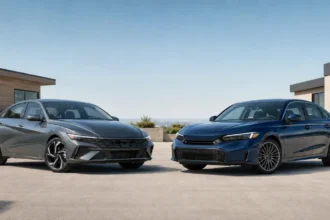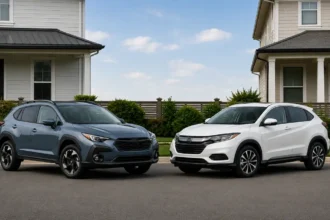



If you are comparing Mazda CX-5 vs. Honda CR-V as a used compact SUV choice, start with this rule: the Honda CR-V is the more practical default for space, family use, fuel economy, and everyday ownership. The Mazda CX-5 is the better fit if you care more about steering feel, cabin polish, and a more premium daily drive.
That does not mean every CR-V is the better used buy. A clean CX-5 with strong service records can beat a rough CR-V. A fairly priced CR-V Hybrid can beat a loaded CX-5 if fuel economy and family practicality matter more than driving feel. The right answer depends on the exact year, trim, powertrain, maintenance history, and price. Do not buy either SUV on brand reputation alone.
Editorial note: Specifications, fuel economy, safety information, and recall references were checked at the date above where hard claims are made. Used-car condition, service history, and local pricing can still change the better buy.
CarMerit reliability comparator
Mazda CX-5 vs Honda CR-V: 2013-2025 NHTSA snapshot
Owner-complaint and recall counts from NHTSA for 2013-2025, each model’s best used-year lane, and which buyer each one fits.
| 2,384 | complaints (2013-25) | 9,277 |
| 20 | recalls (2013-25) | 64 |
EngineElectricalUnknown / otherBrakesExterior lighting | top issues | EngineSteeringFuel systemElectricalDriver-assist (ADAS) |
Mazda CX-5
Best used year: 2017
Shortlist 2017-2020 and 2021-2025; inspect 2016 hardest. Treat 2018-2019 as inspection-priority years, not blanket avoids.
Best for: Driver-focused buyers who want better steering feel, cabin polish, value appeal, and a more premium daily drive.
Honda CR-V
Best used year: 2016
Shortlist 2016 and 2020-2022; check 2015 and 2017-2018 harder for vibration, oil-history, and cold-climate-use proof. Treat 2023-2025 as still maturing.
Best for: Space-first family buyers who prioritize cargo flexibility, fuel economy, and easy daily use.
Quick take: The Honda CR-V is the more practical all-around default for space, family use, fuel economy, and everyday ownership. Choose the Mazda CX-5 when steering feel, cabin polish, value appeal, and a more premium daily drive matter more than maximum room. Do not crown either SUV from raw NHTSA counts alone.
Complaint counts are raw owner reports filed with NHTSA, not adjusted for sales volume, so they should guide inspection rather than crown a winner. The quick comparator above uses a 2013-2025 overlapping NHTSA snapshot for both models; CR-V has older NHTSA history before 2013 and both models have newer records after 2025, but those years are excluded here to keep the comparison balanced. Always inspect the specific vehicle before buying.
Mazda CX5 vs Honda CRV: Quick Verdict for Used Buyers
Choose the Honda CR-V if you want the easier all-around used compact SUV. It is the stronger default for families, commuters who value fuel economy, and buyers who carry people or cargo often. Current CR-V specs list up to 39.3 cubic feet behind the second row in gas trims and up to 76.5 cubic feet with the rear seats folded. Hybrid trims list 36.3 cubic feet behind the second row and 71.8 cubic feet with the rear seats folded.
Choose the Mazda CX-5 if you want a compact SUV that feels more engaging and more upscale from the driver’s seat. Mazda lists the current CX-5 with standard i-Activ AWD, a 2.5-liter engine rated at 187 horsepower and 186 lb-ft of torque, and a 6-speed automatic transmission.
The core trade-off is simple. The CR-V is the more useful tool. The CX-5 is the more enjoyable tool.
Before you decide, remember that used buyers are not buying a spec sheet. You are buying one specific vehicle with one specific history.
| Buyer Need | Better Fit | Why |
|---|---|---|
| Maximum family practicality | Honda CR-V | More useful passenger and cargo layout |
| More engaging drive | Mazda CX-5 | Better steering feel and cabin appeal |
| Fuel economy priority | Honda CR-V Hybrid | Stronger EPA efficiency ratings |
| Standard AWD preference | Mazda CX-5 | Current CX-5 has standard i-Activ AWD |
| Cargo-heavy use | Honda CR-V | Stronger cargo-first case, especially against prior-generation CX-5 examples |
| Premium feel on a tighter budget | Mazda CX-5 | Often feels more upscale than its price suggests |
| Most practical default for most used buyers | Honda CR-V | Easier fit for families, commuters, and practicality-focused shoppers |
If $20,000 is your ceiling, compare like-for-like CX-5 and CR-V listings by model year, mileage, trim, condition, accident history, and service records. Use our best used cars under $20,000 guide to widen the shortlist before deciding which local listing offers the strongest value.
Which SUV Fits Your Situation Better?
The CR-V is usually the better pick if the SUV will serve as a family tool. Rear-seat room, cargo flexibility, visibility, and fuel economy matter more in that use case than steering feel.
The CX-5 is usually the better pick if you mostly drive solo or with one passenger and want a more satisfying daily drive. It is not the roomiest compact SUV, but it can feel more special than many practical rivals.
Think of it this way: if you carry kids, a stroller, sports bags, and groceries every week, start with the CR-V. If you mostly commute, take weekend drives, and want the SUV to feel less dull, test-drive the CX-5 before defaulting to Honda.
Use this table as a first filter. The final choice should still come down to condition, records, trim, and price.
| Situation | Mazda CX-5 | Honda CR-V |
|---|---|---|
| Small family with regular cargo needs | Works if space demands are moderate | Better fit |
| Daily commuter | Good if you value drive feel | Better if fuel economy matters more |
| Long highway trips | More premium-feeling cabin | Roomier and easier for passengers |
| City parking | Compact and easy to place | Practical, but less sharp-feeling |
| Driver-focused buyer | Stronger fit | Acceptable, but less engaging |
| Value-sensitive buyer | Compare local examples | Compare local examples; match year, mileage, equipment, condition, and history |
| Hybrid shopper | Not the right angle | CR-V Hybrid deserves priority |
| Budget shopper comparing used examples | Look for clean mid-trims | Compare condition and records before paying more |
If your shortlist is still open beyond Mazda and Honda, compare Forester vs RAV4. It gives another practical compact-SUV decision path, especially for buyers weighing AWD confidence against long-term resale strength.
How This Comparison Should Be Read
Do not read this as “every CR-V beats every CX-5” or “every CX-5 is better to drive than every CR-V.” That is too broad for used-car buying.
A used compact SUV is a condition-first purchase. The same model can be a smart buy or a bad buy depending on service records, accident history, tires, recalls, mileage, trim, and how it drives during inspection.
Current model data is useful for understanding the general direction of the comparison. It does not replace checking the exact used year and trim you are buying.
For this comparison, use three rules:
- Use the CR-V as the practical baseline.
- Use the CX-5 as the driver-focused alternative.
- Use the exact listing to decide the final winner.
Interior Space, Cargo Room, and Daily Practicality
The Honda CR-V has the practical advantage for most cargo-first buyers. That matters if you regularly carry rear passengers, child seats, pets, luggage, or bulky household items.
Mazda-side data also supports keeping the cargo claim realistic. Mazda’s own CX-5 and CX-50 comparison resource lists the 2025 CX-5 at 29.1 cubic feet with the rear seat up and 58.1 to 59.3 cubic feet with the rear seat down, which is below the current CR-V figures cited above.
That does not make the CX-5 impractical. It means the CR-V is the stronger first choice when cargo space and rear-seat usability are central to the purchase.
Cargo shape also matters. A wide opening, low load floor, flat-folding rear seat, and usable second row can matter more than one headline number.
| Practicality Factor | Mazda CX-5 | Honda CR-V |
|---|---|---|
| Rear-seat space | Fine for many buyers, but not its main strength | Stronger fit for adults, kids, and family use |
| Cargo space | Useful, but not the main reason to choose it | Clearer cargo-first case |
| Child-seat use | Works, but check rear-door opening and seat space | Usually easier for family use |
| Visibility | Manageable | Often easier for daily family driving |
| Road-trip packing | Good for two people or lighter family use | Better for luggage-heavy trips |
| Cabin feel | Stronger premium impression | More practical than premium |
| Best use case | Driver-focused daily SUV | Family-first compact SUV |
Driving Feel, Comfort, and Road Manners
The CX-5’s strongest advantage is the way it feels.
Mazda gives the CX-5 a more connected driving character than most compact SUVs. The steering, seating position, cabin layout, and transmission feel are part of why many shoppers prefer it after a test drive.
The CR-V feels more like a smart practical tool. That is not a weakness if your priorities are comfort, space, fuel economy, and easy daily use.
A short test-drive filter works well here:
- If the CR-V feels comfortable but forgettable, drive the CX-5.
- If the CX-5 feels tighter than you want, choose the CR-V.
- If both feel fine, buy the cleaner, better-priced example.
| Driving Factor | Mazda CX-5 | Honda CR-V |
|---|---|---|
| Steering feel | Stronger | Lighter and more practical |
| Ride comfort | Comfortable, but can feel firmer depending on trim and wheels | Easygoing and family-friendly |
| Transmission feel | Conventional automatic feel on current CX-5 | CVT in gas trims; hybrid system behaves differently |
| AWD | Current CX-5 has standard AWD | Available, but not always standard |
| Highway use | Stable and refined for its class | Comfortable and efficient |
| Buyer who will notice | Someone who enjoys driving | Someone who wants low-effort comfort |
Reliability and Repair-Risk Reality
Do not reduce Mazda CX-5 vs Honda CR-V reliability to brand reputation. That is not enough to protect a used buyer.
Both models can be smart long-term choices, but the condition of the specific vehicle matters more than the badge. A well-maintained CX-5 can be a better purchase than a neglected CR-V. A clean CR-V with verified records can be a better practical buy than a loaded CX-5 with unclear maintenance.
Judge reliability in layers:
- Vehicle history: title status, accidents, owners, and service records.
- Model year: recalls, known issues, and generation changes.
- Powertrain: gas, hybrid, turbo, AWD.
- Condition: tires, brakes, suspension, leaks, warning lights.
- Proof: VIN recall check and pre-purchase inspection.
Use NHTSA’s recall lookup before buying either SUV. NHTSA says its VIN lookup can show whether a specific vehicle has unrepaired recalls, while year/make/model searches can show broader recall, investigation, complaint, and manufacturer communication results.
This is where many comparisons are weak. They compare models, but buyers purchase individual used vehicles.
| Reliability Check | Why It Matters | CX-5 / CR-V Buying Note |
|---|---|---|
| VIN recall lookup | Finds open safety recalls | Required for both |
| Service records | Shows whether maintenance was consistent | More important than reputation |
| Transmission behavior | Can expose drivability problems | Test for smoothness, hesitation, vibration, and unusual noise |
| Hybrid system check | Relevant to CR-V Hybrid | Verify service history and system condition |
| Turbo maintenance | Relevant to CX-5 Turbo examples | Demand stronger maintenance proof |
| Suspension and tires | Can reveal wear, alignment concerns, or deferred maintenance | Inspect before negotiating |
| Pre-purchase inspection | Catches hidden risk | Worth doing on both |
Ownership Costs, Fuel Economy, and Local Value
The CR-V has the stronger fuel-economy case, particularly when the hybrid is included. Used buyers should compare the exact model year, engine, drivetrain, transmission, and stop-start configuration rather than applying a current-model rating to an older vehicle.
Mazda CX-5 EPA fuel economy:
| Model Year | Configuration | City MPG | Highway MPG | Combined MPG |
|---|---|---|---|---|
| 2013 | 2.0L FWD, 6-speed automatic | 26 | 32 | 28 |
| 2013 | 2.0L FWD, 6-speed manual | 26 | 34 | 29 |
| 2013 | 2.0L AWD, 6-speed automatic | 25 | 30 | 27 |
| 2014 | 2.0L FWD, 6-speed automatic | 26 | 32 | 28 |
| 2014 | 2.0L FWD, 6-speed manual | 26 | 34 | 29 |
| 2014 | 2.5L FWD, 6-speed automatic | 25 | 31 | 27 |
| 2014 | 2.0L AWD, 6-speed automatic | 25 | 30 | 27 |
| 2014 | 2.5L AWD, 6-speed automatic | 24 | 29 | 26 |
| 2015 | 2.0L FWD, 6-speed automatic | 26 | 32 | 28 |
| 2015 | 2.0L FWD, 6-speed manual | 26 | 34 | 29 |
| 2015 | 2.5L FWD, 6-speed automatic | 25 | 31 | 27 |
| 2015 | 2.0L AWD, 6-speed automatic | 25 | 30 | 27 |
| 2015 | 2.5L AWD, 6-speed automatic | 24 | 29 | 26 |
| 2016 | 2.0L FWD, 6-speed manual | 26 | 34 | 29 |
| 2016 | 2.5L FWD, 6-speed automatic | 26 | 33 | 29 |
| 2016 | 2.5L AWD, 6-speed automatic | 24 | 29 | 26 |
| 2017 | 2.5L FWD, 6-speed automatic | 24 | 31 | 27 |
| 2017 | 2.5L AWD, 6-speed automatic | 23 | 29 | 26 |
| 2018 | 2.5L FWD, 6-speed automatic | 25 | 31 | 28 |
| 2018 | 2.5L AWD, 6-speed automatic | 24 | 30 | 26 |
| 2018 | 2.2L turbo-diesel FWD, 6-speed automatic | 28 | 31 | 29 |
| 2018 | 2.2L turbo-diesel AWD, 6-speed automatic | 27 | 30 | 28 |
| 2019 | 2.5L FWD, 6-speed automatic | 25 | 31 | 28 |
| 2019 | 2.5L AWD, 6-speed automatic | 24 | 30 | 26 |
| 2019 | 2.5L turbo FWD, 6-speed automatic | 23 | 28 | 25 |
| 2019 | 2.5L turbo AWD, 6-speed automatic | 22 | 27 | 24 |
| 2019 | 2.2L turbo-diesel FWD, 6-speed automatic | 28 | 31 | 29 |
| 2019 | 2.2L turbo-diesel AWD, 6-speed automatic | 27 | 30 | 28 |
| 2020 | 2.5L FWD, 6-speed automatic | 25 | 31 | 28 |
| 2020 | 2.5L AWD, 6-speed automatic | 24 | 30 | 26 |
| 2020 | 2.5L turbo AWD, 6-speed automatic | 22 | 27 | 24 |
| 2021 | 2.5L FWD, 6-speed automatic | 25 | 31 | 28 |
| 2021 | 2.5L AWD, 6-speed automatic | 24 | 30 | 26 |
| 2021 | 2.5L turbo FWD, 6-speed automatic | 23 | 28 | 25 |
| 2021 | 2.5L turbo AWD, 6-speed automatic | 22 | 27 | 24 |
| 2022 | 2.5L AWD, 6-speed automatic | 24 | 30 | 26 |
| 2022 | 2.5L turbo AWD, 6-speed automatic | 22 | 27 | 24 |
| 2023 | 2.5L AWD, 6-speed automatic | 24 | 30 | 26 |
| 2023 | 2.5L turbo AWD, 6-speed automatic | 22 | 27 | 24 |
| 2024 | 2.5L AWD, 6-speed automatic, without stop-start | 23 | 29 | 25 |
| 2024 | 2.5L AWD, 6-speed automatic, with stop-start | 26 | 31 | 28 |
| 2024 | 2.5L turbo AWD, 6-speed automatic | 22 | 27 | 24 |
| 2025 | 2.5L AWD, 6-speed automatic, without stop-start | 23 | 29 | 25 |
| 2025 | 2.5L AWD, 6-speed automatic, with cylinder deactivation and stop-start | 26 | 30 | 28 |
| 2025 | 2.5L turbo AWD, 6-speed automatic | 22 | 27 | 24 |
| 2026 | 2.5L AWD, 6-speed automatic, with stop-start | 24 | 30 | 26 |
Table Note: Each row represents a separate configuration in FuelEconomy.gov’s official downloadable data; the figures are not model-year averages. The table includes the gasoline automatic, 2013–2016 manual, and 2018–2019 diesel configurations present in the official dataset. Match the exact engine, drivetrain, transmission, turbo status, and stop-start equipment before applying a rating. Actual mileage varies.
Honda CR-V gasoline EPA fuel economy:
| Model Year | Configuration | City MPG | Highway MPG | Combined MPG |
|---|---|---|---|---|
| 2013 | 2.4L FWD, 5-speed automatic | 23 | 30 | 26 |
| 2013 | 2.4L AWD, 5-speed automatic | 22 | 29 | 25 |
| 2014 | 2.4L FWD, 5-speed automatic | 23 | 30 | 26 |
| 2014 | 2.4L AWD, 5-speed automatic | 22 | 29 | 25 |
| 2015 | 2.4L FWD, CVT | 27 | 33 | 29 |
| 2015 | 2.4L AWD, CVT | 26 | 32 | 28 |
| 2016 | 2.4L FWD, CVT | 26 | 32 | 29 |
| 2016 | 2.4L AWD, CVT | 25 | 31 | 27 |
| 2017 | 2.4L FWD, CVT | 26 | 32 | 28 |
| 2017 | 2.4L AWD, CVT | 25 | 31 | 27 |
| 2017 | 1.5L turbo FWD, CVT | 28 | 34 | 30 |
| 2017 | 1.5L turbo AWD, CVT | 27 | 33 | 29 |
| 2018 | 2.4L FWD, CVT | 26 | 32 | 28 |
| 2018 | 2.4L AWD, CVT | 25 | 31 | 27 |
| 2018 | 1.5L turbo FWD, CVT | 28 | 34 | 30 |
| 2018 | 1.5L turbo AWD, CVT | 27 | 33 | 29 |
| 2019 | 2.4L FWD, CVT | 26 | 32 | 28 |
| 2019 | 2.4L AWD, CVT | 25 | 31 | 27 |
| 2019 | 1.5L turbo FWD, CVT | 28 | 34 | 30 |
| 2019 | 1.5L turbo AWD, CVT | 27 | 33 | 29 |
| 2020 | 1.5L turbo FWD, CVT | 28 | 34 | 30 |
| 2020 | 1.5L turbo AWD, CVT | 27 | 32 | 29 |
| 2021 | 1.5L turbo FWD, CVT | 28 | 34 | 30 |
| 2021 | 1.5L turbo AWD, CVT | 27 | 32 | 29 |
| 2022 | 1.5L turbo FWD, CVT, with stop-start | 28 | 34 | 30 |
| 2022 | 1.5L turbo AWD, CVT, with stop-start | 27 | 32 | 29 |
| 2023 | 1.5L turbo FWD, CVT, with stop-start | 28 | 34 | 30 |
| 2023 | 1.5L turbo AWD, CVT, with stop-start | 27 | 32 | 29 |
| 2024 | 1.5L turbo FWD, CVT, with stop-start | 28 | 34 | 30 |
| 2024 | 1.5L turbo AWD, CVT, with stop-start | 27 | 32 | 29 |
| 2025 | 1.5L turbo FWD, CVT, with stop-start | 28 | 34 | 30 |
| 2025 | 1.5L turbo AWD, CVT, with stop-start | 26 | 31 | 28 |
| 2026 | 1.5L turbo FWD, CVT, with stop-start | 28 | 33 | 30 |
| 2026 | 1.5L turbo AWD, CVT, with stop-start | 27 | 31 | 29 |
Table Note: Each row represents a separate gasoline configuration in FuelEconomy.gov’s official downloadable data; the figures are not model-year averages. Match the exact engine, drivetrain, transmission, and stop-start equipment. Actual mileage varies.
Honda CR-V Hybrid EPA fuel economy:
| Model Year | Configuration | City MPG | Highway MPG | Combined MPG |
|---|---|---|---|---|
| 2020 | 2.0L Hybrid AWD, automatic | 40 | 35 | 38 |
| 2021 | 2.0L Hybrid AWD, automatic | 40 | 35 | 38 |
| 2022 | 2.0L Hybrid AWD, automatic | 40 | 35 | 38 |
| 2023 | 2.0L Hybrid FWD, automatic | 43 | 36 | 40 |
| 2023 | 2.0L Hybrid AWD, automatic | 40 | 34 | 37 |
| 2024 | 2.0L Hybrid FWD, automatic | 43 | 36 | 40 |
| 2024 | 2.0L Hybrid AWD, automatic | 40 | 34 | 37 |
| 2025 | 2.0L Hybrid FWD, automatic | 43 | 36 | 40 |
| 2025 | 2.0L Hybrid AWD, automatic | 40 | 34 | 37 |
| 2026 | 2.0L Hybrid FWD, automatic | 43 | 36 | 40 |
| 2026 | 2.0L Hybrid AWD, automatic | 40 | 34 | 37 |
| 2026 | 2.0L Hybrid TrailSport AWD, automatic | 38 | 33 | 35 |
Table Note: Each row represents a separate hybrid configuration in FuelEconomy.gov’s official downloadable data; the figures are not model-year averages. Match FWD, AWD, and TrailSport AWD separately. Actual mileage varies.
Neither model should be declared the universal value or resale winner from a broad depreciation figure. Local supply, mileage, trim, accident history, condition, service records, and seller type can materially change the comparison.
Compare same-year, similarly equipped examples in your market. Treat advertised prices as asking prices rather than confirmed transaction prices, and investigate why any vehicle sits well above or below comparable listings.
| Ownership Factor | Mazda CX-5 | Honda CR-V |
|---|---|---|
| Fuel economy | Good, not class-leading | Stronger, especially hybrid |
| Local-market value | Compare year, mileage, trim, condition, history, and asking price | Compare year, mileage, trim, condition, history, and asking price |
| Maintenance risk | Condition and powertrain matter | Condition and hybrid system matter |
| Insurance | Quote before buying | Quote before buying |
| Tires and brakes | Depends on trim and wheel size | Depends on trim and wheel size |
| Best value path | Clean mid-trim or fairly priced higher trim | Clean gas trim or fairly priced hybrid |
| Main cost trap | Loaded or turbo model without service proof | Buying a rough example because of brand reputation |
Trims and Powertrains Worth Shortlisting
The best trim is not the one with the longest feature list. It is the one that gives you the features you will actually use without pushing the price too close to a better option.
For the CR-V, the biggest decision is gas versus hybrid. The hybrid makes sense if fuel savings, smoother daily driving, and long-term efficiency matter. It makes less sense if the price premium is too high or your annual mileage is low.
For the CX-5, the main used-market decision is standard engine versus turbo. The standard engine is the calmer ownership choice. The turbo is more appealing if you value acceleration, but it should come with stronger service records.
Do not assume a feature is present because a listing says “loaded.” Verify the trim, options, and window sticker when possible.
| Trim / Powertrain Choice | Best For | Be Careful If |
|---|---|---|
| CR-V gas trim | Practical buyer who wants lower complexity | Price is too close to a hybrid |
| CR-V Hybrid | Higher-mileage driver who values fuel savings | Hybrid premium wipes out the benefit |
| CR-V Sport Touring Hybrid | Buyer who wants top comfort and efficiency | You are paying for features you will not use |
| CX-5 standard engine | Buyer who wants simple, refined daily use | You expect strong acceleration |
| CX-5 Turbo | Driver who wants extra punch | Maintenance history is weak |
| Higher CX-5 trims | Premium cabin feel for less than some rivals | Price overlaps better CR-V Hybrid examples |
Safety, Driver Assistance, and Family Confidence
Safety is not just the crash rating. For used buyers, it is the exact mix of model year, trim, driver-assistance equipment, tire condition, recall status, and how the vehicle behaves on a test drive.
Both models have meaningful IIHS evidence, but the results change by test type, generation, build date, and equipment. The most useful comparison is the exact rating that applies to the used vehicle being considered.
| IIHS Test and Overlapping Years | Mazda CX-5 | Honda CR-V |
|---|---|---|
| Driver-side small overlap, 2013–2016 | 2013–2014 built before November 2013: M; 2014–2016 built after October 2013: G | 2013–2014: M; 2015–2016: G |
| Driver-/passenger-side small overlap, 2017–2022 | G/G; ratings apply through 2025 | G/G |
| Updated side test, 2017–2022 | G; rating applies through 2025 | A |
| Updated moderate-overlap test, overlapping 2023–2025 years | G; rating applies to 2023–2025 | P; rating applies to 2023–2026 |
| Vehicle-to-vehicle front crash prevention 2.0, overlapping 2023–2025 years | P; rating applies to 2023–2025 | A; rating applies to 2023–2026 |
| Headlights, overlapping 2023–2025 years | G or A, depending on trim and equipment | G on all trims; rating applies to 2023–2026 |
Table Note: IIHS uses G for Good, A for Acceptable, M for Marginal, and P for Poor. Compare only the same test family and criteria regime; results from different tests are not interchangeable. An unlisted year, trim, or configuration should not be interpreted as receiving a poor rating. Confirm the exact model year, build date, trim, and installed equipment on the vehicle being considered.
These results do not establish one model-wide safety winner. Separately, NHTSA selected the 2026 Mazda CX-5 for its 5-Star Safety Ratings test program.
Still, do not assume every used CR-V or CX-5 has the same safety equipment. Adaptive cruise control, lane keeping, blind-spot monitoring, parking sensors, 360-degree cameras, and power liftgate availability can vary by year and trim.
Use this rule: check safety equipment on the exact vehicle, not just the model name.
| Safety / Tech Check | Why It Matters |
|---|---|
| IIHS rating by model year | Confirms crash-test context |
| NHTSA rating and recalls | Verifies federal safety information |
| Adaptive cruise control | Useful for commuters and highway drivers |
| Lane keeping assist | Helpful, but system behavior varies |
| Blind-spot monitoring | Important for family and highway use |
| Backup camera and sensors | Useful in tight spaces |
| Tire age and condition | Affects braking and wet-road safety |
| Open recalls | Must be checked before purchase |
Used-Year Notes and Pre-Purchase Checks
The main mistake is buying the model instead of buying the specific vehicle.
A clean CR-V or CX-5 should have consistent service records, no scary accident history, no unresolved recalls, matching tires in good condition, smooth transmission behavior, working electronics, and no warning lights. If those basics are missing, the brand badge should not rescue the deal.
Official maintenance schedules also create year- and powertrain-specific checks that should be matched against the service records.
| Vehicle and Scope | Official Maintenance Rule | What the Buyer Should Verify |
|---|---|---|
| 2013–2015 Mazda CX-5, U.S. normal-use schedule | Engine oil and filter every 6 months or 7,500 miles, whichever comes first | Dated oil-service records consistent with the exact model-year manual |
| 2016 Mazda CX-5 | Flexible setting: wrench indication, capped at 12 months or 10,000 miles; fixed setting: 6 months or 7,500 miles; severe-use Schedule 2: 4 months or 5,000 miles | Which maintenance setting and operating conditions applied |
| 2017–2025 Mazda CX-5, U.S. flexible setting | Wrench indication, capped at 12 months or 7,500 miles | Oil-service invoices and evidence that the maintenance data was reset after service |
| 2019–2025 Mazda CX-5 | Turbo spark plugs every 40,000 miles; non-turbo gasoline spark plugs every 75,000 miles | Engine type and spark-plug replacement history |
| 2019–2025 Mazda CX-5 AWD under specified special-use conditions | Rear differential oil every 30,000 miles | Whether towing, dusty or wet use, extensive idling, or repeated short trips made the special-use schedule applicable |
| 2023–2024 Honda CR-V Hybrid | Maintenance Minder codes control oil, filter and inspection, tire, filter, transmission, spark-plug and valve-clearance, coolant, applicable AWD rear-differential, and brake-fluid service | Code-based service history rather than an invented universal mileage interval |
| 2025–2026 Honda CR-V gas and Hybrid | Maintenance Minder controls service; replace oil yearly if no oil-life message appears for more than 12 months after reset, and replace brake fluid every three years if no message appears | Completed Minder items, reset history, and time-based oil and brake-fluid service |
Table Note: These are exact U.S. schedule scopes, not universal intervals for every year or operating condition. “Months or miles” means whichever occurs first where the official schedule states that rule. A completed service item does not by itself establish overall reliability.
Certain years also have official warranty extensions or support programs worth checking before purchase.
When repair history becomes the tie-breaker between two otherwise similar CX-5 and CR-V listings, screen both model years in CarMerit’s Manufacturer Special Coverage Lookup before assuming either issue will be fully out of pocket; the exact VIN and manufacturer program terms still control eligibility.
| Vehicle and Program | Exact Coverage Scope | Required Buyer Check |
|---|---|---|
| 2019–2020 Mazda CX-5 CSP11 | Confirmed cylinder-head coolant leak around the exhaust-manifold area on qualifying PYT-engine vehicles; 10 years or 120,000 miles from original in-service date, whichever comes first | Exact VIN, Mazda dealer eligibility status, mileage, in-service date, and qualifying diagnosis |
| 2017–2019 Mazda CX-5 CSP12 | Specified Denso low-pressure fuel-pump failure; 15 years or 150,000 total vehicle miles | Exact VIN group and eligibility; the coverage start differs between recall-repaired and additional vehicles |
| 2016–2020 Mazda CX-5 CSP13 | Qualifying Connectivity Master Unit condition; 24 additional months with no mileage limit, beginning from the later of the original limited-warranty expiration or February 17, 2025 | VIN, program status, diagnosis, and whether the exact CMU condition qualifies |
| Certain 2018–2025 Mazda CX-5 vehicles under SSPD8 | Qualifying coolant-control-valve condition involving the fail-safe thermostat or dummy plug and PCM update; 15 years or 150,000 miles from original warranty start, whichever comes first | Exact VIN and production date, program status, diagnosis, mileage, and warranty-start date |
| Certain 2017–2018 Honda CR-V vehicles | Camshafts and rocker-arm assemblies under the oil-dilution drivability-concern extension; six years with no mileage limit from the original sale date | Coverage may already be expired. Verify the VIN and original sale date, and ask whether a qualifying repair was previously completed; do not describe this as blanket engine coverage |
| 2017–2022 Honda CR-V 1.5T | Qualifying A/C compressor shaft-seal leak; 10 years from original purchase with no mileage limit | 1.5T configuration, VIN eligibility, purchase date, and confirmed shaft-seal diagnosis |
| 2020 Honda CR-V Hybrid | Greater-than-normal high-voltage battery capacity degradation; eight years or 100,000 miles, subject to the written warranty terms | In-service date, mileage, state and certification rules, maintenance history, and dealer diagnosis |
Table Note: A listed program does not prove that the condition is common, that a particular vehicle has failed, or that coverage remains available. VIN, production date, engine, diagnosis, mileage, in-service date, prior repairs, and current manufacturer records can control eligibility. Verify coverage with the manufacturer or an authorized dealer before purchase.
Add these checks to the inspection process:
- Ask for dated invoices rather than relying only on a dashboard reminder or seller statement.
- Have a dealer run the VIN through the manufacturer’s program and warranty system.
- Confirm the original in-service or purchase date before assuming time-based coverage remains.
- Treat warranty coverage as a verification opportunity, not as evidence that the vehicle is defective.
A practical inspection order:
- Check the VIN. Confirm trim, history, title status, and recalls.
- Check service records. Look for oil changes, brake work, tire replacement, and major repairs.
- Inspect tires and brakes. Uneven wear can reveal alignment or suspension issues.
- Test every feature. Safety tech, infotainment, power liftgate, seats, windows, and HVAC.
- Drive it cold and warm. Listen for rattles, hesitation, vibration, or transmission issues.
- Compare local prices. Do not pay CR-V money for a rough CR-V or CX-5 Turbo money for a neglected turbo.
A 5-minute shortlist filter:
- If you need space first, start with the CR-V.
- If you need driving feel first, start with the CX-5.
- If you drive a lot, price the CR-V Hybrid carefully.
- If you want a turbo CX-5, demand stronger maintenance proof.
- If either vehicle lacks records, keep shopping.
If you are still comparing the broader compact SUV field, our used compact SUV shortlist explains where the CR-V, RAV4, and CX-5 each make the most sense.
If your decision is mainly about family use, the CX-5 and CR-V should also be compared against the wider shortlist. Our best used family cars guide shows when a family SUV, sedan, or smaller crossover makes more sense.
Final Recommendation: Mazda CX-5 or Honda CR-V?
For most used compact SUV buyers, the Honda CR-V is the better first choice. It is roomier, easier to recommend for family use, and stronger on fuel economy—especially when the CR-V Hybrid is included.
The Mazda CX-5 is the better driver-focused choice. It makes sense if you want a compact SUV that feels more upscale and more engaging, and you do not need the CR-V’s full cargo and rear-seat advantage.
The cleanest decision is this:
- Buy the CR-V if practicality, space, fuel economy, and easy ownership are your top priorities.
- Buy the CX-5 if cabin feel, steering, standard AWD on current models, and driving enjoyment matter more.
- Walk away from either one if the service history, recall status, or trim details are unclear.
The best used SUV here is not the one with the stronger reputation. It is the one that fits your use case and proves it with condition, records, and price.
Before committing to either, check the model years that carry the most risk in our Honda CR-V years to avoid and Mazda CX-5 years to avoid guides.
If the CR-V still feels like the more practical pick but you want a lower-priced alternative with strong feature value, compare it against Kia next. Our Kia Sportage vs. Honda CR-V guide explains when the Sportage makes sense and when the CR-V is still the smarter used buy.
If reliability is your main filter, the CX-5 and CR-V are both worth comparing against the wider used-car field. Our Most Reliable Used Cars guide shows how they stack up against RAV4, Camry, Corolla, Civic, and more.
Frequently Asked Questions
Is the Mazda CX-5 or Honda CR-V more reliable?
Both can be reliable used compact SUVs, but the most defensible answer is condition-first. Do not buy either one based only on brand reputation. Check service records, VIN history, recalls, tire condition, and get a pre-purchase inspection.
Which is better for families, the CX-5 or CR-V?
The Honda CR-V is usually better for families because it has the stronger space and cargo case. The CX-5 can work for smaller families, but the CR-V is easier to recommend if rear-seat room, child seats, and cargo flexibility matter.
Does the Honda CR-V have more cargo space than the Mazda CX-5?
For many used-year comparisons, yes—the CR-V is the stronger cargo-first pick. Current Honda CR-V specifications list more cargo room than Mazda’s listed 2025 CX-5 figures, but always compare the exact model years and trims you are shopping.
Is the Mazda CX-5 more fun to drive than the Honda CR-V?
For most buyers who care about steering feel and road manners, yes. The CX-5 is the more engaging choice. The CR-V is easier to drive and more practical, but it is not the more driver-focused SUV.
Is the Honda CR-V Hybrid better than the Mazda CX-5 Turbo?
It depends on your priority. The CR-V Hybrid is better if fuel economy and smooth daily use matter most. The CX-5 Turbo is better if acceleration and driving feel matter more, but it needs stronger maintenance-history scrutiny.
Which used SUV is cheaper to maintain, Mazda CX-5 or Honda CR-V?
Do not assume the answer without checking the exact vehicle. A clean, well-maintained CX-5 may cost less to own than a neglected CR-V. A CR-V Hybrid may save fuel but needs hybrid-system verification. A CX-5 Turbo may be more fun but deserves closer maintenance review.
Which holds value better, the Mazda CX-5 or Honda CR-V?
There is no universal winner across every used year and local market. Compare same-year, similar-mileage, similarly equipped examples, then account for condition, accident history, service records, seller type, and regional demand. Remember that an advertised asking price is not the same as a completed transaction price.
What used years should I check carefully before buying either SUV?
Check every used year carefully. Look up recalls, service records, accident history, and trim-specific safety features. Do not apply current-model specs or ratings to an older used example without verifying the exact year.
When the CX-5 versus CR-V decision comes down to two actual listings, verify that you are comparing the exact vehicles described in those ads. Run each VIN through the CarMerit VIN Lookup and compare the returned vehicle details with the seller’s paperwork and advertised configuration. Then judge the two SUVs on their actual model year, trim, service history, condition, recall status, and price rather than assuming two similar-looking listings are directly comparable.
Should I buy a used Mazda CX-5 or a used Honda CR-V for commuting?
Choose the CR-V if fuel economy and comfort matter most. Choose the CX-5 if you want a commute that feels more engaging and you are comfortable trading some practicality for better driving feel.
Is the CX-5 vs CR-V decision different if I want a road-trip SUV?
Yes. The CR-V is better if passengers and luggage matter most. The CX-5 is better if the trip is mostly two people, lighter cargo, and you want a more premium-feeling drive.