

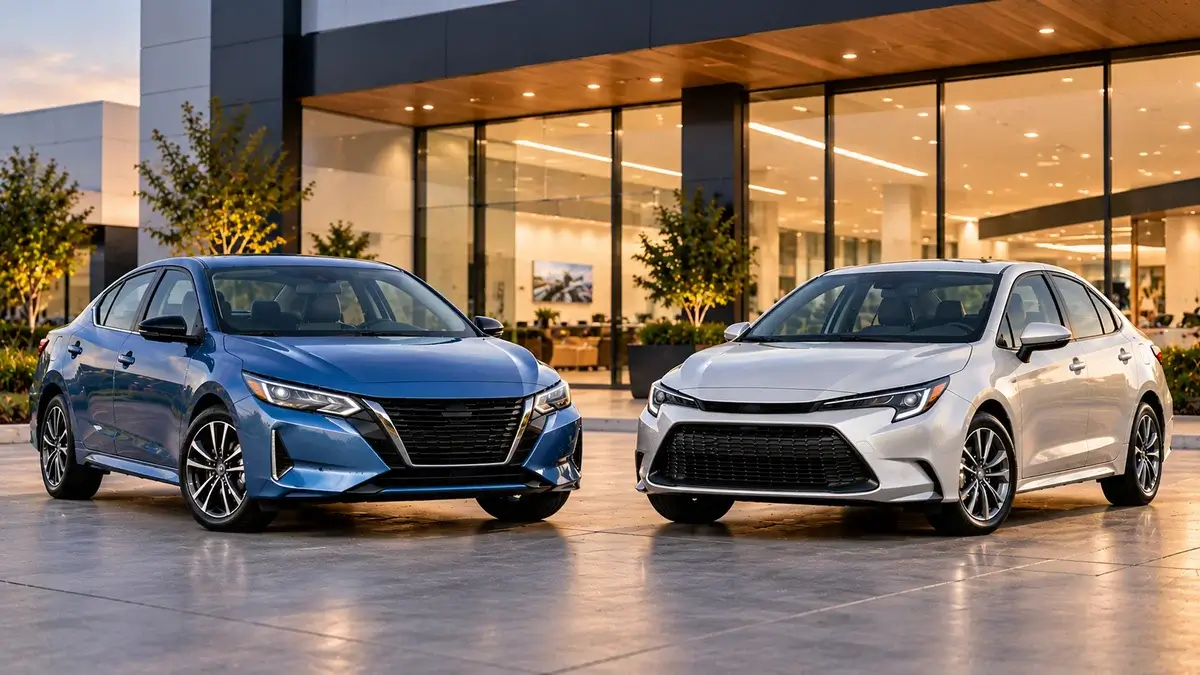
When choosing a used Nissan Sentra or Toyota Corolla, buy the stronger individual car, not the stronger reputation. A well-maintained Sentra at a genuinely better all-in price may make more sense than a neglected Corolla. A Corolla with clearer service history, better condition, and features you actually need may justify a higher asking price. Neither conclusion is safe without comparing the same model year and checking the vehicles.
This Nissan Sentra vs. Toyota Corolla comparison focuses on U.S. gasoline compact sedans, with model-year evidence and practical checks that can move either car onto—or off—your shortlist. The Toyota Corolla Hybrid and Corolla Hatchback are different configurations and should not be silently mixed into the gasoline-sedan comparison.
Quick Used-Buyer Decision: Sentra or Corolla?
Start with condition, documented risk, and total purchase exposure. A lower advertised price is not a bargain if deferred maintenance or a serious unresolved problem consumes the difference. Conversely, paying more for the Corolla badge alone is not proof of a better purchase.
| Your situation | Nissan Sentra | Toyota Corolla |
|---|---|---|
| You have two similarly aged, equipped and maintained cars | Worth choosing if its verified price and condition produce the stronger deal | Worth choosing if its condition, history, equipment and price produce the stronger deal |
| One car has complete records and a clean inspection; the other does not | Favor the documented Sentra if it is the cleaner example | Favor the documented Corolla if it is the cleaner example |
| A Sentra has uncertain CVT service, abnormal transmission behavior or an applicable open recall | Do not treat the low price as compensation without diagnosis and a satisfactory remedy plan | Still inspect the Corolla independently; it does not win by default |
| A Corolla has steering concerns, unresolved recalls, collision damage or missing records | Still assess the Sentra on its own evidence | Do not pay a reputation premium for unresolved defects or poor documentation |
| Both look acceptable but the price gap is hard to justify | Compare independent inspection findings and documented upcoming service—not brand assumptions | Apply exactly the same standard |
The practical rule: shortlist the car with the better combination of condition, maintenance documentation, safety-recall status, equipment and verified total cost. If neither seller will allow a proper inspection, keep shopping.
CarMerit used-sedan comparator
Nissan Sentra vs Toyota Corolla: Used-Car Snapshot
Compare selected model years, NHTSA records, gasoline-sedan MPG, inspection priorities, and two actual 2024 dealer asking-price pairs.
Select model year
| 41 | NHTSA complaints received 2020–2026 | 66 |
| 24 | Manufacturer communications received 2020–2026 | 78 |
| 33–34 mpgSR / S–SV | EPA combined mpg gasoline sedans only | 34–35 mpglisted 2.0L trims |
| Poor / Marginal | IIHS selected-year ratings headlights / pedestrian prevention | Good / Good |
NHTSA counts are distinct records received during 2020–2026, not lifetime totals or failure rates. IIHS values above are specific 2024 assessments; other tested categories and exact equipment also matter.
Nissan Sentra
Buyer checks for 2024
Check VIN applicability for the driver-airbag (24V-154), driveshaft (24V-304), and windshield (24V-498) campaigns. Evaluate CVT operation and service history.
Shortlist when: An independent inspection, records and verified total purchase cost support its price advantage.
Toyota Corolla
Buyer checks for 2024
Check VIN applicability for the steering intermediate-shaft campaign (24V-878). Review service records, steering, condition and fitted safety equipment.
Shortlist when: Better documented condition, equipment or lower near-term repair exposure justify its price.
2024 dealer asking-price examples
Two Dallas–Fort Worth 2024 Sentra SV vs Corolla LE pairs, reviewed October 25, 2026. Vehicle asking prices only—not out-the-door costs, sale prices or matched-condition valuations.
2024 Sentra SV
$16,910
2024 Corolla LE
$18,336
Observed Corolla asking-price difference: +$1,426 (1,192-mile odometer difference).
The Corolla listing disclosed a $225 documentation fee; the Legacy Toyota fee was not independently confirmed. Title, condition, CPO status, taxes, add-ons and other fees were not matched.
Quick take: Neither nameplate is the automatic used-car winner. Choose the individual car with the better documented history, VIN-level recall status, independent inspection and realistic purchase exposure. The lower advertised price alone is not proof of better value.
Sources: NHTSA datasets (files updated October 24, 2026); official VIN recall lookup; IIHS Sentra 2024 / Corolla 2024; EPA estimates as reproduced in the supplied article. Dealer prices are a dated research snapshot, not live offers. NHTSA counts are not adjusted for sales, mileage, time in service or reporting, and Corolla NHTSA identifiers are not guaranteed to isolate gasoline sedans. No overall recall totals or all-years reliability rankings are claimed.
Make the Comparison Fair: Model Year, Trim, Mileage and Condition
Used-car comparison pages often put vehicle specifications side by side. That is only a starting point. The outcome can reverse when one listing is a different year, has substantially more miles, carries a salvage title, or includes repairs the other does not need.
| Match this first | Why it changes the choice | What to check |
|---|---|---|
| Model year and body style | Safety equipment, design revisions and reported issues change across years | Compare sedan with sedan, and similar production years |
| Engine and transmission | Different configurations can have different EPA ratings, service needs and equipment | Verify the exact powertrain from the VIN/build details and documentation |
| Mileage and use | An older, lightly used car and a newer, heavily used car are not equivalent | Odometer, usage history, service intervals and signs of wear |
| Title, collision history and condition | A low price may reflect prior damage or needed repairs | Title status, credible history documents, body inspection and independent mechanic report |
| Trim and equipment | Driver-assistance features, headlights and comfort features vary | Confirm equipment on the specific car, rather than relying on a model-year headline |
| Listing market and date | Asking prices change by region, inventory and time | Compare current, local, similarly equipped listings captured in the same period |
For example, a 2024 Sentra and a 2024 gasoline Corolla sedan are a more sensible starting pair than a newer low-mileage Sentra against an older high-mileage Corolla. Even then, the 2024 badges do not make the cars equal: trim, prior damage, tires, service history and seller terms can still determine the stronger purchase.
Also separate asking price from what a car is worth to you. A dealer’s advertised figure is not proof of the final transaction price or a national value premium.
Reliability and Year-Specific Ownership Risks
The Sentra–Corolla reliability question needs a year-specific answer. NHTSA complaint and recall records can identify concerns worth checking, but their raw totals are not failure rates. They are not adjusted here for vehicles on the road, miles driven, years of exposure or reporting behavior. Newer model years have had less time to accumulate reports.
What NHTSA records show for selected model years
The figures below are recalculated from NHTSA files updated October 24, 2026. They answer a specific, limited question: how many distinct complaints and manufacturer communications for these model years appear in records received by NHTSA during 2020–2026, not how many complaints were ever received for each model year. This distinction especially matters for the 2020 cars, which may have records received before January 2020. Manufacturer communications are technical or service information, not automatically recalls or evidence of a defect.
| Model year | Sentra: distinct complaints received 2020–2026 | Corolla: distinct complaints received 2020–2026 | Sentra: distinct manufacturer communications received 2020–2026 | Corolla: distinct manufacturer communications received 2020–2026 |
|---|---|---|---|---|
| 2020 | 206 | 298 | 115 | 195 |
| 2022 | 81 | 102 | 98 | 109 |
| 2024 | 41 | 66 | 24 | 78 |
Method and source: NHTSA complaints received-date files for 2020–2024 and 2025–2026, counted by unique NHTSA complaint reference (ODINO), and NHTSA manufacturer-communications CSV files for the same received-date groups, counted by unique TSB/Document ID within each exact make/model/year. Each manufacturer’s relevant records were selected using the exact NISSAN/SENTRA or TOYOTA/COROLLA model identifiers. The source ZIPs were updated October 24, 2026; this is a file-update cutoff, not an assertion that every real-world incident through October 24 has been reported. Earlier NHTSA received-date archives are available; the 2015–2019 files reviewed in the source verification contain pre-2020 records for the 2020 Corolla. Those records are intentionally excluded from this table’s January 2020 onward received-date window, and the figures are not lifetime complaint or communication totals. The source fields do not consistently isolate gasoline-only Corolla sedans from other Corolla configurations.
The separate official NHTSA investigations file, also updated October 24, 2026, returned zero distinct investigation action numbers matching each of these six exact make/model/year combinations. This is not proof that those cars have no defects. Comprehensive all-campaign recall totals are not reported here. The NHTSA post-2010 recall bulk file was reviewed to confirm the named campaigns; recall applicability and repair completion remain VIN-specific.
How to use this evidence: complaint and communication totals are not failure rates, reliability scores, or fair cross-model rankings. They are not adjusted for fleet size, mileage, exposure time, repeated components, or reporting behavior. For an actual purchase, use the record patterns to guide inspection and confirm safety recalls at VIN level.
Specific issues worth checking
For 2020–2022 Sentras, NHTSA recall campaign 23V-581 concerns potentially insufficient-strength tie rods on certain vehicles. A bent or broken tie rod can affect steering control. Check the VIN for applicability and ask for the completed remedy record—not merely a seller’s assurance. This recall is not proof that every 2020–2022 Sentra has the defect.
For certain 2023–2024 Sentras, NHTSA campaign 24V-154 addresses the driver airbag module; separate 2024 Sentra campaigns address driveshaft installation (24V-304) and windshields (24V-498). These have different vehicle populations and remedies, so a generic “recalls done” statement is not sufficient.
For certain 2023–2024 Corollas, NHTSA campaign 24V-878 addresses a steering intermediate-shaft manufacturing concern. The affected population and remedy status must be confirmed against the individual VIN. It is wrong to assume the entire model year is affected—or that a seller has already had the repair completed.
Does the Sentra CVT make the Corolla safer to own?
Not automatically, but it changes what you inspect. A used Sentra with a continuously variable transmission deserves a careful road test and service-history review. Watch for delayed engagement, abnormal shuddering, slipping-like behavior, unusual noise, warning lights or inconsistent operation. Have a qualified mechanic evaluate any symptom; a quick test drive cannot rule out every transmission issue.
Nissan has also issued model-year- and VIN-specific CVT warranty extensions for some older Sentras, including eligible 2013–2017 and 2018–2019 vehicles. These are not universal promises of coverage today. Verify the original in-service date, mileage, VIN eligibility, coverage wording and whether any time or mileage limit has already expired.
The Corolla is not inspection-exempt. Its service history, transmission operation, steering behavior, cooling system, tires, brakes and any applicable campaigns still matter. Neither NHTSA records nor warranty extensions establish a blanket winner across every generation.
Asking Price, Maintenance and Repair Exposure: Where Is the Better Value?
The Sentra may offer a lower advertised asking price than the Corolla, but the size of the difference depends on the vehicles you compare. A useful used-car comparison must account for model year, trim, mileage, region, title/accident history, certification, dealer fees and near-term repair exposure. Do not confuse an asking price with a completed sale or an independently established vehicle value.
Dealer-origin 2024 gasoline-sedan price examples
The following original dealer advertisements were reviewed together on October 25, 2026; the prices reflect the displayed figures at review rather than sale proceeds or a guaranteed offer. Each vehicle has a VIN, a stated odometer reading and the same model year. The comparisons are between a 2024 Nissan Sentra SV and a 2024 Toyota Corolla LE in the Dallas–Fort Worth area. The quoted values are the dealers’ vehicle asking prices before fees, because fee treatment is not consistent across sellers. These are individual retail offers, not a representative or statistically adjusted U.S. market sample.
| Advertised vehicle | VIN (last six) | Mileage | Dealer’s vehicle asking price | Dealer |
|---|---|---|---|---|
| 2024 Nissan Sentra SV | 297178 | 48,033 mi | $16,910 | Legacy Toyota of Dallas |
| 2024 Toyota Corolla LE | 168075 | 46,841 mi | $18,336 | Toyota of Dallas |
| 2024 Nissan Sentra SV | 276043 | 52,992 mi | $14,999 | Nissan of McKinney |
| 2024 Toyota Corolla LE | 131897 | 54,952 mi | $18,039 | Toyota of Dallas |
Method and limitations: two illustrative mileage-near comparisons of 2024 gasoline sedans. The first pair differs by 1,192 miles; the second by 1,960 miles. Prices are attributed to the original dealerships’ public vehicle pages, not copied from a commercial vehicle-data feed. Toyota of Dallas advertises a $225 documentation fee on each listed Corolla, and Nissan of McKinney discloses a $225 documentation fee on its cited Sentra; a fee for the Legacy Toyota example has not been independently confirmed. Taxes, registration, dealer add-ons, financing conditions and other charges remain outside this table. Vehicle availability and displayed prices may change without notice. A listing’s presence and a seller-provided history-report link are not proof of clean title, accident-free condition, equivalent wear, identical equipment or confirmed CPO status. These factors have not been fully reconciled across all four VINs.
In these two advertised pairs, the Corolla base asking prices exceeded the nearby-mileage Sentra prices by $1,426 and $3,040, respectively, before the listed fees and any repairs. These are observed differences between four advertised vehicles, not adjusted market-price estimates or proof that an equivalent Corolla generally costs more. For the McKinney Sentra, a dealer-linked CARFAX report dated October 23 shows no reported accidents or branded-title issues, but records 53,992 miles versus 52,992 miles on the dealer page checked for this comparison. That 1,000-mile discrepancy requires clarification before relying on the mileage match; it does not, by itself, establish odometer tampering. The other vehicles also lack fully equivalent independently verified history, certification and condition evidence. Compare written out-the-door prices, complete vehicle histories and inspection findings before choosing.
Why national asking-price summaries need restraint
Third-party public pricing reports may help establish a broad shopping range, but an average of different vehicle populations cannot replace the VIN-level decision. Prior Sentra and Corolla summary rows were collected on different dates and included a mixture of standard used and certified inventory. They therefore cannot establish a same-date, condition- and CPO-adjusted price gap or guaranteed savings. This article does not make that claim.
| Value question | Favor the Sentra when… | Favor the Corolla when… |
|---|---|---|
| Asking price | Comparable local listings and documented condition show a meaningful net advantage | Any additional asking price is justified by verified condition, service, equipment or lower expected immediate work |
| Maintenance record | Oil, transmission-related and other due services are documented for the correct year/use | The equivalent service history is better documented or more complete |
| Immediate repair exposure | An independent inspection finds no material deferred work that erases its price advantage | Its inspection and known upcoming service make the full purchase cost more defensible |
| Warranty or special coverage | The exact VIN, in-service date and mileage confirm applicable coverage | Its exact applicable warranty or other valid coverage can be documented |
A useful real-world comparison is: asking price + documented immediate repairs + overdue maintenance + essential tires/brakes = near-term purchase exposure. This is a calculation for your two cars, not a published market average or forecast of future repair bills. Insurance, taxes and fees can also differ, so obtain actual quotes before deciding.
Manufacturer maintenance schedules are not interchangeable
| Relevant example | Nissan Sentra | Toyota Corolla |
|---|---|---|
| 2024 gasoline sedan: normal engine oil/filter service | Nissan’s 2020–2025 2.0L Sentra material specifies replacement at 10,000 miles or 12 months under standard conditions | Toyota’s 2022–2024 gasoline Corolla guidance generally uses a 5,000-mile/6-month scheduled maintenance checkpoint, with normal engine oil/filter replacement at up to 10,000 miles/12 months under the applicable conditions |
| More demanding driving | The applicable severe-driving schedule can change service needs; Nissan’s 2024 CVT guidance includes periodic inspection and a 60,000-mile/72-month severe-use replacement direction | Toyota provides additional service conditions; particular driving patterns can call for oil/filter service at 5,000 miles/6 months and other extra checks |
| Transmission and coverage | Verify CVT service documents and any genuinely applicable special extension | Verify the correct gas-sedan transmission service instructions and any actual remaining original coverage |
These are examples for the stated years and conditions, not instructions for every Sentra or Corolla ever built. Follow the exact owner’s manual and maintenance guide for the vehicle you are buying, especially if its driving history meets a manufacturer’s severe-use definition. A missing invoice is a reason to investigate; it is not proof that service never happened.
A numerical repair-cost winner is not established by the available comparable evidence. Instead of assuming that one car will cost a set amount less every year, price the work actually identified by the inspection and ask a local repair facility for a vehicle-specific estimate.
Fuel Economy, Safety and Everyday Use
For comparable recent gasoline sedans, the EPA mileage difference can be modest. The specific configuration—not the broader brand—determines the official rating. Safety tests can also favor one particular year or feature without proving that car is mechanically more reliable.
EPA fuel economy: matched gasoline sedans
| Model year and configuration | Nissan Sentra | Toyota Corolla |
|---|---|---|
| 2022 | 2.0L CVT gasoline S/SV: 33 mpg combined (29 city / 39 highway); SR: 32 (28 / 37) | 1.8L automatic gasoline sedan: 33 combined (30 / 38); listed 2.0L automatic gasoline sedan: 34 combined (31 / 40) |
| 2024 | 2.0L CVT gasoline S/SV: 34 mpg combined (30 city / 40 highway); SR: 33 (30 / 38) | Listed 2.0L automatic gasoline-sedan configurations: 34–35 combined (31–32 city / 40–41 highway) |
Source: official EPA/FuelEconomy.gov configuration-specific rounded estimates, consistent with Nissan’s published 2022 and 2024 U.S. specifications. The Sentra S/SV and SR have different listed ratings, and the 2024 Corolla figure is a range across listed gasoline-sedan configurations. Real-world mileage varies. Corolla Hybrid and hatchback estimates are not included.
The 2024 trim-dependent figures overlap and do not support choosing one car on fuel economy alone without considering your route, yearly mileage, fuel prices and the exact trim. Avoid converting these figures into a “current annual fuel-cost savings” promise without current assumptions.
IIHS safety: selected 2024 sedan tests
| IIHS test or assessment | 2024 Nissan Sentra sedan | 2024 Toyota Corolla sedan |
|---|---|---|
| Small-overlap front crashworthiness | Good | Good |
| Updated side-impact test | Acceptable | Acceptable |
| Headlights, rated equipment on the respective 2024 pages | Poor | Good |
| Pedestrian front crash prevention, listed standard system | Marginal | Good |
Source: IIHS vehicle rating pages for the 2024 Sentra and 2024 Corolla sedan. These are specific assessments under IIHS test protocols; different test generations and awards must not be pooled into one universal safety score. Equipment and rating applicability should be checked for the exact vehicle.
Buyer interpretation: The Corolla’s reported 2024 headlight and pedestrian-prevention assessments are relevant if nighttime visibility or pedestrian detection is a priority. Both sedans have an Acceptable result in the updated side-impact assessment. That does not erase the need to check tire condition, repairs after a collision, functioning sensors and the actual equipment fitted to the car.
Space and everyday comfort
Neither badge answers whether the car will fit your household. Bring the people and gear you regularly carry, test rear-seat access and child-seat placement if relevant, assess trunk loading, and drive each candidate on the roads you actually use. A dimension taken from a different model year or a Corolla Hatchback is not a substitute for a matched sedan comparison.
What to Inspect and Which One Should You Shortlist?
At this point, the winner should become clearer through evidence about the two actual cars. Before paying a deposit or committing to either vehicle:
- Confirm the VIN and identity. Match the VIN on the car, title, seller paperwork and relevant records. Verify the exact year, trim, engine and transmission.
- Run the official recall check. Check the NHTSA recall lookup using the VIN and request written proof of completed work from the appropriate dealer where a campaign applies. A model-year campaign does not prove that this VIN is affected or still unrepaired.
- Review service records against the correct schedule. Check oil service, tire and brake work, relevant transmission/CVT maintenance, coolant and due inspections; investigate gaps rather than making automatic assumptions.
- Test the actual car. Check cold start, engine warnings, acceleration, transmission engagement, braking, steering feel, alignment, vibrations, climate controls and driver-assistance functions. For the affected Sentra and Corolla years mentioned above, pay particular attention to steering complaints and documented recall remedies.
- Get an independent pre-purchase inspection. Ask the mechanic to identify urgent faults, near-term maintenance and evidence of collision or flood damage. Price those findings before comparing the two asking prices.
- Make the conditional decision. Shortlist the Sentra if it is the better-supported, genuinely better-priced example after these checks. Shortlist the Corolla if its documented condition, equipment and ownership exposure justify its price. Reject either vehicle if significant safety or mechanical issues remain unresolved, or the seller blocks meaningful verification.
Bottom line: Between a used Nissan Sentra and Toyota Corolla, the smart choice is the better verified purchase—not a model-wide declaration based on brand reputation, raw complaint counts or a mismatched price average.
Frequently Asked Questions
Is a used Nissan Sentra or Toyota Corolla more reliable?
There is no defensible all-years winner from NHTSA complaint totals alone. Reliability depends on the model year, exact vehicle history, mileage, maintenance and current mechanical condition. Compare applicable recalls and known concerns for each year, then inspect both candidates rather than treating a brand name as a diagnosis.
What is the main downside to check on a used Sentra?
For a CVT-equipped Sentra, transmission behavior and documented service are important purchase checks. Some older model years also have vehicle-specific CVT warranty-extension terms; they should not be assumed to cover the car today. Certain 2020–2022 Sentras also require VIN-level attention to the tie-rod recall.
Is the Nissan Sentra smaller than the Toyota Corolla?
That cannot be answered accurately across all generations and body styles with one universal measurement. Compare the same model year and sedan configurations, check published dimensions for the specific trims, then test rear-seat comfort, child-seat fit and usable cargo room in person.
Should I pay more for a used Corolla instead of a comparable Sentra?
Only when the actual Corolla’s condition, verified service history, equipment, inspection results and realistic purchase exposure justify the extra money. A brand-based premium or an unadjusted cross-model asking-price average is not sufficient evidence. If the Sentra is better documented and meaningfully cheaper after necessary work, it deserves consideration.