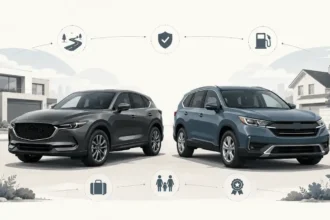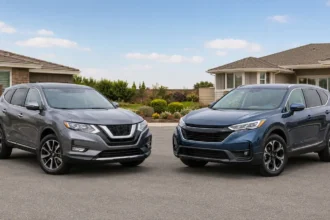


The Honda HR-V vs Toyota Corolla Cross decision should not start with brand loyalty. It should start with the exact used listing: price, mileage, trim, condition, drivetrain, safety equipment, and service history.
The Toyota Corolla Cross is the stronger default pick if fuel economy, hybrid availability, rear-seat comfort, and practical small-SUV utility matter most. The Honda HR-V becomes the smarter used buy when it is meaningfully cheaper, cleaner, better equipped, or easier for your daily driving.
Do not treat the gas Corolla Cross and Corolla Cross Hybrid as the same choice. The Hybrid can change the value math, especially for commuters, but only if the used price premium is reasonable.
CarMerit reliability comparator
Honda HR-V vs Toyota Corolla Cross: 2022-2026 NHTSA snapshot
Owner-complaint and recall counts from NHTSA for 2022-2026, each model’s best used-year lane, and which buyer each one fits.
| 911 | complaints (2022-26) | 294 |
| 11 | recalls (2022-26) | 14 |
Visibility / wipersUnknown / otherSteeringAirbags / seatbelts / structure | top issues | EngineElectricalUnknown / otherExterior lighting |
Honda HR-V
Best used year: 2022
Best 2020-2022 overall; 2022 is the strongest year inside this snapshot; inspect 2023-2025 carefully; 2026 is too new to judge.
Best for: Buyers who find a cleaner, cheaper, or better-equipped listing and want an easy city-friendly small SUV without paying a Toyota premium.
Toyota Corolla Cross
Best used year: 2024
Best value 2024 gas; safety-confidence pick 2025; inspect 2022 hardest; verify Hybrid recall status on 2023-2026 examples.
Best for: Practical-first buyers who want better fuel-economy logic, hybrid availability, rear-seat practicality, and the stronger default used-SUV case.
Quick take: The Corolla Cross is the stronger default pick when price, mileage, trim, and condition are close. Choose the HR-V when the actual listing is meaningfully cheaper, cleaner, or better equipped for your daily driving. Treat the Corolla Cross Hybrid as a separate value case. Do not crown either SUV from raw NHTSA counts alone.
Complaint counts are raw owner reports filed with NHTSA, not adjusted for sales volume, so they should guide inspection rather than crown a winner. The quick comparator above uses a 2022-2026 overlapping NHTSA snapshot for both models; if one model has older NHTSA history before 2022, those model-only years are excluded here to keep the comparison balanced. Always inspect the specific vehicle before buying.
Quick Verdict: Honda HR-V vs Toyota Corolla Cross
For most used small-SUV buyers, the Toyota Corolla Cross has the stronger all-around case. Toyota lists the Corolla Cross with gas and hybrid powertrain options, FWD or AWD, up to an estimated 42 combined mpg, and standard rear-seat vents, which gives it a practical edge for commuters and small families.
The HR-V is still worth shortlisting. Honda lists a 158-hp engine, available Real Time AWD, 24.4 cubic feet of cargo space behind the rear seats, 55.1 cubic feet with the seats folded, and 7.0 to 7.3 inches of ground clearance depending on trim. Honda HR-V
Use this rule: choose the Corolla Cross when price, mileage, trim, and condition are close. Choose the HR-V when the actual listing is clearly cleaner, cheaper, or better equipped.
| Decision point | Honda HR-V | Toyota Corolla Cross |
|---|---|---|
| Best default used pick | Strong if cheaper or cleaner | Better for most practical buyers |
| Fuel economy | Acceptable, but not the main strength | Clear edge, especially Hybrid |
| Hybrid option | No U.S. hybrid shown in the checked HR-V lineup | Available Corolla Cross Hybrid |
| Cargo flexibility | Strong maximum cargo number | Strong daily practicality and rear-seat comfort |
| City driving | Easy to park and live with | Still easy, with a more utility-focused feel |
| Best trim targets | Sport or EX-L | LE, XLE, or Hybrid SE/XSE |
| Main warning | Modest power and weaker MPG | Used prices and hybrid premiums can run high |
If you are still deciding whether either SUV belongs on your shortlist, start with our best used small SUVs guide for the bigger HR-V vs Corolla Cross decision path.
Under $20,000, the HR-V is usually the more realistic small-SUV pick, while Corolla Cross availability is more limited. For a wider budget shortlist, compare both in our best used cars under $20,000 guide.
What This Used-SUV Comparison Covers
This is a used-buyer comparison, not a new-car spec race. That matters because the Corolla Cross and HR-V do not line up perfectly by model history.
The cleanest used-market comparison is 2022+ Toyota Corolla Cross against 2023+ Honda HR-V. Older 2016 to 2022 HR-V listings can still make sense as budget buys, but they should not be judged as the same vehicle as the redesigned HR-V.
For 2016–2020 HR-V CVT listings, add one documentation check. American Honda extended the CVT primary drive belt warranty on qualifying models to 7 years from the original purchase date or 150,000 miles, whichever came first. Eligibility was VIN-specific, and Honda’s bulletin tied qualifying replacement to a PCM software update and CVT inspection procedure.
If an older HR-V is winning this comparison mainly on price but its CVT history gives you pause, check that model year in CarMerit’s Manufacturer Special Coverage Lookup before moving straight to the Corolla Cross; Honda’s exact VIN and current records still determine whether the program applies.
Do not assume that coverage remains today. Check the VIN and service history for the software update, inspection, and any previous CVT work.
The Corolla Cross Hybrid also needs separate treatment. Its fuel economy advantage can change the answer, but that does not make every Corolla Cross the better buy.
Size, Seating, Cargo, and Everyday Practicality
The HR-V is better than its small footprint suggests. Its listed 24.4 cubic feet of cargo space behind the rear seats and 55.1 cubic feet with the seats folded make it useful for groceries, bags, strollers, and weekend gear.
The Corolla Cross feels more practical for regular passenger use. Toyota lists standard rear-seat vents, which matters if you often carry kids or adults in the second row. It is a small feature, but it affects daily comfort more than many shoppers expect.
Ground clearance also favors the Toyota. Honda lists the HR-V at 7.0 to 7.3 inches depending on trim, while Toyota lists the Corolla Cross at 8.1 inches. Neither is a trail SUV, but the Corolla Cross has the stronger crossover stance.
| Practicality factor | Honda HR-V | Toyota Corolla Cross |
|---|---|---|
| Passenger comfort | Good for a small SUV | Better rear-seat comfort cues |
| Cargo behind rear seats | 24.4 cu ft listed by Honda | Useful daily cargo area |
| Maximum cargo | 55.1 cu ft listed by Honda | Verify exact figure by year and trim |
| Ground clearance | 7.0 to 7.3 in listed by Honda | 8.1 in listed by Toyota |
| Child-seat use | Check rear-seat fit before buying | Slight edge for regular family use |
| Parking ease | Very strong | Still easy to manage |
| Best fit | City buyers and flexible cargo needs | Small families and practical commuters |
Performance, Fuel Economy, and AWD
Neither SUV is exciting. If you want strong acceleration, this is the wrong pair to obsess over. This comparison is really about easy ownership, decent comfort, fuel economy, and whether AWD is worth paying for.
The redesigned 2023–2026 HR-V is rated by EPA at 26 city, 32 highway, and 28 combined mpg with FWD, or 25 city, 30 highway, and 27 combined mpg with AWD.
For the 2022–2026 gas Corolla Cross, FWD is rated at 32 combined mpg and AWD at 30 combined mpg. The 2023–2026 Corolla Cross Hybrid AWD is rated at 42 combined mpg. Exact city and highway figures change slightly on some Corolla Cross model years, so use the year-by-year configuration tables below instead of treating every Corolla Cross as one MPG number.
| Powertrain factor | Honda HR-V | Toyota Corolla Cross |
|---|---|---|
| Gas engine | 158-hp 2.0-liter | 2.0-liter gas powertrain |
| Hybrid option | No U.S. hybrid in the checked HR-V lineup | Available from 2023; Hybrid is AWD |
| Gas efficiency | 2023–26: 28 combined mpg FWD; 27 AWD | 2022–26: 32 combined mpg FWD; 30 AWD |
| Hybrid efficiency | Not applicable | 2023–26: 42 combined mpg, Hybrid AWD |
| AWD | Available Real Time AWD | FWD or AWD, depending on trim/powertrain |
| Best commuter choice | Good if priced well | Corolla Cross Hybrid |
| Main caution | Modest power and MPG | Hybrid premium must make sense |
Table Note: EPA combined MPG is shown here as a quick comparison. Exact city/highway values and year-specific configuration changes are shown in the tables immediately below.
Honda HR-V EPA Fuel Economy
| Model Year | Configuration | City | Highway | Combined |
|---|---|---|---|---|
| 2023 | FWD | 26 | 32 | 28 |
| 2023 | AWD | 25 | 30 | 27 |
| 2024 | FWD | 26 | 32 | 28 |
| 2024 | AWD | 25 | 30 | 27 |
| 2025 | FWD | 26 | 32 | 28 |
| 2025 | AWD | 25 | 30 | 27 |
| 2026 | FWD | 26 | 32 | 28 |
| 2026 | AWD | 25 | 30 | 27 |
Table Note: EPA city/highway/combined MPG for the redesigned 2023–2026 HR-V configurations shown. Older 2016–2022 HR-V configurations belong to the previous-generation budget-buy lane discussed elsewhere in this article and are intentionally not mixed into this direct comparison table. EPA estimates are standardized for comparison, but actual fuel economy varies with driving style, weather, speed, traffic, vehicle condition, cargo, and other factors.
Toyota Corolla Cross EPA Fuel Economy
| Model Year | Configuration | City | Highway | Combined |
|---|---|---|---|---|
| 2022 | Gas FWD | 31 | 33 | 32 |
| 2022 | Gas AWD | 29 | 32 | 30 |
| 2023 | Gas FWD | 31 | 33 | 32 |
| 2023 | Gas AWD | 29 | 32 | 30 |
| 2023 | Hybrid AWD | 45 | 38 | 42 |
| 2024 | Gas FWD | 31 | 33 | 32 |
| 2024 | Gas AWD | 29 | 31 | 30 |
| 2024 | Hybrid AWD | 45 | 38 | 42 |
| 2025 | Gas FWD | 31 | 33 | 32 |
| 2025 | Gas AWD | 29 | 31 | 30 |
| 2025 | Hybrid AWD | 45 | 38 | 42 |
| 2026 | Gas FWD | 31 | 33 | 32 |
| 2026 | Gas AWD | 29 | 31 | 30 |
| 2026 | Hybrid AWD | 46 | 39 | 42 |
Table Note: EPA city/highway/combined MPG for the exact Corolla Cross configurations shown. Gas FWD, gas AWD, and Hybrid AWD are separate configurations and should not be averaged into one model-year figure. EPA estimates are standardized for comparison, but actual fuel economy varies with driving style, weather, speed, traffic, vehicle condition, cargo, and other factors.
Reliability, Safety, Recalls, and Cost to Own
This is where buyers need discipline. Toyota’s reputation matters, but it does not rescue a bad listing. Honda’s reputation matters too, but it does not erase the HR-V’s efficiency disadvantage.
Safety and recall checks should be done by exact model year and VIN. NHTSA says a VIN or license-plate search can show whether a specific vehicle still needs recall repair, and it also notes that some recently announced recalls may not show every VIN immediately.
That matters for the Corolla Cross Hybrid. Toyota announced a recall involving certain 2026 Corolla Cross Hybrid vehicles and told owners to check Toyota’s recall page or NHTSA with the VIN or license plate. The NHTSA filing lists 3,761 potentially involved 2026 Corolla Cross Hybrid vehicles in that recall population.
Before buying either SUV, check:
- VIN history
- Title status
- Open recalls
- Service records
- Accident history
- Tire and brake condition
- AWD operation if equipped
- Hybrid status and repair documentation if buying a Corolla Cross Hybrid
- Safety-feature presence by trim and year
The ownership answer is conditional. If you drive a lot, the Corolla Cross Hybrid has the stronger fuel-cost argument. If you drive fewer miles, the cleaner and cheaper used example may matter more than the fuel-economy gap.
| Ownership factor | Honda HR-V | Toyota Corolla Cross |
|---|---|---|
| Brand reputation | Strong Honda mainstream reputation | Strong Toyota mainstream reputation |
| Fuel cost | Acceptable, not standout | Better, especially Hybrid |
| Recall check | Required by VIN | Required by VIN, especially Hybrid |
| Maintenance setup | 2023–26: Honda Maintenance Minder is condition-based; follow the displayed service codes rather than assuming one universal mileage schedule. | Verified 2023–24 gas guides use 5,000-mile/6-month maintenance checkpoints; AWD adds drivetrain-specific service items. Check the exact model-year guide for Hybrid and other years. |
| Used-buying risk | Depends on condition and records | Depends on condition, trim, and hybrid premium |
| Best for low-mileage buyers | Often strong if cheaper | Strong if price gap is small |
| Best for high-mileage commuters | Less compelling | Corolla Cross Hybrid |
| Main rule | Buy the clean HR-V deal | Buy the Corolla Cross when value supports it |
Table Note: These are differences in how the manufacturers specify maintenance, not evidence that either SUV is more reliable or cheaper to own.
Best Used Trims and Value
Trim choice can flip this comparison. A low-trim Corolla Cross at a high price is not automatically better than a well-equipped HR-V. A loaded HR-V priced near a Corolla Cross Hybrid is also hard to justify.
For the HR-V, Sport is the value trim to watch first. Honda’s spec page lists Blind Spot Information System with Cross Traffic Monitor, 18-inch wheels, Honda Sensing features, and the same 158-hp engine across trims. EX-L is the comfort pick if the price stays sensible.
For the Corolla Cross, LE is usually the trim to start with. Toyota lists Blind Spot Monitor with Rear Cross-Traffic Alert in the feature area, while Hybrid SE and Hybrid XSE bring the stronger fuel-economy case. Toyota also lists the 12.3-inch digital gauge cluster and 10.5-inch multimedia touchscreen on higher trims.
| Trim decision | Best target | Why it matters |
|---|---|---|
| HR-V value trim | Sport | Useful comfort and convenience features |
| HR-V comfort trim | EX-L | Better cabin features if priced sensibly |
| Corolla Cross value trim | LE | Better feature mix than base L |
| Corolla Cross comfort trim | XLE | Stronger screen and display package |
| Corolla Cross efficiency trim | Hybrid SE | Good balance if fuel savings justify premium |
| Trim to inspect carefully | Any base trim | Make sure features match the listing |
| Main rule | Compare actual equipment | Do not buy by trim name alone |
Used Price Gap: When the HR-V Becomes the Better Buy
The Corolla Cross is the better default, but not at any price. Used-market value changes quickly by mileage, trim, accident history, dealer fees, drivetrain, region, and whether the Corolla Cross is gas or hybrid.
Use a listing-based rule instead of a fixed national number. If the Corolla Cross costs only slightly more than a similar HR-V, it usually has the stronger practical case. If the HR-V is meaningfully cheaper and has cleaner history, better tires, lower mileage, or a stronger trim, the HR-V deserves priority.
The Corolla Cross Hybrid needs its own math. It makes the most sense when the premium is reasonable and your annual mileage is high enough for fuel savings to matter. For low-mileage drivers, a cheaper gas HR-V or gas Corolla Cross may be the more rational buy.
If you are paying extra for a Corolla Cross Hybrid, check the warranty context too. Toyota’s official 2023–2026 Corolla Cross Hybrid materials list 8 years or 100,000 miles of coverage for hybrid-related components and 10 years or 150,000 miles for the hybrid battery. Toyota also states that the hybrid battery warranty is transferable across ownership.
Do not treat that as a battery-life or capacity guarantee. Remaining coverage on a used vehicle depends on its original in-service date, mileage, and eligibility.
| Price-gap situation | Better move |
|---|---|
| Similar price, mileage, trim, and condition | Lean Corolla Cross |
| Corolla Cross Hybrid priced fairly above gas models | Consider the Hybrid if you drive a lot |
| HR-V Sport is clearly cheaper than Corolla Cross LE | Lean HR-V |
| HR-V EX-L is priced near Corolla Cross Hybrid | Compare hard against the Hybrid |
| Base Corolla Cross costs like a better-equipped HR-V | Check features before paying Toyota premium |
| Either vehicle has accident history or weak records | Negotiate hard or walk away |
Safety, Driver Assistance, and Used Listing Verification
Both SUVs can be strong safety-tech choices, but used buyers need to verify the exact vehicle. Do not assume every trim and year has the same equipment.
Honda lists Honda Sensing features for the HR-V, including Collision Mitigation Braking System, Road Departure Mitigation, Adaptive Cruise Control with Low-Speed Follow, Lane Keeping Assist, Forward Collision Warning, Lane Departure Warning, Traffic Jam Assist, and Traffic Sign Recognition.
Toyota lists Toyota Safety Sense 3.0 on the Corolla Cross page, along with Blind Spot Monitor with Rear Cross-Traffic Alert in its feature area.
Selected IIHS Results for Overlapping Model Years
| IIHS test or rating | Honda HR-V | Toyota Corolla Cross | Applicable overlap |
|---|---|---|---|
| Small overlap front – driver side | G | G | 2023–26 |
| Small overlap front – passenger side | G | G | 2023–26 |
| Updated moderate overlap front | G | A | 2023–26 |
| Updated side | G | A for 2023–24; G for 2025–26 | 2023–26 |
| Headlights | A, all trims | 2023–25: A on listed L/LE/XLE headlights; G on XLE with Adaptive Front Lighting. 2026: A, all trims. | 2023–26 |
| LATCH ease of use | A | G+ with extra LATCH positions | 2023–26 |
| Pedestrian front crash prevention – current combined evaluation | G | G | 2024–26 |
Table Note: G = Good, A = Acceptable, M = Marginal, P = Poor. G+ is IIHS’s LATCH Good+ designation with extra LATCH positions. This is a decision-focused subset of aligned IIHS evidence, not an overall safety score. Ratings apply only to the model years, test families, and equipment scopes shown; do not extend the 2023–2025 Corolla Cross headlight results to unlisted configurations.
One model-year change is especially worth noticing when comparing listings: the Corolla Cross moves from A in the updated side test for 2023–2024 to G for 2025–2026.
A listing headline can say “loaded,” but the VIN, window sticker, photos, and test drive tell the real story.
Once your HR-V-versus-Corolla Cross choice reaches actual listings, verify that each SUV is the vehicle the ad claims it is before comparing value. Run each VIN through the CarMerit VIN Lookup and compare the returned vehicle details with the seller’s description and paperwork. Then confirm trim, AWD or hybrid equipment, recall status, title and accident history, service records, and condition separately before deciding which listing is the stronger buy.
| Used-listing check | Why it matters |
|---|---|
| VIN history | Confirms accident, title, and ownership records |
| Trim confirmation | Prevents overpaying for a lower trim |
| AWD confirmation | Listings can be vague or wrong |
| Hybrid confirmation | Corolla Cross Hybrid is a separate value case |
| Safety-feature check | Features vary by trim and model year |
| Recall check | Open recalls should be handled |
| Tire and brake condition | Cheap listings can hide near-term costs |
| Service records | Reduces ownership guesswork |
| Test drive | Reveals noise, vibration, alignment pull, and hesitation |
Interior Comfort, Tech, and Daily Driving Feel
The HR-V makes sense if you prefer a compact, easygoing cabin and do not need hybrid fuel economy. Honda lists seating for five, a 60/40 split second row, and consistent interior measurements across the lineup, with some trim differences in passenger volume.
The Corolla Cross feels more practical for passengers. Rear-seat vents give it a daily comfort edge, especially in hot or cold climates. Higher trims also add stronger display tech, including the 12.3-inch digital gauge cluster and 10.5-inch multimedia touchscreen listed by Toyota.
The better cabin depends on how you use the car. Choose the HR-V if you prefer its size, layout, and deal quality. Choose the Corolla Cross if passenger comfort, efficiency, and utility matter more.
If the HR-V is still on your shortlist, compare it with Subaru’s more rugged small SUV in Subaru Crosstrek vs Honda HR-V. That matchup helps if you are choosing between city-friendly practicality and stronger AWD confidence.
Final Recommendation: Which One Should You Buy Used?
Buy the Toyota Corolla Cross if you want the stronger practical bet. It has the better fuel-economy story, the available hybrid, useful rear-seat comfort cues, and a more utility-focused small-SUV setup.
Buy the Honda HR-V if the actual used listing is clearly better. A clean HR-V Sport or EX-L can make more sense than an overpriced Corolla Cross, especially if you drive mostly in the city and do not need hybrid-level fuel economy.
Skip both if you need strong acceleration, towing ability, more cargo room, or a larger rear seat. In that case, move up to a true compact SUV instead of forcing a small SUV to do a bigger job.
If the HR-V and Corolla Cross both feel too conservative, compare the Subaru Crosstrek vs Mazda CX-30 next. The Crosstrek gives you a more outdoorsy utility-first option, while the CX-30 gives you a more refined daily-driver alternative.
| Buyer type | Better choice | Why |
|---|---|---|
| Most used buyers | Toyota Corolla Cross | Better default mix of efficiency, utility, and passenger comfort |
| Value shopper | Honda HR-V | Better only if the listing is cleaner, cheaper, or better equipped |
| Fuel-economy buyer | Corolla Cross Hybrid | Strongest efficiency case |
| Small family | Toyota Corolla Cross | Rear-seat comfort cues give it the edge |
| City driver | Honda HR-V | Easy size and useful cargo flexibility |
| High-mileage commuter | Corolla Cross Hybrid | Fuel savings matter more with mileage |
| Buyer needing more space or power | Skip both | Move up to a larger compact SUV |
If the HR-V and Corolla Cross feel too small, compare Forester vs RAV4. That matchup is better for buyers stepping up to compact SUVs with more space, stronger road-trip usability, and broader family practicality.
If you want a more upscale-feeling small SUV than either the HR-V or Corolla Cross, the Mazda CX-30 is worth comparing. Just check the Mazda CX-30 years to avoid before treating it as the safer buy.
The Honda HR-V vs Toyota Corolla Cross decision should not end with blind brand loyalty. The Corolla Cross is the better default. The HR-V is the better deal when price, trim, condition, and history clearly work in its favor.
If you are shopping these two for family use, remember that both are small-family vehicles, not full family haulers. Our best used family cars guide shows when to move up to a CR-V, RAV4, CX-5, Camry, or Accord.
HR-V and Corolla Cross both work best for buyers who want smaller, easier-to-own SUVs. If you are open to larger SUVs or reliable sedans too, use our Most Reliable Used Cars guide before finalizing.
Frequently Asked Questions
Is the Honda HR-V or Toyota Corolla Cross better to buy used?
The Toyota Corolla Cross is better for most used buyers when price, mileage, condition, and trim are close. It has the stronger efficiency case and the available hybrid.
The HR-V is better when the exact listing is cheaper, cleaner, or better equipped.
Which is more reliable, the Honda HR-V or Toyota Corolla Cross?
Both are mainstream Honda and Toyota small SUVs, so the better used buy depends on the individual vehicle. Maintenance records, accident history, recalls, tires, brakes, and trim condition matter more than the badge alone.
Do not buy either one only because of brand reputation.
Which has more cargo space, the HR-V or Corolla Cross?
Honda lists the HR-V at 24.4 cubic feet behind the rear seats and 55.1 cubic feet with the rear seats folded, which gives the HR-V a strong cargo-flexibility argument.
The Corolla Cross still feels practical for daily passenger use, especially because Toyota lists standard rear-seat vents.
Which gets better fuel economy, the HR-V or Corolla Cross?
The Corolla Cross gets the edge. EPA rates the 2022–2026 gas Corolla Cross at 32 combined mpg with FWD and 30 combined mpg with AWD. The 2023–2026 Corolla Cross Hybrid AWD is rated at 42 combined mpg.
For the redesigned 2023–2026 HR-V, EPA estimates are 28 combined mpg with FWD and 27 combined mpg with AWD. Check the tables above for the exact city and highway figures by model year and configuration.
Is the Toyota Corolla Cross Hybrid worth paying more for?
It can be worth paying more if you drive enough miles to benefit from the fuel savings and the used premium is reasonable.
It is less compelling if you drive low miles or the hybrid costs close to a larger, more capable SUV.
Which is better for commuting, HR-V or Corolla Cross?
The Corolla Cross Hybrid is the best commuter choice if fuel economy matters most. The gas Corolla Cross also has a stronger efficiency case than the HR-V.
The HR-V still works well for city commuting if it is cheaper, clean, and comfortable for your route.
Which is better for small families?
The Corolla Cross has the edge for small families because of its passenger comfort cues and standard rear-seat vents.
The HR-V can still work, but test child-seat fit and rear-seat comfort before buying.
Which used trim is the best value?
For the HR-V, Sport is usually the first trim to check. EX-L is better if comfort features matter and the price is fair.
For the Corolla Cross, LE is usually the practical value trim. XLE adds more comfort and screen tech, while Hybrid SE is worth checking if fuel savings matter.
Should I buy an older Honda HR-V or a newer Corolla Cross?
Only buy an older HR-V if the price is clearly lower and the condition is strong. The older HR-V should not be treated as the same vehicle as the redesigned HR-V.
If the price difference is small, a newer Corolla Cross usually makes more practical sense.
How do I check recalls before buying?
Use the VIN to check open recalls before buying. NHTSA says a VIN or license-plate search can show whether a specific vehicle still needs recall repair.
This is especially important on hybrids and newer used vehicles because recall status can change after a vehicle is listed for sale.
What should I check before buying either one used?
Check the VIN history, title status, open recalls, maintenance records, accident history, trim, AWD status, hybrid status, safety features, tires, and brakes.
Then test drive it cold and warm. A clean listing photo does not prove a clean used car.