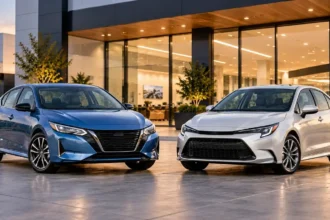


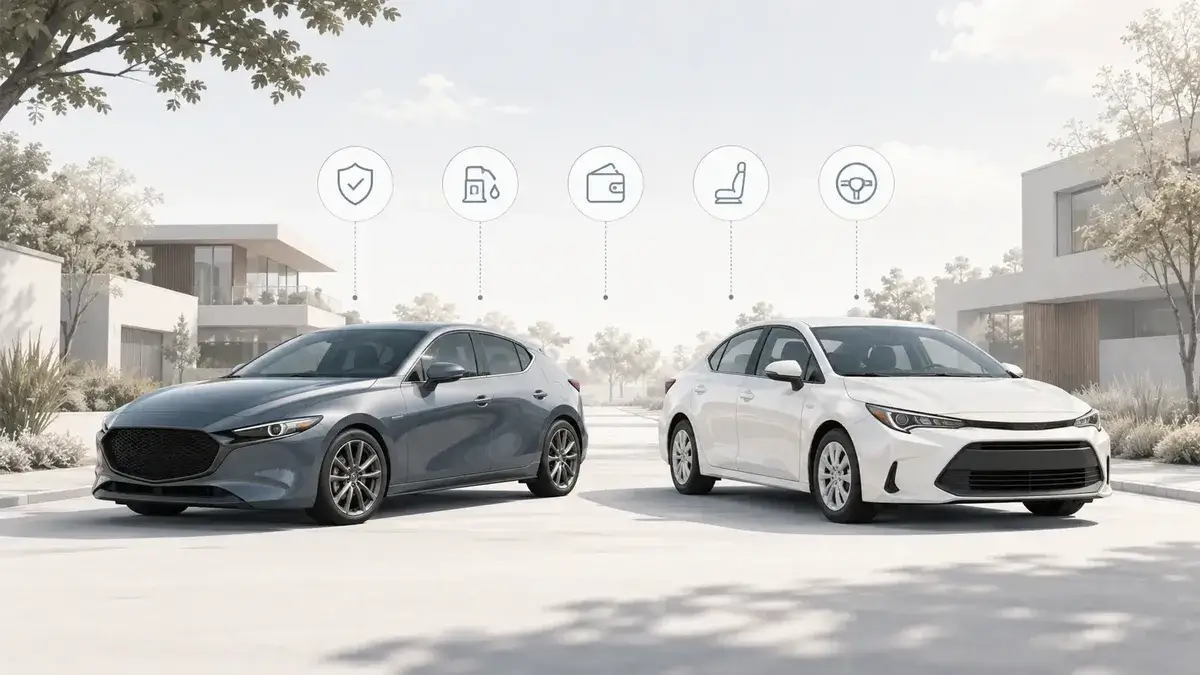
The Mazda3 vs Toyota Corolla decision is better framed as efficiency and practicality versus driving feel. The Corolla makes the stronger efficiency-first case, especially when a Hybrid is in the shortlist. The Mazda3 makes the stronger cabin-and-driving case.
For most used buyers, start with the Corolla when fuel economy and straightforward daily use are the priorities. Start with the Mazda3 when steering feel, cabin quality, available AWD on newer versions, or the quality of the specific listing matters more. Neither badge replaces a year-specific history check, maintenance records, recall check, and pre-purchase inspection.
A well-kept Mazda3 can still be the better buy when its price, condition, and records are stronger than the Corolla you are comparing.
CarMerit reliability comparator
Mazda3 vs Toyota Corolla: 2004-2026 NHTSA snapshot
Owner-complaint and recall counts from NHTSA for 2004-2026, each model’s best used-year lane, and which buyer each one fits.
| 2,974 | complaints (2004-26) | 9,191 |
| 58 | recalls (2004-26) | 122 |
Airbags / seatbelts / structureSteeringSuspension / wheelsElectrical | top issues | Airbags / seatbelts / structureSteeringEngineVehicle speed control |
Mazda3
Best used year: 2017
Best overall 2017-2018; best newer 2020-2023 non-turbo; budget 2012-2013 with strong records; inspect 2004-2011, 2014, and 2019 harder.
Best for: Value-and-drive buyers who want a more engaging drive and nicer cabin, when the car is priced well and has clean records.
Toyota Corolla
Best used year: 2013
Safest default 2011-2013; best value 2005-2008; newer 2017-2019; use more caution with 2000-2003, 2009, and 2014.
Best for: Practical-first buyers who prioritize fuel economy, straightforward daily use, and the availability of a Hybrid sedan.
Quick take: For most used buyers, start with the Corolla if fuel economy and straightforward daily use matter more. Choose the Mazda3 when a more engaging drive, nicer cabin, available AWD on newer versions, or a stronger specific listing matters more. Do not crown either car from raw NHTSA counts alone.
Complaint counts are raw owner reports filed with NHTSA, not adjusted for sales volume, so they should guide inspection rather than crown a winner. The quick comparator above uses a 2004-2026 overlapping NHTSA snapshot for both models; Corolla has older NHTSA history before 2004, but those Corolla-only years are excluded here to keep the comparison balanced. Always inspect the specific vehicle before buying.
Mazda 3 vs Toyota Corolla: Quick Verdict for Used-Car Buyers
Choose the Toyota Corolla if you want the efficiency-first, straightforward daily-driver option. It fits commuters and practical buyers who care more about fuel economy and simple usability than steering feel.
Choose the Mazda3 if you want the more engaging compact, a more upscale-feeling cabin, or available AWD on newer versions.
Neither car wins automatically. When two examples are close in price, compare the exact model year, powertrain, mileage, service history, accident history, recall status, equipment, and asking price before deciding.
| Decision Point | Mazda3 | Toyota Corolla |
|---|---|---|
| Primary strength | Driving feel and cabin quality | Fuel economy and straightforward daily use |
| Fuel-economy direction | Lower in the exact 2026 FWD sedan comparison shown later | Higher in the exact 2026 gas-sedan comparison; Hybrid widens the gap |
| AWD path | Available on newer versions | Available with Corolla Hybrid AWD |
| Body-style choice | Sedan and hatchback | Sedan and hatchback |
| Used-car condition rule | Buy the clean, well-documented example | Buy the clean, well-documented example |
| Best buyer fit | Wants the nicer-feeling daily driver | Wants the stronger efficiency-first daily driver |
Table Note: Fuel-economy direction refers to the exact EPA configurations shown later in this article. It is not a model-wide or model-year average.
Best Choice by Buyer Type
The useful question is not which badge is safer to own. It is which car better fits your priorities and which specific used example is stronger.
| Buyer Type | Better Starting Point | Why |
|---|---|---|
| Daily commuter | Toyota Corolla | Stronger efficiency-first case |
| First-time used-car buyer | Corolla if efficiency and simple daily use dominate; Mazda3 if the specific car is clearly cleaner or better documented | Condition and records still control the exact purchase |
| Small family | Toyota Corolla sedan as the starting point | Practical sedan packaging; still test rear-seat and child-seat fit |
| Driver who wants a nicer cabin | Mazda3 | More upscale-feeling interior |
| Driver who enjoys back roads | Mazda3 | Sharper steering and stronger driving character |
| Buyer who wants AWD | Mazda3 or Corolla Hybrid AWD | Compare exact year, powertrain, fuel economy, and asking price |
| Clean examples at similar prices | Corolla for efficiency; Mazda3 for driving feel | No automatic ownership-cost winner |
| Cheaper, clean Mazda3 | Mazda3 can be the better listing | The price advantage matters only when condition and history are also strong |
Table Note: These are buyer-fit starting points, not reliability, safety, repair-cost, or resale rankings.
Maintenance and Long-Term Ownership Checks
Do not reduce this comparison to one reliability score or one average annual repair-cost number. For a used Mazda3 or Corolla, the stronger ownership check is whether the exact year and powertrain were maintained on schedule and whether the records support what the seller claims.
Manufacturer schedules also show why powertrain matters. A turbo Mazda3 has different service checkpoints from a non-turbo car, and gasoline Corolla maintenance should not be applied automatically to a Corolla Hybrid.
| Vehicle / Exact Scope | Official Checkpoint to Verify in Service Records |
|---|---|
| 2026 Mazda3 2.5T | Spark plugs every 40,000 miles |
| 2026 Mazda3 except 2.5T | Spark plugs every 75,000 miles |
| 2024–2026 Mazda3 | Engine coolant first at 120,000 miles or 10 years, then every 60,000 miles or 5 years |
| 2022–2026 Corolla gasoline | Engine/intercooler coolant, if applicable, first at 100,000 miles or 10 years, then every 50,000 miles or 5 years |
| 2022–2026 Corolla gasoline | Spark plugs at 120,000 miles |
Table Note: These are selected manufacturer service checkpoints, not complete maintenance schedules. Use the exact model-year and powertrain guide for the vehicle being inspected. Gasoline Corolla rows should not be applied to the Corolla Hybrid.
Missing paperwork does not prove that a service was skipped, but it should trigger a closer inspection and a request for receipts. Use the exact maintenance guide for the model year and powertrain rather than applying one schedule to every Mazda3 or Corolla.
Fuel Economy and Corolla Hybrid Warranty Context
Fuel economy is the cleanest verified running-cost difference in this comparison, but it has to stay configuration-specific. Official EPA/FuelEconomy.gov data for 2026 show:
| Model Year | Exact EPA Configuration | City | Highway | Combined |
|---|---|---|---|---|
| 2026 | Mazda3 4-Door 2WD, 2.5L, Automatic (S6), FWD | 27 | 36 | 30 |
| 2026 | Toyota Corolla, 2.0L, Automatic (AV-S10), FWD | 31 | 38 | 34 |
| 2026 | Toyota Corolla Hybrid, 1.8L, Automatic (variable gear ratios), FWD | 53 | 46 | 50 |
| 2026 | Toyota Corolla Hybrid AWD, 1.8L, Automatic (variable gear ratios), AWD | 51 | 44 | 48 |
Table Note: EPA/FuelEconomy.gov city, highway, and combined MPG. These are exact 2026 configurations, not averages for every Mazda3 or Corolla. Other engines, transmissions, body styles, drivetrains, and model years can differ.
For a buyer who drives a lot, the Corolla Hybrid can create a much larger fuel-economy gap than the gas Corolla. But compare the Hybrid’s used asking price separately and do not assume fuel savings automatically erase a higher purchase price.
If you are shopping a 2020-or-newer Corolla Hybrid, Toyota’s hybrid-battery warranty is 10 years or 150,000 miles from the original date of first use and is transferable under the written warranty terms. It is defect coverage, not a battery-capacity guarantee. Remaining coverage depends on the exact car’s in-service date, mileage, and eligibility.
Used-Listing Reality Check
Use advertised prices as a shopping snapshot, not as proof of resale strength or actual transaction value. Compare like with like: the same model year, body style, powertrain or drivetrain, similar mileage, comparable trim and equipment, title and accident history, service history, and the same local market.
A cheaper Mazda3 is not automatically the better value if it has worse history or more mileage. A higher Corolla asking price does not prove better quality or future resale. Treat the posted number as an asking price, then judge the exact car.
Do not pay more for either badge without a reason you can verify in the vehicle itself.
Interior, Comfort, Cargo, and Daily Practicality
The Mazda 3 feels nicer inside. That is one of its strongest advantages. If you sit in both and the Mazda immediately feels more premium, that reaction matters.
The Corolla feels simpler. That is not automatically bad. A simple cabin, easy controls, and predictable daily use are exactly what many used-car buyers want.
Sedan-to-sedan numbers are close. Mazda lists the Mazda3 sedan with 35.1 inches of rear legroom and 13.2 cubic feet of cargo volume. Edmunds lists the Corolla sedan with 34.8 inches of rear legroom and 13.1 cubic feet of cargo capacity. In real shopping, seat shape, roofline, visibility, and child-seat fit may matter more than the small numerical gap.
Performance, Ride Quality, and Driving Feel
The Mazda 3 is the better driver’s car. Mazda lists the 2026 Mazda3 sedan with a 2.5-liter engine producing 186 horsepower on regular fuel. Edmunds lists the 2026 Corolla at 169 horsepower.
Power is only part of the story. The Mazda also tends to feel more planted and more polished from behind the wheel. It is the compact car for someone who wants daily driving to feel more special.
The Corolla is easier to recommend to someone who wants transportation first. It is efficient, predictable, and low-stress.
Do not buy the Mazda3 just because it is “sportier.” Buy it because you drove both and prefer the Mazda enough to accept the fuel-economy and practicality trade-offs of the exact configuration.
Sedan vs Hatchback: Which Body Style Makes More Sense?
Do not mix sedan and hatchback conclusions. Mazda3 sedan vs Corolla sedan is not the same decision as Mazda3 hatchback vs Corolla hatchback.
The sedans are the cleaner comparison for most shoppers because rear-seat use, trunk space, fuel economy, and pricing are easier to compare body-for-body.
The hatchbacks are more personal. They can work well if you like the look or want a wider cargo opening. Compare the exact same-year sedan and hatchback listings in your area rather than assuming a fixed price difference.
| Body Style Question | Better Direction |
|---|---|
| You carry adults or kids in back often | Start with sedans |
| You want the cleanest value comparison | Compare sedan to sedan |
| You want style and cargo flexibility | Consider hatchbacks |
| You care about rear visibility | Test the Mazda3 hatchback carefully |
| You want maximum fuel savings | Compare Corolla Hybrid separately |
| You are unsure | Start with sedan-to-sedan, then test the hatchbacks |
Best Years and Used-Buy Watchouts
For modern used shoppers, current-generation context matters. The Mazda3 was redesigned for the 2019 model year, while the Corolla hatchback was redesigned for 2019 and the Corolla sedan for 2020. These years are useful comparison starting points, but a redesign or newer model year does not automatically make a vehicle more reliable, safer, or a better value. Check recalls, accident history, maintenance, mileage, tires, brakes, body style, powertrain, and feature availability on the exact vehicle.
NHTSA’s recall tool lets shoppers search by VIN, license plate, or year, make, and model. NHTSA says a VIN or plate search can show whether a specific vehicle needs recall repair.
| Used-Buy Filter | Mazda3 | Toyota Corolla |
|---|---|---|
| Current-generation comparison point | 2019+ Mazda3; verify the exact sedan or hatchback | 2020+ Corolla sedan or 2019+ Corolla hatchback; verify the exact body style and powertrain |
| Must verify | Recalls, service records, infotainment, tires, suspension, drivetrain | Recalls, service records, CVT behavior, body style, and Hybrid battery context if Hybrid |
| Bigger warning sign | Rough shifts, poor records, accident repairs, neglected tires | Poor records, accident history, rough CVT behavior, unresolved recalls, or questionable condition |
| Best used example | Clean records, fair price, right trim, and good condition | Clean records, fair price, right powertrain and trim, and good condition |
Table Note: A redesign or newer model year does not by itself establish better reliability, safety, or value.
Trim Value: Which Versions Make the Most Sense Used?
Do not chase the highest trim first. Used value usually comes from the trim that gives you the features you will use without forcing you to overpay.
For the Mazda 3, look for the trim that gives you the comfort and safety features you care about. Mazda’s current specs page lists safety and convenience features such as Blind Spot Monitoring, Rear Cross Traffic Alert, Mazda Radar Cruise Control with Stop & Go, and Smart Brake Support. Feature availability can still vary by model year and trim, so verify the exact car.
For the Corolla, LE and SE are usually the first trims to compare. Higher trims can be worth it if they add features you actually use, but they can weaken the Corolla’s value case if priced too close to larger cars or newer hybrids.
| Trim Question | Best Advice |
|---|---|
| Cheapest Mazda 3 or Corolla | Only buy if safety and comfort features are acceptable |
| Mazda3 mid trim | Often a strong balance if priced fairly |
| Mazda3 Carbon or AWD versions | Good if you value style or AWD, weak if overpriced |
| Mazda3 Turbo | Performance-first choice; verify fuel economy and the turbo-specific maintenance schedule before buying |
| Corolla LE | Practical baseline if its equipment meets your needs |
| Corolla SE | Worth considering if you want a nicer look and feel |
| Corolla Hybrid | Efficiency-first option; compare the exact asking price plus Hybrid service and warranty history |
| Corolla XSE | Nice, but can weaken the value case if the price is too close to larger cars |
Table Note: Trim choice should remain separate from vehicle condition, service history, and exact powertrain-specific evidence.
Safety, Driver Assistance, and Family Use
IIHS evidence should be read test-by-test, not as one overall safety score. The current pages also show why sedan, hatchback, and Hybrid scope cannot be merged.
| IIHS Test / Exact Scope | Mazda3 Sedan | Corolla Sedan | Corolla Hatchback |
|---|---|---|---|
| Updated moderate overlap front | G — applies to 2024–2026 Mazda3 sedan | M — applies to 2025–2026 Corolla sedan; IIHS says this rating does not apply to the hatchback or Hybrid sedan | Not displayed on the 2026 hatchback page |
| Updated side | G — applies to 2023–2026 Mazda3 sedan and hatchback scope | G — applies to 2026 Corolla sedan | A — displayed for the 2026 Corolla hatchback |
Table Note: G = Good, A = Acceptable, M = Marginal, P = Poor. These are test-specific IIHS ratings with different model-year and body-style applicability. “Not displayed” is not a Poor rating. Do not combine these tests into one overall safety score.
Driver-assistance equipment also varies by year and trim, so verify the exact car rather than assuming every used example has the same systems.
For family use, do not use a blanket safety winner. Check the exact IIHS page for the body style and year, confirm the listing’s safety equipment, then test rear-seat access, child-seat fit, rear visibility, and trunk or hatch usability.
What to Check Before Buying Either Used
A clean Corolla is better than a neglected Mazda 3. A clean Mazda 3 is better than an overpriced Corolla with weak records. Brand reputation helps, but it does not replace inspection.
When your Mazda3-versus-Corolla decision comes down to two real listings, first confirm that both cars match what the sellers are advertising. Run each VIN through CarMerit and compare the returned vehicle details with the listing and paperwork. Once they line up, let condition, service history, actual equipment, and asking price decide whether the Mazda3’s stronger driving appeal or the Corolla’s lower-risk value case makes more sense.
Use this checklist before you buy either car.
| Check | Why It Matters |
|---|---|
| VIN recall check | Confirms whether the specific car has unrepaired safety recalls |
| Service records | Shows whether the car was maintained, not just cleaned for sale |
| Accident history | Structural or poor paint repair can ruin value |
| Tires | Cheap or mismatched tires can reveal neglect |
| Brakes | Pulsation, noise, or uneven wear can signal upcoming cost |
| Suspension | Clunks or uneven tire wear can mean repairs are near |
| Transmission behavior | Any hesitation, harshness, or slipping needs inspection |
| Infotainment | Screens, cameras, Bluetooth, CarPlay, and Android Auto should all work |
| Driver-assist warnings | Warning lights or unavailable systems can become expensive |
| Pre-purchase inspection | Worth it if the car is out of warranty or privately sold |
For a broader compact-car decision, see our used compact car comparison covering Mazda3, Corolla, and Civic by value, reliability, and driving feel.
If your Corolla shortlist also includes Hyundai, compare the value side more directly in Hyundai Elantra vs Toyota Corolla. That guide is useful if you want another efficiency-and-practicality comparison before deciding.
Final Recommendation: Which One Should You Buy?
Choose the Toyota Corolla if fuel economy, straightforward daily use, and the option of a Hybrid are your top priorities.
Choose the Mazda3 if steering feel, cabin quality, and available AWD on newer versions matter more.
Neither car is automatically the lower-risk used buy. The exact year, powertrain, maintenance history, accident history, recall status, mileage, and asking price can outweigh the badge. When two examples are similarly clean and fairly priced, the Corolla has the stronger efficiency case; the Mazda3 has the stronger driving-and-cabin case.
If reliability is your main concern, use the exact year and powertrain checks above and get a pre-purchase inspection rather than relying on one brand-level score.
Cross-shoppers weighing the Mazda3 usually compare more than one rival. See Mazda3 vs Honda Civic for the other Mazda matchup and Honda Civic vs Toyota Corolla for the benchmark pairing.
Under $20,000, the Mazda3 can win on feel while the Corolla can win on efficiency and straightforward daily use. If you are still comparing compact cars, sedans, and SUVs, use our best used cars under $20,000 guide.
Frequently Asked Questions
Is the Mazda 3 as reliable as the Toyota Corolla?
No single reliability score proves that one is more reliable across every used model year. Compare the exact year and powertrain, then check maintenance records, recall status, accident history, current condition, and a pre-purchase inspection before choosing between them.
Is the Toyota Corolla cheaper to own than the Mazda 3?
Not automatically. In the exact 2026 configurations compared here, the Corolla has the fuel-economy advantage, and the Corolla Hybrid widens that gap further. But fuel economy alone does not establish lower total ownership cost, so compare the exact used vehicle, its asking price, condition, maintenance history, and powertrain.
Which is better for a first-time used-car buyer, Mazda 3 or Toyota Corolla?
Start with the Toyota Corolla if fuel economy and straightforward daily use are your priorities. Choose the Mazda 3 if the specific car is cleaner, better documented, or better suited to what you want from the driving experience. For either car, condition and maintenance history matter more than the badge alone.
Is the Mazda 3 better to drive than the Toyota Corolla?
Yes, for most buyers who care about steering feel and cabin experience. The Mazda 3 has the stronger current base-sedan engine and generally feels more premium. The Corolla is better if you prefer simple, efficient, predictable transportation.
Which has better fuel economy, Mazda 3 or Toyota Corolla?
The Toyota Corolla has the advantage in the exact 2026 configurations compared here. EPA figures are 27 city, 36 highway, and 30 combined mpg for the Mazda3 2.5L FWD; 31 city, 38 highway, and 34 combined mpg for the Corolla 2.0L FWD; and 53 city, 46 highway, and 50 combined mpg for the Corolla Hybrid FWD. Compare the exact configuration because fuel economy varies by powertrain and drivetrain.
Should I buy a Mazda 3 hatchback or Toyota Corolla hatchback?
Buy the Mazda3 hatchback if style, cabin feel, and driving character matter more. Buy the Corolla hatchback if you want a simpler and usually more efficiency-minded choice. Test both for rear visibility, rear-seat comfort, and cargo access before deciding.
Which has more rear-seat and cargo space, Mazda 3 or Corolla?
Sedan-to-sedan numbers are very close. Mazda lists the Mazda3 sedan with 35.1 inches of rear legroom and 13.2 cubic feet of cargo volume. Edmunds lists the Corolla sedan with 34.8 inches of rear legroom and 13.1 cubic feet of cargo capacity. In practice, seating shape and visibility may matter more than the small numerical gap.
Which used trims are best, Mazda3 or Toyota Corolla?
For Mazda3, mid trims often make the most sense if they add comfort and safety features without a large price jump. For Corolla, LE and SE are usually the first trims to compare. Corolla Hybrid is worth considering if fuel savings matter, but only if the used price does not erase the savings.
Is the Toyota Corolla Hybrid a better choice than a Mazda 3?
It can be if fuel economy is your top priority and the asking-price difference makes sense for your budget. The exact 2026 Corolla Hybrid FWD configuration compared here is EPA-rated at 50 mpg combined, versus 30 mpg combined for the Mazda3 FWD configuration. On a used Corolla Hybrid, also verify service history and remaining vehicle-specific warranty coverage; Toyota’s hybrid battery warranty is defect coverage, not a guarantee of battery capacity or degradation.
Which should I buy used, a Mazda 3 or Toyota Corolla?
Choose the Toyota Corolla if fuel economy and straightforward daily use matter most. Choose the Mazda 3 if driving feel and cabin experience matter more. In either case, buy the stronger individual car after comparing the exact year, powertrain, mileage, maintenance history, accident history, recall status, condition, and asking price.