

Start with extra caution on the 2013–2014 Nissan Sentra. In a historical compilation of NHTSA records, 2013 has 638 owner complaints and 2014 has 379; each year is linked to three NHTSA investigation actions. More decisively for a safety-minded buyer, IIHS rated the 2013–2014 design Poor in the driver-side small-overlap crash test, while the revised 2015–2019 design earned Good in that test. These findings justify added scrutiny, not an assertion that every 2013–2014 Sentra is defective.
Other model years have more specific checks. Nissan documented CVT warranty extensions for eligible 2013–2019 Sentras. Certain 2016–2019 cars have a brake-light-switch recall, certain 2020–2022 cars have a safety recall involving steering tie rods, and certain 2024 cars have a driveshaft installation recall. These are VIN-dependent issues, not all-car condemnation.
A better used Sentra is the individual vehicle with the most convincing combination of tested safety, documented maintenance, completed recall remedies, sound road-test behavior, and an independent inspection. The comparisons below separate those confirmed issues from unreliable model-year rankings.
Nissan Sentra Years to Avoid—and Better Years to Check First
| U.S. model years | Buying guidance | Supported reason | Inspection priority |
|---|---|---|---|
| 2013–2014 | Highest caution in this comparison | Poor IIHS driver-side small-overlap result; larger historical complaint tallies, three shared NHTSA investigation actions, and multiple airbag/occupant-classification campaigns | Prefer a comparably suitable 2015-or-newer car for that specific crash test; verify airbag recalls, CVT work, brake condition, and inspection |
| 2015–2017 | Conditional alternatives, not automatic winners | Improved IIHS driver-side small-overlap result; relevant CVT warranty-extension years; some 2016–2017 vehicles have specific recall coverage | Check CVT repair history; verify affected-vehicle recall completion, including the stop-lamp switch where applicable |
| 2018–2019 | Conditional alternatives with targeted checks | Improved IIHS result and lower recorded raw complaint tallies than 2013–2014 in the historical snapshot; eligible CVT extensions and 2016–2019 stop-lamp switch recall | Verify transmission records, brake lights, VIN-specific recalls, and vehicle condition |
| 2020–2022 | Do not shortlist without checking the steering recall | Separate generation and applicable IIHS findings; recall 23V-581 covers certain Sentras and expands a prior tie-rod recall | Confirm final tie-rod campaign remedy by VIN, particularly if an older recall repair appears on the record |
| 2023 | Newer inspection candidate, not a proven reliability leader | Shorter reporting history; model-year recall associations still exist | Check VIN, actual equipment, service records and inspection |
| 2024–2025 | Newer inspection candidates with specific recall/test caveats | Certain 2024 cars have driveshaft/CVT-installation recall 24V-304; other model-year recalls and non-uniform IIHS category results apply | Verify recalls and safety results for the exact year/trim; do not equate newness with zero risk |
| 2026 — new ninth generation | Strong current IIHS safety evidence; too new for a mechanical-reliability verdict | Nissan’s redesign is distinct from 2020–2025; IIHS lists 2026 TOP SAFETY PICK+ and Good ratings in small-overlap, updated moderate-overlap and updated side crash tests | Check VIN and the exact car; weigh the verified crash-test evidence separately from its still-unknown long-term engine/CVT durability |
For a similarly priced, similarly maintained 2014 versus 2015 Sentra, choosing the 2015 for its better rating in the same IIHS crash test is supported. Calling 2015 the most reliable engine/CVT year is not supported by that safety test.
CarMerit reliability tool
Nissan Sentra Years to Avoid Checker
Select a U.S. Nissan Sentra model year to explore historical NHTSA complaints, recalls, investigation records and article-based inspection guidance.
Owner complaints
—
Historical NHTSA compilation
Recall campaigns
—
Associated with model year
Investigation actions
—
May be shared across model years
Manufacturer communications
N/A
Annual attribution unresolved
What to verify for this year
Select another model year to compare historical record counts.
Data scope: July 17, 2026 historical NHTSA compilation; model-year analysis reviewed in the October 20, 2026 CarMerit article. Figures are not live totals. The historical compilation did not undergo an independently reproducible raw-flat-file source reconciliation.
A complaint is an owner-filed report, not a confirmed defect or failure rate. Recall counts represent distinct campaigns associated with a model year in the historical compilation. They do not represent the number of open recalls on a specific VIN. Investigation actions may cover more than one model year.
Manufacturer-communication totals are omitted because many historical records could not be assigned reliably to a model year. Shorter reporting histories mean newer years may show fewer complaints. Raw counts cannot establish the most mechanically reliable Sentra year.
Guidance reflects the published article’s safety, recall and inspection distinctions, not an NHTSA reliability verdict. Always confirm the VIN, maintenance, transmission history, repair invoices, title history and independent pre-purchase inspection.
Sources: NHTSA, IIHS and official Nissan campaign documentation.
Historical NHTSA records: what the model-year counts actually show
The table below uses a historical NHTSA-record compilation dated July 17, 2026, not current live agency totals or confirmed failure rates. The original underlying NHTSA flat-file extracts and their extraction cutoff were not available to independently reproduce the source-level reconciliation. A complaint is a report about an alleged concern; a recall count is the number of distinct campaigns associated with that model year in the compilation; an investigation count is the number of actions associated with the year. The same recall or investigation can be associated with multiple years.
| Sentra model year | Owner complaint records | Recall campaigns associated with year | Investigation actions associated with year |
|---|---|---|---|
| 2013 | 638 | 6 | 3 |
| 2014 | 379 | 5 | 3 |
| 2015 | 346 | 3 | 0 |
| 2016 | 266 | 6 | 0 |
| 2017 | 228 | 3 | 0 |
| 2018 | 183 | 2 | 0 |
| 2019 | 219 | 2 | 0 |
| 2020 | 200 | 4 | 0 |
| 2021 | 127 | 3 | 0 |
| 2022 | 80 | 2 | 0 |
| 2023 | 18 | 1 | 0 |
| 2024 | 30 | 3 | 0 |
| 2025 | 25 | 3 | 0 |
| 2026 | 8 | 1 | 0 |
How to read this: 2013 has the largest raw reported count in these reviewed years, so it deserves more questions than a simple sales listing might suggest. But 638 versus 183 is not a measured probability of failure, because exposure time, vehicles in service, mileage and reporting behavior differ. Recent years have had much less time to accumulate complaints. Recall totals also describe campaign associations, not the number of unresolved recalls on a particular VIN. Manufacturer-communication counts were not included in this table because many records could not be assigned reliably to a model year.
A buyer should use the table to prioritize questions, then rely on the confirmed year-specific campaigns and condition checks below to decide.
Why Some Sentra Years Need More Scrutiny
2013–2014: airbag campaigns and an investigated brake concern
Certain 2013–2016 Sentras fall under passenger occupant-classification and restraint-system recalls, including the Nissan campaign documented as 16V-242. Earlier 2013–2014 occupant-classification actions also appear in the NHTSA records. These systems determine how the passenger airbag operates; the buyer must verify the actual VIN and documented remedy, not assume a model-year-wide defect remains unfixed. See Nissan's 2013–2016 occupant-classification recall bulletin and NHTSA recall lookup.
NHTSA also opened preliminary evaluation PE14-014 concerning reports of excessive brake pedal travel on certain 2013–2014 Sentra and Versa vehicles. That preliminary evaluation was closed in 2015 without a brake recall linked to the action. A closed investigation is neither proof that every car had a defect nor a guarantee that a candidate's brakes are sound. It is a reason to check braking behavior and the repair history on the actual car. The official NHTSA investigation-opening document identifies its precise model-year scope.
Buyer consequence: The poor small-overlap crash-test result cannot be corrected by routine maintenance. An individual car may have had its recall remedies completed, but that does not change the original crash-test design. If the price difference is modest, a properly inspected 2015-or-newer alternative is easier to justify for that specific safety priority.
CVT: 2013–2019 requires documentation, not automatic rejection
Nissan announced an applicable 7-year/84,000-mile CVT warranty extension for eligible 2013–2017 Sentras and a separate 84-month/84,000-mile extension for eligible 2018–2019 Sentras (time or mileage, whichever comes first). The extension included certain transmission components and was subject to VIN-specific terms, exclusions and eligibility. Nissan told dealers to verify each VIN, and noted that some owners opted out of the relevant settlement. See the 2013–2017 owner communication and 2018–2019 warranty-extension bulletin.
These extensions are not safety recalls, failure percentages, or a promise of current coverage. A 2026 used-car shopper should assume nothing about remaining protection until Nissan confirms the car's in-service date, mileage and eligibility. The more useful question is whether its CVT has been inspected, repaired or replaced, with dated invoices identifying the work. If a seller claims a replacement, confirm the repair order and any separate parts warranty.
Do not infer a Sentra-specific CVT failure rate from generic Nissan discussions or from the total number of powertrain complaints across all model years.
2016–2019: check the brake-light-switch recall
Nissan's safety campaign 21V-135 / PM971 applies to certain 2016–2019 Sentras because the stop-lamp switch can become contaminated, potentially affecting brake-light operation and related systems. Nissan instructs dealers to confirm the affected VIN and replace the switch where applicable. See the official Nissan recall bulletin filed with NHTSA.
This is not a reason to reject every 2016–2019 Sentra. It is a reason to confirm completion and verify normal brake-light operation during inspection.
2020–2022: the steering recall is a real buyer decision point
Nissan's 23V-581 / R23B3 safety recall concerns certain 2020–2022 Sentras with tie rods that may bend; a bent tie rod can fracture, potentially causing loss of steering control. Critically, this campaign replaced and expanded recall 21V-461, and NHTSA's notice says previously repaired vehicles under the earlier campaign needed the newer remedy. See the NHTSA 23V-581 official notice.
Do not accept “the steering recall was fixed years ago” without checking which campaign and remedy the repair order covers. If the steering wheel is off-center, there is unexplained vibration, or the seller cannot substantiate recall completion, follow Nissan's dealer inspection and transportation guidance instead of treating the issue as a harmless used-car quirk.
2024: a distinct driveshaft/CVT-connection recall
For certain 2024 Sentras, recall 24V-304 / PMA37 addresses a front left driveshaft that may not be fully seated in the CVT assembly. The issue can cause a fluid leak or loss of drive power; Nissan's remedy is inspection and, where needed, driveshaft/CVT replacement. This is an installation-related recall in a defined population—not evidence that all 2024 Sentra CVTs have the same long-term failure risk. See the NHTSA 24V-304 official notice.
Why recall counts and complaint totals cannot pick the best year alone
A recall addresses a particular safety defect or noncompliance affecting a defined vehicle population. A complaint records an owner's allegation. An investigation tests a question and may close without a recall. A manufacturer communication may describe procedures, service updates or general information without documenting an unsafe vehicle. Those are different evidence types.
Older vehicles have more exposure, and the number of cars on the road is not equal across years. The historical counts above are therefore not exposure-normalized defect rates. The NHTSA safety datasets and API documentation describes the underlying record types. Always use the official VIN recall check to determine whether a specific vehicle still needs a remedy. A clean recall result does not certify its mechanical condition.
How Generations and Equipment Change the Choice
Not every Sentra wearing the same nameplate has the same structural design, engine, transmission or safety equipment. The 2013 and 2020 redesigns and the 2015 structural changes alter the comparison. The 2026 Sentra is a separate, redesigned ninth generation, not a continuation of the 2020–2025 design, as Nissan confirms in its 2026 generation description.
What the crash tests can—and cannot—tell you
| Model-year group | Verified IIHS observation | What it means when shopping |
|---|---|---|
| 2013–2014 | Driver-side small-overlap frontal test: Poor; the original moderate-overlap and original side tests were Good. | Do not call the entire car uniformly unsafe or safe from one score; the specific small-overlap weakness is a meaningful reason for caution. |
| 2015–2019 | Driver-side small-overlap test: Good after structural and restraint changes. | This is a documented improvement over 2013–2014 within the comparable test, not proof of mechanical reliability. |
| 2020–2023 | The redesigned 2020 vehicle earned Good in applicable driver- and passenger-side small-overlap tests. The 2022 updated moderate-overlap test was Poor, so individual test type and equipment still matter. | Check the actual year/trim and applicable test rather than assuming every safety feature is present. |
| 2024–2025 | Small overlap: Good; updated side test: Acceptable. IIHS lists Poor headlights for 2024 and 2025; the 2025 updated moderate-overlap test is Marginal. | Newer does not mean perfect in every tested category. Assess the tests that matter to you. |
| 2026 — redesigned ninth generation | Good: small-overlap front, updated moderate-overlap front, updated side, headlights, and standard pedestrian front crash prevention. Acceptable: standard vehicle-to-vehicle front crash prevention 2.0. 2026 TOP SAFETY PICK+. | These are verified safety-test and crash-avoidance results under the 2026 IIHS award criteria, not long-term mechanical reliability evidence. |
IIHS assigns ratings to particular tests, vehicle configurations and model-year applicability groups. For example, its 2013 Sentra record identifies the earlier small-overlap result, while the 2015 record explains the structural improvement. The 2022 record and 2025 record use newer tests in some categories. The 2026 Sentra IIHS record documents the redesign, specific tests, trim/equipment applicability and TOP SAFETY PICK+ result. The 2026 updated moderate-overlap and side results should be compared with matching updated tests, not older protocols; the 2026 award is not a claim that every earlier model-year test was evaluated under identical criteria.
Fuel economy depends on the exact drivetrain
The official EPA configuration data provides useful operating-cost context without deciding reliability. The following are individual U.S. gasoline configurations, not averages for every trim in a model year:
| Example EPA configuration | City MPG | Highway MPG | Combined MPG |
|---|---|---|---|
| 2013 Sentra, 1.8L, CVT, one standard entry | 30 | 38 | 33 |
| 2015 Sentra, 1.8L, CVT | 29 | 37 | 32 |
| 2020 Sentra, 2.0L, CVT, non-SR entry | 29 | 39 | 33 |
| 2024 Sentra, 2.0L, CVT, non-SR entry | 30 | 40 | 34 |
| 2024 Sentra SR, 2.0L, CVT | 30 | 38 | 33 |
These values come from EPA model-year/configuration records, with source data updated in September 2026. A different transmission, fuel/engine variant or performance model may have different numbers. You can verify the exact vehicle on FuelEconomy.gov. A one- or two-MPG distinction is not a reason to ignore a major mechanical inspection concern.
Cost, Maintenance and Value Before You Commit
The right used-year decision accounts for upcoming maintenance and the price of this car, not just its model-year reputation.
Check the correct Nissan maintenance regime
| Relevant U.S. Sentra group | Example documented Nissan maintenance requirement | Buyer action |
|---|---|---|
| 2013–2016 CVT configurations | Inspect CVT fluid at 15,000 miles or 12 months under the applicable standard schedule. | Match the car's engine/transmission, condition of use and inspection entries to its specific maintenance schedule. |
| 2017–2019 CVT configurations | Inspect CVT fluid at 10,000 miles or 12 months under the applicable standard schedule; some severe-use schedules specify additional service. | Do not assume an inspection instruction means the fluid was replaced. Check service documentation and exact usage conditions. |
| 2020–2025, applicable standard oil schedule | Engine oil and filter: 10,000 miles or 12 months in the documented standard regime. | Review date and mileage intervals and any more demanding operating-condition guidance for the exact vehicle. |
These are scope-specific examples from Nissan's U.S. documentation, not a universal schedule for every Sentra. Consult the correct year and configuration using Nissan's official maintenance resources, especially where severe-use rules differ. Missing or inconsistent records increase uncertainty; complete records reduce it but cannot guarantee future reliability.
Before valuing a warranty claim, ask a Nissan dealer to verify the specific VIN, original in-service date, mileage and program eligibility. On older 2013–2019 cars, do not budget as though the historical CVT extension automatically pays for a future repair.
Treat asking prices as offers, not proof of value
When comparing two Sentras, collect current local listings with similar mileage, trim, title history and condition. A dealer's advertised asking price is not a confirmed transaction price, an appraisal or proof that a model year will hold its value. An inexpensive car with undocumented transmission work may be a worse purchase than a more expensive example that passes inspection.
Prices vary by year, mileage, trim, condition, and location. Verify local listings before buying. No universal Sentra price band or numerical transmission-repair estimate is justified here without publication-eligible, like-for-like evidence.
Used Nissan Sentra Inspection and VIN Checks
Use this sequence before paying a deposit or making an offer contingent on inspection:
- Identify the exact car. Record its VIN, model year, trim, engine and transmission. Do not assume two Sentras of the same year use identical equipment.
- Run the VIN recall check. Check the actual VIN through NHTSA and Nissan dealer records. For 2013–2016, verify applicable airbag/occupant-classification work; for 2016–2019, the stop-lamp switch; for 2020–2022, the final 23V-581 tie-rod remedy rather than only the earlier 21V-461 campaign; and for affected 2024 cars, driveshaft remedy 24V-304. These are eligibility checks, not claims that every car is recalled.
- Request a chronological service and repair history. Look for regular dated maintenance, transmission diagnosis or replacement records, and explanations for significant gaps. Compare the history with the applicable Nissan schedule.
- Verify CVT work and coverage claims. For eligible 2013–2019 groups, ask a Nissan dealer to confirm any warranty-extension history against the VIN. Do not rely on the seller's assumption that coverage remains active.
- Road-test the actual vehicle under appropriate conditions. Notice warning lights, inconsistent acceleration, unexpected hesitation, unusual noise or vibration, and abnormal behavior after the vehicle has warmed up. These are reasons for professional diagnosis, not proof of a particular failure.
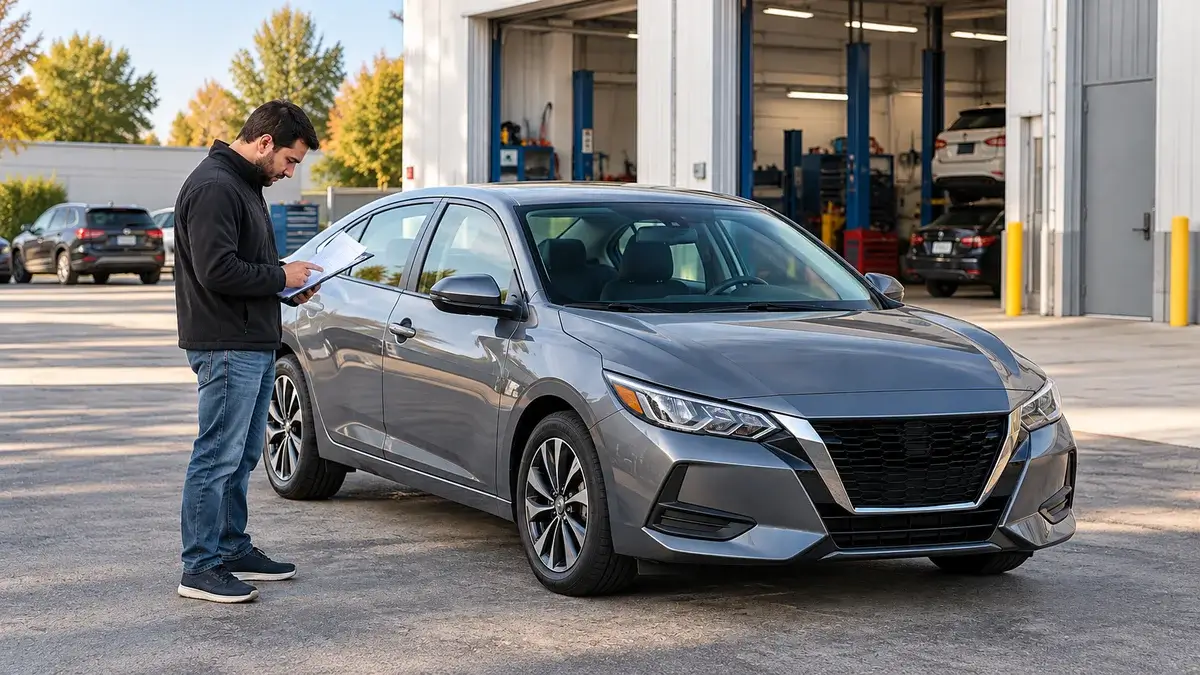
- Arrange an independent pre-purchase inspection. Ask the shop to review diagnostic codes, leaks, underbody condition, brakes, steering, suspension, tires and any specific symptoms discovered during the road test. Check whether past collision repairs affect safety-system operation.
- Require resolution before you buy. If the seller refuses an independent inspection, cannot substantiate a major repair claim, or expects you to accept a serious unexplained driving symptom, walk away or make purchase conditional on documented diagnosis and satisfactory repairs.
A well-maintained car can still develop problems. Conversely, a car from a more heavily scrutinized year is not automatically defective. The inspection is how you replace a general concern with evidence about the one vehicle you might buy.
Which Used Nissan Sentra Makes Sense for You?
If crash-test protection is a deciding factor, the documented driver-side small-overlap improvement makes a properly inspected 2015-or-newer Sentra preferable to a similarly suitable 2013–2014 car on that measure. Check other IIHS categories, trim-dependent equipment and condition before choosing.
If minimizing uncertain transmission risk is your top priority, do not select a 2013–2019 CVT-equipped Sentra based on price alone. Require clear transmission history and a satisfactory independent inspection. A warranty extension is a reason to ask precise questions, not a prediction that a transmission will fail.
If you want a newer commuter, a 2020–2025 Sentra can enter your shopping shortlist when the VIN, relevant safety evidence, maintenance and inspection check out. Treat 2020–2022 steering-remedy records and applicable 2024 driveshaft-recall records as purchase prerequisites, not optional trivia. Those years are candidates to evaluate, not certified winners in a long-term reliability ranking. The redesigned 2026 is a separate decision: its 2026 IIHS TOP SAFETY PICK+ and Good updated crash-test ratings give a documented safety reason to consider it, but its comparatively short ownership history cannot establish long-term engine or CVT reliability.
Bottom line: 2013–2014 warrants the strongest caution in this comparison because the verified IIHS weakness combines with higher historical complaint tallies and shared NHTSA airbag/brake investigation history. 2015–2019 can be considered selectively with CVT history and applicable recalls checked. 2020–2022 require especially careful verification of the tie-rod recall remedy. 2023–2025 are legitimate inspection candidates, not proven all-around reliability champions; 2024 has a separate specific driveshaft recall. The new ninth-generation 2026 earns a 2026 IIHS TOP SAFETY PICK+ on its applicable safety evidence, but its mechanical durability remains unproven over the long term. Choose the documented and inspected vehicle, not an unsupported universal “best year.”
Frequently Asked Questions
What is the most reliable Nissan Sentra year?
No year has been established as the lowest-risk Sentra mechanically after adjusting for miles driven, number of vehicles, and time in service. A well-documented 2015–2019 car can be a practical alternative to a 2013–2014 example for the specific IIHS crash-test improvement, while an inspected newer car may be attractive too. Check CVT history and applicable recalls before choosing; raw complaint counts alone cannot name the most reliable year.
Does a Nissan Sentra CVT warranty extension mean the transmission will fail?
No. Nissan's extension covers a defined eligible population under specific terms. It does not establish the percentage of transmissions that fail. Verify the particular VIN's repair and coverage history, then have a qualified shop investigate any symptoms.
Can a well-maintained Sentra from a more closely scrutinized year still be worth buying?
Possibly. Documented maintenance, an acceptable inspection and a fair price can make an individual car worth considering. However, maintenance cannot change a model year's original crash-test design, so a safety-related reason for preferring another year still matters.