

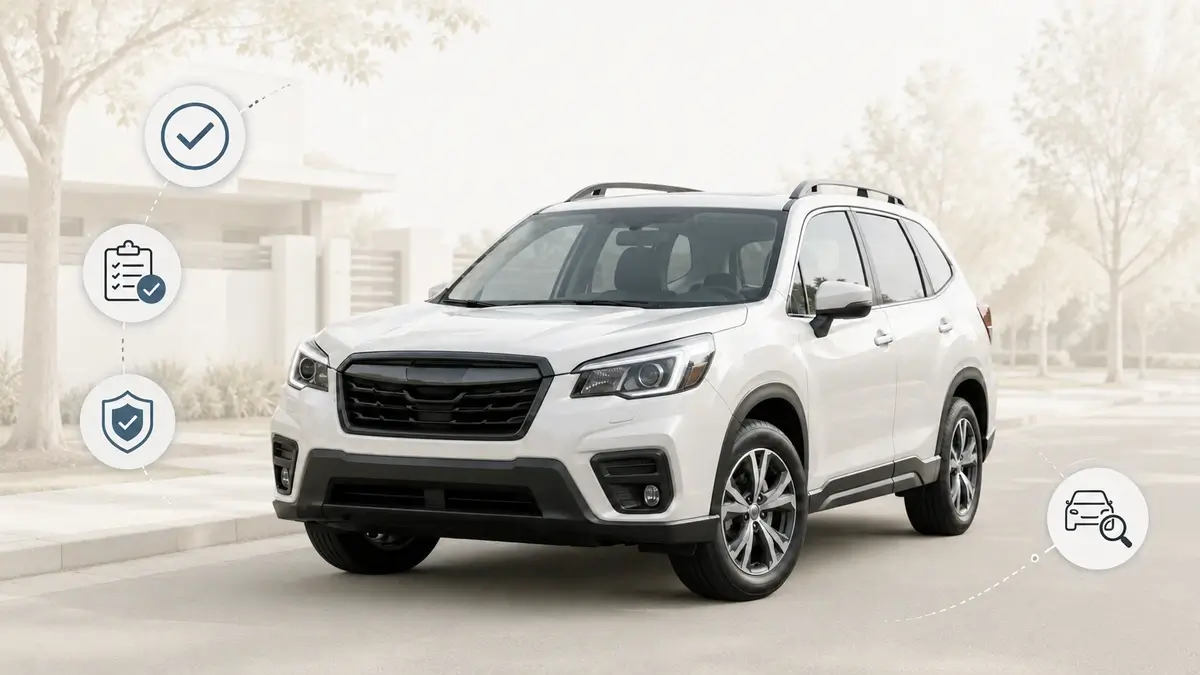
The best years for Subaru Forester are the years that give used buyers the cleanest mix of safety context, ownership confidence, maintenance history, and lower risk signals.
For most buyers, start with 2021-2024. Then consider 2019-2020 or 2016-2018 if the price, condition, and records are strong.
Do not buy a Forester by model year alone. A well-maintained “acceptable” year can be a better buy than a neglected “best” year.
Evidence checked: NHTSA and used-market references May 25, 2026; IIHS July 28, 2026; EPA/FuelEconomy.gov evidence August 1, 2026 (dataset dated June 16, 2026); Subaru maintenance and warranty August 3, 2026.
CarMerit reliability tool
Check any Forester year — NHTSA-backed verdict
Pick a model year to see complaint, recall, investigation, and manufacturer-communication counts from NHTSA, plus CarMerit’s verdict on whether that year is a safe used buy.
Owner complaints
…
NHTSA, CarMerit snapshot
Safety recalls
…
NHTSA, CarMerit snapshot
Investigations
…
NHTSA, CarMerit snapshot
Manufacturer communications
…
NHTSA, CarMerit snapshot
Most-reported problem areas
Complaint counts are raw owner reports filed with NHTSA and are not adjusted for sales volume — popular years naturally generate more reports. Verdicts combine this data with CarMerit’s own research. Data source: NHTSA.gov. Always verify a specific vehicle’s history before buying.
Quick Verdict: Best Years for Subaru Forester
The safest shortcut is simple: start newer, verify recalls, and do not ignore maintenance records.
Choose 2021-2024 if you want the easiest default shortlist. Choose 2019-2020 if you want newer-generation value. Choose 2016-2018 if your budget is tighter but you still want a reasonable older target.
Be more careful with 2011-2015. These years can still work, but only when records, condition, and inspection results are strong.
The fastest safe default is a clean 2021-2024 Forester with complete records and no open recalls.
The mistake is buying only because a model year appears on a “best years” list. That can still leave you with oil-use issues, poor maintenance, accident history, or unresolved safety repairs.
The table below is a shortlist filter. It is not a purchase approval.
Use it to decide which years deserve priority and which years need a stricter inspection.
| Used Forester years | Buy / inspect / avoid verdict | Best fit | Main caution |
|---|---|---|---|
| 2021-2024 | Buy-first shortlist | Lower-risk used buyers | Still verify recalls, accident history, service records, and price |
| 2019-2020 | Good with normal checks | Value-focused newer-used buyers | Check recalls, tires, brakes, glass history, and CVT behavior |
| 2016-2018 | Best older budget shortlist | Budget buyers who still want modern safety context | Inspect CVT behavior, oil use, records, and rust |
| 2014-2015 | Inspect carefully | Only if price and records are strong | Early-generation risk and owner-reported oil-use concerns |
| 2011-2013 | High caution | Buyers comfortable with older-car risk | Age, oil-use history, leaks, suspension wear, and records |
| 2009-2010 and older | Avoid as default low-risk picks | Only for cheap, well-documented examples | Age, head gasket history, rust, and repair exposure |
| 2025 and newer | Too new for used-year judgment | Nearly-new buyers | Limited long-term used history |
Before buying any used Forester, run a VIN recall check through NHTSA or Subaru’s vehicle recall lookup.
That check matters because recall status is vehicle-specific. A model year can look acceptable while a specific VIN still needs work.
Best Subaru Forester Years to Buy Used
The best used Forester years are not just the newest ones.
They are the years that give you the best balance of safety context, age, fuel economy, market availability, and repair-risk control.
This section separates the strongest default choices from the older budget choices.
The right pick depends on budget and risk tolerance.
Once you know which Forester years are safer to shop, compare the Forester against the Mazda CX-5 before committing. The Mazda CX-5 vs Subaru Forester guide is the better next step if you are weighing refinement against space, visibility, and all-weather practicality.
2021-2024 Subaru Forester: Best default used choice
Choose 2021-2024 first if you want the easiest used Forester recommendation.
These years are newer and have less age exposure than older Foresters. They also sit inside the 2019-2024 generation covered by IIHS ratings from the 2019 redesign.
IIHS applies Good driver- and passenger-side small-overlap ratings to 2019-2024 Foresters. It also applies an Acceptable Side 2.0 rating to 2019-2024 models, while the updated moderate-overlap rating is Moderate for 2021-2024 models.
These tests use different procedures and criteria. Do not combine them into one overall safety score. Use them as model-year context, then verify the exact vehicle’s recalls, condition, and equipment.
The main downside is price. A clean 2021-2024 Forester will usually cost more than an older 2016-2018 example.
That premium makes sense if you want lower age risk. It makes less sense if the car has accident history, weak records, poor tires, or unresolved recalls.
2019-2020 Subaru Forester: Good value if records are clean
The 2019-2020 Forester is a good middle-ground choice.
You get the newer 2019-generation design without paying the same premium as a later used example. That makes these years useful for buyers who want modern packaging but still care about value.
Do not buy one blindly. Check recall completion, service history, tire wear, brake condition, windshield history, and CVT behavior.
If a 2021 costs only slightly more, the newer car may be worth the stretch. If the 2019 or 2020 has cleaner records and lower mileage, it can be the smarter buy.
2016-2018 Subaru Forester: Best older budget target
The 2016-2018 Forester is the older group I would consider first.
These years sit late in the 2014-2018 generation. IIHS applies Good ratings across 2014-2018 for the driver-side small-overlap, original moderate-overlap, original side, roof-strength, and head-restraint evaluations. The passenger-side small-overlap rating is Moderate.
Equipment details matter. All four 2016 headlight configurations tested by IIHS were rated Poor. For 2017-2018, headlight ratings varied by trim, equipment, and build date, and EyeSight front crash prevention was optional. Verify the exact configuration instead of treating every 2016-2018 Forester as equivalent.
The trade-off is age. These cars now need a stricter inspection.
Look for maintenance records, smooth CVT behavior, clean oil history, no warning lights, and no rust-prone background. If those are weak, move on.
Used Subaru Forester Price Context by Year Band
Used prices change by mileage, trim, accident history, region, and seller type. Treat this table as market context, not a fixed buying price.
The current U.S. used-market signal is clear: newer 2021-2024 Foresters usually cost much more than older 2016-2018 examples.
That makes 2021-2024 the lower-risk band and 2016-2018 the stronger value band for buyers trying to control budget.
| Year band | Current U.S. used-market signal | Buyer meaning |
|---|---|---|
| 2021-2024 | Approx. $22.6K-$30.2K average | Best lower-risk band, but not cheap |
| 2019-2020 | Approx. $19.3K-$21.3K average | Good newer-generation value |
| 2016-2018 | Approx. $13.2K-$16.7K average | Best older value band |
| 2014-2015 | Approx. $10.3K-$11.4K average | Cheap, but needs stronger inspection |
| 2011-2013 | Approx. $7.9K-$9.0K average | Low price, higher age/risk burden |
| 2009-2010 | Approx. $6.8K-$7.3K average | Only for buyers comfortable with older-car repairs |
These numbers come from current U.S. listing and market-price signals, including CarGurus Subaru Forester price trends. They should be checked again before publishing price-sensitive updates.
For most buyers, the sweet spot is not simply the cheapest Forester. A clean 2016-2018 can be the better value buy, while a clean 2021-2024 is the better lower-risk buy.
If a 2014-2015 or 2011-2013 example is cheap but has weak records, the savings can disappear quickly.
Subaru Forester Years to Avoid or Inspect Carefully
The years below are not automatic failures. They are years where the burden of proof is higher.
A cheap Forester is not a good deal if it needs engine work, transmission work, suspension repairs, or unresolved safety fixes soon after purchase.
Use this section to decide when a deal deserves a closer look and when it is better to walk away.
Do not treat recalls as a simple model-year label. Recalls are often VIN-specific, and two Foresters from the same year can have different recall status.
Before buying, check the exact VIN through NHTSA or Subaru’s official recall lookup. Use year/make/model recall searches for research, but use VIN recall status before purchase.
2014-2015 Subaru Forester: Inspect carefully
The 2014-2015 Forester deserves caution.
These years are early fourth-generation models. That does not make them bad by default, but early-generation examples often need more careful screening than later examples.
Owner-reported oil-use complaints are one reason to inspect carefully. CarComplaints lists owner reports for 2015 Subaru Forester excessive oil consumption, which is not official defect proof for every vehicle.
Treat it as a directional warning, not a blanket verdict.
A clean 2014 or 2015 can still work if records are strong. A weak-record example is not a low-risk buy.
Ask for oil-change records. Check for oil-level warning history, smoke, leaks, abnormal consumption, and repair invoices.
2011-2013 Subaru Forester: High caution
The 2011-2013 Forester is a higher-caution choice for mainstream used buyers.
The issue is not that every one is bad. The problem is that age, mileage, oil-use history, and maintenance gaps can stack together.
This group should be judged mainly through condition and records. Do not buy one because it is cheap.
If you are considering one, look for regular oil-change proof, no repeated low-oil complaints, no overheating history, and no neglected maintenance. A pre-purchase inspection is not optional here.
For most buyers, 2016-2018 is a cleaner older target.
2009-2010 and older Foresters: Not ideal for low-risk buyers
Older Foresters can still be useful cars, but they are not the best default recommendation.
Age changes the math. Rubber parts harden, suspension components wear, rust becomes more important, and prior ownership matters more.
These years can make sense only if the price is low and the records are unusually strong.
They are better for buyers who understand older Subaru maintenance risk. If you want a simple, low-stress used compact SUV, start newer.
Subaru Forester Reliability by Year: What Patterns Matter Most?
Reliability by year helps, but it can mislead you if you treat it like a guarantee.
A used Forester’s real risk depends on three things:
- Model year
- Generation and issue patterns
- The actual car’s condition and records
The 2019-2024 group gives buyers the cleanest age context. Use the specific IIHS results in the 2021-2024 section above; they are mixed across test families and should not be presented as one overall safety score.
The 2014-2018 group is more mixed. The later 2016-2018 years are better older targets, while 2014-2015 deserve extra caution.
The 2009-2013 group is where buyers should become stricter. At that age, even a decent model year needs maintenance proof.
The table below turns reliability patterns into buyer action.
It does not rank every individual vehicle.
Use it to decide how strict your inspection should be.
| Forester group | Practical reliability read | Buyer action |
|---|---|---|
| 2021-2024 | Strongest default used shortlist | Buy if records, recall status, and inspection are clean |
| 2019-2020 | Good newer-used value | Compare price against cleaner 2021+ examples |
| 2016-2018 | Best older budget target | Inspect CVT behavior, oil use, records, and rust |
| 2014-2015 | Mixed | Require strong records before buying |
| 2011-2013 | Higher caution | Buy only if records and inspection are excellent |
| 2009-2010 and older | Age-sensitive | Buy only if cheap, clean, and well documented |
This is not a defect ranking. It is a buyer-risk filter.
Evidence-Weighted Risk Confidence by Year Band
This table does not give fake reliability scores.
It separates stronger evidence from directional risk signals, so buyers can see how much confidence each year band deserves before inspection.
A newer Forester is not automatically perfect. An older Forester is not automatically bad.
| Year band | Risk confidence | Evidence strength | Why it gets this label |
|---|---|---|---|
| 2021-2024 | Lower risk | Stronger | Newer age, useful IIHS safety context, clear EPA fuel-economy data, less age exposure |
| 2019-2020 | Moderate-low risk | Stronger | Same 2019-generation safety context, but older than 2021-2024 |
| 2016-2018 | Moderate risk | Medium | Better older target, 2014-2018 IIHS safety context, but age and condition matter more |
| 2014-2015 | Moderate-high caution | Medium | Early fourth-generation years with directional owner-reported oil-use concerns |
| 2011-2013 | High caution | Medium | Older age, maintenance sensitivity, oil-use checks, and repair exposure matter more |
| 2009-2010 and older | High risk for low-stress buyers | Medium | Age, rust, head-gasket history, and repair exposure can outweigh low purchase price |
This is why the article avoids hard reliability scores. The safer wording is lower risk, moderate risk, and high caution.
Used-car risk depends on records, mileage, recall status, inspection results, and how the vehicle was maintained.
NHTSA Evidence Snapshot by Subaru Forester Year Band
| Forester year band | NHTSA complaints | Unique recall campaigns | Investigations | Manufacturer communications |
|---|---|---|---|---|
| 2025-2026 (Gen 6) | 87 | 5 | 0 | 221 |
| 2021-2024 (Gen 5) | 395 | 3 | 0 | 1,022 |
| 2019-2020 (Gen 5) | 1,423 | 3 | 0 | 1,004 |
| 2016-2018 (Gen 4) | 1,469 | 5 | 3 | 1,274 |
| 2014-2015 (Gen 4) | 1,013 | 4 | 0 | 1,113 |
| 2011-2013 (Gen 3) | 329 | 16 | 0 | 1,099 |
| 1998–2010 older Foresters (Gen 1, Gen 2, and early Gen 3) | 1,685 | 27 | 7 | 1,654 |
Table note: Complaint and manufacturer-communication counts are raw NHTSA records, not defect rates or reliability scores. Older model years have had more time to collect reports, so lower counts on newer years do not automatically prove better reliability. Always check the specific VIN for open recalls.
Common Subaru Forester Problems to Check Before Buying
A used Forester inspection should not stop at mileage and price.
The biggest mistake is asking, “Is this a good year?” and ignoring the actual vehicle.
A clean inspection matters more than a ranking list.
This checklist keeps the problem discussion practical.
It does not mean every Forester has these issues. It means these are the areas worth checking before money changes hands.
The complaint patterns below can tell you what deserves extra attention, but first make sure you are applying them to the right Forester. Check the Forester’s VIN with CarMerit and compare the returned vehicle details with the seller’s listing and paperwork. Once those details line up, use the model-year risk, service history, recall status, and inspection findings to judge the individual SUV.
NHTSA Primary Complaint Areas in the Provided Forester Data
| Primary complaint area | NHTSA complaint count | Years / generations in NHTSA records | Why it matters | Buyer check |
|---|---|---|---|---|
| Visibility / wipers | 1,195 | 1998-1999, 2001-2005, 2007-2026; Gen 1-Gen 6 | Visibility complaints can involve glass, wipers, leaks, or sightline issues. | Check windshield, wipers, water leaks, and glass-repair history. |
| Airbags / Seatbelts / Structure | 950 | 1998-2025; Gen 1-Gen 6 | Safety-system and structure complaints deserve higher priority than comfort issues. | Check warning lights, seatbelts, airbag recalls, and accident repairs. |
| Engine | 767 | 1998-2025; Gen 1-Gen 6 | Engine complaints can turn a cheap Forester into an expensive buy. | Review oil use, leaks, overheating history, warning lights, and service records. |
| Electrical | 613 | 1998-1999, 2001, 2003-2023, 2025-2026; Gen 1-Gen 6 | Electrical complaints can be intermittent and hard to diagnose. | Test electronics, battery or charging behavior, sensors, and warning lights. |
| Suspension / wheels | 491 | 1998-2010, 2012, 2014-2025; Gen 1-Gen 6 | Suspension and wheel complaints can reveal hard use, rust, or poor repairs. | Check tire wear, clunks, alignment, underbody, and wheel condition. |
| Powertrain / Transmission | 370 | 1998-2023, 2025-2026; Gen 1-Gen 6 | Driveability and transmission issues can be expensive. | Test for shudder, delay, slipping, harsh engagement, and warning lights. |
| Fuel system | 344 | 1998-2020, 2022-2023, 2025; Gen 1-Gen 6 | Fuel-system complaints can involve smell, leaks, fuel delivery, or stall risk. | Check fuel smell, leaks, recall work, and driveability. |
| Vehicle speed control | 309 | 1998-2023; Gen 1-Gen 5 | Speed-control complaints need careful road-test attention. | Watch for surging, hesitation, warning lights, and cruise-control faults. |
| Brakes | 281 | 1998-1999, 2001-2025; Gen 1-Gen 6 | Brake complaints affect safety and repair priority. | Inspect pedal feel, brake lines, corrosion, pads, rotors, and ABS lights. |
Table note: Counts show the primary complaint area listed in NHTSA records. One complaint may involve more than one issue, but this table uses the main listed area to keep the comparison simple. Use these patterns as inspection priorities, not proof that every Forester has the issue.
| Area to check | Why it matters | Buyer action |
|---|---|---|
| CVT behavior | Transmission problems can be expensive | Test for shudder, delay, slipping feel, warning lights, or harsh engagement |
| Oil use | Some owner reports point to oil-consumption concerns | Ask about top-offs and review oil-change records |
| Head gasket history | Older Subarus can be sensitive to cooling-system neglect | Check for overheating, leaks, and repair invoices |
| Recall status | Open safety recalls are VIN-specific | Check NHTSA or Subaru before buying |
| Rust | Snow-belt cars can hide expensive structural and suspension issues | Inspect underbody, brake lines, suspension mounts, and exhaust |
| Records | Maintenance history changes the risk level | Favor documented cars over cheap unknowns |
CVT behavior
Many used Foresters have a continuously variable transmission, or CVT.
During the test drive, watch for shuddering, delayed response, slipping sensations, warning lights, or harsh engagement.
Match the CVT service history to the model-year owner’s and warranty/maintenance booklets. Do not assume one replacement interval applies to every Forester.
Do not accept “they all drive like that” as an answer. A healthy CVT should feel consistent in normal driving.
Oil consumption
Oil consumption is one of the main reasons older Foresters need caution.
Ask the seller whether the car needs oil between changes. Then check the dipstick, oil-change records, tailpipe residue, and service invoices.
A car that has needed frequent top-offs should be treated differently from one with normal oil use and documented service.
Head gasket history
Head gasket concern is more relevant on older Subaru models.
If you are buying an older Forester, ask whether head gasket work has ever been done. Look for coolant loss, overheating history, oil-coolant mixing, or repair invoices.
Do not buy an older Forester with vague cooling-system history unless the price leaves room for repairs.
Recall and safety checks
Always run a VIN recall check before purchase.
NHTSA says its recall tool can show whether a specific vehicle needs recall repair. Subaru also provides a VIN-based recall lookup through its official recall page.
This matters because recall status is vehicle-specific. A model year can look acceptable, while a specific VIN still needs work.
Newer Forester NHTSA Recall Campaigns to VIN-Check
| Campaign # | Affected Forester years | Recall issue | Why it matters | Buyer check |
|---|---|---|---|---|
| 19V065000 | 2019 (Gen 5) | Steering power-assist connector | Loss of power steering assist can increase steering effort and crash risk. | Verify recall completion by VIN. |
| 19V856000 | 2019 (Gen 5) | PCV valve / engine power loss | Unexpected loss of power while driving can increase crash risk. | Verify campaign completion. |
| 21V263000 | 2019 (Gen 5) | Rear stabilizer bracket bolts | Missing bolts can allow the stabilizer bracket to shift. | Check recall completion and rear-suspension noise. |
| 23V723000 | 2024 (Gen 5) | Engine water pipe / coolant leak | Coolant can contact hot exhaust and increase fire risk. | Verify by VIN before purchase. |
| 23V754000 | 2023-2024 (Gen 5) | Front driveshaft crack | Driveshaft failure can cause loss of drive power or rollaway. | Confirm inspection or replacement proof. |
| 23V755000 | 2022 (Gen 5) | Park / neutral start interlock switch | Reverse lights or rearview camera display may not work correctly. | Verify completed repair. |
| 25V033000 | 2025 (Gen 6) | 18-inch wheel lug-seat issue | Wheel attachment issues can affect vehicle stability. | Check VIN and wheel-recall completion. |
| 25V419000 | 2025 (Gen 6) | Child-seat anchor bolts | Loose anchor bolts can increase child-injury risk in a crash. | Confirm anchor-bolt inspection or tightening. |
| 25V889000 | 2026 (Gen 6) | Rear hatch support bracket | The hatch can fall unexpectedly during use. | Confirm bracket inspection or replacement. |
| 26V346000 | 2026 (Gen 6) | Moonroof glass bonding | Detached glass can become a road hazard. | Verify campaign status by VIN. |
Table Note: Recall applicability is VIN-specific. Before buying, run the exact Forester VIN through NHTSA or Subaru’s recall lookup and confirm whether each required repair has been completed.
Subaru Warranty Extensions to Check Before Paying for Repairs
To quickly screen a Forester by model year, use CarMerit’s Manufacturer Special Coverage Lookup to see which manufacturer-issued warranty extensions or special coverage programs may apply before confirming final VIN-specific eligibility with Subaru.
| Affected Forester | Component or program | Published maximum term | What to verify |
|---|---|---|---|
| 2014-2018 2.5L or 2.0L turbo CVT | CVT warranty extension | 10 years/100,000 miles | VIN eligibility, in-service date, mileage, and original or approved replacement CVT |
| 2019-2020 2.5L CVT | CVT warranty extension | 10 years/100,000 miles | VIN eligibility, diagnosis, and current term; the separate grace window ended June 30, 2026 |
| Certain 2014-2018 models | Electronic power-steering gear-box housing | 10 years/unlimited miles | Qualifying housing crack, diagnosis, and authorization |
| Certain 2016-2018 models | Data communication module | 8 years/100,000 miles | Affected module, 3G-related battery-drain diagnosis, and conditional battery rules |
| Certain 2017-2018 models | Front exhaust-pipe bellows | 15 years/150,000 miles | Vehicle eligibility and the qualifying crack or rattle condition |
| Certain 2019-2021 models | Thermo control valve | 15 years/150,000 miles | VIN eligibility, diagnostic code or qualifying condition, and applicable emissions-warranty terms |
| 2019-2022 models with the original Subaru windshield | Front windshield | 8 years/100,000 miles; one qualifying replacement | Inspection result, impact or chip exclusions, and whether the windshield was previously replaced or is non-OEM |
Table Note: These are warranty extensions or coverage adjustments, not recalls and not proof that a failure is common. Coverage is vehicle-specific and may depend on VIN, original in-service date, mileage, equipment, production date, diagnosis, prior repairs, and Subaru’s current Vehicle Coverage Inquiry. Confirm eligibility with Subaru before assuming any coverage remains.
Fuel economy expectations
Fuel economy depends on the exact year and configuration. Use the EPA estimates below instead of one model-wide number.
| Model year and configuration | Fuel | City MPG | Highway MPG | Combined MPG |
|---|---|---|---|---|
| 2018 Forester AWD, 2.5L manual | Regular gasoline | 22 | 28 | 24 |
| 2018 Forester AWD, 2.5L CVT | Regular gasoline | 26 | 32 | 28 |
| 2018 Forester AWD, 2.0L turbo CVT | Premium gasoline | 23 | 27 | 25 |
| 2019-2023 Forester AWD, 2.5L CVT | Regular gasoline | 26 | 33 | 29 |
| 2022-2023 Forester Wilderness AWD, 2.5L CVT | Regular gasoline | 25 | 28 | 26 |
| 2024 Forester AWD, 2.5L CVT | Regular gasoline | 26 | 33 | 29 |
| 2024 Forester Wilderness AWD, 2.5L CVT | Regular gasoline | 25 | 28 | 26 |
Table Note: Each row keeps the EPA configuration separate. Do not average the rows together. Actual mileage varies, and EPA fuel economy does not measure reliability or total ownership cost.
For a frequent commuter, the 2024 non-Wilderness Forester has a 3-mpg combined advantage over the 2024 Wilderness. The Wilderness may suit capability needs, but it is not the fuel-economy choice.
How Mileage, Maintenance History, and Condition Change the Best-Year Decision
Model year gets you into the right search lane. Condition decides whether the car is worth buying.
A clean 2018 with excellent records can beat a neglected 2021. A cheap 2015 with oil-use history can become expensive fast.
Service Records That Matter Most on 2019-2024 Foresters
Subaru’s U.S. maintenance booklets for 2019-2024 use the normal-service checkpoints below. Ask for records showing that each applicable task was completed by time or mileage, whichever came first.
| Record checkpoint | Subaru action | Normal-use interval |
|---|---|---|
| Engine oil and oil filter | Replace | Every 6 months/6,000 miles |
| Tires | Rotate and inspect | Every 6 months/6,000 miles |
| Brake system, steering, and suspension | Inspect | Every 12 months/12,000 miles |
| Air-cleaner element | Replace | Every 30 months/30,000 miles |
| CVT fluid and front/rear differential oil | Inspect | Every 30 months/30,000 miles |
| Brake and clutch fluid | Replace | Every 30 months/30,000 miles |
| Spark plugs and wheel bearings | Replace spark plugs; inspect wheel bearings | Every 60 months/60,000 miles |
| Engine coolant | Replace | First at 132 months/137,500 miles; then every 72 months/75,000 miles |
Table Note: These intervals apply to the captured U.S. 2019-2024 Forester booklets. Under applicable severe use, repeated short trips or extreme cold shorten oil and filter service to 3 months/3,000 miles. Repeated trailer towing calls for CVT-fluid replacement every 24,855 miles and differential-oil replacement every 15 months/15,000 miles. Maintenance records do not prove reliability.
Before buying, ask for:
- Oil-change records
- CVT service history where applicable
- Recall completion proof
- Tire and brake condition
- Suspension and alignment history
- Accident history
- Rust inspection, especially in snow-belt states
- Pre-purchase inspection results
The strongest used Forester is not always the newest one. It is the one with the best balance of year, condition, price, and records.
If the seller cannot show records, lower your offer or walk away.
Which Subaru Forester Years Are Best for Different Buyers?
There is no single best Forester year for everyone.
A risk-averse buyer should not shop like a cash buyer chasing the cheapest clean SUV.
Use the table below to match the year group to the buyer.
This avoids the weak “one best year for everyone” mistake.
| Buyer type | Best starting point | Why |
|---|---|---|
| Lowest-risk used buyer | 2021-2024 | Newer, better-documented, and lower age exposure |
| Value-focused newer-used buyer | 2019-2020 | Modern generation with better pricing than later years |
| Budget buyer | 2016-2018 | Better older target if records and inspection are strong |
| Long-term owner | 2021-2024 | Better if you want to keep the car many years |
| Low-budget cash buyer | 2016-2018 first, older only with proof | Older cars need more repair-risk tolerance |
| Fuel-conscious buyer | Non-Wilderness 2019-2024 | Better EPA combined rating than Wilderness versions |
| Risk-averse buyer | Avoid weak-record 2011-2015 examples | Oil-use and age risk can outweigh savings |
If you are choosing between two similar Foresters, buy the better-documented one.
Service history matters more than a one-year difference.
Subaru Forester Best Years vs. Years to Avoid: Final Recommendation
For most shoppers, the best used Subaru Forester years are 2021-2024.
They are the cleanest default recommendation because they combine newer age, useful safety context, practical fuel economy, and lower wear exposure than older examples.
The best value fallback is 2019-2020. These years can make sense if the price is meaningfully lower than a comparable 2021-2024 Forester.
The best older budget target is 2016-2018. Buy one only after a stricter inspection.
Be careful with 2011-2015. These years are not automatic rejects, but they need stronger proof around oil use, maintenance, CVT behavior, recall status, and overall condition.
Avoid very old or poorly documented Foresters if you want a low-risk daily driver.
The best final rule is simple: shortlist the right years, then buy the right car. A clean record beats a clean headline.
Once you’ve zeroed in on a strong Forester year, see how it compares to its rivals in Forester vs RAV4 and Honda CR-V vs Subaru Forester.
Frequently Asked Questions
What is the best year for a used Subaru Forester?
For most used buyers, 2021-2024 are the best starting point. They are newer and have better age, safety, and ownership-risk positioning than older examples.
Which Subaru Forester years should I avoid?
Avoid weak-record examples from 2011-2015 unless the price, inspection, and service history are strong. Also avoid very old high-mileage Foresters if you want low repair risk.
Are Subaru Foresters reliable used SUVs?
Yes, a good used Forester can be reliable. The catch is that model year, maintenance records, oil-use history, CVT behavior, and recall status matter a lot.
Is a 2014 Subaru Forester a good used buy?
A 2014 Forester can be usable, but it is not a low-risk default pick. Check oil consumption history, CVT behavior, service records, recall completion, and inspection results before buying.
Is a 2018 Subaru Forester a good used buy?
A 2018 Forester is one of the better older targets. It still needs a careful inspection, but it is usually a stronger budget choice than earlier fourth-generation examples.
How many miles can a Subaru Forester last?
A well-maintained Forester can last a long time, but mileage alone is not enough. Service history, oil changes, cooling-system care, transmission behavior, and rust matter more than a broad mileage claim.
Should I buy an older low-mileage Forester or a newer higher-mileage one?
Buy the one with better records and cleaner inspection results. Lower mileage helps, but a poorly maintained low-mileage car can still be a bad buy.
Which Forester years had CVT concerns?
CVT concerns should be checked on CVT-equipped used Foresters, especially older or high-mileage examples. Focus on service history, test-drive behavior, warning lights, and inspection results rather than assuming every CVT is bad.
Do Subaru Foresters have head gasket problems?
Head gasket concern is more important on older Subaru models. If you are buying an older Forester, ask for cooling-system history and inspect for leaks, overheating signs, or past repairs.
What should I check before buying a used Subaru Forester?
Check recalls, service records, oil-use history, CVT behavior, accident history, rust, tires, brakes, suspension, and inspection results. Do not buy only because the year appears on a best-years list.